18) Other things being equal, a national health insurance program would
A) decrease the demand for health care.
B) decrease moral hazard.
C) decrease total health care expenditures.
D) reduce individuals’ incentives to make decisions that promote better health.
19) Rising healthcare costs are attributable to
A) people living longer and desiring more care.
B) reliance on expensive technology to support and prolong life.
C) third-party financing of healthcare costs.
D) all of the above.
20) A benefit of deductibles and health savings accounts is that they
A) reduce the moral hazard problem associated with third-party payers.
B) increase the quality of health care.
C) reduce the use of expensive techniques for hopeless cases.
D) reduce the incomes of physicians.
21) The percentage of total national income spent on health care in the United States has
A) declined rapidly since 1965.
B) remained below the level of inflation.
C) risen steadily since 1965.
D) remained constant over the last few years.
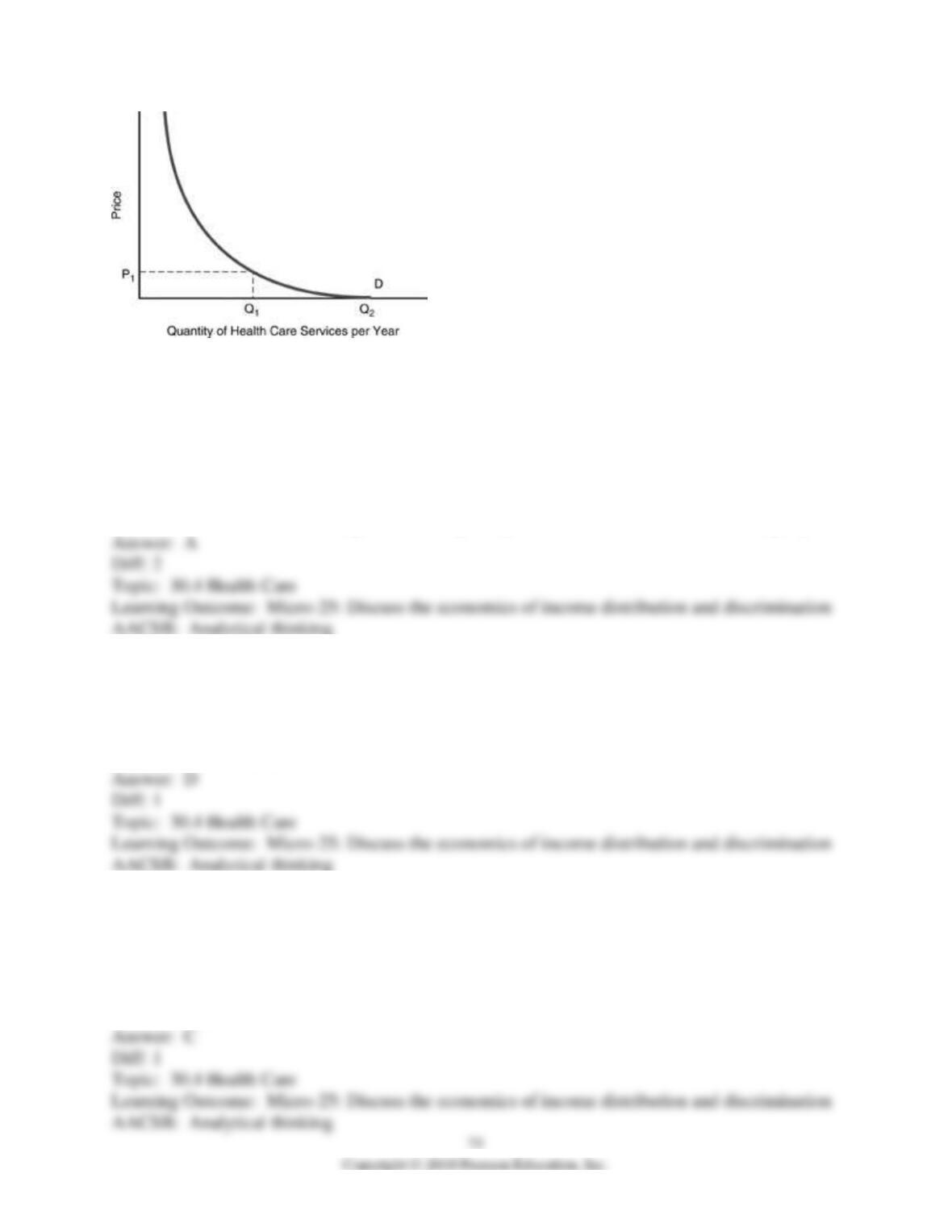
22) The above figure supports all of the following statements regarding health care EXCEPT
A) the demand for health care is insensitive to price changes; as the price goes up, so does the
quantity demanded.
B) if all medical expenses were paid for by third parties, the quantity demanded would increase
tremendously.
C) due to third party payments, patients demand a higher quantity of health care services per
year.
D) the lower the deductible, the greater is the quantity demanded of health care services per year.
23) Health care costs have been rising due to
A) an aging population.
B) new technologies.
C) third-party financing.
D) All of the above are correct.
24) Approximately how much of aggregate national income in the United States is spent on
health care today?
A) 3 percent
B) 45 percent
C) 17 percent
D) 34 percent
25) The use of hospitals today is dominated by
A) the elderly.
B) immigrants.
C) obstetrical care.
D) the wealthy.
26) The impact of technology on health care has
A) provided for a higher quality of life.
B) increased health care costs.
C) contributed to increased life expectancy.
D) All of the above are correct.
27) All of the following are reasons that health care costs have risen so much in the past few
decades EXCEPT
A) the aging population.
B) higher imports.
C) new technologies.
D) third party payments.
28) The idea that some people engage in risky behavior due to the fact that they have good health
care is known as
A) moral hazard.
B) risk aversion.
C) zero-sum game.
D) risk-taking behavior.
29) The twin economic problems of the U.S. health care industry are the
A) rising health care costs and the declining quality of health care services.
B) rising health care costs and the rising malpractice insurance costs.
C) rising health care costs and the moral hazard problem in health care services.
D) declining rate of immunization rates and the rising malpractice insurance costs.
30) In the year 2015, the United States spent about
A) 17 percent of GDP on health care.
B) 100 percent of GDP on health care.
C) 6 percent of GDP on health care.
D) 2 percent of GDP on health care.
31) Currently, about ________ of all health care spending is paid by individuals.
A) 89 percent.
B) 45 percent.
C) 10 percent.
D) 3 percent.
32) Which of the following is NOT a reason for the increase in health care costs?
A) the aging of the population
B) the implementation of new technologies
C) the increase in third party payments
D) the decrease in the fertility rate
33) The federal government and insurance companies are examples of third party
A) payers for health care.
B) users of health care.
C) providers of health care.
D) observers of health care.
34) Since the 1930s, out-of-pocket payments for health care have
A) declined from about 50 to 40 percent of total payments.
B) declined from about 95 to 10 percent of total payments.
C) declined from about 70 to 30 percent of total payments.
D) not changed and remain at 70 percent of total payments.
35) Since the 1930s, third-party payments for health care have
A) risen from about 5 to 90 percent of total payments.
B) declined from about 95 to 10 percent of total payments.
C) declined from about 70 to 30 percent of total payments.
D) risen from about 30 to 50 percent of total payments.
36) The health care market in the United States is characterized by
A) considerable government involvement.
B) third-party payment of health care costs.
C) asymmetric information between providers and consumers.
D) all of the above
37) Joseph decides to join the Big State University’s football team when he learns that his health
insurance will pay for any subsequent injury. This illustrates
A) a moral hazard problem.
B) monopolistic behavior.
C) a symmetric information problem.
D) oligopolistic behavior.
38) A major benefit of a health savings account is that it
A) combats moral hazard.
B) means more health care services will be demanded.
C) eliminates rising health care costs.
D) creates the incentive to see a doctor regularly.
39) In insurance markets, moral hazard occurs when the behavior of
A) the insured person changes in a way that raises costs for the insurer, since the insured person
no longer bears the full costs of that behavior.
B) the insurer changes in a way that raises costs for the insured person, since the insurer no
longer bears the full costs of that behavior.
C) the insured person changes in a way that eliminates rising health care costs for the insurer,
since the insured person no longer bears the full costs of that behavior.
D) the insured person has an incentive to under consume medical services, simply because the
insured person no longer bears the full cost of medical services.
40) As a result of moral hazard
A) both physicians and hospitals order more procedures.
B) physicians and hospital administrators have no incentive to raise costs.
C) patients increasingly have to worry about the expense of operations and other medical
procedures.
D) both physicians and hospitals have a financial interest in trying to keep hospital costs down.
41) All of the following are key features of the federal government’s new national health care
program EXCEPT
A) people must either purchase health insurance or pay a fine to the federal government.
B) a young person in good health can opt not to purchase health insurance without penalty.
C) firms with at least 50 employees must either provide health insurance or pay fines when
uninsured employees receive tax subsidies to purchase insurance.
D) government-directed exchanges will assist in matching individuals and small businesses with
health insurance policies that satisfy government requirements.
42) Which of the following is an individual mandate in the federal government’s new national
health
care program?
A) Under the new program, the federal government will coordinate the establishment of health
insurance exchanges.
B) Firms with at least 50 employees must either provide health insurance or pay fines when
uninsured employees receive tax subsidies to purchase insurance.
C) A tax rate of 3.8 percent will be assessed on nearly all earnings above $200,000 per year for
individuals and above $250,000 per year for married couples.
D) Nearly all U.S. residents must either purchase health insurance coverage or pay a fine of up to
$750 per year for an individual (up to $2,250 per year for a family).
43) Which of the following is an employer mandate in the new the federal government’s new
national health
care program?
A) Under the new program, the federal government will coordinate the establishment of health
insurance exchanges.
B) A tax rate of 3.8 percent will be assessed on nearly all earnings above $200,000 per year for
individuals and above $250,000 per year for married couples.
C) Firms with at least 50 employees must either provide health insurance or pay fines when
uninsured employees receive tax subsidies to purchase insurance.
D) Nearly all U.S. residents must either purchase health insurance coverage or pay a fine of up to
$750 per year for an individual (up to $2,250 per year for a family).
44) How will the federal government’s new national health care program be funded?
A) The federal government will charge all participants of health insurance exchanges 3.8%.
B) Firms with at least 50 employees must pay an annual fine of up to $750 per employee
regardless of coverage.
C) A tax rate of 3.8 percent will be assessed on nearly all earnings above $200,000 per year for
individuals and above $250,000 per year for married couples.
D) Nearly all U.S. residents will pay a fine of up to $750 per year for an individual (up to $2,250
per year for a family) regardless of coverage.
45) The new federal government’s national health care program imposes the following
regulations on health care insurers EXCEPT
A) health insurers must cover all who apply, including people who already have health problems.
B) all new plans must cover certain preventive services such as mammograms and colonoscopies
but must be paid 100% by patients.
C) a ceiling is imposed on the rate of increase in health insurance prices charged to elderly
people.
D) insurance companies will be prohibited from imposing lifetime dollar limits on essential
benefits, like hospital stays.
46) Government agencies to which the national health care program assigns the task of assisting
individuals, families, and small businesses in identifying health insurance policies to purchase
are known as
A) health care exchanges.
B) markets for health care.
C) health insurance regulations.
D) health insurance mandates.
47) Which of the following is NOT a subsidy in the new the federal government’s new national
health care program?
A) Families with incomes up to 133% of the federal poverty level are eligible for federal
Medicaid coverage.
B) Families with incomes up to 400% of the federal poverty level are eligible for thousands of
dollars in tax subsidies per year (amounts vary with family incomes).
C) Tax credits are available to businesses providing health insurance to 25 or fewer workers and
paying annual salaries averaging no more than $50,000.
D) A special subsidy rate of 3.8% is applied to nearly all income earnings above $200,000 for
individuals or $250,000 for married couples.
48) Once the national health care program goes into effect and more people will pay fewer of
their health care expenses out of their own pockets than they did previously, we can expect
A) the quantity of health care services demanded will increase.
B) the quantity of health care services demanded will decrease.
C) the quantity of health care services supplied will increase.
D) the quantity of health care services supplied will decrease.
49) Once the national health care program goes into effect, we can expect
A) total expenditures on health care will decrease.
B) more individuals will have more incentives to make decisions that promote better health.
C) total expenditures on health care will increase.
D) moral hazard will decrease.
50) Once the national health care program goes into effect, we can expect
A) the quantity of health care services supplied will increase.
B) total expenditures on health care will decrease.
C) more individuals will pay more out of pocket expenses.
D) moral hazard will increase.
51) The effects of the national health care program on labor markets will
A) lower the effective wage rate that they must pay for each unit of labor.
B) decrease the marginal revenue product of labor.
C) increase the marginal revenue product of labor.
D) move upward along their downward-sloping marginal-product-of-labor curve.
52) The effects of the national health care program on labor markets will
A) increase the quantity supplied of labor.
B) decrease the quantity supplied of labor.
C) increase the quantity demanded for labor.
D) decrease the quantity demanded for labor.
53) The effects of the national health care program on goods and services markets will
A) increase the marginal cost of the firm.
B) increase the quantity produced of the firm.
C) consumers will pay lower prices for many goods and services.
D) decrease the quantity demanded for all goods and services.
54) Based on most observations, what are the effects on government budgets from the national
health care program?
A) Tax revenues will not flow into the new program immediately.
B) The federal government ultimately will have to search for ways to reduce its health care
expenditures.
C) Federal government expenditures on the program are being phased in immediately.
D) the federal government ultimately will lower taxes since the program’s cost will decline over
time.
55) Why have health care costs risen so much in recent years?
56) “It is difficult to compare over time health care expenditures, costs, and output.” Do you
agree or disagree? Why?
57) How is moral hazard related to health care?