Chapter 30
Farm Policy
Multiple Choice
1. Between 1974 and 2006 prices for food commodities
A) rose far faster than inflation.
B) rose far slower than inflation.
C) rose at about the overall rate of inflation.
D) Remained largely constant even in nominal terms.
2. Between 1974 and 2006 hog prices
A) rose far faster than inflation.
B) rose far slower than inflation.
C) rose at about the overall rate of inflation.
D) remained largely constant even in nominal terms.
3. Between 1974 and 2006 milk prices
A) rose far faster than inflation.
B) rose far slower than inflation.
C) rose at about the overall rate of inflation.
D) remained largely constant even in nominal terms.
4. Between 2006 and 2013 prices for food commodities
A) rose far faster than inflation.
B) rose far slower than inflation.
C) rose at about the overall rate of inflation.
D) remained largely constant even in nominal terms.
5. Between 2006 and 2013 corn prices
A) rose far faster than inflation.
B) rose far slower than inflation.
C) rose at about the overall rate of inflation.
D) remained largely constant even in nominal terms.
6. If you want to compare the price of a good through time you need to
A) just graph its price.
B) compare it to how other prices changed using price indexes.
C) see if it is higher than the overall CPI.
D) see if it is lower than the overall CPI.
7. A justification for government price supports on agricultural that economists generally accept
as potentially legitimate is
A) the market is unfair to poor farmers.
B) the market punishes innovation.
C) the price variability needs to be dampened.
D) the market favors milk producers.
8. The primary source(s) of price variability is
A) demand variability.
B) unemployment.
C) supply variability.
D) demand and supply variability.
9. For price variability in agricultural crops, US weather related issues fall under the category of
A) demand variability.
B) supply variability.
C) static variability.
D) demand and supply variability.
10. Viewed from the perspective of a US farmer, weather variability in other exporting countries
can be viewed as
A) demand variability.
B) supply variability.
C) static variability.
D) demand and supply variability.
11. Viewed from the perspective of a US corn farmer, gasoline price variability can be viewed
as a source of
A) demand variability.
B) supply variability.
C) static variability.
D) demand and supply variability.
12. Viewed from the perspective of a US beef farmer, gasoline price variability can be viewed as
a source of
A) demand variability, because an increase in gasoline costs drive up corn costs and corn is
what farmers feed their cattle.
B) supply variability, because an increase in gasoline costs drive up corn costs and corn is
what farmers feed their cattle.
C) static variability.
D) demand and supply variability, because an increase in gasoline costs drive up corn costs
and corn is what farmers feed their cattle.
13. The primary reason that supply variability can have a significant impact on price is that
A) demand for agricultural products tends to be elastic.
B) demand for agricultural products tends to be inelastic.
C) supply for agricultural products tends to be elastic.
D) supply for agricultural products tends to be inelastic.
14. The primary means by which a farmer can protect against weather related crop failure is with
A) overtime labor.
B) crop insurance.
C) bond markets.
D) stock markets.
15. A price support on agricultural products is labeled by economists as a
A) price limit.
B) price floor.
C) price ceiling.
D) just price.
16. When the government wishes to help producers of goods (such as farmers) they can enact a
law establishing a _____, which economists call a price floor.
A) minimum price
B) maximum price
C) market equilibrium price
D) lost price
17. When the government wishes to help producers of goods (such as farmers) by establishing
the minimum price at which their good can be sold, economists call this a
A) price ceiling.
B) price statement.
C) price floor.
D) alternative price.
18. If order to be relevant the price floor must be
A) at equilibrium.
B) above equilibrium.
C) within 10% of equilibrium (either way).
D) below equilibrium.
19. Simply establishing a price floor affects/changes
A) demand and supply.
B) demand and quantity supplied.
C) quantity demanded and quantity supplied.
D) quantity demanded and supply.
20. If the market price for a crop is $4 a bushel and the price support is $3, then raising the price
support to $3.50
A) will cause nothing to happen.
B) will cause the price received by farmers to rise.
C) will cause the price received by farmers to fall.
D) will cause the price paid by consumers to rise.
21. If the market price for a crop is $4 a bushel and the price support is $5, then dropping the
price support to $3.50
A) will cause nothing to happen.
B) will cause the price received by farmers to rise.
C) will cause the price received by farmers to fall to $3.50.
D) will cause the price received by farmers to fall to $4.00.
22. If the market price for a crop is $4 a bushel and the price support is $3, then raising the price
support to $5
A) will cause nothing to happen.
B) will cause the price received by farmers to fall.
C) will cause the price received by farmers to rise to $4.
D) will cause the price received by farmers to rise to $5.
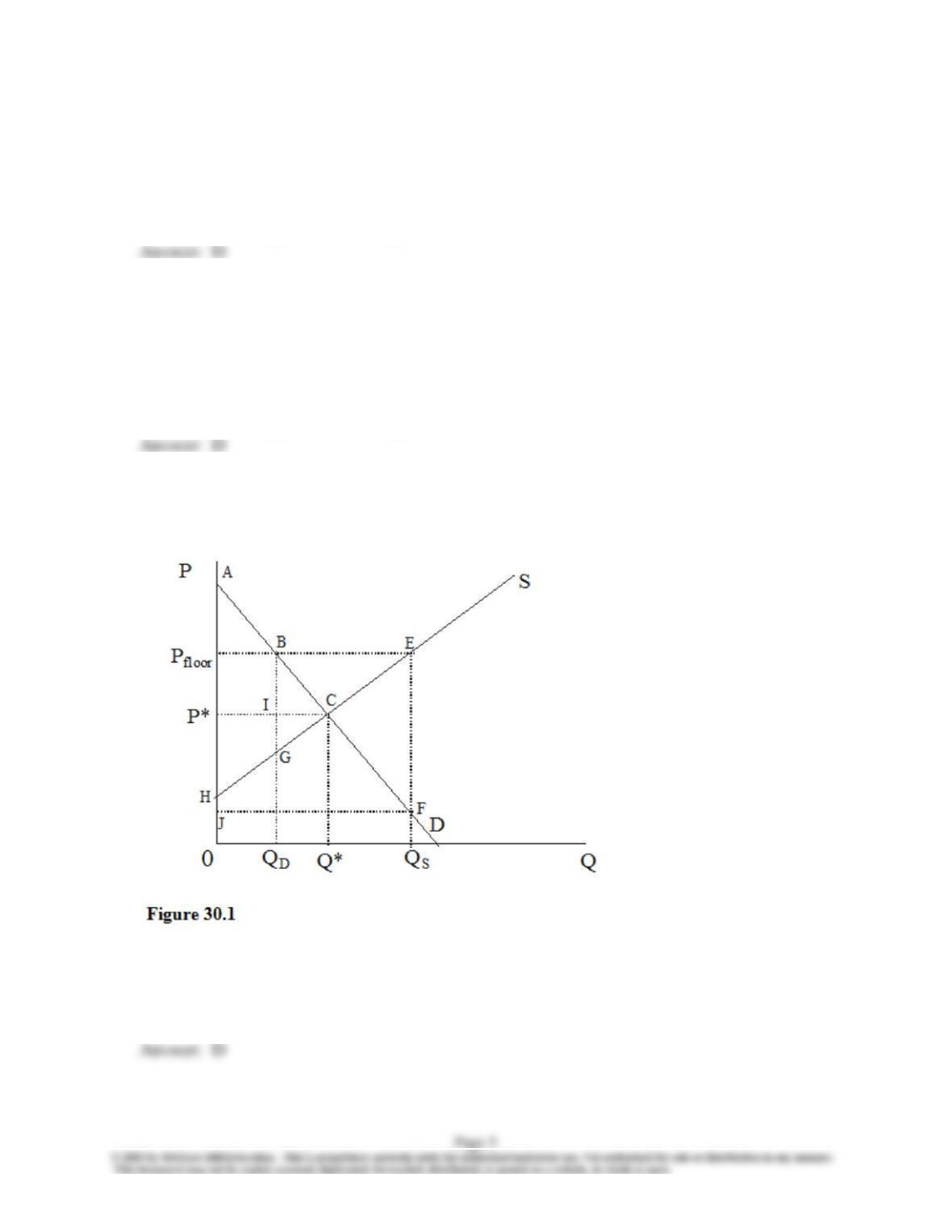
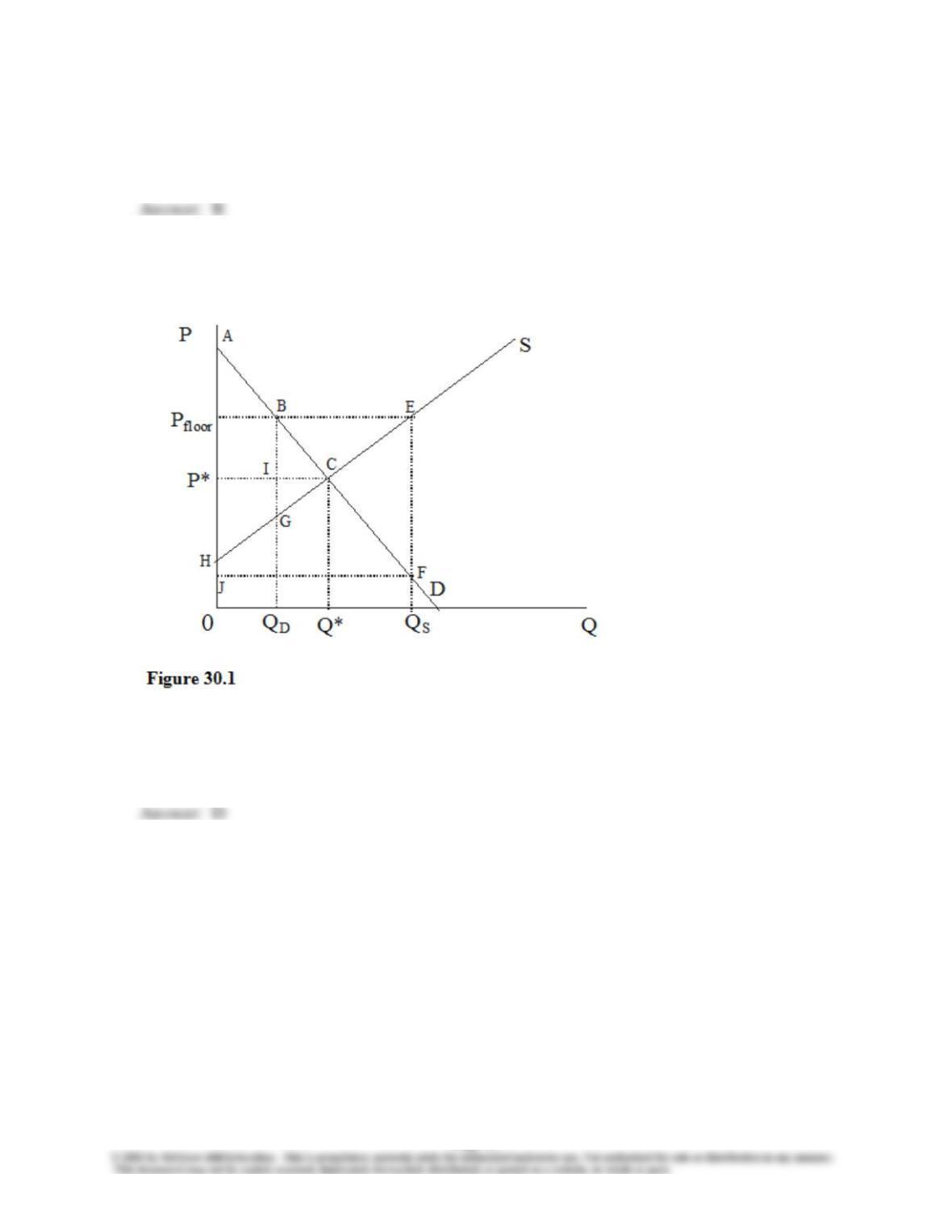
23. In Figure 30.1, at the market equilibrium price-quantity combination, the value to consumers
is
A) 0ABQD
B) 0P*CQ*
C) 0PfloorBQD
D) 0ACQ*
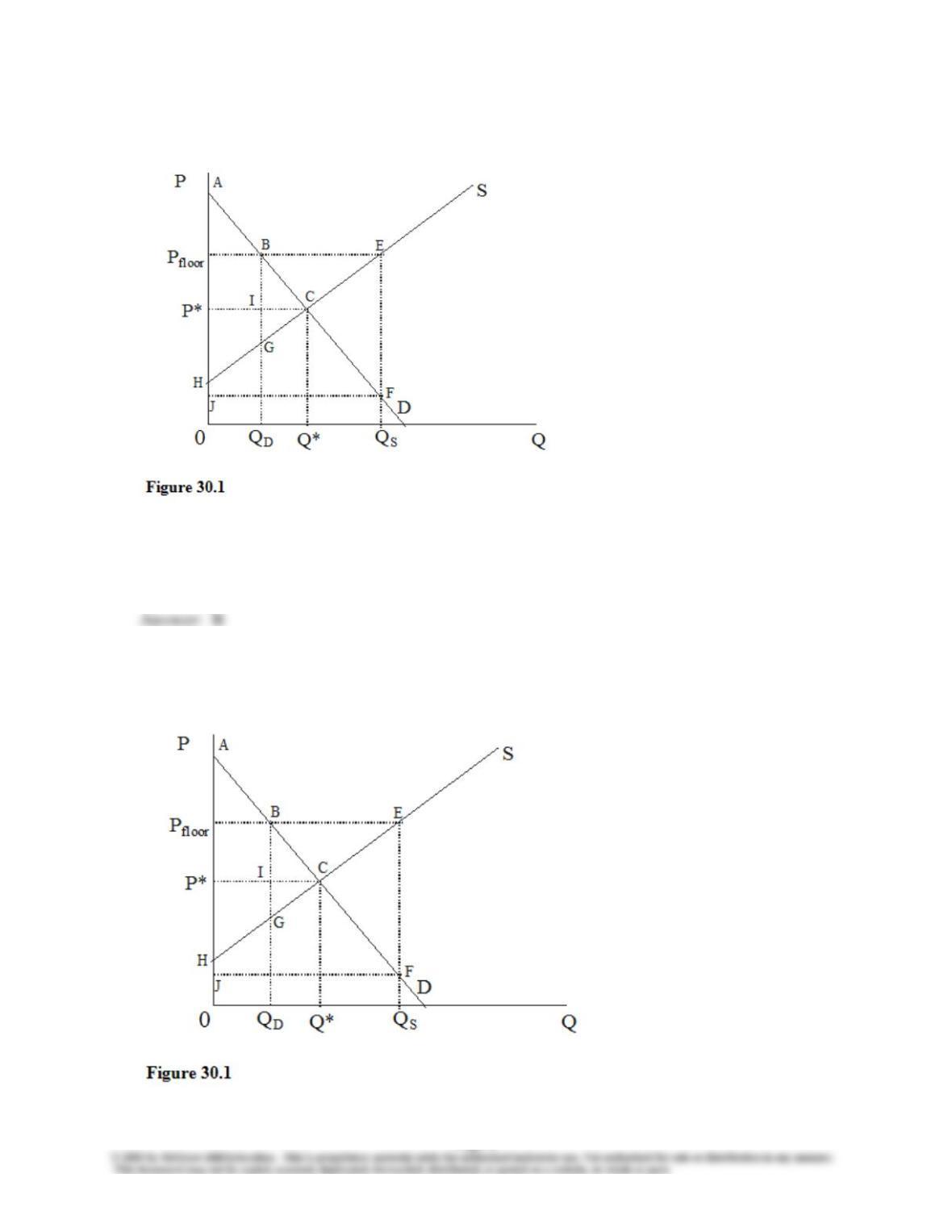
24. In Figure 30.1, at the market equilibrium price-quantity combination, the money consumers
pay producers is
A) 0ABQD
B) 0P*CQ*
C) 0PfloorBQD
D) 0HCQ*
25. In Figure 30.1, at the market equilibrium price-quantity combination, the total variable cost
to producers is
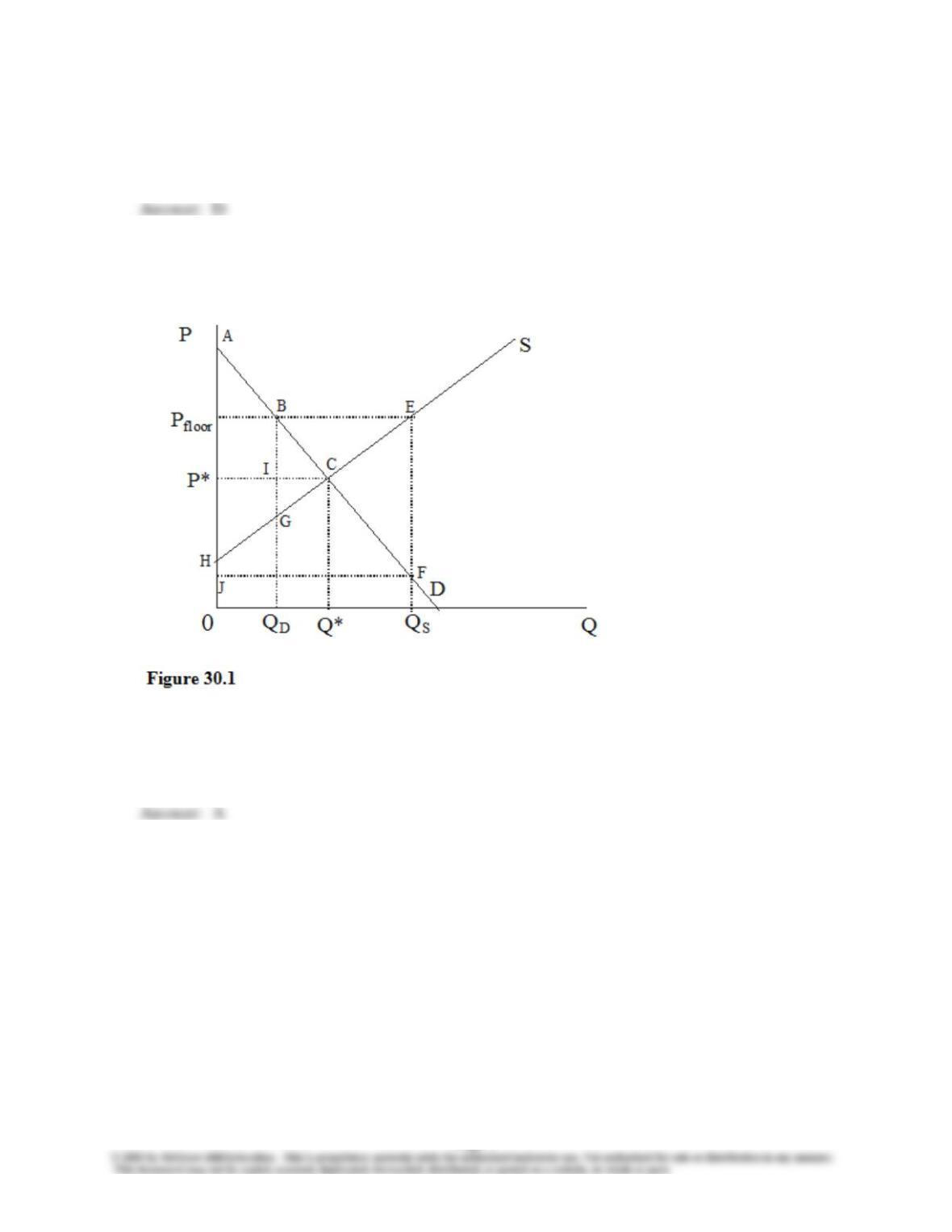
A) 0ABQD
B) 0HEQS
C) 0HGQD
D) 0HCQ*
26. In Figure 30.1, at the supported price-quantity combination where production is limited, the
value to consumers is
A) 0ABQD
B) 0P*CQ*
C) 0PfloorBQD
D) 0HCQ*
27. In Figure 30.1, at the supported price-quantity combination where production is limited, the
money consumers pay producers is
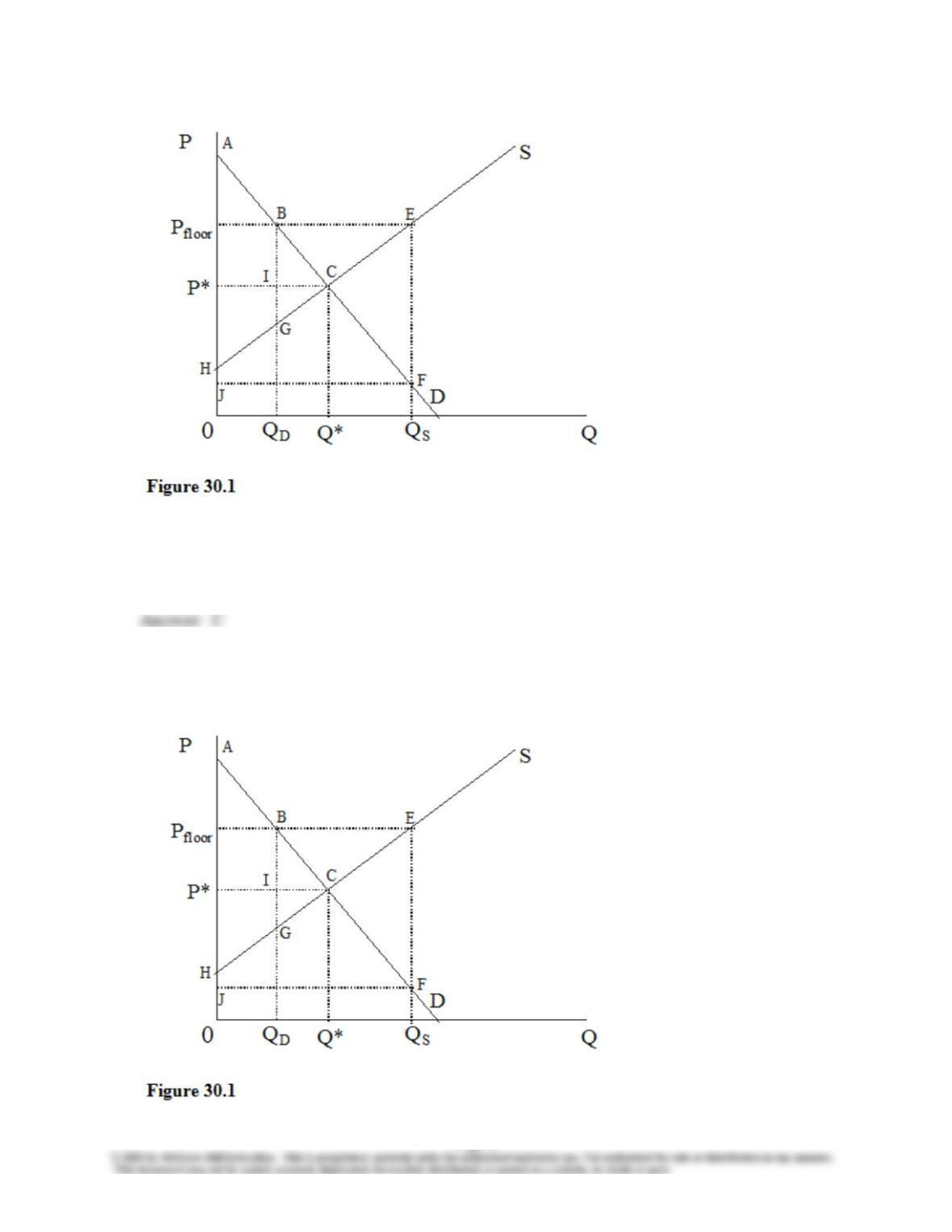
A) 0ABQD
B) 0P*CQ*
C) 0PfloorBQD
D) 0HCQ*
28. In Figure 30.1, at the supported price-quantity combination where production is limited, the
variable cost to producers is
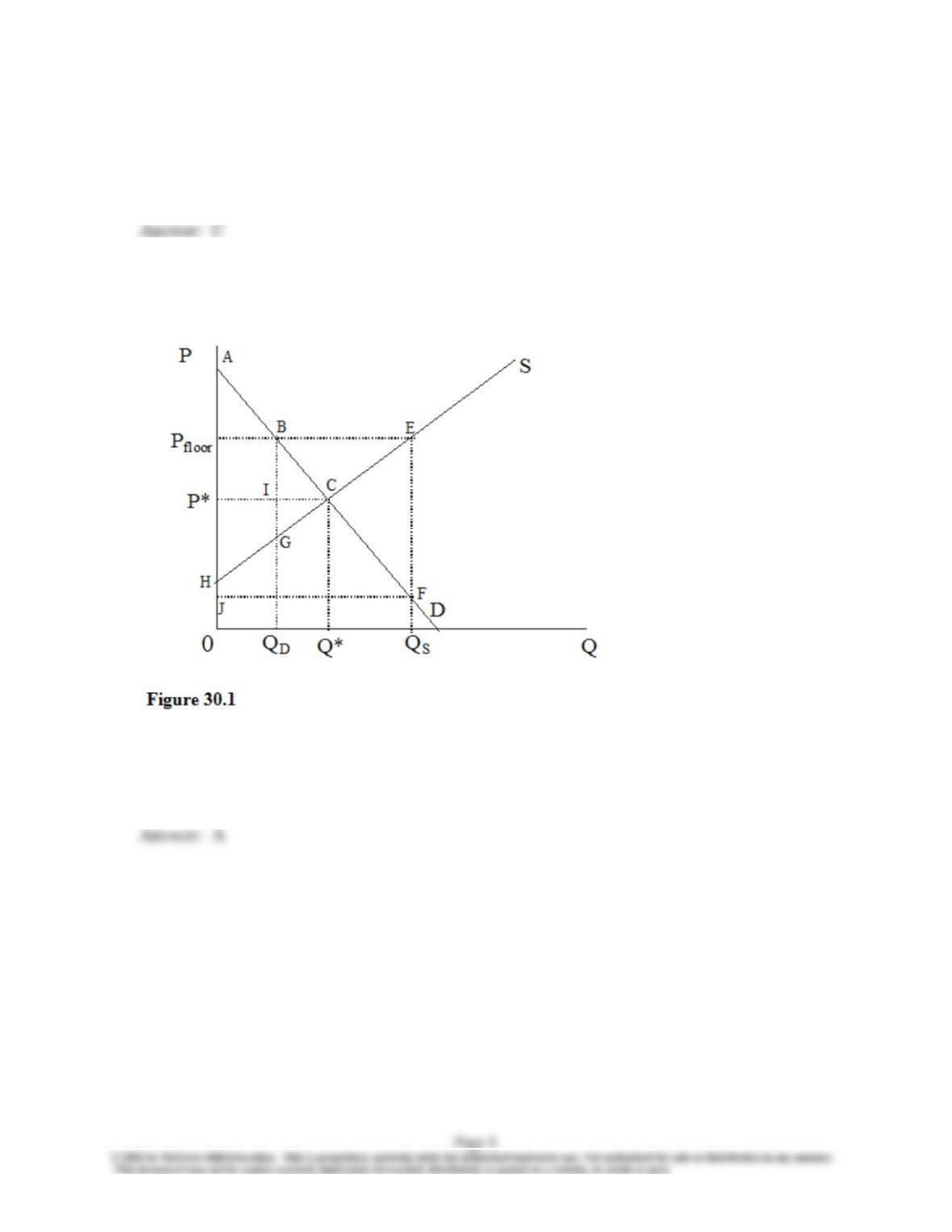
A) 0ABQD
B) 0HEQS
C) 0HGQD
D) 0HCQ*
29. In Figure 30.1, at the supported price-quantity combination where production is unlimited,
and government buys the excess, the value to consumers is
A) 0ABQD
B) 0P*CQ*
C) 0PfloorBQD
D) 0HCQ*
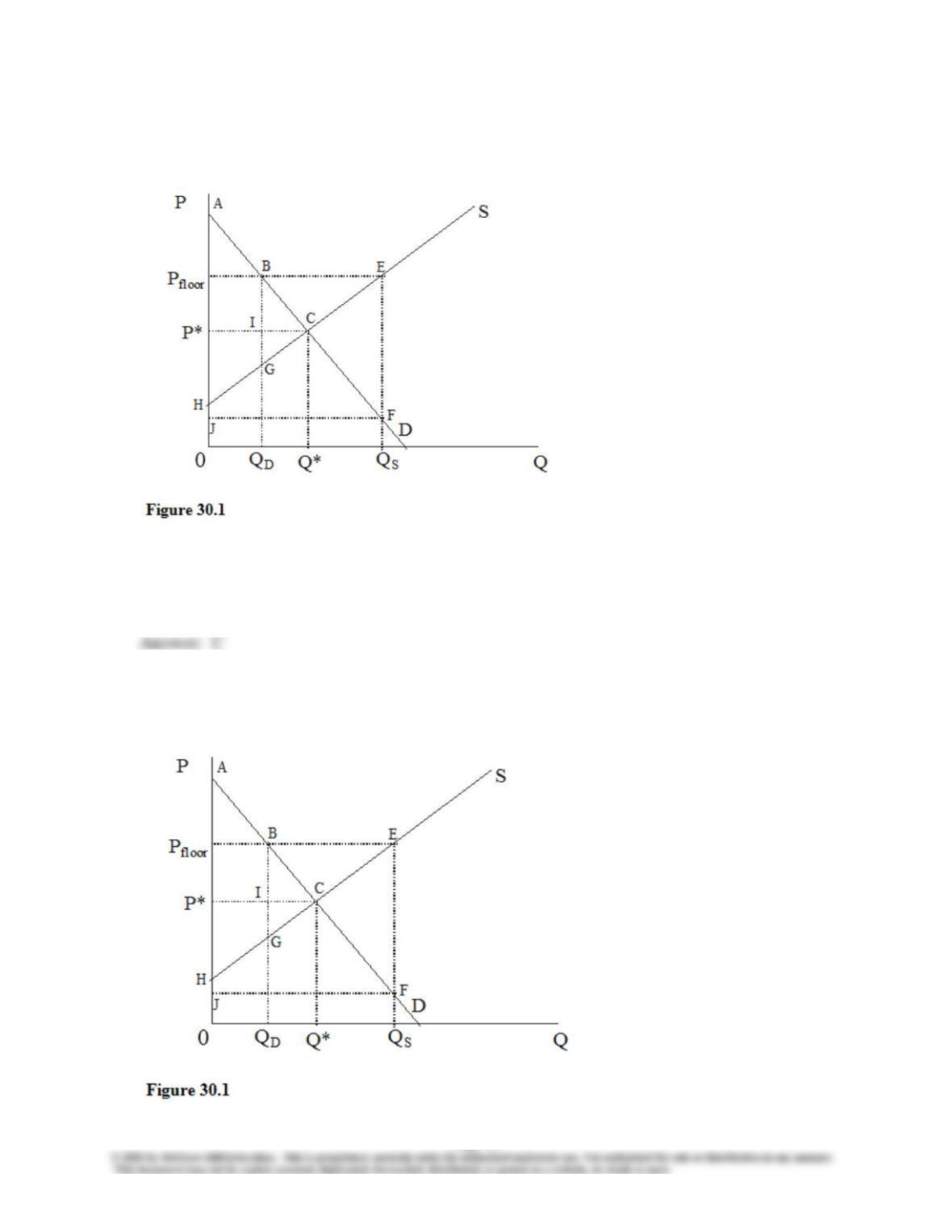
30. In Figure 30.1, at the supported price-quantity combination where production is unlimited,
and government buys the excess, the money consumers pay producers is\
A) 0ABQD
B) 0P*CQ*
C) 0PfloorBQD
D) 0HCQ*
31. In Figure 30.1, at the supported price-quantity combination where production is unlimited,
and government buys the excess, the variable cost to producers is
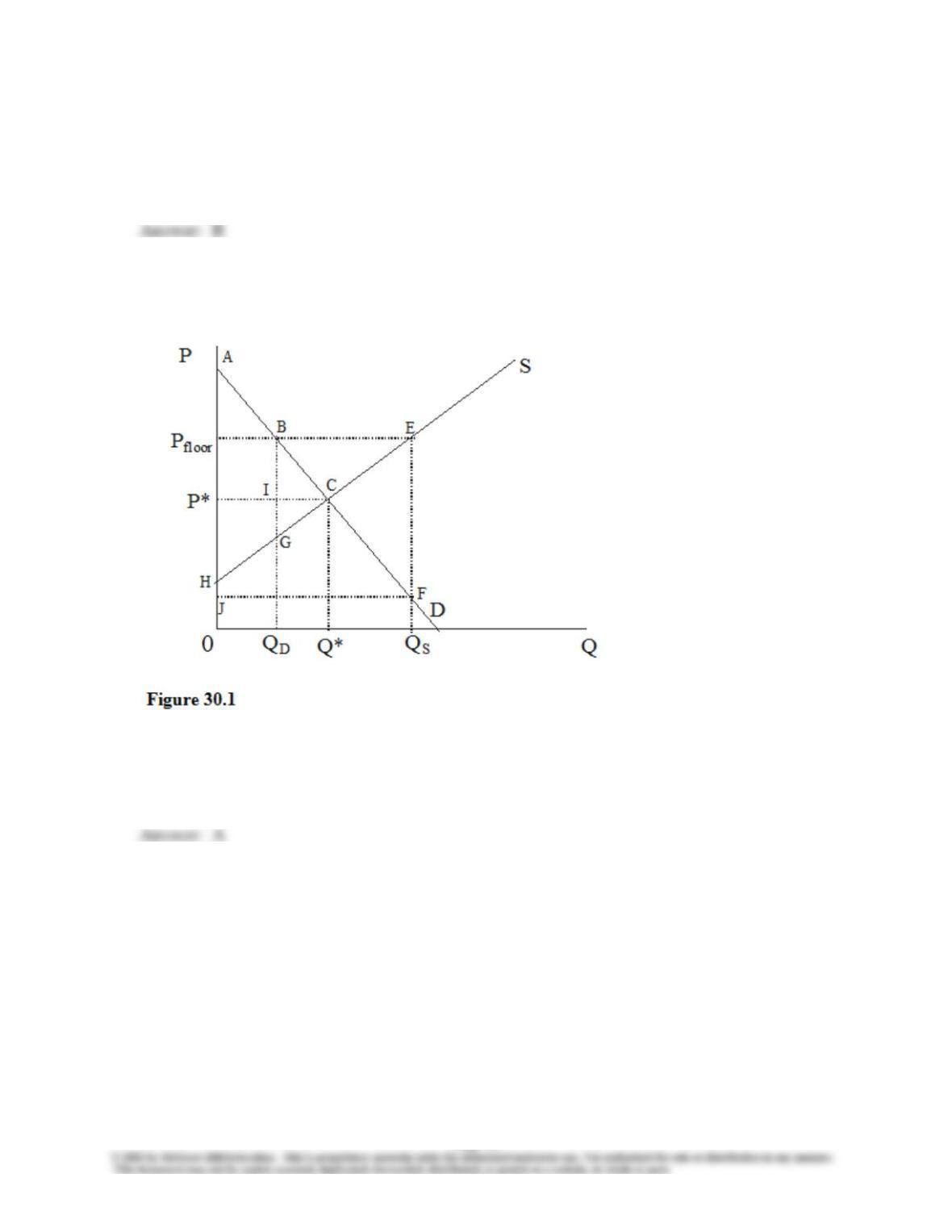
A) 0ABQD
B) 0HEQS
C) 0HGQD
D) 0HCQ*
32. In Figure 30.1, at the supported price-quantity combination where production is unlimited,
and government buys the excess, the money government pays producers is
A) QDBEQS
B) 0P*CQ*
C) 0PfloorBQD
D) 0HCQ*
33. In Figure 30.1, at the market price-quantity combination, the producer surplus is
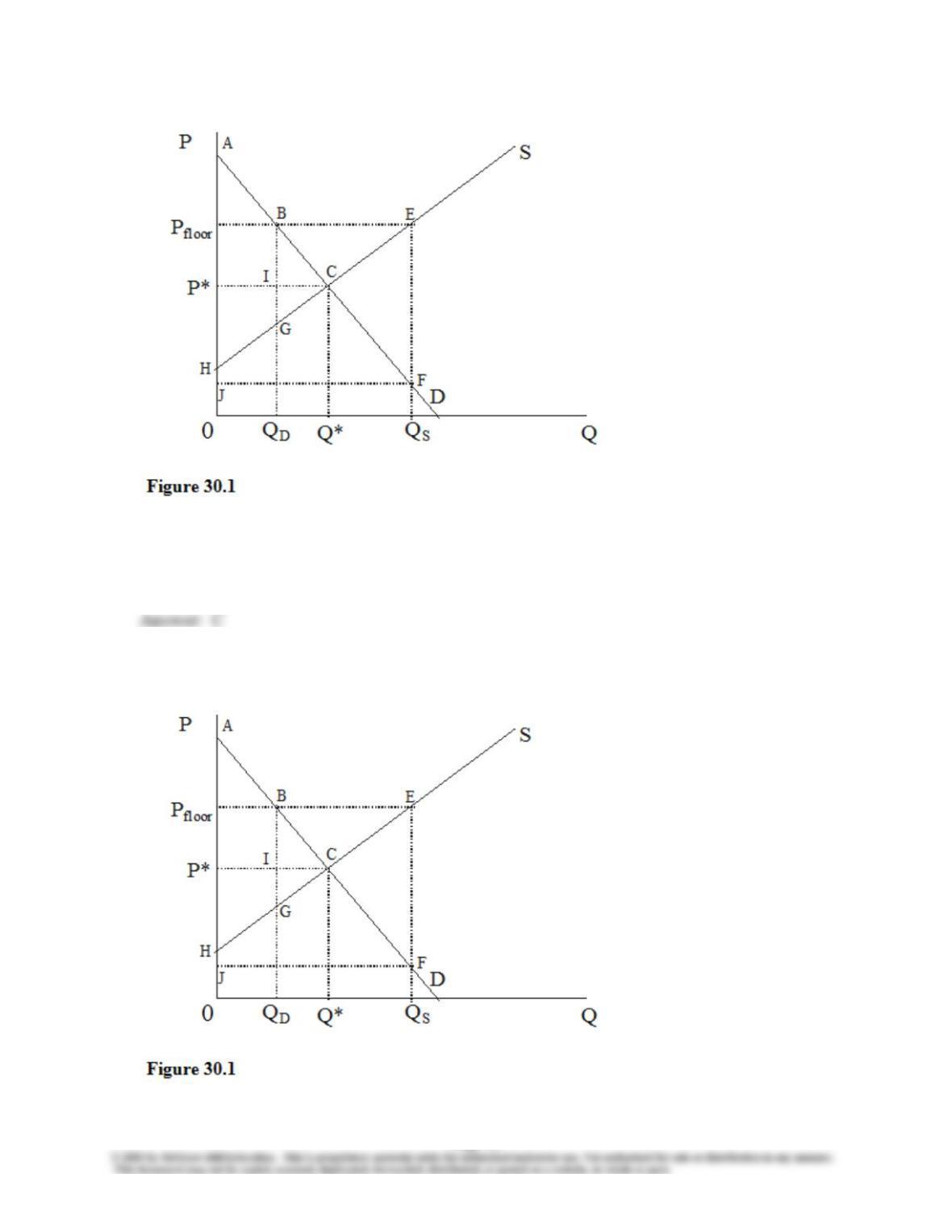
A) APfloorB
B) P*AC
C) HP*C
D) HPfloorBG
34. In Figure 30.1, at the market price-quantity combination, the consumer surplus is
A) APfloorB
B) P*AC
C) HP*C
D) HPfloorBG
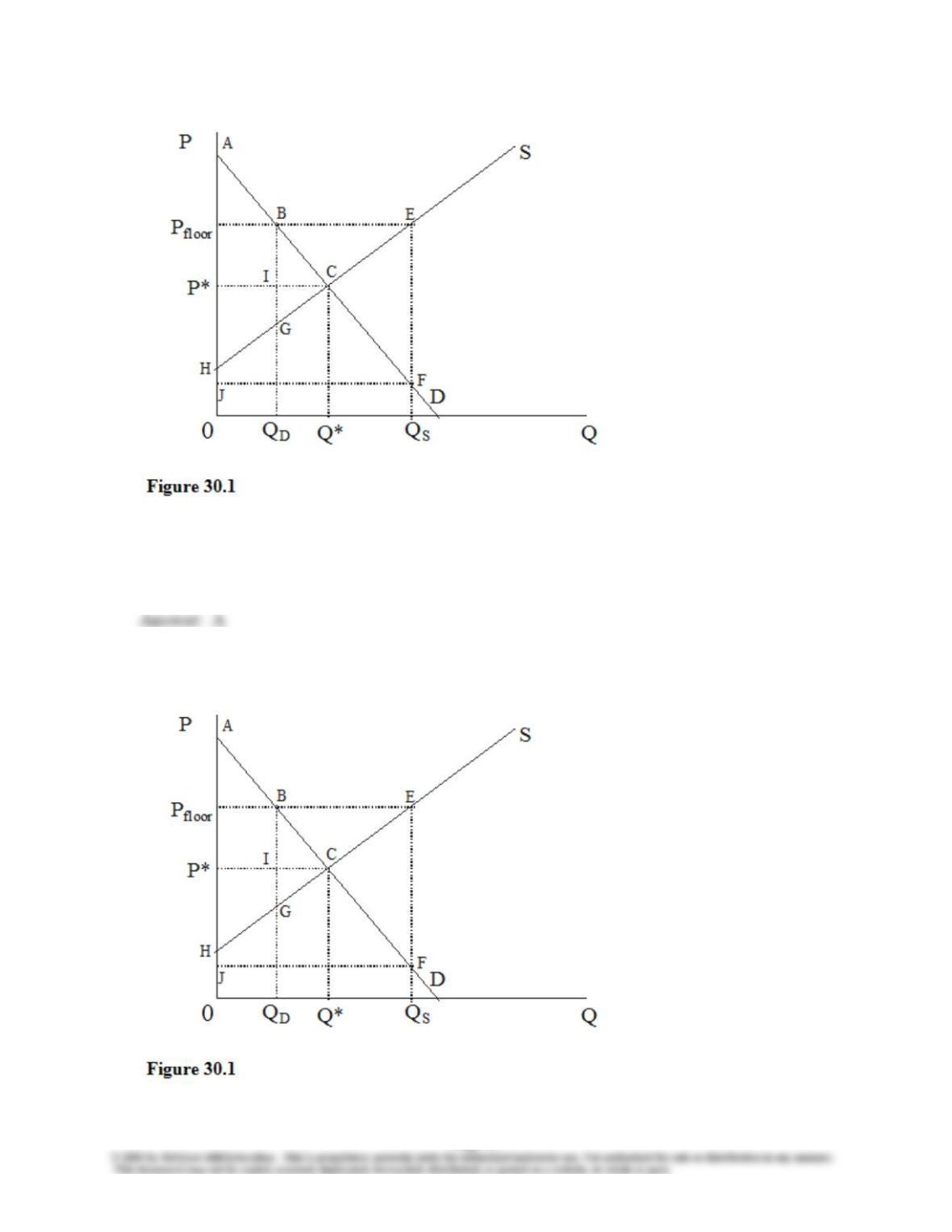
35. In Figure 30.1, at the supported price-quantity combination where production is limited, the
producer surplus is
A) APfloorB
B) P*AC
C) HP*C
D) HPfloorBG
36. In Figure 30.1, at the market price-quantity combination where production is limited, the
consumer surplus is
A) APfloorB
B) P*AC
C) HP*C
D) HPfloorBG
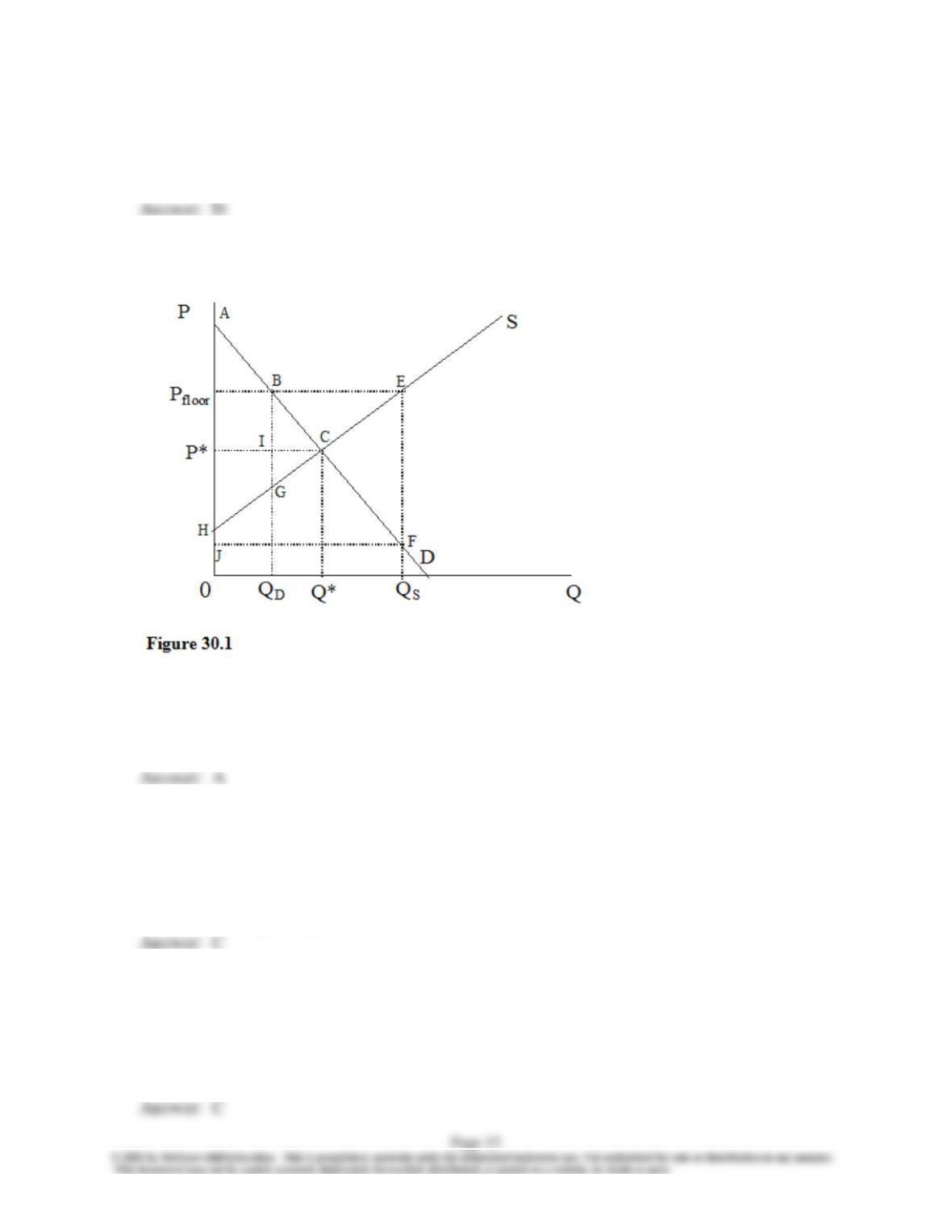
37. In Figure 30.1, at the supported price-quantity combination where production is unlimited
and the government buys the excess, the producer surplus is
A) APfloorB
B) P*AC
C) HP*C
D) HPfloorE
38. In Figure 30.1, at the market price-quantity combination where production is unlimited and
the government buys the excess, the consumer surplus is
A) APfloorB
B) P*AC
C) HP*C
D) HpfloorBG
39. The Eau-Claire Rule is in place to
A) protect dairy farmers in Wisconsin.
B) ensure low prices to consumers.
C) protect dairy farmers outside Wisconsin.
D) protect foreign dairy farmers.
40. Agricultural subsidies are generally
A) unpopular with politicians and economists.
B) popular with politicians and economists.
C) popular with politicians and unpopular with economists.
D) popular with economists and unpopular with economists.
41. Government can support agricultural prices by
A) subsidizing imports of a particular crop.
B) buying up all output that consumers do not buy at the supported price.
C) making it illegal to consume more than a specified amount.
D) subsidizing imports of a particular crop and buying up all output that consumers do not
buy at the supported price.
42. Government can support agricultural prices by
A) making it illegal to produce without a government-provided license.
B) buying up all output that consumers do not buy at the supported price.
C) making it illegal to consume more than a specified amount.
D) making it illegal to produce without a government-provided license and buying up all
output that consumers do not buy at the supported price.
43. Government can support agricultural prices by
A) paying farmers not to produce in particular fields.
B) lending farmers enough at subsidized interest rates to expand their production.
C) making it illegal to consume more than a specified amount.
D) paying farmers not to produce in particular fields and making it illegal to consume more
than a specified amount.
44. Since, according to the CPI, inflation between 1982 and 2013 was 130 percent
A) a 100% increase in prices of farm products would cut farmers’ real incomes by 50%.
B) unchanged prices for farm products would cut farmers’ real incomes by 56%.
C) a 50% increase in prices of farm products would cut farmers’ real incomes by 50%.
D) farmers’ real incomes would fall only if the prices of farm products decreased.
45. In 2009, the U.S. was supposed to be without price supports for milk and grains, but will
actually spend
A) $75 billion on such price supports.
B) $45 billion on such price supports.
C) $19 billion on such price supports.
D) $1 billion on such price supports.
46. In 2015, the U.S. was supposed to be without price supports for milk and grains, but is
projected to spend
A) $73 billion on such price supports.
B) $43 billion on such price supports.
C) $33 billion on such price supports.
D) $12 billion on such price supports.
47. In 2007 and 2008 the sharp increase in the price of soybeans reflected primarily
A) the increased demand for corn needed to produce ethanol.
B) increased use of advanced fertilizers by soybean producers.
C) government cash subsidies to soybean producers per ton harvested.
D) an unseasonably warm spring in the soybean-producing states of Indiana, Illinois and
Iowa.
48. In 2007 and 2008, the prices of both corn and soybeans increased sharply because
A) all agricultural grain prices always rise and fall together.
B) corn and soybeans are “alternative outputs”.
C) an unseasonably warm spring in the “grain belt” states of Indiana, Illinois and Iowa.
D) unprecedented expansion in all federal government price support programs.
49. In 2008, increased gasoline prices led to increased corn prices, primarily because
A) corn production and gasoline production are both concentrated in the high-cost Midwest.
B) corn oil is a good substitute for gasoline, and ethanol is an essential input to corn
production.
C) ethanol is a good substitute for gasoline, and corn is an input to ethanol production.
D) gasoline is a good substitute for corn oil, and corn oil is an input to input to gasoline
production.
50. Corn and beef prices are typically linked because
A) they are alternative outputs.
B) corn is an input to beef.
C) corn is a substitute for beef.
D) corn is a complement to beef.
51. Corn and poultry prices are typically linked because
A) they are alternative outputs.
B) corn is an input to poultry.
C) corn is a substitute for poultry.
D) corn is a complement to poultry.
52. The degree to which gasoline and corn prices are linked is dependent on
A) consumer tastes for corn.
B) consumer driving habits.
C) how high gasoline prices are, because when they are high, corn based ethanol becomes a
more attractive substitute.
True False
53. True or False? Farm price supports require that the government buy up surplus goods.
A) True
B) False
54. True or False? Farm price supports require price floors.
A) True
B) False
55. True or False? A Farm price supports that includes a price floor but does not include a
program for dealing with the surplus will potentially create problems for farmers than it will
solve.
A) True
B) False
56. True or False? The governmental expense of a farm price support tends to diminish as the
price of the good rises.
A) True
B) False
57. True or False? The governmental expense of a farm price support tends to diminish as the
price of the good falls.
A) True
B) False
58. True or False? The governmental expense of a farm price support tends to increase as the
price of the good rises.
A) True
B) False
59. True or False? The governmental expense of a farm price support tends to increase as the
price of the good falls.
A) True
B) False
60. True or False? Economists are general supporters of farm price support programs as being
economically efficiency enhancing.
A) True
B) False