
CHAPTER 3: EVALUATION OF FINANCIAL PERFORMANCE
1. Which of the following financial ratios are market-based ratios?
a. debt–to–equity
b. price-to-earnings
c. return on investment
d. gross profit margin
2. The appropriate standard which should be used for the comparison of financial ratios probably should be
the
a. best firm in the industry
b. worst firm in the industry
c. industry average
d. better performing firms in the industry
3. indicate the ability of the firm to meet its short-term financial obligations
a. Activity ratios
b. Liquidity ratios
c. Leverage ratios
d. Profitability ratios
4. indicate the firm’s capacity to meet its debt obligations, both short-term and long-term.
a. Liquidity ratios
b. Activity ratios
c. Financial leverage ratios
d. Profitability ratios
5. The primary weakness of the current ratio is
a. it is difficult to calculate
b. it includes some items, such as inventory, that may not be readily liquid
c. it requires many years of past data
d. it includes many non-current items in its calculation

Chapter 3: Evaluation of Financial Performance
6. The quick ratio is the same as current ratio except it does not consider
a. cash
b. accounts receivable
c. prepaid items
d. inventories
7. The fixed asset turnover ratio is influenced by
a. the age of the assets employed
b. the depreciation method used by the firm
c. the firm’s choice of a production technology
d. all of these
8. The greater the amount of financial leverage used by a firm, the greater its , all other things being
equal.
a. profitability
b. liquidity
c. risk
d. size
9. The best accounting-based measure of a firm’s profitability is
a. gross profit margin
b. net profit margin
c. return on fixed assets
d. return on total assets
10. Financial ratio analysis is most often performed as a
a. comparative analysis
b. trend analysis
c. point in time analysis
d. comparative analysis and a trend analysis
11. A firm‘s return on equity is a function of its net profit margin, and equity multiplier.
a. current ratio
b. cost of goods
c. total asset turnover
d. fixed asset turnover

Chapter 3: Evaluation of Financial Performance
12. Primary sources of comparative financial data include
a. Dun and Bradstreet
b. New York Times
c. Richard Moore, Inc.
d. Framingham Financial Library
13. The data from is especially useful when analyzing small firms.
a. Prentice-Hall
b. Robert Morris Associates
c. Dan Bradbury Ltd.
d. Securities and Exchange Commission
14. In an inflationary period, a firm is likely to show temporary profit increases because
a. accounts receivable collections increase
b. cash balances decline
c. inventory profits are realized
d. all of these
15. If a firm wanted to report high profits, it would choose which method of inventory accounting in
inflationary times?
a. FIFO
b. LIFO
c. FILO
d. GIGO
16. Financial ratios can be used to analyze a firm’s performance from
a. day to day
b. period to period
c. purchase to purchase
d. sale to sale
17. The earnings per share figure
a. is a comparative ratio
b. is the best measure of a firm’s profitability
c. can only be computed if a firm has no debt
d. is only one measure of a firm’s profitability

Chapter 3: Evaluation of Financial Performance
18. A firm wants to receive cash earnings. Management’s viewpoint is that cash earnings are:
a. stock dividends.
b. high quality earnings.
c. retained earnings.
d. debt retirement.
19. Which ratio is frequently used in conjunction with the analysis of a bond’s quality?
a. times interest earned
b. deferred liability ratio
c. receivables turnover
d. dividend coverage ratio
20. The current ratio would normally be increased by
a. paying off some current liabilities with cash
b. selling bonds and investing the proceeds in marketable securities
c. buying treasury stock
d. paying off some current liabilities with cash and selling bonds and investing the proceeds in marketable
securities
21. The following policy that is consistent with an increase in a firm’s return on total assets is:
a. costs increase more than revenues
b. the firm‘s net working capital (current assets minus current liabilities) position declines
c. the firm sells off some unused assets and pays the proceeds to existing stockholders in the form of an
extra dividend
d. the firm’s net working capital (current assets minus current liabilities) position declines, and the firm sells
off some unused assets and pays the proceeds to existing stockholders in the form of an extra dividend
22. If a firm wishes to retain the same return on equity when its net profit margin and total asset turnover has
declined, it must
a. decrease its equity multiplier
b. increase its equity multiplier
c. increase sales and increase assets
d. reduce sales and increase assets

Chapter 3: Evaluation of Financial Performance
23. A fresh fruit wholesaler would normally be expected to have
a. high profit margin and high asset turnover
b. low profit margin and low asset turnover
c. low profit margin and high asset turnover
d. high profit margin and low asset turnover
24. The ratio group most likely to be used to indicate a firm’s ability to meet short-term financial obligations
would be
a. liquidity ratios
b. financial leverage ratios
c. activity ratios
d. profitability ratios
25. The following ratio(s) that would probably not be used to assess the profitability of a firm is:
a. return on stockholders‘ equity
b. return on total assets
c. times interest earned
d. both return on stockholders‘ equity and return on total assets
26. In general, firm‘s with risk and earnings growth prospects will have higher P/E multiples.
a. low, low
b. high, low
c. low, high
d. high, high
27. The analysis of financial statements is affected by inflation because
a. the value of long-term debt will increase
b. the value of fixed assets may be understated
c. the life of long-term assets are decreased
d. inventory increases
28. An increase in the average collection period may suggest all of the following except
a. easing of credit terms
b. customers are not paying their bills on time
c. sales have decreased
d. firm could have a liquidity problem in the future

Chapter 3: Evaluation of Financial Performance
29. Asset management ratios indicate
a. how well a firm is using its assets to support sales
b. how efficiently a firm is allocating its liabilities
c. the return on assets
d. the profitability of the firm
30. Christy would like to improve the current ratio of her firm, which is now 0.5, so that she will have a better
chance of obtaining a working capital loan. Which of the following options would improve her current
ratio?
a. use cash to pay off notes payable
b. collect some of her accounts receivables
c. purchase additional inventory on credit
d. borrow short-term funds to pay off some payables
31. The major types of financial ratios include all of the following except
a. market-based
b. liquidity
c. financial leverage
d. equity
32. Financial leverage ratios measure the
a. amount of interest paid by the firm
b. firm’s use of fixed-charge financing
c. amount of equity funds retired by the firm
d. static ratio
33. ratios indicate how efficiently a firm is using its assets to generate sales.
a. Liquidity
b. Asset management
c. Financial leverage
d. Equity

Chapter 3: Evaluation of Financial Performance
34. A common-size balance sheet shows the firm’s assets and liabilities as a percentage of:
a. stockholders’ equity
b. industry averages
c. total assets
d. net sales
35. A common-size income statement shows the firm‘s income and expense items as a percentage of .
a. stockholders’ equity
b. net sales
c. industry averages
d. total assets
36. The ratio, sometimes called the “acid test,” is a more stringent measure of than the current
ratio.
a. quick; liquidity
b. fixed-asset turnover; activity
c. net profit margin; gross profit margin
d. equity, activity
37. Return on stockholders’ equity is equal to times times .
a. net profit margin; fixed asset turnover; equity multiplier ratio
b. gross profit margin; total asset turnover; equity multiplier ratio
c. net profit margin; total asset turnover; equity multiplier ratio
d. net profit margin; total asset turnover; debt-to-equity ratio
38. When considering the quality of a firm’s earnings, high quality earnings tend to be
a. cash earnings
b. earnings derived from regularly recurring transactions
c. cash earnings and earnings derived from regularly recurring transactions
d. earnings per share
39. The fixed charge coverage ratio includes all of the following except in the denominator.
a. lease payments
b. preferred dividends before tax
c. before tax sinking fund
d. common stock dividends

Chapter 3: Evaluation of Financial Performance
40. The ratio is a more severe measure of a firm’s ability to meet fixed financial obligations than is the
times interest earned ratio.
a. acid test
b. debt
c. fixed charge coverage
d. debt to equity
41. If a firm‘s current ratio is 1.5,
a. its current liabilities exceed its current assets
b. it is possible for its quick ratio to be 2.0
c. it is possible for its quick ratio to be 1.0
d. its current assets equal its current liabilities
42. If a firm‘s total asset turnover ratio is 2.0,
a. its annual sales are less than its total assets
b. it is possible that its fixed asset turnover ratio is 1.5
c. its total assets are two times its annual sales
d. its annual sales are two times its total assets
43. If a firm‘s return on investment, i.e., earnings after taxes divided by total assets, is 7%, and the firm
has no preferred stock financing, it is
a. possible that its return on stockholders’ equity is 10%.
b. possible that its return on stockholders‘ equity is 5%.
c. not possible for its debt-to-equity ratio to be 1.0.
d. not possible for its net profit margin to be 7%.
44. If a firm‘s price to earnings (P/E) ratio is 10,
a. it is not possible for it to be paying dividends also
b. its market to book ratio has to be at least 2.0
c. its net profit margin is positive
d. its return on stockholders’ equity is negative

Chapter 3: Evaluation of Financial Performance
45. The analysis of the financial performance and condition of a firm with sizable international operations is
generally more complicated than analyzing a firm whose operations are largely domestic for all of the
following reasons except:
a. problems with the translation of foreign operating results
b. problems with definition of capital
c. fluctuating exchange rates
d. all of these are correct reasons
46. The work of the external independent auditor includes a letter that states that the financial information
represents fairly the financial position of the company and that these statements were:
a. an accurate picture of the company‘s market position
b. based on the company’s accounting information system (AIS)
c. constructed in conformity with generally accepted accounting principles
d. developed using management’s choice of accounting enhancement techniques
47. The Market Value Added (MVA) is the .
a. indicator of how successful a firm has been at increasing its financing its assets
b. return on total capital minus cost of capital
c. indication of an increase in operating efficiency
d. positively related to the present value of all expected future EVA.
48. Economic value added (EVA) is a measure of operating performance that indicates how successful a
firm has been at:
a. increasing the growth in earnings
b. increasing the MVA of the enterprise in any given year
c. increasing the rate of return on investment
d. all of these
49. Firms with a positive economic value added (EVA):
a. have increasing growth in earnings
b. have an increasing rate of return on investment
c. have a return on capital greater than their cost of capital
d. have a high return on book value

Chapter 3: Evaluation of Financial Performance
50. Deferred taxes may occur due to the use of
a. different tax schedules
b. different depreciation methods for taxes and financial reporting
c. long-term equipment
d. different cash flow methods
51. The ratio indicates the percentage of a firm’s earnings that are distributed as dividends.
a. dividend yield
b. payout
c. return on earnings
d. earnings
52. Firms with growth rates would be expected to have payout ratios.
a. high, low
b. high, high
c. low, low
d. low, high
53. Stocks with dividend yield often indicate expected future growth.
a. high, high
b. low, low
c. low, high
d. high, low
54. To increase the return on stockholders’ equity, management could increase the .
a. current ratio
b. price-to-earnings ratio
c. dividend yield
d. equity multiplier
55. Although ratios can provide valuable information, they can also be misleading for the following reason(s):
a. ratios are only as reliable as the accounting data on which they are based.
b. compilation of industry norms often do not report information about the distribution of values.
c. comparative analysis depends on the availability of data for appropriately defined industries.
d. all of these are correct.
Chapter 3: Evaluation of Financial Performance
56. A component of earnings that recognizes the return that the firm is expected to earn on assets that have
not been placed in services is called .
a. earnings allowance
b. allowance for funds used during construction
c. capital budgeted
d. budgeted earnings
57. Companies can avoid paying income taxes on inventory profits by using the inventory valuation
method.
a. LIFO
b. FIFO
c. Priced out
d. Priced in
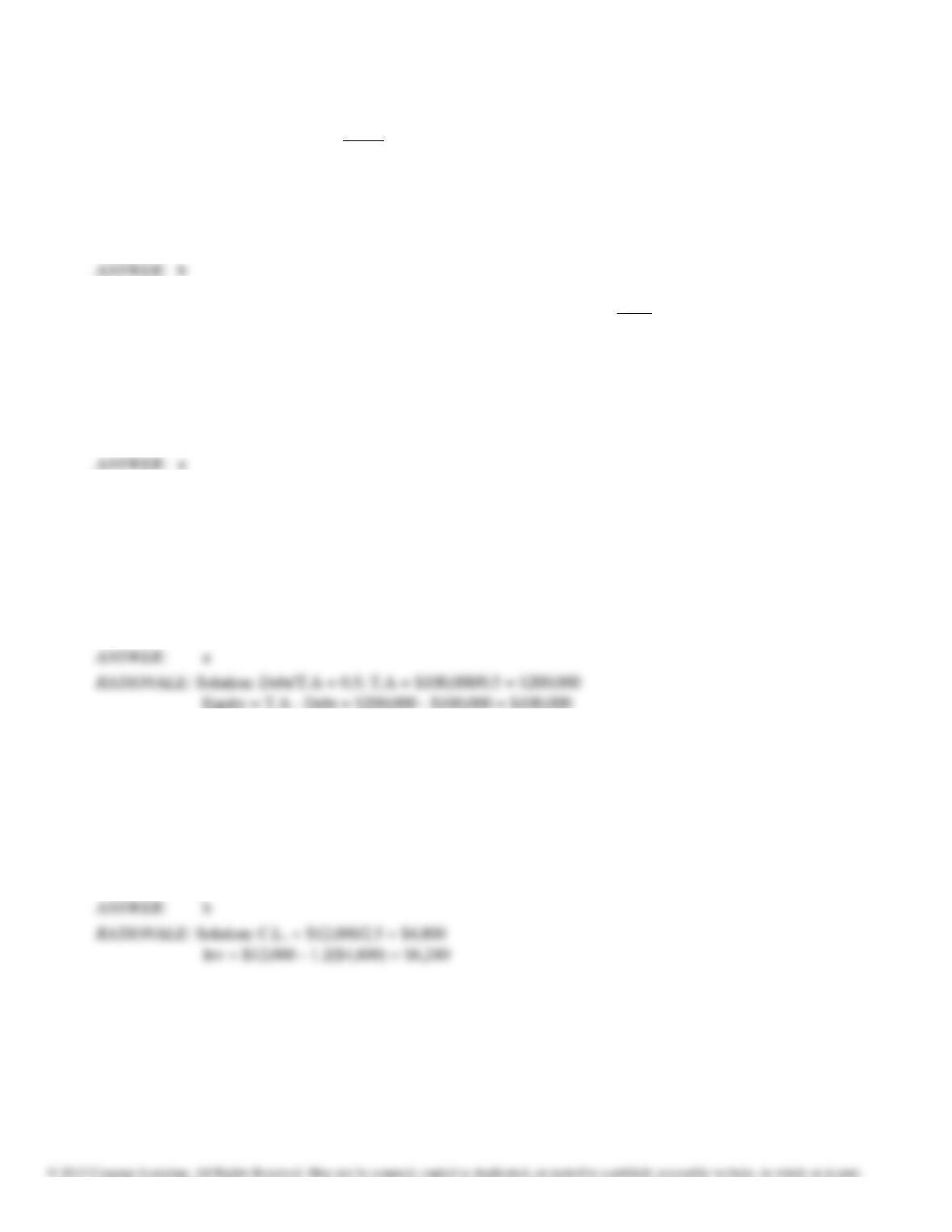
58. Nuking Gnats Pest Service, Inc. has a debt ratio of 50% and an equity multiplier of 2. What is Nuking
Gnats’ stockholders’ equity if total debt is $100,000?
a. $100,000
b. $150,000
c. $200,000
d. $50,000
59. Given the following information, calculate the inventory for Big Show Videos: Quick ratio = 1.2;
Current assets = $12,000; Current ratio = 2.5
a. $4,800
b. $6,240
c. $7,200
d. $5,660
Chapter 3: Evaluation of Financial Performance
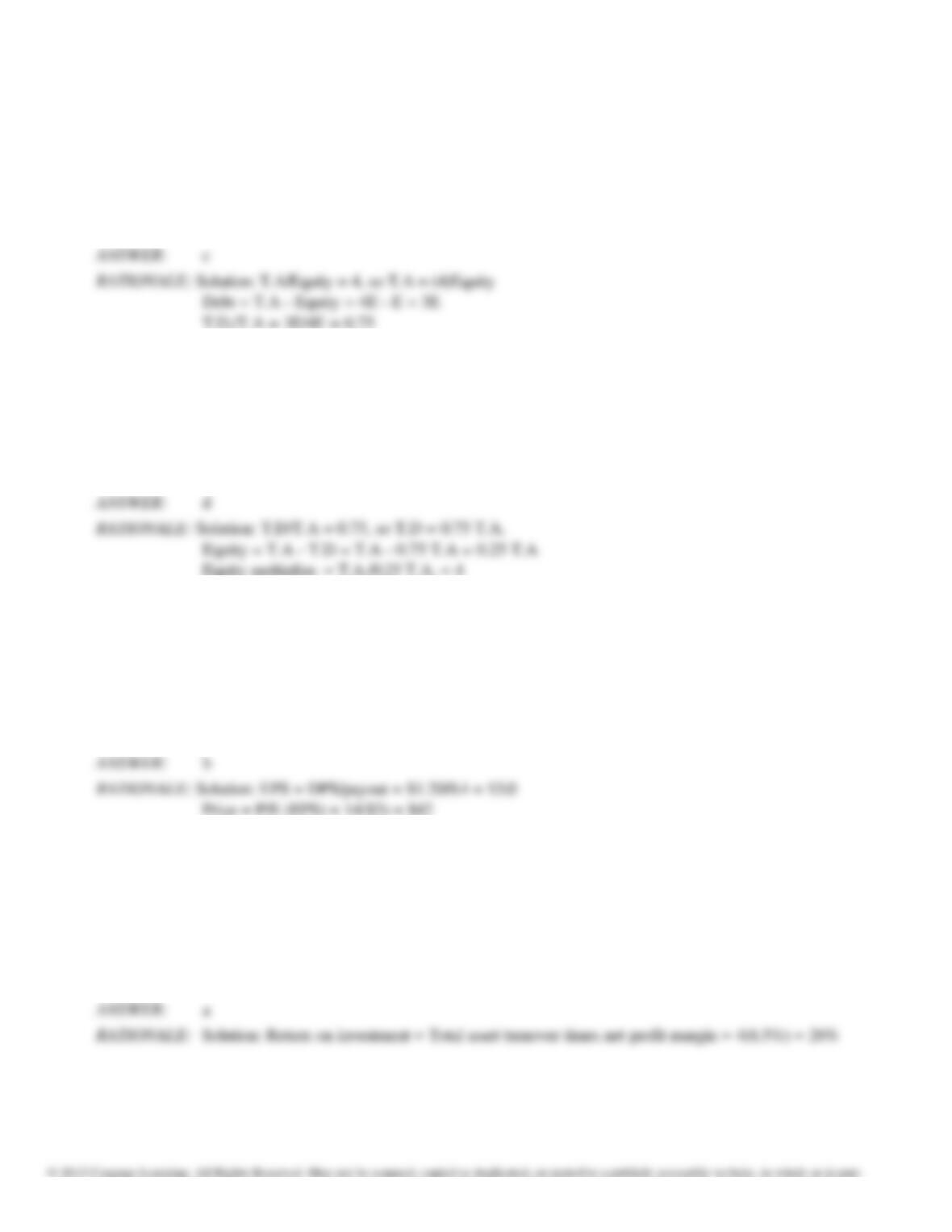
60. A firm with an equity multiplier of 4.0, will have a debt ratio of
a. 0.25
b. 1.00
c. 0.75
d. 4.00
61. A firm with a debt ratio of 0.75, will have an equity multiplier of
a. 0.25
b. 1.00
c. 0.75
d. 4.00
62. What is the market price of a share of stock for a firm that pays dividends of $1.20 per share, has a P/E
of 14, and a dividend payout ratio of 0.4?
a. $16.80
b. $42
c. $3
d. $28
63. What is the return on investment for a firm that has a debt ratio of 0.65, a net profit margin of 6.5%, sales
of $740,000, and a total asset turnover of 4?
a. 26.0%
b. 16.9%
c. 6.5%
d. 4.6%
Chapter 3: Evaluation of Financial Performance
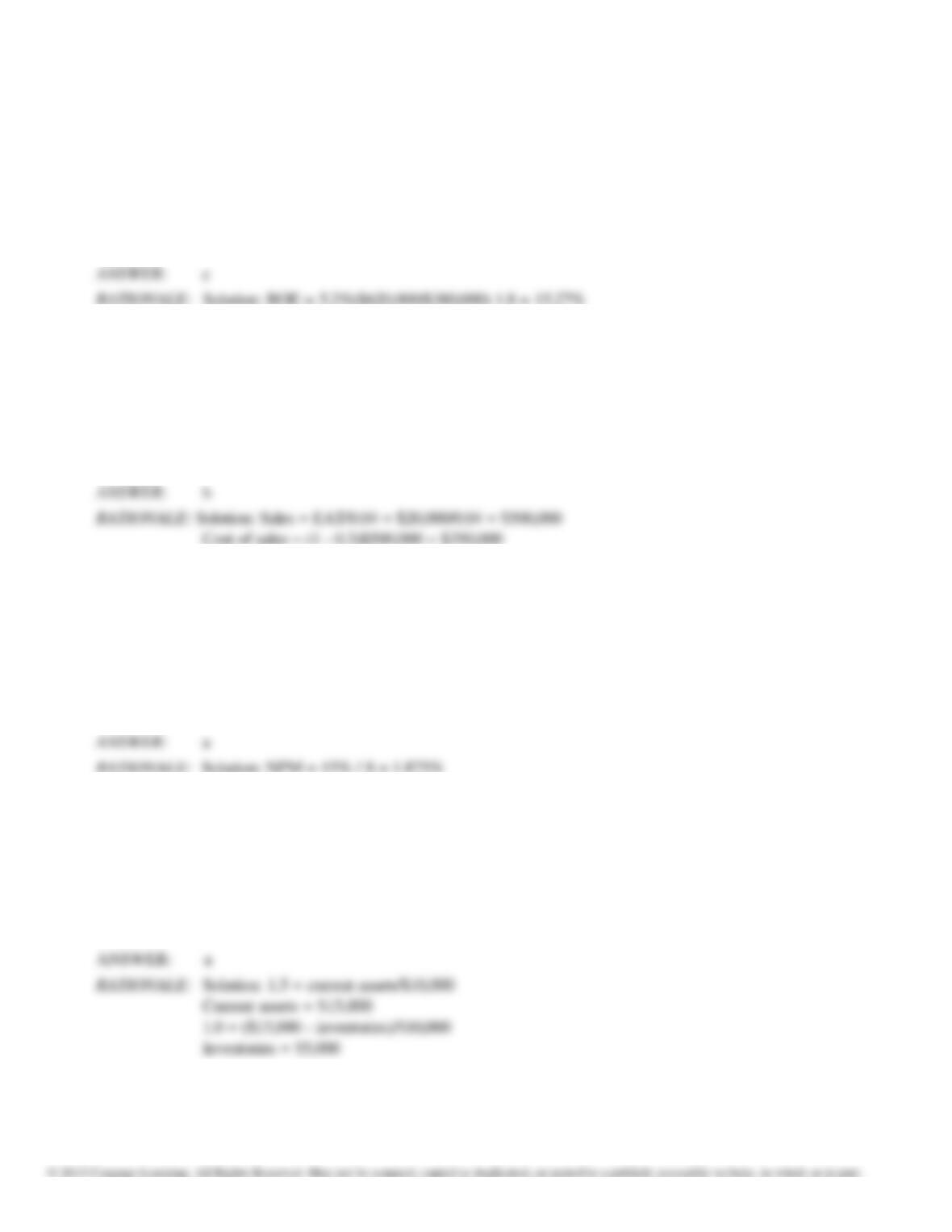
64. What is the return on stockholders’ equity for a firm with a net profit margin of 5.2 percent, sales of
$620,000, an equity multiplier of 1.8, and total assets of $380,000?
a. 8.48%
b. 5.74%
c. 15.27%
d. 9.36%
65. What is the cost of sales for a firm with a gross profit margin of 30 percent, a net profit margin of 4
percent, and earnings after taxes of $20,000?
a. $200,000
b. $350,000
c. $150,000
d. $125,000
66. If a firm has a total asset turnover of 8 times and a return on total assets of 15%, its net profit margin
must be
a. 1.875%
b. 1.95%
c. 2.05%
d. 2.25%
67. A firm’s current ratio is 1.5 and its quick ratio is 1.0. If its current liabilities are $10,000, what are its
inventories?
a. $ 5,000
b. $10,000
c. $15,000
d. $20,000