71) Total market demand can be calculated by
A) horizontally summing individual demand curves at each and every price level.
B) vertically summing individual demand curves at each and every income level.
C) adding up the largest quantity demanded by each individual.
D) looking at the changes in the products’ popularity.
72) The law of demand states that there is
A) an inverse relationship between income and quantity demanded, ceteris paribus.
B) a direct relationship between income and quantity demanded, ceteris paribus.
C) no relationship between taste and quantity demanded, ceteris paribus.
D) an inverse relationship between price and quantity demanded, ceteris paribus.
73) The law of demand shows that there is
A) an inverse relationship between price and profit.
B) an inverse relationship between price and resource cost.
C) an inverse relationship between price and quantity demanded.
D) a direct relationship between price and quantity demanded.
74) The demand curve shows the relationship between quantity demanded and
A) income.
B) price.
C) supply.
D) quantity supplied.
75) When the price of TVs goes up and fewer TVs are purchased, this is representative of the
A) law of demand.
B) law of supply.
C) law of market operations.
D) law of increasing costs.
76) Suppose that the demand curve for apples is downward sloping and the price per pound
decreases from $1.25 to $1.00. We would then expect
A) the demand for apples to decrease.
B) the quantity of apples demanded to fall.
C) the demand curve to shift toward the origin.
D) the quantity of apples demanded to increase.
77) The law of demand implies that the demand curve
A) has a negative slope.
B) has a positive slope.
C) shifts to the right when the price of a good increases.
D) shifts to the left when the price of a good decreases.
78) A demand curve
A) slopes down because of the inverse relationship between price and quantity demanded.
B) slopes up because of the direct relationship between price and quantity demanded.
C) can slope up or down depending on the tastes of the consumer.
D) is vertical for necessities, upward sloping for luxury goods, and downward sloping for all
other goods.
79) If Apple’s iTunes Music Store increases its “fee” for its music downloads, the law of demand
predicts that
A) the number of iTunes music downloads would increase.
B) there would be no change in the demand for iTunes music downloads.
C) the number of iTunes music downloads would decrease.
D) iTunes music supply would change but demand would not.
80) Which of the following will occur as the price of a good decreases?
A) The demand curve for that good will shift to the left.
B) The demand curve for that good will shift to the right.
C) The quantity demanded for that good will increase.
D) Demand for that good will increase.
81) A demand curve is a graphical representation of
A) consumer tastes.
B) national income.
C) the demand schedule.
D) relative prices.
82) When economists talk about a demand schedule for a product, they mean
A) the amount of a good that consumers intend to purchase at each price in a set of possible
prices in a given time period.
B) the amount of a good that consumers are able to purchase (though they might not be willing
to) at different prices in a given period of time.
C) the amount of a good that consumers intend to purchase at only one particular price in a given
period of time.
D) the amount of a good that producers are willing to make available for sale at a particular price
in a given time period.
83) Adding the quantities demanded by all consumers at every price will yield
A) the market-clearing price.
B) the number of consumers.
C) the total substitution effect from a price change.
D) the market demand curve.
84) When the price of a good falls, there will be
A) an outward shift in the good’s demand curve.
B) both an outward shift in the good’s demand curve and a movement along the good’s demand
curve.
C) a movement along the good’s demand curve.
D) no change in quantity demanded.
85) In deriving the demand schedule for a good, economists assume that
A) consumers have equal incomes to allocate among goods.
B) a consumer will allocate all of her income to one good.
C) all other influences on demand except the product price are held constant.
D) reported income changes at each point on the demand schedule.
86) A demand schedule provides
A) the quantities of a good people are willing to sell every year.
B) the amount of a good a person wants to sell during a given time period.
C) the alternative quantities demanded for a given time period at different possible prices.
D) the amount of a good a person wants at different times of the day.
87) An increase in quantity demanded is caused by
A) an increase in income.
B) a decrease in the price of the good.
C) a decrease in the price of a complement.
D) a change in expectations about price in the future.
88) Gasoline prices in the United States decreased significantly between 2014 and 2016. A
decrease in the price of gasoline, holding other things constant, will cause which of the following
to occur?
A) increase the demand for gasoline.
B) decrease the demand for gasoline.
C) increase the quantity of gasoline demanded.
D) decrease the quantity of gasoline demanded.
89) A schedule of how much of a good people will purchase for a range of possible prices during
a specified time period, other things constant, is the definition of
A) supply.
B) demand.
C) a purchasing contract.
D) an economic market.
90) The market demand curve for a particular good
A) is the horizontal sum of all individual demand curves for the good.
B) may be less than an individual demand curve for the good.
C) may or may not show a direct relationship between price and quantity demanded.
D) will not be affected by any of the determinants of individual demand.
91) A market demand schedule for a product indicates that
A) as the product’s price falls, consumers buy less of the good.
B) there is a positive relationship between price and quantity demanded.
C) as a product’s price rises, consumers buy more of the good.
D) there is a negative relationship between price and quantity demanded.
92) Graphically, a market demand curve is found by
A) taking the average of all prices that people are willing to pay.
B) summing the quantities demanded by all individuals at each price.
C) summing the prices each consumer would pay for each quantity.
D) taking the average of the individual demand curves.
93) The alternative quantities demanded for a given time period at different possible prices is
known as
A) absolute demand.
B) a demand schedule.
C) real demand.
D) constant demand.
94) For a demand schedule, which of the following is held constant?
A) relative prices
B) quantity demanded
C) quality of the good
D) nominal prices
95) Four points on a demand schedule are given: $12, 2 units; $10, 3 unit; $15, 5 units; and $2, 4
units. Which combination is inconsistent with the law of demand?
A) $12 and 2 units
B) $10 and 3 unit
C) $15 and 5 units
D) $2 and 4 units
96) A demand schedule
A) holds all prices constant.
B) is only for a given time period.
C) holds quantity constant.
D) is for a given variety of goods.
28
97) A demand curve is derived from
A) the production possibilities curve.
B) consumer’s income.
C) a demand schedule.
D) an equilibrium.
98) A demand curve represents a(n)
A) direct relationship between price and quantity demanded.
B) direct relationship between price and demand.
C) indirect or inverse relationship between price and quantity demanded.
D) indirect or inverse relationship between price and supply.
99) A demand curve is a
A) graphical representation of the demand schedule.
B) graphical representation of alternative demands.
C) horizontal line connecting amounts demanded at various income levels.
D) graphical relationship, that includes several things such as tastes, time, and supply.
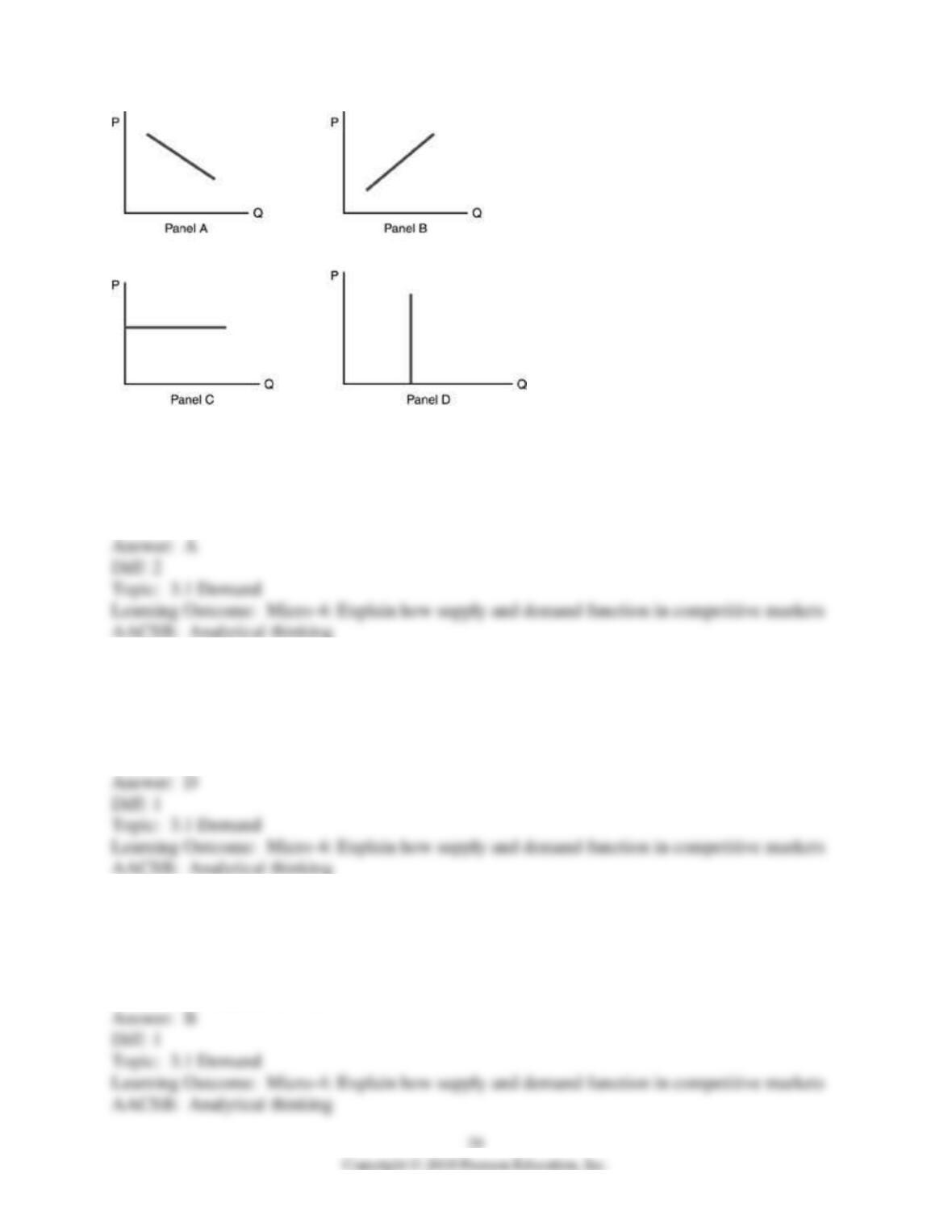
100) Refer to the above figure. Which panel best demonstrates the demand curve?
A) Panel A
B) Panel B
C) Panel C
D) Panel D
101) An indirect or inverse relationship between price and quantity demanded is
A) the market clearing price.
B) a change in demand.
C) a supply curve.
D) a demand curve.
102) By summing the quantities demanded by individuals at each price we obtain the
A) equilibrium price.
B) market demand curve.
C) market supply curve.
D) individual demand curve.
103) We are given the individual demand curves for all of the people that consume ice cream.
Which statement is TRUE about the market demand curve for ice cream?
A) The market demand curve is obtained by horizontally summing the individual demand curves.
B) The market demand curve is obtained by vertically summing the individual demand curves.
C) The market demand curve cannot be obtained because information on prices is missing.
D) The market demand curve cannot be obtained from individual demand curves.
104) A market demand curve is found by
A) adding the prices each consumer would pay for each quantity.
B) adding the prices and the quantities demanded by a consumer.
C) adding the quantities demanded for each individual consumer at each price.
D) taking the demand curve of the “representative” consumer.
105) Refer to the above table. What is the market quantity demanded of DVDs at a price of $12?
A) 6
B) 9
C) 12
D) 24
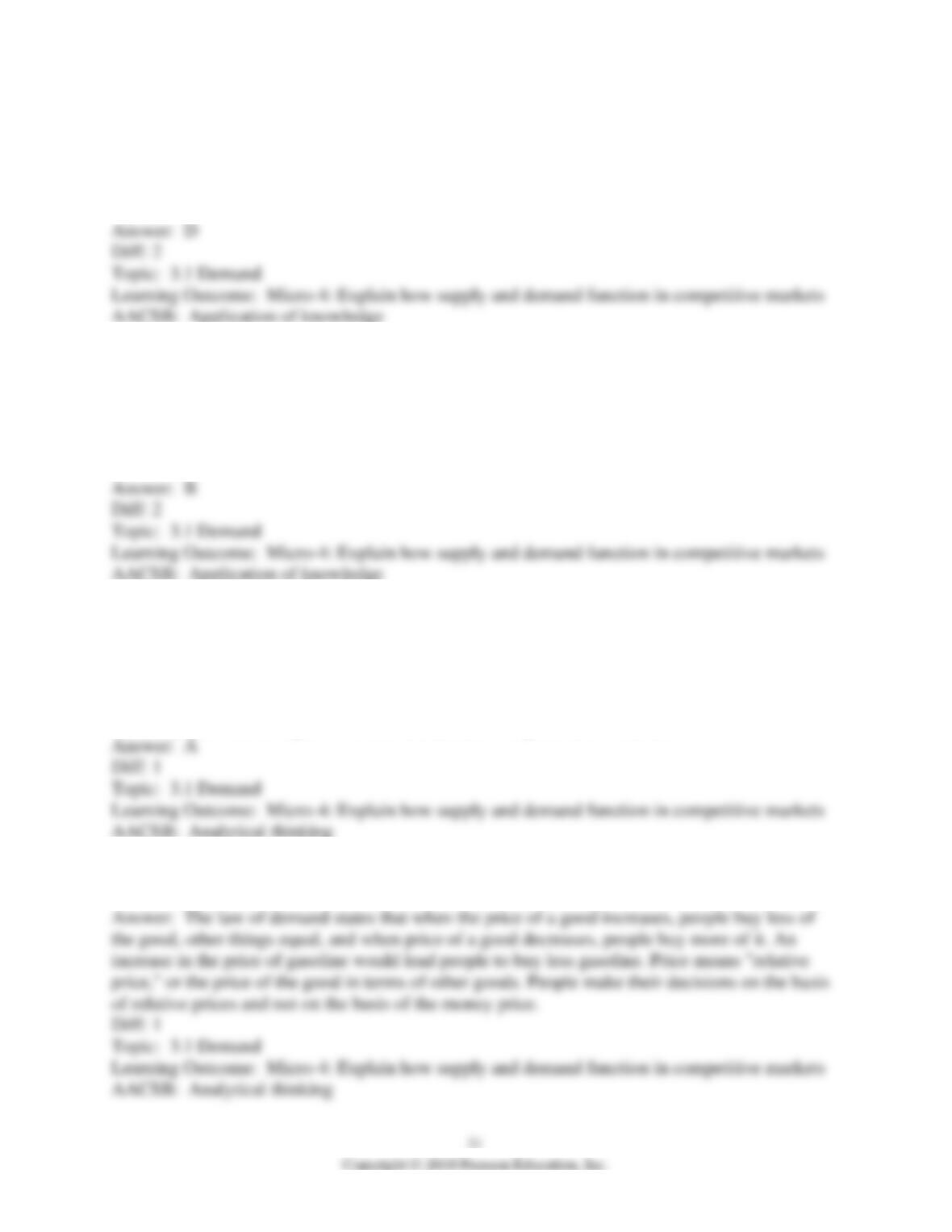
106) Refer to the above table. What is the market quantity demanded at a price of $8?
A) 5
B) 15
C) 35
D) 44
107) Refer to the above table. Suppose Buyer 2 leaves the market. What is the new market
quantity of DVDs demanded at a price of $10?
A) 33
B) 25
C) 22
D) 8
108) Demand is a schedule that shows
A) a set of possible prices for a good and the quantities of the good that will be purchased at each
of those prices.
B) how much income it takes to afford various quantities of a good.
C) the relationship between the cost of producing a good and the price that sellers will charge.
D) how population changes will affect the amount of a good that is needed.
109) State the law of demand and illustrate it. Explain what is meant by the term “price” in the
law of demand.
110) In 1950, a phone call at a pay phone cost 5 cents and a first-class stamp cost 3 cents. Today,
those prices are 50 cents and 49 cents respectively. What has happened to the price of each good
relative to the other? What has happened to the price of each good relative to all other goods?
111) What information is provided by a demand curve? What variables are measured along the
axes of the graph?
112) Explain how a market demand curve is constructed.
3.2 Shifts in Demand
1) Which of the following statements is FALSE about the demand curve?
A) An increase in demand shifts the demand curve to the left, closer to the price axis.
B) When only the price of a good changes, there is movement along the demand curve but no
change in demand.
C) A change in demand is graphically shown by shifting the entire demand curve.
D) When demand decreases, there is a drop in the quantity demanded at each price.
2) Which of the following will cause a movement along the demand curve instead of a shift of
the demand curve?
A) income
B) tastes and preferences
C) Expectations e the future price of a good
D) none of the above
3) Which of the following is a determinant of market demand?
A) consumers’ expectation of the future relative price of a product
B) taxes imposed on firms that sell the product
C) cost of inputs used to produce the product
D) number of firms that produce the product
4) If more buyers came into the market for a good, we would expect to see the market demand
curve
A) shift inward and to the left.
B) remain unchanged since none of the determinants of individual demand changed.
C) shift outward and to the right.
D) reflect a positive relationship between price and quantity demanded.
5) Suppose that jeans that were fashionable in the 1990s become unfashionable today. If other
factors were held constant, then there would be in the market of jeans
A) a rightward movement along the supply curve.
B) a rightward shift of the demand curve.
C) a leftward shift in the demand curve.
D) a leftward movement along the supply curve.
6) Suppose a college increases the wages paid to student employees. Which of the following
options is the best description of the most likely effect of the increase in wage earnings on the
demand curve for school sweatshirts in the bookstore?
A) The demand curve shifts to the right.
B) The demand curve shifts to the left.
C) a leftward movement along the demand curve
D) a rightward movement along the demand curve
7) An increase in demand is shown graphically by
A) a shift of the demand curve to the left.
B) a movement up along the existing curve.
C) a shift of the demand curve to the right.
D) a movement down the existing curve.
8) If a demand curve shifts, we know that
A) the price of the good itself is not a factor.
B) the price of the good itself is a factor.
C) the price of the good and supply are the major factors.
D) the price of the good and demand are major factors.
9) Which of the following statements is FALSE?
A) If there is an increase in the demand for a product, consumers want to buy more of the
product at each and every possible price.
B) A decrease in demand shifts the demand curve leftward toward the origin, while a decrease in
quantity demanded involves a movement upward along a particular demand curve.
C) If the price of a good rises, quantity demanded of the good decreases and the demand curve
shifts toward the origin as long as supply is static.
D) A change in the demand for a product is caused by factors other than changes in the product’s
price.
10) A demand curve for a normal good
A) slopes upward and to the right.
B) is constructed based on the assumption that income is rising.
C) is constructed based on the assumption that an inverse relationship exists between price and
income.
D) shows the inverse relationship between price and quantity demanded.
11) Which of the following statements is FALSE?
A) An increase in income causes an increase in the demand for a normal good.
B) An increase in income causes a decrease in the demand for an inferior good.
C) A decrease in income causes the demand curve for a normal good to shift to the left.
D) An increase in income causes the demand curve for an inferior good to shift to the right.
12) Suppose an individual experiences a permanent increase in income. As a result of this
increased income, further assume that the individual eats dinner at restaurants more frequently
each month. This information suggests that dinners at restaurants for this individual are
A) an inferior good.
B) a substitute good.
C) a normal good.
D) both complimentary and inferior.
13) In economic terminology, a normal good is a good
A) on which a monetary value cannot be placed.
B) that is liked only by normal people.
C) for which demand increases when price increases.
D) for which demand increases when income increases.
14) In economic terminology, an inferior good is a good
A) that no one will purchase.
B) that doesn’t work properly.
C) that has no monetary value.
D) for which demand increases as income decreases.
37
15) If the demand of a good is inversely related to income, it must be
A) a bad good.
B) an inferior good.
C) a normal good.
D) an everyday product.
16) If an increase in the incomes of people who live in the Los Angeles area leads to an increase
in the demand for season tickets for games played by the Los Angeles Lakers professional
basketball team, then these season tickets are
A) a normal good.
B) an inferior good.
C) an income complement.
D) an income substitute.
17) An inferior good is one for which
A) demand increases as income increases.
B) demand decreases as income increases.
C) the demand curve is vertical.
D) the demand curve slopes up.
38
18) For a normal good, an increase in consumer income will lead to
I. a movement down the demand curve
II. a rightward shift in the demand curve
III. a reduction in supply
A) I only.
B) II only.
C) III only.
D) both II and III.
19) Sarah gets a salary increase. Before her raise, she purchased 5 pounds of fish and 1 pound of
beef stew a month. After her raise, she consumes 2 pounds of fish and 3 pounds of beef stew a
month. If everything else is held constant, we know that
A) fish is an inferior good and beef stew is a normal good for Sarah.
B) fish is a normal good and beef stew is an inferior good for Sarah.
C) both fish and beef stew are normal goods for Sarah.
D) both fish and beef stew are inferior goods for Sarah.
20) Fashion trends are a nonprice determinant for demand because
A) they cause a movement along the demand curve.
B) they influence people’s tastes and preferences in clothing.
C) they change the supply of accessories.
D) they do not affect demand.
21) Which of the following will cause a rightward shift of the demand curve?
A) a decrease in the cost of production
B) a decrease in the price of the good
C) an increase in the expected future price of the good
D) all of the above
22) Which one of the following is NOT a determinant of demand?
A) prices of related goods
B) cost of inputs in production
C) income
D) future price expectations
23) All of the following will affect the position of the demand curve EXCEPT
A) income.
B) taste and preference.
C) changes in expectations of future relative prices.
D) prices of resources used to produce the product.
24) Assume that coffee and tea are substitutes. Given a downward sloping demand curve for tea,
an increase in the price of tea will cause
A) an increase in the demand for coffee.
B) a decrease in the demand for coffee.
C) a leftward shift of the demand curve for tea.
D) a leftward shift in the demand for coffee.
25) If goods X and Y are substitute goods, then an increase in the price of Y, other things being
equal,
A) results in a decrease in the amounts of both X and Y consumed.
B) decreases the quantity demanded of Y, but has no effect on the amount of X consumed.
C) results in a decrease in the quantity of Y consumed, but increases the demand for X.
D) has no real effect on the quantity demanded of good Y, but increases the demand for X.
26) If bagels and croissants are substitute goods, which of the following is likely to occur if the
price of bagels has decreased?
A) The demand curve for bagels shifts to the right.
B) A leftward movement along the bagel demand curve.
C) The demand curve for croissants shifts to the right.
D) The demand curve for croissants shifts to the left.
27) If two goods are substitutes, then
A) an increase in the price of one causes the demand for the other to fall.
B) there is an inverse relationship between changes in the price of one good and changes in the
demand for the other.
C) if the price of one good falls, the demand for the other good falls also.
D) changes in the quantity demanded of one good will not affect the demand for the other.
28) Suppose that goods X and Y are substitutes and the price of good Y falls. We would then
expect
A) the quantity of good Y demanded to increase and the demand for good X to increase also.
B) an increase in the demand for good X and a decrease in the quantity of good Y demanded.
C) an increase in the quantity demanded of good Y and a decrease in the demand for good X.
D) an increase in the demand for both good X and good Y.