Macroeconomics 2017 (Hubbard)
Chapter 3 Where Prices Come From: The Interaction of Demand and Supply
3.1 The Demand Side of the Market
1) The market for smartwatches is becoming very competitive. The increase in competition in this
market is an example of how the market responds to
A) changes in consumer tastes.
B) increases in income.
C) changes in population.
D) decreases in the price of smartphones (a substitute for the product).
2) If you are considering buying either an Apple Watch or a Samsung Gear S2, and you choose the
Samsung only because the price is lower, then you consider
A) the Apple Watch to be a normal good and the Samsung Gear S2 to be an inferior good.
B) the Apple Watch to be an inferior good and Samsung Gear S2 to be a normal good.
C) the Apple Watch and the Samsung Gear S2 to be complements.
D) the Apple Watch and the Samsung Gear S2 to be substitutes.
3) A(n) ________ is represented by a rightward shift of the demand curve while a(n) ________ is
represented by a movement along a given demand curve.
A) increase in demand; decrease in demand
B) increase in demand; increase in quantity demanded
C) decrease in demand; decrease in quantity demanded
D) increase in quantity demanded; increase in demand
4) A demand curve shows the relationship between
A) the price of a product and the quantity of the product demanded.
B) the amount of a product sellers are willing to sell at a particular price and the amount consumers are
willing to buy at that price.
C) the quantity that consumers are willing and able to buy and the quantity that sellers are willing and
able to offer.
D) the price of a produce and the demand for the product.
5) If, in response to a decrease in the price of coffee, the quantity of coffee demanded increases,
economists would describe this as
A) an increase in demand.
B) an increase in quantity demanded.
C) a change in consumer income.
D) an increase in consumers’ taste for coffee.
6) If, in response to an increase in the price of pineapples, the quantity of pineapples demanded
decreases, economists would describe this as
A) an decrease in demand.
B) a decrease in quantity demanded.
C) a change in consumer income.
D) a decrease in consumers’ taste for pineapples.
7) By drawing a demand curve with price on the vertical axis and quantity on the horizontal axis,
economists assume that the most important determinant of the demand for a good is
A) consumer income.
B) consumer tastes and preferences.
C) the price of the good.
D) the quality of the good.
8) The law of demand implies, holding everything else constant, that as the price of yogurt
A) increases, the demand for yogurt will increase.
B) increases, the quantity of yogurt demanded will decrease.
C) decreases, the quantity of yogurt demanded will decrease.
D) decreases, the demand for yogurt will increase.
9) The phrase “demand has increased” means that
A) a demand curve has shifted to the left.
B) there has been an upward movement along a demand curve.
C) there has been a downward movement along a demand curve.
D) a demand curve has shifted to the right.
10) Holding everything else constant, a decrease in the price of GPS systems will result in
A) an decrease in the quantity of GPS systems demanded.
B) an increase in the demand for GPS systems.
C) a decrease in the supply of GPS systems.
D) an increase in the quantity of GPS systems demanded.
11) Holding everything else constant, an increase in the price of raisins will result in
A) a decrease in the quantity of raisins demanded.
B) an increase in the demand for raisins.
C) a decrease in the supply of raisins.
D) an increase in the quantity of raisins demanded.
12) A change in which variable will change the market demand for a product?
A) the price of the product
B) expected future prices
C) the number of firms in the market
D) the quantity of the product supplied
Table 3-1
Kona Coffee
Price per lb.
(dollars)
Luke’s
Quantity
Demanded
(lbs.)
Ravi’s
Quantity
Demanded
(lbs.)
Rest of
Market
Quantity
Demanded
(lbs.)
Market
Quantity
Demanded
(lbs.)
$10
3
0
23
8
9
3
32
6
14
7
68
5
18
12
85
4
22
18
110
13) Refer to Table 3-1. The table above shows the demand schedules for Kona coffee of two individuals
(Luke and Ravi) and the rest of the market. At a price of $6, the quantity demanded in the market
would be
A) 36 lbs.
B) 68 lbs.
C) 89 lbs.
D) 123 lbs.
14) Refer to Table 3-1. The table above shows the demand schedules for Kona coffee of two individuals
(Luke and Ravi) and the rest of the market. At a price of $4, the quantity demanded in the market
would be
A) 40 lbs.
B) 70 lbs.
C) 110 lbs.
D) 150 lbs.
15) Refer to Table 3-1. The table above shows the demand schedules for Kona coffee of two individuals
(Luke and Ravi) and the rest of the market. If the price of Kona coffee rises from $4 to $5, the market
quantity demanded would
A) decrease by 35 lbs.
B) increase by 115 lbs.
C) increase by 35 lbs.
D) decrease by 115 lbs.
16) Refer to Table 3-1. The table above shows the demand schedules for Kona coffee of two individuals
(Luke and Ravi) and the rest of the market. If the price of Kona coffee falls from $6 to $4, the market
quantity demanded would
A) decrease by 89 lbs.
B) increase by 26 lbs.
C) increase by 61 lbs.
D) increase by 110 lbs.
17) The ________ effect of a price change refers to the impact of a change in the price of a good on a
consumer’s purchasing power.
A) income
B) substitution
C) demographics
D) ceteris paribus
18) Which of the following will not shift the demand curve for a good?
A) an increase in population
B) an increase in the price of the good
C) a decrease in the price of a substitute good
D) an increase in consumer incomes
19) A ________ demand curve for shampoo would be caused by a change in the price of shampoo.
A) rightward shift of the
B) leftward shift of the
C) movement along the
D) positively sloped
20) The substitution effect of a price change refers to
A) the change in quantity demanded that results from a change in price making a good more or less
expensive relative to other goods that are substitutes.
B) the shift of a demand curve when the price of a substitute good changes.
C) the movement along the demand curve due to a change in purchasing power brought about by the
price change.
D) the shift in the demand curve due to a change in purchasing power brought about by the price
change.
21) If the price of pork rinds falls, the substitution effect due to the price change will cause
A) an increase in the demand for pork rinds.
B) an increase in the demand for corn chips, a substitute for pork rinds.
C) an increase in the quantity of pork rinds demanded.
D) a decrease in the quantity of pork rinds demanded.
22) If the price of beef jerky rises, the substitution effect due to the price change will cause
A) an increase in the demand for beef jerky.
B) an increase in the demand for hot sauce, a complement for beef jerky.
C) an increase in the quantity of beef jerky demanded.
D) a decrease in the quantity of beef jerky demanded.
23) The income effect of a price change results in a
A) shift of the demand curve when income changes.
B) movement along the demand curve due to a change in relative prices.
C) shift of the demand curve due to a change in purchasing power brought about by the price change.
D) movement along the demand curve due to a change in purchasing power brought about by the price
change.
24) If a decrease in income leads to a decrease in the demand for ice cream, then ice cream is
A) a normal good.
B) a neutral good.
C) a complement.
D) a necessity.
25) If an increase in income leads to an increase in the demand for sushi, then sushi is
A) a normal good.
B) a neutral good.
C) a complement.
D) a necessity.
26) If a decrease in income leads to an increase in the demand for macaroni, then macaroni is
A) an inferior good.
B) a neutral good.
C) a necessity.
D) a normal good.
27) If an increase in income leads to a decrease in the demand for salami, then salami is
A) an inferior good.
B) a neutral good.
C) a necessity.
D) a normal good.
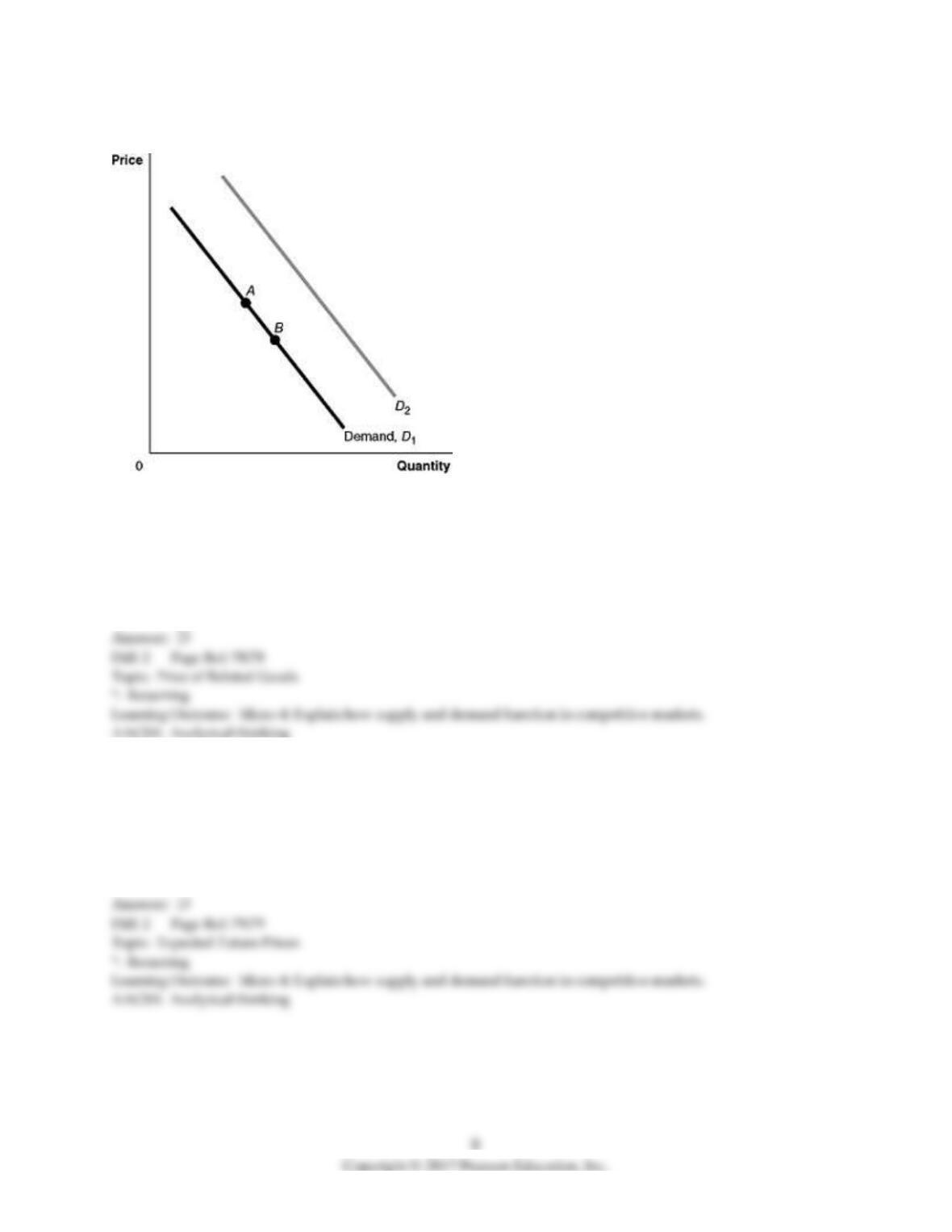
Figure 3-1
28) Refer to Figure 3-1. An increase in the price of a complement would be represented by a movement
from
A) A to B.
B) B to A.
C) D1 to D2.
D) D2 to D1.
29) Refer to Figure 3-1. A decrease in the expected future price of the product would be represented by a
movement from
A) A to B.
B) B to A.
C) D1 to D2.
D) D2 to D1.
30) Refer to Figure 3-1. If the product represented is a normal good, an increase in income would be
represented by a movement from
A) A to B.
B) B to A.
C) D1 to D2.
D) D2 to D1.
31) Refer to Figure 3-1. An increase in the price of the product would be represented by a movement
from
A) A to B.
B) B to A.
C) D1 to D2.
D) D2 to D1.
32) Refer to Figure 3-1. An increase in the price of a substitute would be represented by a movement
from
A) A to B.
B) B to A.
C) D1 to D2.
D) D2 to D1.
33) Refer to Figure 3-1. If the product represented is an inferior good, a decrease in income would be
represented by a movement from
A) A to B.
B) B to A.
C) D1 to D2.
D) D2 to D1.
34) Refer to Figure 3-1. An increase in taste or preference would be represented by a movement from
A) A to B.
B) B to A.
C) D1 to D2.
D) D2 to D1.
35) Refer to Figure 3-1. A decrease population would be represented by a movement from
A) A to B.
B) B to A.
C) D1 to D2.
D) D2 to D1.
36) How has the growing popularity of factory outlet stores affected the market for clothing at retail
department stores?
A) The demand curve for clothing at retail department stores shifts to the right.
B) The demand curve for clothing at retail department stores shifts to the left.
C) The supply curve for clothing at retail department stores shifts to the right.
D) The supply curve for clothing at retail department stores shifts to the left.
37) According to a recent study, “Stricter college alcohol policies, such as raising the price of alcohol, or
banning alcohol on campus, decrease the number of students who use marijuana.” On the basis of this
information, how would you describe alcohol and marijuana?
A) The two goods are substitutes in consumption.
B) There is no relationship between the two goods.
C) The two goods are complements in consumption.
D) They are both luxury goods.
38) If the price of propane-fueled gas grills was to decrease, then
A) the demand for propane would decrease.
B) the demand for propane would increase.
C) the quantity of propane demanded would increase.
D) the quantity of propane demanded would decrease.
39) If the price of smartphones was to increase, then
A) the demand for smartphone apps would decrease.
B) the demand for smartphone apps would increase.
C) the quantity of smartphone apps demanded would increase.
D) the quantity of smartphone apps demanded would decrease.
40) Suppose that when the price of hamburgers increases, the Ruiz family increases their purchases of
hot dogs. To the Ruiz family,
A) hamburgers and hot dogs are complements.
B) hamburgers and hot dogs are inferior goods.
C) hamburgers and hot dogs are normal goods.
D) hamburgers and hot dogs are substitutes.
41) Suppose that when the price of oranges decreases, Sarita decreases her purchases of peaches. To
Sarita,
A) oranges and peaches are complements.
B) oranges and peaches are inferior goods.
C) oranges and peaches are normal goods.
D) oranges and peaches are substitutes.
42) Suppose that when the price of pickles decreases, Teddy increases his purchase of ketchup. To
Teddy,
A) pickles and ketchup are complements.
B) pickles and ketchup and substitutes.
C) pickles and ketchup are normal goods.
D) pickles are a normal good and ketchup is an inferior good.
43) Suppose that when the price of ice cream increases, Liza decreases her purchase of hot fudge. To
Liza,
A) ice cream and hot fudge are complements.
B) ice cream and hot fudge and substitutes.
C) ice cream and hot fudge are normal goods.
D) ice cream is a normal good and hot fudge is an inferior good.
44) Several studies have shown promising links between green tea consumption and cancer prevention.
How does this affect the market for green tea?
A) The quantity of green tea demanded increases because of a change in tastes in favor of green tea.
B) The green tea demand curve shifts to the right because of a change in tastes in favor of green tea.
C) The green tea demand curve shifts to the left because this new information will increase the price of
green tea.
D) The quantity of green tea demanded decreases because this new information will increase the price
of green tea.
45) If the price of gasoline increases, what will be the impact in the market for public transportation?
A) The demand curve for public transportation shifts to the right.
B) The quantity of public transportation demanded increases.
C) The demand curve for public transportation shifts to the left.
D) The quantity of public transportation demanded decreases.
46) If the price of train tickets decreases, what will be the impact in the market for bus travel?
A) The demand curve for bus travel shifts to the right.
B) The quantity of bus travel demanded increases.
C) The demand curve for bus travel shifts to the left.
D) The quantity of bus travel demanded decreases.
47) How does the increasing use of digital cameras affect the market for traditional camera film?
A) The demand curve for traditional camera film shifts to the right.
B) The quantity of traditional camera film demanded decreases.
C) The quantity of traditional camera film demanded increases.
D) The demand curve for traditional camera film shifts to the left.
48) How does the decreasing use of DVD players affect the market for prerecorded DVDs?
A) The demand curve for prerecorded DVDs shifts to the right.
B) The quantity of prerecorded DVDs demanded decreases.
C) The quantity of prerecorded DVDs demanded increases.
D) The demand curve for prerecorded DVDs shifts to the left.
49) Technological advancements have led to lower prices and an increase in the sale of color laser
printers. How does this affect the market for laser printer ink cartridges?
A) The demand curve for laser printer ink cartridges shifts to the right.
B) The demand curve for laser printer ink cartridges shifts to the left.
C) The quantity of laser printer ink cartridges demanded increases.
D) The quantity of laser printer ink cartridges demanded decreases.
50) Technological advancements have led to lower prices and an increase in the sale of color laser
printers. How does this affect the market for traditional inkjet printers?
A) The demand curve for inkjet printers shifts to the right.
B) The demand curve for inkjet printers shifts to the left.
C) The quantity of inkjet printers demanded increases.
D) The quantity of inkjet printers demanded decreases.
51) Buyers scrambled to secure stocks of Australian wool following a forecast of an 11 percent decline in
wool production. What happens in the Australian wool market as a result of this announcement?
A) The demand curve for Australian wool shifts to the left in anticipation of higher prices in the future.
B) The demand curve for Australian wool shifts to the right in anticipation of higher prices in the future.
C) The quantity of Australian wool demanded increases in anticipation of higher prices in the future.
D) The quantity of Australian wool demanded decreases in anticipation of lower quantities in the
future.
52) Factory incentives on cell phones have encouraged consumers to upgrade their phones. How does
this affect the market for bluetooth headsets?
A) The quantity of bluetooth headsets demanded increases.
B) The quantity of bluetooth headsets demanded decreases.
C) The demand for bluetooth headsets increases.
D) The demand for bluetooth headsets decreases.
53) In January, buyers of gold expect that the price of gold will fall in February. What happens in the
gold market in January, holding everything else constant?
A) The demand curve shifts to the right.
B) The quantity demanded increases.
C) The quantity demanded decreases.
D) The demand curve shifts to the left.
54) In September, buyers of silver expect that the price of silver will rise in October. What happens in
the silver market in September, holding all else constant?
A) The quantity demanded decreases.
B) The demand curve shifts to the left.
C) The demand curve shifts to the right.
D) The quantity demanded increases.
55) If smartwatches are considered substitutes for smartphones, the increase in the price of
smartwatches would, all else equal,
A) increase the demand for smartphones.
B) decrease the demand for smartphones.
C) increase the quantity of smartphones demanded.
D) decrease the quantity of smartphones demanded.
56) If smartwatches are considered substitutes for smartphones, the decline in the price of smartphones
would, all else equal,
A) increase the demand for smartwatches.
B) decrease the demand for smartwatches.
C) increase the quantity of smartwatches demanded.
D) decrease the quantity of smartwatches demanded.
57) Which of the following has occurred as the millennial generation has come of age?
A) The demand for “fast casual” food has decreased in the U.S. market.
B) The demand for golf equipment has increased in the U.S. market.
C) The demand for traditional fast food has decreased in the U.S. market.
D) all of the above
58) Which of the following generation categories has the smallest population in the United States in
2015?
A) the millennials
B) generation X
C) the baby boomers
D) generation Y
59) Apple’s decision in 2002 to focus on developing a smartphone rather than a tablet computer
exemplifies the
A) refusal of firms to invest in more than one project where unlimited resources are involved.
B) refusal of firms to invest in more than one project where limited resources are involved.
C) trade-off that firms face due to unlimited resources.
D) trade-off that firms face due to limited resources.
Table 3-2
Cashews
Price per lb.
(dollars)
Jordy’s
Quantity
Demanded
(lbs)
Amy’s
Quantity
Demanded
(lbs)
Rest of
Market
Quantity
Demanded
(lbs)
Market
Quantity
Demanded
(lbs)
$10
1
1
50
8
2
3
70
6
3
5
95
4
5
9
128
2
8
14
156
60) Refer to Table 3-2. The table above shows the demand schedules for cashews of two individuals
(Jordy and Amy) and the rest of the market. At a price of $6, the quantity demanded in the market
would be
A) 87 lbs.
B) 95 lbs.
C) 103 lbs
D) 215 lbs.
61) Refer to Table 3-2. The table above shows the demand schedules for cashews of two individuals
(Jordy and Amy) and the rest of the market. At a price of $10, the quantity demanded in the market
would be
A) 2 lbs.
B) 48 lbs.
C) 50 lbs
D) 52 lbs.
62) Refer to Table 3-2. The table above shows the demand schedules for cashews of two individuals
(Jordy and Amy) and the rest of the market. If the price of cashews rises from $4 to $6, the market
quantity demanded would
A) decrease by 33 lbs.
B) increase by 39 lbs.
C) increase by 33 lbs.
D) decrease by 39 lbs.
63) Refer to Table 3-2. The table above shows the demand schedules for cashews of two individuals
(Jordy and Amy) and the rest of the market. If the price of cashews falls from $4 to $2, the market
quantity demanded would
A) decrease by 28 lbs.
B) increase by 36 lbs.
C) increase by 28 lbs.
D) decrease by 36 lbs.
64) When the price of a good rises, consumers buy a smaller quantity because of the ________ effect and
the ________ effect.
A) substitution; income
B) normal; inferior
C) substitute; complement
D) supply; demand
65) If the price of prime rib falls, the income effect due to the price change will cause
A) an increase in the demand for prime rib.
B) an increase in the demand for flank steak, a substitute for prime rib.
C) an increase in the quantity of prime rib demanded.
D) an increase in the quantity of prime rib supplied.
66) An increase in population results in an increase in demand.
67) Peanut butter and jelly are complements. If the price of peanut butter increases, the demand for jelly
will increase.
68) A normal good is a good for which the demanded decreases as income decreases, holding
everything else constant.