Economics Today, 19e (Miller)
Chapter 3 Demand and Supply
3.1 Demand
1) In economics, “demand” refers to
A) what people need instead of want without paying for it.
B) the minimum amount of a good people need to survive.
C) the satisfaction a good will provide a person.
D) how much of a good people will buy at any price during a given time period.
2) The concept of “demand” in economics refers to
A) the different quantities of a good or service people will buy at different possible prices.
B) the different types of goods and services that people of different income levels want to buy.
C) how changes in the prices of all goods affect people’s buying behavior.
D) changes in people’s consumption behavior over time.
3) The law of demand states that
A) consumers with more income will spend more on goods and services.
B) a higher price will lead to increased sales.
C) the price can never be too high for some consumers.
D) quantity demanded of a good will vary inversely with the price of that good.
4) The law of demand states that
A) consumers will exhaust their incomes as they purchase goods and services at given absolute
prices.
B) the quantity demanded of a good is higher at a lower relative price than at a higher relative
price.
C) there is a direct positive relationship between relative price and quantity demanded.
D) if the price of a good increases both relatively and absolutely, there will be no change in
quantity demanded.
5) The law of demand includes the statement “other things being equal.” These other things
include all of the following EXCEPT
A) the price of that good in the law of demand.
B) consumers’ income.
C) consumers’ tastes and preferences.
D) the number of potential buyers.
6) According to the law of demand, other things being equal
A) when the price a good goes up, then people buy more of that good.
B) when the price a good goes down, then people buy more of that good.
C) when people’s income goes down, then they buy less of a good.
D) when people’s income goes up, then they buy less of a good.
7) The law of demand tells us that people will buy less of a good if
A) the price of that good increases.
B) the prices of other goods increase.
C) people’s income decreases.
D) every factor that can affect people’s buying decisions changes.
8) The law of demand is based on the observation that
A) people buy less of a product when the product becomes less fashionable.
B) people buy more of a product when its price falls.
C) people are indifferent to price changes.
D) people always want more than they need.
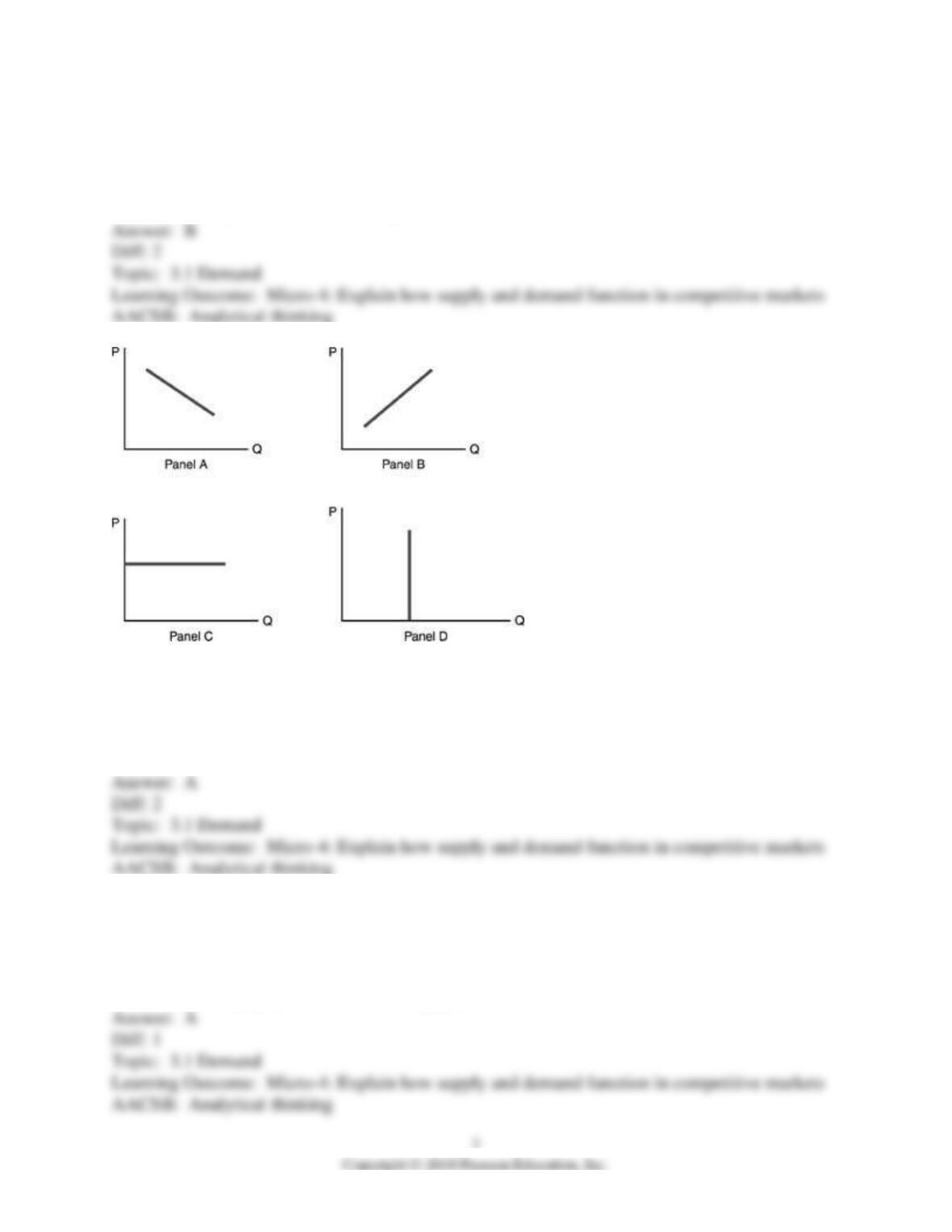
9) Refer to the above figure. Which panel demonstrates the law of demand?
A) Panel A
B) Panel B
C) Panel C
D) Panel D
10) A fundamental principle in demand analysis is that a change in price leads to
A) a movement along the demand curve.
B) a rightward shift of the demand curve.
C) a leftward shift of the demand curve.
D) a complementary movement on the supply curve.
11) The law of demand states that
A) people demand less at lower prices.
B) the quantity demanded is directly related to price.
C) the quantity demanded is inversely related to price.
D) changes in price and changes in quantity demanded move in the same direction.
12) Which of the following is an example of the law of demand?
A) An increase in the price of magnetic optical disks is followed by a reduction in the amount of
magnetic optical disks purchased.
B) An increase in the price of tablets is followed by an increase in the sale of tablets.
C) A decrease in the price of milk has no effect on the amount of milk consumed.
D) The amount of smartphones sold increases while the price of smartphones is constant.
13) According to the law of demand, a decrease in the price of a good causes
A) a rightward shift of the demand curve for that good.
B) a leftward shift of the demand curve for that good.
C) an upward movement along the demand curve for that good.
D) a downward movement along the demand curve for that good.
14) The only variable that can affect a movement along the demand curve is
A) income levels.
B) the price of the good itself.
C) the number of buyers.
D) the number of substitutes.
15) The demand curve is downward sloping because
A) the price must rise to induce firms to increase quantity supplied.
B) a reduction in the price of a good causes individuals to increase their purchase of that good.
C) an increase in the price will cause a leftward shift in the demand curve.
D) all of the above.
16) The money price of a good is also known as its
A) relative price.
B) comparative price.
C) absolute price.
D) subjective price.
17) Suppose that the price of cornflakes is $6.75 per box and the price of oatmeal is $4.50 per
box. Both boxes contain the same number of ounces of cereal. The relative price of cornflakes in
terms of oatmeal is
A) 0.67.
B) 1.0.
C) 0.75.
D) 1.50.
18) The money price of a good is that price
A) expressed in constant 2017 dollars.
B) expressed in purchasing power against a common item like bread.
C) expressed in today’s dollars.
D) that would clear the market.
19) The relative price of a good is that price
A) expressed in today’s dollars.
B) expressed in constant 2017 dollars.
C) expressed in terms of the price of another good.
D) that is equal to the equilibrium price.
20) The price of a smartphone increased from $250 to $400 while the price of a smartphone app
increased from $1 to $2. The relative price of smartphones in terms of smartphone apps
A) increased from 175 to 350.
B) decreased from 250 to 200.
C) increased from 0.003 to 0.05.
D) decreased from 0.35 to 0.2.
21) The price of a new textbook is $60 in one year and $75 two years later, while the price of a
used copy of the textbook increased from $25 to $37.50. The relative price of a new textbook
A) increased by 25 percent.
B) increased from 2.4 to 3.
C) decreased from 2.4 to 2.0.
D) decreased from 1.4 to 1.25.
22) The price of a new textbook increased from $100 to $120 in one year, while the price of a
used textbook increased by 20 percent. What happened to the relative price of a used textbook?
A) It decreased by 25 percent.
B) It increased by 20 percent.
C) It remained constant.
D) It can’t be determined without knowing the nominal price of the used textbook in at least one
of the years.
7
23) The price of a new textbook increases from $75 to $90 while the price of used copies of the
textbook increases from $50 to $65. Other things equal, we would expect to observe
A) the quantity demanded of the used textbook to increase while the quantity demanded of the
new textbook to fall.
B) the quantity demanded of both to fall.
C) the demand for the new textbook to increase while the demand for the used textbook to
decrease.
D) the quantity demanded of the used textbook to decrease and the quantity demanded of the
new textbook to increase.
24) When the term “price” is used in the law of demand, price refers to
A) the dollar price of the good.
B) the price of the good relative to the price of another good.
C) the absolute price of the good.
D) the nominal price of the good relative to its nominal price in the previous year.
25) According to the law of demand, the quantity demanded of a good is related to
A) the average price of all goods.
B) income.
C) any factor that affects the decision of an individual consumer but not the market.
D) the relative price of that good.
26) Which one of the following statements is FALSE?
A) Generally, what matters most to consumers is what a good costs in dollars.
B) The relative price of a good is its price measured relative to the price of other goods.
C) The nominal price of a good is its price measured in current dollars.
D) When the price of beer goes up by the same proportion as the prices of all other goods, the
relative price of beer does not change.
27) Markets are
A) a mechanism through which prices of goods and services are determined by the forces of
supply and demand.
B) specific geographic locations.
C) hypothetical constructs used to analyze how people form their tastes and preferences.
D) places where people can inspect goods and services carefully.
28) The arrangements that individuals have with each other to exchange goods is known as
A) demand.
B) supply.
C) a market.
D) complements.
29) In economics, the meaning of demand refers to
A) how badly someone wants a good.
B) the quantities of a good that people will buy at various prices.
C) the quantities of a good that people will sell at various prices.
D) the total satisfaction that consuming a good provides people at different prices.
30) Market demand is
A) the total quantities demanded of all consumers of a particular item at given prices.
B) a movement along the demand curve in response to the market.
C) total equilibrium demand for the market.
D) the demand for and supply of a good or service.
31) Demand is a schedule of
A) how much of a good a person wants.
B) how much of a good people will purchase at each different possible price.
C) how much of a good people will purchase at each income level.
D) each possible price and the amount people will buy when their incomes change.
32) A schedule of amounts of a good that people will purchase at various prices during a specific
time period holding other factors constant is
A) a market.
B) supply.
C) demand.
D) the market clearing price.
33) Which of the following best represents the law of demand?
A) As the price of a good decreases, the quantity demanded of that good decreases.
B) As the price of a good decreases, the quantity demanded of that good increases.
C) As the demand for a good increases, the price of that good increases.
D) As the price of a good decreases, the demand curve for that good shifts to the right.
34) Other things being equal, an increase in the prices of portable power banks leads to a
decrease in the amount portable power banks that people purchase. This is known as
A) the law of demand.
B) the law of supply.
C) ceteris paribus.
D) equilibrium.
35) According to the law of demand
A) price and quantity demanded move in the same direction.
B) price and quantity demanded move in opposite directions.
C) ceteris paribus does not apply.
D) price and quantity demanded are unrelated.
36) Demand applies to which of the following?
A) fast food
B) criminal activity
C) labor market
D) all of the above
37) According to the law of demand
A) people buy more of a good when the price rises.
B) people buy more of a good when their income rises.
C) people buy more of a good when the relative price rises.
D) people buy more of a good when the price falls.
38) Which of the following is an example of the law of demand?
A) A decrease in the price of tea is followed by an increase in tea purchases.
B) A decrease in the price of tea is followed by a decrease in tea purchases.
C) An increase in the price of tea has no effect on the amount of tea purchased.
D) The amount of tea purchased increases when the price is constant.
39) John argues that when the price of a good decreases, people will purchase less of the good.
This statement is
A) consistent with the law of demand.
B) inconsistent with the law of demand.
C) referring to money prices.
D) consistent with the law of supply.
40) Which of the following illustrates the law of demand?
A) More people watch college basketball in March than in November.
B) The number of long distance calls in the United States is greater on Christmas than on
Valentine’s Day.
C) College enrollment decreases when tuition increases.
D) The prevailing wage rate in an industry determines how many people choose to work in the
industry.
41) The law of demand includes the statement “other things being equal.” These other things
include all of the following EXCEPT
A) the price of the good itself.
B) the price of related goods.
C) incomes.
D) tastes.
42) Pam graduates from law school and gets a position in a law firm. At the same time the price
of hamburger falls while other food prices have stayed the same. She notices that she buys less
hamburger than she did before. Is she violating the law of demand?
A) Yes, since she is buying less hamburger at a lower price.
B) Yes, since she is buying less hamburger in a relatively short period of time and we wouldn’t
expect her tastes to have changed.
C) No, since the law of demand refers to relative price changes and the price of hamburger
falling is an absolute price change.
D) No, since other things are not held constant, such as her income.
43) Suppose all prices decrease by 5 percent in the year while the total sales of laptops remain
constant. This is
A) a violation of the law of demand since fewer laptops should be purchased at a higher price.
B) a violation of the law of demand since more laptops should have been purchased with higher
incomes.
C) not a violation of the law of demand since the relative price of laptops did not change.
D) not a violation of the law of demand since the law of demand does not apply to expensive
goods like laptops.
44) The price of a commodity in terms of another commodity is
A) the law of demand.
B) a substitute.
C) the money price.
D) the relative price.
45) The price that we observe in the market is
A) the law of demand.
B) a substitute.
C) the money price.
D) the relative price.
46) The absolute price of a good is its
A) relative price.
B) money price.
C) subjective price.
D) projected price.
47) The “real” price of a good is known as
A) the absolute price of the good.
B) the dollar price of the good since we use dollars in the United States.
C) relative price of the good.
D) the price actually paid for a good instead of the sticker price.
48) Jane has noticed that she used to pay $2.75 for a hamburger and now she pays $3.0. Which
of the following statements is TRUE?
A) The relative price of hamburgers has increased compared to hotdogs.
B) The money price of hamburgers has increased.
C) The law of supply explains why the price of hamburgers has increased.
D) Jane will stop consuming hamburgers.
49) The price of a first-class stamp in 1957 was 3 cents, and it is 47 cents in 2016. From this we
know that
A) both the relative and the absolute price of first-class stamps increased from 1957 to 2016.
B) the money price of first-class stamps increased from 1957 to 2016 but the absolute price of
first-class stamps stayed constant.
C) the money price of first-class stamps increased from 1957 to 2016 and the relative price of
first-class stamps decreased.
D) the money price of first-class stamps increased from 1957 to 2016, but we can’t tell if the
relative price of first-class stamps increased or decreased without more information.
50) The price of a phone call at a pay phone was 5 cents in 1950 and the price of a first-class
stamp was 3 cents. In 2016, the pay phone costs 50 cents for a call and a first-class stamp costs
47 cents. We know that
A) both the nominal and the relative price of phone calls increased from 1950 to 2016.
B) both the nominal prices of phone calls and first-class stamps increased from 1950 to 2016, but
the relative price of stamps increased and the relative price of phone calls decreased from 1950
to 2016.
C) all prices increased from 1950 to 2016: Nominal prices of phone calls, first-class stamps, and
the relative prices of phone calls and first-class stamps.
D) both the nominal prices of phone calls and first-class stamps increased from 1950 to 2016, but
we can’t tell if the relative prices increased or decreased without more information.
51) The price of a gallon of gasoline increased from $2.00 to $2.25 while the price of a ride on
the city bus increased from 50 cents to 75 cents. The relative price of riding the city bus
A) increased from 0.25 to 0.6.
B) decreased from 4.0 to 3.0.
C) stayed constant at 0.25.
D) stayed constant at 4.0.
15
52) If we are comparing the price of regular gasoline with the price of super gasoline, then an
increase in the relative price of regular gasoline implies that
A) the nominal price of regular gasoline increased.
B) the nominal price of super gasoline decreased.
C) the relative price of super gasoline decreased.
D) the relative price of regular gasoline increased.
53) The price of a new textbook is $120 in one year and is $150 two years later, while the price
of a used copy of the text increased from $40 to $60. The relative price of a new textbook
A) increased from 3 to 4.5.
B) decreased from 0.8 to 0.67.
C) decreased from 3 to 2.5.
D) remained constant.
54) The price of a new textbook increased by 35 percent and the price of a used textbook
increased by 30 percent. What happened to the relative price of the new textbook?
A) It increased by 5 percent.
B) It increased, but we can’t tell by how much without more information.
C) It decreased by 5 percent.
D) It decreased, but we can’t tell by how much without more information.
55) The price of a new textbook increases from $200 to $270, while the price of used copies of
the textbook increased from $100 to $125. Other things being equal, we would expect
A) the quantity demanded of the used textbook to increase and the quantity demanded of the new
textbook to decrease.
B) the quantity demanded of both to fall.
C) the demand for the new textbook to increase and the demand for the used textbook to
decrease.
D) the quantity demanded of the used textbook to decrease and the quantity demanded of the
new textbook to increase.
56) The price of a new car is $40,000 while the price of a five-year old car of the same brand is
$16,000. The next year the price of the new car increases to $44,000 and the price of a five-year
old car of the same brand is $17,600. The relative price of the used car
A) decreased by $2,400.
B) decreased by 10 percent.
C) increased by 10 percent.
D) remained constant at 0.4.
57) The price of a loaf of bread is $1.50, the price of a gallon of milk is $3.00, and the price of a
pound of butter is $2.40. The price of a loaf of bread relative to a gallon of milk is ________,
while the price of a gallon of milk relative to a pound of butter is ________.
A) 0.5; 0.8.
B) 0.5; 1.25.
C) 2.0; 1.25.
D) 2.0; 0.8.
58) The price of cookies in terms of gallons of milk per cookie is 0.6 and the price a gallon of
milk in terms of pounds of butter per gallon is 1.2. What is the relative price of cookies to butter?
A) 1.39
B) 0.6
C) 0.72
D) 0.50
59) An increase in the relative price of a good cannot be caused by
A) an increase in the nominal price of the good that is greater than the increase in the nominal
price of the other good.
B) a decrease in the nominal price of the good that is less than the decrease in the nominal price
of the other good.
C) a decrease in the nominal price of the other good while the price of the good itself remains
constant.
D) an increase in the nominal price of the other good while the price of the good itself remains
constant.
60) The relative price of a smartphone is
A) the money price of the smartphone divided by the money price of some other good.
B) the price of the smartphone compared with what students think it should cost.
C) the amount it cost to make the smartphone.
D) what the company earned for selling the smartphone.
61) The law of demand
A) is only an assumption that cannot be tested.
B) only applies to necessities, not luxuries.
C) is consistent with human behavior in the world.
D) does not apply to scarce goods.
62) Which one of the following statements is TRUE?
A) If the money price of a good increases, its relative price necessarily increases.
B) If the money price of a good increases, its relative price necessarily decreases.
C) The relative price of a good refers to the opportunity cost of purchasing it.
D) Rational consumers always ignore the monetary price of a good when deciding whether to
buy it.
63) Demand is defined as
A) a schedule of how much of an item people will purchase at any particular price of that item
during a specified time period, other things being constant.
B) a specific quantity of an item that people want at a particular price of that item during a
specified time period, other things being constant.
C) a schedule of how much of a good or service people will purchase at any particular price of a
different item during the specified time period, other things being constant.
D) a specific quantity of a good or service that people will purchase at one particular price of
another item during a specified time period, other things being constant.
64) The fact that when the price of a good goes down, people buy more of it is called
A) the law of supply.
B) the law of demand.
C) market equilibrium.
D) ceteris paribus.
65) Ceteris paribus, as the price of a good or service increases
A) people will buy more of it.
B) people will buy less of it.
C) people will want less of it.
D) people will want more of it.
66) The statement “other things being equal” in the law of demand means all of the following
remain constant EXCEPT
A) consumer income.
B) the price of the good concerned in the law of demand.
C) the prices of substitutes.
D) tastes and preferences.
67) The price of one product in terms of another commodity is called its
A) relative price.
B) money price.
C) financial price.
D) converse price.
68) What type of relationship does the law of demand demonstrate?
A) direct
B) equilibrium
C) inverse
D) dynamic
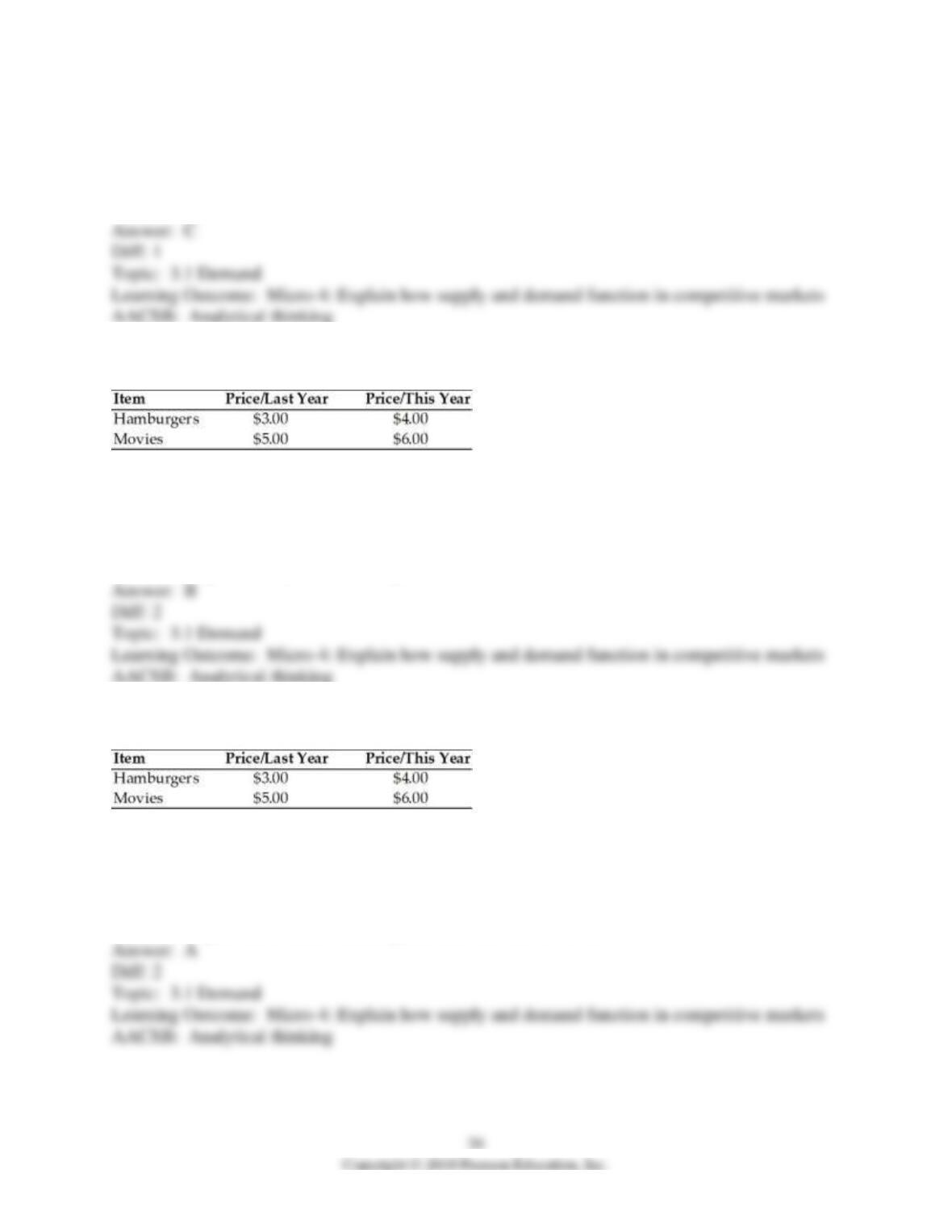
69) Consider the following:
The relative price of movies this year has
A) increased.
B) decreased.
C) stayed the same.
D) Not enough information has been given to calculate an answer.
70) Consider the following:
The relative price of hamburgers this year has
A) increased.
B) decreased.
C) stayed the same.
D) Not enough information has been given to calculate an answer.