102) Which of the following will cause the demand curve for cable TV services to shift to the
left?
A) a rise in the price of cable TV services
B) a decrease in average incomes of cable TV subscribers
C) an increase in population
D) the creation of several hit TV series
103) Which of the following will cause the demand curve for beer to shift right?
A) a fall in the price of beer
B) a fall in average incomes of beer consumers
C) a decline in population
D) a successful advertising campaign linking beer consumption to lower cholesterol
104) Which of the following products are likely to be complementary goods?
A) Coke and Pepsi
B) portable MP3 players and batteries
C) HD-DVDs and Blu-Ray DVDs
D) Domino’s pizza and Papa John’s pizza
105) If a decrease in the price of good A causes a decrease in demand for good B, the two goods
are
A) substitutes.
B) complements.
C) normal.
D) inferior.
62
106) Which one of the following would cause a rightward shift in the demand curve of digital
cameras?
A) Digital cameras become easier to use.
B) The price of digital cameras decreases.
C) Production methods are modified to make production of digital cameras more efficient.
D) Government regulations are imposed to limit the number of digital cameras imported.
107) The Chunnel auto tunnel allows motorists to travel between England and France. As an
alternative, there is ferry service across the English Channel. What would happen in the market
for ferry service if fees for using the Chunnel were increased?
A) The demand for ferry service would increase.
B) The demand for ferry service would decrease.
C) There would be an upward movement along the demand curve for transits through the
Chunnel.
D) There would be a downward movement along the demand curve for transits through the
Chunnel.
108) Which one of the following would cause an increase in the demand for hotel rooms in
Hawaii?
A) an increase in airfares to Hawaii
B) a decrease in airfares to Hawaii
C) an upward movement along the demand curve for stays in Hawaiian hotel rooms
D) a downward movement along the demand curve for stays in Hawaiian hotel rooms
109) What would happen in the market for prescription drugs if people begin to view over-the-
counter remedies as a good substitute for prescription medications?
A) Prescription medications will become an inferior good.
B) There is an upward movement along the demand curve for prescription medications.
C) There is a downward movement along the demand curve for prescription medications.
D) The demand for prescription medications will decrease.
110) Which of the following is a non-price determinant of demand?
A) income
B) tastes and preferences
C) prices of related goods and services
D) All of the above are correct.
111) Which of the following is NOT a non-price determinant of demand?
A) the price of the good or service
B) tastes and preferences
C) expectations of future prices
D) prices of related goods and services
112) Which of the following would cause a change in the quantity demanded of a product?
A) a higher price
B) a higher income
C) expectations of future price increases
D) All of the above are correct.
113) Which of the following would most likely be considered complements?
A) butter and margarine
B) rental cars and taxis
C) plastic wrap and aluminum foil
D) tennis rackets and tennis balls
114) If a good is a normal good, an increase in income will
A) decrease the quantity demanded of the good.
B) increase the demand for the good.
C) cause the demand curve for the good to shift to the left.
D) cause a movement down along the demand curve.
115) All of the following cause a shift in the demand curve EXCEPT a change in the
A) price of related goods.
B) price of the good or service.
C) consumer income.
D) number of consumers.
116) If the price of one good goes up and the demand of a related good goes down, the two
goods are
A) complements.
B) substitutes.
C) inferior goods.
D) normal goods.
117) When income increases, the demand curve for an inferior good
A) shifts to the right.
B) shifts to the left.
C) moves up along the demand curve for the product.
D) remains constant.
118) We know that products A and B are related goods, because when the price of A increases
A) the demand curve for B will shift to the right, because A and B are complementary goods.
B) the quantity of B demanded will shift along its demand curve, because A and B are
complementary goods.
C) the demand curve for B will shift to the left, because A and B are complementary goods.
D) the demand curve for B will remain unchanged because A and B are substitute goods.
119) An increase in the quantity demanded is shown by
A) a leftward shift of the demand curve.
B) a rightward shift of the demand curve.
C) a movement down along a demand curve.
D) a movement up along a demand curve.
120) A movement along a demand curve is
A) a change in demand and can be caused by a change in consumers’ income.
B) a change in the quantity demanded and is caused by a change in the price of the good.
C) a change in the quantity demanded and can be caused by a change in consumers’ income.
D) a change in demand and is caused by a change in the price of the good.
121) Which of the following are complementary goods?
A) sport utility vehicles and gasoline
B) butter and margarine
C) white wine and red wine
D) trucks and sedans
122) Which of the following are substitute goods?
A) margarine and butter
B) peanut butter and jelly
C) pizza and soda
D) trucks and gasoline
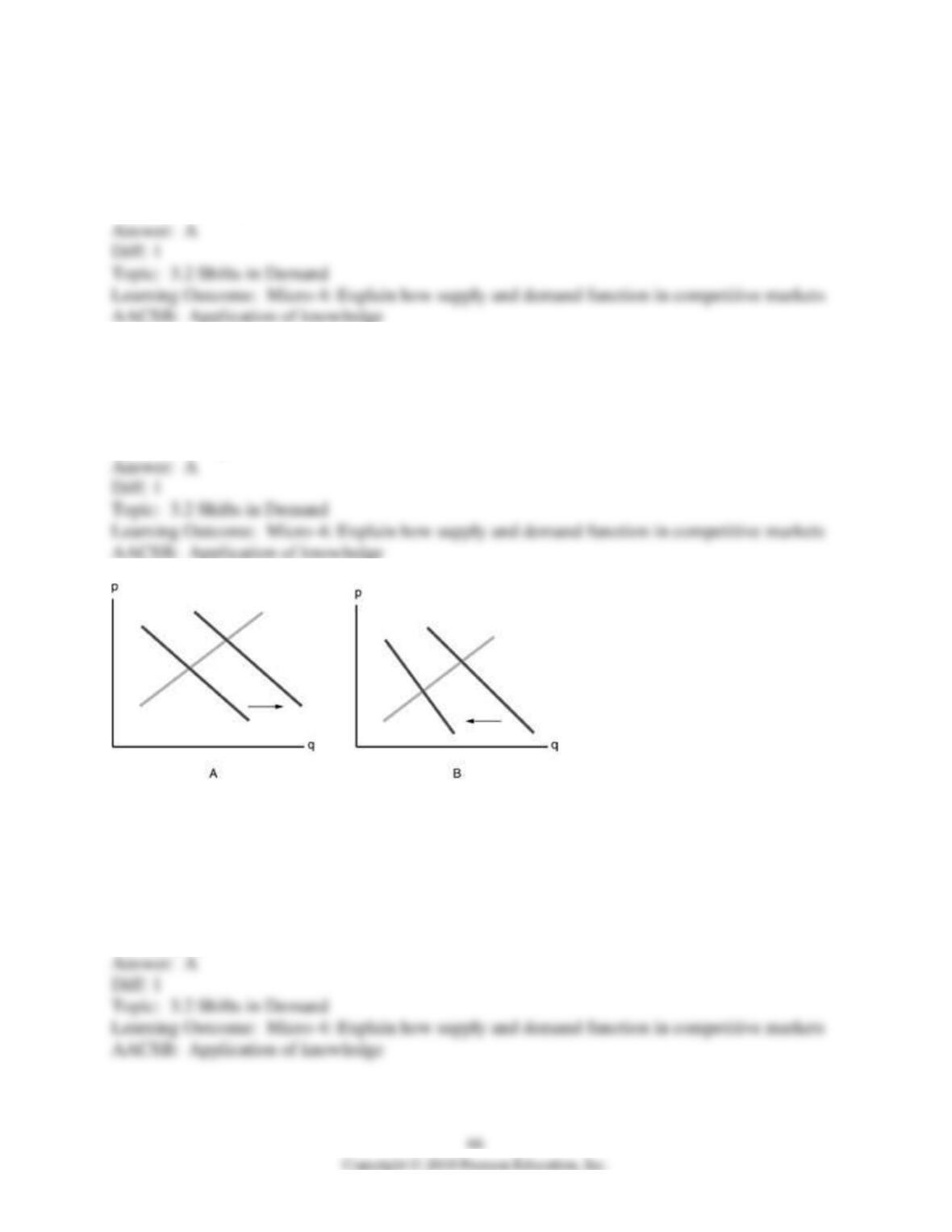
123) Refer to the above figure. Suppose that Cheerios and Apple Jacks are substitutes. Which
diagram shows the effect on the demand for Cheerios when the price of Apple Jacks cereal has
increased?
A) A
B) B
C) neither graph
D) both graphs
124) Refer to the above figure. Suppose that Cheerios and Apple Jacks are substitutes. Which
diagram shows the effect on the demand for Cheerios when the price of Apple Jacks cereal has
decreased?
A) A
B) B
C) neither graph
D) both graphs
125) Refer to the above figure for the market of Cheerios. Which diagram depicts the effect of an
increase in the price of Cheerios?
A) A
B) B
C) neither graph
D) both graphs
126) If the price of margarine falls, the demand for butter will
A) remain unchanged.
B) increase.
C) decrease.
D) rise at first and then fall.
127) If the price of gasoline rises sharply and the demand for trucks falls, then the two goods are
A) complements.
B) normal goods.
C) substitutes.
D) inferior goods.
68
128) If the price of airline travel in Europe falls and the demand for train travel in Europe also
falls, then the two goods are
A) complements.
B) normal goods.
C) substitutes.
D) inferior goods.
129) Here’s what we know about last year’s weekly demand for 2-night DVD rentals in the
Village of Harmony: When P = $3, Qd = 100; at P = $5, Qd = 75; and when P = $7, Qd = 50.
This year the village population has increased by 25%. What impact is this most likely to have?
A) Each individual’s demand for DVD rentals will increase.
B) Each individual’s demand curve for DVD rentals will shift to the left.
C) The market demand curve for DVD rentals shifts left.
D) The market demand for DVD rentals increases.
130) Which of the following is NOT a determinant of demand?
A) consumers’ incomes
B) prices of other goods
C) consumers’ tastes
D) production technology
131) All other factors held constant, when McDonald’s raises the price of its Quarter Pounder by
50 cents,
A) there is likely to be a decrease in the quantity of Taco Bell’s Chalupas demanded, assuming
the Quarter Pounder and Chalupas are substitutes.
B) there is likely to be an increase in demand for Taco Bell’s Chalupas, assuming the Quarter
Pounder and Chalupas are substitutes.
C) there is likely to be a decrease in demand for Taco Bell’s Chalupas, assuming the Quarter
Pounder and Chalupas are substitutes.
D) there is likely to be an increase in demand for McDonald’s Quarter Pounder, assuming the
Quarter Pounder and Chalupas are substitutes.
132) Distinguish between a change in demand and a change in quantity demanded.
133) Briefly discuss the determinants of demand other than price.
134) What is the difference between a normal good and an inferior good? How does this relate to
3.3 Supply
1) The law of supply implies that the supply curve is
A) flat.
B) upward sloping.
C) downward sloping.
D) vertical.
2) If the price of portable power banks increases, then there will be ________ of portable power
banks.
A) a decrease in the supply
B) an increase in the supply
C) an increase in the quantity supplied
D) a decrease in the quantity supplied
3) The law of supply states that other things being equal
A) supply creates its own demand.
B) supply will increase if productivity increases.
C) as price increases, quantity supplied increases.
D) supply will increase to meet demand if demand increases.
4) Other things being equal, the relationship between price and quantity supplied is
A) negative.
B) constant.
C) positive.
D) non-existent.
5) A movement along a supply curve is induced by a change in
A) input prices.
B) taxes and subsidies.
C) price expectations.
D) the product’s own price.
6) The quantity supplied of a particular good is the amount of the good that
A) households are willing to consume at each particular price.
B) firms will actually end up buying at a particular price during a given time period.
C) firms are willing to sell at each price during a particular time period.
D) households want firms to sell at each price during a particular time period.
7) Which of the following represents the law of supply?
A) An increase in the price of a good causes an increase in the supply of that good.
B) An increase in the price of a good causes a rightward shift of the supply curve for that good.
C) An increase in the price of a good causes an increase in the quantity supplied of that good.
D) all of the above
8) An increase in price will lead to an increase in quantity supplied. This statement is
A) the law of supply.
B) the law of demand.
C) untrue always.
D) a normative statement.
9) Which of the following is an example of the law of supply?
A) The price of gum has increased so producers are making more gum.
B) The price of labor has increased and producers decrease supply.
C) The amount of a good purchased increases when the price decreases.
D) Producers provide less of a good when the price increases.
10) According to the law of supply
A) people buy more of a good when the price increases.
B) people buy less of a good when the price decreases.
C) producers provide more of a good when the price decreases.
D) producers provide less of a good when the price decreases.
11) Suppliers will provide more of a good when
A) the market price increases.
B) the good is a normal good.
C) resource prices increase.
D) there is a decrease in demand.
12) A given supply curve illustrates
A) the relationship between price and quantity supplied.
B) the effect of a change in resource costs on quantity supplied.
C) the effect of a change in technology on quantity supplied.
D) the relationship between expected future prices and quantity supplied.
13) The data points on a supply curve come from
A) survey analysis.
B) the same place from which we get the data points on a demand curve.
C) the supply schedule.
D) companies’ annual reports.
14) Other things being equal, an increase in the price of a good leads to an increase in the amount
produced. This is known as
A) the law of demand.
B) the law of supply.
C) ceteris paribus.
D) equilibrium.
15) The direct relationship between changes in price and changes in quantity supplied is
A) a change in supply.
B) shown by a shift in the supply curve.
C) the law of supply.
D) the law of relative production.
74
16) If the price of oil rises, producers of oil will
A) increase the quantity of oil supplied.
B) supply less oil.
C) leave the amount of oil supplied unchanged.
D) cut the price.
17) The law of supply states that there is
A) an inverse relationship between price and technology, ceteris paribus.
B) a direct relationship between profit and quantity supplied, ceteris paribus.
C) no relationship between price of resources and number of suppliers, ceteris paribus.
D) a direct relationship between price and quantity supplied, ceteris paribus.
18) Regarding the law of supply, which of the following statements is correct?
A) As the price of a good or service rises, the quantity supplied will increase.
B) As the price of a good or service rises, the quantity supplied will decrease.
C) The ceteris paribus assumption does not apply.
D) As demand falls, supply rises.
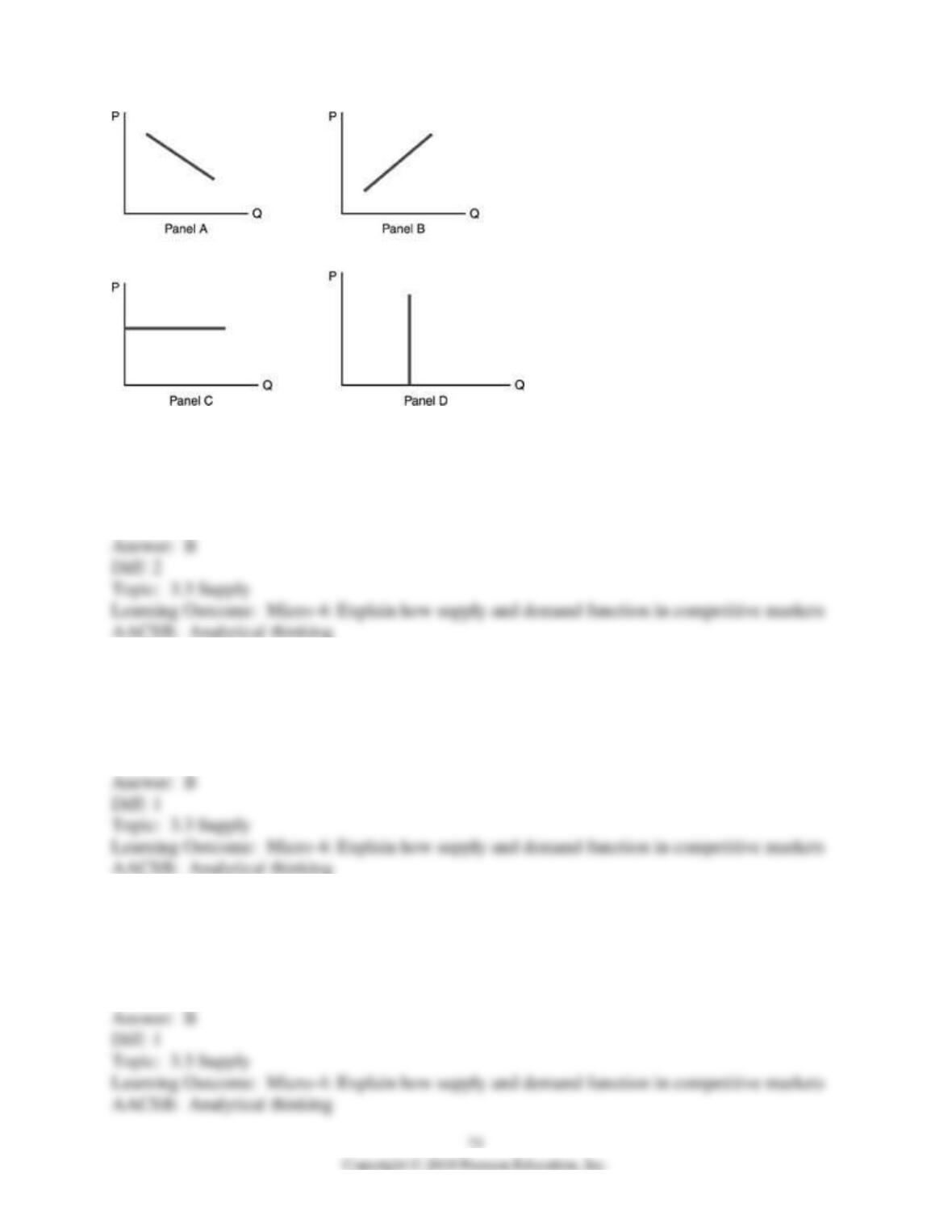
19) Refer to the above figure. Which panel demonstrates the law of supply?
A) Panel A
B) Panel B
C) Panel C
D) Panel D
20) The relationship between quantity supplied and the price of output is such that
A) an increase in quantity will automatically lead to a reduction in price.
B) an increase in price will lead to an increase in quantity supplied.
C) an increase in price will produce an inward shift in the supply curve.
D) quantity will decrease as the number of firms increases.
21) For typical goods, supply curves are
A) downward sloping.
B) upward sloping.
C) horizontal.
D) vertical.
22) Which one of the following statements is FALSE?
A) There is an inverse (negative) relationship between product price and quantity supplied.
B) There is some price at which quantity supplied of a product is zero.
C) As product price increases, producers are willing to put more of the good on the market for
sale.
D) In order to entice producers to offer more of a product on the market for sale, product price
must rise.
23) If the price of a product increases, we would expect
A) the level of demand to decrease.
B) quantity supplied to increase.
C) the level of supply to increase.
D) an increase in quantity demanded.
24) The relationship between quantity supplied and price is usually
A) an inverse relationship.
B) a direct relationship.
C) a negative relationship.
D) impossible to determine.
25) Which of the following statements about a supply curve is FALSE?
A) It shows a direct (positive) relationship between price and quantity supplied.
B) It shows the quantity supplied at each specific price.
C) It typically slopes downward to the right.
D) It has a positive slope.
26) A supply schedule
A) can be used to generate a supply curve.
B) is a table reflecting the inverse relationship between price and quantity supplied.
C) shows what happens to quantity supplied when price is held constant.
D) all of the above.
27) A direct or positive relationship between price and quantity supplied is
A) the market clearing price.
B) a change in demand.
C) a supply curve.
D) a demand curve.
28) A supply curve
A) has an indirect or negative relationship between price and quantity supplied.
B) has a direct or positive relationship between price and quantity supplied.
C) shows the relationship between quantity supplied and income.
D) shows the relationship between complements.
29) Which of the following causes a movement along a supply curve?
A) a change in resource costs
B) a change in technology
C) a change in the price
D) all of the above
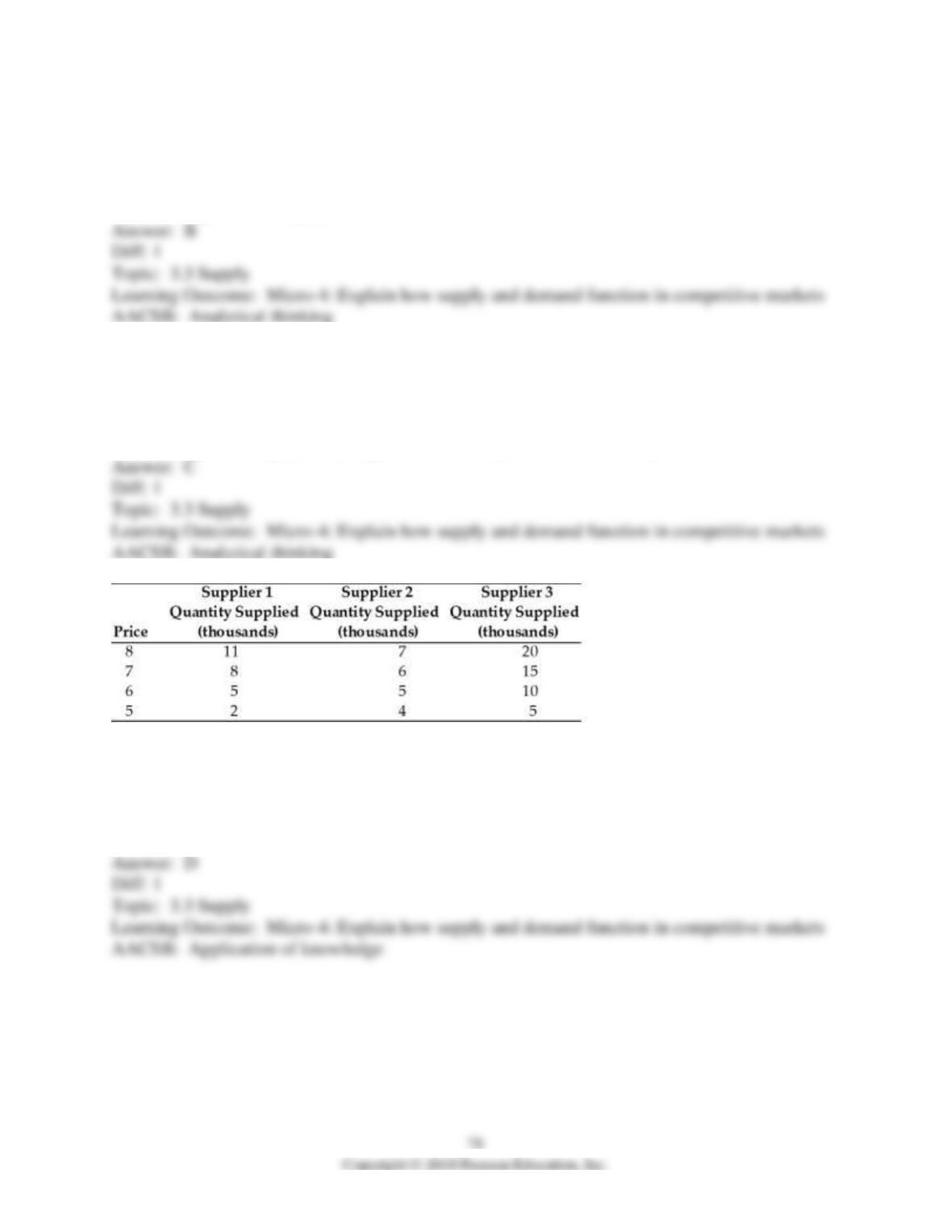
30) Market supply is obtained by
A) summing the amount demanded by individual consumers at various prices.
B) summing the amount supplied by individual producers at various prices.
C) the law of supply.
D) observing how the supply curve shifts.
31) Graphically, the market supply curve is obtained by
A) changing the ceteris paribus conditions.
B) a change in quantity supplied.
C) horizontally summing quantity supplied at various prices for individual producers.
D) vertically summing quantity supplied at various prices for individual producers.
32) Refer to the above table. The market quantity supplied when the price is $6 is
A) 0.
B) 5.
C) 10.
D) 20.
33) Refer to the above table. The market quantity supplied when the price is $7 is
A) 0.
B) 20.
C) 29.
D) 38.
34) The market supply curve is found by
A) plotting the supply curves of individual firms.
B) plotting and summing up the supply curves of individual firms.
C) plotting the supply curves of individual consumers.
D) taking the supply curve of the representative firm.
35) Total market supply can be derived by
A) horizontally summing individual supply curves at each and every price level.
B) vertically summing individual supply curves at the current technology level.
C) adding up the largest quantity demanded at various prices.
D) looking at the changes in the price of raw materials needed to produce the product.
36) The market supply curve can be derived by
A) vertically adding the individual supplies at each quantity level.
B) multiplying the price and quantity supplied at each price level.
C) horizontally adding the individual supplies at each price level.
D) looking at the capacity utilization in the largest firms in the industry.
37) The supply curve has a
A) negative slope.
B) positive slope.
C) slope equal to -1.
D) undefined slope.
38) The supply curve shows the relationship between the
A) cost of production and the price of the product.
B) cost of resources and cost of production.
C) price of the product and quantity supplied.
D) quantity demanded and the quantity supplied.
39) The law of supply includes the statement “other things being equal.” These other things
include all of the following EXCEPT
A) resource prices.
B) technology.
C) producers’ expectations.
D) consumer’s income.
40) Explain why there is a direct relationship between price and quantity supplied.