41) State the law of supply and explain it.
3.4 Shifts in Supply
1) Last year there were 6 pizza shops in town. This year there are only 4. Other things being
equal, the decrease in the number of suppliers will
A) cause the market supply curve to shift to the right.
B) increase the market demand for pizza.
C) cause a decrease in the quantity supplied at each price.
D) have no impact on market supply as long as the demand for pizza remains strong.
2) Other things being equal, an increase in wages paid to workers in firms making portable
power banks will cause
A) the quantity of portable power banks demanded to increase.
B) the quantity of portable power banks supplied to decrease.
C) the supply of portable power banks to decrease.
D) the demand for portable power banks to decrease.
3) Flour is an input used to produce cookies. Suppose that the price of flour rises. As a result
A) the supply curve for flour will shift to the right.
B) the supply curve for flour will shift to the left.
C) the supply curve for cookies will shift to the right.
D) the supply curve for cookies will shift to the left.
4) A technological improvement in the production of tablets would
A) increase the demand for tablets.
B) increase the supply of tablets.
C) decrease the demand for tablets.
D) decrease the supply of tablets.
5) A per-unit government tax on producers of a good tends to
A) reduce the supply of the good.
B) increase the supply of the good.
C) cause an upward movement along the supply curve.
D) not have any effect on the good’s supply.
6) In the long run, the number of firms in an industry may change. If the number of firms
increases, then
A) the supply curve will shift outward to the right.
B) the demand curve will shift outward to the right.
C) the supply curve will shift inward to the left.
D) the demand curve will shift inward to the left.
7) Any improvement in overall production technology that permits more output to be produced
with the same level of inputs causes
A) a movement up the supply curve resulting in both a higher equilibrium price and quantity.
B) a rightward shift of the supply curve so that more is offered at each price.
C) no movement of the supply curve, but a fall in price and a decrease in quantity supplied.
D) a leftward shift of the supply curve so that less is offered for sale at each price.
8) If more foreign steel plants relocate to the United States, we would expect
A) the U.S. supply curve for steel to shift to the right.
B) the U.S. supply curve for steel would shift to the left.
C) that the U.S. steel market would not respond.
D) that U.S. steel demand might change, but U.S. steel supply would remain the same.
9) Which of the following is a determinant of supply?
A) tastes and preferences of consumers
B) technology
C) consumer income
D) number of consumers
10) All of the following will cause a shift in the supply of portable power banks EXCEPT
A) a decrease in the prices of portable power banks.
B) an increase in the cost of producing portable power banks.
C) a per-unit government subsidy on the production of portable power banks.
D) a decrease in the number of portable power bank manufacturers.
11) Which of the following will shift today’s supply curve to the right?
A) Input prices rise.
B) Sales taxes increase.
C) Prices are expected to be higher in the future.
D) Prices are expected to be lower in the future.
12) In general, any ceteris paribus determinant of supply that is favorable to production will
A) cause a movement along the supply curve.
B) shift the supply curve to the right.
C) shift the demand curve to the left.
D) shift the supply curve to the left.
13) Other things being constant, the only way to move along a given supply curve for a product
is for
A) the product’s relative price to change.
B) the future relative price of related goods to change.
C) the number of sellers to change.
D) technological changes to occur.
14) The effects of a per-unit tax imposed on sales of an industry’s product would likely include
A) a lower product price at any amount of the product supplied.
B) a leftward shift of the market supply curve for the product.
C) a leftward movement along the market supply curve for the product.
D) none of the above.
15) If the government imposes a per-unit tax on sales of an industry’s product, then we would
expect
A) the supply curve in that industry would shift to the left.
B) the supply curve in that industry would shift to the right.
C) the demand curve for that industry would shift to the right.
D) the demand curve for that industry would shift to the left.
16) If the price of cotton used in making blue jeans increases, which of the following will occur?
A) There will be a movement along an unchanged supply curve for jeans.
B) The supply curve for jeans will shift rightward.
C) The supply curve for jeans will shift leftward.
D) There will be a rightward shift in the supply curve for jeans, followed by a movement along
the supply curve.
17) Which of the following will cause an outward (rightward) shift in the supply curve?
A) a reduction in the price of the good
B) an increase in the price of labor input
C) an increase in the number of consumers
D) technological progress
18) All of the following will cause the supply curve of good A to shift rightward EXCEPT
A) a reduction in the prices of inputs used to produce good A.
B) an increase in the number of firms in the industry producing good A.
C) a decrease in the per-unit tax on good A which producers must pay.
D) an increase in the market price of good A.
19) How does a change in quantity supplied differ from a change in supply?
A) A change in quantity supplied shifts the supply curve; a change in supply is a movement
along the curve.
B) A change in one of the ceteris paribus conditions affects quantity supplied, not supply.
C) A change in the price affects quantity supplied, not supply.
D) There is no difference.
20) There is a 50 percent decrease in the price of lumber used by a firm that builds new homes.
This causes
A) a decrease in the quantity of new homes supplied.
B) an increase in the supply of new homes.
C) an increase of the quantity supplied of new homes.
D) a decrease in the supply of new homes.
21) Suppose that milk producers expect that the price of milk is going to drop next week. This
would cause
A) a decrease in the supply of milk today.
B) an increase in the supply of milk today.
C) an increase in the demand for milk today.
D) the selling price of milk to rise today.
22) Each of the following would cause an increase in the supply of baseballs EXCEPT
A) an improvement in technology.
B) a decrease in the cost of labor used to produce baseballs.
C) an expectation that the price of baseballs will rise in the future.
D) an increase in the number of baseball producers.
23) Which of the following does NOT cause a rightward shift in the supply curve?
A) a reduction in resource costs
B) an increase in technology
C) a reduction in the price of the good
D) a reduction in the expected future price of the good
24) A change in the price of a good causes
A) an increase in supply.
B) a decrease in supply.
C) an increase in demand and a decrease in supply.
D) a change in quantity supplied.
25) A change in the ceteris paribus conditions for supply will lead to a
A) change in quantity supplied.
B) change in supply.
C) change in quantity supplied and a change in supply.
D) change in how consumers view the quality of the good.
26) An increase in supply will occur when
A) the supply curve shifts downward to the right.
B) the supply curve shifts upward to the left.
C) the demand curve shifts downward to the left.
D) the demand curve shifts upward to the right.
27) A decrease in supply will occur when
A) the supply curve shifts downward to the right.
B) the supply curve shifts upward to the left.
C) the demand curve shifts downward to the left.
D) the demand curve shifts upward to the right.
28) There will be an increase in supply when
A) a consumer’s income increases.
B) there is an improvement in technology.
C) the demand curve shifts.
D) the market price rises from $3 to $4.
29) Which of the following statements is consistent with an increase in supply?
A) The price of labor input has increased.
B) There has been an advance in technology.
C) Consumers’ incomes have increased.
D) The market price has decreased.
30) Which of the following statements is consistent with a decrease in supply?
A) Prices of raw material inputs have increased.
B) There has been an advance in technology.
C) Consumers’ incomes have increased.
D) The market price has decreased.
31) An increase in the price of input used to produce a product will lead to
A) a decrease in the demand for that product.
B) a decrease in quantity supplied of that product
C) a decrease in the supply of that product.
D) an increase in the supply of that product.
32) An increase in the price of steel to car manufacturers will cause
A) the quantity demanded for cars to increase.
B) the demand for cars to decrease.
C) the quantity supplied of cars to increase.
D) the supply curve for cars to shift left.
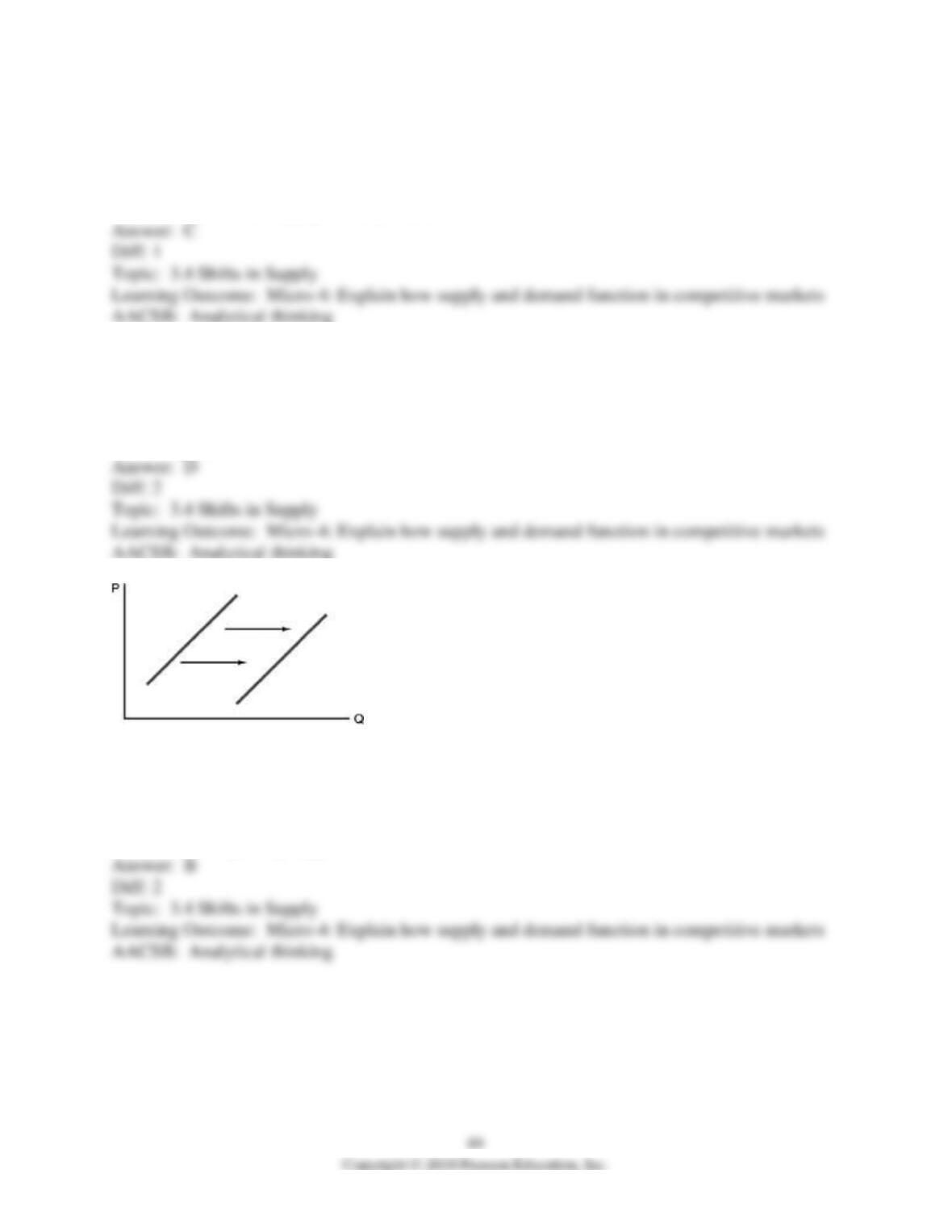
33) Refer to the above figure. The rightward shift of the curve indicates
A) an increase in demand.
B) an increase in supply.
C) a change in quantity demanded.
D) a change in quantity supplied.
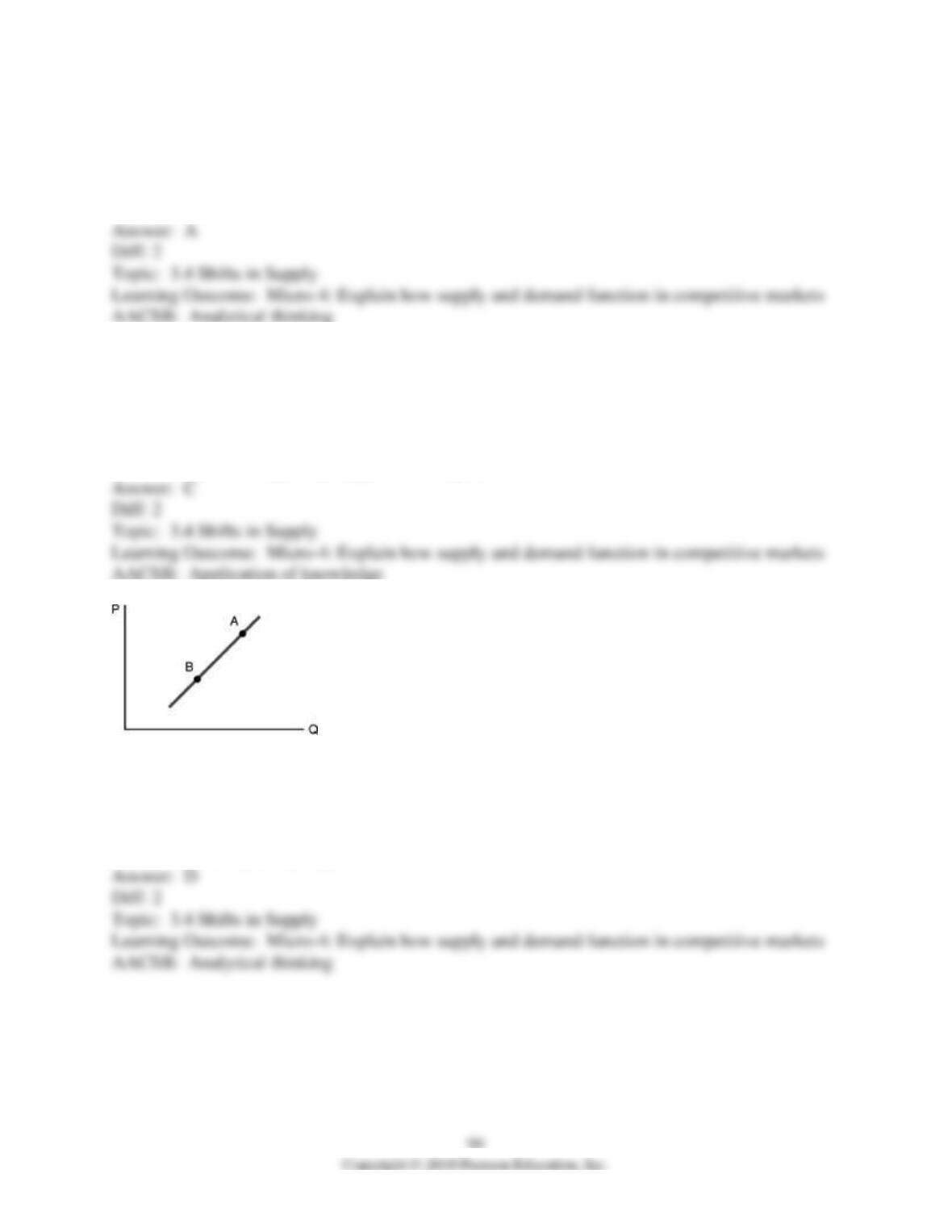
34) Refer to the above figure. The rightward shift of the curve could have been caused by
A) a technological improvement.
B) a technological setback.
C) an increase in income.
D) a decrease in income.
35) Which of the following is a likely result of the dramatic decrease in the price of
microprocessor chips to computer manufacturers in the last two decades?
A) an increase in the demand for computers
B) a decrease in the supply of diskettes
C) an increase in the supply of computers
D) an increase in the quantity supplied of computers
36) Refer to the above figure. Moving from point A to point B indicates
A) an increase in supply.
B) an increase in quantity supplied.
C) a decrease in supply.
D) a decrease in quantity supplied.
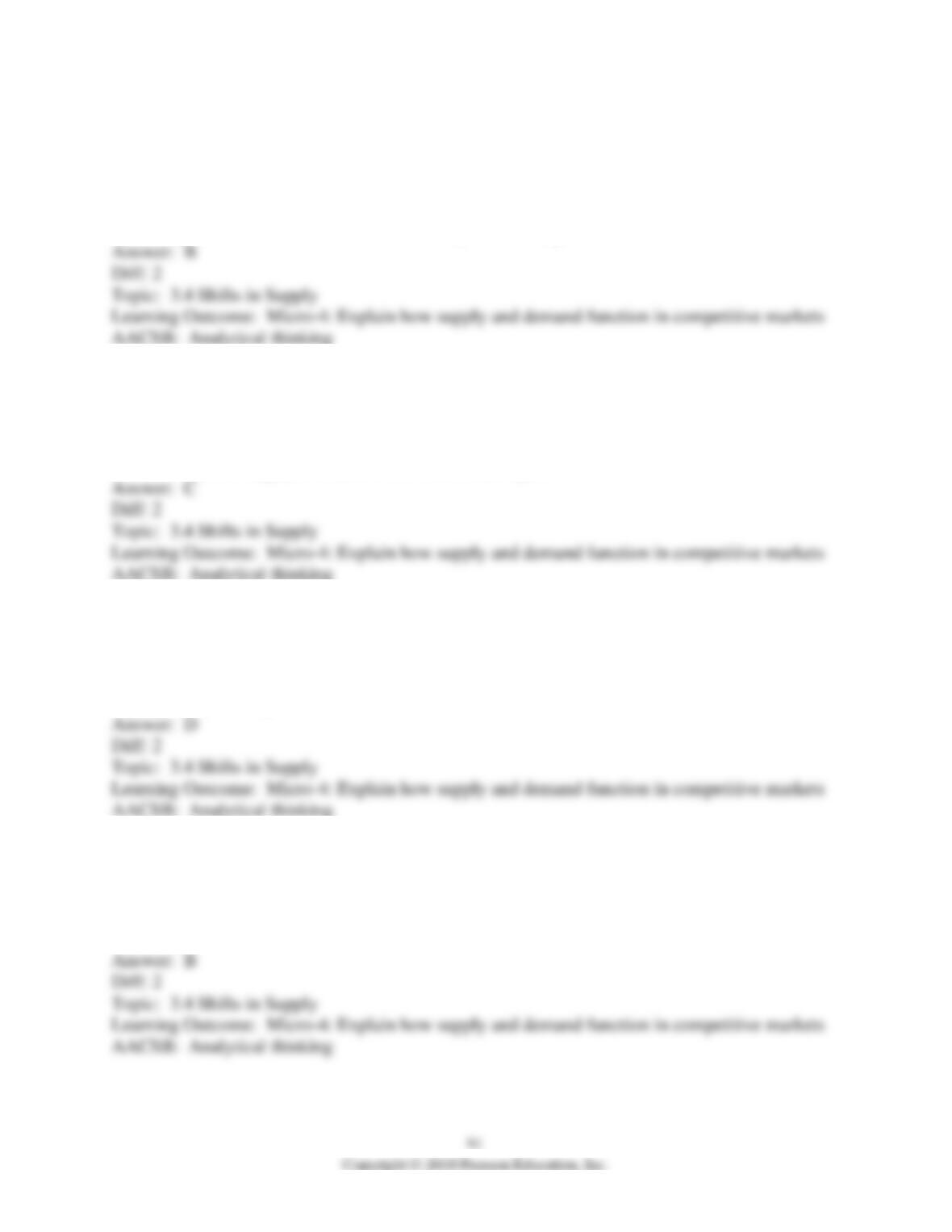
37) Refer to the above figure. A movement from point A to point B for a good is most likely a
result of
A) an increase in the price of that good.
B) a decrease in the price of that good.
C) an expectation of an increase in the relative price of that good.
D) an expectation of a decrease in the relative price of that good.
38) A subsidy to wheat farmers will
A) increase the quantity of wheat demanded.
B) decrease the quantity of wheat supplied.
C) increase the supply of wheat.
D) leave both the supply and demand of wheat unchanged.
39) Which of the following will NOT affect the supply of trucks?
A) an increase in the price of steel
B) an improvement in truck production technology
C) an increase in the productivity of truck factories
D) a decrease in the price of trucks
40) Which of the following is a non-price determinant of supply?
A) the price of related goods consumers may buy
B) technological advances in production
C) consumers’ incomes
D) the number of consumers
41) The supply curve will shift to the left when
A) the supply of the product increases.
B) the demand for the product decreases.
C) some producers leave the industry.
D) the product becomes fashionable.
42) When the price of a good rises, there is
A) an increase in supply.
B) a decrease in supply.
C) a decrease in quantity supplied.
D) an increase in quantity supplied.
43) Which of the following would likely cause an increase in the supply of single-serve coffee
makers?
A) a decrease in the number of consumers demanding single-serve coffee makers
B) an increase in the price of single-serve coffee makers
C) a decrease in the cost of manufacturing single-serve coffee makers
D) a widespread expectation that the price of single-serve coffee makers will rise in the future
44) Which of the following will NOT cause a rightward shift in the supply curve?
A) an improvement in technology
B) a reduction in resource costs
C) a reduction in the expected future price
D) none of the above
45) When producers anticipate that the price of their product will increase in the future
A) the supply curve will shift to the right.
B) the supply curve will shift to the left.
C) the current production will move along on the supply curve.
D) they will immediately lobby Congress to adjust prices now.
46) The imposition of a per unit tax on a product
A) will cause the supply curve to shift downward and to the right.
B) will cause the supply curve to shift upward and to the left.
C) will reduce the quantity supplied of the product.
D) will encourage producers to increase the quantity supplied of the product.
47) Which of the following will NOT cause market supply to increase?
A) an increase in the number of firms supplying the product in the market
B) a change in technology which allows a larger level of production at every price
C) an increase in the costs of resources used to produce the product
D) a decrease in labor costs
48) Which of the following would cause an increase in the market supply of drones?
A) a decrease in the demand for drones
B) an increase in taxes levied on drones
C) an increase in the cost of components used to make drones
D) an increase in the number of firms making drones
49) Which one of the following would cause an increase in the supply of planes?
A) a decrease in the demand for planes
B) an increase in the price of planes
C) an increase in taxes applied to plane producers
D) an improvement in the technology used to produce planes
50) Which of the following will shift the supply curve for laptop computers to the left?
A) development of a cheaper microchip used in laptop computer production
B) a subsidy to the laptop computer industry
C) expectations of a future decline in laptop computer prices
D) a reduction of the number of firms that make laptop computers
51) Which of the following will cause a movement along the supply curve for oil?
A) new technology to drill oil from existing oil wells
B) an increase in the price of oil
C) an increase in the number of oil producers
D) government tax on oil producers in Texas
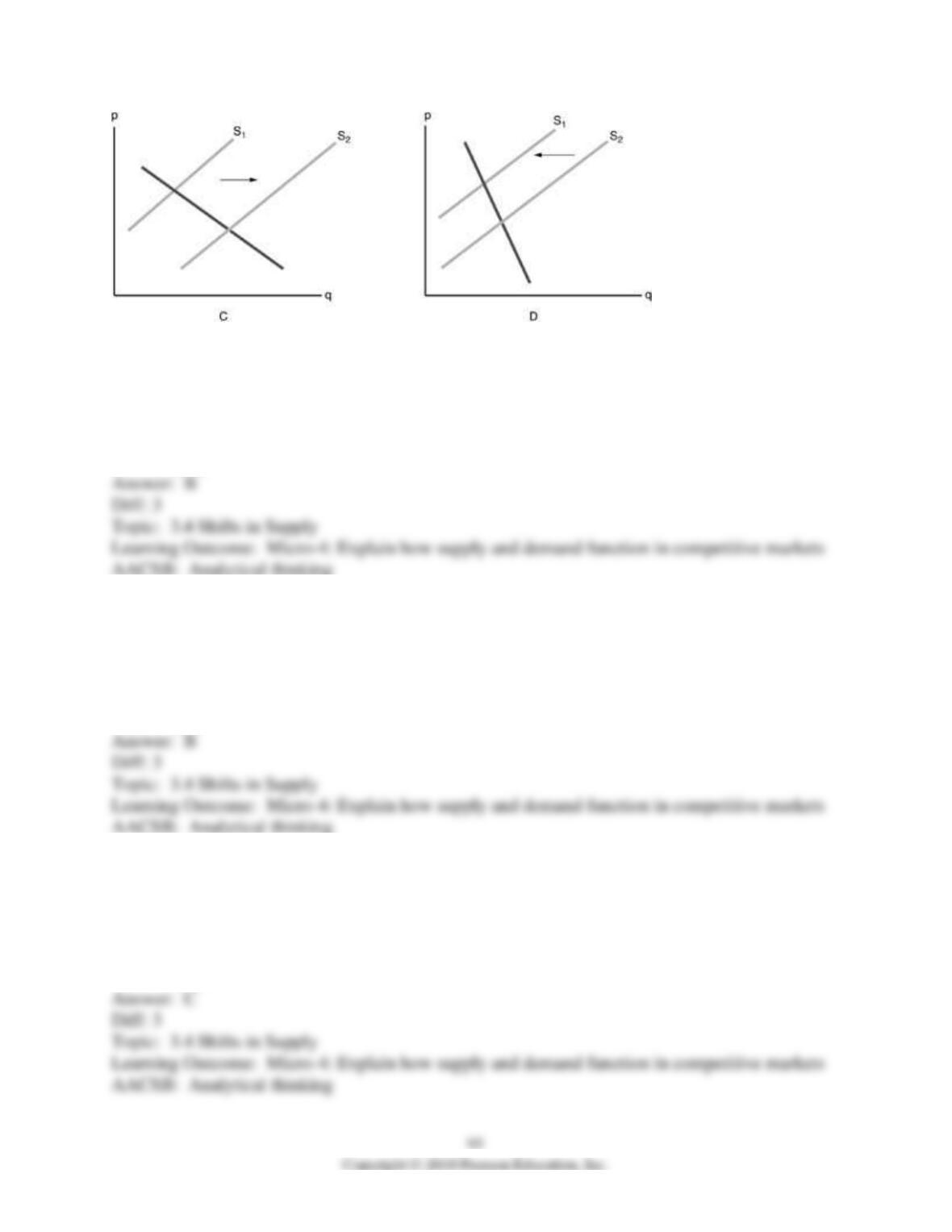
52) Refer to the above figure. Plastic is an input for producing cellphones. Which diagram shows
the effect on the supply of cellphones when the price of plastic has increased?
A) graph C
B) graph D
C) neither graph
D) both graphs
53) Refer to the above figure. Which diagram shows the effect on the market of cellphones when
the demand for cellphones has increased?
A) graph C
B) graph D
C) neither graph
D) both graphs
54) Refer to the above figure. Which diagram shows the effect on the market of cellphones when
the price of plastic has increased?
A) graph C
B) graph D
C) neither graph
D) both graphs
55) If one day a terrible disease were to wipe out over one-half of the orange trees in the United
States, which of the following would likely result?
A) The supply curve of orange juice would shift downward and to the right.
B) The supply curve of orange juice would shift upward and to the left.
C) The demand curve for orange juice would shift to the right.
D) The demand curve for orange juice would shift to the left.
56) Suppose the price of steel goes up in the United States. What happens in the market for
automobiles?
A) Supply shifts upward and to the left.
B) Demand shifts left.
C) Supply shifts downward and to the right.
D) Demand shifts to the right.
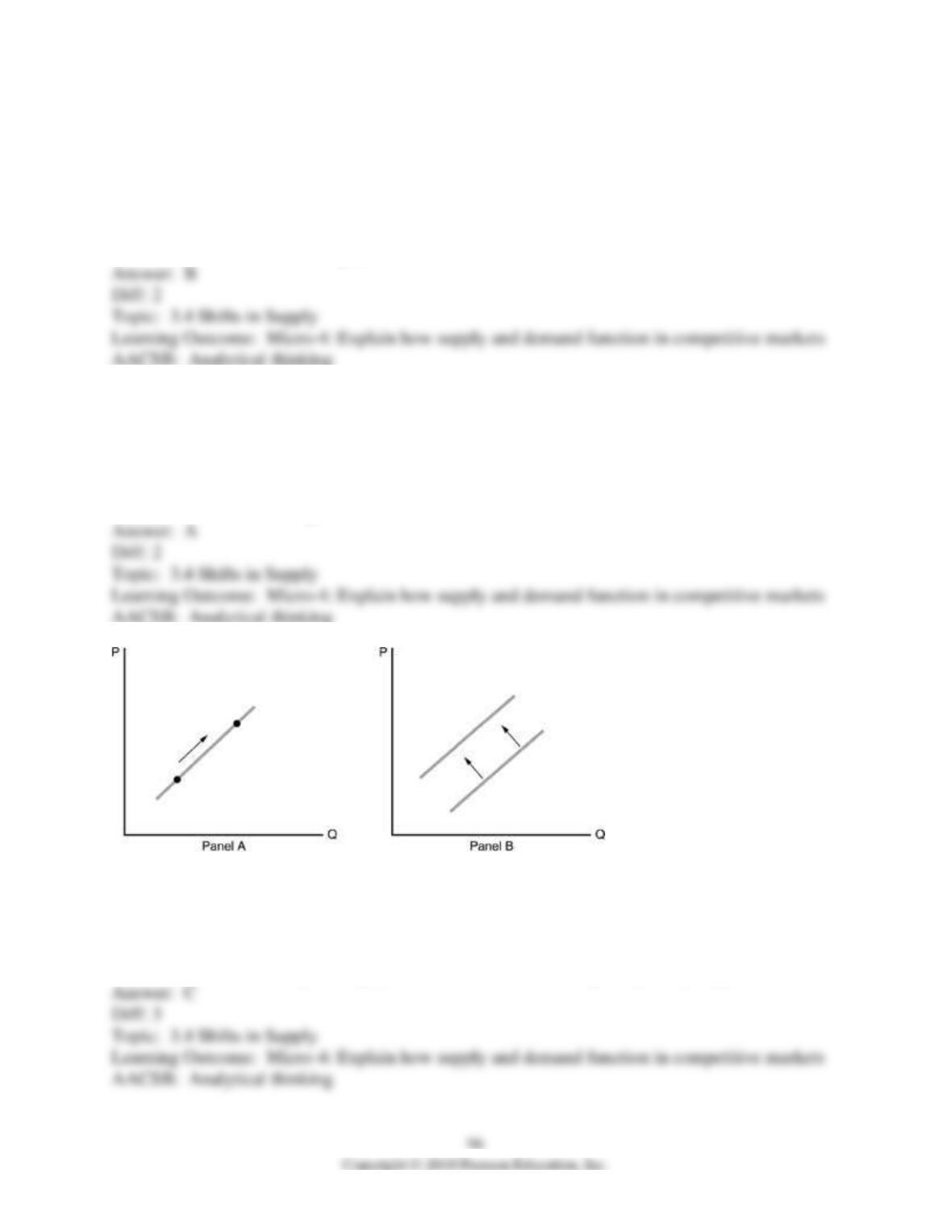
57) Refer to the above figure. Which of the following statements is TRUE?
A) Panel A shows an increase in supply and Panel B shows a decrease in supply.
B) Both Panels A and B show an increase in supply.
C) Panel A shows a change in quantity supplied and Panel B shows a change in supply.
D) Panel A shows a change in supply and Panel B shows a change in quantity supplied.
58) If there is a decline in the price of milk, an input in the production of ice cream, then there
will be a(n)
A) decrease in the supply of ice cream and a leftward shift of the supply curve.
B) decrease in the quantity of ice cream supplied and a movement up along the supply curve.
C) increase in the supply of ice cream and a rightward shift of the supply curve.
D) increase in the quantity of ice cream supplied and a movement down along the supply curve.
59) Which of the following will NOT affect the position of the market supply curve for a good?
A) The government grants a subsidy to the producers for each unit of a good that they produce.
B) The price of the good increases.
C) The number of sellers in the market increases.
D) There is an increase in the prices of the inputs used in production.
60) When the amount supplied is greater at each price, there is a(n)
A) rightward shift in the supply curve.
B) leftward shift in the supply curve.
C) upward movement along the supply curve.
D) downward movement along the supply curve.
61) In order to increase the supply of a good, producers must
A) convince consumers to reduce the quantity demanded.
B) see an increase in quantity supplied by competitors.
C) reduce their per-unit costs of producing the good.
D) cut back on labor to reduce production costs.
62) The market supply curve is found by
A) surveys of consumer groups.
B) vertically summing up the equilibrium prices of individual firms.
C) horizontally summing up the supply curves of individual firms.
D) estimating what the supply curve would be of one huge firm large enough to serve the entire
market.
63) Suppose that because of unseasonably cold weather in Florida, a significant portion of the
orange crop has been lost to freezing temperatures. This statement means that
A) the demand for oranges will rise.
B) the equilibrium quantity of oranges will rise.
C) the amount of oranges available at various prices will decline.
D) the price of oranges will fall.
64) How is the market supply curve found? In what ways is the process similar to the way the
market demand curve is determined? In what ways are they different?
65) Distinguish between a change in quantity supplied and a change in supply.
66) Briefly discuss the determinants of supply other than price.
3.5 Putting Demand and Supply Together
1) According to the above table, at a price of $1 per unit, which of the following would exist?
A) a shortage of 800 units
B) a surplus of 800 units
C) a surplus of 200 units
D) a shortage of 200 units
2) According to the above table, the market clearing (equilibrium) price would adjust to
A) $1.
B) $3.
C) $4.
D) $5.
3) According to the above table, a surplus exists when
A) the price is $1 per unit.
B) the price is $2 per unit.
C) the price is $3 per unit.
D) the price is greater than $3 per unit.
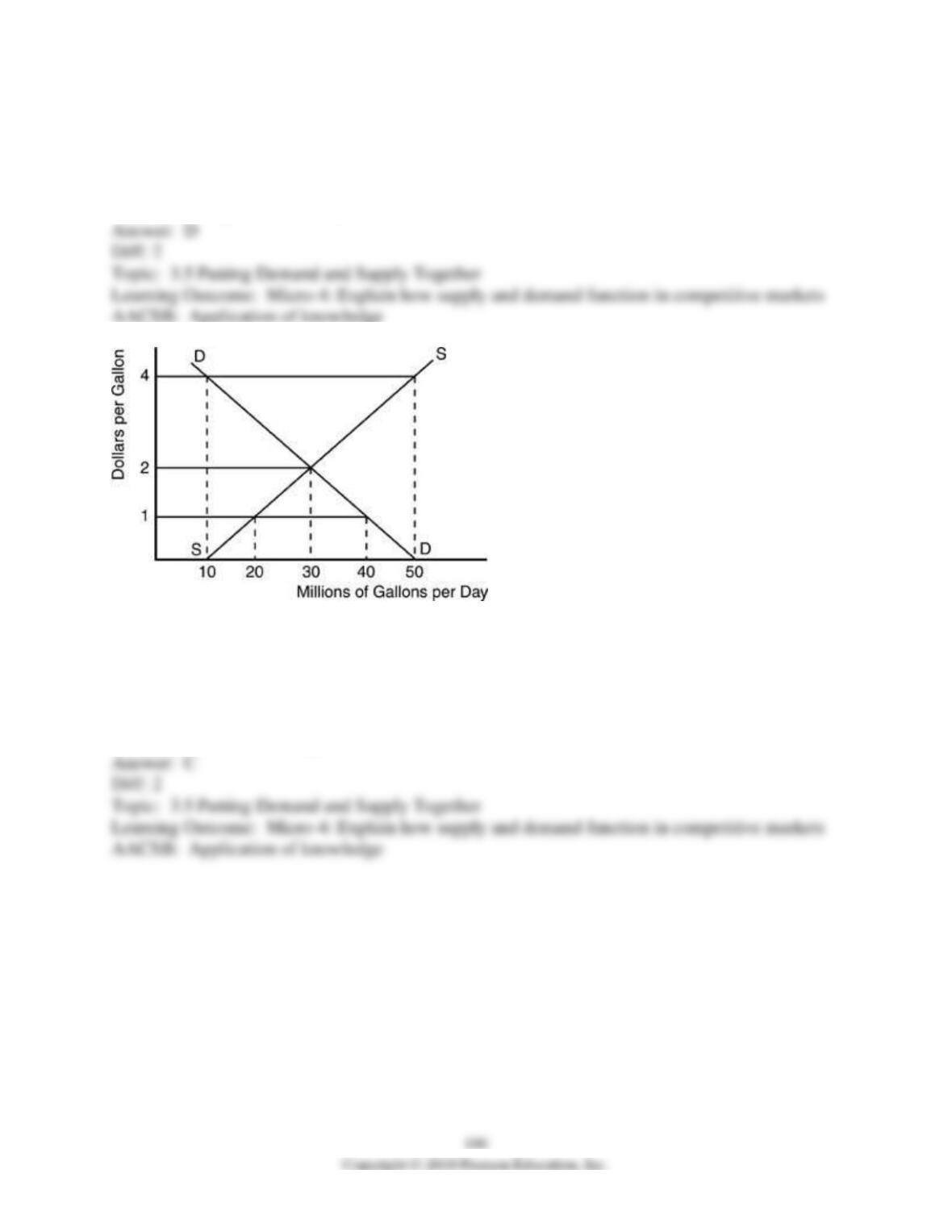
4) According to the above figure for a gasoline market, at a price of $1 per gallon of gasoline,
there would be
A) a shortage of 30 million gallons.
B) a surplus of 30 million gallons.
C) a shortage of 20 million gallons.
D) a surplus of 50 million gallons.