23) Refer to Figure 3-7. Assume that the graphs in this figure represent the demand and supply curves
for mustard and that bratwurst and mustard are complements. What panel describes what happens in
this market when the price of bratwurst falls?
A) Panel (a)
B) Panel (b)
C) Panel (c)
D) Panel (d)
24) Refer to Figure 3-7. Assume that the graphs in this figure represent the demand and supply curves
for coffee. What happens in this market if buyers expect the price of coffee to rise?
A) Panel (a)
B) Panel (b)
C) Panel (c)
D) Panel (d)
25) Refer to Figure 3-7. Assume that the graphs in this figure represent the demand and supply curves
for ramen noodles, an inferior good. Which panel describes what happens in this market as a result of
an increase in income?
A) Panel (a)
B) Panel (b)
C) Panel (c)
D) Panel (d)
26) During the 1990s positive technological change in the production of chicken caused the price of
chicken to fall. Holding everything else constant, how would this affect the market for pork (a
substitute for chicken)?
A) The supply of pork would increase and the equilibrium price of pork would decrease.
B) The demand for pork would decrease and the equilibrium price of pork would decrease.
C) The demand for pork would increase because consumers could afford to buy more chicken and pork.
D) The demand for pork would decrease and the equilibrium price of pork would increase.
27) A decrease in input costs in the production of LCD televisions caused the price of LCD televisions to
decrease. Holding everything else constant, how would this affect the market for video game consoles
(a complement to LCD televisions)?
A) The supply of video game consoles would increase and the equilibrium price of video game consoles
would decrease.
B) The demand for video game consoles would decrease and the equilibrium price of video game
consoles would decrease.
C) The demand for video game consoles would decrease because consumers could afford to buy fewer
LCD televisions and video game consoles.
D) The demand for video game consoles would increase and the equilibrium price of video game
consoles would increase.
28) Assume that both the demand curve and the supply curve for DVD players shift to the left but the
demand curve shifts more than the supply curve. As a result,
A) both the equilibrium price and quantity of DVD players will decrease.
B) the equilibrium price of DVD players will decrease; the equilibrium quantity may increase or
decrease.
C) the equilibrium price of DVD players may increase or decrease; the equilibrium quantity will
decrease.
D) the equilibrium price of DVD players will increase; the equilibrium quantity may increase or
decrease.
29) Assume that both the demand curve and the supply curve for DVD players shift to the left but the
supply curve shifts more than the demand curve. As a result,
A) both the equilibrium price and quantity of DVD players will decrease.
B) the equilibrium price of DVD players will decrease; the equilibrium quantity may increase or
decrease.
C) the equilibrium price of DVD players may increase or decrease; the equilibrium quantity will
increase.
D) the equilibrium price of DVD players will increase; the equilibrium quantity will decrease.
30) Assume that the demand curve for DVD players shifts to the left and the supply curve for DVD
players shifts to the right, but the supply curve shifts more than the demand curve. As a result,
A) both the equilibrium price and quantity of DVD players will decrease.
B) the equilibrium price of DVD players will decrease; the equilibrium quantity may increase or
decrease.
C) the equilibrium price of DVD players may increase or decrease; the equilibrium quantity will
increase.
D) the equilibrium price of DVD players will decrease; the equilibrium quantity will increase.
31) Assume that the demand curve for DVD players shifts to the left and the supply curve for DVD
players shifts to the right, but the supply curve shifts less than the demand curve. As a result,
A) both the equilibrium price and quantity of DVD players will decrease.
B) the equilibrium price of DVD players will decrease; the equilibrium quantity may increase or
decrease.
C) the equilibrium price of DVD players may increase or decrease; the equilibrium quantity will
increase.
D) the equilibrium price of DVD players will decrease; the equilibrium quantity will increase.
63
32) “The price of digital cameras fell because of improvements in production technology. As a result,
the demand for non-digital cameras decreased. This caused the price of non-digital cameras to fall; as
the price of non-digital cameras fell the demand for non-digital cameras decreased even further.”
Evaluate this statement.
A) The statement is false because the demand for non-digital cameras would increase as the price of
digital cameras fell.
B) The statement is false. A decrease in the price of digital cameras would decrease the demand for
non-digital cameras, but a decrease in the price of non-digital cameras would not cause the demand for
non-digital cameras to decrease.
C) The statement is false because it confuses the law of demand with the law of supply.
D) The statement is false because digital camera producers would not reduce their prices as a result of
improvements in technology; doing so would reduce their profits.
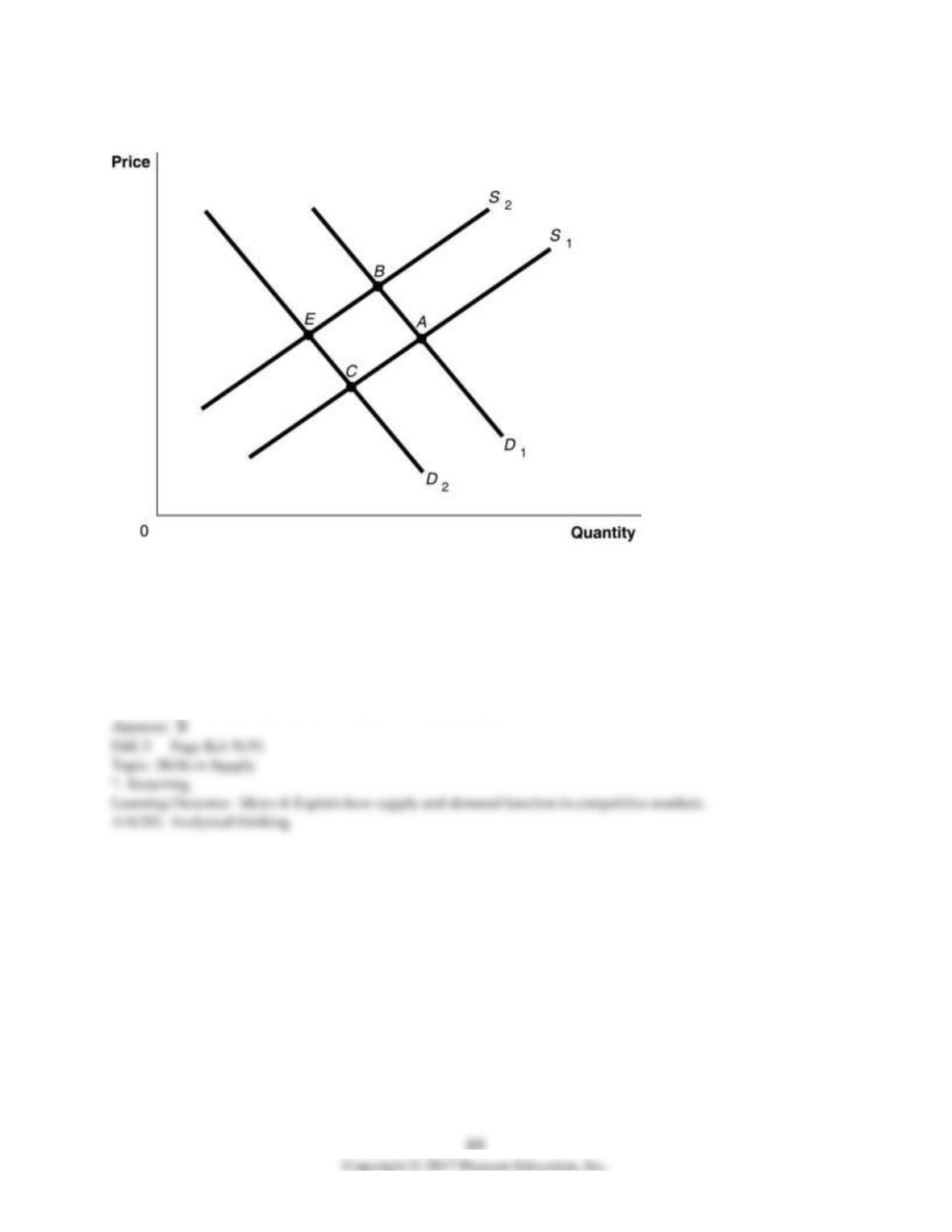
Figure 3-8
33) Refer to Figure 3-8. The graph in this figure illustrates an initial competitive equilibrium in the
market for motorcycles at the intersection of D1 and S1 (point A). If the price of motorcycle engines
increases, and the wages of motorcycle workers increase, how will the equilibrium point change?
A) The equilibrium point will move from A to E.
B) The equilibrium point will move from A to B.
C) The equilibrium point will move from A to C.
D) The equilibrium will first move from A to B, then return to A.
34) Refer to Figure 3-8. The graph in this figure illustrates an initial competitive equilibrium in the
market for motorcycles at the intersection of D2 and S1 (point C). If the price of motorcycle side cars (a
complement to motorcycles) decreases, and the wages of motorcycle workers increase, how will the
equilibrium point change?
A) The equilibrium point will move from C to E.
B) The equilibrium point will move from C to B.
C) The equilibrium point will move from C to A.
D) The equilibrium will first move from C to A, then return to C.
35) Refer to Figure 3-8. The graph in this figure illustrates an initial competitive equilibrium in the
market for motorcycles at the intersection of D2 and S2 (point E). If the technology to produce
motorcycles improves and the number of buyers increases, how will the equilibrium point change?
A) The equilibrium point will move from E to A.
B) The equilibrium point will move from E to B.
C) The equilibrium point will move from E to C.
D) The equilibrium point will remain at E.
36) Refer to Figure 3-8. The graph in this figure illustrates an initial competitive equilibrium in the
market for motorcycles at the intersection of D1 and S1 (point A). If there is a surplus of motorcycles
how will the equilibrium point change?
A) The equilibrium point will move from A to B.
B) The equilibrium point will move from A to C.
C) There will be no change in the equilibrium point.
D) The equilibrium point will move from A to E.
37) Refer to Figure 3-8. The graph in this figure illustrates an initial competitive equilibrium in the
market for motorcycles at the intersection of D2 and S1 (point C). Which of the following changes
would cause the equilibrium to change to point B?
A) A positive change in the technology used to produce motorcycles and decrease in the price of
motorcycle insurance, a complement to motorcycles.
B) An increase in the wages of motorcycle workers and a decrease in the price of motorcycle insurance,
a complement to motorcycles.
C) An increase in the number of motorcycle producers and an increase in the number of consumers who
prefer riding motorcycles.
D) An increase in the wages of motorcycle workers and an increase in the price of motorcycle insurance,
a complement to motorcycles.
38) Refer to Figure 3-8. The graph in this figure illustrates an initial competitive equilibrium in the
market for motorcycles at the intersection of D1 and S1 (point A). If there is an increase in the wages of
motorcycle workers and an increase in the price of motorcycle insurance, a complement to motorcycles,
the equilibrium could move to which point?
A) A
B) B
C) C
D) E
39) Refer to Figure 3-8. The graph in this figure illustrates an initial competitive equilibrium in the
market for motorcycles at the intersection of D1 and S2 (point B). If there is an increase in number of
companies producing motorcycles and a decrease in income (assume motorcycles are a normal good),
the equilibrium could move to which point?
A) A
B) B
C) C
D) E
40) Which of the following statements is true?
A) An increase in demand causes an increase in equilibrium price; the increase in price causes supply to
increase.
B) A decrease in supply causes equilibrium price to rise; the increase in price then results in a decrease
in quantity demanded.
C) If both demand and supply decrease, there must be a decrease in equilibrium price; equilibrium
quantity may either increase or decrease.
D) If demand increases and supply decreases one cannot determine if equilibrium price will increase or
decrease without knowing which change is greater.
41) Which of the following statements is true?
A) A decrease in demand causes a decrease in equilibrium price; the decrease in price causes supply to
decrease.
B) A decrease in demand causes equilibrium price to fall; the decrease in price then results in a decrease
in quantity supplied.
C) If both demand and supply increase, there must be an increase in equilibrium price; equilibrium
quantity may either increase or decrease.
D) If demand decreases and supply increases one cannot determine if equilibrium price will increase or
decrease without knowing which change is greater.
42) An increase in the equilibrium price for a product will result
A) when the quantity of the product demanded exceeds the quantity supplied.
B) when there is a decrease in supply and an increase in demand for the product.
C) when there is a decrease in supply and a decrease in demand for the product.
D) when there is an increase in demand and an increase in the number of firms producing the product.

43) An increase in the equilibrium quantity of a product will result
A) when the quantity of the product supplied exceeds the quantity demanded.
B) when there is an increase in supply and an increase in demand for the product.
C) when there is an increase in supply and a decrease in demand for the product.
D) when there is an decrease in demand and a decrease in the cost of inputs used to make the product.
44) When Toyota introduced its 2010 Prius, it announced that the average retail price of the 2010 model
would be lower than the average retail price was for the equivalent 2009 model. Which of the following
would explain the price differential?
A) The demand for the Prius had increased, and the supply of the Prius remained unchanged.
B) The supply of the Prius had decreased, and the demand for the Prius remained unchanged.
C) The demand for the Prius had decreased, and the supply of the Prius had increased.
D) The demand for the Prius had increased, and the supply of the Prius had decreased.
45) Which of the following would cause an increase in the equilibrium price and decrease in the
equilibrium quantity of watermelon?
A) a decrease in demand and an increase in supply
B) a decrease in supply
C) an increase in demand and an increase in supply greater than the increase in demand
D) an increase in demand and an increase in supply
46) Which of the following would cause a decrease in the equilibrium price and decrease in the
equilibrium quantity of papayas?
A) a decrease in supply and an increase in demand
B) a decrease in demand
C) an increase in supply and an increase in demand greater than the increase in supply
D) a decrease in supply and a decrease in demand
47) Select the phrase that correctly completes the following statement. “A decrease in the number of
manufacturers caused a decrease in the supply of sailboats. As a result,
A) the price of sailboats increased and the demand for sailboats decreased.”
B) the equilibrium quantity of sailboats increased.”
C) the price of sailboats increased and the quantity of sailboats demanded decreased.”
D) the price of sailboats increased. The higher price caused the supply of sailboats to increase.”
48) Select the phrase that correctly completes the following statement. “A decrease in the expected
future price caused an increase in the supply of smartphones. As a result,
A) the price of smartphones decreased and the demand for smartphones increased.”
B) the equilibrium quantity of smartphones decreased.”
C) the price of smartphones decreased and the quantity of smartphones demanded increased.”
D) the price of smartphones decreased. The lower price caused the supply of smartphones to decrease.”
49) What would happen in the market for knee replacement surgery if insurance companies started to
cover a smaller portion of the cost of the surgery?
A) Demand will decrease, but this will not shift the supply curve.
B) Supply will decrease, but this will not shift the demand curve.
C) Demand and supply will both decrease.
D) Demand will decrease and supply will increase.
50) What would happen in the market for knee replacement surgery if insurance companies started to
cover a smaller portion of the cost of the surgery, and fewer doctors decide to enter the field of joint
replacement surgery?
A) Demand will decrease, but this will not shift the supply curve.
B) Supply will decrease, but this will not shift the demand curve.
C) Demand and supply will both decrease.
D) Demand will decrease and supply will increase.
51) Because new plastic and recycled plastic are substitutes, as the price of newly produced plastic
increases,
A) the demand curve for recycled plastic shifts to the left.
B) the demand curve for recycled plastic shifts to the right.
C) there is a movement up along the demand curve for recycled plastic.
D) there is a movement down along the demand curve for recycled plastic.
52) Suppose consumer preference for beef starts to rise while the cost of raising beef continues to rise. In
the market for beef, this would be represented by the equilibrium price ________ and the equilibrium
quantity ________.
A) increasing; increasing or decreasing
B) decreasing; increasing or decreasing
C) increasing or decreasing; increasing
D) increasing or decreasing; decreasing
53) “Because Coke and Pepsi are substitutes, a decrease in the price of Pepsi will cause the demand for
Coke to decrease. This initial shift in demand for Coke results in a lower price for Coke; this lower price
will cause the demand curve for Coke to shift to the left.” Which of the following correctly comments
on this statement?
A) The statement will be true if consumer tastes for Coke and Pepsi do not change.
B) The statement is false because a change in the price of Coke would not change the demand for Coke.
C) The statement is false because Pepsi is an inferior good; Coke is a normal good.
D) The statement is false because one cannot assume that Coke and Pepsi are substitutes for all
consumers.
54) All else equal, an increase in the price of complementary products for the Apple Watch, such as
Sensoria’s wearable technology, would
A) shift the supply curve for the Apple Watch to the right.
B) shift the supply curve for the Apple Watch to the left.
C) shift the demand curve for the Apple Watch to the right.
D) shift the demand curve for the Apple Watch to the left.
55) Suppose a drought resulted in a major reduction in the California lettuce crop. In the market for
lettuce,
A) the supply curve shifted to the left resulting in an increase in the equilibrium price.
B) the supply curve shifted to the left resulting in a decrease in the equilibrium price.
C) the demand curve shifted to the right resulting in an increase in the equilibrium price.
D) the demand curve shifted to the left resulting in a decrease in the equilibrium price.
56) Studies have shown that smoking cigarettes can cause heart disease. Assume this is true, and
favorable weather has increased the tobacco harvest in North Carolina. In the market for cigarettes,
these two developments would
A) decrease demand and decrease supply, resulting in an increase in the equilibrium quantity and a
decrease in the equilibrium price of cigarettes.
B) increase demand and increase supply resulting in an increase in the equilibrium quantity and an
uncertain effect on the equilibrium price of cigarettes.
C) decrease demand and increase supply, resulting in a decrease in the equilibrium price and an
uncertain effect on the equilibrium quantity of cigarettes.
D) decrease demand and increase supply, resulting in an increase in both the equilibrium price and the
equilibrium quantity of cigarettes.
57) An increase in the demand for LED light bulbs due to changes in consumer tastes, accompanied by
an increase in the supply of LED light bulbs as a result of government subsidies, will result in
A) an increase in the equilibrium quantity of LED light bulbs and no change in the equilibrium price.
B) an increase in the equilibrium price of LED light bulbs and no change in the equilibrium quantity.
C) an increase in the equilibrium price of LED light bulbs; the equilibrium quantity may increase or
decrease.
D) an increase in the equilibrium quantity of LED light bulbs; the equilibrium price may increase or
decrease.
58) Suppose a positive technological change in the production of disease-resistant corn caused the price
of corn to fall. Holding everything else constant, how would this affect the market for wheat (a
substitute for corn)?
A) The supply of wheat would increase and the equilibrium price of wheat would decrease.
B) The demand for wheat would decrease and the equilibrium price of wheat would decrease.
C) The demand for wheat would increase because consumers could afford to buy more wheat and corn.
D) The demand for wheat would decrease and the equilibrium price of wheat would increase.
Article Summary
More than a million Americans are estimated to have gone to other countries in 2014 for medical
procedures. Documentary filmmaker Morgan Spurlock was among those Americans who travelled
abroad in 2014 to partake in what is being referred to as “medical tourism”. From his own experience
and those of others who had also travelled for medical procedures, Spurlock found that there can be
distinct advantages to medical tourism for certain patients and procedures. Those advantages
include: The level of care offered in many hospitals, with the best hospitals reportedly meeting or
exceeding Western standards; Significantly lower costs, examples of which include a heart bypass
operation in the United States that typically runs $88,000 can cost as little as $31,500 in Costa Rica,
and hip replacement surgery that averages $33,000 domestically is only $12,400 in Thailand; The
ability to combine medical procedures with vacations to amazing locations around the globe.
Source: Sean Redlitz, ” Surf, sand … and surgery? Inside the world of medical tourism,” cnn.com,
February 6, 2015
59) Refer to the Article Summary. Assume that foreign governments begin to publicize their existing
medical services to American medical tourists and more Americans consider hip-replacement surgery
to improve their quality of life. What will happen in the market for hip-replacement surgery as a result
of these two factors?
A) Demand will increase, but these two factors will not shift the supply curve.
B) Supply will increase, but these two factors will not shift the demand curve.
C) Demand and supply will both increase.
D) Demand will increase and supply will decrease.
60) If the demand for a product increases and the supply of the same product decreases, the equilibrium
price will increase.
61) If the demand for a product decreases and the supply of the same product increases, the equilibrium
quantity will increase.
62) As the number of firms in a market increases, the supply curve will shift to the left and the
equilibrium price will rise.
63) As the number of firms in a market decreases, the supply curve will shift to the left and the
equilibrium price will fall.
64) If the population increases and input prices increase, the equilibrium price of a product will
definitely increase.
65) If the number of firms producing electric cars increases and consumer preference for electric cars
increases, the equilibrium quantity of electric cars will definitely increase.
66) If the demand for a product decreases and the supply of the product does not change, equilibrium
price and equilibrium quantity will both increase.
67) If the demand curve for a product shifts to the right and the supply curve for the product shifts to
the left, equilibrium price and equilibrium quantity will both increase.
68) Discuss the correct and incorrect economic analysis in the following statements.
“If a disease kills a large number of turkeys, the supply of turkeys will decrease. This will result in a
price increase, which will then cause the supply of turkeys to increase.”
69) If pilots and flight attendants agree to wage and benefit reductions in the wake of the financial
difficulties in the airline industry, what impact would this have on the supply and demand in the
market for airline service, assuming no other changes take place in this market?
70) In most countries in South America, the legal driving age is 18. If the legal driving age in the United
States was raised from 16 to 18, how would this affect the market for new and used automobiles? What
would happen to the equilibrium price and quantity of new and used automobiles?
71) Shrimp is an increasingly popular part of the American diet. Louisiana shrimpers who represent the
bulk of the U.S. industry were almost all put out of business by Hurricane Katrina. How did this affect
the equilibrium price and quantity of shrimp?
72) In each of the following situations, list what will happen to the equilibrium price and the
equilibrium quantity for a particular product, which is an inferior good.
a. The population decreases and productivity increases
b. Income increases and the price of inputs increase
c. The number of firms in the market decreases and income decreases
d. Consumer preference decreases and the price of a complement increases
e. The price of a substitute in consumption increases and the price of a substitute in production
increases
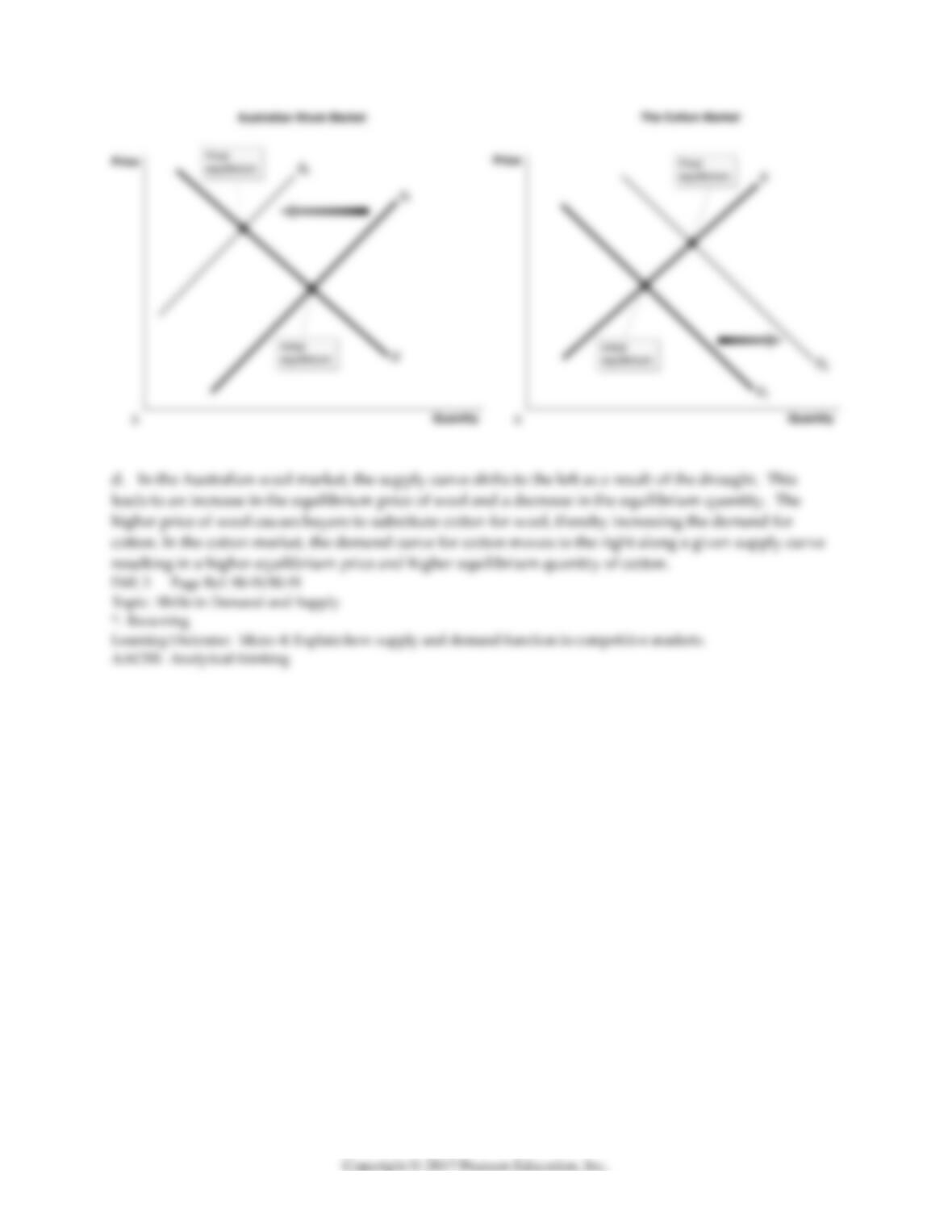
73) According to the Australian Wool Innovation, severe drought conditions in Australia contributed to
the lowest level of wool production in 50 years. This record low production has driven up prices
sharply in Australian wool markets. Meanwhile, the price of raw cotton increased significantly for the
first time in many years.
a. Illustrate this observation with one demand and supply graph for the market for Australian wool
and another demand and supply graph for raw cotton.
b. Make sure that your graphs clearly show (1) the initial equilibrium before the decrease in the
supply of Australian wool and (2) the final equilibrium.
c. Use arrows to indicate any shifts in the demand and supply curves for each market.
d. Label your graphs fully and write an explanation of your work.
77