5) According to the above figure for a gasoline market, what happens when the price per gallon
of gasoline jumps from $1 to $4?
A) A gasoline surplus is replaced by a gas shortage.
B) The market moves from a shortage of 40 million gallons/day to a surplus of 50 million
gallons/day.
C) The market shortage is replaced by market equilibrium.
D) A surplus of 40 million gallons/day results.
6) In a free market, the market price and quantity in the above figure will adjust to equilibrium
values of
A) $1 per gallon and 50 million gallons.
B) $4 per gallon and 10 million gallons.
C) $2 per gallon and 60 million gallons.
D) $2 per gallon and 30 million gallons.
7) According to the above figure for a gasoline market, an increase in the price from $2 to $4
will result in
A) a shortage of 30 million gallons.
B) an increase in quantity demanded of 10 million gallons.
C) an increase in quantity supplied of 20 million gallons.
D) an increase in demand of 20 million gallons.
8) In the above figure, a surplus exists in the gasoline market when the price is
A) $1/gallon.
B) $2/gallon.
C) $4/gallon.
D) below $2/gallon.
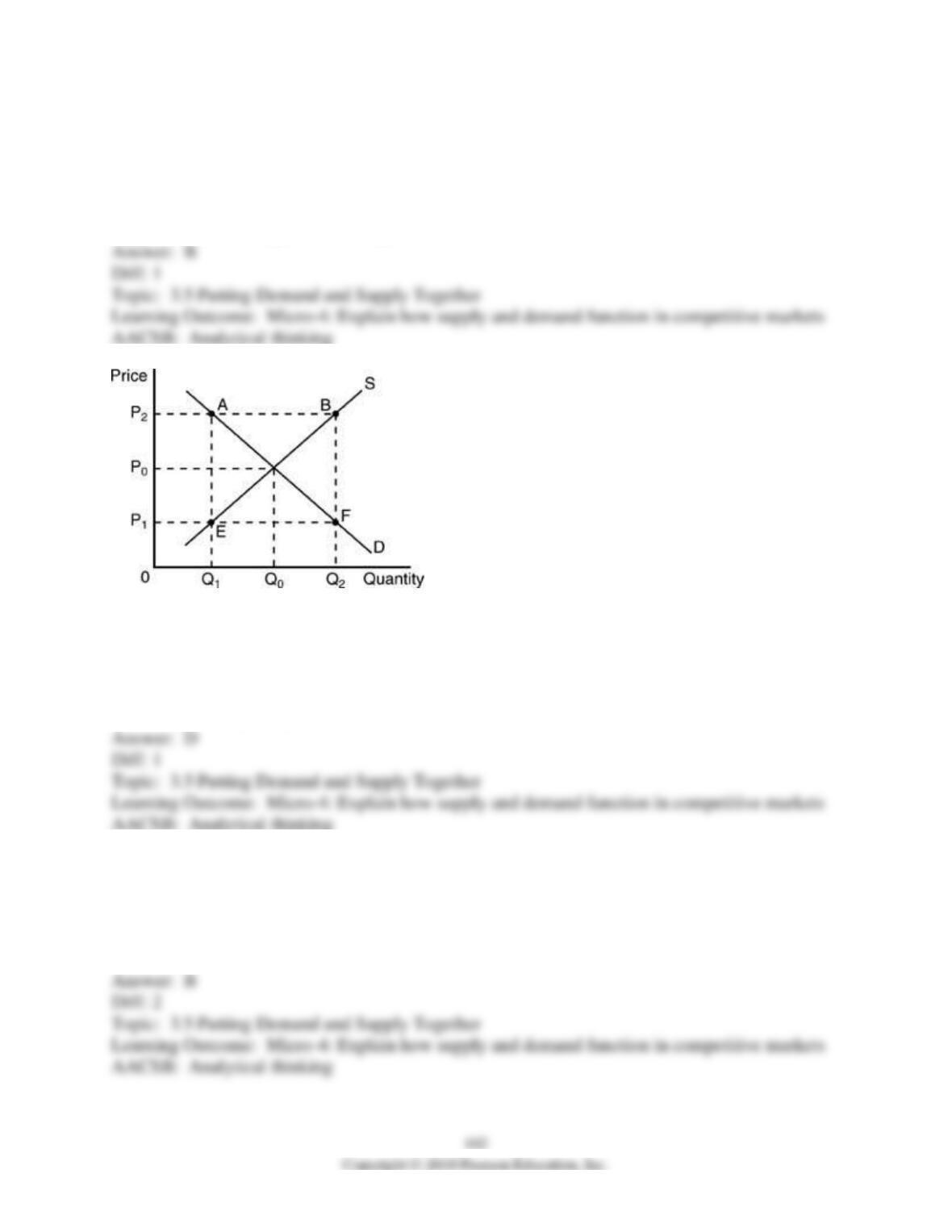
9) According to the above figure, a shortage will occur at a price at which
A) quantity demanded equals quantity supplied.
B) quantity demanded exceeds quantity supplied.
C) quantity supplied exceeds quantity demanded.
D) government sets a price above equilibrium.
10) At a price of P0 in the above figure, which of the following statements is FALSE?
A) Quantity demanded equals quantity supplied.
B) There is an equilibrium in the market.
C) P0 is the market clearing price.
D) There is a surplus equal to Q0.
11) If the market price falls from P0 to P1 in the above figure, then
A) a new equilibrium quantity is established.
B) there is a shortage equal to the distance EF.
C) there will be a further tendency for price to fall.
D) there is a surplus of goods on the market equal to the distance Q1, Q2.
103
12) If the market price rises from P0 to P2 in the above figure, then there is a
A) surplus equal to the distance Q0, Q2.
B) surplus equal to the distance Q1, Q2.
C) shortage equal to the distance Q0, Q2.
D) shortage equal to the distance Q1, Q2.
13) Refer to the above figure. The highest price that consumers would be willing to pay for
quantity Q2 is
A) P2.
B) P0.
C) P1.
D) cannot be determined from the diagram.
14) Refer to the above figure. Other things being equal, if price is at P2, then we would expect
A) price to decline until an equilibrium is achieved at P0.
B) consumers to reduce their offering price for the good.
C) an excess quantity demanded to occur.
D) consumers to bid against each other for goods and force the price still higher.
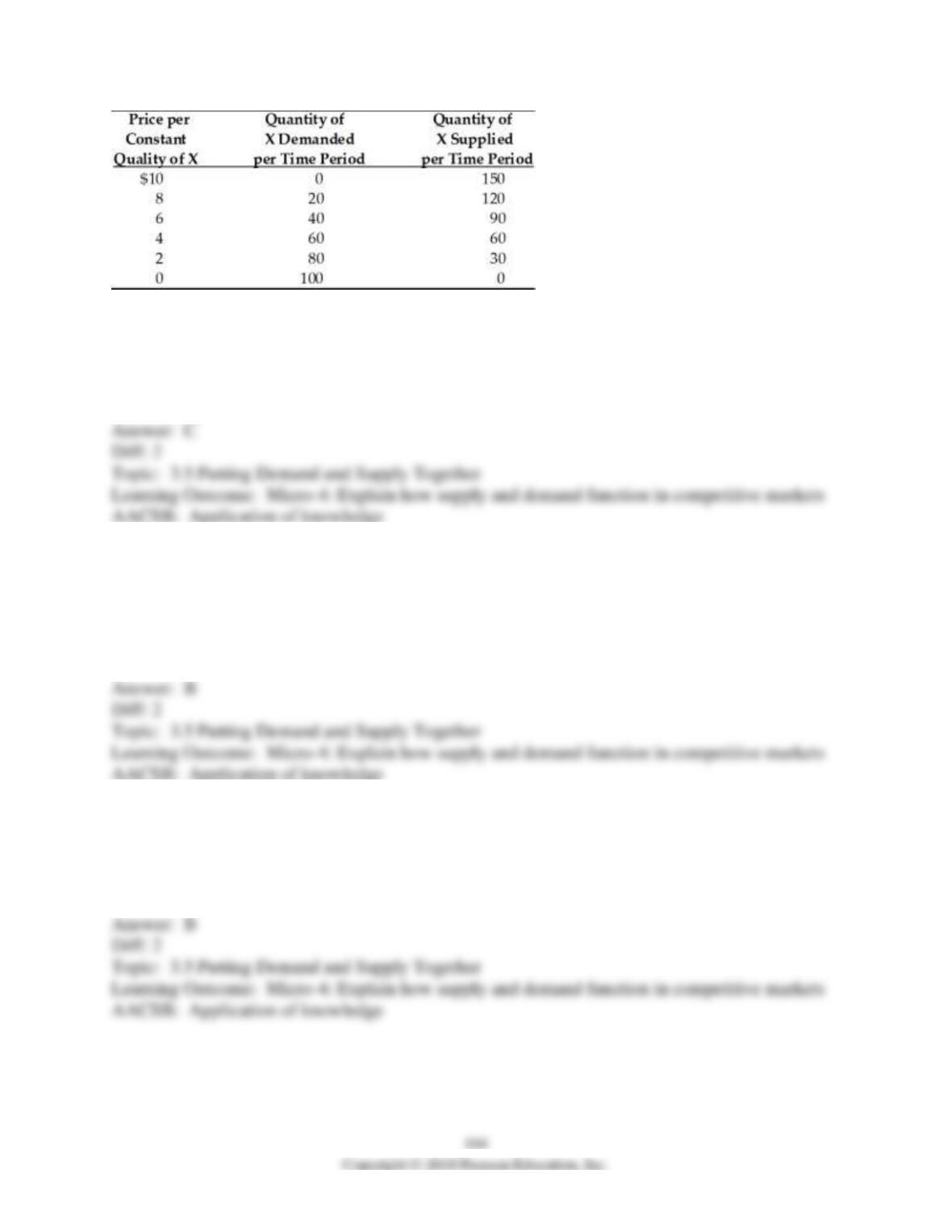
15) According to the above table, at a price of $8 per unit, other things constant
A) consumers will continue to bid prices upward.
B) there will be no tendency for the market to approach an equilibrium.
C) a surplus of 100 units will exist.
D) a shortage of 80 units will exist.
16) According to the market data for good X in the above table, a stable equilibrium price is
established at
A) $2.
B) $4.
C) $6.
D) $8.
17) Given the market data for good X in the above table, an equilibrium quantity is established at
A) 90 units.
B) 60 units.
C) 30 units.
D) 120 units.
18) In any given market, prices are determined by
A) specialization of labor.
B) transactions costs.
C) supply and demand.
D) comparative advantage.
19) The equilibrium or market clearing price occurs at the point at which
A) quantity demanded equals quantity supplied.
B) the supply curve intersects the horizontal axis.
C) the demand curve intersects the vertical axis.
D) there is a shortage of the desired good.
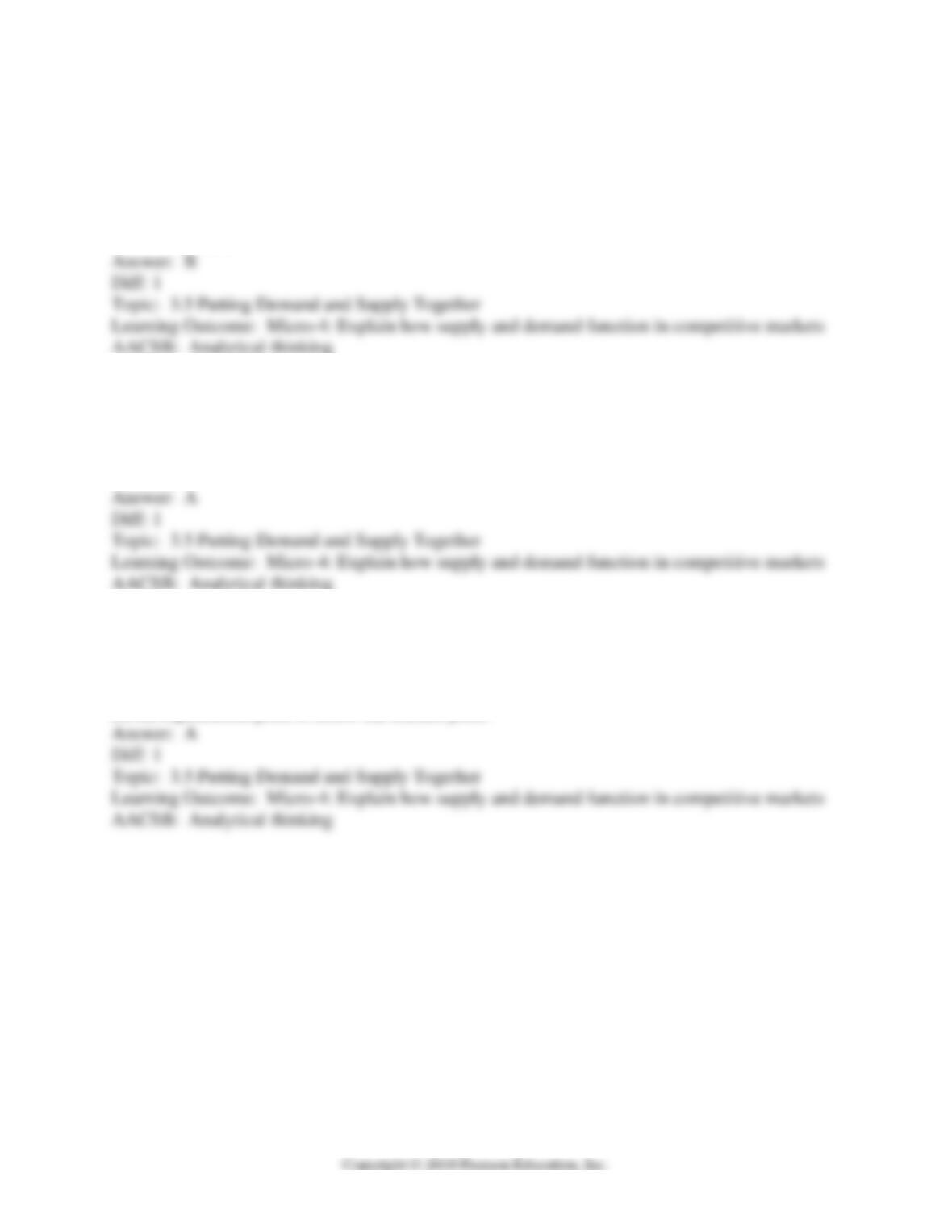
20) According to the above figure, a shortage is shown between which two points?
A) A and E
B) C and B
C) A and B
D) E and F
106
21) Using the above figure, at which price is there neither excess quantity demanded nor excess
quantity supplied?
A) P1
B) P2
C) P3
D) none of these
22) At a market clearing price
A) the quantity demanded will just equal the quantity supplied.
B) there will be an excess quantity demanded.
C) there will be a tendency for price to rise over time.
D) the demand function will shift outward.
23) A market is in equilibrium when
A) the quantity demanded equals the quantity supplied at the market clearing price.
B) the horizontal axis crosses the vertical axis.
C) buyers do not desire for the price to be any lower.
D) the equilibrium price is below the market price.
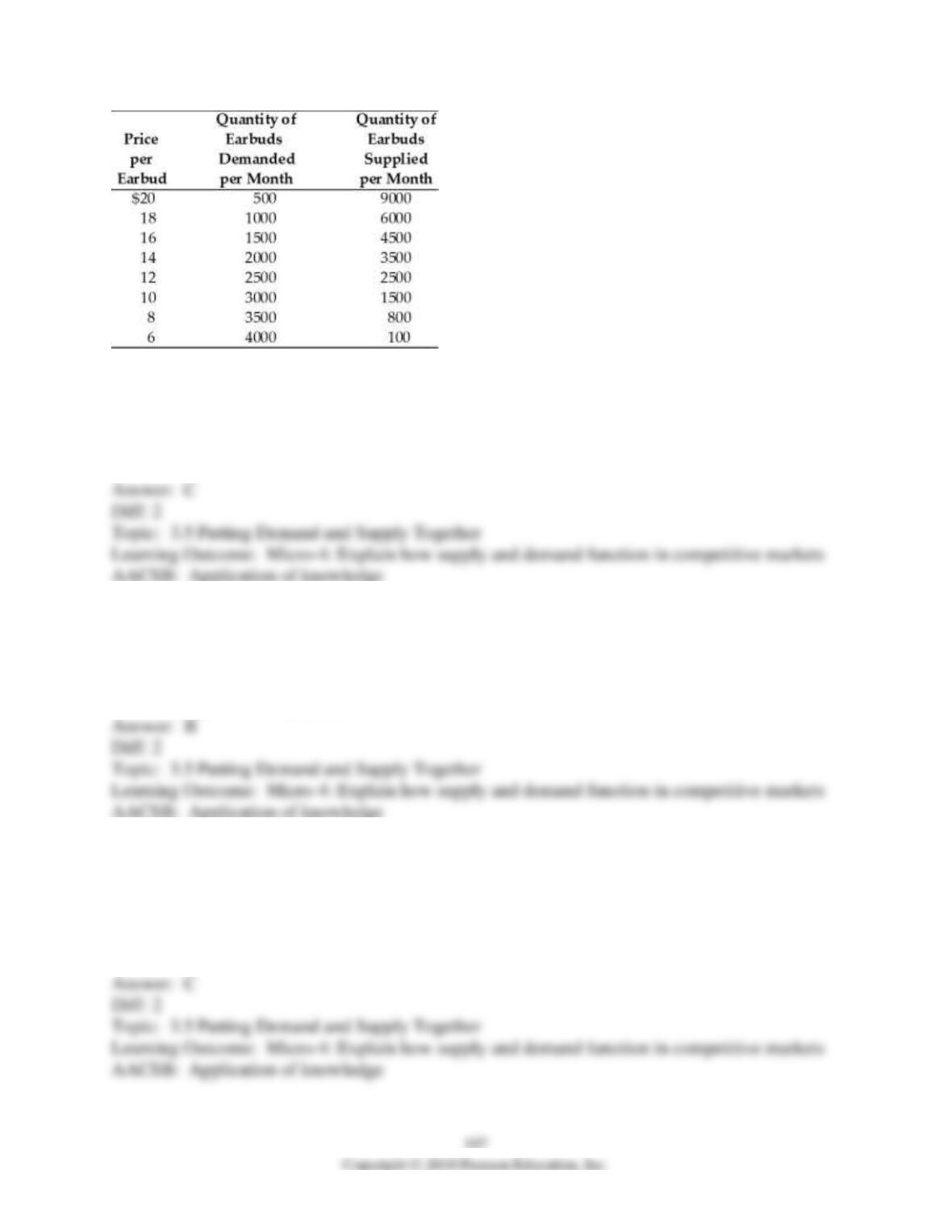
24) According to the above table, the equilibrium price of earbuds is
A) $16.
B) $14.
C) $12.
D) $10.
25) According to the above table, at a price of $16 per earbud, there is
A) an equilibrium.
B) a surplus of 3000 earbuds.
C) a shortage of 3000 earbuds.
D) a shortage of 1500 earbuds.
26) According to the above table, there is an excess quantity demanded of 1500 earbuds at the
price
A) $14.
B) $12.
C) $10.
D) $8.
108
27) Refer to the above table about a free market of earbuds. When the quantity demanded is 3000
earbuds and the quantity supplied is 1500 earbuds, the market price of earbuds will likely
A) decrease to $8.
B) decrease to $6.
C) increase to $12.
D) stay unchanged at $10.
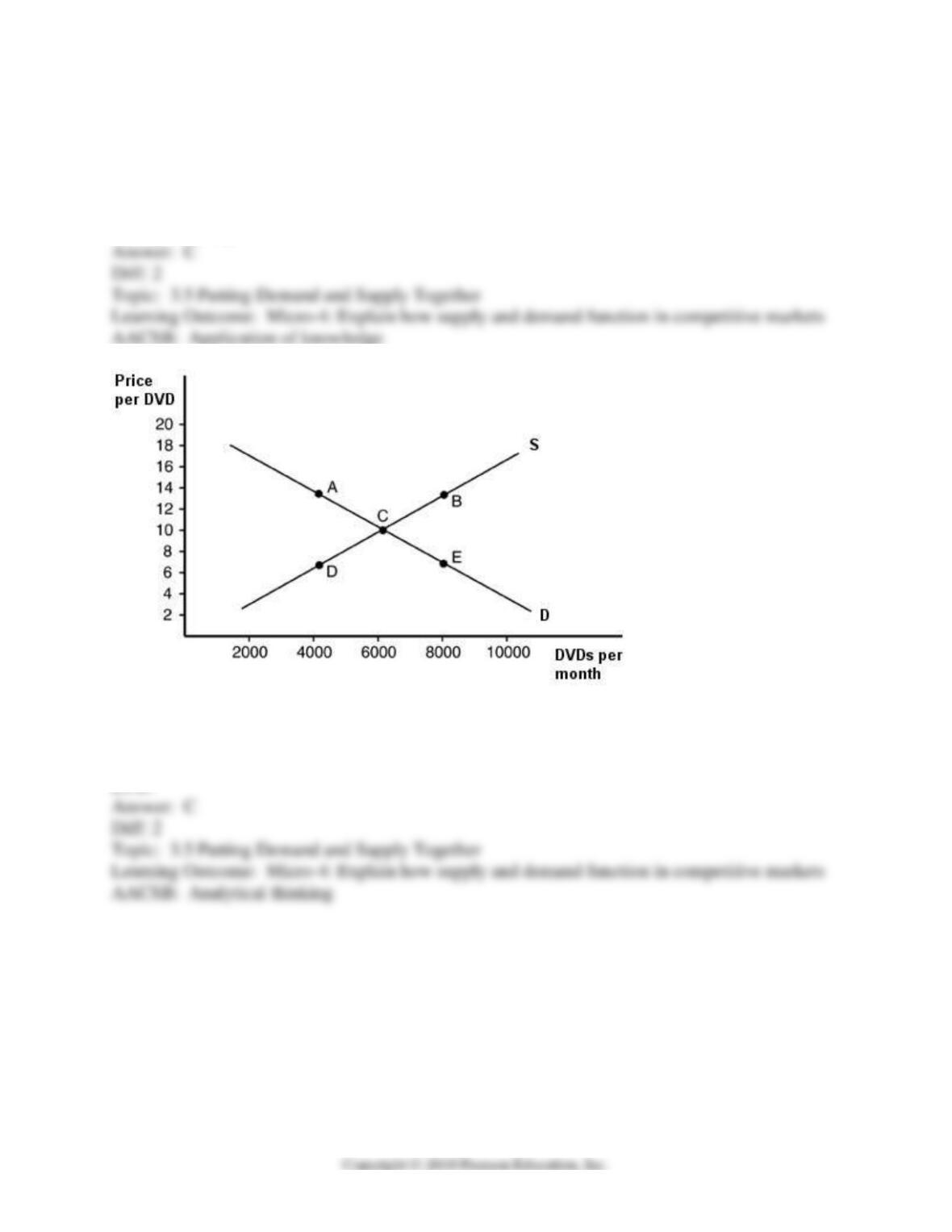
28) According to the above figure, equilibrium is at point
A) E.
B) B.
C) C.
D) D.
29) According to the above figure, the equilibrium price of DVDs is
A) $20.
B) $14.
C) $10.
D) $6.
30) According to the above figure, at a price of $6 per DVD, there is a
A) surplus of 4000 DVDs per month.
B) market equilibrium of 4000 DVDs per month.
C) shortage of 4000 DVDs per month.
D) market equilibrium of 6000 DVDs per month.
31) Suppose a change takes place and the new equilibrium is at point A in the above figure. This
change could have been caused by
A) an increase in the per-unit tax on DVDs.
B) a decrease in the income of consumers.
C) a reduction in the wages paid to workers in the DVD industry.
D) a reduction in the price of DVD players.
32) A market requires
A) sellers only.
B) buyers and sellers.
C) government intervention.
D) buyers only.
33) A surplus occurs whenever
A) price is below the equilibrium price.
B) price is above the equilibrium price.
C) price is equal to the equilibrium price.
D) the supply curve is downward sloping.
34) If there is a shortage in a free market, then
A) consumers will offer to pay a lower price for the good, and the price will fall toward the
equilibrium level.
B) consumers will offer to pay a higher price for the good, and the price will rise toward the
equilibrium level.
C) suppliers will decrease their output to match demand.
D) suppliers will accept any price below equilibrium.
35) Scalping activity arises when
A) the prices of goods are allowed to adjust to their equilibrium levels.
B) the quantities of goods demanded and supplied are allowed to adjust to their equilibrium
levels.
C) the prices of goods are restricted to levels above equilibrium prices.
D) the prices of goods are restricted to levels below equilibrium prices.
36) A shortage will occur when
A) the price equals the market clearing level.
B) the price is above the market clearing level.
C) there is an excess quantity supplied.
D) the price is below the market clearing level.
37) When there is a shortage
I. there is a tendency for price to increase.
II. there is an excess quantity demanded.
A) I only
B) II only
C) both I and II
D) neither I nor II
38) When a surplus exists
A) the price is below the market clearing price.
B) quantity demanded exceeds quantity supplied.
C) an excess quantity demanded exists.
D) none of the above.
39) Suppose that the price of wheat is above its equilibrium price. You would expect to see
A) a shortage on the market that causes prices to increase further.
B) an increase in quantity demanded because of the high price.
C) a leftward shift of the demand curve because of the high price.
D) sellers begin to lower their prices because of the surplus of wheat.
40) Which of the following is TRUE of the activities of ticket scalpers?
A) These activities cannot generate profits for the scalpers unless ticket prices are currently
below market clearing levels.
B) These activities help reduce the quantities of excess tickets supplied for events in which ticket
surpluses currently exist.
C) Engaging in these activities enable scalpers to push the price above the market clearing level.
D) Engaging in these activities enable scalpers to push the price below the market clearing level.
41) When there is an excess quantity of a product supplied, there will be
A) a tendency for price of the product to increase.
B) a tendency for price of the product to fall.
C) incentives for consumers to leave the market.
D) upward pressure on the price of labor.
42) An excess quantity supplied can be corrected by
A) a fall in price.
B) legally fixing the price at its present level.
C) a decrease in demand.
D) an increase in supply.
43) Equilibrium in a market occurs when
A) demand and supply indicate a small surplus of a good.
B) price is at its minimum.
C) quantity supplied and quantity demanded are equal at the market clearing price.
D) the market price leads to a decrease in quantity demanded.
44) Another term for the equilibrium price is
A) ceteris paribus.
B) black market.
C) law of demand.
D) market clearing price.
45) Market clearing price
A) refers to a movement along the demand curve.
B) refers to a supply curve.
C) exists at a the point at which quantity demanded equals quantity supplied.
D) refers to a surplus.
46) Which of the following is NOT true about the equilibrium price?
A) the price where a change in quantity supplied occurs
B) the price where the demand curve intersects the supply curve
C) the price where quantity demanded equals quantity supplied
D) the price where there is neither excess quantity demanded or excess quantity supplied
47) The market clearing price is
A) the price which eliminates excess quantity supplied or excess quantity demanded.
B) the price which leaves an excess quantity demanded.
C) the price which leaves an excess quantity supplied.
D) the lowest price at which a positive quantity supplied exists.
48) When there is an excess quantity supplied
A) the market is in equilibrium.
B) quantity demanded is greater than quantity supplied.
C) quantity demanded is less than quantity supplied.
D) prices will remain stable.
49) If the price of an item can freely adjust, a market will
A) always move towards equilibrium.
B) always have an excess quantity demanded.
C) always have an excess quantity supplied.
D) never move towards equilibrium because prices are always increasing.
50) A surplus exists
A) in equilibrium.
B) when quantity supplied is greater than quantity demanded.
C) when quantity supplied is less that quantity demanded.
D) at the market clearing price.
51) A shortage exists
A) in equilibrium.
B) when quantity supplied is greater than quantity demanded.
C) when quantity supplied is less than quantity demanded.
D) at the market clearing price.
52) Another name for a shortage is
A) excess quantity supplied.
B) excess quantity demanded.
C) equilibrium.
D) market clearing.
53) Another name for a surplus is
A) excess quantity supplied.
B) excess quantity demanded.
C) equilibrium.
D) market clearing.
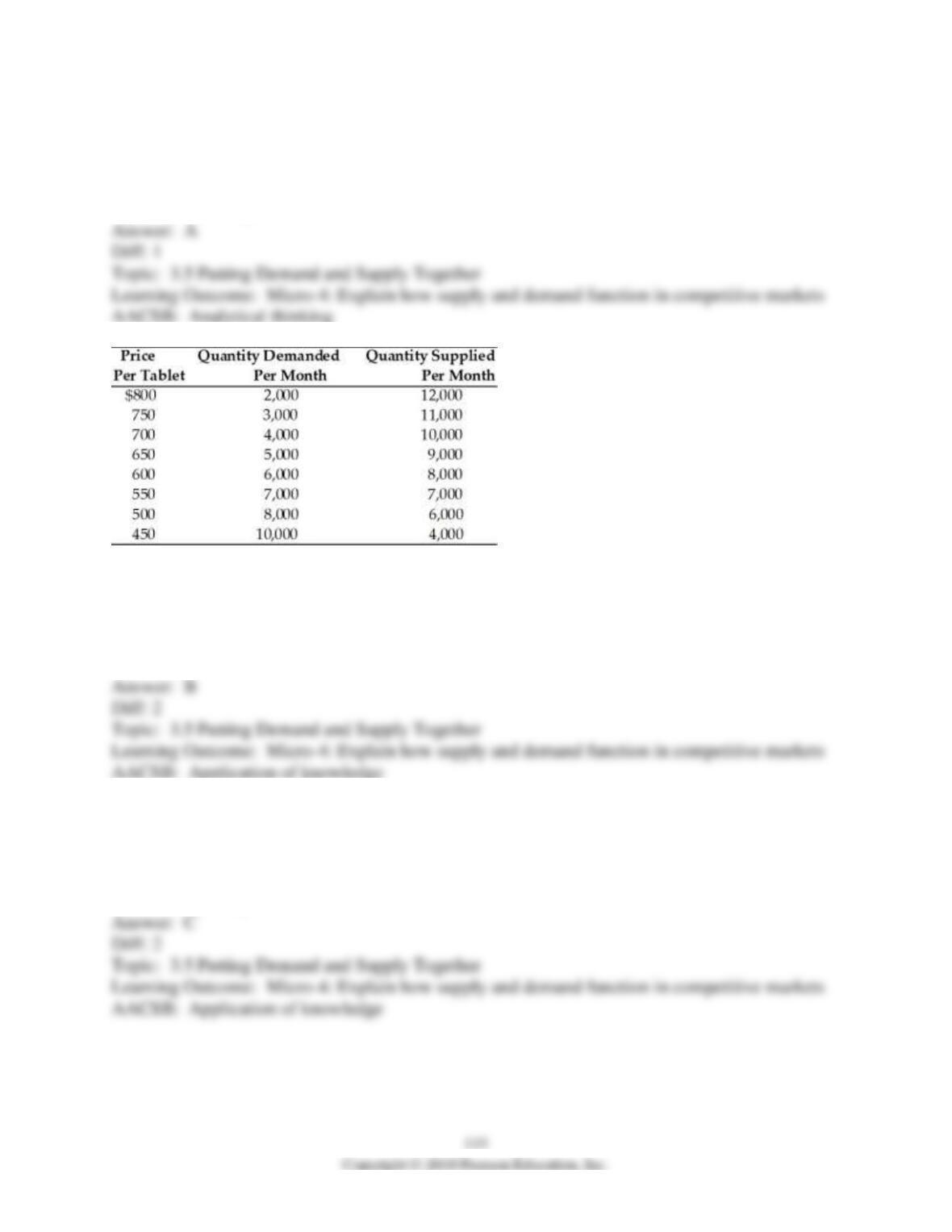
54) Refer to the above table. The equilibrium price of tablets is
A) $500.
B) $550.
C) $650.
D) $700.
55) Refer to the above table. At a price of $450, there is an
A) equilibrium.
B) excess quantity supplied of 4,000 tablets.
C) excess quantity demanded of 6,000 tablets.
D) excess quantity demanded of 9,000 tablets.