7) A permanent increase in the real wage rate has a ________ income effect on labor supply than
a temporary increase in the real wage, so labor supply is ________ with a permanent wage
increase than for a temporary wage increase.
A) larger; more
B) larger; less
C) smaller; more
D) smaller; less
8) Research on labor supply generally shows that
A) labor supply rises in response to a permanent increase in the real wage, but falls in response
to a temporary increase in the real wage.
B) labor supply rises in response to a temporary increase in the real wage, but falls in response to
a permanent increase in the real wage.
C) labor supply rises in response to both a temporary and a permanent increase in the real wage.
D) labor supply falls in response to both a temporary and a permanent increase in the real wage.
9) How would each of the following events affect Cheryl Shirker’s supply of labor?
(a) Cheryl’s firm announces a reorganization plan, in which she will get a big promotion and
raise in six months.
(b) Cheryl’s speculative investment in plutonium futures pays off big, netting her a profit of $300
thousand.
(c) Cheryl’s father, who had planned to leave her a large bequest, must spend all his wealth on
medical bills after a prolonged illness.
10) Over the past 100 years, what has happened to the average workweek in the U.S.
manufacturing industry? Why has this occurred? What are the implications for the size of the
income and substitution effects?
11) In each of the following scenarios, state whether the labor supply curve would shift to the
left, to the right, not shift at all, or if the shift is ambiguous because there is more than one effect
and they would move the curve in opposite directions.
(a) The stock market rises sharply.
(b) Fewer teenagers work while in school than before.
(c) A large fraction of the population flees the country because of a bird flu epidemic.
(d) The expected future wage declines and the stock market crashes.
(e) The current real wage rate rises.
3.4 Labor Market Equilibrium
1) Suppose the marginal product of labor is
MPN = 200 – 0.5N
where N is aggregate employment. The aggregate quantity of labor supplied is 300 + 8w, where
w is the real wage. What is the equilibrium real wage?
A) 5
B) 10
C) 15
D) 20

2) Suppose the marginal product of labor is
MPN = 200 – 0.5N
where N is aggregate employment. The aggregate quantity of labor supplied is 300 + 8w, where
w is the real wage. What is the equilibrium quantity of employment?
A) 12
B) 190
C) 380
D) 760
3) Suppose the marginal product of labor is
MPN = 200 – 0.5N
where N is aggregate employment. The aggregate quantity of labor supplied is 300 + 8w, where
w is the real wage. If a supply shock increases the marginal product of labor by 10 (to MPN =
210 – 0.5 N), by how much does the real wage increase?
A) 1
B) 2
C) 3
D) 4
4) Suppose the marginal product of labor is
MPN = 200 – 0.5N
where N is aggregate employment. The aggregate quantity of labor supplied is 300 + 8w, where
w is the real wage. If a supply shock increases the marginal product of labor by 10 (to MPN =
210 – 0.5 N), by how much does employment increase?
A) 0
B) 4
C) 8
D) 16

5) A tremendous flood along the Mississippi River destroys thousands of factories, reducing the
nation’s capital stock by 5%. What happens to current employment and the real wage rate?
A) Both employment and the real wage rate would increase.
B) Both employment and the real wage rate would decrease.
C) Employment would increase and the real wage would decrease.
D) Employment would decrease and the real wage would increase.
6) A sharp increase in stock prices makes people much wealthier. If the main effect of this
increased wealth is felt on labor supply, what happens to current employment and the real wage
rate?
A) Both employment and the real wage rate would increase.
B) Both employment and the real wage rate would decrease.
C) Employment would increase and the real wage would decrease.
D) Employment would decrease and the real wage would increase.
7) An adverse oil-price shock reduces labor demand. What happens to current employment and
the real wage rate?
A) Both employment and the real wage rate would increase.
B) Both employment and the real wage rate would decrease.
C) Employment would increase and the real wage would decrease.
D) Employment would decrease and the real wage would increase.
8) A bird flu epidemic causes many people to flee the country, but does not affect labor demand
significantly because almost all the goods produced within the country are exported. What
happens to current employment and the real wage rate?
A) Both employment and the real wage rate would increase.
B) Both employment and the real wage rate would decrease.
C) Employment would increase and the real wage would decrease.
D) Employment would decrease and the real wage would increase.
9) The government announces a tax increase on workers’ wages to take effect in the future. What
happens to current employment and the real wage rate?
A) Both employment and the real wage rate would increase.
B) Both employment and the real wage rate would decrease.
C) Employment would increase and the real wage would decrease.
D) Employment would decrease and the real wage would increase.
10) The equilibrium level of employment, achieved after the complete adjustment of wages and
prices, is known as the
A) zero-unemployment level of employment.
B) natural state.
C) invisible handshake.
D) full-employment level of employment.
11) Full-employment output is the level of output that firms in the economy supply when
A) taxes are zero.
B) wages and prices have fully adjusted.
C) the unemployment rate is zero.
D) all capital is fully utilized.
12) Suppose oil prices fall temporarily, as oil becomes more plentiful. What impact is this likely
to have on the production function, the marginal products of labor and capital, labor demand,
employment, and the real wage?
13) Suppose the marginal product of labor in the economy is given by MPN = 200 – 0.5 N, while
the supply of labor is 100 + 4w.
(a) Find the market-clearing real wage rate.
(b) What happens if the government imposes a minimum wage of 40? Is there involuntary
unemployment?
(c) What happens if the government imposes a minimum wage of 60? Is there involuntary
unemployment?
14) Suppose the marginal product of labor in the economy is given by MPN = 0.002(16,000 – N),
while the supply of labor is 1000 + 1000w.
(a) Find the market-clearing real wage rate and level of employment.
(b) What happens to the wage rate and employment if wealth rises, reducing the supply of labor
to 500 + 1000w?
(c) What happens to the wage rate and employment if after wealth has risen as in part (b), there
is a productivity shock that increases the marginal product of labor to MPN = 0.0025(16,000 –
N)?
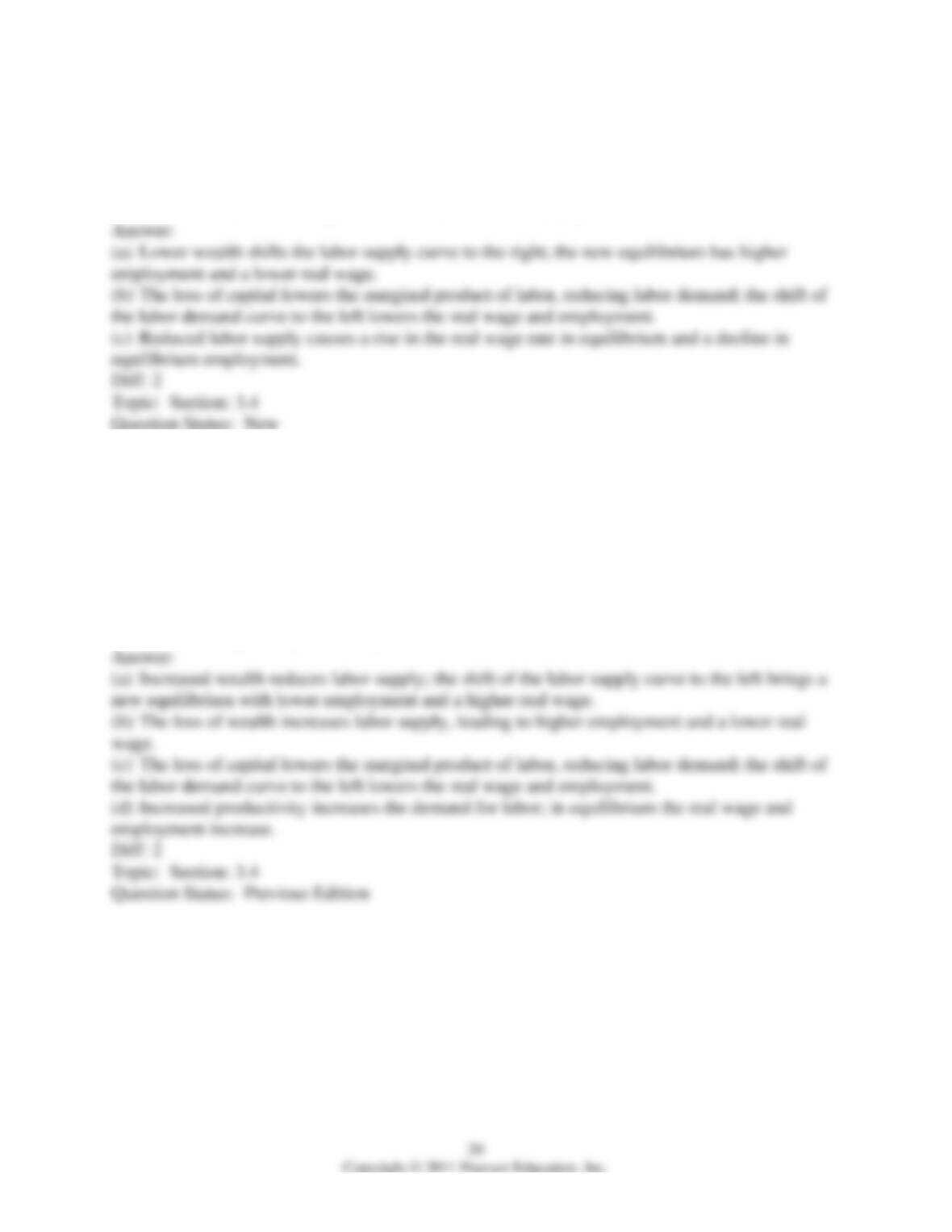
15) How would each of the following events affect the level of employment and the real wage
rate? Explain which curves in the labor market diagram would be affected and show your work.
(a) The stock market falls sharply.
(b) A war destroys a substantial amount of a country’s physical capital.
(c) A new law reduces immigration of workers into the country.
16) How would each of the following events affect the level of employment and the real wage
rate?
(a) A tremendous boom occurs in the stock market, increasing people’s wealth by $100 billion
overnight.
(b) A major government loan-guarantee program goes bust, losing $500 billion. To pay off the
loss, the government announces that tax rates will rise 30% in the future.
(c) A nuclear mishap contaminates all auto plants in the Detroit area, destroying their capital.
(d) Medical science cures the common cold, causing fewer work days lost due to illness, thus
greatly increasing labor productivity.

3.5 Unemployment
1) What is the unemployment rate if there are 150 million people employed, 25 million people
unemployed, and 25 million not in the labor force?
A) 14.3%
B) 13.4%
C) 12.5%
D) 25.0%
2) The labor force participation rate is the percentage of the adult population that is
A) employed.
B) willing to work but unable to find jobs.
C) unemployed.
D) working or actively looking for work.
3) The ________ is the number of unemployed divided by the labor force and the ________ is
the number of employed divided by the adult population.
A) unemployment rate; employment rate
B) unemployment rate; employment ratio
C) unemployment ratio; participation rate
D) discouraged worker ratio; employment rate
4) The ________ is the number of unemployed divided by the labor force and the ________ is
the labor force divided by the adult population.
A) unemployment rate; employment rate
B) unemployment rate; employment ratio
C) unemployment ratio; participation rate
D) discouraged worker ratio; employment rate

5) What is the participation rate if there are 125 million people in the labor force, 100 million
people employed, and 25 million not in the labor force?
A) 83%
B) 80%
C) 75%
D) 67%
6) How many people are unemployed if the employment ratio is 75%, there are 90 million
people employed, and there are 20 million people not in the labor force?
A) 20 million
B) 10 million
C) 5 million
D) 0 million
7) How many people are employed if the labor force participation rate is 60%, there are 3 million
people unemployed, and there are 30 million people not in the labor force?
A) 54 million
B) 48 million
C) 42 million
D) 30 million
8) The city of Hope has a labor force of 1000. Twenty people lose their jobs each month and
remain unemployed for exactly one month before finding jobs. On January 1, May 1, and
September 1 of each year, 50 people lose their jobs for a period of four months before finding
new jobs. What is the unemployment rate in any given month?
A) 2%
B) 3%
C) 5%
D) 7%

9) The city of Hope has a labor force of 1000. Twenty people lose their jobs each month and
remain unemployed for exactly one month before finding jobs. On January 1, May 1, and
September 1 of each year, 50 people lose their jobs for a period of four months before finding
new jobs. What is the average duration of an unemployment spell?
A) 2.15 months
B) 2.85 months
C) 3.14 months
D) 3.43 months
10) Frictional unemployment arises when
A) unskilled or low-skilled workers find it difficult to obtain desirable,
long-term jobs.
B) labor must be reallocated from industries that are shrinking to areas that are growing.
C) workers must search for suitable jobs and firms must search for suitable workers.
D) output and employment are below full-employment levels.
11) Cyclical unemployment arises when
A) unskilled or low-skilled workers find it difficult to obtain desirable,
long-term jobs.
B) labor must be reallocated from industries that are shrinking to areas that are growing.
C) workers must search for suitable jobs and firms must search for suitable workers.
D) output and employment are below full-employment levels.
12) Cyclical unemployment is caused by
A) people entering the labor force to search for jobs.
B) technological progress, which causes some industries to expand employment and others to
reduce employment.
C) reducing international trade barriers, which causes some industries to expand employment
and others to reduce employment.
D) business cycle fluctuations
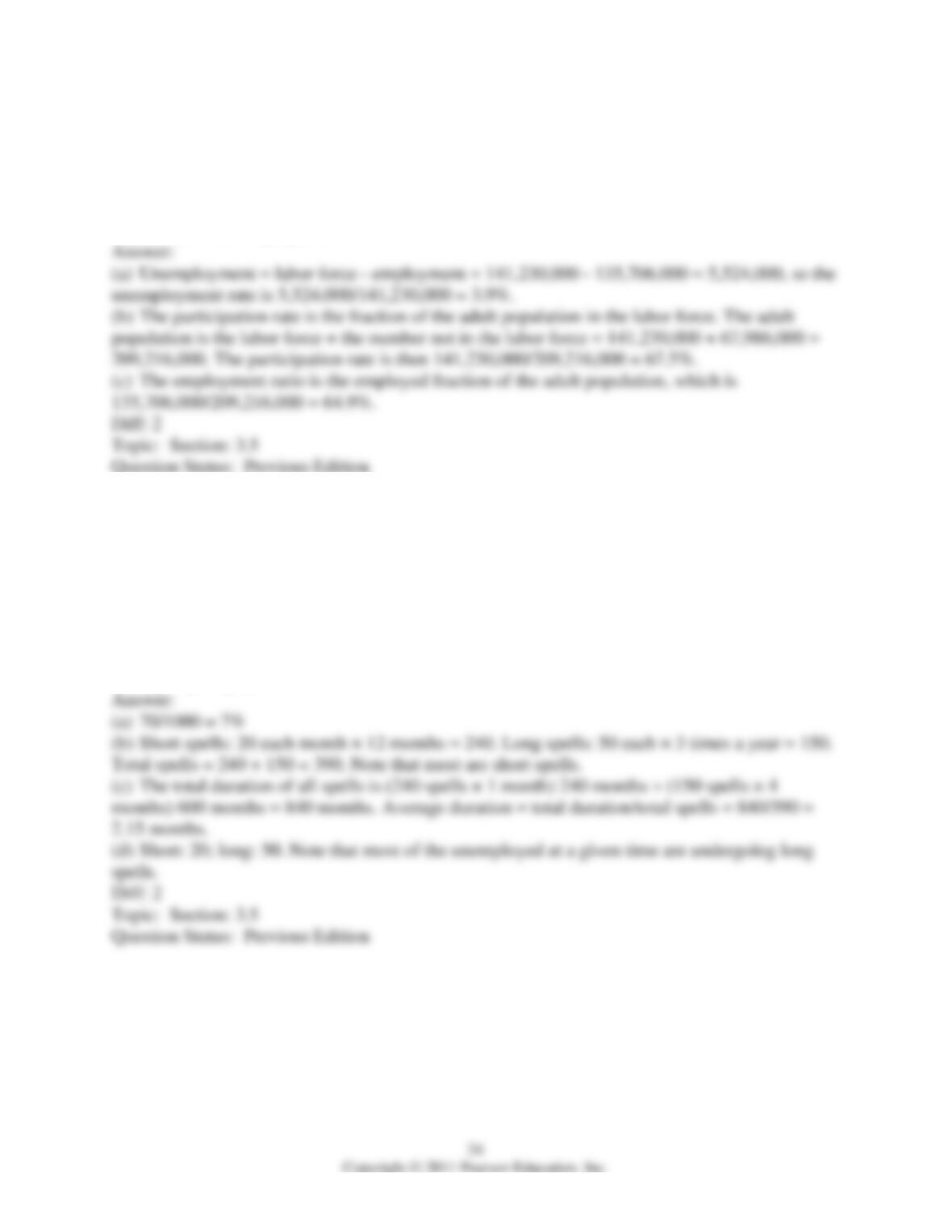
13) In April 2000, the United States had a labor force of 141,230,000, employment of
135,706,000, and there were 67,986,000 people not in the labor force (all numbers rounded to the
nearest 1000).
(a) Calculate the unemployment rate.
(b) Calculate the participation rate.
(c) Calculate the employment ratio.
14) The city of Hope has a labor force of 1000. Twenty people lose their jobs each month and
remain unemployed for exactly one month before finding jobs. On January 1, May 1, and
September 1 of each year 50 people lose their jobs for a period of four months before finding
new jobs.
(a) What is the unemployment rate in any given month?
(b) How many unemployment spells are there in a year?
(c) What is the average duration of an unemployment spell?
(d) On any given date, how many people are undergoing short spells, and how many are
undergoing long spells?

3.6 Relating Output and Unemployment: Okun’s Law
1) According to Okun’s law, an increase in the unemployment rate will cause ________ in the
level of employment and ________ in the level of output.
A) an increase; an increase
B) an increase; a decrease
C) a decrease; an increase
D) a decrease; a decrease
2) Assume that the full-employment level of output is $5000 billion and the natural
unemployment rate is 5%. Suppose the current unemployment rate is 8%. What would be the
current level of output according to Okun’s law (when the Okun’s law coefficient is 2)?
A) $4500 billion
B) $4700 billion
C) $4900 billion
D) $5000 billion
3) According to Okun’s law, if output grew 7% and full-employment output rose 5%, what would
be the change in the unemployment rate?
A) -4%
B) -1%
C) 1%
D) 4%
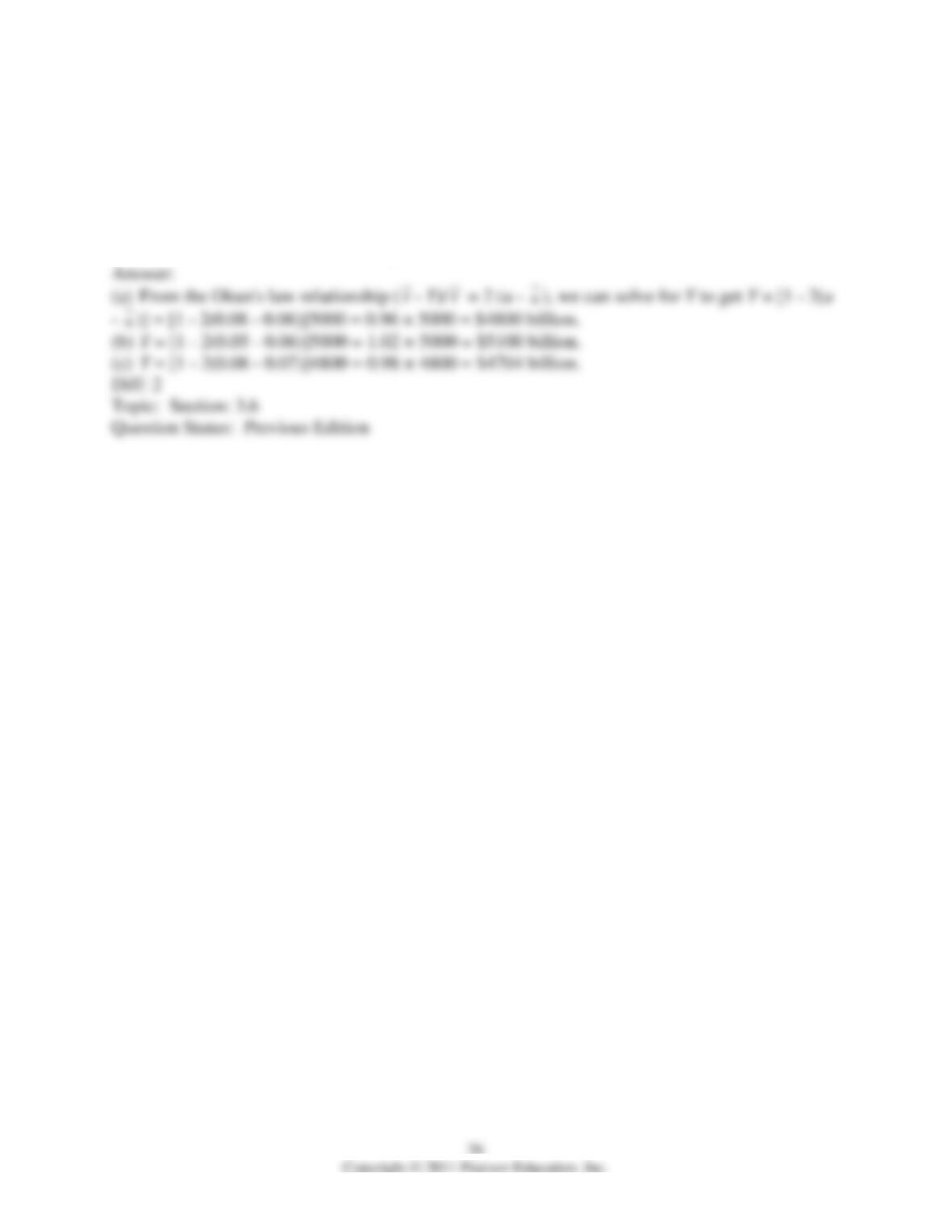
4) Suppose the Okun’s law coefficient is 2, the full-employment level of output is $5000 billion,
and the natural rate of unemployment is 6%.
(a) What is the current level of output if the current unemployment rate is 8%?
(b) Suppose the unemployment rate falls to 5%; what is the current level of output?
(c) Suppose structural changes in the economy raise the natural rate of unemployment to 7%,
and lower the full-employment level of output to $4800 billion. If the current unemployment rate
is 8%, what is the current level of output?