
International Economics, 9e (Husted/Melvin)
Chapter 3 The Classical Model of International Trade
3.1 Multiple-Choice Questions
1) Mercantilism
A) is the philosophy of free international trade.
B) was a system of export promotion and barriers to imports practiced by governments,
especially in the 17th and 18th centuries.
C) was praised by Adam Smith in The Wealth of Nations.
D) Both A and C.
2) If factors of production cannot flow between countries
A) there is no reason to expect that wages should be equal worldwide.
B) multinational corporations would not exist.
C) trade in goods could still occur.
D) All of the above.
3) The labor theory of value
A) is what economists believe determines prices today.
B) says that wages must always be greater than prices.
C) says that the price of a good is determined by the amount of labor required to produce it.
D) All of the above.
4) Given constant returns to scale between labor and output, if it takes 1 hour to make 10 yards
of cloth, then 100 yards of cloth can be made in
A) 10 hours.
B) 100 hours.
C) 1000 hours.
D) Can’t tell without knowing how much capital is used.

Answer the question(s) below based on the information in the following table
Country
Goods
A
B
X
3
9
Y
4
2
(numbers indicate hours of labor per unit of output)
5) Refer to the table above. Country A has absolute advantage in
A) Good X.
B) Good Y.
C) Neither X nor Y.
D) Both X and Y.
6) Refer to the table above. Country B has absolute advantage in
A) Good X.
B) Good Y.
C) Neither X nor Y.
D) Both X and Y.
7) Refer to the table above. If countries were to trade along the lines of absolute advantage
A) A would export X to B.
B) B would import Y from A.
C) neither country would want to trade.
D) More information is needed to determine the pattern.
8) Refer to the table above. If countries were to trade along the lines of comparative advantage
A) B would export Y to A.
B) A would import X from A.
C) neither country would want to trade.
D) More information is needed to determine the pattern.
9) Refer to the table above. In autarky the relative price of X (in terms of Y) in A would be
A) 3/4.
B) 4/3.
C) 3/9.
D) $3.

Answer the question(s) below based on the information in the following table
Country
Goods
A
B
Beer
3
9
Wine
1
2
(numbers indicate hours of labor per unit of output)
10) Refer to the table above. Country A has a comparative advantage in
A) beer.
B) wine.
C) both beer and wine.
D) neither beer nor wine.
11) Refer to the table above. Country A has an absolute advantage in
A) beer.
B) wine.
C) both beer and wine.
D) neither beer nor wine.
12) Refer to the table above. For trade to occur along the lines of comparative advantage, wages
in A relative to wages in B (measured in the same currency)
A) must be at least twice but less than 3 times as great.
B) must be less than three times as small.
C) must be greater than $2 but less than $3.
D) Need more information to answer.
13) Refer to the table above. If each country were to reduce production of its comparative
disadvantage good by 1 unit, world output of wine would rise by
A) 1.5 units.
B) 2 units.
C) 3 units.
D) 3.5 units.
14) Refer to the table above. The relative price of beer in terms of wine in B is
A) $4.50.
B) 2.
C) 4.5.
D) $2.00.
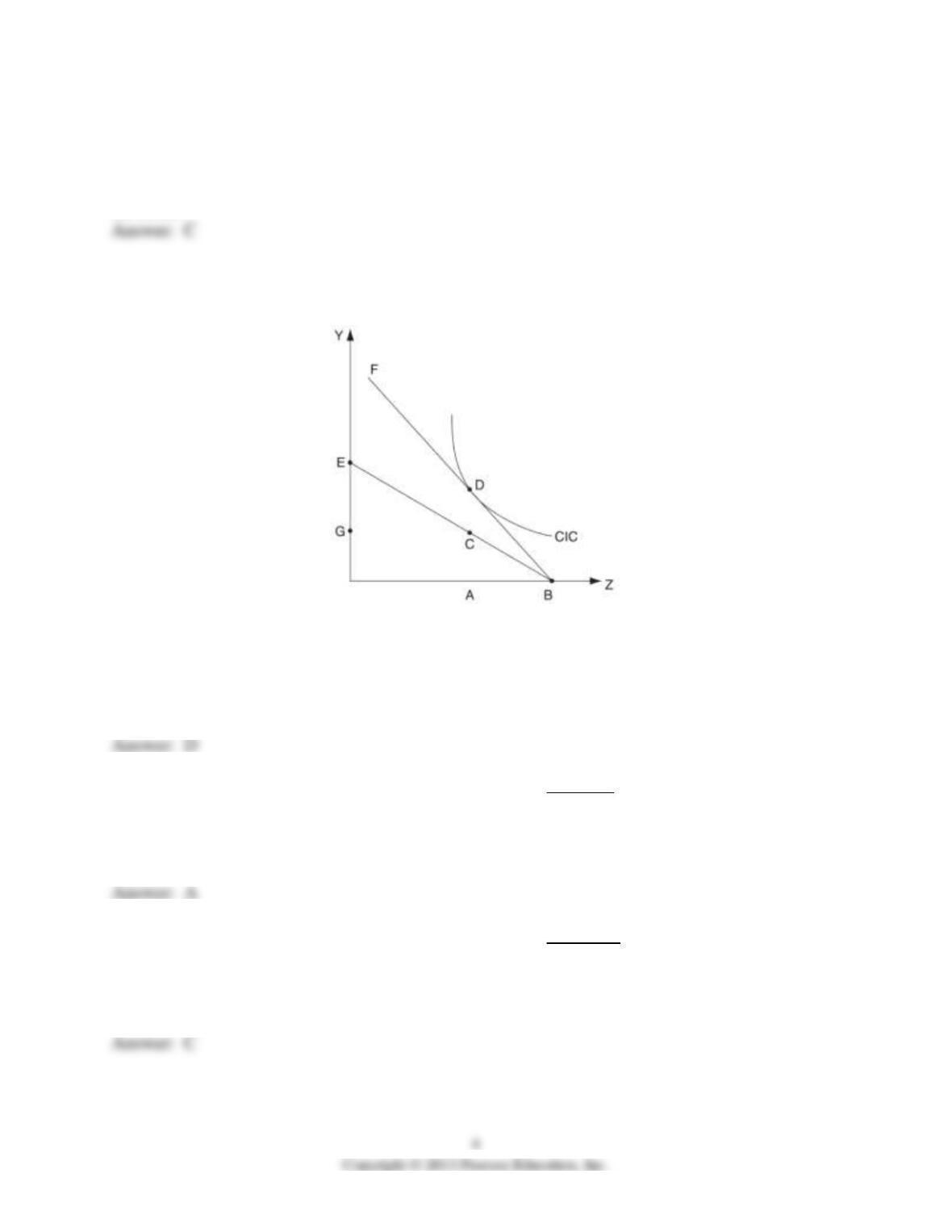
Answer the question(s) below based on the following diagram of a country in international trade
equilibrium.
15) Refer to the figure above. This country has comparative advantage in good
A) S.
B) T.
C) Y.
D) Z.
16) Refer to the figure above. In equilibrium, this country produces at point
A) B.
B) C.
C) D.
D) E.
17) Refer to the figure above. In equilibrium, this country consumes at point
A) B.
B) C.
C) D.
D) E.

18) Refer to the figure above. Exports for this country equal
A) OA units of Z.
B) AB units of Z.
C) AC units of Y.
D) AD units of Y.
19) Refer to the figure above. Imports for this country equal
A) OA units of Z.
B) AB units of Z.
C) AC units of Y.
D) AD units of Y.
20) The classical theory predicts that
A) countries will completely specialize in the production of export goods.
B) considerable trade will occur between countries with different levels of technology.
C) small countries could obtain all of the gains from trade when trading with large countries.
D) All of the above.
21) The gains from international trade are closely related to
A) the labor theory of value.
B) how much the autarky price differs from the international price (i.e. the terms of trade).
C) the fact that one country must lose from trade.
D) All of the above.
22) According to the classical theory of international trade
A) only countries with low wages will export.
B) only countries with high wages will import.
C) countries with high wages will have higher relative prices of all goods.
D) All the above are false.
23) In the classical model, the direction of trade is determined by
A) comparative advantage.
B) absolute advantage.
C) physical advantage.
D) which way the wind blows.

24) Absolute advantage is determined by
A) actual differences in labor productivity between countries.
B) relative differences in labor productivity between countries.
C) Both A and B.
D) Neither A nor B.
25) Comparative advantage is determined by
A) actual differences in labor productivity between countries.
B) relative differences in labor productivity between countries.
C) Both A and B.
D) Neither A nor B.
Answer the question(s) below based on the information in the following table, where the
numbers represent the number of labor hours it will take to produce a unit of the given good.
Spain
France
Grapes
3
9
Textiles
1
2
26) Refer to the table above. Spain has comparative advantage in
A) grapes.
B) textiles.
C) both grapes and textiles.
D) neither grapes nor textiles.
27) Refer to the table above. France has absolute advantage in
A) grapes.
B) textiles.
C) both grapes and textiles.
D) neither grapes nor textiles.
28) Refer to the table above. Once trade begins, a possible international price (i.e. terms of trade)
for textiles in terms of grapes is
A) $5.
B) 2/5.
C) 2.
D) 4/5.

29) Refer to the table above. If complete specialization occurs, and France has a labor force of
30,000 hours of labor, then after trade begins it will produce
A) 2000 units of grapes.
B) 15,000 units of textiles.
C) 2000 units of grapes and 6000 units of textiles.
D) None of the above.
30) Refer to the table above. France will gain from trade so long as the international price of
grapes measured in terms of textiles is below
A) $15.
B) 3.
C) 5.
D) 8.
31) The various bundles of goods that a country can obtain by taking advantage of international
trade is known as
A) the non-indifference curve.
B) the consumption possibility frontier.
C) the production possibility frontier.
D) the trade possibility frontier.
32) Which of the following statements about international trade is true?
A) Potentially, a country can have absolute advantage in all goods.
B) Potentially, a country can have relative advantage in all goods.
C) After trade, countries tend to specialize in the production of those goods in which they enjoy
absolute advantage.
D) None of the above is true.
33) The notion that in a world with n markets, if n – 1 are in equilibrium, so must the nth, is
known as
A) the uncertainty principle.
B) the first law of international trade.
C) Walras Law.
D) Friedman Law.
3.2 True or False Questions
1) An international division of labor will have no effect on total world output because resources
are limited.
2) Comparative advantage is determined by the relative levels of autarky prices.
3) A country must have absolute advantage in a good in order to have comparative advantage in
that good.
4) A country must have comparative advantage in a good in order to have absolute advantage in
that good.
5) Countries with high wages cannot export to low wage countries.
6) Countries with low wages will always be able to export to countries with high wages.
7) If country A has a larger trade triangle than country B, reciprocal demand will lead to an
increase in the relative price of A’s imports.
8) In a two country world, at least one country must lose from trade.
9) Once trade begins, a country will tend to specialize completely in the production of its export
good.
10) A country gains more from international trade the more its terms of trade differ from its
autarky price.
11) A country in autarky does not trade.
12) Adam Smith was an American economist that published The Wealth of Nations, one of the
most important books in the history of economic thought.
13) Mercantilism is another name given to the version of capitalism that has emerged in the
globalized world of the 21st century.
3.3 Essay Questions
1) Given the input-output relationships in the table below:
Countries
A B
Goods
X 8 4
Y 4 1
(a) Which country has absolute advantage in which good and why?
(b) Which country has comparative advantage in which good and why?
(c) If A is endowed with 8000 hours of labor, how much X will it produce after trade begins?
How much Y? Explain.
(d) What is the allowable range on A’s wages relative to B’s if trade is flowing between these
two countries according to comparative advantage?
2) Explain how trade will tend to emerge along the lines of comparative advantage if markets are
allowed to work freely.
3) Starting from a situation where country A which exports good S and imports good T has a
larger trade triangle than country B, explain how the process of reciprocal demand leads to
international trade equilibrium.
4) Suppose that workers in A can produce 1 unit of S in 3 hours and 1 unit of T in 9 hours.
Suppose that the relative price of S in B is 2. Graph the PPF for country A. Indicate the exact
slope of the PPF. Show how the autarky equilibrium is determined. Illustrate a hypothetical
international trade equilibrium, including production and consumption points, and trade volumes
for a given (your assumption-be explicit) but permissible value of the international terms of
trade.
5) Can a country have comparative advantage in all products?