b.
No, scarcity does not apply to governments.
c.
Yes, resources are limited even for the U.S. government.
d.
Yes, although the U.S. government can easily obtain more resources.
e.
Uncertain-economic theory has no answer to this question.
183. Is faster economic growth unambiguously better?
a.
No, because growth has an opportunity cost.
b.
No, because growth serves no useful purpose.
c.
Yes, because more goods and services are always better.
d.
Yes, because it expands the production possibilities of an economy.
e.
Uncertain-economic growth has no answer to this question.
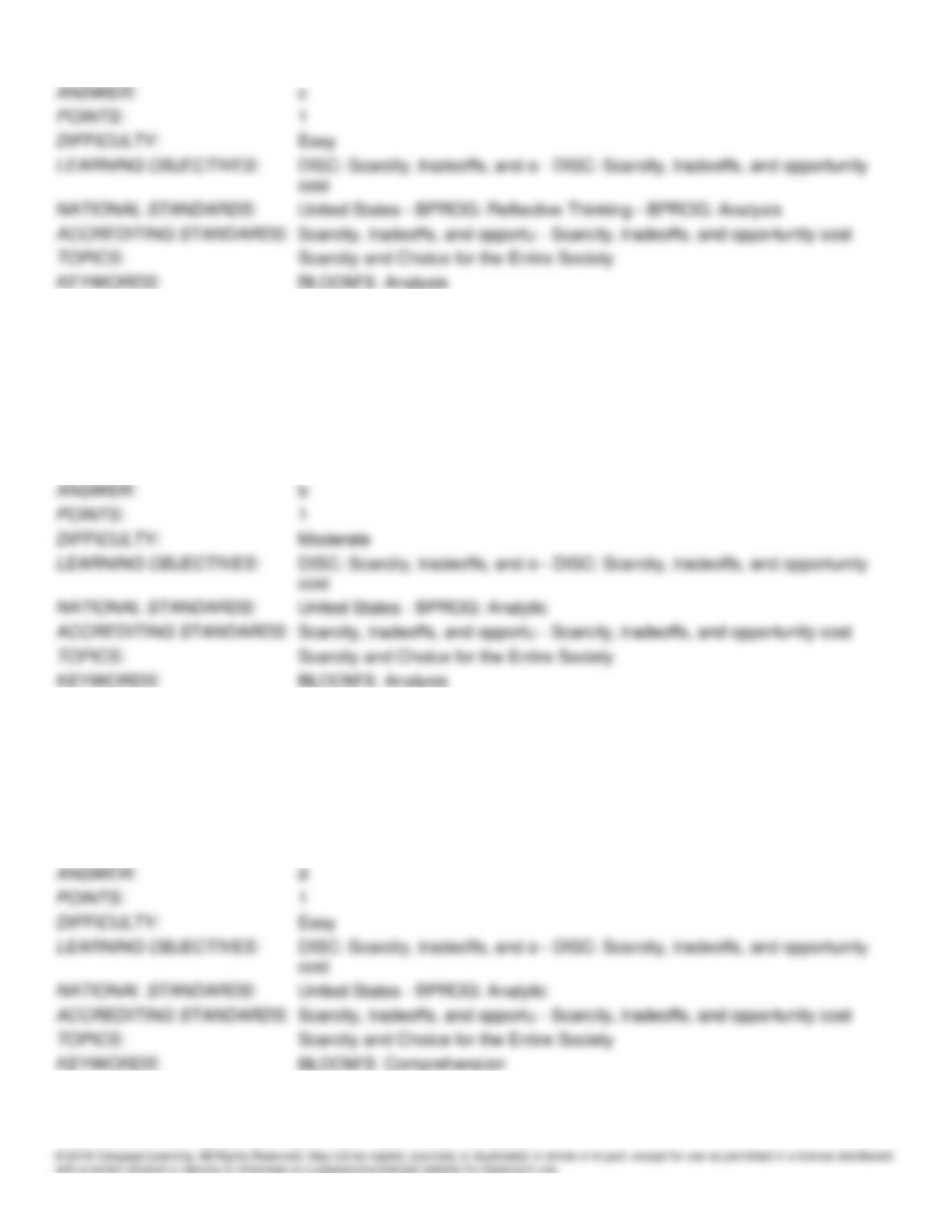
Figure 3-5
184. At present, faculty in the Economics Department teach introductory and upper-level courses. Which graph in Figure
3-5 represents the change in the production possibilities of the Economics Department after a policy of using graduate
students in addition to faculty to teach introductory sections was implemented?
a.
1
b.
2
c.
3
d.
4
185. Which of the following events create an outward shift of the production possibilities curve?
a.
The United States moves resources from the production of goods for domestic production to the production of
goods for export.
b.
Tax reductions reduce the cost and increase the volume of investment in factories, machinery, and research
and development.
c.
There is an exodus of young people to another country where there is more political freedom.
d.
The unemployment rate falls from 33 percent to 12 percent.
186. If the economy of Gwondanaland is growing more rapidly than the economy of Japan, most likely
a.
Japan has more current investment than Gwondanaland.
b.
Japan has more government spending than Gwondanaland.
c.
Japan spends more on capital goods than Gwondanaland.
d.
Gwondanaland has lower current consumption than Japan.
e.
Gwondanaland has lower current investment than Japan.
187. Is increased capital spending the only way for an economy to expand its production possibilities frontier?
a.
No, an economy can also expand by invention and innovation.
b.
No, an economy can also grow by investment instead of capital spending.
c.
Yes, more capital is the only way to expand its production possibilities frontier.
d.
Yes, although more capital clearly has a high opportunity cost.
e.
Yes, because capital is the only constraining resource that limits growth.
188. Economists define efficiency as
a.
output maximization.
b.
the absence of waste.
c.
input maximization.
d.
the presence of surplus.
189. If an economy is operating inefficiently, then
a.
the economy can increase production of consumption goods without reducing capital goods.
b.
there is always a positive opportunity cost to increasing output.
c.
output can only be increased through capital investment.
d.
output cannot be increased.
190. If you discover that the opportunity cost of raising your economics grade is zero, you
a.
are studying too hard and receiving a higher grade than is optimal for you.
b.
must be on the production possibilities frontier that describes your trade-offs between producing high grades
and producing other goods.
c.
must be inside the production possibilities frontier that describes your trade-offs between producing high
grades and producing other goods.
d.
must be producing more of other goods than is optimal for you.
191. Inefficiency in an economy can be caused by
a.
misallocating resources.
b.
underemploying resources.
c.
discrimination.
d.
All of the above are correct.
192. A point lying inside (under) a production possibilities curve indicates that
a.
the economy is saving money.
b.
there are no associated opportunity costs.
c.
more output could be produced with existing resources.
d.
technology limits production.
193. As a general rule, an increase in the capital available to a society
a.
reduces the slope of the production possibilities frontier, making it shallower.
b.
increases the slope of the production possibilities frontier, making it steeper.
c.
shifts the production possibilities frontier outward, away from the origin.
d.
shifts the production possibilities frontier inward, toward the origin.
e.
makes the production possibilities frontier more bowed out.
194. When a firm or economy is operating efficiently, it is operating
a.
outside its production possibilities frontier.
b.
inside its production possibilities frontier.
c.
on its production possibilities frontier.
d.
at the intersection of the production possibilities frontier and the vertical axis.
e.
at the intersection of the production possibilities frontier and the horizontal axis.
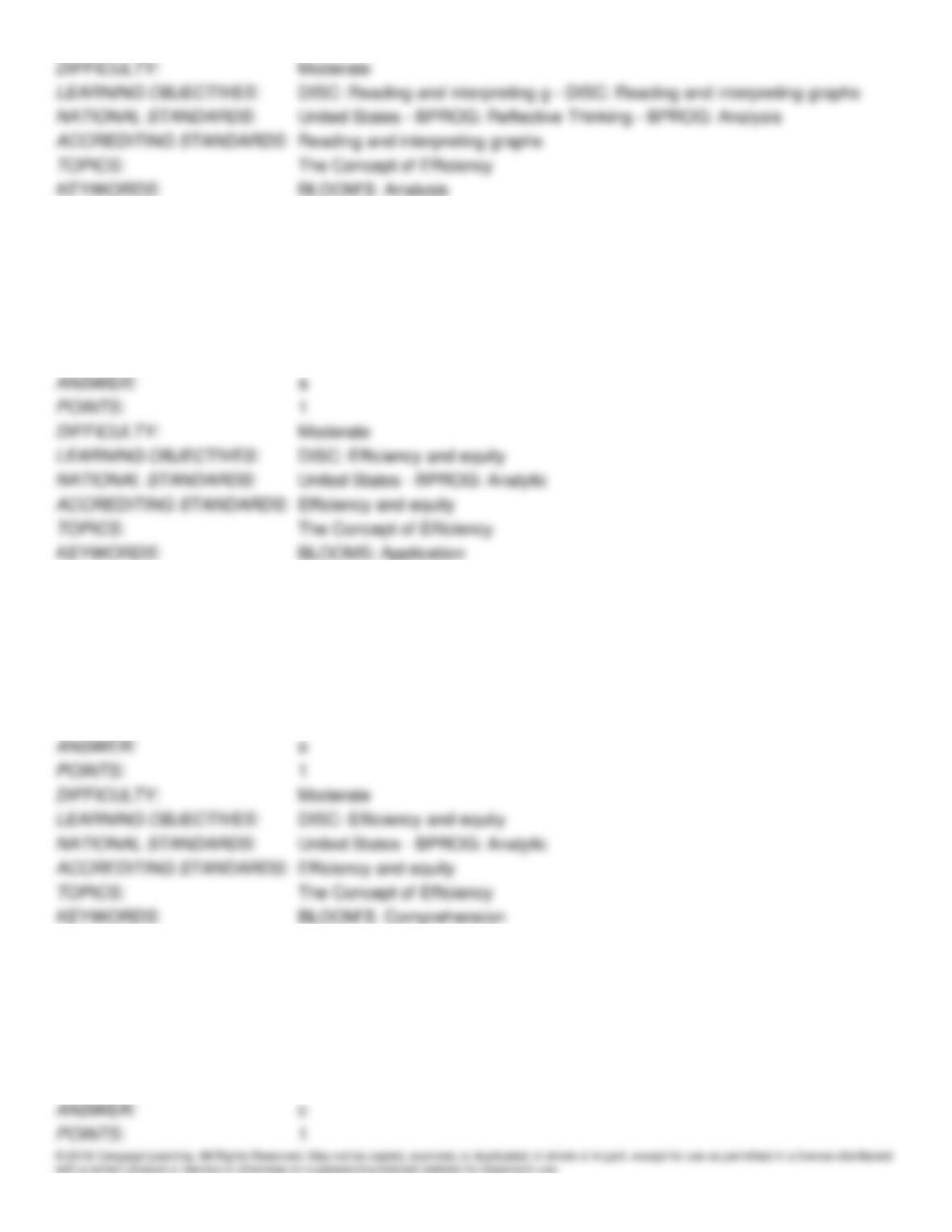
Figure 3-6
195. In Figure 3-6 assume this economy is currently operating at point D. What is the opportunity cost of moving to B?
a.
about 200 bushels of wheat
b.
200 bushels of soybeans
c.
Infinite, B cannot be produced at any cost.
d.
0
196. If an economy is producing inefficiently, it is
a.
possible to increase production of all goods simultaneously.
b.
possible to increase production of one good at the expense of another.
c.
not possible to increase production of any good.
d.
not possible to increase economic growth.
e.
possible to increase production with no effort.
197. Some authors claim that any point not on the frontier cannot be best. What is their reasoning to support this?
a.
A point inside the frontier implies that society is not facing up to the problem of scarcity.
b.
A point inside the frontier limits growth, and growth is always a goal worth pursuing.
c.
A point inside the frontier represents inflation, and inflation is a dangerous situation.
d.
A point inside the frontier results in fewer goods, and more is always better.
e.
A point inside the frontier is inefficient, and represents wasted resources.
198. The most important way in which inefficiency occurs is
a.
producing more military goods instead of civilian goods.
b.
limiting economic growth by limiting capital spending.
c.
unemployment of labor and other resources.
d.
producing outside the production possibilities frontier.
e.
All of the above are correct.
199. Employment discrimination is a source of
a.
economic inefficiency.
b.
increased economic growth.
c.
innovation.
d.
shifting production possibilities.
e.
All of the above are correct.
200. List the three coordination decisions made by every economy.
a.
Where? When? How?
b.
How? What? To whom?
c.
Why? Where? What?
d.
When? To Whom? Where?
201. The major coordination tasks can be summarized with the questions
a.
who, what, when, where?
b.
how, what, for whom?
c.
how, what, why?
d.
how, why, for whom?
e.
who, how, what?
202. In a market system, the major coordination tasks are carried out
a.
with the approval of central planners.
b.
as part of the regular appropriation process of Congress.
c.
irregularly by the major corporations.
d.
automatically by the market mechanism.
203. The market system provides a way
a.
to allow specialization and exchange to work in tandem.
b.
to improve the well-being of mankind.
c.
to harness self-interest.
d.
to allocate goods and services.
e.
All of the above are correct.
204. A market system (market economy) depends on the market to
a.
find the most efficient way of using resources.
b.
determine how large the budget deficit should be.
c.
decide how much government regulation there should be.
d.
provide minimum incomes for everyone.
e.
All of the above are correct.
205. A market system solves the
a.
“what” and “how” decisions but not the “to whom.”
b.
“what” and “to whom” decisions but not the “how.”
c.
“how” and “to whom” decisions but not the “what.”
d.
“what,” “how,” and “to whom” decisions.
206. The division of labor usually refers to splitting
a.
the three coordination decisions among different sets of planners.
b.
the parts of a complex task among different workers.
c.
the production of consumption goods and capital goods among different workers.
d.
political leaders into radical and conservative camps each year.
207. Specialization in production
a.
raises productivity.
b.
requires money.
c.
stimulates exchange.
d.
All of the above are correct.
208. Probably the most important source of efficiency in production is
a.
investing in more capital goods.
b.
consuming rationally.
c.
expanding the production possibilities frontier.
d.
increasing inputs of energy and raw materials.
e.
the specialization of labor.
209. The first economist to point out the importance of specialization of labor was
a.
Leonardo da Vinci.
b.
Adam Smith.
c.
David Ricardo.
d.
John Maynard Keynes.
e.
Enrico Caruso.
210. The total amount of consumption of a society can be increased if
a.
firms allow each worker to perform multiple tasks.
b.
resources are allocated by a central planning group.
c.
individuals engage in specialization and voluntary trade.
d.
barter exchange is used in place of money.
211. The law of comparative advantage explains why
a.
individuals choose specialized careers.
b.
firms specialize in the production of certain goods.
c.
nations develop strengths in certain industries.
d.
All of the above are correct.
212. According to the law of comparative advantage, a doctor who is also a talented auto mechanic should
a.
get a part-time job at a gas station.
b.
do her own auto repairs and those of her neighbors.
c.
hire a professional mechanic to repair her car.
d.
only repair the cars of other doctors.
213. Adam Smith’s book, one of the first systematic treatments of economics, was entitled
a.
The Plan of the Ages.
b.
The General Theory of Money, Taxes, and Income.
c.
The Wealth of Nations.
d.
Principles of Economics.
e.
Concepts in Moral Philosophy.
214. The division of labor benefits society only if
a.
a system of exchange exists.
b.
society uses all of its resources efficiently.
c.
society has no specialized resources.
d.
labor resources are not scarce.
215. Which of the following is a good example of efficient specialization and voluntary exchange?
a.
A college professor hires someone to rototill a garden for spring planting.
b.
A college professor works on the engine of a car for a neighbor who is a mechanic.
c.
A lawyer decides to babysit his young child and agrees to do so for others for cash.
d.
A physician agrees to help a neighbor work on her income tax return in exchange for her bookkeeping
services.
216. Although specialization of labor increases efficiency of production, it can lead to another major problem:
a.
the need to exchange goods among producers.
b.
the need to remain fully employed.
c.
the depletion of natural resources.
d.
assuring that exchange leads to mutual gains.
e.
All of the above are correct.
217. Workers in Adam Smith’s famous pin factory example, who were proficient in pin production, then faced the
problem of
a.
too many different tasks.
b.
becoming bored with their jobs.
c.
having to exchange pins for other goods and services.
d.
not having enough pins to purchase other goods and services.
218. Voluntary exchange
a.
is usually beneficial to one party, but not the other.
b.
is always beneficial to both parties.
c.
is occasionally beneficial to both parties.
d.
occurs only between nations, not between individuals.
219. Adam Smith noted that people are adept at which of the following?
a.
Confusing themselves if given the chance.
b.
Proving the truth of “Murphy’s Law.”
c.
Denying themselves for the sake of others.
d.
Pursuing their own self-interest.
e.
All of the above are correct.
220. The concept of “an invisible hand” led Adam Smith to believe that
a.
if each person looks out for himself or herself, then chaos will inevitably ensue.
b.
pursuit of self-interest promotes economic well-being for society as a whole.
c.
governmental rule actually results in greater good than is apparent at the time.
d.
traditional religion is an appropriate guide for human behavior.
e.
All of the above are correct.
221. Which of the following ideas of Adam Smith has religious overtones?
a.
comparative advantage
b.
aggregate demand
c.
perfect competition
d.
rational expectations
e.
invisible hand