
Macroeconomics, 7e (Abel/Bernanke/Croushore)
Chapter 3 Productivity, Output, and Employment
3.1 How Much Does the Economy Produce? The Production Function
1) A mathematical expression relating the amount of output produced to quantities of capital and
labor utilized is the
A) real interest rate.
B) productivity relation.
C) production function.
D) marginal product.
2) In the production function Y = AF(K, N), A is ________, K is ________, and N is ________.
A) total factor productivity; the capital stock; the number of workers employed
B) total factor productivity; investment; the number of workers employed
C) the productivity of labor; the capital stock; the size of the labor force
D) the productivity of labor; investment; the size of the labor force
3) In the production function Y = AF(K, N), total factor productivity is
A) Y/A.
B) A.
C) K/N.
D) Y/N.
4) Suppose the economy’s production function is Y = AK0.3N0.7. If K = 2000, N = 100, and A =
1, then Y = 246. If K and N both rise by 20%, and A is unchanged, by how much does Y increase?
A) 5%
B) 10%
C) 15%
D) 20%

5) If Y = A × N × (75 + K/N), where K = 1000, N = 20, and A = 10, what happens if K doubles
and N doubles?
A) Y is unchanged.
B) Y increases 50%.
C) Y doubles.
D) Y quadruples.
6) Suppose the economy’s production function is Y = AK0.3N0.7. When K = 1000, N = 50, and A
= 15, what is Y?
A) 1842
B) 6106
C) 750,000
D) 123
7) Suppose that Freedonia has GDP equal to 2000 million, the capital stock is 1700 million, and
the number of employees equals 70 million. The production function is Y = AK0.25N0.75. Total
factor productivity of the economy is approximately equal to
A) 0.09.
B) 2.61.
C) 4.19.
D) 12.87.

8) The table below represents Freedonia’s macroeconomic data for Year 1 and Year 2.
Suppose that the production function is given by Y = AK0.25N0.75. Between Year 1 and Year 2,
total factor productivity of Freedonia’s economy increased by
A) -1.5%.
B) 5.0%.
C) 5.5%.
D) 12.7%.
9) The two main characteristics of the production function are
A) it slopes downward from left to right, and the slope becomes flatter as the input increases.
B) it slopes upward from left to right, and the slope becomes steeper as the input increases.
C) it slopes upward from left to right, and the slope becomes flatter as the input increases.
D) it slopes downward from left to right, and the slope becomes steeper as the input increases.
10) If the marginal product of capital doesn’t change as the amount of capital increases, a figure
showing the relationship between output and capital
A) is a straight line with constant upward slope.
B) is a straight line with a slope of zero.
C) is a vertical line.
D) slopes upward with a slope that declines as the amount of capital increases.
11) The marginal product of capital is the increase in
A) capital needed to produce one more unit of output.
B) output from a one-unit increase in capital.
C) labor needed to accompany a one-unit increase in capital.
D) output from a one-dollar increase in capital.

12) Suppose the economy’s production function is Y = AK0.3N0.7. Suppose K = 200, N = 2000,
and A = 1. Calculate the marginal product of capital.
A) 1.0
B) 1.5
C) 2.0
D) 2.5
13) The fact that the production function relating output to capital becomes flatter as we move
from left to right means that
A) the marginal product of labor is positive.
B) the marginal product of capital is positive.
C) there is diminishing marginal productivity of labor.
D) there is diminishing marginal productivity of capital.
14) The marginal product of labor
A) is measured by the slope of the production function relating capital to employment.
B) is larger when the labor supply is relatively larger.
C) is smaller when the labor supply is relatively smaller.
D) decreases as the number of workers already employed increases.
15) The fact that the production function relating output to labor becomes flatter as we move
from left to right means that
A) the marginal product of labor is positive.
B) the marginal product of capital is positive.
C) there is diminishing marginal productivity of labor.
D) there is diminishing marginal productivity of capital.

16) An adverse supply shock would
A) shift the production function up and decrease marginal products at every level of
employment.
B) shift the production function down and decrease marginal products at every level of
employment.
C) shift the production function down and increase marginal products at every level of
employment.
D) shift the production function up and increase marginal products at every level of employment.
17) An invention that speeds up the Internet is an example of
A) an income effect.
B) an increase in labor.
C) a substitution effect.
D) a supply shock.
18) A supply shock that reduces total factor productivity directly affects which term in the
production function Y = AF(K, N)?
A) A
B) F
C) K
D) N
19) Suppose the production function is Y = AK0.3N0.7. Suppose in 2000, K = 1000, N = 100,
and Y = 199.5. In 2010, capital, labor, and output have doubled, so K = 2000, N = 200, and Y =
399.
(a) By what percentage did productivity grow from 2000 to 2010?
(b) If output had risen to 798 instead of 399, and capital and labor doubled, by what percentage
would productivity have grown from 2000 to 2010?
20) In the U.S. economy in 1991, real GDP was 4861.4 (in billions of 1987 dollars), the capital
stock was 13,806.2 (in billions of 1987 dollars), and employment was 118.4 (in millions of
workers). In 1992 the numbers were: real GDP 4986.3, capital stock 14,040.8, employment
119.2. Suppose the production function in both years is Y = AK0.25N0.75.
(a) Calculate total factor productivity for 1991 and 1992.
(b) How much did total factor productivity grow from 1991 to 1992?
(c) Calculate the percent increase in real output between 1991 and 1992.
(d) Suppose tax incentives had raised the capital stock in 1992, making it 10% higher, to
15,444.9. If employment didn’t change, what would have been the percent increase in real output
between 1991 and 1992?
(e) Instead of the increase in the capital stock in part d, suppose employment was 10% higher in
1992, making it 131.1. With the capital stock fixed at 14,040.8, what would have been the
increase in real output between 1991 and 1992?
21) Suppose the economy’s production function is Y = AK0.3N0.7. Suppose K = 200, N = 2000,
and A = 1.
Calculate the marginal products of labor and capital.

1) Economists often treat the economy’s capital stock as fixed because
A) labor is a more important factor of production than capital, so economists ignore capital.
B) it takes a long time for new investment and the scrapping of old capital to affect the overall
quantity of capital.
C) there is very little capital in the economy compared with the amount of labor.
D) unless the interest rate changes, the capital stock doesn’t change.
2) Changes in the capital stock occur ________, and changes in the amount of labor that firms
employ occur ________.
A) quickly; quickly
B) slowly; slowly
C) slowly; quickly
D) quickly; slowly
3) An increase in the real wage rate will cause
A) the labor demand curve to shift to the right.
B) the labor demand curve to shift to the left.
C) the quantity of labor demanded to rise.
D) a movement along the labor demand curve.
4) A decrease in the real wage would result in a
A) movement along the labor demand curve, causing an increase in the number of workers hired
by the firm.
B) shift of the labor demand curve, causing an increase in the number of workers hired by the
firm.
C) movement along the labor demand curve, causing a decrease in the number of workers hired
by the firm.
D) shift of the labor demand curve, causing a decrease in the number of workers hired by the
firm.

5) An increase in the number of workers hired by a firm could result from
A) a decrease in the marginal product of labor.
B) a decrease in the marginal revenue product of labor.
C) an increase in the real wage.
D) a decrease in the real wage.
6) A decrease in the number of workers hired by a firm could result from
A) an increase in the marginal product of labor.
B) an increase in the marginal revenue product of labor.
C) an increase in the real wage.
D) a decrease in the real wage.
7) What two factors should you equate in deciding how many workers to employ?
A) The marginal product of labor and the marginal product of capital
B) The marginal product of labor and the real wage rate
C) The marginal product of labor and the real interest rate
D) The marginal product of capital and the real wage rate
8) One reason that firms hire labor at the point where w = MPN is
A) if w < MPN, the cost (w) of hiring additional workers exceeds the benefits (MPN) of hiring
them, so they should hire fewer workers.
B) if w > MPN, the cost (w) of hiring additional workers is less than the benefits (MPN) of hiring
them, so they should hire more workers.
C) if w < MPN, the cost (w) of hiring additional workers equals the benefits (MPN) of hiring
them, so they have the right number of workers.
D) if w > MPN, the cost (w) of hiring additional workers exceeds the benefits (MPN) of hiring
them, so they should hire fewer workers.
9) Firms hire labor at the point where the
A) nominal wage rate equals the marginal product of labor.
B) real wage rate equals the marginal revenue product of labor.
C) nominal wage rate equals the marginal revenue product of labor.
D) real wage rate equals the marginal revenue product of capital.
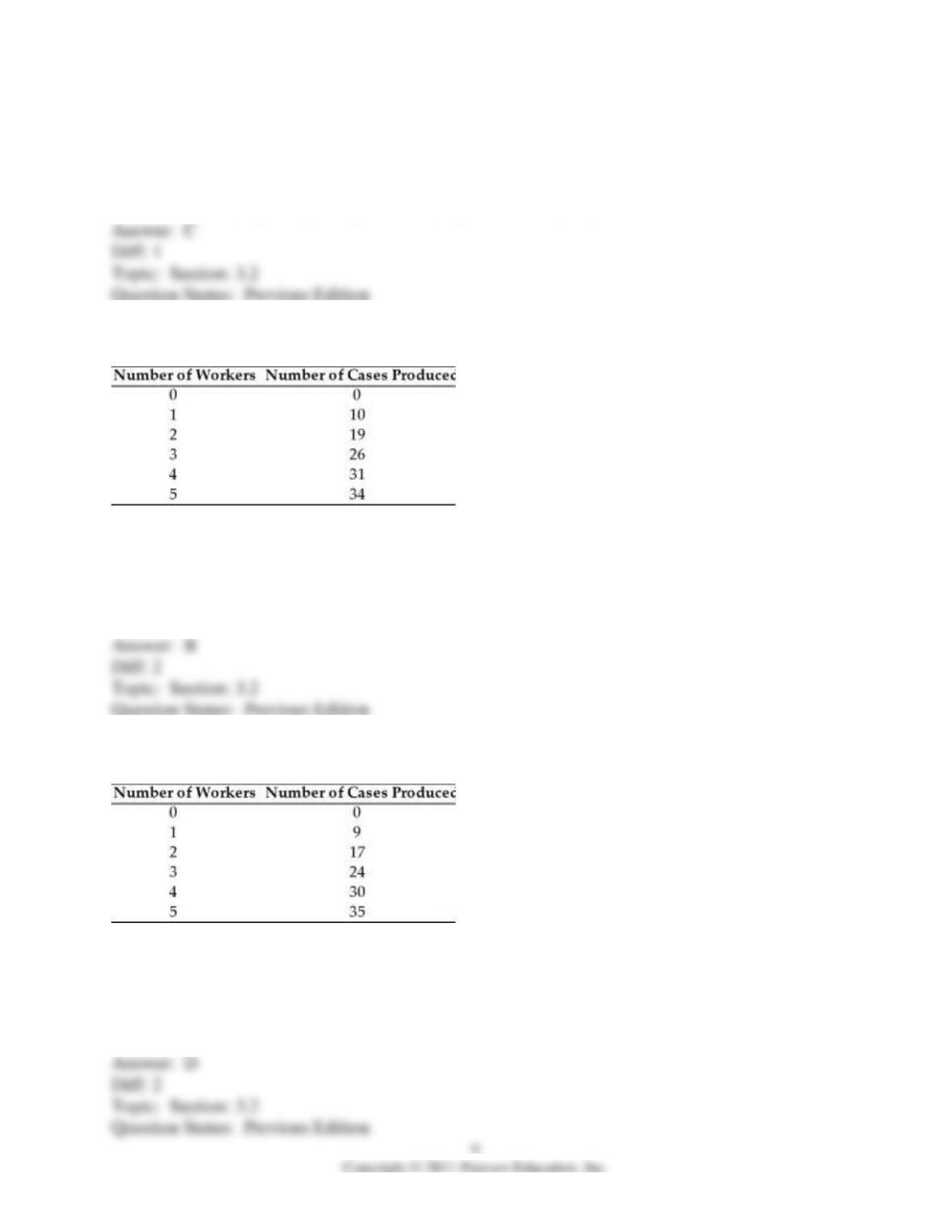
10) The Upstart Company has the following production function.
If the company hires 4 workers, which of the following could be the real wage rate?
A) 2
B) 4
C) 6
D) 8
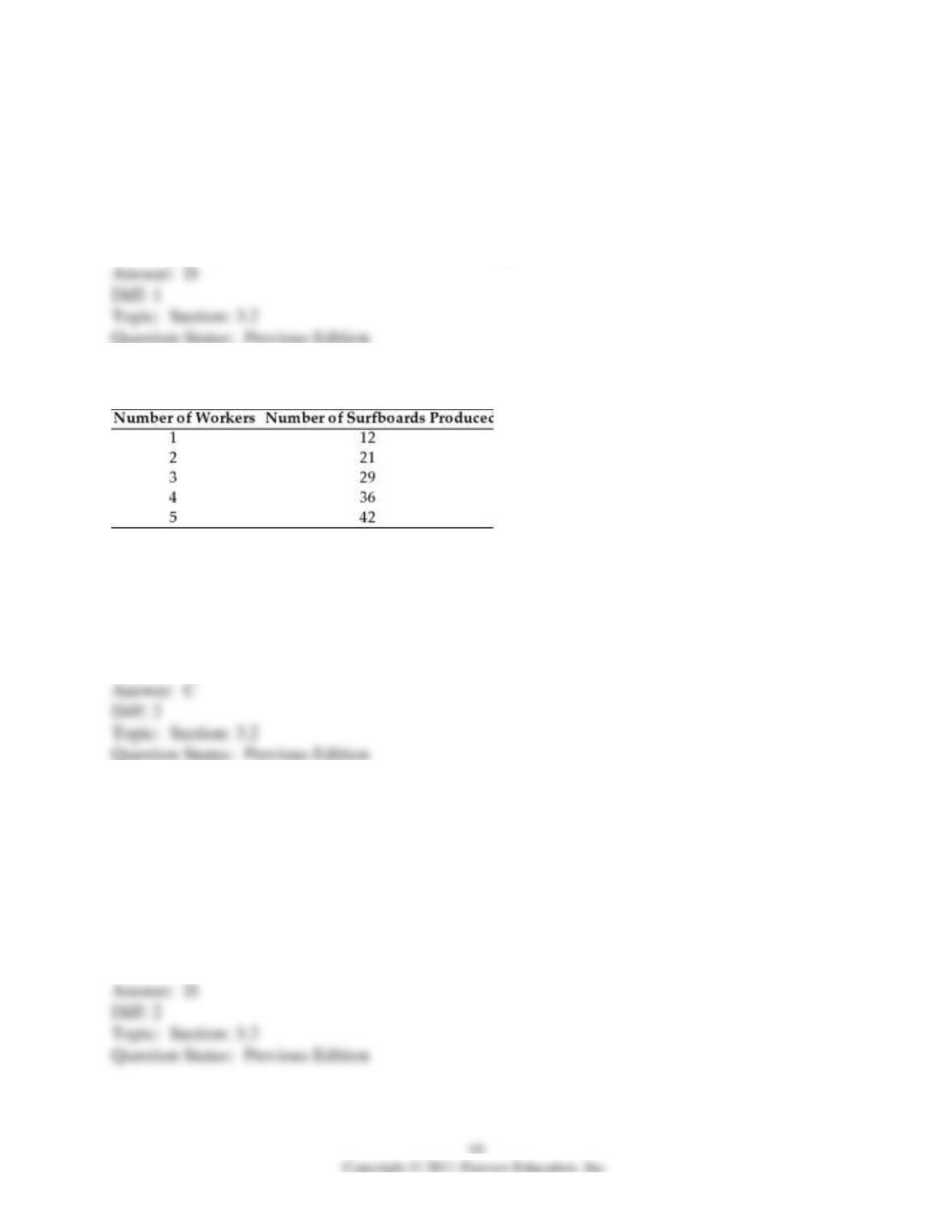
11) The Widget Company has the following production function.
If widgets sell for $6 each and the wage rate is $33, how many workers will the company hire?
A) 0
B) 1
C) 2
D) 4
12) Your boss wants to know if you should lay off any workers. You answer that you should lay
off workers if the
A) marginal revenue product of labor is greater than the nominal wage rate.
B) marginal product of labor is greater than or equal to the real wage rate.
C) marginal revenue product of labor is equal to the nominal wage rate.
D) marginal product of labor is less than the real wage rate.
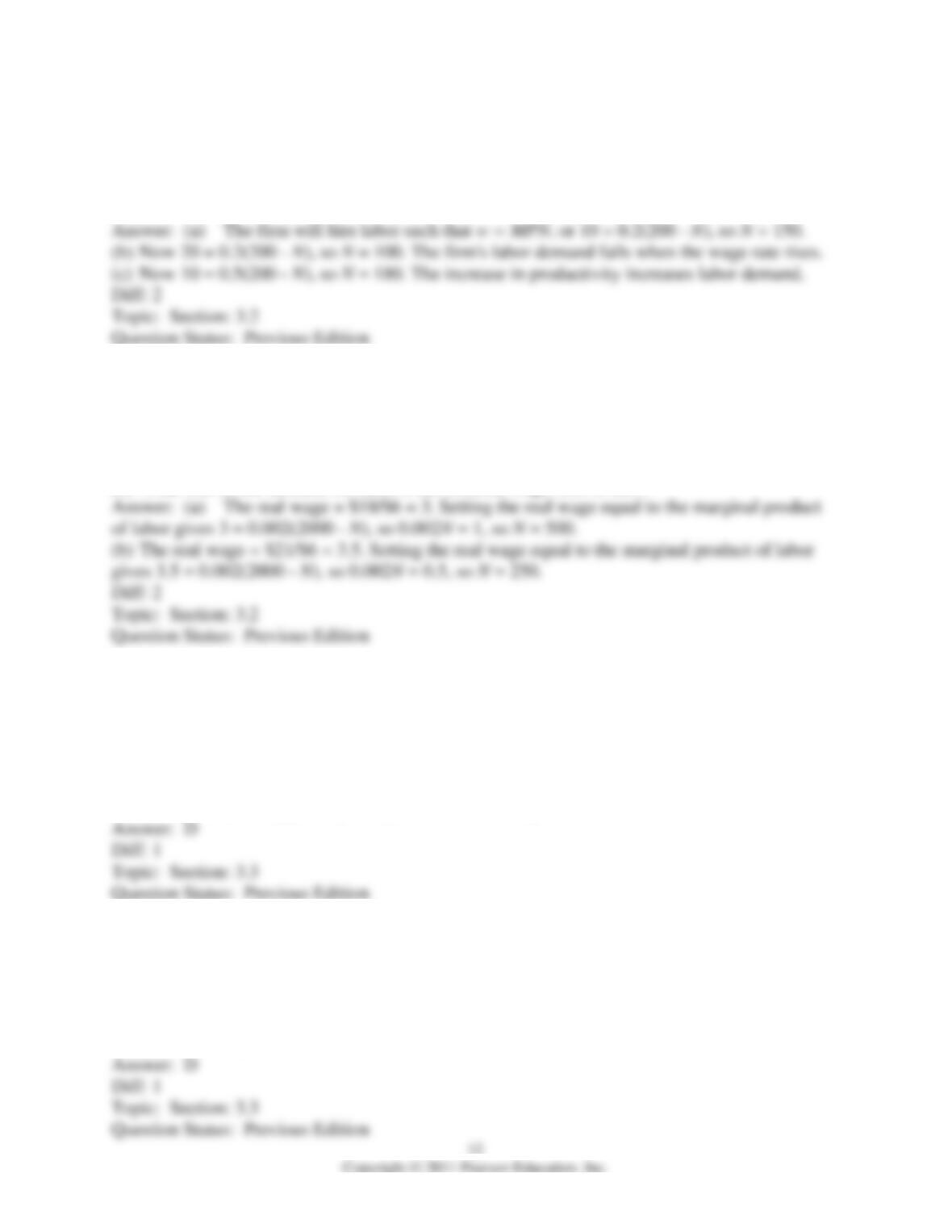
13) Zowie! Surfboards has the following production function.
If surfboards sell for $30 and the nominal wage rate is $200, how many workers should the firm
employ?
A) 2
B) 3
C) 4
D) 5
14) The marginal product of labor (measured in units of output) for Expando Corp. is given by
MPN = A(400 – N)
where A measures productivity and N is the number of labor hours used in production. Suppose
the price of output is $3 per unit and A = 2.0. What will be the demand for labor if the nominal
wage is $18?
A) 57
B) 107
C) 197
D) 397

15) An adverse supply shock, such as a reduced supply of raw materials, would
A) increase the marginal product of labor.
B) decrease the marginal product of labor.
C) decrease the marginal product of capital, but have no effect on the marginal product of labor.
D) not affect the marginal product of labor.
16) Which of the following events would lead to an increase in the marginal product of labor for
every quantity of labor?
A) An increase in the real wage
B) A decrease in the real wage
C) A favorable supply shock such as a fall in the price of oil
D) An adverse supply shock, such as a reduced supply of raw materials
17) A winter ice storm has paralyzed the entire east coast, reducing productivity sharply. This
supply shock shifts the marginal product of labor curve
A) up and to the right, raising the quantity of labor demanded at any given real wage.
B) down and to the left, reducing the quantity of labor demanded at any given real wage.
C) up and to the right, reducing the quantity of labor demanded at any given real wage.
D) down and to the left, raising the quantity of labor demanded at any given real wage.
18) A technological breakthrough in using photons for computers will increase the productivity
of those working with computers a hundredfold. You would expect this breakthrough to shift the
A) marginal product of labor curve up and to the right, raising the quantity of labor demanded at
any given real wage.
B) marginal product of labor curve down and to the left, reducing the quantity of labor demanded
at any given real wage.
C) labor supply curve up, reducing the quantity of labor demanded at any given real wage.
D) labor supply curve down, raising the quantity of labor demanded at any given real wage.
19) Suppose a firm’s hourly marginal product of labor is given by MPN = A (200 – N).
(a) If A = 0.2 and the real wage rate is $10 per hour, how much labor will the firm want to hire?
(b) Suppose the real wage rate rises to $20 per hour. How much labor will the firm want to hire?
(c) With the real wage rate at $10 per hour, how much labor will the firm want to hire if A rises
to 0.5?
20) The marginal product of labor (measured in units of output) of a firm is given by
MPN = A(2000 – N)
where A measures productivity and N is the number of labor hours used in production. Suppose
the price of output is $6 per unit and A = 0.002.
(a) What will be the demand for labor if the nominal wage is $18?
(b) What will be the demand for labor if the nominal wage rises to $21?
3.3 The Supply of Labor
1) The aggregate supply of labor is the
A) total amount of time a person works over his or her lifetime.
B) total amount of time a person spends in the labor force over his or her lifetime.
C) unemployment rate.
D) sum of the labor supplied by everyone in the economy.
2) The tendency of workers to supply more labor in response to a larger reward for working is
called the ________ of a higher real wage on the quantity of labor supplied.
A) homogeneous labor supply effect
B) negative correlation effect
C) income effect
D) substitution effect

3) The income effect of a higher real wage on the quantity of labor supply is the
A) idea that workers feel psychologically wealthier when wages are higher, so they work more.
B) effect that income must rise when wages rise.
C) tendency of workers to supply more labor in response to becoming wealthier.
D) tendency of workers to supply less labor in response to becoming wealthier.
4) If Jeff’s wage rate rises, he decides to work fewer hours. From this, we can infer that
A) for Jeff, the substitution effect is greater than the income effect.
B) for Jeff, the substitution effect is equal to the income effect.
C) for Jeff, the substitution effect is less than the income effect.
D) Jeff is a nitwit.
5) As a result of the superb economics essay that you wrote during this quarter, you won the
Adam Smith prize of $100. The receipt of these funds would be an example of
A) the substitution effect being stronger than the income effect.
B) the income effect being stronger than the substitution effect.
C) a pure income effect.
D) a pure substitution effect.
6) A person is more likely to increase labor supply in response to an increase in the real wage,
the ________ is the income effect and the ________ is the substitution effect.
A) larger; larger
B) larger; smaller
C) smaller; larger
D) smaller; smaller