Microeconomics Chapter 3 B—Supply, Demand, and the Market Process
MULTIPLE CHOICE
226. Suppose prices for new homes have risen and sales of new homes have also risen. We can conclude
that
a.
the demand for new homes has risen.
b.
the law of demand has been violated.
c.
new firms have entered the construction industry.
d.
construction firms must be facing higher costs.
227. If the demand for a good decreased, what would be the effect on the equilibrium price and quantity?
a.
Price would increase, and quantity would decrease.
b.
Price would decrease, and quantity would decrease.
c.
Price would increase, and quantity would increase.
d.
Price would decrease, and quantity would increase.
228. If we observe a decrease in the price of a good and a decrease in the amount of the good bought and
sold, this could be explained by
a.
an increase in the supply of the good.
b.
an increase in the demand for the good.
c.
a decrease in the demand for the good.
d.
a decrease in the supply of the good.
229. If the demand for a good increased, what would be the effect on the equilibrium price and quantity?
a.
Price would increase, and quantity would decrease.
b.
Price would decrease, and quantity would decrease.
c.
Price would increase, and quantity would increase.
d.
Price would decrease, and quantity would increase.
230. If we observe an increase in the price of a good and an increase in the amount of the good bought and
sold, this could be explained by
a.
an increase in the supply of the good.
b.
an increase in the demand for the good.
c.
a decrease in the demand for the good.
d.
a decrease in the supply of the good.
231. Between 1994 and 2004, the monthly charge for cellular phone service decreased from $120 per
month to $30 per month. At the same time, the number of subscribers increased from less than 10
million to more than 75 million. Which of the following provides the best explanation for these
changes?
a.
an increase in consumer income between 1994 and 2004
b.
a reduction in the price of residential phone service, a substitute for cellular phone service
c.
an increase in the wages of workers in the cellular phone industry
d.
technological improvements that reduced the cost of supplying cellular phone service
232. If the supply of a good decreased, what would be the effect on the equilibrium price and quantity?
a.
Price would increase, and quantity would decrease.
b.
Price would decrease, and quantity would decrease.
c.
Price would increase, and quantity would increase.
d.
Price would decrease, and quantity would increase.
233. If we observe an increase in the price of a good and a decrease in the amount of the good bought and
sold, this could be explained by
a.
an increase in the supply of the good.
b.
an increase in the demand for the good.
c.
a decrease in the demand for the good.
d.
a decrease in the supply of the good.
234. If we observe a decrease in the price of a good and an increase in the amount of the good bought and
sold, this could be explained by
a.
an increase in the supply of the good.
b.
an increase in the demand for the good.
c.
a decrease in the demand for the good.
d.
a decrease in the supply of the good.
235. How would a decrease in consumer income affect the market for new furniture?
a.
Demand would decrease, leading to an increase in price and a reduction in quantity sold.
b.
Demand would decrease, leading to a reduction in price and a reduction in quantity sold.
c.
Demand would increase, leading to an increase in price and an increase in quantity sold.
d.
Demand would increase, leading to a reduction in price and an increase in quantity sold.
236. If there is a decrease in demand for lettuce, we would expect
a.
both the price and quantity sold to increase.
b.
both the price and quantity sold to decrease.
c.
the price to decrease and the quantity sold to increase.
d.
the price to increase and the quantity sold to decrease.
237. Which of the following would most likely cause both a decrease in the price of plasma screen TVs and
a decrease in the number sold?
a.
an increase in the supply of plasma screen TVs
b.
an increase in the demand for plasma screen TVs
c.
a decrease in the supply of plasma screen TVs
d.
a decrease in the demand for plasma screen TVs
238. Which of the following is the most likely effect of lower apple juice prices on the price and quantity
purchased of orange juice, a substitute product?
a.
The price of orange juice will increase, and the quantity purchased will fall.
b.
The price of orange juice will fall, and the quantity purchased will increase.
c.
The price of orange juice will increase, and the quantity purchased will increase.
d.
The price of orange juice will fall, and the quantity purchased will fall.
239. A recent study suggested that moderate wine drinking may actually benefit one’s health. If this
information leads to an increased demand for wine, we would expect
a.
both the price and quantity of wine sold to increase.
b.
both the price and quantity of wine sold to decrease.
c.
the price to decrease and the quantity of wine sold to increase.
d.
the price to increase and the quantity of wine sold to decrease.
240. After a hurricane in Florida knocked out the regional water supply for several days, the demand for
bottled water increased sharply. In a market economy, how will this increase in demand affect the
equilibrium price and quantity of bottled water?
a.
Price will increase, and quantity will decrease.
b.
Price will decrease, and quantity will decrease.
c.
Price will decrease, and quantity will increase.
d.
Price will increase, and quantity will increase.
241. An increase in the demand for tattoos will lead to a
a.
higher price and a larger quantity sold.
b.
lower price and a larger quantity sold.
c.
higher price and a smaller quantity sold.
d.
lower price and a smaller quantity sold.
242. How will an increase in the price of coffee affect the market for cocoa, a substitute good?
a.
The supply of cocoa will increase, leading to a reduction in the price of cocoa.
b.
The supply of cocoa will decrease, leading to an increase in the price of cocoa.
c.
The demand for cocoa will increase, leading to an increase in the price of cocoa.
d.
The demand for cocoa will decrease, leading to a reduction in the price of cocoa.
243. Which of the following is the most likely effect of higher chicken prices on the price and quantity
purchased of beef, a substitute product?
a.
The price of beef will increase, and the quantity purchased will fall.
b.
The price of beef will fall, and the quantity purchased will increase.
c.
The price of beef will increase, and the quantity purchased will increase.
d.
The price of beef will fall, and the quantity purchased will fall.
244. If Georgia experiences a late frost that damages the peach crop, we should expect the
a.
supply curve for peaches to shift to the right and the price of peaches to fall.
b.
supply curve for peaches to shift to the left and the price of peaches to rise.
c.
demand curve for peaches to shift to the left and the price of peaches to fall.
d.
demand curve for peaches to shift to the right and the price of peaches to rise.
245. Suppose a new law requires all piercing studios to pass tougher licensing tests and to begin using more
costly sterilization methods. Other things constant, this law would cause
a.
an increase in the supply of piercings and a lower price for piercings.
b.
an increase in the supply of piercings and a higher price for piercings.
c.
a decrease in the supply of piercings and a higher price for piercings.
d.
a decrease in the supply of piercings and a lower price for piercings.
246. Which of the following will most likely result from a destruction of half of the Florida orange crop due
to a hard freeze?
a.
a decrease in the demand for oranges
b.
an increase in the supply of oranges
c.
an increase in the quantity of oranges bought and sold
d.
an increase in the price of oranges
247. During a major war between two oil producing nations, there would likely be
a.
an increase in the price of oil because the supply of oil would decrease.
b.
an increase in the price of oil because the supply of oil would increase.
c.
a decrease in the price of oil because the supply of oil would decrease.
d.
a decrease in the price of oil because the supply of oil would increase.
248. How would a decrease in the cost of production affect the market for new washing machines?
a.
Supply would decrease, leading to an increase in price and a reduction in quantity sold.
b.
Supply would decrease, leading to a reduction in price and a reduction in quantity sold.
c.
Supply would increase, leading to an increase in price and an increase in quantity sold.
d.
Supply would increase, leading to a reduction in price and an increase in quantity sold.
249. Which of the following would reduce the price of DVD players and increase the quantity sold?
a.
an increase in the demand for DVD players
b.
a decrease in the demand for DVD players
c.
a decrease in the supply of DVD players
d.
an increase in the supply of DVD players
250. How would a decrease in the price of the feed grains used to feed cattle affect the market for beef?
a.
The demand for beef would increase, increasing beef prices.
b.
The demand for beef would decrease, decreasing beef prices.
c.
The supply of beef would increase, decreasing beef prices.
d.
The supply of beef would decrease, increasing beef prices.
251. Which of the following would most likely increase the price of automobiles?
a.
a decrease in the price of steel used to produce automobiles
b.
an increase in the price of gasoline
c.
a decrease in consumer income
d.
the United Auto Workers union obtaining a substantial wage increase for auto workers
252. Which of the following would increase the price of fitness equipment?
a.
a reduction in consumer income
b.
a major study indicating that a 30-minute workout each day improved health more than
was previously thought to be the case
c.
a decrease in the price of steel used to produce the equipment
d.
all of the above
253. Which of the following is most likely to lead to an increase in the rental price of apartments near your
campus?
a.
lower property taxes on apartment buildings
b.
an unexpected increase in enrollment at your college
c.
lower prices for the bricks used in the construction of apartments
d.
the building of a new large dormitory on the college campus
254. Which of the following is most likely to result in higher prices of tickets at movie theatres near your
campus?
a.
an unexpected increase in enrollment at your college
b.
lower electricity rates that reduces the cost of keeping the theater at a comfortable
temperature
c.
lower prices for video tape and DVD movie rentals in the stores near your campus
d.
an increase in tuition at your school that lowers enrollment
255. Which of the following would decrease the price of packaged hot dogs?
a.
an increase in the price of hot dog buns, a complement to packaged hot dogs
b.
a decrease in the price of hamburger meat, a substitute for packaged hot dogs
c.
a technological advance that lowers the cost of producing packaged hot dogs
d.
all of the above
256. Which of the following will most likely decrease the current price of personal computers?
a.
a technological advance that decreases the production costs of personal computers
b.
an increase in consumer income
c.
development of new software that makes it easier for more people to use personal
computers
d.
the expectation that the price of personal computers will increase during the next six
months
257. Which of the following would most likely cause the price of wheat to decline?
a.
an increase in the production costs of corn, a substitute for wheat
b.
a decrease in the price of soybeans, a substitute for wheat
c.
an increase in the price of fertilizer, a resource used to produce wheat
d.
a sandwich craze among Americans, causing increased demand for whole-wheat bread
258. Suppose demand decreases and supply decreases. Which of the following will happen?
a.
Equilibrium price will rise, fall, or stay the same while equilibrium quantity will decrease.
b.
Equilibrium price will rise, fall, or stay the same while equilibrium quantity will increase
c.
Equilibrium quantity will rise, fall, or stay the same and equilibrium price will increase.
d.
Equilibrium quantity will rise, fall, or stay the same while equilibrium price will decrease.
e.
The change in equilibrium price and quantity cannot be determined.
259. Suppose demand decreases and supply increases. Which of the following will happen?
a.
Equilibrium price will rise, fall, or stay the same while equilibrium quantity will decrease.
b.
Equilibrium price will rise, fall, or stay the same while equilibrium quantity will increase.
c.
Equilibrium quantity will rise, fall, or stay the same and equilibrium price will increase.
d.
Equilibrium quantity will rise, fall, or stay the same while equilibrium price will decrease.
e.
The change in equilibrium price and quantity cannot be determined.
260. Suppose demand increases and supply increases. Which of the following will happen?
a.
Equilibrium price will rise, fall, or stay the same while equilibrium quantity will decrease.
b.
Equilibrium price will rise, fall, or stay the same while equilibrium quantity will increase.
c.
Equilibrium quantity will rise, fall, or stay the same and equilibrium price will increase.
d.
Equilibrium quantity will rise, fall, or stay the same while equilibrium price will decrease.
e.
The change in equilibrium price and quantity cannot be determined.
261. Suppose demand increases and supply decreases. Which of the following will happen?
a.
Equilibrium price will rise, fall, or stay the same while equilibrium quantity will decrease.
b.
Equilibrium price will rise, fall, or stay the same while equilibrium quantity will increase.
c.
Equilibrium quantity will rise, fall, or stay the same and equilibrium price will increase.
d.
Equilibrium quantity will rise, fall, or stay the same while equilibrium price will decrease.
e.
The change in equilibrium price and quantity cannot be determined.
262. Assume that supply increases slightly and demand increases greatly. Which of the following will
happen?
a.
Equilibrium price will fall and equilibrium quantity will rise.
b.
Equilibrium price will rise and equilibrium quantity will fall.
c.
Equilibrium price will rise and equilibrium quantity will rise.
d.
Equilibrium price will fall and equilibrium quantity will fall.
e.
Neither equilibrium price nor equilibrium quantity will change.
263. Assume that supply increases greatly and demand increases slightly. Which of the following will
happen?
a.
Equilibrium price will fall and equilibrium quantity will rise.
b.
Equilibrium price will rise and equilibrium quantity will fall.
c.
Equilibrium price will rise and equilibrium quantity will rise.
d.
Equilibrium price will fall and equilibrium quantity will fall.
e.
Neither equilibrium price nor equilibrium quantity will change.
264. Assume that supply decreases slightly and demand decreases greatly. Which of the following will
happen?
a.
Equilibrium price will fall and equilibrium quantity will rise.
b.
Equilibrium price will rise and equilibrium quantity will fall.
c.
Equilibrium price will rise and equilibrium quantity will rise.
d.
Equilibrium price will fall and equilibrium quantity will fall.
e.
Neither equilibrium price nor equilibrium quantity will change.
265. Assume that supply decreases greatly and demand decreases slightly. Which of the following will
happen?
a.
Equilibrium price will fall and equilibrium quantity will rise.
b.
Equilibrium price will rise and equilibrium quantity will fall.
c.
Equilibrium price will rise and equilibrium quantity will rise.
d.
Equilibrium price will fall and equilibrium quantity will fall.
e.
Neither equilibrium price nor equilibrium quantity will change.
266. Suppose both the equilibrium price and quantity rise for a particular product. Which of the following
best explains this situation?
a.
Supply and demand simultaneously increased and the shift in supply was greater than the
shift in demand.
b.
Supply and demand simultaneously increased and the shift in supply was less than the
shift in demand.
c.
Supply and demand simultaneously decreased and the shift in supply was greater than the
shift in demand.
d.
Supply and demand simultaneously decreased and the shift in supply was less than the
shift in demand.
267. Suppose both the equilibrium price and quantity fall for a particular product. Which of the following
best explains this situation?
a.
Supply and demand simultaneously increased and the shift in supply was greater than the
shift in demand.
b.
Supply and demand simultaneously increased and the shift in supply was less than the
shift in demand.
c.
Supply and demand simultaneously decreased and the shift in supply was greater than the
shift in demand.
d.
Supply and demand simultaneously decreased and the shift in supply was less than the
shift in demand.
268. If there is a decrease in both the supply and demand for a good, which of the following will definitely
occur?
a.
The price of the good will increase.
b.
The price of the good will decrease.
c.
The equilibrium quantity will increase.
d.
The equilibrium quantity will decrease.
269. If there is an increase in both the supply and demand for a good, which of the following will definitely
occur?
a.
The price of the good will increase.
b.
The price of the good will decrease.
c.
The equilibrium quantity will increase.
d.
The equilibrium quantity will decrease.
270. Prices direct economic activity in a market economy by
a.
influencing the actions of buyers and sellers.
b.
reducing scarcity of the goods and services produced.
c.
eliminating the need for government intervention.
d.
allocating goods and services in the most equitable way.
271. Which of the following observations was made famous by Adam Smith in his book The Wealth of
Nations?
a.
There is no such thing as a free lunch.
b.
People buy more when prices are low than when prices are high.
c.
No matter how much people earn, they tend to spend more than they earn.
d.
Households and firms interacting in markets are guided by an “invisible hand” that leads
them to desirable market outcomes.
272. According to the invisible hand principle, competitive markets generally
a.
bring the self-interest of individuals into harmony with the efficient allocation of
resources, even though centralized planning of economic activities is absent.
b.
bring the self-interest of individuals into harmony with the efficient allocation of resources
when the behavior of individuals is directed by democratic centralized planning.
c.
require central direction; otherwise, the actions of self-interested individuals will conflict
with the general interests of society.
d.
promote the economic welfare of self-interested producers at the expense of unorganized
groups such as consumers and taxpayers.
273. Adam Smith’s invisible hand principle stresses
a.
that benevolence is a powerful motivator that encourages individuals to engage in
productive economic activity.
b.
the tendency of the competitive market process to direct self-interested individuals into
activities that enhance the economic welfare of society.
c.
the potential of government regulation as a means of bringing the self interest of
individuals into harmony with the economic welfare of society.
d.
the tendency of self-interested individuals to pursue activities that benefit themselves but
harm the overall economic welfare of society.
274. Which of the following most accurately describes the invisible hand concept?
a.
Wise central planning by government is necessary for the efficient use of resources.
b.
In a democratic setting, majority rule will result in the efficient use of resources.
c.
In a market setting, when individuals pursue their own interests, they simultaneously tend
to promote the public interest.
d.
In a market setting, when individuals pursue their own interests, they tend to engage in
activities that lower the overall economic welfare of society.
275. Which of the following is a major implication of the invisible hand concept?
a.
When directed by competitive market prices, the actions of self-interested individuals will
tend to promote overall economic prosperity.
b.
Prosperity cannot be achieved unless the selfish nature of people can be changed.
c.
Competition is harmful to the health of an economy because it results in wasteful
duplication.
d.
Government-operated firms tend to have higher efficiency and lower costs than private
sector firms.
276. When the “invisible hand” guides economic activity, prices of products reflect
a.
only the values that society places on those products.
b.
only the costs to society of producing those products.
c.
both the values that society places on those products and the costs to society of producing
those products.
d.
none of the above; when the “invisible hand” guides economic activity, prices of products
are set by the government in a manner that is thought to be “fair.”
277. Which of the following is not a function of prices in a market system?
a.
Prices have the crucial job of balancing supply and demand.
b.
Prices send signals to buyers and sellers to help them make rational economic decisions.
c.
Prices coordinate economic activity.
d.
Prices ensure an equitable distribution of goods and services among consumers.
278. According to Adam Smith, what is the primary source of a nation’s wealth?
a.
The amount of gold and silver in the government’s possession.
b.
A spirit of cooperation in which people share according to their means.
c.
Strong central planning authorities.
d.
The people’s ability to produce products and trade in free markets.
279. “He [the producer] intends only his gain, and he is in this, as in many other cases, led by an invisible
hand to promote an end which was no part of his intention.” What famous economist made this
statement?
a.
Alfred Marshall
b.
Friedrich Hayek
c.
Adam Smith
d.
David Ricardo
280. In his book The Wealth of Nations, this famous economist argued that economic activity was directed
by an “invisible hand.”
a.
Alfred Marshall
b.
Milton Friedman
c.
Adam Smith
d.
David Ricardo
281. “He [the producer] intends only his gain, and he is in this, as in many other cases, led by an invisible
hand to promote an end which was no part of his intention.” What is the “invisible hand” referred to in
this statement?
a.
the elasticity of the market demand curve
b.
the power of government when decisions are made democratically
c.
the guidelines and regulations set for his industry by the government
d.
the incentive structure accompanying market prices
282. The invisible hand principle, as developed by Adam Smith in The Wealth of Nations, states that
a.
government control over economic activity is essential for the talents of individuals to be
directed toward their highest valued use.
b.
the economic wealth of a nation is determined by a nation’s holdings of precious metals,
such as gold and silver.
c.
public policy should prohibit domestic producers from selling their goods to foreigners.
d.
competitive markets will bring individual self-interest and the public interest into
harmony.
283. According to Adam Smith’s invisible hand principle, productive actions that promote the general
welfare of society will be undertaken when
a.
political representatives are elected democratically.
b.
competitive markets direct the actions of self-interested individuals.
c.
the selfish instincts of individuals are controlled.
d.
workers are able to organize and develop strong unions.
284. Market prices are
a.
conveyors of information.
b.
determined by the interactions of supply and demand in voluntary exchange.
c.
indicators of the relative scarcity of resources and products.
d.
all of the above.
285. Which of the following is a function performed by market prices?
a.
Market prices communicate information to buyers and sellers.
b.
Market prices coordinate the decisions of buyers and sellers.
c.
Market prices motivate entrepreneurs to produce those products that are currently most
desired relative to their costs of production.
d.
All of the above are functions performed by market prices.
286. Under competitive conditions, market prices
a.
generally convey little information about the value and cost of goods.
b.
do not usually have much of an effect on the decisions of individuals.
c.
are incapable of coordinating the actions of buyers and sellers.
d.
generally bring the self-interest of individuals into harmony with the general welfare.
287. Price is important in a market economy because it
a.
eliminates imbalances between supply and demand.
b.
serves as the rationing mechanism for the limited supplies of goods and services.
c.
coordinates the choices of consumers and producers and brings them into harmony.
d.
is all of the above.
288. Market prices generally promote social cooperation because they
a.
clarify the options available to people and encourage individuals to help others in
exchange for income.
b.
encourage government officials to levy taxes to provide people with the necessities of life.
c.
eliminate scarcity by allowing prices to rise.
d.
reward only altruistic actions, whereby, people seek to help others without the expectation
of personal gain.
289. Market prices provide information to consumers, helping them coordinate their activities so long as
a.
competition is present and buyers and sellers are free to choose mutually agreeable prices.
b.
prices are not allowed to rise too high, causing a shortage.
c.
prices are legally kept equal in all markets, preventing unfair price increases in markets
with shortages and unfair price decreases when a market surplus is present.
d.
the government carefully screens producers and effectively keeps inefficient producers out
of the market.
290. Which of the following is necessary for the invisible hand of market prices to work properly?
a.
buyers and sellers who generally tend to disregard their own self-interest
b.
democratic political procedures and highly regulated markets
c.
price controls that restrict the movement of market prices
d.
competition and property rights that are well-defined and enforced
291. When oil prices increased to record levels in the 1970s, salaries dramatically increased for petroleum
geologists skilled in finding oil. Those geologists who moved from other areas to the higher paying
jobs were
a.
seeking to profit from society’s needs rather than following the guidance of the invisible
hand, which would have led them to seek jobs serving society rather than jobs with higher
pay.
b.
following the guidance of the invisible hand and probably serving society’s best interests
as well as their own.
c.
causing oil prices to rise even more by moving to jobs with higher salaries.
d.
helping themselves but hurting the economy.
292. When an unusually bad frost reduces the apple crop in Washington state, the price of canned apple
juice may rise immediately in supermarkets, even though the juice on the shelves was made from last
year’s plentiful crop. The invisible hand theory tells us that the profit-seeking merchants who raise
their prices in such situations
a.
are hurting the economy, since the juice now on the shelves was produced at a lower cost.
b.
are profiting by rationing the juice, which is now more scarce to the consumers willing to
pay the most for the now more limited supply.
c.
are ignoring the motivating function of prices, which the invisible hand theory holds
should be set according to the cost paid by the merchant.
d.
will not actually profit since they are ignoring a basic economic rule: Only raise prices
when consumer demand increases.
293. When experts first predicted major weather-related coffee crop failures in Central and South America
in 1986, the price of coffee already on grocery shelves in the United States increased sharply. When
coffee became temporarily more scarce, the usefulness to society of “coffee conservation” increased.
The immediate sharp price increase (which soon leveled off) gave consumers an incentive to
a.
buy all the coffee they could at the higher prices and hoard it, since there was obviously a
shortage.
b.
drink as much coffee as possible at the higher price.
c.
start conserving coffee immediately and switch to other beverages if it was easy to do so.
d.
ignore the price of coffee and drink it as they normally would.
294. When a conflict arises in a major oil-exporting area of the world, such as the Middle East, the price of
gasoline already in the storage tanks at local gas stations usually increases. Which of the following
best explains this occurrence?
a.
Gas station owners anticipate consumers will buy more gasoline as gasoline prices
increase.
b.
Gas station owners are attempting to repeal the laws of supply and demand.
c.
Gas station owners anticipate higher replacement costs for their supply of gasoline and,
therefore, raise their prices in response to this higher expected cost.
d.
A decline in consumer demand generally causes gas station owners to raise their prices.
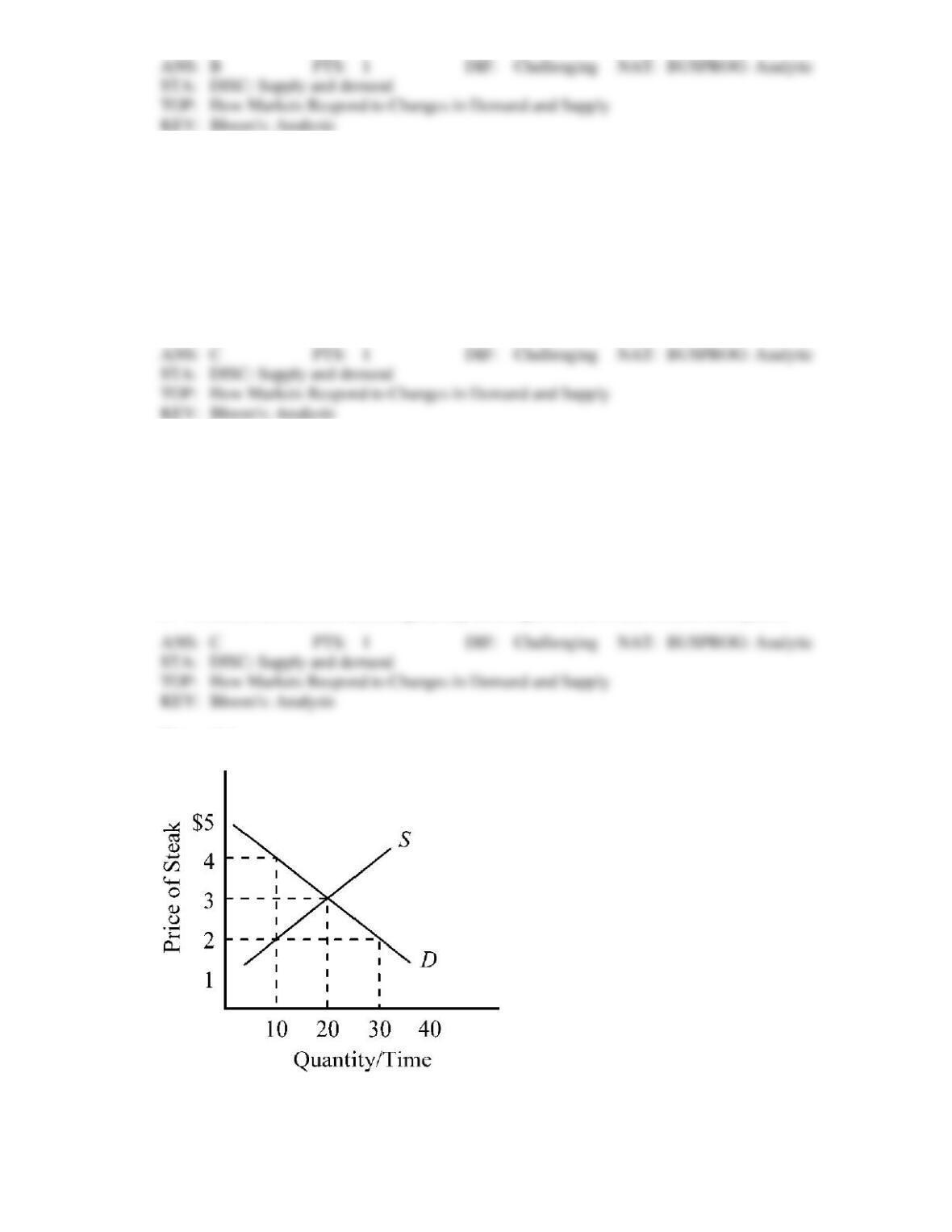
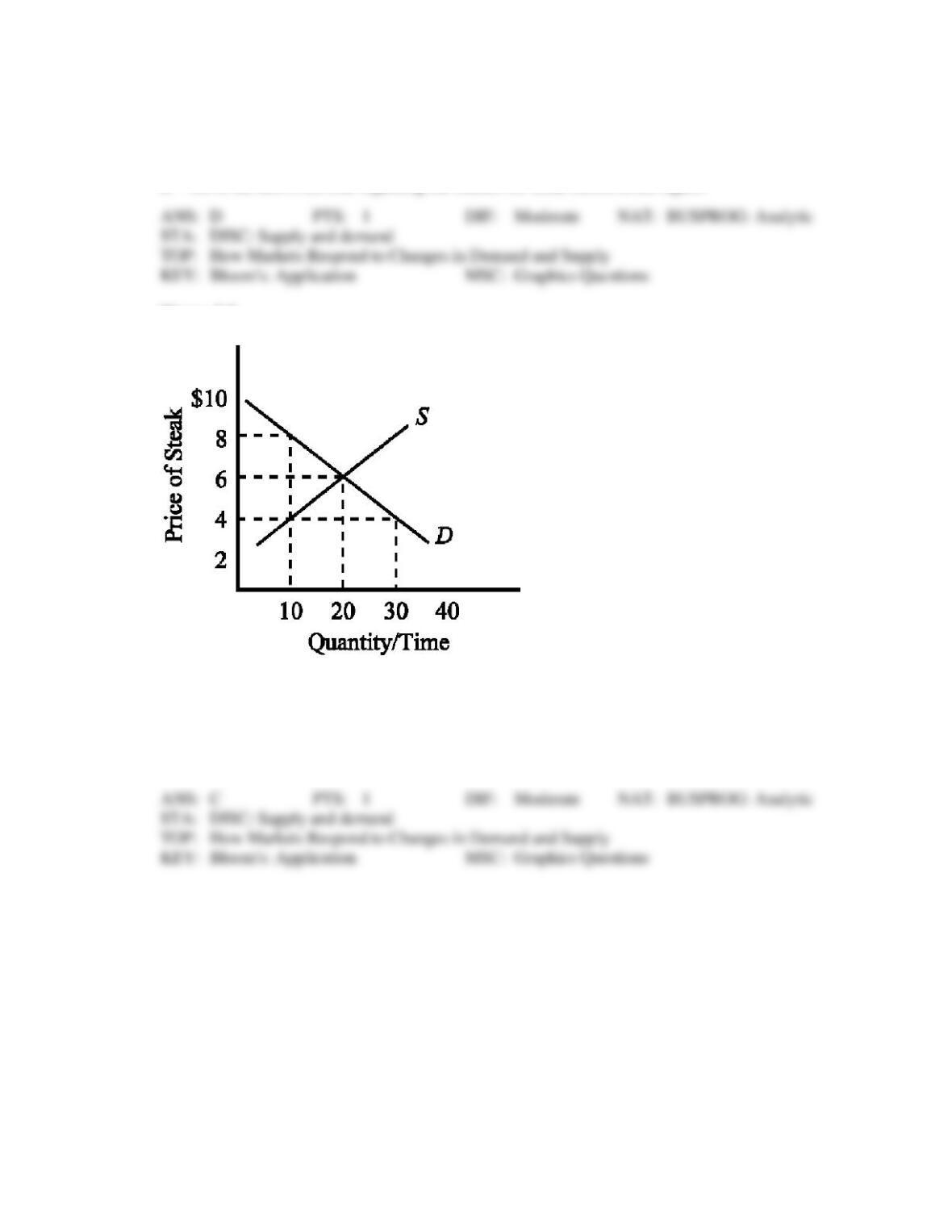
Figure 3-1
295. Which of the following is true regarding the market for steak shown in Figure 3–1?
a.
If the price of steak were $2 per pound, producers would want to supply less steak than
consumers would want to buy.
b.
If the price of steak were $4 per pound, producers would want to supply more steak than
consumers would want to buy.
c.
If the price of steak were $3 per pound, producers would want to supply the same amount
of steak that consumers would want to buy.
d.
All of the above are true regarding the market for steak shown in the figure.
Figure 3-2
296. Given the supply and demand conditions illustrated in Figure 3-2, the equilibrium price of steak is
a.
$2 per pound.
b.
$4 per pound.
c.
$6 per pound.
d.
$8 per pound.
Use the figure below to answer the following question(s).
Figure 3-3
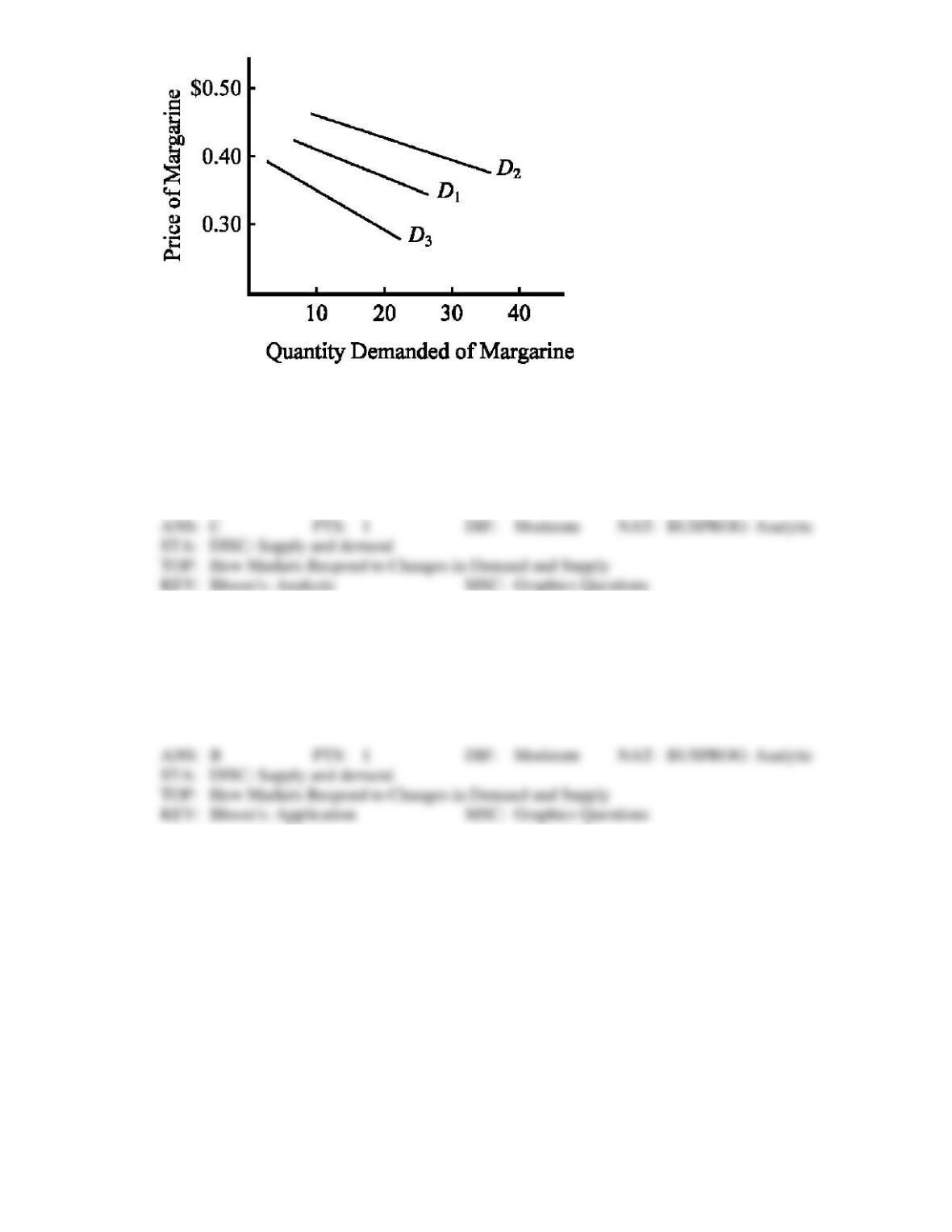
297. In Figure 3-3, if the initial demand for margarine were D1, the impact of an increase in the price of
margarine from $0.35 to $0.40 per pound on consumer purchases would be illustrated as
a.
a shift in the demand curve to D2.
b.
a shift in the demand curve to D3.
c.
a movement upward to the left along the original demand curve D1.
d.
none of the above.
298. In Figure 3-3, if the initial demand for margarine were D1, the impact of a decrease in the price of
butter, a substitute good for margarine, would be illustrated as
a.
a shift in the demand curve to D2.
b.
a shift in the demand curve to D3.
c.
a movement downward to the right along the original demand curve D1.
d.
none of the above.
Figure 3-4
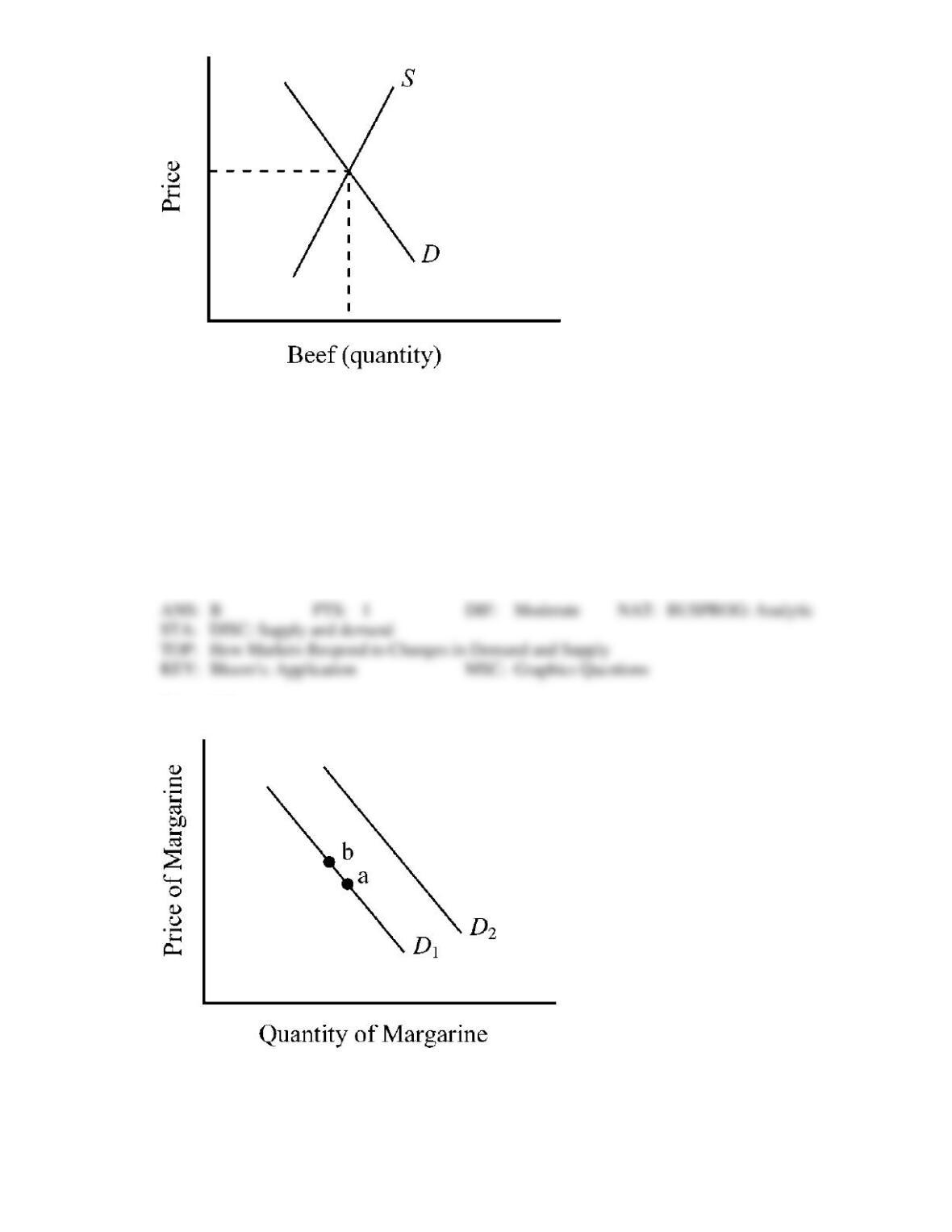
299. Figure 3-4 shows conditions in the market for beef. A reduction in the price of the grain used to feed
cattle results in
a.
the supply curve for beef shifting to the left resulting in higher beef prices and a lower
quantity sold.
b.
the supply curve for beef shifting to the right resulting in lower beef prices and a higher
quantity sold.
c.
the demand curve for beef shifting to the left resulting in lower beef prices and a lower
quantity sold.
d.
the demand curve for beef shifting to the right resulting in higher beef prices and a higher
quantity sold.
Figure 3-5
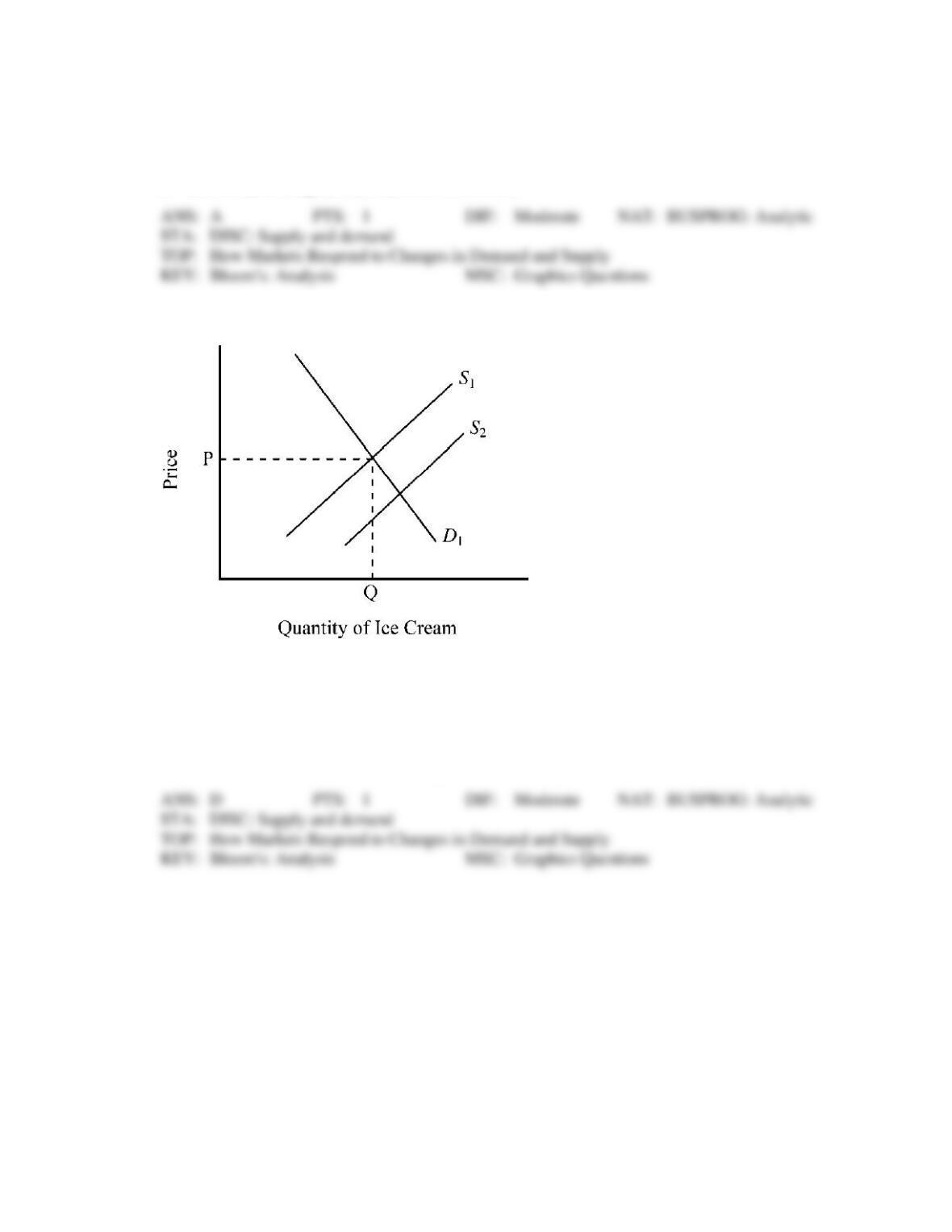
300. In Figure 3-5, if the initial demand for margarine were D1, an increase in the price of butter, which is a
substitute for margarine, would tend to cause which of the following changes in the market for
margarine?
a.
a shift in the demand curve from D1 to D2
b.
a shift in the demand curve from D2 to D1
c.
a movement along demand curve D1 from a to b
d.
a movement along demand curve D1 from b to a
Figure 3-6
301. In Figure 3-6, suppose D1 and S1 indicate initial conditions in the market for ice cream. Which of the
following changes would tend to cause a shift from S1 to S2 in the market for ice cream?
a.
an increase in the price of sugar, an ingredient used to produce ice cream
b.
a decrease in the price of frozen yogurt, a substitute for ice cream
c.
abnormally hot weather that temporarily increases consumer desire for ice cream
d.
a decrease in the price of milk, an ingredient used to produce ice cream
Figure 3-7