Macroeconomics: Policy and Practice, 2e (Mishkin)
Chapter 3 Aggregate Production and Productivity
3.1 Determinants of Aggregate Production
1) Which of the following constitutes an input to the Cobb-Douglas production function?
A) capital
B) labor
C) total factor productivity
D) all of the above
E) none of the above
2) To analyze aggregate productivity, economists typically assume ________.
A) that the hours each person works varies with the wage rate
B) that all of the capital and labor in the economy are fully utilized
C) that output can increase only if inputs have become more productive
D) all of the above
E) none of the above
3) The output an economy can produce with one unit of capital and one unit of labor is
________.
A) indicated by the A variable in the Cobb-Douglas production function
B) commonly referred to as labor productivity
C) a variable that depends on how many units of capital and labor are available
D) all of the above
E) none of the above
4) What does the Cobb-Douglas production function assume about the input shares in the
economy?
A) the capital share is larger than the labor share of income
B) both the capital and labor shares of income grow over time
C) both the capital and labor shares of income remain relatively constant over time
D) the capital share of income is equal to the labor share of income
E) none of the above

5) What does the Cobb-Douglas production function assume about the input shares in the
economy?
A) the capital share is smaller than the labor share of income
B) both the capital and labor shares of income are positive
C) both the capital and labor shares of income remain relatively constant over time
D) all of the above
E) none of the above
6) Which of the following is true about labor productivity?
A) it is the amount of total factor productivity (TFP) per unit of labor
B) it is more difficult to measure than TFP
C) it is a more general and better measure of productivity than TFP
D) all of the above
E) none of the above
7) Which of the following is true about labor productivity?
A) it is the amount of output produced per unit of labor
B) it is easier to measure than total factor productivity (TFP)
C) it is more commonly mentioned in the media than total factor productivity (TFP)
D) all of the above
E) none of the above
8) Which of the following is true about total factor productivity (TFP)?
A) it tells us how productive capital and labor are
B) it is a more general and better measure of productivity than labor productivity
C) it is not directly measurable
D) all of the above
E) none of the above
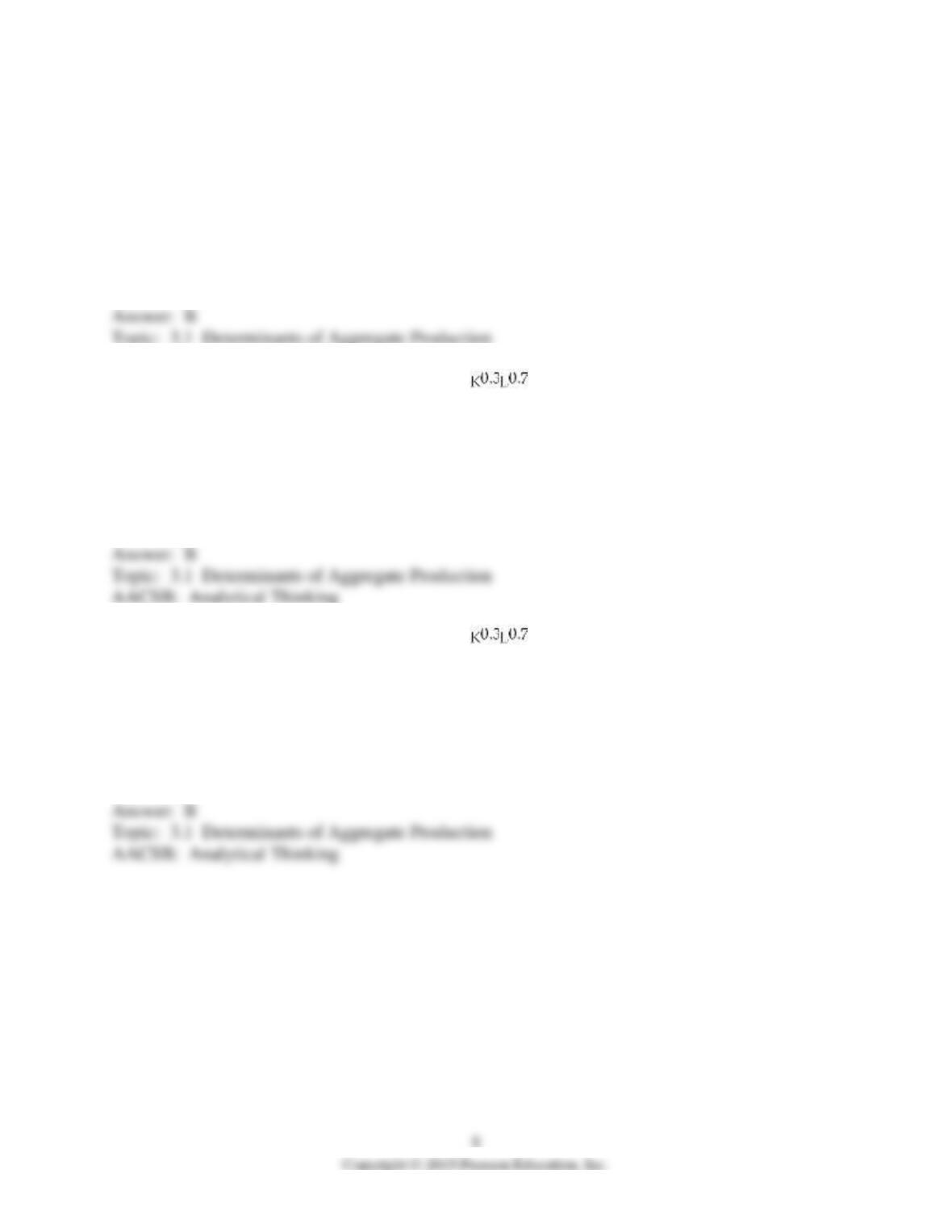
9) Which of the following is true about total factor productivity (TFP)?
A) it can be measured just like capital and labor
B) it cannot be directly measured so it has to be calculated from given values of capital, labor
and output
C) while it cannot be measured directly, it has an exponent of 0.3 in the Cobb-Douglas
production function
D) while it cannot be measured directly, it has an exponent of 0.7 in the Cobb-Douglas
production function
E) none of the above
10) Suppose than an economy has output Y = A , that Y equals $12 trillion, capital K is
$27 trillion, and labor L is 64 million workers. Given this information, what is the closest
approximation of total factor productivity A?
A) less than 0.01
B) around 0.25
C) roughly 0.33
D) close to 0.4
E) exactly 144
11) Suppose than an economy has output Y = A , that Y equals $19 trillion, capital K is
$27 trillion, and labor L is 125 million workers. Given this information, what is the closest
approximation of total factor productivity A?
A) less than 0.01
B) around 0.25
C) roughly 0.33
D) close to 0.4
E) exactly 144

12) Suppose than an economy has output Y = A , that Y equals $42 trillion, capital K is
$64 trillion, and labor L is 125 million workers. Given this information, what is the closest
approximation of total factor productivity A?
A) less than 0.01
B) around 0.25
C) roughly 0.33
D) close to 0.4
E) exactly 144
13) Given the production function Y = A , if an economy’s capital per worker k is $27
thousand, and its total factor productivity A is 0.5, then output per worker is (approximately)
________.
A) $13,500
B) $40,500
C) $3,000
D) $5,000
E) $1,500
14) Which of the following is true about per capita income?
A) it is an approximate measure of how rich or poor a country is
B) it is the same as income per worker only if everyone in the economy is assumed to work
C) it is the product of TFP and capital per worker only if everyone in the economy is assumed to
work
D) all of the above
E) none of the above
15) From the Cobb-Douglas production function we learn that there are two sources that help
explain cross-country differences in per capita income: ________ and ________.
A) capital; labor productivity
B) labor share of income; TFP
C) TFP; capital per person
D) labor per person; capital
E) none of the above

16) If country X has a higher capital per person than country Y, then ________.
A) country X is richer than country Y
B) the only way for country X to be richer than country Y is if X is just as productive (has the
same TFP) as Y
C) the only way for country Y to be richer than country X is if Y is more productive (has a
higher TFP) than X
D) the only way for country X to be richer than country Y is if X is less productive (has a lower
TFP) than Y
E) none of the above
17) The main cause of low per capita income is ________.
A) a low level of capital
B) a small workforce
C) low productivity of capital and labor
D) slow growth of capital and labor shares of income
E) none of the above
18) What do you think would be the Cobb-Douglas single best prescription for poor countries to
catch up with the rich?
A) to increase their stock of capital
B) to increase their labor force
C) to find more efficient ways to allocate and use capital and labor
D) to ask help of the rich countries
E) none of the above
19) Capital per person k is higher in Japan than in the United States. As a result ________.
A) per capita income is higher in Japan
B) total factor productivity is higher in Japan
C) the marginal product of capital is higher in Japan
D) all of the above
E) none of the above

20) A ten percent increase in total factor productivity A will increase ________.
A) the marginal product of capital (MPK) by ten percent
B) the marginal product of labor (MPL) by ten percent
C) output by ten percent
D) all of the above
E) none of the above
21) Constant returns to scale (CRS) implies that ________.
A) increasing all the factor inputs by the same percentage lead to the same percentage increase in
output
B) increasing all the factor inputs by the same percentage lead to a higher percentage increase in
output
C) increasing all the factor inputs by the same percentage lead to a lower percentage increase in
output
D) increasing all the factor inputs by the same percentage leaves output unchanged
E) none of the above
22) Constant returns to scale (CRS) implies that when the firm ________.
A) doubles all inputs, output more than doubles
B) doubles all inputs, output doubles
C) doubles all inputs, output increases by less than 100 percent
D) doubles all inputs, output remains constant
E) none of the above
23) Using the Cobb-Douglas production function, while holding other inputs constant, if the
amount of a specific factor is increasing ________.
A) the increased amount of output from an extra unit of input declines
B) the increased amount of output from an extra unit of input increases
C) that factor’s share of output is declining
D) that factor’s share of output is increasing
E) none of the above

24) Diminishing marginal product means that ________.
A) when adding extra units of a single input, output increases become smaller
B) when adding extra units of a single input, output increases become larger
C) when adding extra units of a single input, output declines
D) the amount of output increases when we add more inputs
E) none of the above
25) The marginal product of capital (MPK) measures ________.
A) by how much output increases for each additional unit of capital
B) by how much capital increases for each additional unit of output
C) by how much capital increases for each additional unit of labor
D) by how much total factor productivity increases for each additional unit of capital
E) none of the above
26) Which of the following will cause an increase in the marginal product of capital (MPK)?
A) a decrease in the quantity of labor in use
B) an increase in labor productivity
C) a decrease in the quantity of capital in use
D) all of the above
E) none of the above
27) As the capital stock increases, ________. This means that the marginal product of capital
(MPK) ________.
A) the slope of the production function falls; declines
B) the slope of the production function increases; goes up
C) the slope of the production function falls; goes up
D) the slope of the production function increases; declines
E) none of the above

28) The marginal product of capital (MPK) is given by the ________.
A) capital share of income + average output per unit of capital
B) capital share of income – average output per unit of capital
C) capital share of income ÷ average output per unit of capital
D) capital share of income × average output per unit of capital
E) none of the above
29) The marginal product of capital (MPK) can be calculated from the following ________.
A) the capital share of income and the average output per unit of capital
B) the capital share of income and average capital per worker
C) output and capital
D) the capital share of income and output
E) none of the above
30) What do we learn from the shape of the Cobb-Douglas production function?
A) its slope falls as capital gets added
B) the marginal product of capital declines as the capital stock increases
C) there are diminishing returns to capital
D) all of the above
E) none of the above
31) The marginal product of labor (MPL) measures ________.
A) by how much labor increases for each additional unit of output
B) by how much labor increases for each additional unit of capital
C) by how much total factor productivity increases for each additional unit of labor
D) by how much labor increases for each additional unit of productivity
E) by how much output increases for each additional unit of labor

32) As the amount of labor input increases ________. This means that the marginal product of
labor (MPL) ________.
A) the slope of the production function increases; goes up
B) the slope of the production function falls; declines
C) the slope of the production function falls; goes up
D) the slope of the production function increases; declines
E) none of the above
33) What do we learn from the shape of the Cobb-Douglas production function?
A) its slope remains constant as labor input increases
B) the marginal product of labor declines as the labor input falls
C) there are diminishing returns to labor
D) all of the above
E) none of the above
34) The marginal product of labor (MPL) is given by the ________.
A) labor share of income + average output per unit of labor
B) labor share of income – average output per unit of labor
C) labor share of income ÷ average output per unit of labor
D) labor share of income × average output per unit of labor
E) none of the above
35) The marginal product of labor (MPL) can be calculated from the following ________.
A) the labor share of income and the average output per unit of labor
B) the labor share of income and average labor per worker
C) output and labor
D) the labor share of income and output
E) none of the above

36) Constant returns to scale (CRS) implies ________.
A) constant returns to labor
B) constant returns to capital
C) increasing marginal products
D) variable total factor productivity
E) diminishing marginal products
37) An example of a supply shock could be ________.
A) a technological innovation
B) a natural disaster
C) an oil price increase
D) all of the above
E) none of the above
38) A technology shock could have a different impact than a natural catastrophe because
________.
A) the former would likely lower TFP and the latter raise labor productivity
B) the former would likely lower output and the latter raise production
C) the former would likely raise output and the latter would raise TFP
D) the former would likely lower labor productivity and the latter would lower TFP
E) the former would likely raise TFP and the latter would curtail production
39) Since the 1980s, China’s output per person has increased tremendously. Which of these
possible contributors to economic growth in China is a good example of a positive supply shock?
A) high levels of saving and investment
B) declining rate of population growth
C) rising consumption of energy
D) all of the above
E) none of the above
40) Which of the following is an example of an adverse supply shock?
A) OPEC cuts oil production
B) a large oil spill in the Gulf of Mexico
C) a devastating hurricane off the Louisiana coast
D) all of the above
E) none of the above
41) Suppose that labor productivity in one economy is higher than it is in some other economy.
Does that mean that the first economy is using its productive resources better than the second
economy? Explain.
42) Use the Cobb-Douglas production function to explain why even massive movements of labor
and capital across national borders may have little impact on differences in per capita income.
43) Capital per person in India is about six percent and per capita income is about eight percent
of the U.S. level. Given that per capita income y = A , calculate the level of total factor
productivity (A), relative to the U.S. level, that would be needed for India to match the U.S. level
of per capita income. ( = 0.43)
44) Use the Cobb-Douglas production function to show that a one-unit increase in the labor input
will reduce the marginal product of labor and increase the marginal product of capital. Explain
each of these results.
45) Suppose an economy has an increase in labor input of 60 percent, while output has increased
by 100 percent. Assuming no change in total factor productivity, calculate the percentage
increase in the capital input. (Use the Cobb-Douglas production function Y = A .)
3.2 Determination of Factor Prices
1) The classical framework is based on which of the following assumptions?
A) many firms in the economy
B) no single firm can control prices
C) in the long-run the quantity of factors supplied must be equal to the quantity of factors
demanded
D) all of the above
E) none of the above
2) In an environment characterized by perfect competition, we expect that ________.
A) there are very few firms in the economy
B) there are many firms in the economy but a very few have the lion’s share of the industry
C) the are many small firms in the economy and every single firm is a price taker
D) the government sets prices for all firms
E) none of the above