13
3) Key determinants of economic profit include ________.
A) the revenue from selling goods and services
B) the cost incurred in buying capital
C) the cost of hiring labor
D) all of the above
E) none of the above
4) Key influences on the valuation of economic profits include ________.
A) the average level of the prices of goods and services sold
B) the rental price of capital
C) the wage rate
D) all of the above
E) none of the above
5) Economic profits differ from accounting profits because ________.
A) the former is calculated by economists and the latter by accountants
B) many firms own their own capital so accounting profits do not factor this cost
C) most firms report economic profits once a year and accounting profits every pay period
D) all of the above
E) none of the above
6) Profit maximization implies that firms will want to ________.
A) accumulate capital while the MPK is greater than the real wage
B) accumulate capital while the MPK is greater than the rental price of capital
C) accumulate labor while the MPK is greater than the rental price of capital
D) accumulate labor while the MPK is greater than the real wage
E) none of the above
14
7) Profit maximization implies that firms will want to ________.
A) accumulate labor while the MPL is greater than the real wage
B) accumulate capital while the MPK is lower than the rental price of capital
C) accumulate labor while the MPK is greater than the rental price of capital
D) accumulate capital while the MPL is greater than the real wage
E) none of the above
8) Profit maximization implies that firms will want to ________.
A) accumulate labor while the MPL is greater than the real wage
B) accumulate capital while the MPK is greater than the rental price of capital
C) not accumulate either input without limit, because of diminishing returns to each factor
D) all of the above
E) none of the above
9) Firms will continue to increase their purchase of factor inputs as long as ________.
A) the marginal product of a given factor is greater than its real factor price
B) the marginal cost of a given factor is lower than its marginal product
C) their total revenues are greater than their total costs
D) all of the above
E) none of the above
10) As firms use more and more of an input, ________.
A) the marginal product of other inputs tends to increase
B) the marginal product of the input declines
C) the price of the input may increase
D) all of the above
11) Which of the following is (are) likely to cause the marginal product of an input to decrease?
A) an increase in the real price of the input
B) a decrease in the quantity of the input used in production
C) technological advances
D) all of the above
E) none of the above
12) Which of the following is (are) likely to cause the marginal product of an input to decrease?
A) an increase in the real price of the input
B) a decrease in the quantity of other inputs used in production
C) technological advances
D) all of the above
E) none of the above
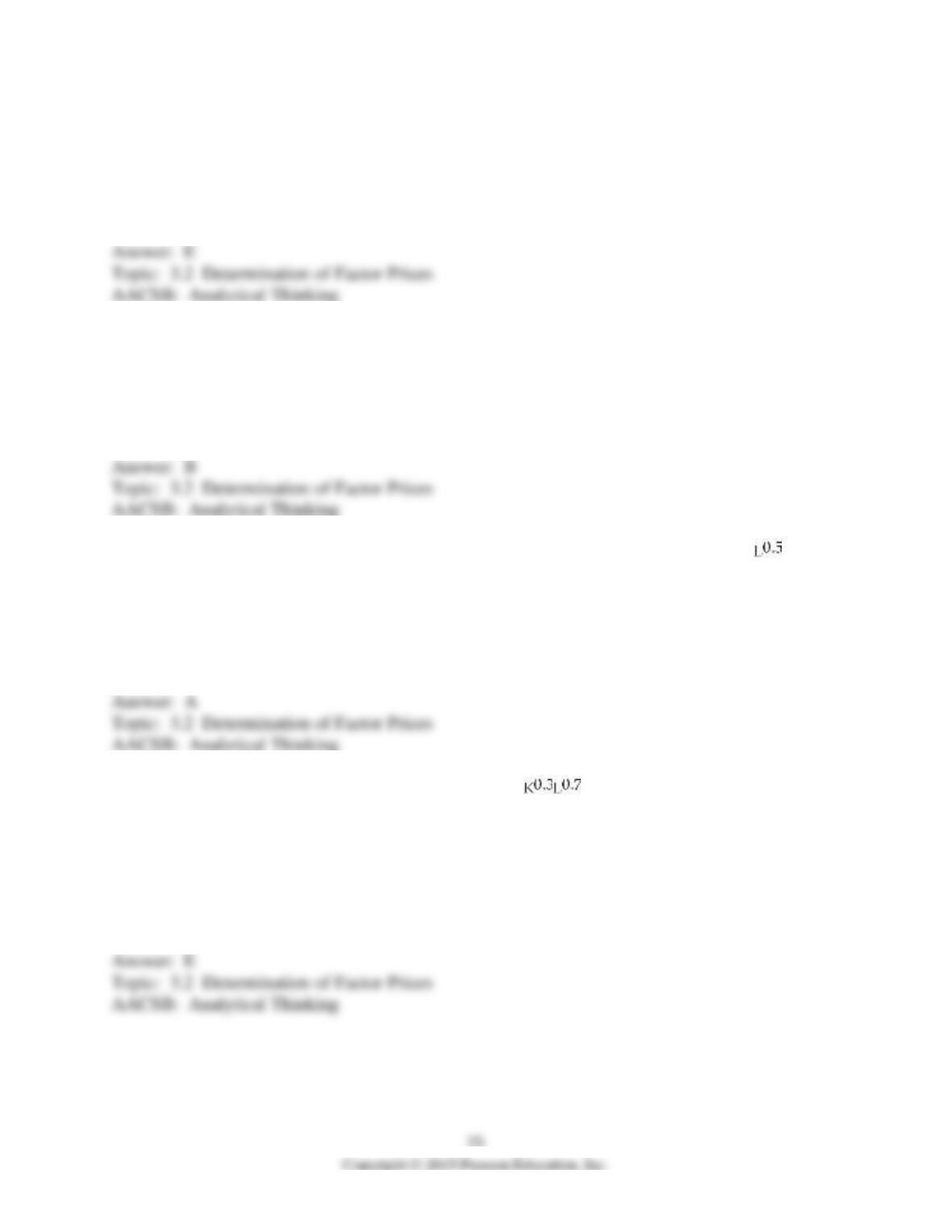
13) When a particular firm is fully utilizing its capital, its output is given by Y = 10 × . The
cost of labor is $1 per unit. To maximize profit, how many units of labor should this firm use?
A) 25
B) 5
C) 3.16
D) 100
E) 50
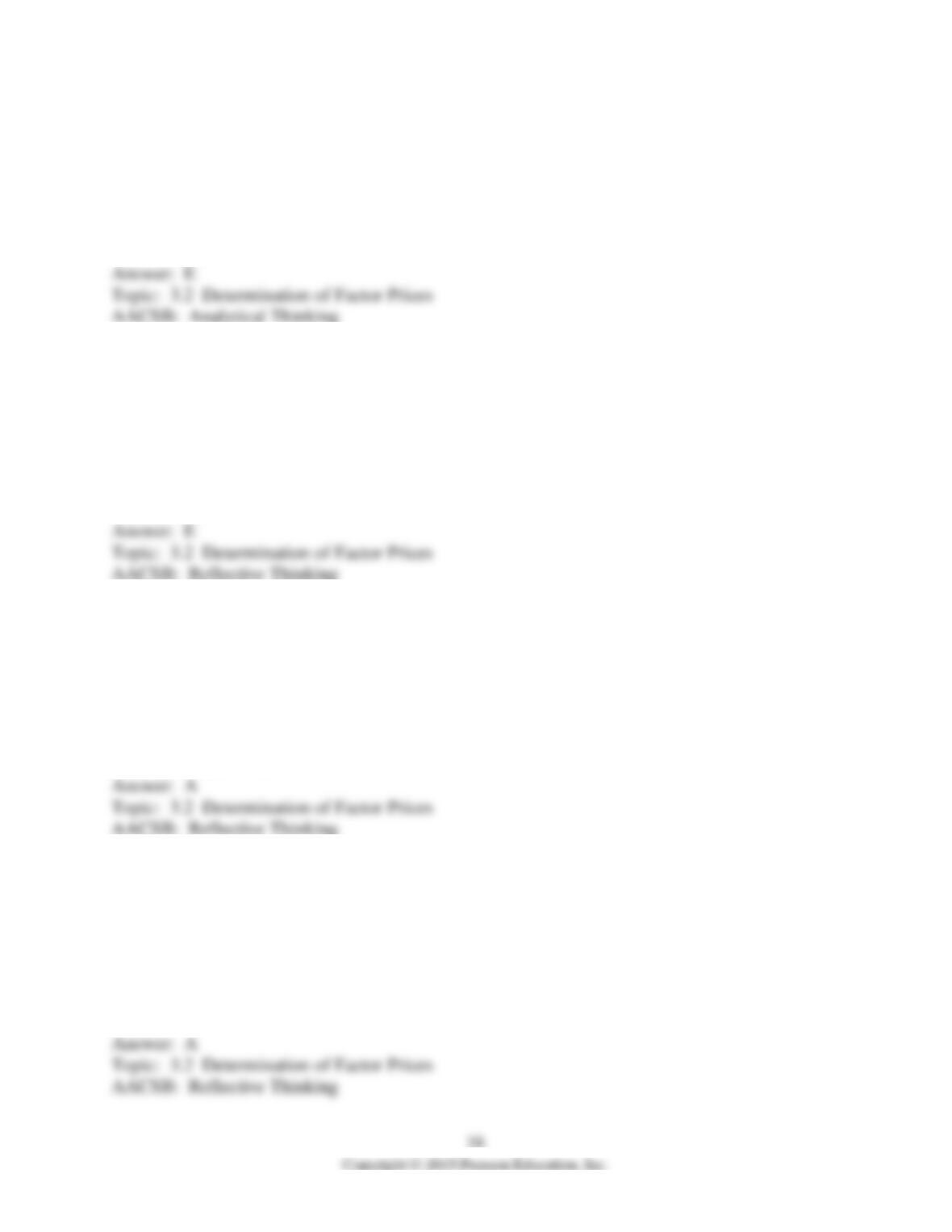
14) In an economy with production function Y = 1.5 × , K = 343, and L = 512. If factor
markets are in equilibrium, then the rental price of capital is (approximately) ________, and the
real wage is (approximately) ________.
A) 0.5; 0.8
B) 7; 8
C) 0.9; 1.35
D) 1.4; 0.4
E) 0.6; 0.9
15) If the quantities of labor and capital in an economy each increase by the same x percent,
which of the following will increase by x percent?
A) marginal product of capital
B) economic profits
C) share of capital income in national income
D) rental price of capital
E) none of the above
16) Assume that an economy is in equilibrium when the arrival of immigrants causes an increase
in the supply of labor. Once the economy has adjusted to its new equilibrium, and assuming that
the supply of capital remains unchanged, which of the following has decreased?
A) the share of capital income in national income
B) the share of labor income in national income
C) national income
D) the rental price of capital
E) none of the above
17) Assume that an economy is in equilibrium when technological progress causes an increase in
total factor productivity. Once the economy has adjusted to its new equilibrium, and assuming
that the supplies of capital and labor remain unchanged, which of the following has increased?
A) the real wage
B) the share of capital income in national income
C) the share of labor income in national income
D) all of the above
E) none of the above
18) Assume that an economy is in equilibrium when there occurs an increase in the supply of
capital. The available quantity of labor remains fixed. Once the economy has adjusted to its new
equilibrium, which of the following has increased?
A) the real wage
B) the rental price of capital
C) the share of capital income in national income
D) all of the above
E) none of the above
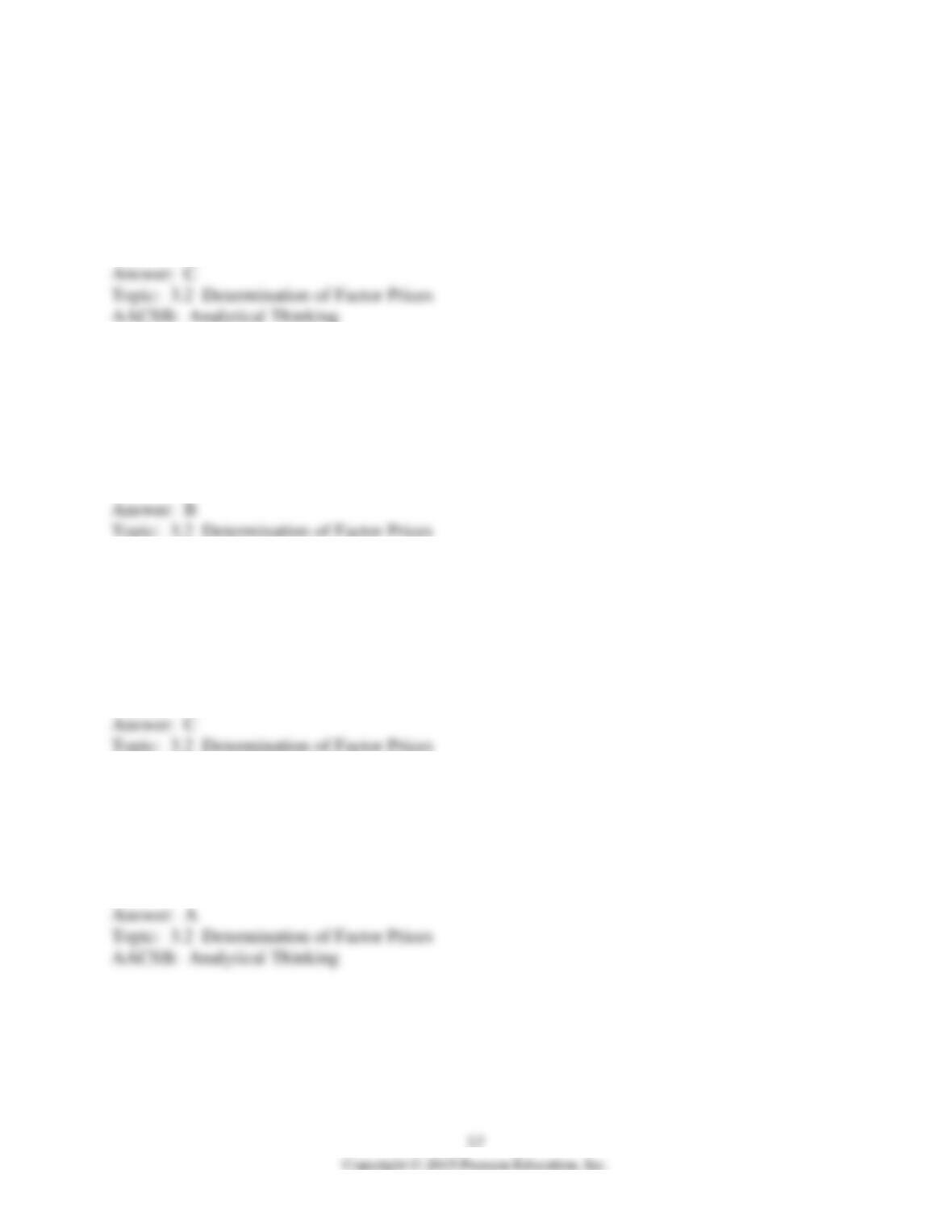
19) To get the first order conditions in a profit maximization problem, we must ________.
A) set the profit function equal to zero and solve for the production function
B) set the partial derivatives of the production function equal to zero and solve for the price
C) set the partial derivative of the profit function equal to zero and solve for the marginal
products
D) set the production function equal to zero and solve for the marginal products
E) none of the above
20) The marginal product of capital indicates ________. Therefore the MPK curve is also
________.
A) the quantity of capital supplied for a given rental price; the equilibrium price of capital
B) the quantity of capital demanded for a given rental price; the demand curve of capital
C) the quantity of capital demanded for a given rental price; the equilibrium price of capital
D) the quantity of capital supplied for a given rental price; the supply curve of capital
E) none of the above
21) The marginal product of labor indicates ________. Therefore the MPL curve is also
________.
A) the quantity of labor supplied for a given wage; the equilibrium price of labor
B) the quantity of labor demanded for a given wage; the equilibrium price of labor
C) the quantity of labor demanded for a given wage; the demand curve of labor
D) the quantity of labor supplied for a given wage; the supply curve of labor
E) none of the above
22) When the rental price of capital is above the equilibrium price ________.
A) we have an excess supply of capital and the rental price should fall
B) we have an excess demand of capital and the rental price should fall
C) we have an excess supply of capital and the rental price should increase
D) we have an excess demand of capital and the rental price should increase
E) none of the above
23) When the real wage is below the equilibrium price in the labor market ________.
A) we have an excess supply of labor and the real wage should fall
B) we have an excess demand of labor and the real wage should fall
C) we have an excess demand of labor and the real wage should increase
D) we have an excess supply of labor and the real wage should increase
E) none of the above
24) Given the production function Y = A , if the rental price of capital is 0.133, Y = 690,
and K = 1,728, what is the value of the exponent α? If A = 1, and the real wage is 1.15, is this
economy in a long-run equilibrium?
25) Suppose that reduced barriers to international financial transactions cause an increase in the
economy’s supply of capital. Explain, step-by-step, how the economy adjusts to arrive at a new
long-run equilibrium.
26) Suppose that a technological advance raises total factor productivity. Explain, step-by-step,
how the economy adjusts to arrive at a new long-run equilibrium.
3.3 Distribution of National Income
1) Real capital income is given by ________.
A) MPK × K
B) capital share of income × output per unit of capital × capital
C) capital share of income × output
D) all of the above
E) none of the above
2) Real labor income is given by ________.
A) MPL × L
B) labor share of income × labor productivity × labor
C) labor share of income × output
D) all of the above
E) none of the above
3) A decrease in the growth rate of labor productivity is likely to cause a decrease in ________.
A) the growth rate of the real wage
B) the growth rate of the marginal product of capital
C) the growth rate of the labor supply
D) the share of labor income in national income
E) none of the above
4) An economy’s total labor income is $2 trillion, and total capital income is $1 trillion. In the
Cobb-Douglas production function, the exponent on capital is ________.
A) two-thirds
B) one-half
C) one-third
D) 0.3
E) none of the above
5) The three oil shocks the U.S. experienced in 1973-1974, 1979-1980 and 2007-2008 had which
of the following consistent results?
A) a decline in real wages due to an upward shift of the production function
B) an increase in the rental price of capital along with a healthy stock market response
C) a decline in real wages due to a downward shift of the MPL curve
D) an increase in the rental price of capital due to an upward shift of the production function
E) none of the above
6) An economy’s production function is Y = A , and the economy’s total output in
equilibrium is $90 billion. Total capital income in this economy is ________.
A) $27 billion
B) $30 billion
C) $21 billion
D) $70 billion
E) none of the above
7) An economy’s production function is Y = A , and the economy’s total output in
equilibrium is $700 billion. Total labor income in this economy is ________.
A) $300 billion
B) $233.3 billion
C) $210 billion
D) $400 billion
E) none of the above
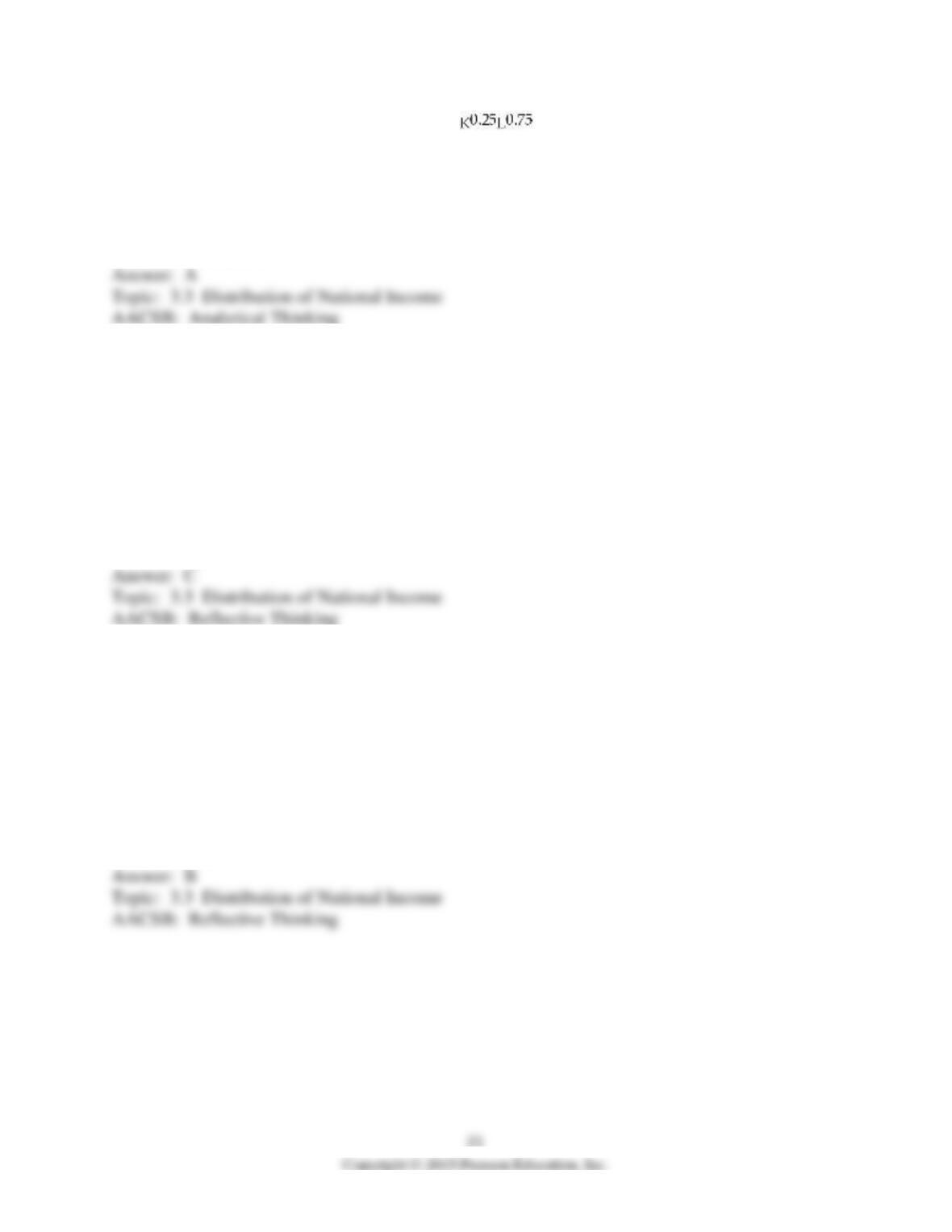
8) An economy’s production function is Y = A , and the economy’s total output in
equilibrium is $800 billion. Total capital income in this economy is ________.
A) $200 billion
B) $25 billion
C) $750 billion
D) $267 billion
E) none of the above
9) Equilibrium market prices for capital and labor are $10 and $8, respectively. Then, the
economy experiences one or more supply shocks, so that the marginal product of capital is $12,
and the marginal product of labor is $9. Assuming that the available quantities of capital and
labor are fixed, which of the following is (are) likely to decrease as the economy approaches its
new equilibrium?
A) real rental price of capital
B) total output
C) economic profits
D) the quantity of capital in use
E) none of the above
10) Equilibrium market prices for capital and labor are $10 and $8, respectively. Then, the
economy experiences one or more supply shocks, so that the marginal product of capital is $9,
and the marginal product of labor is $6. Assuming that the available quantities of capital and
labor are fixed, which of the following is (are) likely to decrease as the economy approaches its
new equilibrium?
A) economic profits
B) real rental price of capital
C) total output
D) the quantity of capital in use
E) none of the above
22
11) The three oil shocks the U.S. experienced in 1973-1974, 1979-1980 and 2007-2008 had a
consistent result ________.
A) a decline in the MPK
B) a decline in the real rental price of capital
C) a decline in stock prices
D) all of the above
E) none of the above
12) As an investor, negative supply shocks are not attractive because ________.
A) they tend to lead to lower productivity
B) the real rental price of capital tends to decline driving rental incomes down
C) with decreases in expected income, claims on those incomes also tend to fall leading to stock
market downturns
D) all of the above
E) none of the above
13) Suppose a government tried to mandate a real wage above the equilibrium real wage.
Assuming that factor markets are otherwise free and competitive, explain why the higher real
wage would fail to increase the share of labor income in national income.
23
14) Consider an economy in which 350 = 3 × . Calculate the long-run equilibrium
values of factor prices and incomes.