75) The wage rate paid by Walkman producers falls and at the same time the price of raw
materials used in the production of Walkmans rises. You predict that the supply curve of
Walkmans will
A) shift either leftward or rightward.
B) surely shift rightward.
C) surely shift leftward.
D) surely become steeper.
4 Market Equilibrium
1) In a supply and demand figure, the equilibrium price and quantity are found at the
A) point where quantity supplied equals quantity demanded.
B) horizontal intercept of the demand curve.
C) vertical intercept of the supply curve.
D) horizontal intercept of the supply and the demand curves.
2) When a market is in equilibrium
A) everyone has all they want of the commodity in question.
B) there is no shortage and no surplus at the equilibrium price.
C) the number of buyers is exactly equal to the number of sellers.
D) the supply curve has the same slope as the demand curve.
3) The equilibrium price is the price at which the quantity
A) sold equals the quantity bought.
B) demanded equals the quantity sold.
C) demanded equals the quantity supplied.
D) supplied equals the quantity bought.
4) Which of the following is the best way to describe equilibrium in a market? At equilibrium,
the
A) price is the lowest possible.
B) price is usually affordable to most people.
C) supply and demand curves can never shift again.
D) quantity supplied equals the quantity demanded.
5) The interaction of supply and demand explains
A) the prices of goods and services but not their quantities.
B) the quantities of goods and services but not their prices.
C) both the prices and the quantities of goods and services.
D) neither the prices nor the quantities of goods and services.
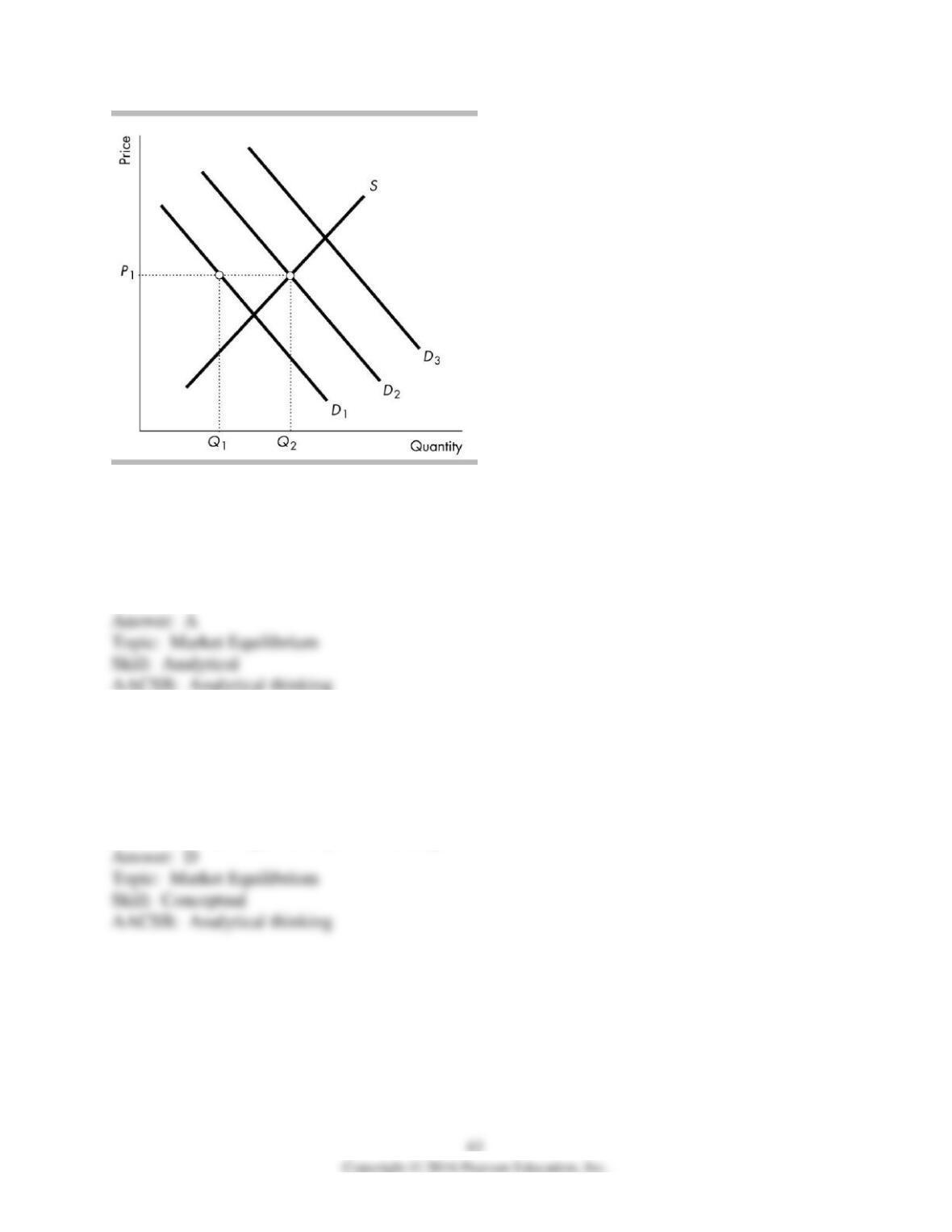
6) The figure illustrates the market for pens. The equilibrium quantity is
A) between 400 and 600 pens, but it is impossible to be precise.
B) 5 pens a month.
C) 2 pens a month.
D) 500 pens a month.
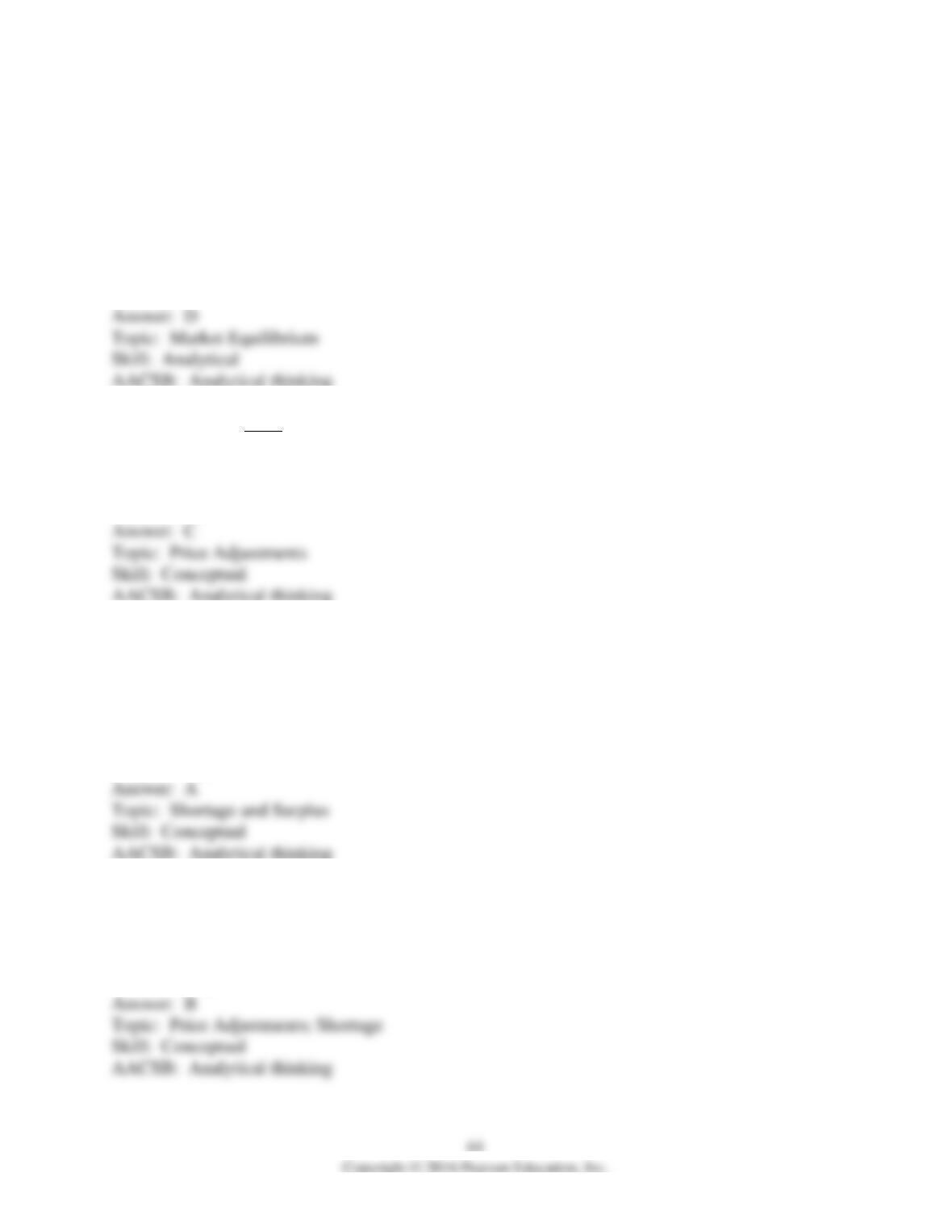
7) In the above figure, if the demand curve is D2, then
A) the equilibrium price will be P1 and the equilibrium quantity will be Q2.
B) the equilibrium price will be P1 and the equilibrium quantity will be Q1.
C) there will be a shortage equal to Q2 – Q1.
D) an increase in price will shift the demand curve to D3.
8) If the price of a CD is equal to the equilibrium price, there will be ________ of CDs and the
price will ________.
A) surplus; rise
B) surplus; fall
C) shortage; fall
D) neither a shortage nor surplus; not change
9) When the price is below the equilibrium price, the quantity demanded
A) is less than the equilibrium quantity and the quantity supplied also is less than the equilibrium
quantity.
B) is less than the equilibrium quantity but the quantity supplied exceeds the equilibrium
quantity.
C) exceeds the equilibrium quantity and the quantity supplied also exceeds the equilibrium
quantity.
D) exceeds the equilibrium quantity but the quantity supplied is less than the equilibrium
quantity.
10) If a market is NOT in equilibrium, then which of the following is likely to occur?
A) The demand curve will shift to bring the market to equilibrium.
B) The supply curve will shift to bring the market to equilibrium.
C) The price will adjust to bring the market to equilibrium.
D) Both A and B are correct.
11) If the price of a video download is below its equilibrium price, the quantity supplied is
________ than the quantity demanded. If the price of a video download is above its equilibrium
price, the quantity supplied is ________ than the quantity demanded.
A) less; greater
B) greater; less
C) less; less
D) greater; greater
12) A price below the equilibrium price results in
A) a surplus.
B) a shortage.
C) excess supply.
D) a further price fall.
13) If the price of a video rental is below its equilibrium price, there will be a ________ of video
rentals and the price will ________.
A) shortage; rise
B) shortage; fall
C) surplus; rise
D) surplus; fall
14) Which of the following CORRECTLY describes how price adjustments eliminate a
shortage?
A) As the price rises, the quantity demanded decreases while the quantity supplied increases.
B) As the price rises, the quantity demanded increases while the quantity supplied decreases.
C) As the price falls, the quantity demanded decreases while the quantity supplied increases.
D) As the price falls, the quantity demanded increases while the quantity supplied decreases.
15) Ticket scalpers at the NCAA basketball tournament last year charged prices high above the
printed ticket price. This observation is evidence of
A) a surplus at printed ticket prices.
B) a shortage at printed ticket prices.
C) the tournament not being televised.
D) the tournament getting too much television exposure.
16) If the quantity of textbooks supplied is 10,000 per year and the quantity of textbooks
demanded is 12,000 per year, there is a ________ in the market and the price will ________.
A) shortage; rise
B) shortage; fall
C) surplus; rise
D) surplus; fall
17) When there is a shortage in the market, the quantity sold is
A) greater than the quantity supplied.
B) equal to the quantity supplied.
C) less than the quantity supplied.
D) less than the quantity bought.
18) When the price is less than the equilibrium price
A) there will be a shortage.
B) some consumers will be willing to pay a price higher than the prevailing price.
C) the price will be forced higher.
D) All of the above answers are correct.
19) If there exists a shortage in the market for snowmobiles, then the price of a snowmobile will
A) rise.
B) fall.
C) neither rise nor fall.
D) at first fall then rise.
20) The existence of a shortage
A) means resources are being allocated efficiently.
B) is impossible in a market economy.
C) pushes the price up.
D) pushes the price down.
21) A shortage causes the
A) demand curve to shift leftward.
B) supply curve to shift rightward.
C) price to fall.
D) price to rise.
22) If the quantity demanded exceeds the quantity supplied, then there is
A) a shortage and the price is below the equilibrium price.
B) a shortage and the price is above the equilibrium price.
C) a surplus and the price is below the equilibrium price.
D) a surplus and the price is above the equilibrium price.
Price
(dollars per
pound)
Quantity
supplied
(pounds)
Quantity
demanded
(pounds)
3
1
7
4
2
5
5
4
4
6
5
2
7
6
1
23) The above table shows the demand schedule and supply schedule for chocolate chip cookies.
What is the equilibrium quantity and equilibrium price for chocolate chip cookies?
A) 7 pounds, $3.00 per pound
B) 2 pounds, $3.00 per pound
C) 2 pounds, $6.00 per pound
D) 4 pounds, $5.00 per pound
24) The above table shows the demand schedule and supply schedule for chocolate chip cookies.
If the price is $4.00 per pound, there is a
A) shortage of 2 pounds of chocolate chip cookies.
B) shortage of 3 pounds of chocolate chip cookies.
C) shortage of 5 pounds of chocolate chip cookies.
D) surplus of 3 pounds of chocolate chip cookies.
25) The above table shows the demand schedule and supply schedule for chocolate chip cookies.
An increase in income results in an increase in the demand for chocolate cookies by an amount
of 3 pounds at every price. What are the new equilibrium quantity and equilibrium price?
A) 5 pounds, $4.00 per pound
B) 5 pounds, $6.00 per pound
C) 5 pounds, $5.00 per pound
D) 4 pounds, $5.00 per pound
26) If the quantity supplied exceeds the quantity demanded, then there is
A) a shortage and the price is below the equilibrium price.
B) a shortage and the price is above the equilibrium price.
C) a surplus and the price is below the equilibrium price.
D) a surplus and the price is above the equilibrium price.
27) The price of a good will fall if
A) there is a surplus at the current price.
B) the current price is less than the equilibrium price.
C) the quantity demanded exceeds the quantity supplied.
D) the price of a complement in consumption falls.
28) When there is a surplus in the market, the quantity sold is
A) equal to the quantity supplied.
B) equal to the quantity demanded.
C) less than the quantity demanded.
D) greater than the quantity bought.
29) Suppose the equilibrium price for soft drinks is $1.00. If the current price in the soft drink
market is $1.25 each
A) there will be a surplus of soft drinks.
B) there will be a shortage of soft drinks.
C) the supply curve of soft drinks will shift leftward.
D) the demand curve for soft drinks will shift leftward.
30) If the quantity of textbooks supplied is 10,000 per year and the quantity of textbooks
demanded is 8,000 per year, there is a ________ in the market and the price will ________.
A) shortage; rise
B) shortage; fall
C) surplus; rise
D) surplus; fall
31) A surplus occurs when the price is
A) less than the equilibrium price.
B) equal to the equilibrium price.
C) greater than the equilibrium price.
D) None of the above because the existence of a surplus is independent of the price of the good.
32) If the price is above the equilibrium price, then there is a
A) surplus, and market forces will operate to lower price.
B) surplus, and market forces will operate to raise price.
C) shortage, and market forces will operate to lower price.
D) shortage, and market forces will operate to raise price.
33) When the price of a good is
A) below the equilibrium price, quantity supplied exceeds quantity demanded and price rises.
B) below the equilibrium price, quantity demanded exceeds quantity supplied and price falls.
C) above the equilibrium price, quantity supplied exceeds quantity demanded and price falls.
D) above the equilibrium price, quantity demanded exceeds quantity supplied and price rises.
34) Suppose a market begins in equilibrium. If supply increases, then at the original equilibrium
price the quantity demanded is
A) is less than the quantity supplied and a surplus results.
B) is less than the quantity supplied and a shortage results.
C) exceeds the quantity supplied and a surplus results.
D) exceeds the quantity supplied and a shortage results.
Price
(dollars
per pair)
Quantity
demanded
(pairs per
week)
Quantity
supplied
(pairs per
week)
30
130
70
40
120
80
50
110
90
60
100
100
70
90
110
80
80
120
90
70
130
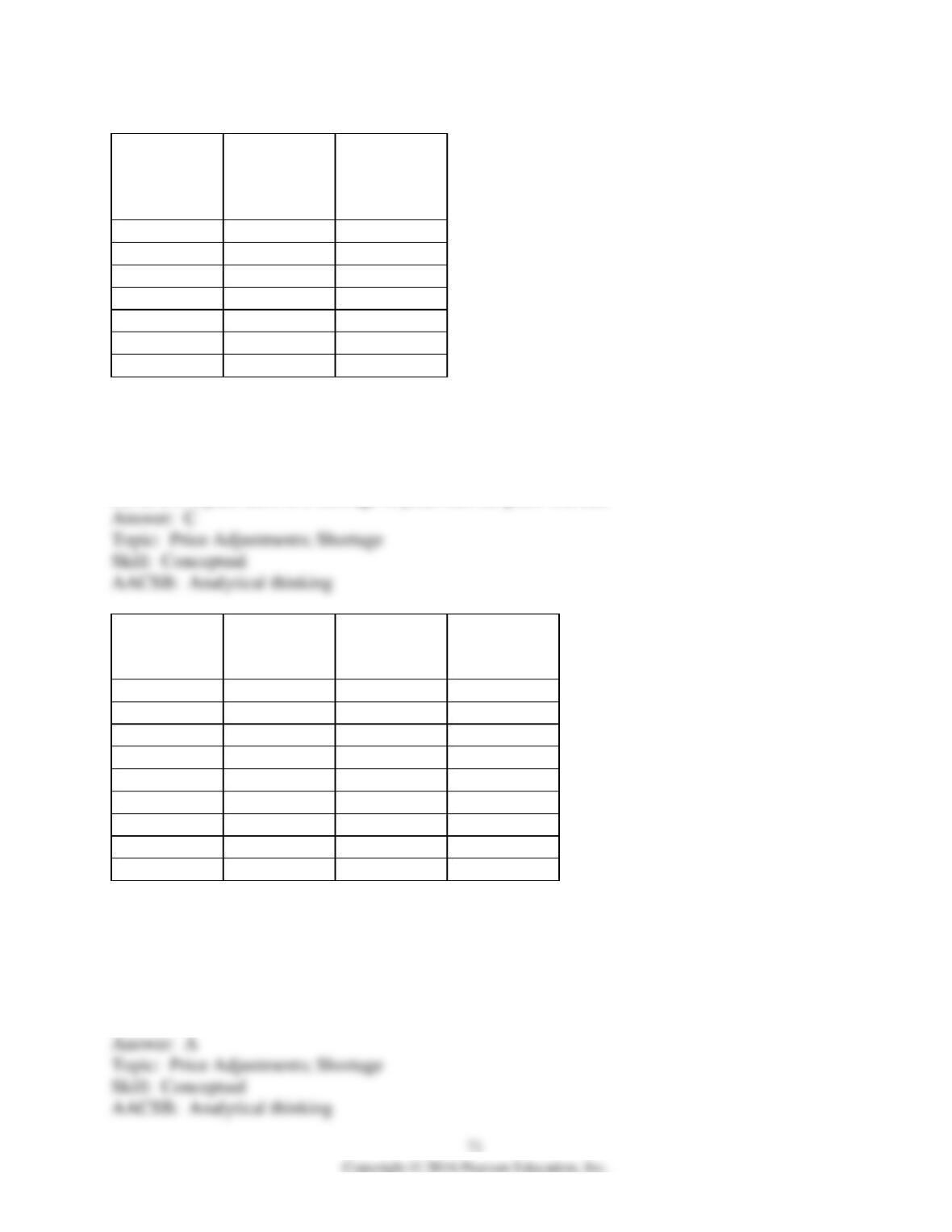
35) The table shows the demand and supply schedules for jeans.
A) At $60 a pair, there is a shortage of jeans and the price will fall.
B) At $60 a pair, there is a surplus of jeans and the price will rise.
C) At $40 a pair, there is a shortage of jeans and the price will rise.
D) At $40 a pair, there is a shortage of jeans and the price will fall.
Price
(dollars per
disc)
Quantity
demanded
Price
(dollars per
disc)
Quantity
supplied
4
36,000
4
4,000
8
32,000
8
8,000
12
28,000
12
12,000
16
24,000
16
16,000
20
20,000
20
20,000
24
16,000
24
24,000
28
12,000
28
28,000
32
8,000
32
32,000
36
4,000
36
36,000
36) The above table gives the demand and supply schedules for Blu-ray discs. If the price of a
Blu-ray disc is $8, there is a ________ and the price of a compact disc will ________.
A) shortage; rise
B) shortage; fall
C) surplus; rise
D) surplus; fall
37) The above table gives the demand and supply schedules for Blu-ray discs. Suppose that the
price of a Blu-ray disc player increases, resulting in the demand for Blu-ray discs decreasing by
8,000 units at all prices. What are the new equilibrium quantity and equilibrium price of Blu-ray
discs?
A) 8,000 and $8
B) 16,000 and $16
C) 20,000 and $20
D) 28,000 and $28
38) The above table gives the demand and supply schedules for Blu-ray discs. Based on the
table, the equilibrium quantity and price of a Blu-ray discs is
A) 28,000 and $12.
B) 20,000 and $20.
C) 16,000 and $24.
D) 16,000 and $16.
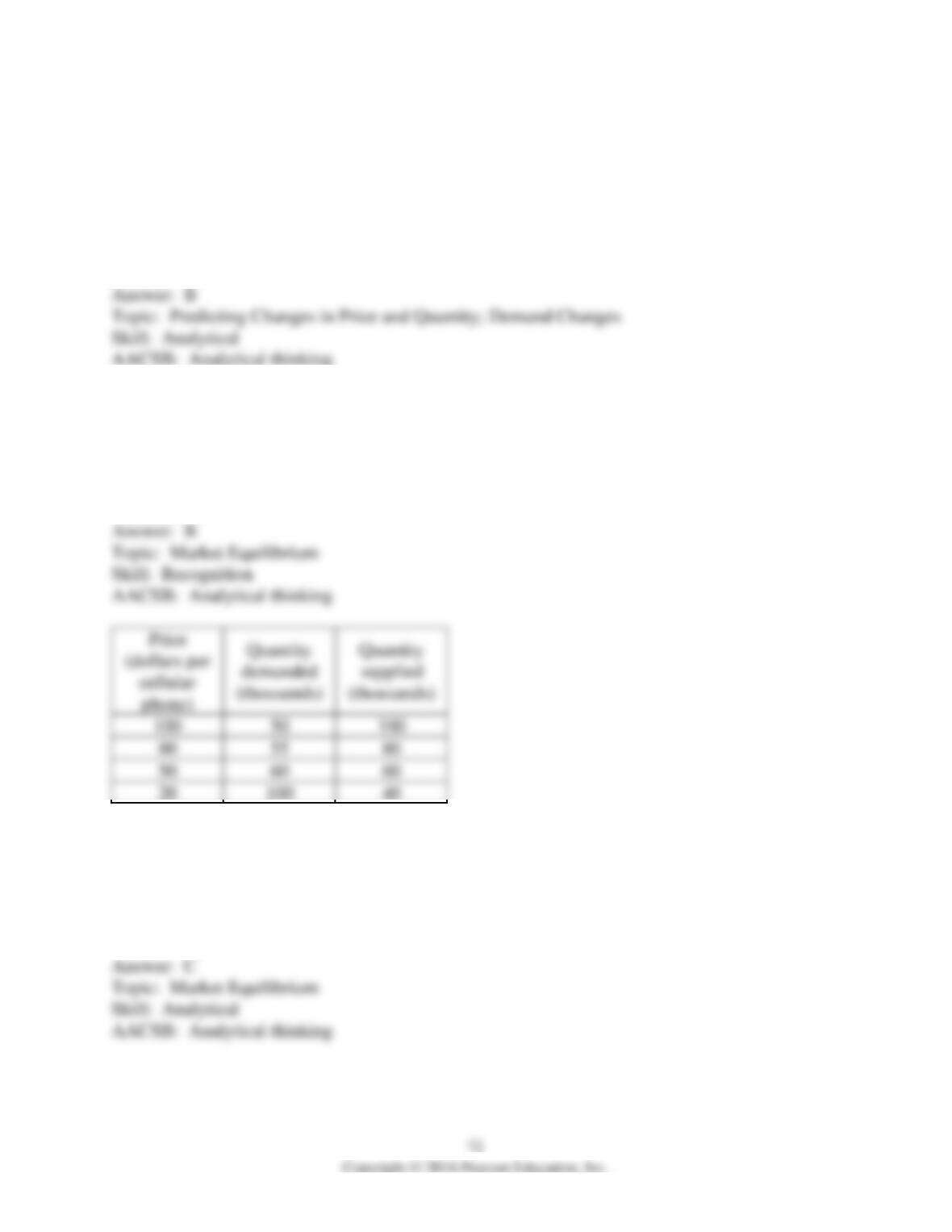
39) Using the data in the above table, the equilibrium quantity and equilibrium price for a
cellular telephone is
A) 50 thousand and $100.
B) 80 thousand and $80.
C) 60 thousand and $50.
D) 40 thousand and $20.
40) Using the data in the above table, at the price of $80 a phone, a
A) shortage of 25 thousand cellular telephones occurs.
B) surplus of 80 thousand cellular telephones occurs.
C) surplus of 25 thousand cellular telephones occurs.
D) shortage of 55 thousand cellular telephones occurs.
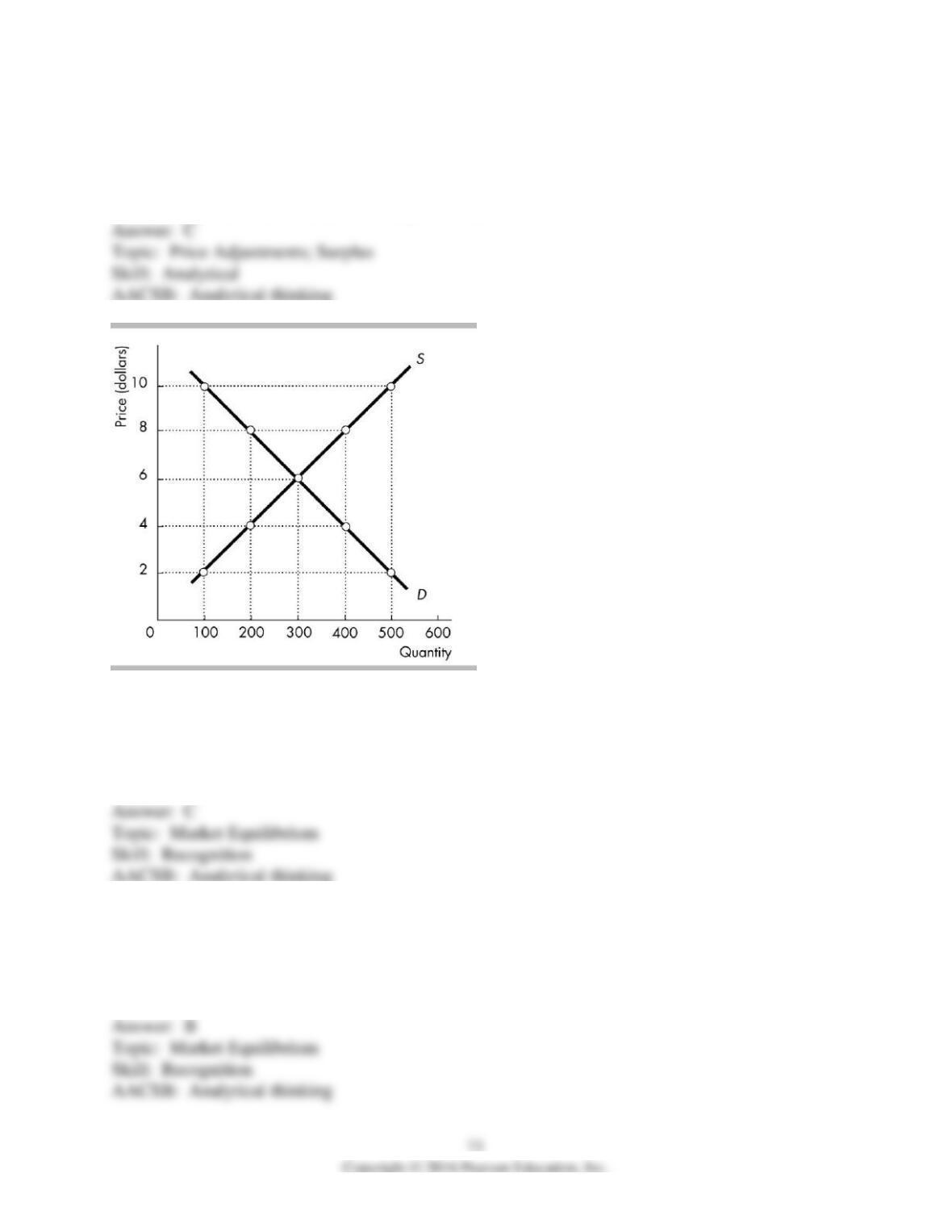
41) The equilibrium price in the above figure is
A) $2.
B) $4.
C) $6.
D) $8.
42) The equilibrium quantity in the above figure is
A) 200 units.
B) 300 units.
C) 400 units.
D) 600 units.
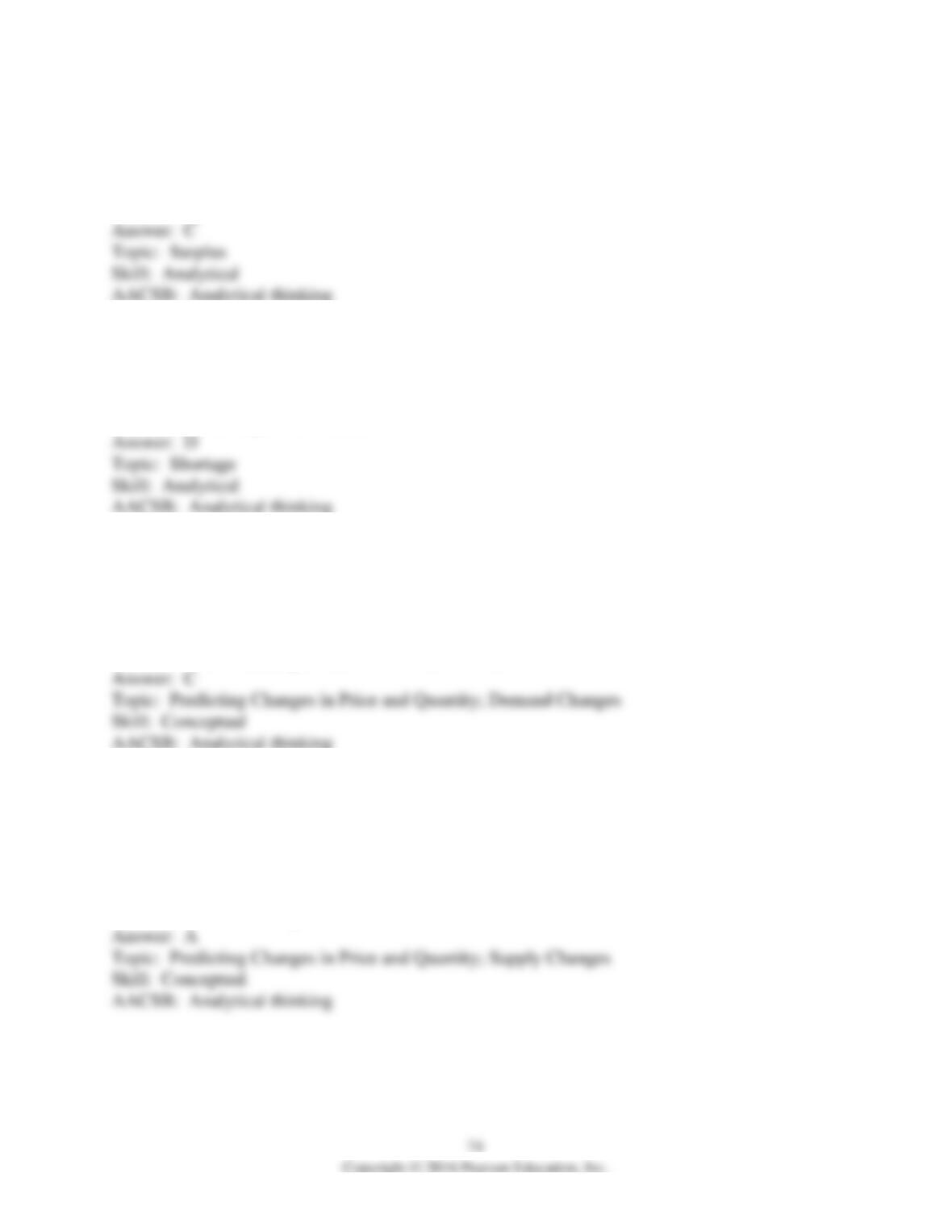
43) At a price of $10 in the above figure, there is
A) a surplus of 200 units.
B) a shortage of 200 units.
C) a surplus of 400 units.
D) a shortage of 400 units.
44) At a price of $4 in the above figure
A) the equilibrium quantity is 400 units.
B) there is a surplus of 200 units.
C) the quantity supplied is 400 units.
D) there is a shortage of 200 units.
45) If the good in the above figure is a normal good and income rises, then the new equilibrium
quantity
A) is less than 300 units.
B) is 300 units.
C) is more than 300 units.
D) could be less than, equal to, or more than 300 units.
46) The initial supply and demand curves for a good are illustrated in the above figure. If there
are technological advances in the production of the good, then the new equilibrium price for the
good
A) is less than $6.
B) is $6.
C) is more than $6.
D) could be less than, equal to, or more than $6.
47) The initial supply and demand curves for a good are illustrated in the above figure. If there is
a rise in the price of a factor of production used to produce the good, then the new equilibrium
price
A) is less than $6.
B) is $6.
C) is more than $6.
D) could be less than, equal to, or more than $6.
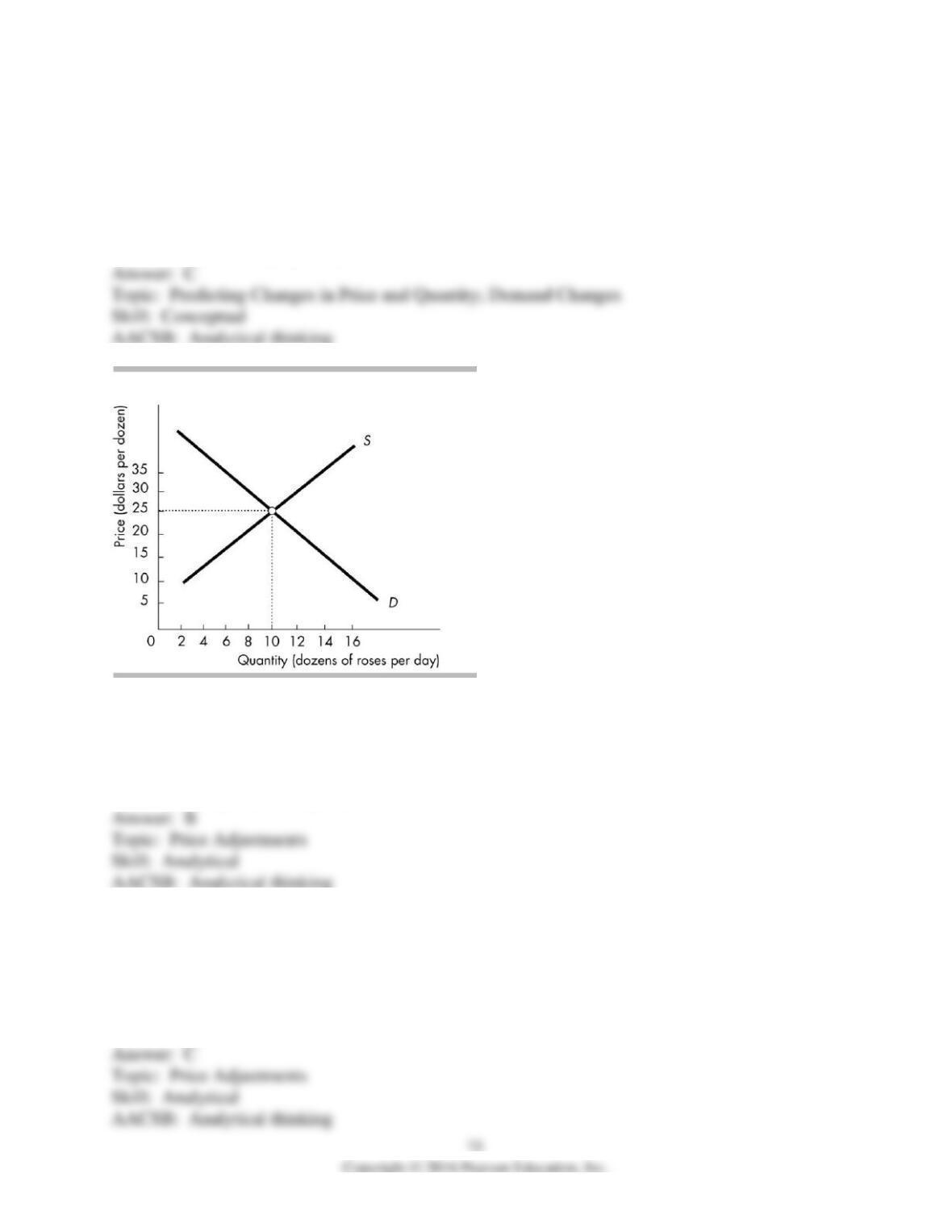
48) In the above figure, a price of $15 per dozen for roses would result in
A) equilibrium.
B) a shortage.
C) a surplus.
D) downward pressure on prices.
49) In the above figure, a price of $15 per dozen roses would result in a ________ so that the
price of roses will ________.
A) surplus; rise
B) surplus; fall
C) shortage; rise
D) shortage; fall
50) In the above figure, a price of $35 per dozen would result in
A) a shortage.
B) equilibrium.
C) a surplus.
D) upward pressure on prices.
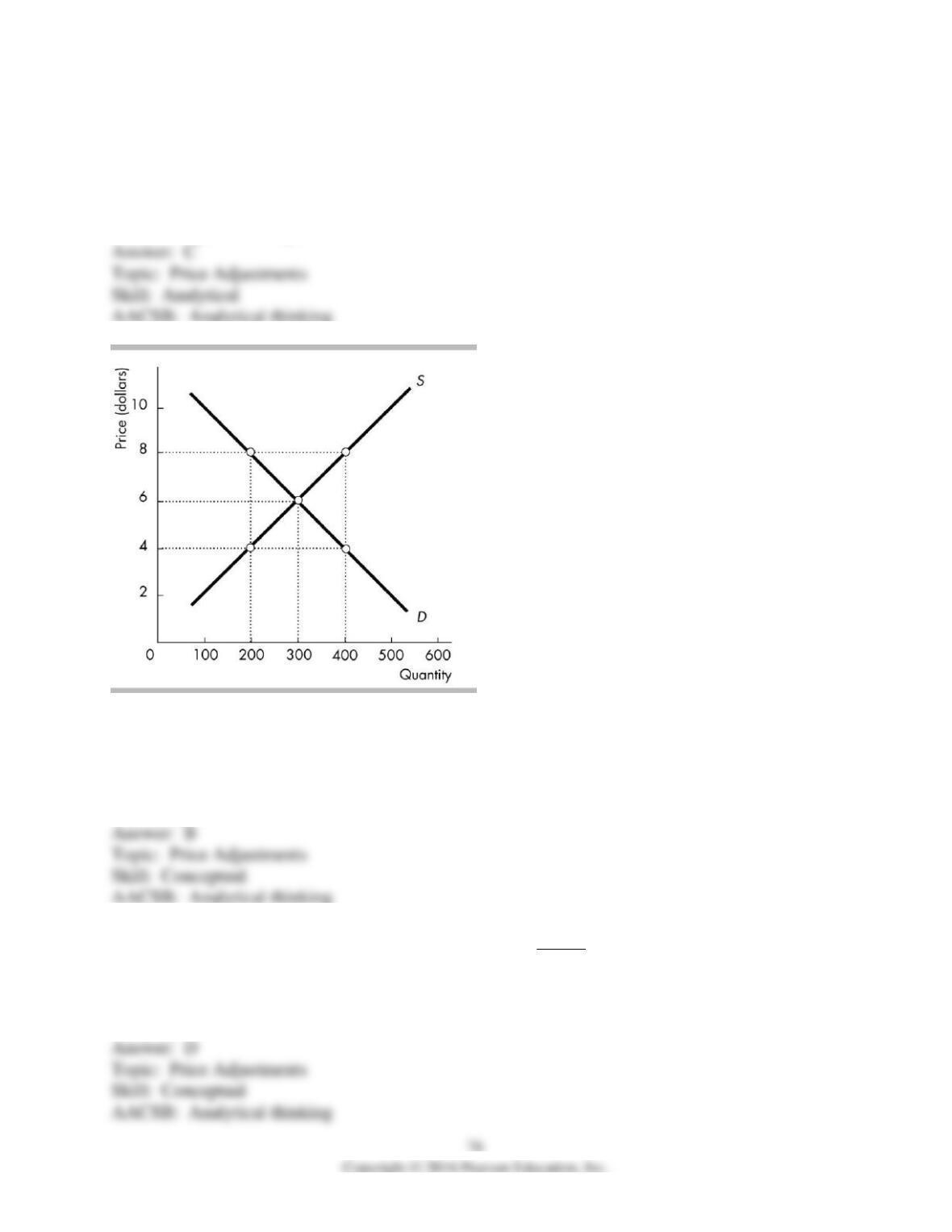
51) In the above figure, if the price is $8 then there is a
A) surplus of 100.
B) surplus of 200.
C) shortage of 100.
D) shortage of 200.
52) Based on the above figure, which of the following is TRUE?
A) At a price of $6, quantity demanded is equal to quantity supplied.
B) At a price of $4, quantity demanded is greater than quantity supplied.
C) At a price of $8, quantity demanded is less than quantity supplied.
D) All of the above answers are correct.
53) If the market for Twinkies is in equilibrium, then
A) Twinkies must be a normal good.
B) producers would like to sell more at the current price.
C) consumers would like to buy more at the current price.
D) the quantity supplied equals the quantity demanded.
54) In a market, at the equilibrium price
A) neither buyers nor sellers can do business at a better price.
B) buyers are willing to pay a higher price, but sellers do not ask for a higher price.
C) buyers are paying the minimum price they are willing to pay for any amount of output and
sellers are charging the maximum price they are willing to charge for any amount of production.
D) None of the above is true.
55) If there is surplus of a good, then the quantity demanded ________ the quantity supplied and
the price will ________.
A) is less than; rise
B) is less than; fall
C) is greater than; rise
D) is greater than; fall
5 Predicting Changes in Price and Quantity
1) When the demand for a good decreases, its equilibrium price ________ and equilibrium
quantity ________.
A) falls; decreases
B) falls; increases
C) rises; decreases
D) rises; increases
2) When demand increases, the equilibrium price ________ and the equilibrium quantity
________.
A) rises; decreases
B) falls; decreases
C) rises; increases
D) falls; increases
3) Which of the following statements is CORRECT?
A) When demand increases, both the price and the quantity increase.
B) When demand decreases, the price rises and the quantity decreases.
C) When supply increases, the quantity decreases and the price rises.
D) When supply decreases, both the price and the quantity decrease.
4) If the U.S. Surgeon General announces that increased wheat consumption could cause
heightened anxiety levels among children and adults, what happens to the equilibrium price and
quantity of shredded wheat?
A) The equilibrium price rises and the equilibrium quantity increases.
B) The equilibrium price falls and the equilibrium quantity decreases.
C) The equilibrium price rises and the equilibrium quantity decreases.
D) The equilibrium price falls and the equilibrium quantity increases.
5) In March, the quantity of orange juice sold in the town of Jackson was 3000 cartons and the
price $3. In May, the quantity of orange juice sold in the town of Jackson was 3500 cartons and
the price was $3.20. This change in the price and quantity sold could have been the result of
A) the release of a medical study suggesting that consuming orange juice helps prevent cancer.
B) a reduction in the number of orange juice coupons provided by local markets.
C) the after effects of a cold winter in Florida that killed half of the orange crop.
D) the after effects of a warm winter in Florida that increased the orange crop yield by 50
percent.
6) Suppose the equilibrium price of bottled water has risen from $1.00 per bottle to $2.00 per
bottle and the equilibrium quantity has increased. These changes are a result of a ________ shift
of the ________ curve for bottled water.
A) rightward; demand
B) rightward; supply
C) leftward; supply
D) leftward; demand
7) If good A is a normal good and income increases, the equilibrium price of A ________ and
the equilibrium quantity of A ________.
A) rises; increases
B) rises; decreases
C) falls; decreases
D) falls; increases
8) The price of a gallon of milk falls. Which of the following is a possible cause?
A) a decrease in the price of oatmeal, a complement to milk
B) a discovery that milk cause diabetes
C) Milk is a normal good and people’s incomes rise.
D) a drought that reduces supplies of feed grains fed to cows that produce milk
9) An increase in demand combined with no change in supply
A) raises the equilibrium price.
B) lowers the equilibrium price.
C) results in only a movement rightward along the demand curve.
D) decreases demand because the supply curve does not shift.
10) For consumers, goods A and B are complementary goods. The cost of a resource used in the
production of A decreases. As a result
A) the equilibrium price of B will fall and the equilibrium price of A will rise.
B) the equilibrium price of B will rise and the equilibrium price of A will fall.
C) the equilibrium prices of both A and B will rise.
D) the equilibrium prices of both A and B will fall.
11) Which of the following raises the equilibrium price and increases the equilibrium quantity of
used cars?
A) a fall in income if used cars are an inferior good
B) an increase in the wage rate paid to used car salespeople
C) neither of the above because the question suggests a violation of the “law of demand”
D) neither of the above because the question suggests a violation of the “law of supply”
12) Coffee and sugar are complements. If a poor sugar harvest leads to an increase in the price of
sugar, there will also be
A) an increase in the price of coffee.
B) a decrease in the price of coffee.
C) a rightward shift in the demand curve for coffee.
D) a leftward shift of the supply curve of coffee.
13) Long-distance travel by bus is an inferior good. As people’s incomes increase and other
things remain the same, you predict that the
A) price of long-distance travel by bus will fall and the demand for long-distance travel by bus
will increase.
B) price of long-distance travel by bus will fall.
C) demand for long-distance travel by bus will decrease and the price will rise.
D) demand for long-distance travel by bus will increase as the price of long-distance travel by
bus falls.