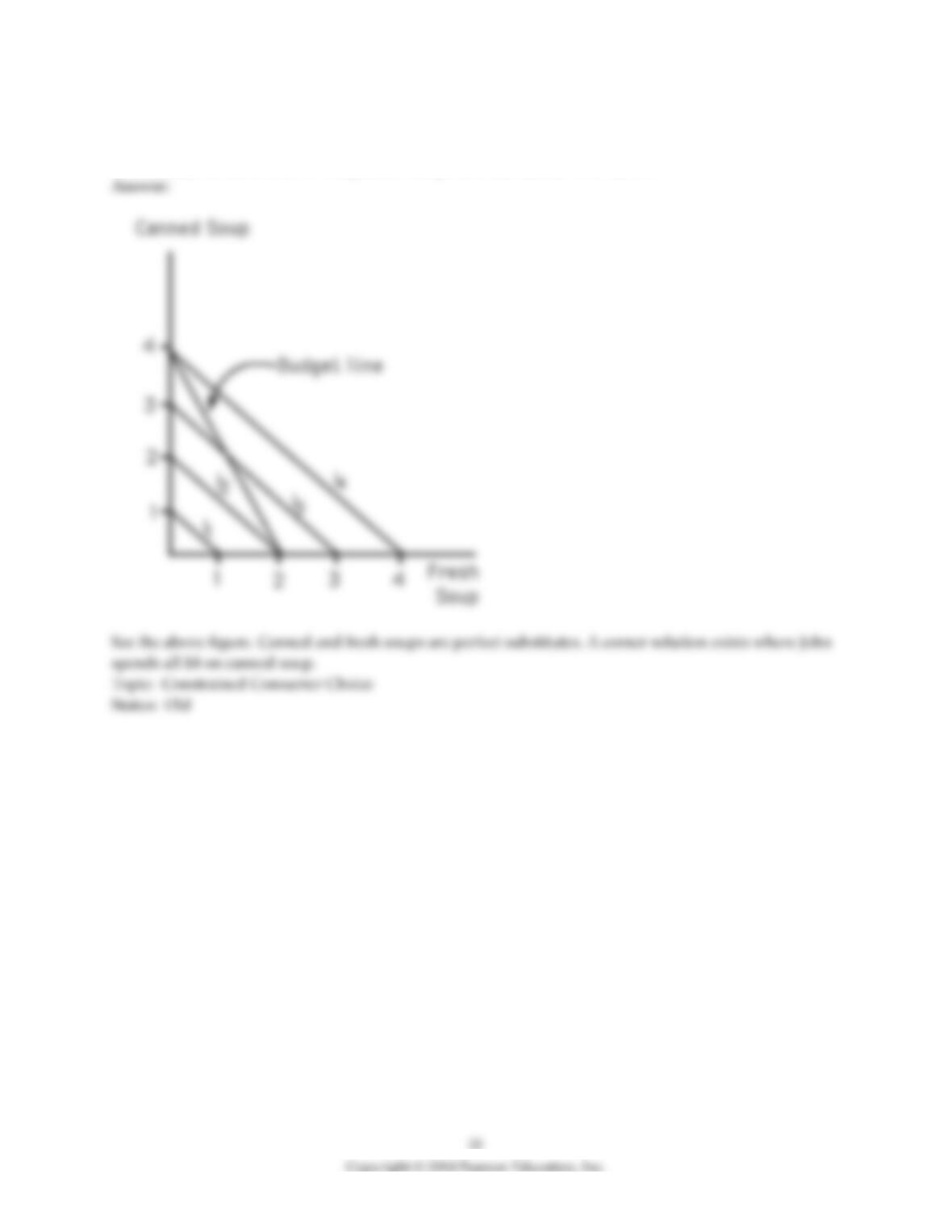
30) John is indifferent between canned soup and fresh soup. Canned soup sells for $1 per serving and
fresh soup sells for $2 per serving. Assuming that John has allocated $4 toward soup, how will he spend
it? Explain your answer by drawing John’s budget line and indifference curves.
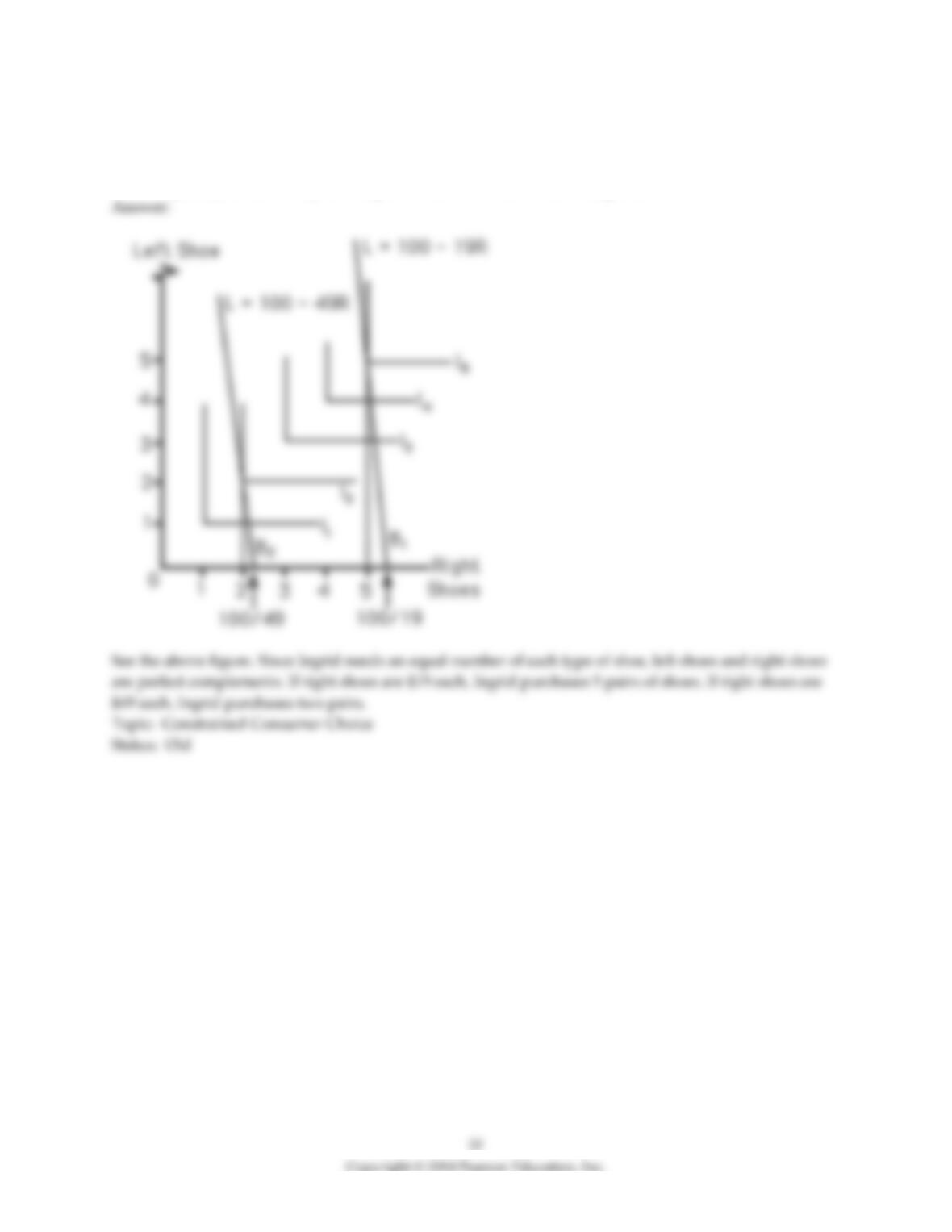
31) Suppose that left shoes and right shoes must be purchased separately. Ingrid needs an equal number
of each type of shoe and has a budget of $100 for shoes. Left shoes always cost $1. If right shoes cost $19
each, how many of each will Ingrid buy? If the price of right shoes increases to $49 each, how will Ingrid
react? Explain your answer by drawing the indifference curves and budget lines.
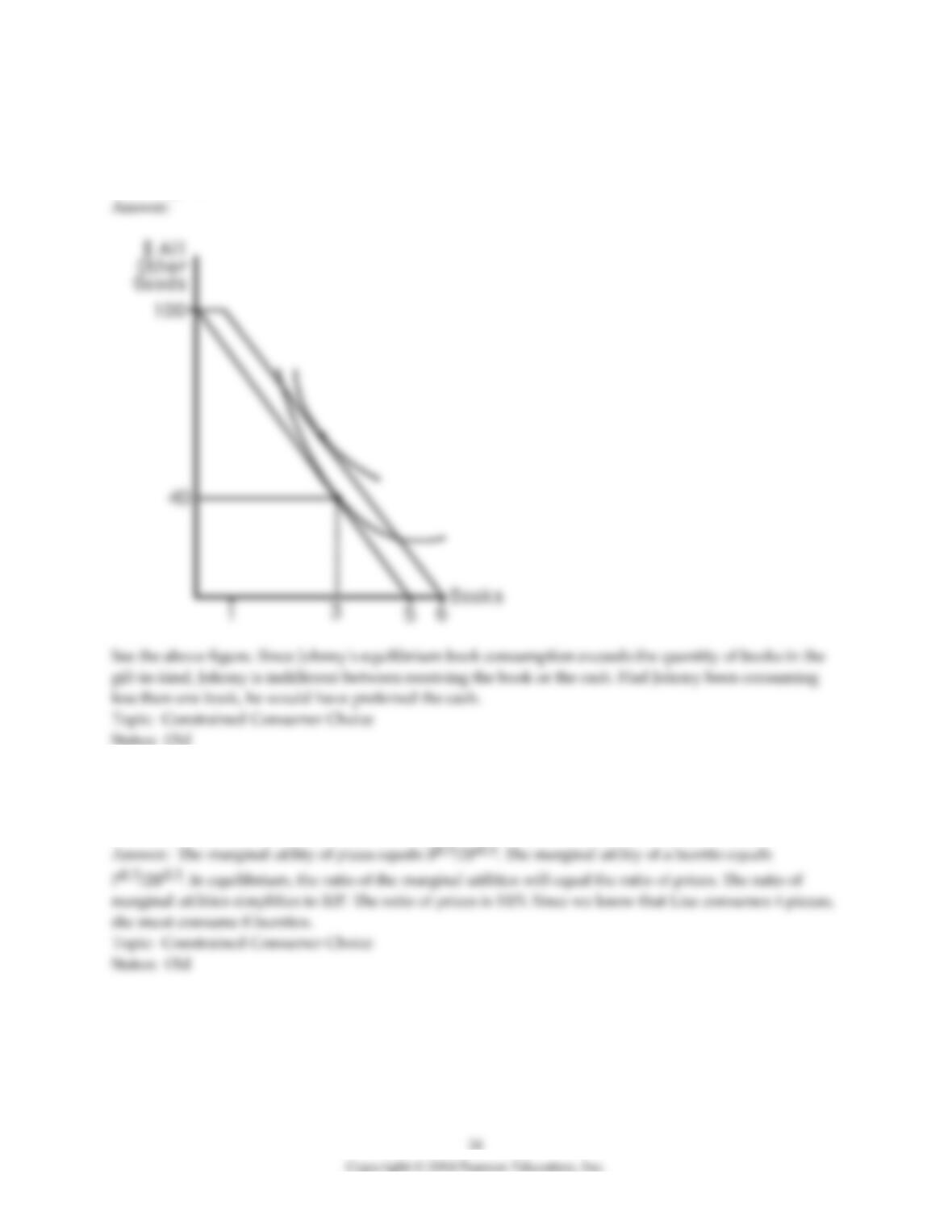
32) Johnny has $100 to spend on books and all other goods. Books cost $20 each and Johnny is at
equilibrium consuming 3 books and $40 worth of other goods. Johnny’s grandmom wants to give Johnny
either a book or $20 for his birthday. Which gift does Johnny prefer? Explain using an indifference map
and budget lines.
33) Lisa consumes only pizzas (P) and burritos (B). Her utility function is U = P0.5 B0.5. The price of per
pizza is $10 and the price per burrito is $5. In equilibrium, Lisa consumes four pizzas. Using Lisa’s utility
function, calculate how many burritos she consumes.
34) Lisa consumes only pizzas and burritos. In equilibrium, her marginal utility of pizza is 20 and her
marginal utility of a burrito is 10. The price of a pizza is $4. What is the price of a burrito?
35) Joseph has the utility function U(F,H)=10F2H, where F is the quantity of food he consumes per year
and H is the quantity of housing per week. Suppose the price of food is $10 and the price of housing is
$5, while Joseph has an income of $150/week.
a. Calculate Joseph’s MRS as a function of the quantities F and H.
b. Write out Joseph’s constrained optimization problem with the information provided.
c. Using the substitution method, solve for Joseph’s optimal consumption bundle of food and housing.
d. Show that at the optimum, Joseph consumes the bundle along the budget constraint where MRS =
MRT.
36) If a consumer views the two goods they consume as perfect substitutes, the optimal bundle will be a
corner solution. Explain.
37) Consider Jen, a consumer with preferences U(H,F) = F1/3H2/3, where H is the quantity of housing and
F is the quantity of food (per month). Suppose Jen has a stipend of $600/month which she uses to
purchase food at a price of $1/unit and housing at a price of $10/unit.
a. Compute Jen’s utility-maximizing bundle of goods.
b. Suppose that Jen’s employer subsidizes housing by paying 50% of her total housing costs, thereby
effectively lowering the price Jen pays for housing to $5/unit. Compute Jen’s new optimal consumption
bundle.
c. How much does Jen’s employer pay in total for this subsidy? How much utility does Jen enjoy with
this subsidy (compute her utility at the optimal bundle).
d. Suppose that her employer simply gave Jen the dollar cost you found in (c) as a lump sum (instead of
subsidizing housing). Will Jen gain a higher utility from the housing subsidy or the lump-sum equivalent
transfer?
38) Suppose that the preferences a typical American has for quantities of electricity (E) and gasoline (G) is
given by
U(E,G) = a ln(E) + (1-a) ln(G)
where 0 < a < 1. Suppose the prices of gasoline and electricity in the units provided are both $1/unit and
the consumer has an income of $100. Suppose in addition, the government has chosen to ration electricity
by allowing a maximum consumption of 50 units of electricity (E≤50).
a. If a = .25, find the optimal consumption bundle of gasoline and electricity. Does the electricity
rationing constraint have an influence on consumer’s choice?
b. If a = .75, find the optimal consumption bundle of gasoline and electricity. Does the electricity
rationing constraint of the government have an influence on the consumer?
39) Howie consumes only beer (B) and donuts (D) each week with his $100 income. Beer costs $1, while
donuts cost only 50¢. Howie has Cobb-Douglas preferences given by:
U(B,D) = B(D-d)
where d is the quantity of donuts that his neighbor Nord consumes. Assume throughout this question
that Howie always consumes more donuts than Nord.
a. How does Nord’s beer consumption influence Howie’s utility function? Specifically, compute and
determine the sign of ∂U/∂d. Intuitively, what does this tell you about Howie’s happiness and Nord’s
consumption of donuts?
b. Holding d fixed, compute Howie’s optimal consumption bundle of Beer and Donuts as functions of
Nord’s consumption of donuts, d.
c. How does Nord’s consumption of donuts affect Howie’s optimal bundle? Specifically calculate and
determine the sign of ∂B*/∂d and ∂D*/∂d where (B*, D*) is Howie’s optimal consumption bundle.
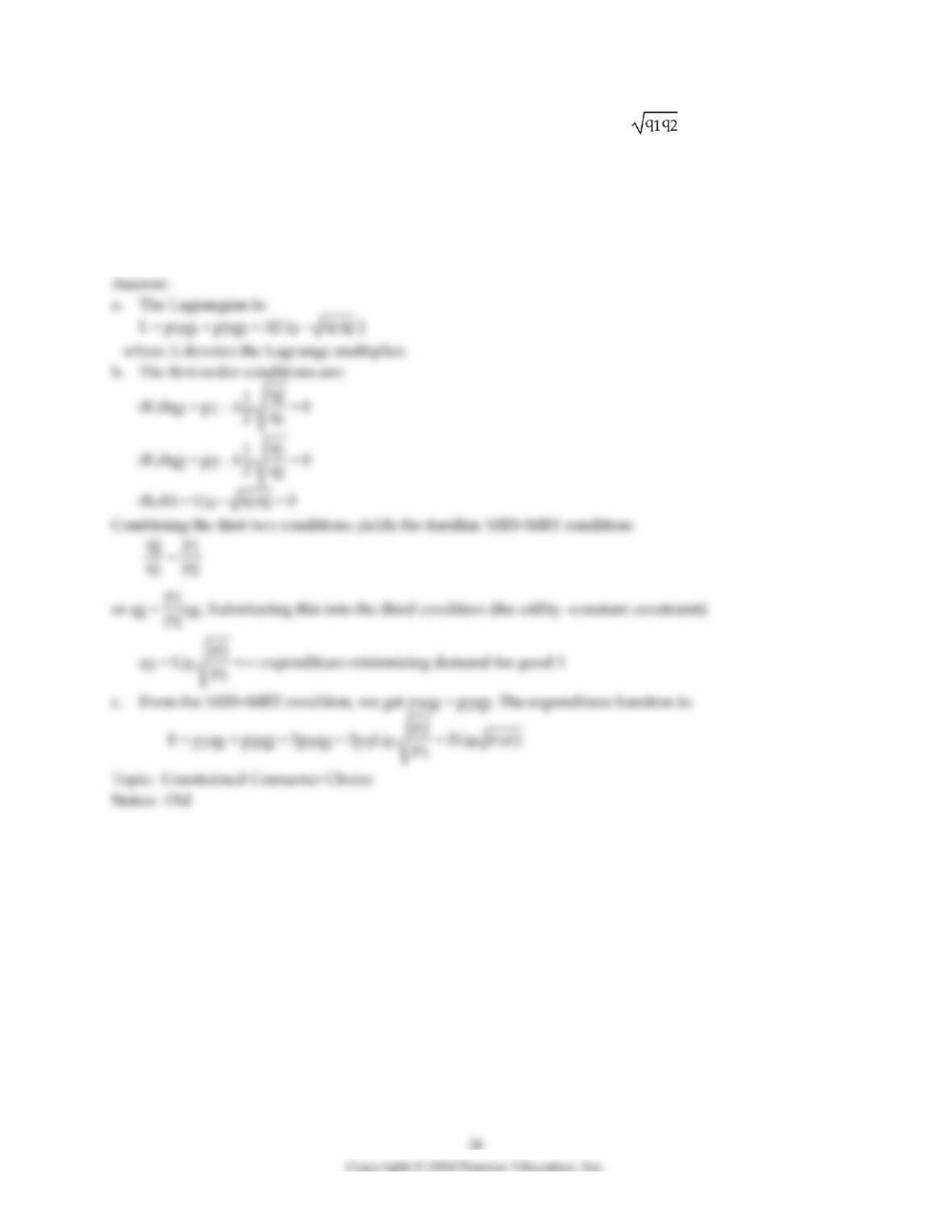
40) Consider a consumer with the Cobb-Douglas utility function U(q1,q2) = , where q1 and q2 are
the quantities of goods 1 and 2 consumed, respectively. This consumer derives a level of utility denoted
by U0. The prices of goods 1 and 2 are denoted p1 and p2.
a. Write out the Lagrangian for the consumer‘s expenditure minimization problem.
b. Using the Lagrangian method, derive the consumer’s (expenditure-minimizing) quantity of good 1 as
functions of the variables p1, p2, and U0.
c. Derive the consumer’s expenditure function, E(p1, p2, U0).
41) The preferences for Californians can be represented by the following utility function: U(X,Y) = XaY1-a.
The consumer faces the budget constraint I = p.X + q.Y, where I is the agent’s income, and p and q are the
prices. Suppose the government imposes a consumption restriction so that any person in the state is
allowed to consume 50 units of electricity at most.
a. If a = 0.25, I = 100, and both prices are equal to one, find the optimal consumption of gasoline and
electricity by the agent. Is the electricity constraint binding? (Hint: solve the problem without the 50≥X
constraint and see if the solution satisfies the constraint. If your answer then does not satisfy 50≥X, the
solution must be 50 = X)
b. How does your answer in part a. change if a = 0.75? Explain.
c. On a graph, illustrate the answers to parts a. and b.
42) Suppose Paul’s utility depends on the amount of time spent playing on the Internet (x) and the
amount of time playing video games (y), and his utility function is
U(x,y) = 3x0.2 y0.8
He has 15 hours of free time to spend on these two activities each week, and his goal is to maximize his
utility.
a. Set up the Lagrangian for this constrained maximization problem.
b. What are the necessary conditions for the optimum from the Lagrangian?
c. What is the optimal amount of time spent surfing the Internet and playing video games each week?
3.5 Behavioral Economics
1) Which of the following is an example of the endowment effect?
A) A consumer places a higher value on a good currently owned as compared to a good they are
considering purchasing.
B) A consumer uses a portion of income in order to provide income to future generations.
C) As a consumer’s income increases, they increase consumption of most goods.
D) Consumers will tend to value objects the same for buying and selling.
2) The fact that consumers often react more to changes in the posted price of a good as compared to
changes in the sales tax that is not posted is an example of
A) salience.
B) salinity.
C) stupidity.
D) rational ignorance.
3) A consumer is given the chance to buy a concert ticket for $50 and refuses. Later, that same consumer
wins a free ticket to the concert. When asked to sell that ticket for $50, the consumer refuses, indicating
that he would rather use the ticket himself. This is an example of
A) endowment effect.
B) salience.
C) framing bias.
D) irrational behavior.