Chapter 3: Financial Statements, Cash Flow, and Taxes
111.
A 5-year corporate bond yields 9%. A 5-year municipal bond of equal risk yields 6.5%. Assume that the state
tax
rate is zero. At what federal tax rate are you indifferent between the two bonds?
a. 27.78%
b. 29.17%
c. 30.63%
d. 32.16%
e. 33.76%
112.
Last year, Stewart-Stern Inc. reported $11,250 of sales, $4,500 of operating costs other than depreciation, and
$1,250 of depreciation. The company had $3,500 of bonds outstanding that carry a 6.5% interest rate, and its
federal-plus-state income tax rate was 35%. During last year, the firm had expenditures on fixed assets and
net
operating working capital that totaled $2,000. These expenditures were necessary for it to sustain
operations and
generate future sales and cash flows. This year’s data are expected to remain unchanged except
for one item,
depreciation, which is expected to increase by $725. By how much will the depreciation change
cause (1) the firm’s
net income and (2) its free cash flow to change? Note that the company uses the same
depreciation for tax and
stockholder reporting purposes.
a. −$383.84; $206.68
b. −$404.04; $217.56
c. −$425.30; $229.01
d. −$447.69; $241.06
e. −$471.25; $253.75
113.
Watson Oil recently reported (in millions) $8,250 of sales, $5,750 of operating costs other than depreciation,
and $650 of depreciation. The company had $3,200 of outstanding bonds that carry a 5% interest rate, and its
federal-
plus-state income tax rate was 35%. In order to sustain its operations and thus generate future sales
and cash
flows, the firm was required to make $1,250 of capital expenditures on new fixed assets and to
invest $300 in net
operating working capital. By how much did the firm’s net income exceed its free cash
flow?
a. $718
b. $756
c. $796
d. $836
e. $878
114.
For 2013, Bargain Basement Stores reported $11,500 of sales and $5,000 of operating costs (including
depreciation). The company has $20,500 of total invested capital, the weighted average cost of that capital
(the
WACC) was 10%, and the federal-plus-state income tax rate was 40%. What was the firm’s Economic
Value
Added (EVA), i.e., how much value did management add to stockholders’ wealth during 2013?
a. $1,670
b. $1,758
c. $1,850
d. $1,943
e. $2,040
115.
Allen Corporation can (1) build a new plant that should generate a before-tax return of 11%, or (2) invest the
same
funds in the preferred stock of Florida Power & Light (FPL), which should provide Allen with a before-
tax return
of 9%, all in the form of dividends. Assume that Allen’s marginal tax rate is 25%, and that 70% of
dividends
received are excluded from taxable income. If the plant project is divisible into small increments,
and if the two
investments are equally risky, what combination of these two possibilities will maximize
Allen’s effective return on
the money invested?
a. All in the plant project.
b. All in FPL preferred stock.
c. 60% in the project; 40% in FPL.
d. 60% in FPL; 40% in the project.
e. 50% in each.
116.
Solarcell Corporation has $20,000 that it plans to invest in marketable securities. It is choosing between
AT&T
bonds that yield 11%, State of Florida municipal bonds that yield 8%, and AT&T preferred stock with
a dividend
yield of 9%. Solarcell’s corporate tax rate is 40%, and 70% of the preferred stock dividends it
receives are tax
exempt. Assuming that the investments are equally risky and that Solarcell chooses strictly on
the basis of after-tax
returns, which security should be selected? Answer by giving the after-tax rate of return
on the highest yielding
security.
a. 7.80%
b. 8.00%
c. 8.20%
d. 8.41%
e. 8.62%
117.
A corporation can earn 7.5% if it invests in municipal bonds. The corporation can also earn 8.5% (before-tax)
by
investing in preferred stock. Assume that the two investments have equal risk. What is the break-even
corporate
tax rate that makes the corporation indifferent between the two investments?
a. 35.39%
b. 37.25%
c. 39.22%
d. 41.18%
e. 43.24%
118.
Mantle Corporation is considering two equally risky investments:
·
A $5,000 investment in preferred stock that yields 7%.
·
A $5,000 investment in a corporate bond that yields 10%.
What is the break-even corporate tax rate that makes the company indifferent between the two investments?
a. 34.27%
b. 36.08%
c. 37.97%
d. 39.87%
e. 41.87%
119.
West Corporation has $50,000 that it plans to invest in marketable securities. The corporation is choosing
between
the following three equally risky securities: Alachua County tax-free municipal bonds yielding 8.5%;
Exxon Mobil
bonds yielding 10.5%; and GM preferred stock with a dividend yield of 9.25%. West’s
corporate tax rate is 35%.
What is the after-tax return on the best investment alternative? (Assume the
company chooses on the basis of
after-tax returns.)
a. 8.500%
b. 8.925%
c. 9.371%
d. 9.840%
e. 10.332%
120.
Arvo Corporation is trying to choose between three alternative investments. The three securities that the
company
is considering are as follows:
·
Tax-free municipal bonds with a return of 8.8%.
·
Wooli Corporation bonds with a return of 11.75%.
·
CFI Corp. preferred stock with a return of 9.8%.
The company’s tax rate is 25%. What is the after-tax return on the best investment alternative?
a. 7.383%
b. 7.772%
c. 8.181%
d. 8.612%
e. 9.065%
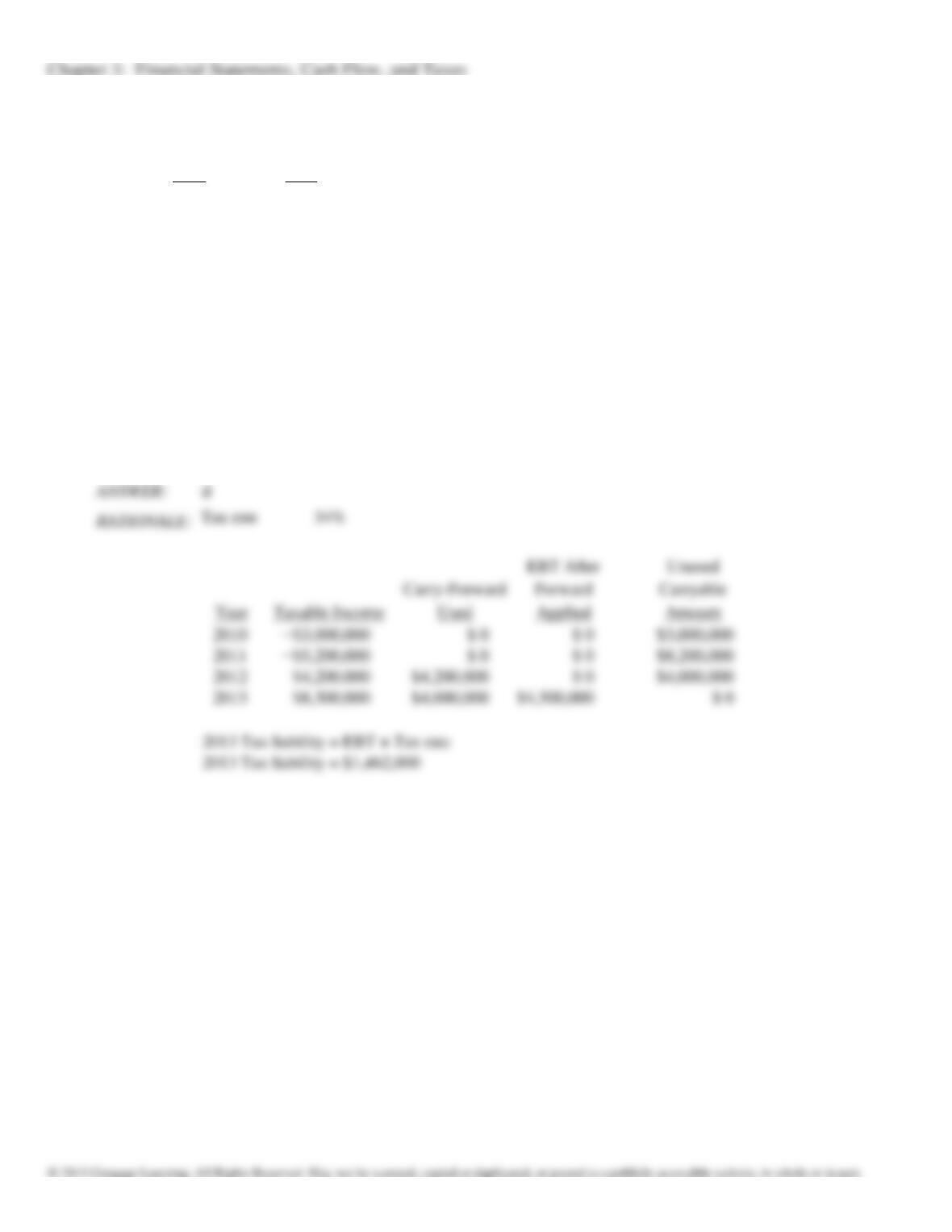
121.
Collins Co. began operations in 2010. The company lost money the first two years, but has been profitable
ever
since. The company’s taxable income (EBT) for its first four years is summarized below:
Year EBT
2010 −$3,000,000
2011 −$5,200,000
2012 $4,200,000
2013 $8,300,000
The corporate tax rate has remained at 34%. Assume that the company has taken full advantage of the Tax
Code’s
carry-back, carry-forward provisions, and assume that the current provisions were applicable in 2010.
What is
Collins’ tax liability for 2013?
a. $1,069,848
b. $1,188,720
c. $1,320,800
d. $1,462,000
e. $1,617,200
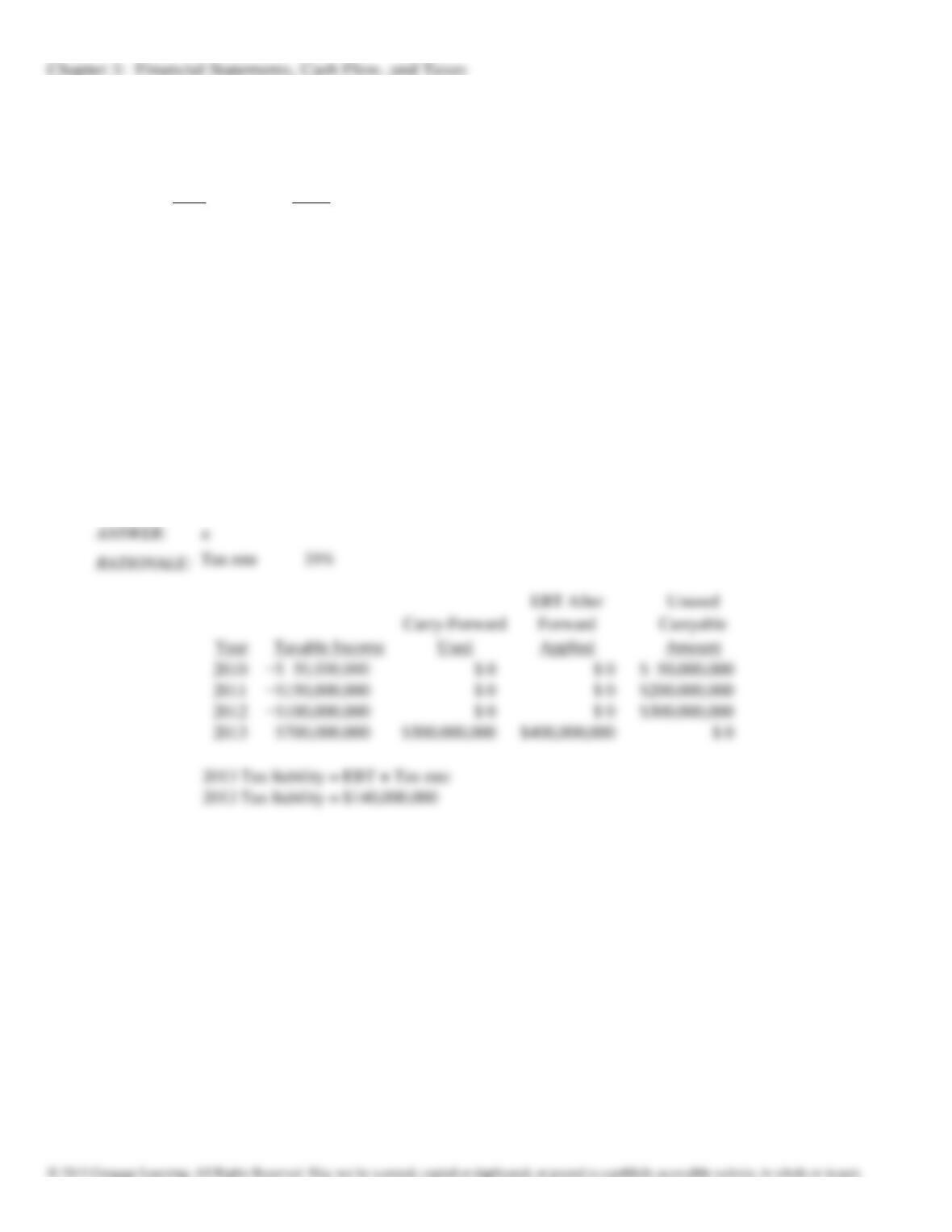
122.
Salinger Software was founded in 2010. The company lost money each of its first three years, but was able to
turn
a profit in 2013. Salinger’s operating income (EBIT) for its first four years of operations is reported
below.
Year EBIT
2010 −$ 50,000,000
2011 −$150,000,000
2012 −$100,000,000
2013 $700,000,000
The company has no debt, so operating income equals earnings before taxes. The corporate tax rate has
remained
constant at 35%. Assume that the company took full advantage of the carry-back, carry-forward
provisions in the
Tax Code, and assume that the current provisions were applicable in 2010. How much tax
did the company pay in
2013?
a. $114,030,875
b. $120,032,500
c. $126,350,000
d. $133,000,000
e. $140,000,000
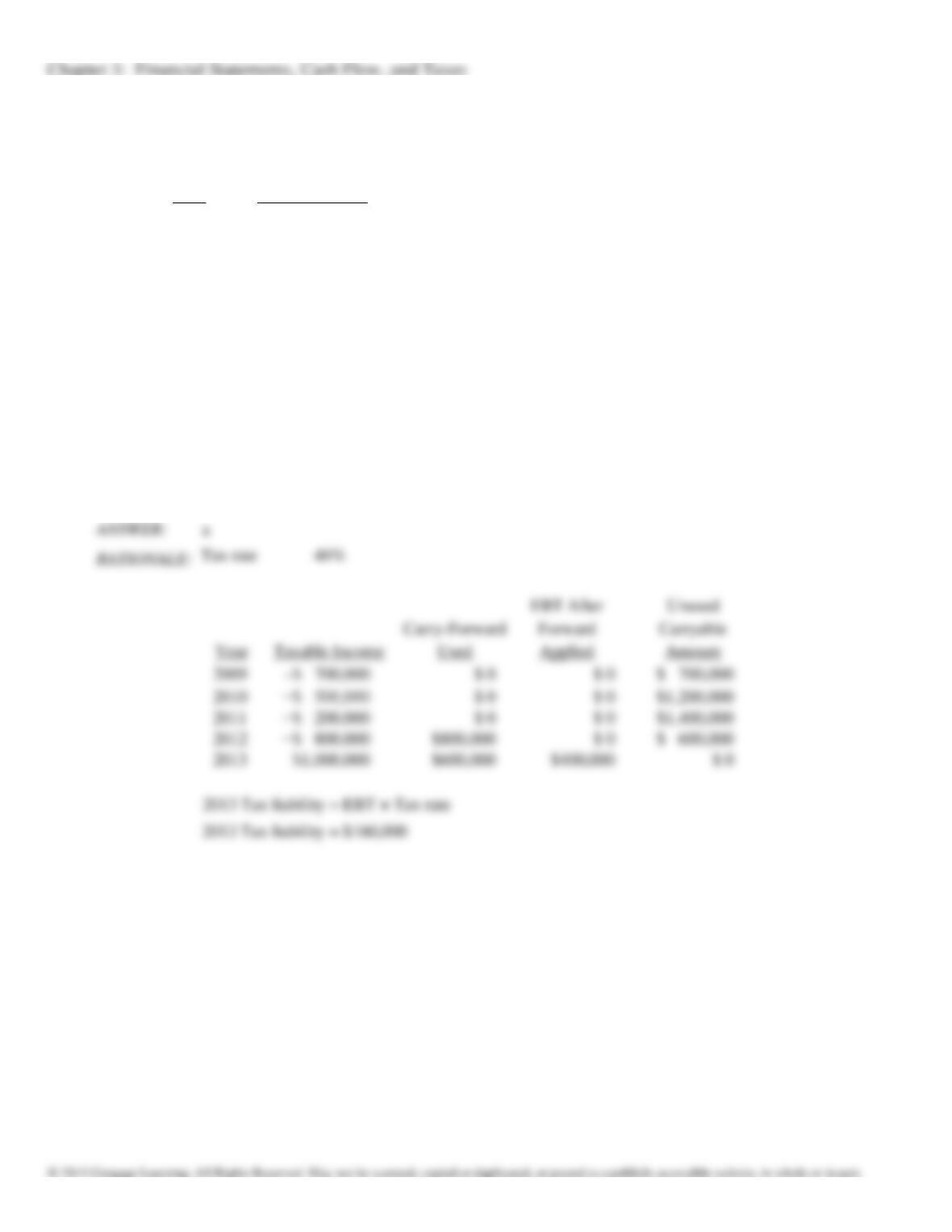
123.
Bradshaw Beverages began operations in 2009. The table below contains the company’s taxable income
during
each year of its operations. Notice that the company lost money in each of its first three years. The
corporate tax
rate has been 40% each year.
Year Taxable Income
2009 −$ 700,000
2010 −$ 500,000
2011 −$ 200,000
2012 $ 800,000
2013 $1,000,000
Assume that the company has taken full advantage of the Tax Code’s carry-back, carry-forward provisions,
and
assume that the current provisions were applicable in 2009. How much did the company pay in taxes
during 2013?
a. $160,000
b. $168,000
c. $176,400
d. $185,220
e. $194,481
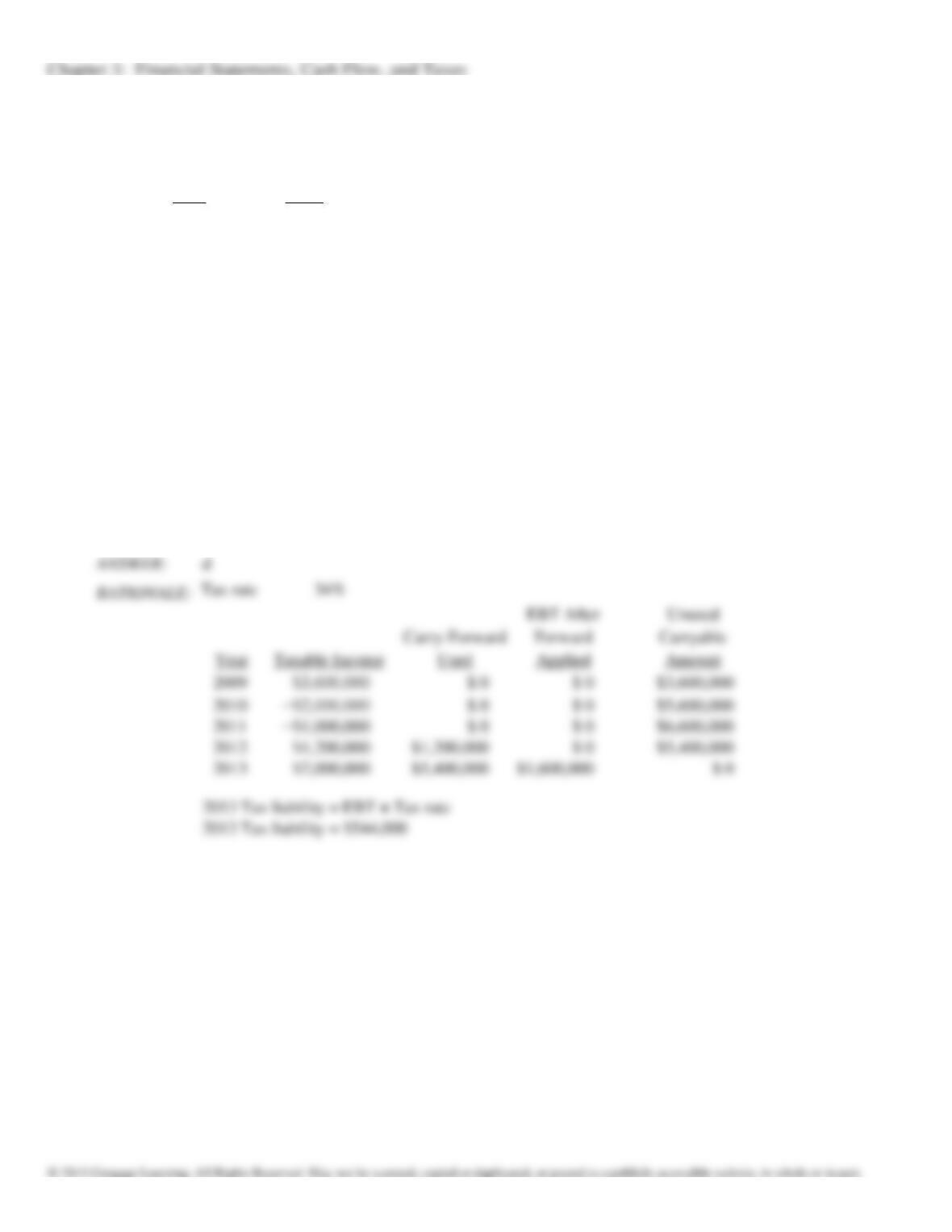
124.
Uniontown Books began operating in 2009. The company lost money its first three years of operations, but
has had
an operating profit during the past two years. The company’s operating income (EBIT) for its first
five years was
as follows:
Year EBIT
2009 −$3,600,000
2010 −$2,000,000
2011 −$1,000,000
2012 $1,200,000
2013 $7,000,000
The company has no debt, and therefore, pays no interest expense. Its corporate tax rate has remained at 34%
during this 5-year period. What was Uniontown’s tax liability for 2013? (Assume that the company has taken
full
advantage of the carry-back and carry-forward provisions, and assume that the current provisions were
applicable
in 2009.)
a. $466,412
b. $490,960
c. $516,800
d. $544,000
e. $571,200
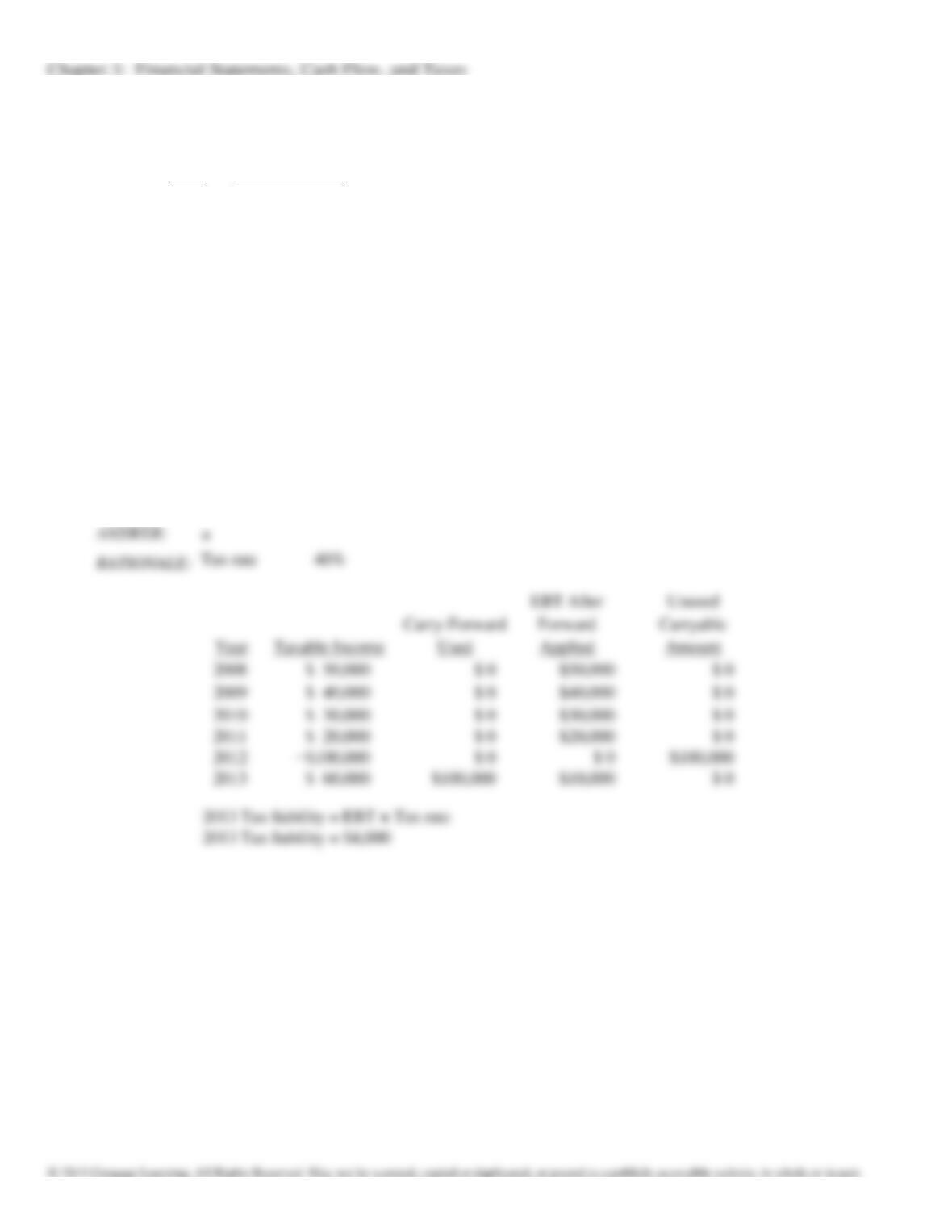
125.
Mays Industries was established in 2008. Since its inception, the company has generated the following levels
of
taxable income (EBT):
Year
Taxable Income
2008
$ 50,000
2009
$ 40,000
2010
$ 30,000
2011
$ 20,000
2012
−$100,000
2013
$ 60,000
Assume that each year the company has faced a 40% income tax rate. Also, assume that the company has
taken
full advantage of the Tax Code’s carry-back, carry-forward provisions, and assume that the current
provisions were
applicable in 2008. What is the company’s tax liability for 2013?
a. $4,000
b. $4,200
c. $4,410
d. $4,631
e. $4,862
Excess above Base
$ 0
15%
25%
34%
39%
34%
$10,000,000
35%
$15,000,000
38%
126.
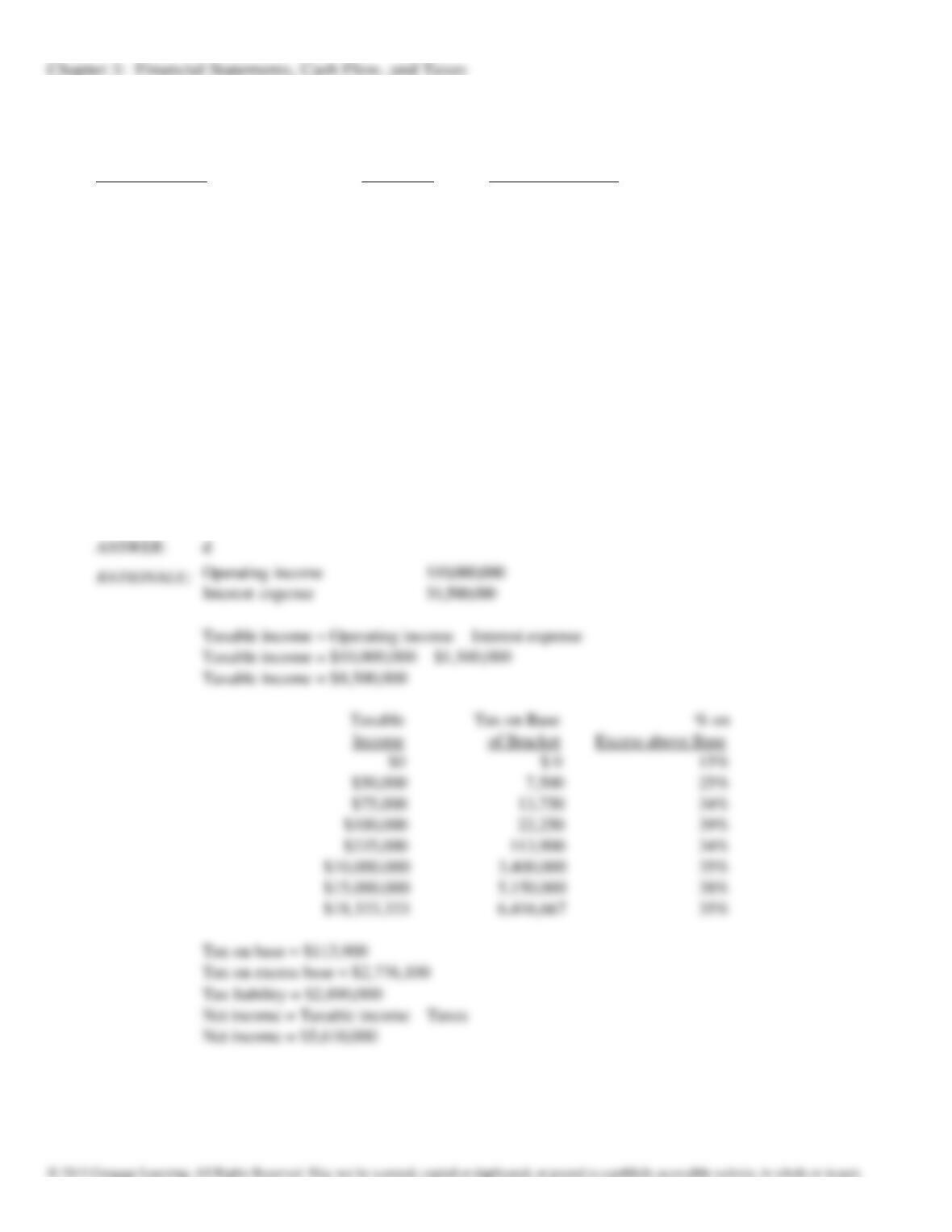
Moose Industries faces the following tax schedule:
Taxable Income
Tax on Base
Percentage on
of Bracket
Excess above Base
Up to $50,000
$ 0
15%
$50,000−$75,000
7,500
25
$75,000−$100,000
13,750
34
$100,000−$335,000
22,250
39
$335,000−$10,000,000
113,900
34
$10,000,000−$15,000,000
3,400,000
35
$15,000,000−$18,333,333
5,150,000
38
Over $18,333,333
6,416,667
35
Last year the company realized $10,000,000 in operating income (EBIT). Its annual interest expense is
$1,500,000. What was the company’s net income for the year?
a. $4,809,874
b. $5,063,025
c. $5,329,500
d. $5,610,000
e. $5,890,500
Interest income
Dividend income
$50,000
25%
$75,000
34%
$100,000
39%
$335,000
34%
$10,000,000
35%
$15,000,000
38%
Tax on excess base = $6,460
127.
Corporations face the following tax schedule:
Tax on Base
Percentage on
Taxable Income
of Bracket
Excess above Base
Up to $50,000
$ 0
15%
$50,000−$75,000
7,500
25
$75,000−$100,000
13,750
34
$100,000−$335,000
22,250
39
$335,000−$10,000,000
113,900
34
$10,000,000−$15,000,000
3,400,000
35
$15,000,000−$18,333,333
5,150,000
38
Over $18,333,333
6,416,667
35
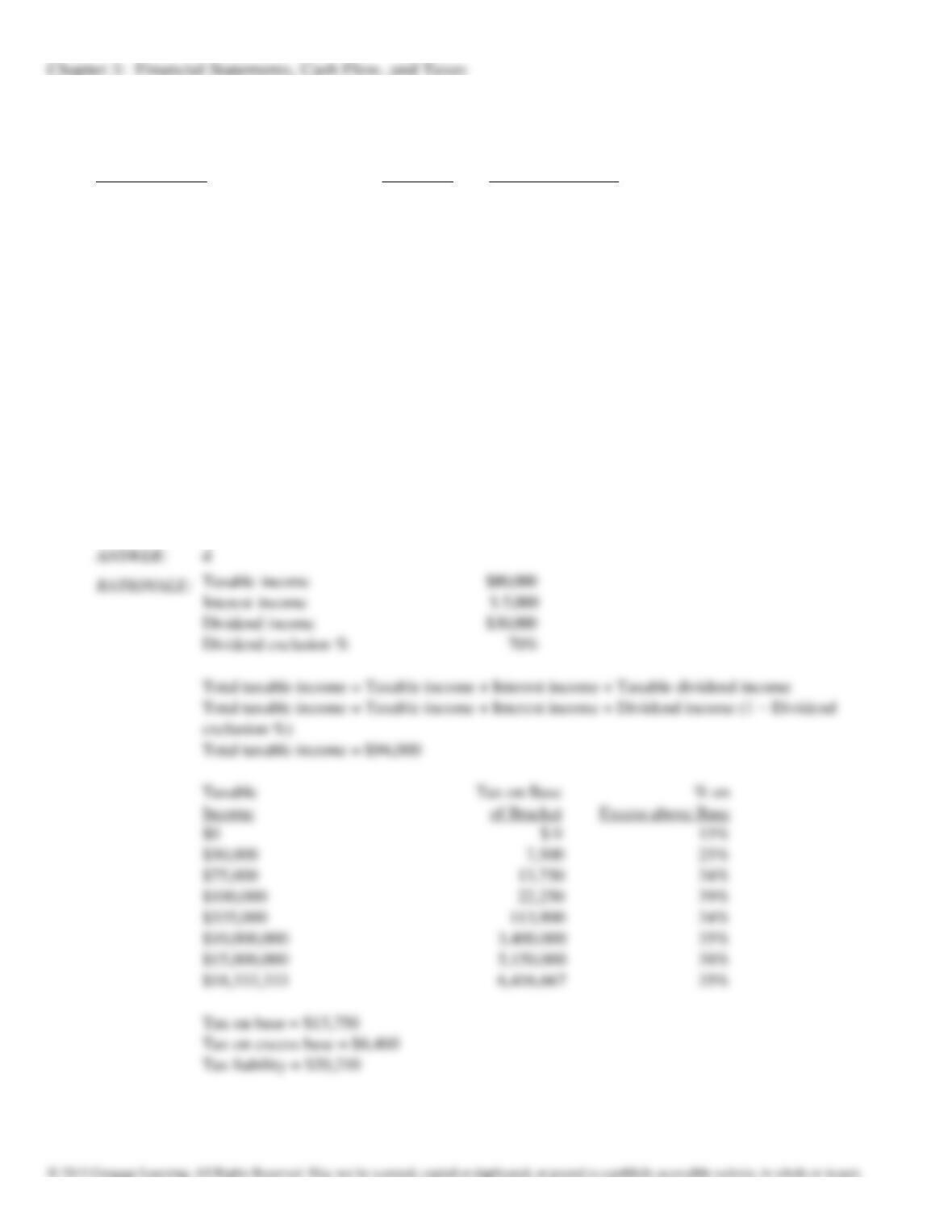
Company Z has $80,000 of taxable income from its operations, $5,000 of interest income, and $30,000 of
dividend income from preferred stock it holds in other corporations. What is Company Z’s tax liability?
a. $17,328
b. $18,240
c. $19,200
d. $20,210
e. $21,221
Interest payments
Dividend income
15%
$50,000
25%
$75,000
34%
$100,000
39%
$335,000
34%
$10,000,000
35%
$15,000,000
38%
128.
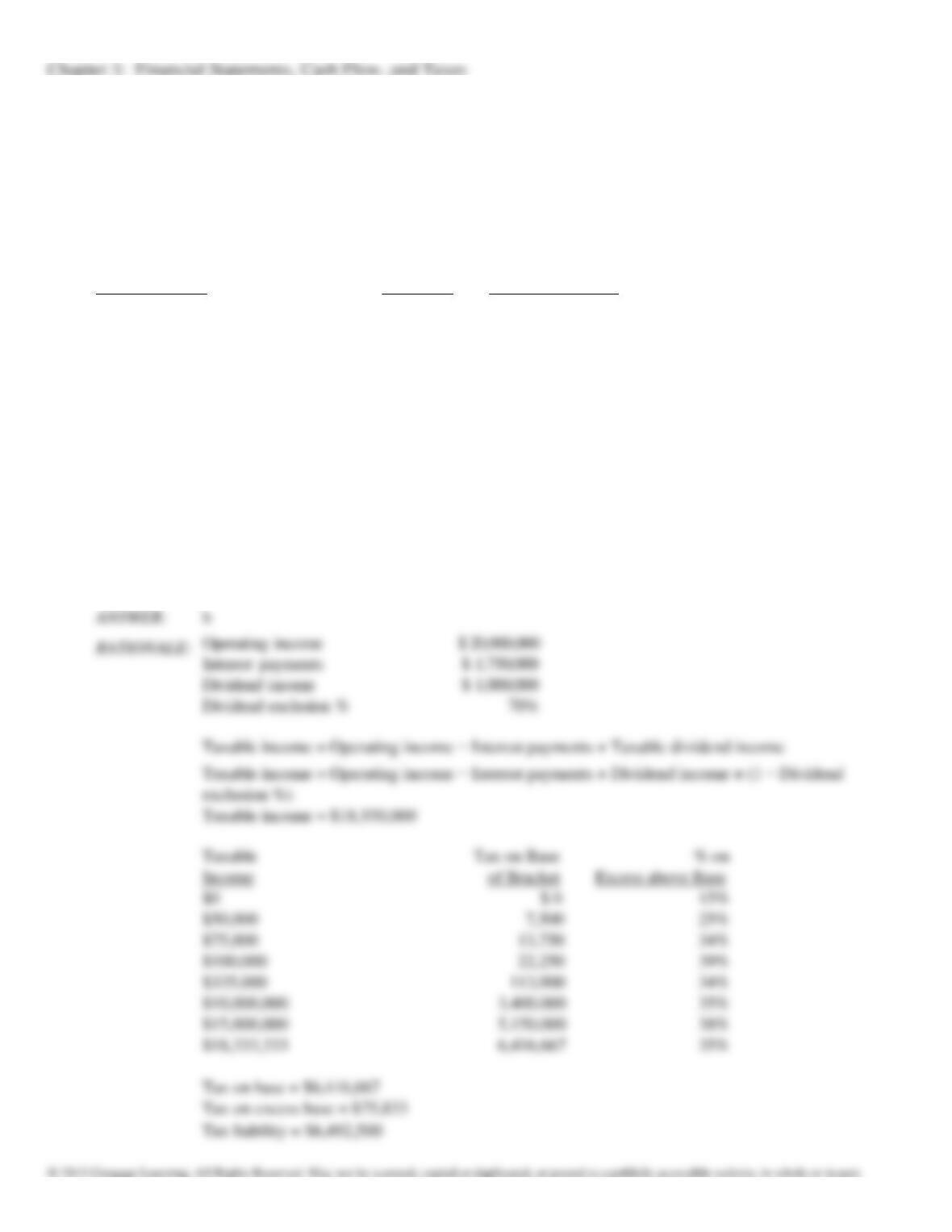
Lintner Beverage Corp. reported the following information from their financial statements:
Operating income (EBIT) = $20,000,000
Interest payments on long-term debt = $1,750,000
Dividend income = $1,000,000
Calculate Lintner’s total tax liability using the corporate tax schedule below:
Tax on Base
Percentage on
Taxable Income
of Bracket
Excess above Base
$0−$50,000
$ 0
15%
$50,000−$75,000
7,500
25
$75,000−$100,000
13,750
34
$100,000−$335,000
22,250
39
$335,000−$10,000,000
113,900
34
$10,000,000−$15,000,000
3,400,000
35
$15,000,000−$18,333,333
5,150,000
38
Over $18,333,333
a. $6,167,875
6,416,667
35
b. $6,492,500
c. $6,817,125
d. $7,157,982
e. $7,515,881
Interest income
Dividend income
$50,000
25%
$75,000
34%
$100,000
39%
$335,000
34%
$10,000,000
35%
$15,000,000
38%
Tax on excess base = $83,300
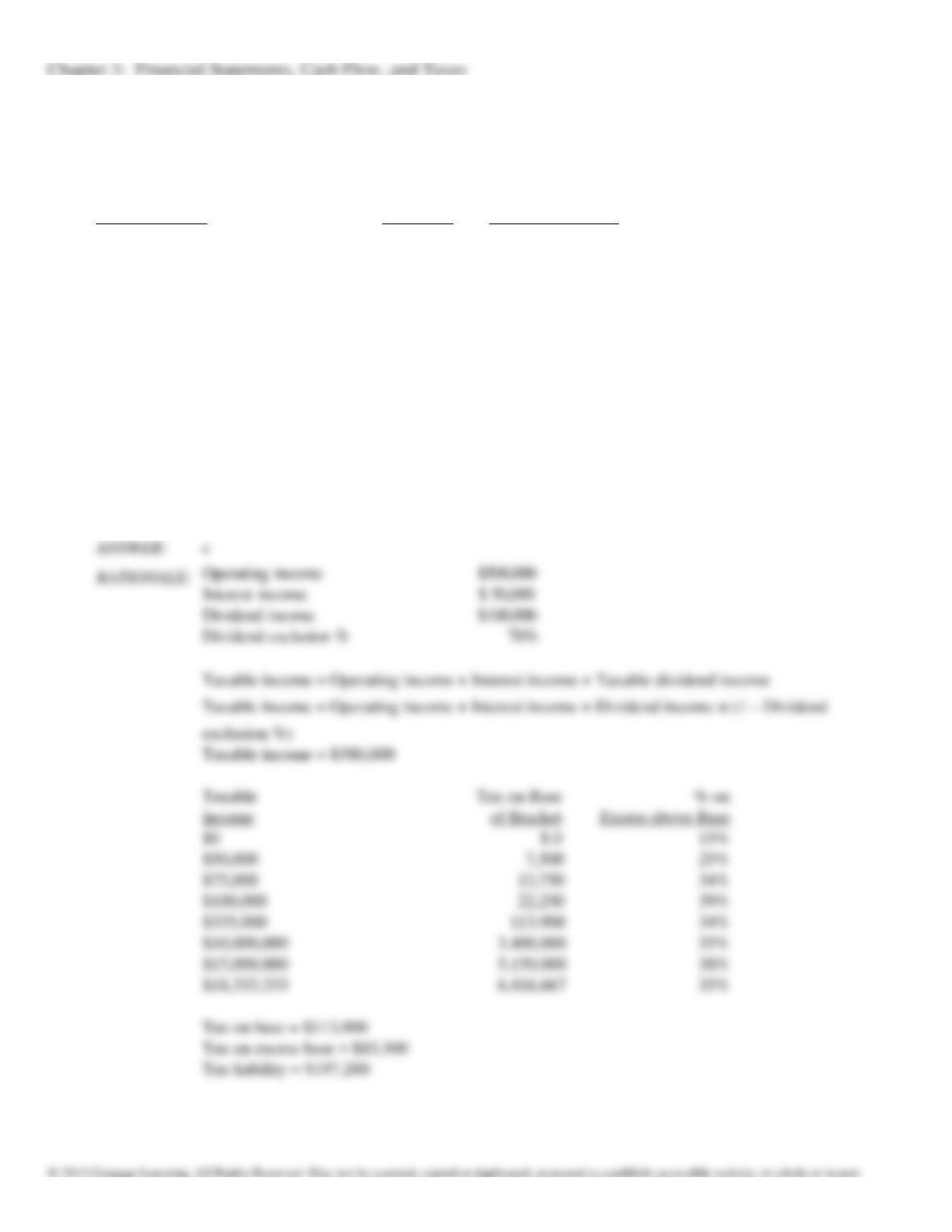
129.
Last year, Martyn Company had $500,000 in taxable income from its operations, $50,000 in interest income,
and $100,000 in dividend income. Using the corporate tax rate table given below, what was the company’s
tax liability
for the year?
Tax on Base
Percentage on
Taxable Income
of Bracket
Excess above Base
$0−$50,000
$ 0
15%
$50,000−$75,000
7,500
25
$75,000−$100,000
13,750
34
$100,000−$335,000
22,250
39
$335,000−$10,000,000
113,900
34
$10,000,000−$15,000,000
3,400,000
35
$15,000,000−$18,333,333
5,150,000
38
Over $18,333,333
a. $177,973
6,416,667
35
b. $187,340
c. $197,200
d. $207,060
e. $217,413
Interest expense
Interest income
Dividend income
$50,000
25%
$75,000
34%
$100,000
39%
$335,000
34%
$10,000,000
35%
$15,000,000
38%
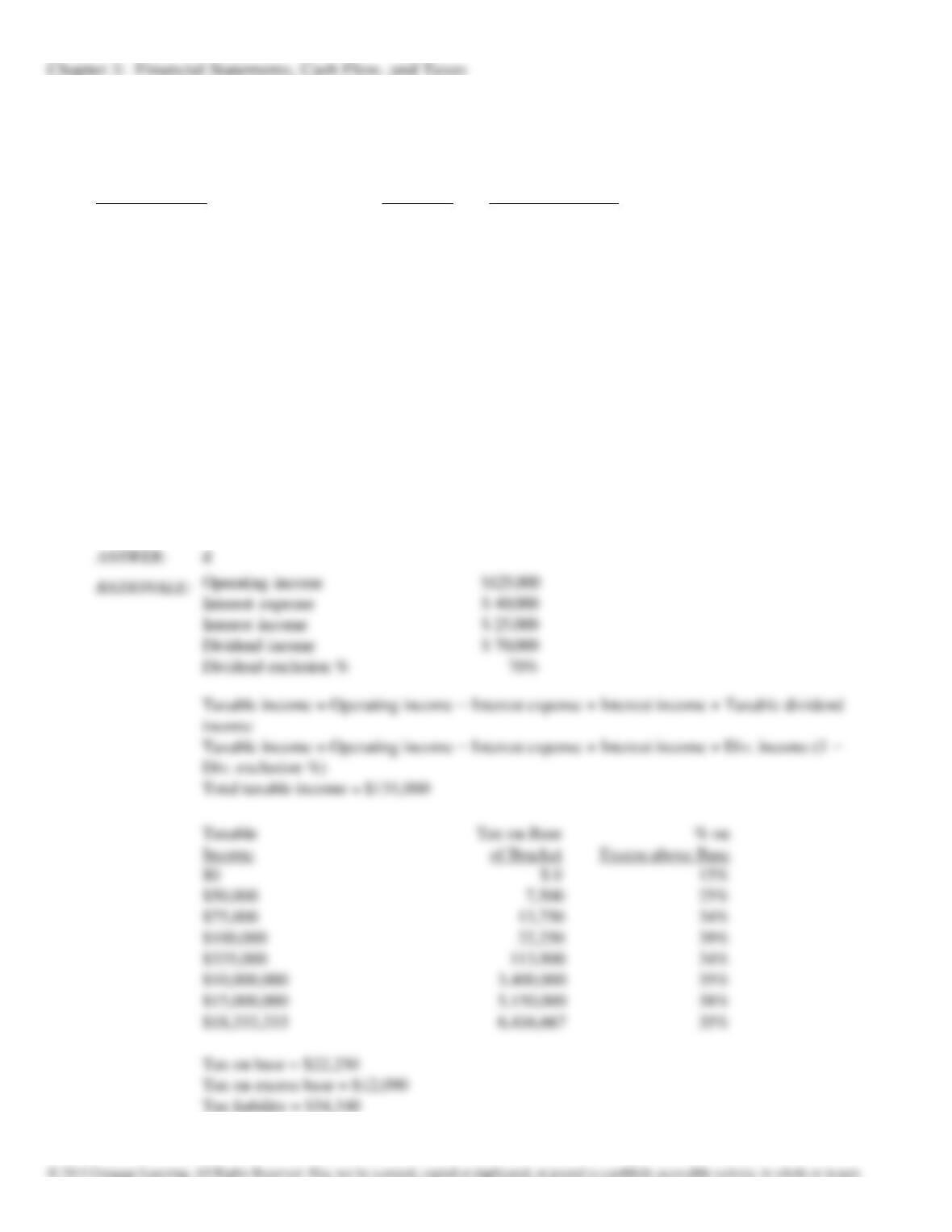
130.
Griffey Communications recently realized $125,000 in operating income. The company had interest income
of $25,000 and realized $70,000 in dividend income. The company’s interest expense was $40,000.
Tax on Base
Percentage on
Taxable Income
of Bracket
Excess above Base
Up to $50,000
$ 0
15%
$50,000−$75,000
7,500
25
$75,000−$100,000
13,750
34
$100,000−$335,000
22,250
39
$335,000−$10,000,000
113,900
34
$10,000,000−$15,000,000
3,400,000
35
$15,000,000−$18,333,333
5,150,000
38
Over $18,333,333
6,416,667
35
Using the corporate tax schedule above, what is Griffey’s tax liability?
a. $29,442
b. $30,992
c. $32,623
d. $34,340
e. $36,057