6) The “law of supply” states that, other things remaining the same, firms produce
A) more of a good the less it costs to produce it.
B) less of a good the more it costs to produce it.
C) more of a good the higher its price.
D) less of a good as the required resources become scarcer.
7) The “law of supply” refers to the fact that, all other things remaining the same, when the price
of a good rises
A) the supply curve shifts leftward.
B) the supply curve shifts rightward.
C) there is a movement up along the supply curve to a larger quantity supplied.
D) there is a movement down along the supply curve to a smaller quantity supplied.
8) Which of the following explains why supply curves slope upward?
A) prices and income
B) increasing marginal cost
C) resources and technology
D) substitutes in production and complements in production
9) The supply curve slopes upward when graphed against ________, because of ________.
A) the price of the good; increasing marginal cost
B) the price of the good; decreasing marginal cost
C) income; increasing marginal cost
D) income; decreasing marginal cost
10) A fall in the price of a good causes producers to reduce the quantity of the good they are
willing to produce. This fact illustrates
A) the law of supply.
B) the law of demand.
C) a change in supply.
D) the nature of an inferior good.
11) Because of increasing marginal cost, most supply curves
A) are horizontal.
B) are vertical.
C) have a negative slope.
D) have a positive slope.
12) A supply curve shows the relation between the quantity of a good supplied and
A) income. Usually a supply curve has negative slope.
B) income. Usually a supply curve has positive slope.
C) the price of the good. Usually a supply curve has negative slope.
D) the price of the good. Usually a supply curve has positive slope.
13) Which of the following is NOT held constant while moving along a supply curve?
A) expected future prices
B) the number of sellers
C) the price of the good itself
D) prices of factors of production
14) Each point on a supply curve represents
A) the highest price buyers will pay for the good.
B) the lowest price for which a supplier can profitably sell another unit.
C) the lowest price buyers will accept per unit of the good.
D) the highest price sellers can get for each unit over time.
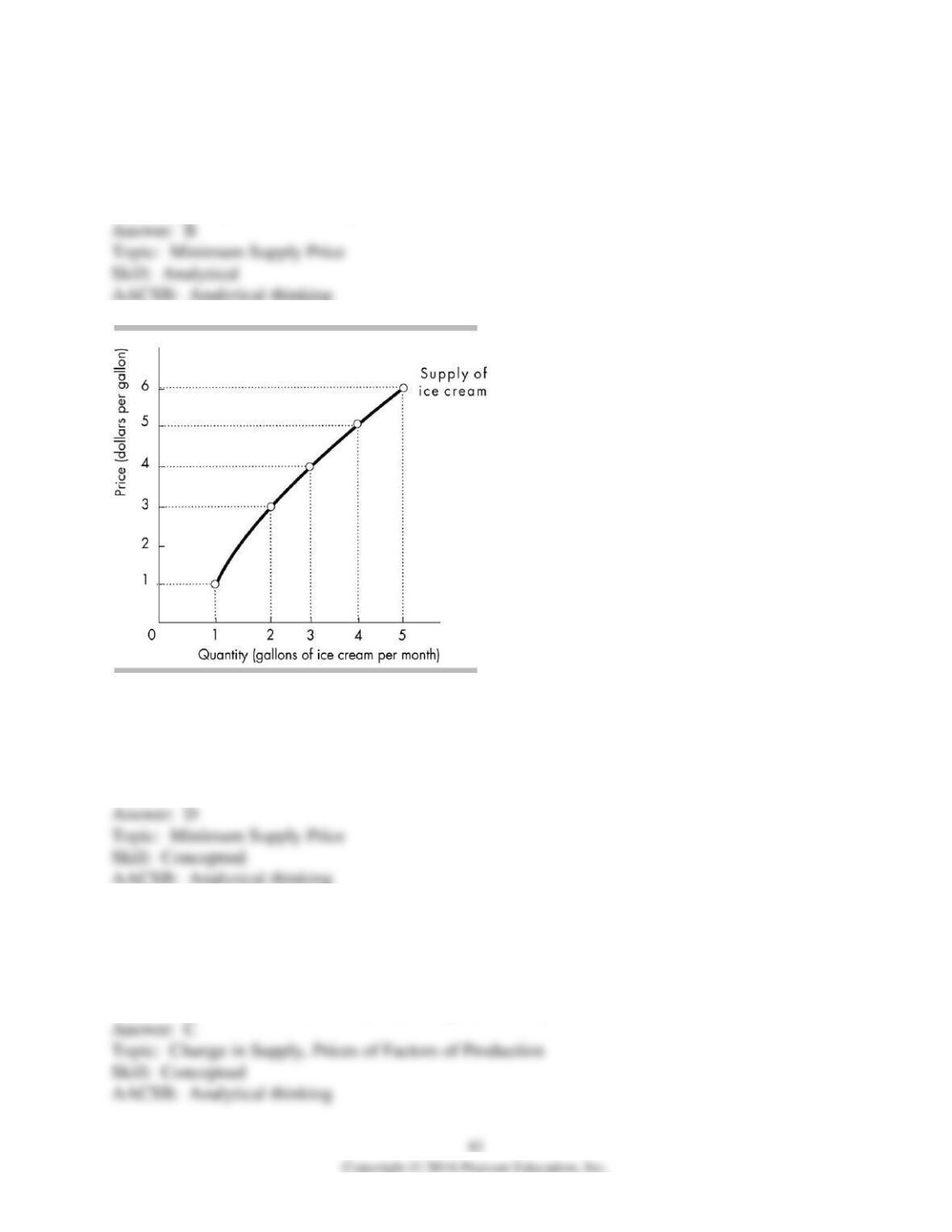
15) In the above figure, what is the minimum supply price for the fourth gallon of ice cream?
A) $2.00
B) $3.00
C) $4.00
D) $5.00
16) Which of the following shifts the supply curve for gasoline rightward?
A) a situation in which the quantity demanded exceeds the quantity supplied
B) an increase in the price of gasoline
C) a decrease in the price of a resource used to produce gasoline, such as crude oil
D) an increase in the demand for gas-guzzling, sport utility vehicles
17) Changes in which of the following shifts the supply curve of hamburgers?
A) a rise in the price of soda, a complement for hamburgers
B) new research that establishes a link between hamburgers and heart problems
C) an increase in the price of meat used to produce hamburgers
D) an economy-wide decrease in income because of a long recession
18) Which of the following decreases the supply of restaurant meals?
A) Waiters get a pay raise.
B) Consumers’ incomes increase and restaurant meals are a normal good.
C) Consumers’ incomes decrease and restaurant meals are a normal good.
D) The price of movies, a complement to restaurant meals, falls.
19) Which of the following shifts the supply curve rightward?
A) an increase in the population
B) a positive change in preferences for the good
C) a decrease in the price of the good
D) a decrease in the price of a factor of production used to produce the good
20) Auto workers negotiate a wage increase. How does this wage hike affect the supply of cars?
A) It decreases the supply.
B) It increase the supply.
C) It has no effect.
D) There is not enough information to tell if the change increases, decreases, or has no effect on
the supply of cars.
21) If a producer can use resources to produce either good A or good B, then A and B are
A) complements in production.
B) substitutes in production.
C) substitutes in consumption.
D) complements in consumption.
22) Good A and good B are substitutes in production. The demand for good A increases so that
the price of good A rises. The increase in the price of good A shifts the
A) demand curve for good B leftward.
B) demand curve for good B rightward.
C) supply curve of good B leftward.
D) supply curve of good B rightward.
23) Blank DVDs and prerecorded DVDs are substitutes in production. An increase in the price of
a blank DVD will lead to
A) an increase in the supply of prerecorded DVDs.
B) a decrease in the supply of prerecorded DVDs.
C) an increase in the quantity supplied of prerecorded DVDs but not in the supply of prerecorded
DVDs.
D) a decrease in the quantity supplied of prerecorded DVDs but not in the supply of prerecorded
DVDs.
24) If the price of lumber rises, then, in the market for sawdust
A) the supply curve of sawdust shifts leftward.
B) the supply curve of sawdust shifts rightward.
C) there is a movement downward along the supply curve for sawdust.
D) there is a movement upward along the supply curve for sawdust.
25) A bakery can produce either cakes or cookies. If the price of cookies rises, then
A) the supply curve of cake shifts leftward.
B) the supply curve of cake shifts rightward.
C) there is a movement downward along the supply curve of cakes.
D) there is a movement upward along the supply curve of cakes.
26) Good A and good B are substitutes in production. The demand for good A decreases, which
lowers the price of good A. The decrease in the price of good A
A) decreases the supply of good B.
B) increases the supply of good B.
C) decreases the demand for good B.
D) increases the demand for good B.
27) Growers expect that the price of a bushel of wheat will increase in one month. This belief
results in
A) an increase in current supply of wheat.
B) a decrease in current supply of wheat.
C) a decrease in future supply of wheat.
D) no change in current or future supply of wheat.
28) An increase in the number of suppliers in a market results in a
A) movement up along the supply curve.
B) rightward shift in the supply curve.
C) leftward shift in the supply curve.
D) Both answers A and C are correct.
29) An increase in the number of fast-food restaurants
A) raises the price of fast-food meals.
B) increases the demand for fast-food meals.
C) increases the supply of fast-food meals.
D) increases the demand for substitutes for fast-food meals.
30) Which of the following increases the supply of a product?
A) a fall in the price of the product
B) a smaller number of sellers producing the product
C) an increase in foreign imports of the product
D) higher taxes imposed upon producers of the product
31) Which of the following decreases the supply of popcorn?
A) a decrease in the price of popcorn
B) an increase in the price of popcorn
C) a technological advance in the production of popcorn
D) a decrease in the number of popcorn producers
32) Over the past decade technological improvements that have lowered the cost of producing an
automobile have increased
A) both the supply and the demand for automobiles.
B) the supply but not the demand for automobiles.
C) the demand but not the supply of automobiles.
D) neither the supply nor the demand for automobiles.
33) An increase in technology for producing personal computers leads to
A) an increase in the demand for personal computers.
B) a decrease in the demand for personal computers.
C) an increase in the supply of personal computers.
D) a decrease in the supply of personal computers.
34) Which of the following shifts the supply curve of broccoli?
A) an increase in income
B) a newly discovered increase in the nutritional value of broccoli
C) a newly discovered link between broccoli consumption and tooth decay
D) the destruction of much of this year’s broccoli crop by hurricanes
35) A severe drought has damaged this year’s lettuce crop. The initial effect on the lettuce market
is a
A) decrease in the demand for lettuce.
B) decrease in the supply of lettuce.
C) decrease in both the demand and supply of lettuce.
D) rightward movement along the demand curve for lettuce.
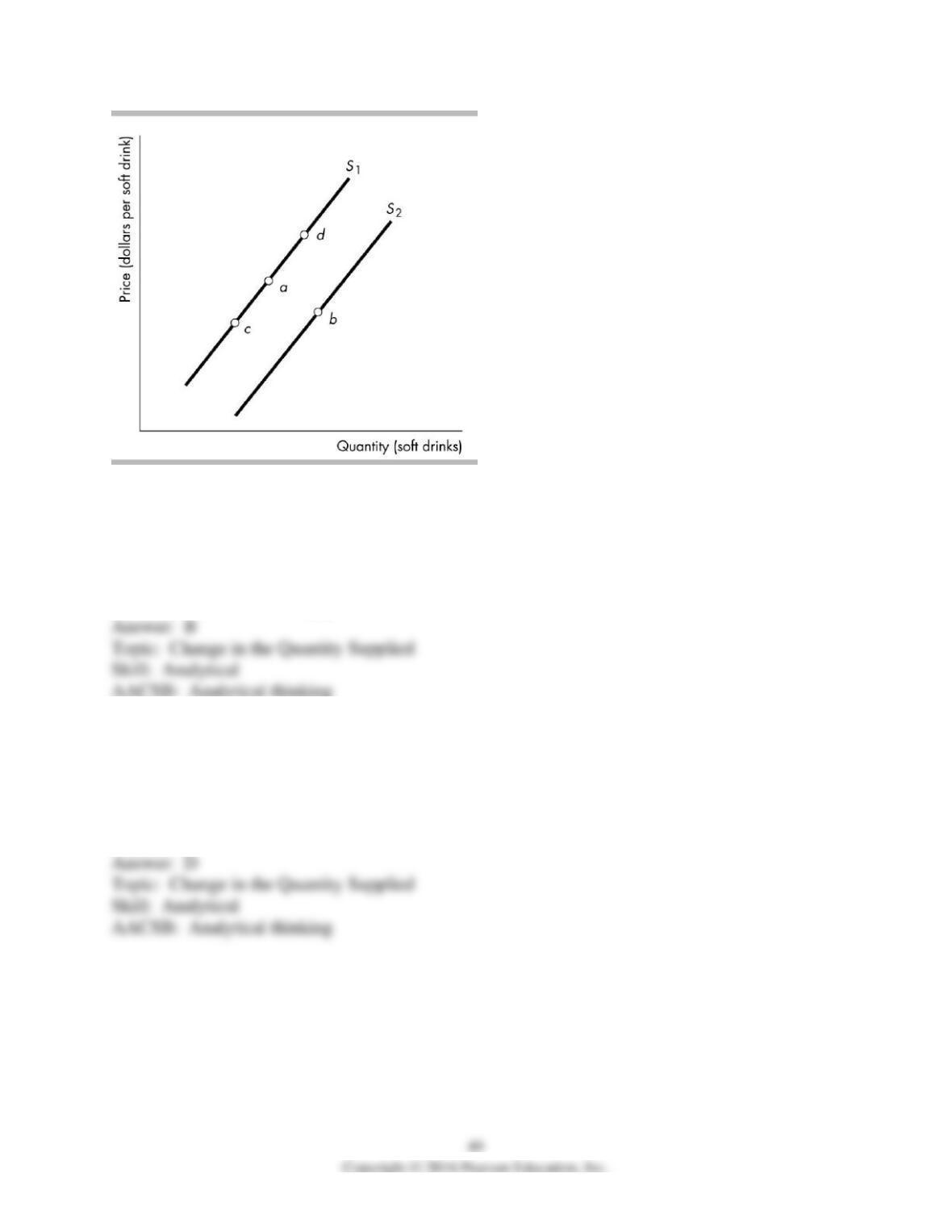
36) The figure above shows supply curves for soft drinks. Suppose the economy is at point a. A
movement to point c could be the result of
A) a decrease in technology.
B) a decrease in the relative price of a soft drink.
C) an increase in the relative price of a soft drink.
D) an increase in the money price of a soft drink.
37) The figure above shows supply curves for soft drinks. Suppose the economy is at point a. An
increase in the price of a soft drink is shown as a movement from point a to
A) none of the points that are illustrated.
B) point b.
C) point c.
D) point d.
38) The figure above shows supply curves for soft drinks. Suppose the economy is at point a. A
movement to point d would be the result of
A) an increase in technology.
B) a decrease in the relative price of a soft drink.
C) an increase in the relative price of a soft drink.
D) an increase in the number of soft drink suppliers.
39) The figure above shows supply curves for soft drinks. Suppose the economy is at point a. A
decrease in the price of sugar used to make soft drinks is shown as a movement from point a to a
point such as
A) none of the points that are illustrated.
B) point b.
C) point c.
D) point d.
40) The figure above shows supply curves for soft drinks. Suppose the economy is at point a. An
increase in the number of suppliers would be shown as a movement from point a to a point such
as
A) none of the points that are illustrated.
B) point b.
C) point c.
D) point d.
41) The figure above shows supply curves for soft drinks. Suppose the economy is at point a. A
movement to point b could be the result of
A) an increase in technology.
B) a decrease in the relative price of a soft drink.
C) an increase in the relative price of a soft drink.
D) an increase in the money price of a soft drink.
42) Which of the following shifts the supply curve for good X leftward?
A) a situation in which quantity demanded exceeds quantity supplied
B) an increase in the cost of the machinery used to produce X
C) a technological advance in the production of X
D) a decrease in the wages of workers employed to produce X
43) Which of the following will NOT shift the supply curve for pick-up trucks?
A) a technological advance
B) an increase in the price of a resource used to produce pick-up trucks
C) a change in the number of firms supplying pick-up trucks
D) a change in the price of pick-up trucks
44) A change in which of the following would NOT shift the supply curve for sneakers?
A) an increase in technology for making sneakers
B) an increase in the price of rubber, used to make sneakers
C) an increase in the price of sneakers
D) None of the above, that is, each change shifts the supply curve
45) Which of the following shifts the supply curve for oranges?
A) disastrous weather that destroys about half of this year’s orange crop
B) a newly discovered increase in the nutritional value of oranges
C) an increase in the price of bananas, a substitute in consumption for oranges
D) an increase in income for all orange consumers
46) Which of the following leads to a movement along the supply curve for shredded wheat but
does not shift the supply curve for shredded wheat?
A) a fall in the price of shredded wheat
B) an increase in the cost of machinery used to shred wheat
C) perfect weather conditions that resulted in a large wheat crop
D) a decrease in the number of shredded wheat producers
47) Which of the following results in a movement along the supply curve of spinach but does not
shift the supply curve of spinach?
A) disastrous weather that destroys half of this year’s spinach crop
B) a rise in the price of spinach
C) an increase in wages for workers in spinach fields
D) great weather that produces a bumper spinach crop this year
48) Which of the following does NOT shift the supply curve?
A) a technological advance
B) a decrease in the wages of labor used in production of the good
C) a fall in the price of a substitute in production
D) an increase in the price of the good
49) If the price of chocolate chip cookies falls, then
A) the supply curve of chocolate chip cookies shifts rightward.
B) the supply curve of chocolate chip cookies shifts leftward.
C) there is a movement downward along the supply curve of chocolate chip cookies.
D) there is a movement upward along the supply curve of chocolate chip cookies.
50) As the price of a pound of peanuts falls, the
A) supply of peanuts increases.
B) supply of peanuts decreases.
C) quantity of peanuts supplied increases.
D) quantity of peanuts supplied decreases.
51) For a “change in the quantity supplied” but not “a change in supply” to occur, there must be a
A) rightward shift of the supply curve.
B) rightward shift of the demand curve.
C) leftward shift of the demand curve.
D) Both answers B and C are correct.
52) If the price of a good changes but everything else influencing suppliers’ planned sales
remains constant, there is a
A) new supply curve that is to the right of the initial supply curve.
B) new supply curve that is to the left of the initial supply curve.
C) movement along the supply curve.
D) rotation of the initial supply curve around the initial price.
53) A decrease in the quantity supplied is represented by a
A) movement down the supply curve.
B) movement up the supply curve.
C) rightward shift in the supply curve.
D) leftward shift in the supply curve.
54) Which of the following increases the quantity supplied of good X but does NOT increase the
supply of good X?
A) a fall in the price of a factor production used to produce X
B) an advance in the technology for producing X
C) an increase in the price of good Y, a complement in the production of X
D) an increase in the price of X
55) Consider the market for broccoli. If the price of a pound of broccoli increases, what happens
to the supply of broccoli?
A) The supply of broccoli decreases.
B) The supply of broccoli increases.
C) There will be no change in the supply of broccoli, but instead there is an increase in the
quantity supplied of broccoli.
D) There will be no change in the supply of broccoli, but instead there is a decrease in the
quantity supplied of broccoli.
56) Which of the following statements is TRUE?
A) An increase in the price of gasoline will decrease the demand for gasoline.
B) An increase in the price of gasoline will increase the quantity demanded of gasoline.
C) An increase in the price of gasoline will increase the supply of gasoline.
D) An increase in the price of gasoline will increase the quantity supplied of gasoline.
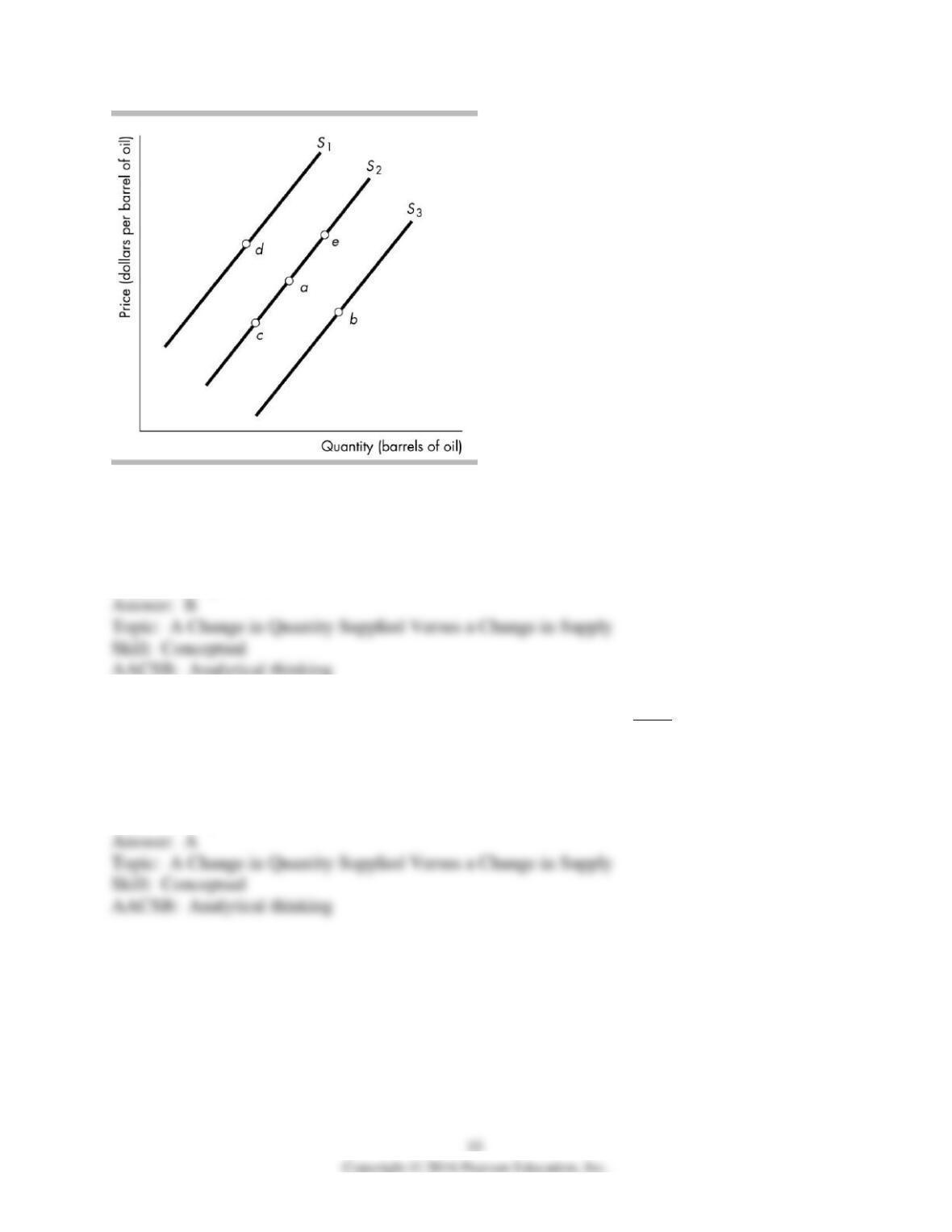
57) In the figure above, an increase in the supply of oil would result in a movement from
A) point a to point e.
B) point a to point b.
C) point a to point c.
D) point a to point d.
58) In the figure above, an increase in the quantity of oil supplied but NOT an increase in the
supply of oil is shown by a movement from
A) point a to point e.
B) point a to point b.
C) point a to point c.
D) point a to point d.
59) In the figure above, a decrease in the quantity of oil supplied but NOT a decrease in the
supply of oil is shown by a movement from
A) point a to point e.
B) point a to point b.
C) point a to point c.
D) point a to point d.
60) In the figure above, which movement could be the result of an increase in the wages paid to
oil workers?
A) point a to point e
B) point a to point b
C) point a to point c
D) point a to point d
61) In the figure above, which movement could be the result of the development of a new, more
efficient refining technology?
A) point a to point e
B) point a to point b
C) point a to point c
D) point a to point d
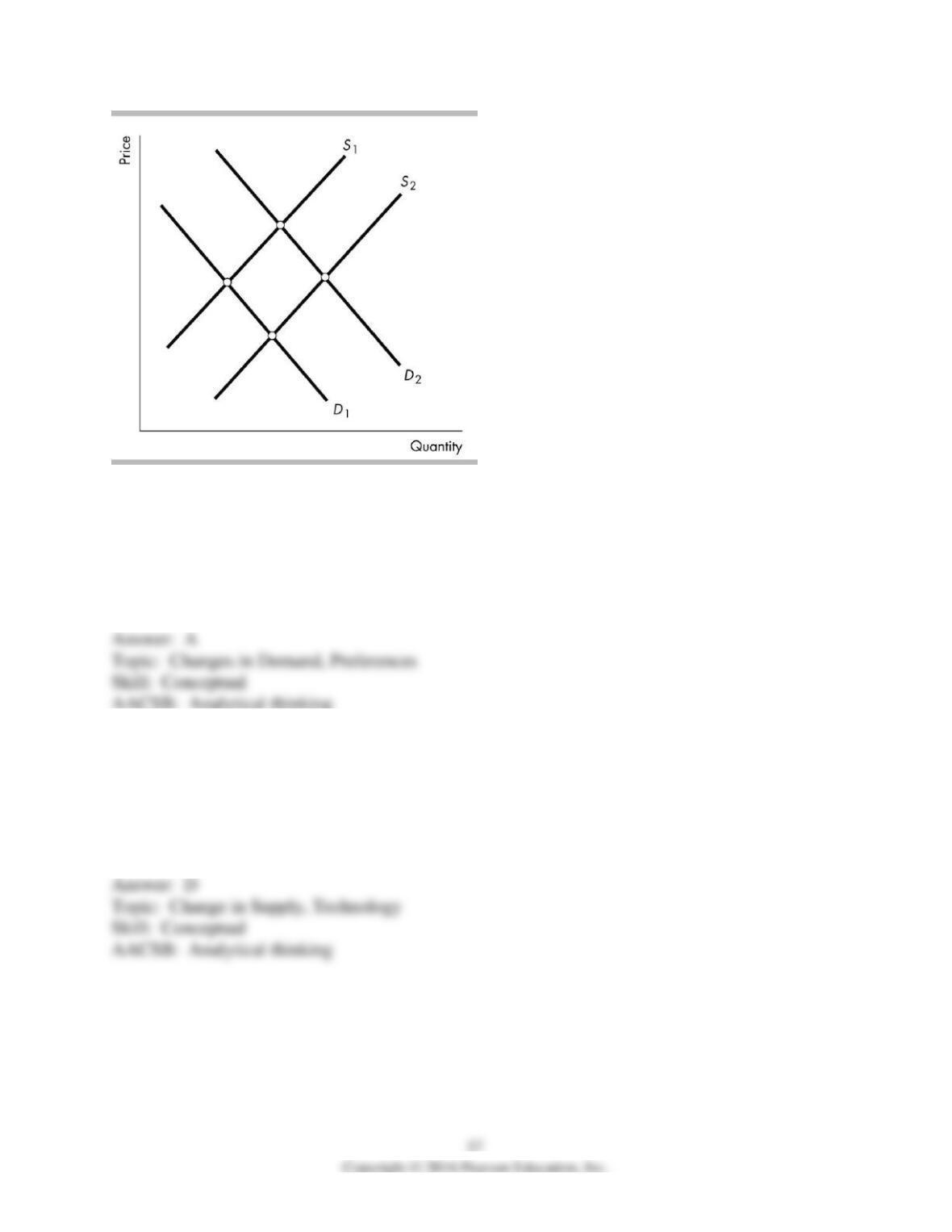
62) The figure above shows the market for candy. People become more concerned that eating
candy causes them to gain weight, which they do not like. As a result, the
A) demand curve shifts from D2 to D1 and the supply curve does not shift.
B) demand curve shifts from D1 to D2 and the supply curve shifts from S1 to S2.
C) demand curve shifts from D2 to D1 and the supply curve shifts from S2 to S1.
D) demand curve does not shift, and the supply curve shifts from S1 to S2.
63) The above figure shows the market for oil. Because of the development of a new deep sea
drilling technology the
A) demand curve shifts from D1 to D2 and the supply curve does not shift.
B) demand curve shifts from D1 to D2 and the supply curve shifts from S1 to S2.
C) demand curve does not shift, and the supply curve shifts from S2 to S1.
D) demand curve does not shift, and the supply curve shifts from S1 to S2.
64) The above figure shows the market for gasoline. When a hurricane destroys a major refinery
that refines oil into gasoline, the
A) demand curve for gasoline shifts from D1 to D2 and the supply curve of gasoline does not
shift.
B) demand curve for gasoline shifts from D1 to D2 and the supply curve of gasoline shifts from
S2 to S1.
C) demand curve for gasoline does not shift, and the supply curve of gasoline shifts from S2 to
S1.
D) demand curve for gasoline does not shift, and the supply curve of gasoline shifts from S1 to
S2.
65) The above figure shows the market for bicycles. When there is a physical fitness craze so
that everyone wants to exercise the
A) demand curve for bicycles shifts from D1 to D2.
B) demand curve for bicycles shifts from D2 to D1.
C) demand curve and the supply curve of bicycles do not shift.
D) supply curve of bicycles shifts from S1 to S2.
66) The above figure shows the market for french fries at fast food joints. If the price of potatoes
rises and simultaneously people become concerned that french fries can cause heart attacks the
A) demand curve for french fries shifts from D2 to D1 and the supply curve of french fries does
not shift.
B) demand curve for french fries shifts from D2 to D1 and the supply curve of french fries shifts
from S2 to S1.
C) demand curve for french fries shifts from D2 to D1 and the supply curve of french fries shifts
from S1 to S2.
D) demand curve for french fries does not shift, and the supply curve of french fries shifts from
S1 to S2.
67) A rise in the price of a good causes producers to supply more of the good. This statement
illustrates
A) the law of supply.
B) the law of demand.
C) a change in supply.
D) the nature of an inferior good.
68) Which of the following influences does NOT shift the supply curve?
A) a rise in the wages paid workers who produce the good
B) the development of new technology
C) people deciding that they want to buy more of the product
D) a decrease in the number of suppliers
69) To say that “supply increases” for any reason, means there is a
A) movement rightward along a supply curve.
B) movement leftward along a supply curve.
C) shift rightward in the supply curve.
D) shift leftward in the supply curve.
70) The price of jet fuel falls. This fall shifts the
A) demand curve for airplane trips rightward.
B) demand curve for airplane trips leftward.
C) supply curve of airplane trips rightward.
D) supply curve of airplane trips leftward.
71) An increase in the price of the cheese used to produce pizza shifts the supply curve of pizza
________ and shifts the demand curve for pizza ________.
A) rightward; leftward
B) leftward; leftward
C) leftward; not at all
D) not at all; leftward
72) An increase in the number of producers of gruel ________ the supply of gruel and shifts the
supply curve of gruel ________.
A) increases; rightward
B) increases; leftward
C) decreases; rightward
D) decreases; leftward
73) Wages for workers producing iPods and similar products will rise next year. Walkman
Watch asks you to predict the effect of this change in next year’s market for iPods. You predict
that the major effect will be that the
A) demand curve for an iPod will shift rightward.
B) demand curve for an iPod will shift leftward.
C) supply curve for an iPod will shift leftward.
D) supply curve for an iPod will shift rightward.
74) Producers of DVDs are able to lower the wage rate that they pay to their workers. You
predict that the
A) price will rise.
B) quantity supplied will decrease.
C) supply curve will shift leftward.
D) supply curve will shift rightward.