Chapter 03 – The Concept of Elasticity and Consumer and Producer Surplus
78) An increase in demand will always
A) increase producer surplus.
B) increase producer surplus and increase consumer surplus.
C) decrease consumer surplus and increase consumer surplus.
D) increase consumer surplus.
79) When looking at the impact of a change in trade policy economists use consumer and
producer surplus to look at the winners and losers. Free trade economists insist that
A) no one loses.
B) everyone loses.
C) there are winners and losers but that the gain to the winners is greater than the loss to the
losers.
D) there are winners and losers but that the loss to the losers is greater than the gain to the
winners.
80) If supply and demand are both straight lines, then at equilibrium consumer and producer
surplus are both
A) equal.
B) shown as trapezoids.
C) shown as squares.
D) shown as triangles.
81) Combined the consumer surplus and producer surplus at equilibrium is
A) lower than it would be at prices below equilibrium.
B) lower than it would be at prices above equilibrium.
C) typically negative.
D) as big as it can get.
82) The elasticity of demand can change with
A) the number of close substitutes.
B) the time available to shift to other alternatives.
C) neither a) nor b)
D) both a) and b)
Chapter 03 – The Concept of Elasticity and Consumer and Producer Surplus
83) If the percentage change in quantity supplied is 10% and the percentage change in price is
10% then the supply for the good is
A) elastic.
B) inelastic.
C) unit elastic.
D) perfectly inelastic.
84) If the percentage change in quantity supplied is 10% and the percentage change in price is
5% then the supply for the good is
A) elastic.
B) inelastic.
C) unit elastic.
D) perfectly inelastic.
85) If the percentage change in quantity supplied is 5% and the percentage change in price is
10% then the supply for the good is
A) elastic.
B) inelastic.
C) unit elastic.
D) perfectly inelastic.
86) If the percentage change in quantity supplied is 0% and the percentage change in price is
10% then the supply for the good is
A) elastic.
B) inelastic.
C) unit elastic.
D) perfectly inelastic.
87) If the percentage change in quantity supplied is 0% and the percentage change in price is 5%
then the good is
A) elastic.
B) inelastic.
C) unit elastic.
D) perfectly inelastic.
Chapter 03 – The Concept of Elasticity and Consumer and Producer Surplus
88) If the percentage change in price is 10% and the percentage change in quantity supplied is
5% then the supply for the good is
A) elastic.
B) inelastic.
C) unit elastic.
D) perfectly inelastic.
89) If the percentage change in price is 5% and the percentage change in quantity supplied is
10% then the supply for the good is
A) elastic.
B) inelastic.
C) unit elastic.
D) perfectly inelastic.
90) If the percentage change in price is 10% and the percentage change in quantity supplied is
0% then the supply for the good is
A) elastic.
B) inelastic.
C) unit elastic.
D) perfectly inelastic.
91) If there is no change in price that can alter the quantity supplied then the supply for the good
is
A) perfectly elastic.
B) inelastic.
C) perfectly unit elastic.
D) perfectly inelastic.
92) If there is no change in demand that will cause a change in the price then the supply for the
good is
A) perfectly elastic.
B) inelastic.
C) perfectly unit elastic.
D) perfectly inelastic.
Chapter 03 – The Concept of Elasticity and Consumer and Producer Surplus
93) Economists suggest that a market can fail if
A) production or consumption can harm an innocent third party.
B) consumers have to pay more than they want to.
C) producers get smaller profits than they desire.
D) governments dictate prices.
94) Economists suggest that a market can fail if
A) consumers have to pay more than they want to.
B) no market for the product exists.
C) producers get smaller profits than they desire.
D) governments dictate prices.
95) Economists suggest that a market can fail if
A) consumers have to pay more than they want to.
B) producers get smaller profits than they desire.
C) the good or service is such that consumers are unable to make well-informed decisions
about its consumption.
D) governments dictate prices.
96) Economists suggest that a market can fail if
A) consumers have to pay more than they want to.
B) producers get smaller profits than they desire.
C) governments dictate prices.
D) the buyer or seller exerts significant power such that they can dictate price.
97) If a consumer can be easily prevented from consuming a good or service by a producer, then
the good exhibits
A) rivalry.
B) exclusivity.
C) an externality.
D) a moral loss.
98)
Chapter 03 – The Concept of Elasticity and Consumer and Producer Surplus
If one person’s enjoyment of a good is reduced when another person consumes the good then
the good exhibits
A) rivalry.
B) exclusivity.
C) an externality.
D) a moral loss.
99) Suppose a long stretch of beach with many possible public and private entrances is such that
it is impossible to control access and, as a result, gets very crowded on summer days. Which
recognized characteristic of goods holds
A) rivalry.
B) exclusivity.
C) lucidity.
D) morality.
100) Suppose a long stretch of beach with many possible public and private entrances is such that
it is impossible to control access and, as a result, gets very crowded on summer days. Which
recognized characteristic of goods does not hold
A) rivalry.
B) exclusivity.
C) lucidity.
D) morality.
101) Suppose a satellite radio signal can be received by any number of devices without the
quality being diminished but that the devices are only activated when consumers pay a
subscription. Which recognized characteristic of goods holds
A) rivalry.
B) exclusivity.
C) lucidity.
D) morality.
Chapter 03 – The Concept of Elasticity and Consumer and Producer Surplus
102) Suppose a satellite radio signal can be received by any number of devices without the
quality being diminished but that the devices are only activated when consumers pay a
subscription. Which recognized characteristic of goods does not hold
A) rivalry.
B) exclusivity.
C) lucidity.
D) morality.
103) Suppose a dyke is constructed in a river city to prevent floods from affecting the city. In this
way all occupants are made equally safe regardless of whether they pay taxes. Which
characteristics of goods hold or do not hold.
A) Rivalry holds but exclusivity does not.
B) Both rivalry and exclusivity hold.
C) Exclusivity holds but rivalry does not.
D) Neither rivalry nor exclusivity hold.
104) A pure private good is such that
A) Rivalry holds but exclusivity does not.
B) Both rivalry and exclusivity hold.
C) Exclusivity holds but rivalry does not.
D) Neither rivalry nor exclusivity hold.
105) A price excludable public good is such that
A) Rivalry holds but exclusivity does not.
B) Both rivalry and exclusivity hold.
C) Exclusivity holds but rivalry does not.
D) Neither rivalry nor exclusivity hold.
106) A congestible public good is such that
A) Rivalry holds but exclusivity does not.
B) Both rivalry and exclusivity hold.
C) Exclusivity holds but rivalry does not.
D) Neither rivalry nor exclusivity hold.
107)
Chapter 03 – The Concept of Elasticity and Consumer and Producer Surplus
A pure public good is such that
A) Rivalry holds but exclusivity does not.
B) Both rivalry and exclusivity hold.
C) Exclusivity holds but rivalry does not.
D) Neither rivalry nor exclusivity hold.
108) When a satellite television company gains a subscriber there is no impact on existing
subscribers. That is there is no rivalry in the consumption for their service. This is an
example of a
A) purely private good.
B) congestible public good.
C) purely public good.
D) excludable public good.
109) Policy makers have considered putting computer chips in cars that would allow tax
collectors to charge people based on how often they drive during rush hours. These policy
makers are dealing with the fact that public roads are
A) purely private good.
B) congestible public good.
C) purely public good.
D) excludable public good.
110) Consumer surplus is defined as
A) the value that the consumer places on a good over the amount they pay for it.
B) the money that the producer gets from a good over the amount they are willing to sell it
for.
C) when quantity supplied is greater than quantity demanded.
D) when quantity demanded is greater than quantity supplied.
111) Producer surplus is defined as
A) the value that the consumer places on a good over the amount they pay for it.
B) the money that the producer gets from a good over the amount they are willing to sell it
for.
C) when quantity supplied is greater than quantity demanded.
D) when quantity demanded is greater than quantity supplied.
Chapter 03 – The Concept of Elasticity and Consumer and Producer Surplus
112) Dead Weight Loss is defined as
A) the loss to society that results from production being too high or too low.
B) the loss to society that results from incomes being too high or too low.
C) the loss to society that results from items costing more than some can afford.
D) none of these
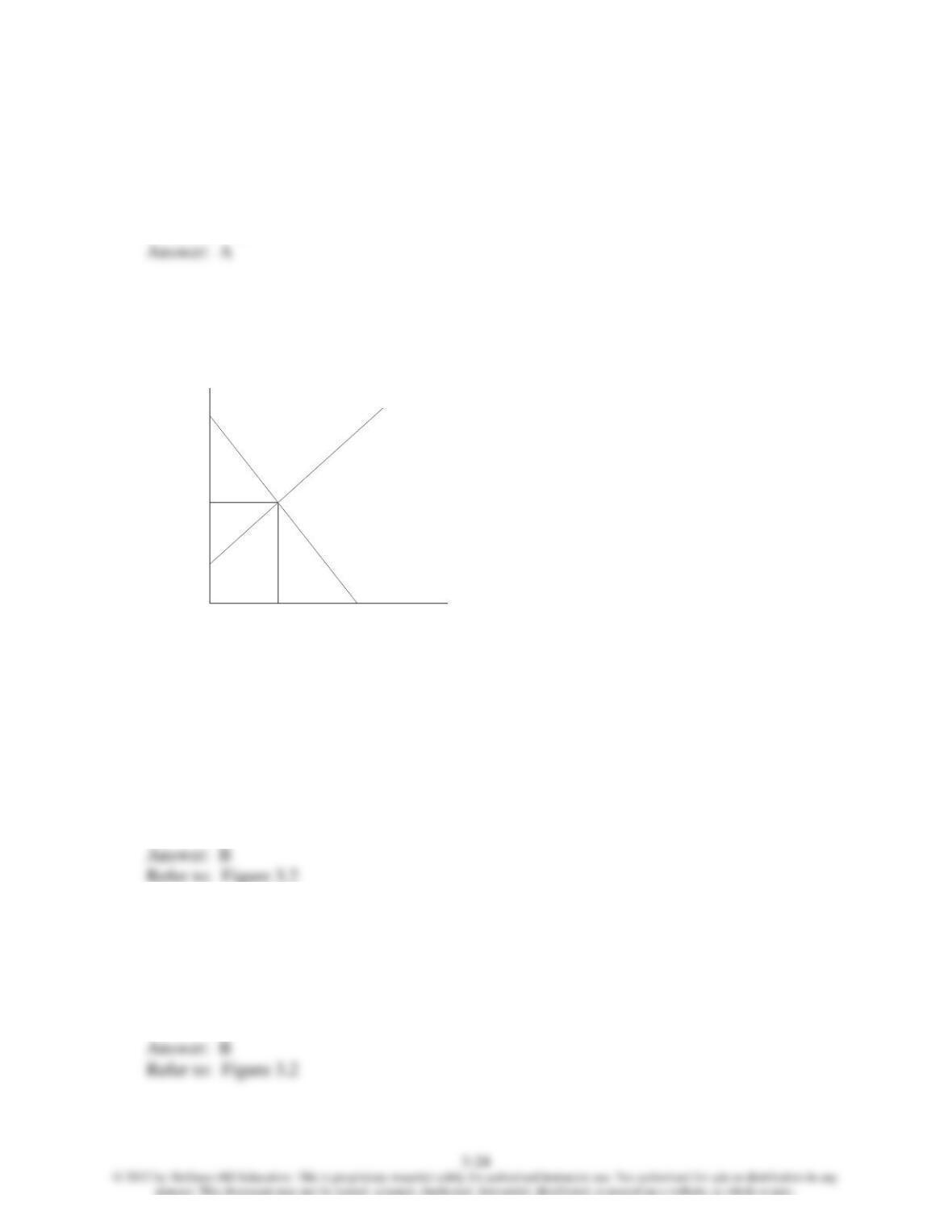
Use the following Figure 3.2 to answer questions 113-117:
P
Q
S
D
P*
Q*
A
B
C
0
Figure 3.2
113) In Figure 3.2, what is the value to the consumer?
A) 0PCQ*
B) 0ACQ*
C) P*AC
D) BP*C
114) In Figure 3.2, what is the variable cost to the producer?
A) 0PCQ*
B) 0BCQ*
C) P*AC
D) BP*C
Chapter 03 – The Concept of Elasticity and Consumer and Producer Surplus
115) In Figure 3.2, what is the money the consumer pays the producer?
A) 0PCQ*
B) 0ACQ*
C) P*AC
D) BP*C
116) In Figure 3.2, what is the consumer surplus?
A) 0PCQ*
B) 0ACQ*
C) P*AC
D) BP*C
117) In Figure 3.2, what is the producer surplus?
A) 0PCQ*
B) 0ACQ*
C) P*AC
D) BP*C
118) Without a belief that the market has failed, which of the following will result in dead weight
loss?
A) A price below equilibrium.
B) A price at equilibrium.
C) A price above equilibrium.
D) A price below or above equilibrium.
119) The value of the market to society is
A) the consumer surplus it generates.
B) the producer surplus it generates.
C) the sum of the producer and consumer surpluses.
D) consumer surplus minus producer surplus.
120)
Chapter 03 – The Concept of Elasticity and Consumer and Producer Surplus
The value to the consumer is
A) the area under the demand curve form the origin to the quantity purchased.
B) the area under the supply curve form the origin to the quantity produced.
C) the area under the demand curve but above the price line from the origin to the quantity
purchased.
D) the area under the supply curve but below the price line from the origin to the quantity
purchased.
121) The consumer surplus is
A) the area under the demand curve form the origin to the quantity purchased.
B) the area under the supply curve form the origin to the quantity produced.
C) the area under the demand curve but above the price line from the origin to the quantity
purchased.
D) the area under the supply curve but below the price line from the origin to the quantity
purchased.
122) The producer surplus
A) the area under the demand curve form the origin to the quantity purchased.
B) the area under the supply curve form the origin to the quantity produced.
C) the area under the demand curve but above the price line from the origin to the quantity
purchased.
D) the area above the supply curve but below the price line from the origin to the quantity
purchased.
123) The variable cost to the producer
A) The area under the demand curve form the origin to the quantity purchased.
B) The area under the supply curve form the origin to the quantity produced.
C) The area under the demand curve but above the price line from the origin to the quantity
purchased.
D) The area above the supply curve but below the price line from the origin to the quantity
purchased.
Chapter 03 – The Concept of Elasticity and Consumer and Producer Surplus
124) The value of the market to society is
A) The area under the demand curve form the origin to the quantity purchased.
B) The area under the supply curve form the origin to the quantity produced.
C) The area under the demand curve but above the price line from the origin to the quantity
purchased.
D) The area under the demand curve but above the supply curve from the origin to the
quantity purchased.
125) The amount of money consumers pay producers is
A) The area under the demand curve form the origin to the quantity purchased.
B) The area under the supply curve form the origin to the quantity produced.
C) The area under the demand curve but above the price line from the origin to the quantity
purchased.
D) The price times the quantity or the rectangle whose height is the price and base is the
quantity purchased.
126) The value to the consumer is based upon adding up
A) The most each consumer is willing to pay for a good.
B) The least a firm is willing to sell the good for.
C) The average of the most a consumer is willing to pay for a good and the least a firm is
willing to sell the good for.
D) The difference between most a consumer is willing to pay for a good and the least a firm
is willing to sell the good for.
127) For a linear and downward sloping demand curve, when the consumer has to pay a positive
price for the good, the value to the consumer is a
A) Rectangle.
B) Triangle.
C) Four-sided figure that is a rectangle on the bottom and a right triangle on the top whose
hypotenuse is the demand curve.
D) Four-sided figure that is a rectangle on the bottom and a right triangle on the top whose
hypotenuse is the supply curve.
Chapter 03 – The Concept of Elasticity and Consumer and Producer Surplus
128) For a linear and upward sloping supply curve, when the consumer has to pay a positive price
for the good, the variable cost to the producer consumer is a
A) Rectangle.
B) Triangle.
C) Four-sided figure that is a rectangle on the bottom and a right triangle on the top whose
hypotenuse is the demand curve.
D) Four-sided figure that is a rectangle on the bottom and a right triangle on the top whose
hypotenuse is the supply curve.
129) For a linear and upward sloping supply curve and a linear downward sloping demand curve,
when the consumer has to pay a positive price for the good, the money the consumer pays
the producer is a
A) Rectangle.
B) Triangle.
C) Four-sided figure that is a rectangle on the bottom and a right triangle on the top whose
hypotenuse is the demand curve.
D) Four-sided figure that is a rectangle on the bottom and a right triangle on the top whose
hypotenuse is the supply curve.
130) For a linear and upward sloping supply curve and a linear downward sloping demand curve,
when the consumer has to pay a positive price for the good, the consumer surplus is a
A) Rectangle.
B) Triangle.
C) Four-sided figure that is a rectangle on the bottom and a right triangle on the top whose
hypotenuse is the demand curve.
D) Four-sided figure that is a rectangle on the bottom and a right triangle on the top whose
hypotenuse is the supply curve.
Chapter 03 – The Concept of Elasticity and Consumer and Producer Surplus
131) For a linear and upward sloping supply curve and a linear downward sloping demand curve,
when the consumer has to pay a positive price for the good, the producer surplus is a
A) Rectangle.
B) Triangle.
C) Four-sided figure that is a rectangle on the bottom and a right triangle on the top whose
hypotenuse is the demand curve.
D) Four-sided figure that is a rectangle on the bottom and a right triangle on the top whose
hypotenuse is the supply curve.
132) For a linear and upward sloping supply curve and a linear downward sloping demand curve,
when the consumer has to pay a positive price for the good, the value to society of the
market is a
A) Rectangle.
B) Triangle.
C) Four-sided figure that is a rectangle on the bottom and a right triangle on the top whose
hypotenuse is the demand curve.
D) Four-sided figure that is a rectangle on the bottom and a right triangle on the top whose
hypotenuse is the supply curve.
133) For an economist to say that too little of the good is produced, what must be true?
A) The consumer surplus plus the producer surplus must be smaller than it could be.
B) The consumer surplus must be smaller than optimal.
C) The consumer surplus must be larger than optimal.
D) The producer surplus must be smaller than optimal.
134) For an economist to say that too much of the good is produced, what must be true?
A) The consumer surplus plus the producer surplus must be smaller than it could be.
B) The consumer surplus must be smaller than optimal.
C) The consumer surplus must be larger than optimal.
D) The producer surplus must be smaller than optimal.
Chapter 03 – The Concept of Elasticity and Consumer and Producer Surplus
135) If a given reduction in market demand causes the market equilibrium price to decrease by a
very large percentage while equilibrium quantity purchased decreases by a very small
percentage,
A) market supply is inelastic (but not perfectly inelastic.)
B) market supply is elastic (but not perfectly elastic.)
C) market supply is perfectly inelastic.
D) market supply is perfectly elastic.
136) The fact that the demand for luxury cars is elastic is not surprising because
A) the supply of luxury cars is inelastic.
B) there are few substitutes for true luxury cars.
C) luxury cars are primarily a “status symbol”.
D) luxury cars are relatively expensive.
137) The difference between the value of a product enjoyed by consumers and the total variable
costs incurred by producers in a competitive market for that product is
A) producer surplus.
B) consumer surplus.
C) the sum of consumer surplus and producer surplus.
D) the difference between consumer surplus and producer surplus.
138) The net gain to society from the operation of a competitive market in equilibrium is
A) consumer surplus only.
B) producer surplus only.
C) the sum of consumer surplus and producer surplus.
D) the profits of the producers.
139) The net cost to society from prohibiting the operation of a competitive market in equilibrium
is
A) lost consumer surplus only.
B) lost producer surplus only.
C) lost producer profits only.
D) a deadweight loss.
Chapter 03 – The Concept of Elasticity and Consumer and Producer Surplus
140) When attempting to correct cases of “market failure”, economists usually seek policies that
maximize
A) the sum of consumer and producer surplus.
B) consumer surplus, not producer surplus.
C) producer surplus, not consumer surplus.
D) the difference between consumer and producer surplus.
141) Goods and services which have relatively inelastic supplies in the short run are
A) fresh produce at the farmer’s market.
B) gasoline and other refined petroleum products.
C) lanes on a toll road.
D) all of these options are correct.
142) Demand for a good which comprises a relatively large share of the consumer’s budget tends
to be
A) inelastic.
B) perfectly inelastic.
C) elastic.
D) perfectly elastic.
143) Demand for a good which comprises a relatively small share of the consumer’s budget tends
to be
A) inelastic.
B) perfectly inelastic.
C) elastic.
D) perfectly elastic.
144) The demand for electricity is more elastic in the long run than in the short run because
A) more electricity can be produced in the long run.
B) consumers can shift to more efficient electrical appliances in the long run.
C) government regulation of electricity producers is most effective in the long run.
D) solar energy will eventually replace electricity in the long run.