20) A consumer’s budget line for food (F) and shelter (S) is represented as F=250-5S. If the price of shelter
increases by 2 and consumption of shelter remains constant at 20, how will consumption of food change?
A) decrease by 10
B) decrease by 20
C) decrease by 40
D) decrease by 60
For the following, please answer “True” or “False” and explain why.
21) The slope of the budget line represents the rate at which the consumer is willing to trade one good for
another at any given bundle.
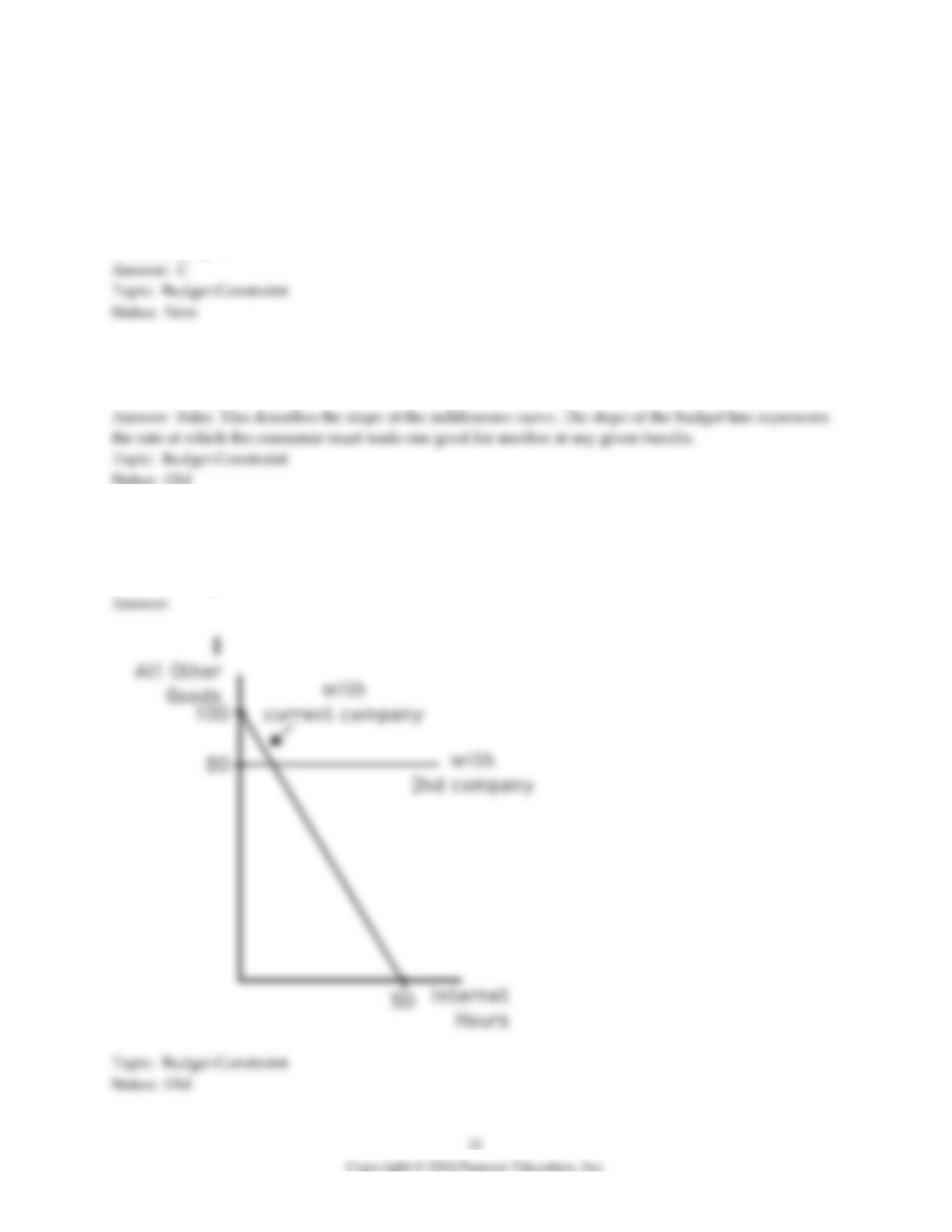
22) Joe subscribes to an Internet provider that charges $2 per hour. Draw his budget line for Internet
access on the horizontal axis and money spent on all other goods on the vertical axis assuming he has
$100 per month to spend. Another company offers unlimited Internet access for a flat monthly fee of $20.
Draw this budget line.
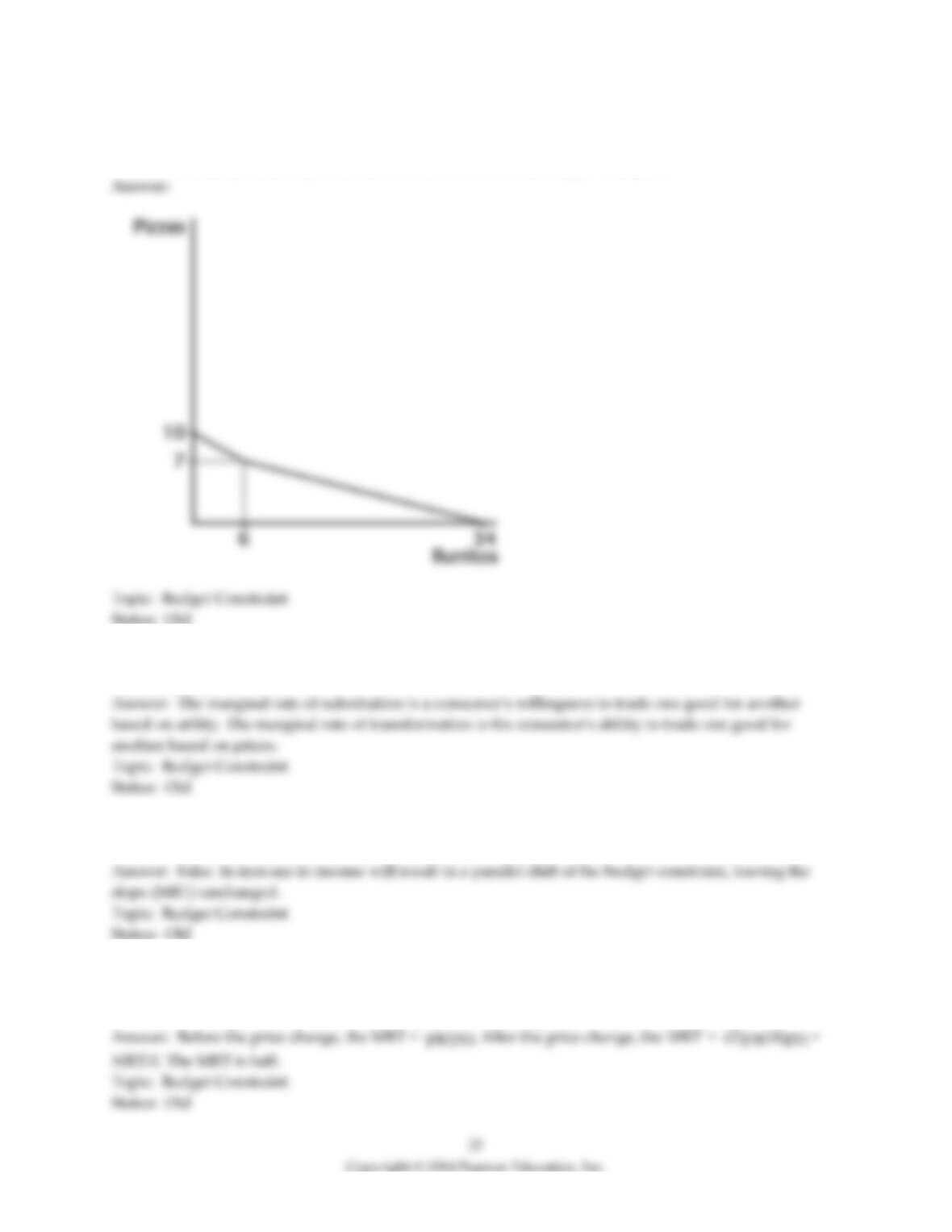
23) Lisa has an income of $100. She spends all of her income on pizza and burritos. A pizza costs $10 and
a burrito costs $5. However, the store where Lisa buys her burritos has a special deal. After you’ve bought
six burritos, then you can buy each burrito for $2.50. Draw Lisa’s opportunity set.
24) Explain the difference between the marginal rate of substitution and the marginal rate of
transformation.
For the following, please answer “True” or “False” and explain why.
25) An increase in a consumer’s income will increase the Marginal Rate of Transformation.
26) Suppose Charley only purchases boardgames (B) and haircuts (H) with his income. If the price of
boardgames increases by 100% while the price of haircuts increases by 300%, how will the MRT change
(consider the budget constraint drawn on a graph with boardgames on the horizontal axis)?
3.4 Constrained Consumer Choice
1) Economists assume consumers select a bundle of goods that maximizes their well-being subject to
A) their budget constraint.
B) their income.
C) relative prices.
D) their marginal rate of substitution.
2) An optimum that occurs as a corner solution
A) includes only one good.
B) cannot be an equilibrium.
C) cannot exhaust the budget constraint.
D) includes the exact same amounts of each good.
3) The consumer is in equilibrium when
A) MRT = MRS.
B) Px/Py = MUx/MUy.
C) the budget line is tangent to the indifference curve at the bundle chosen.
D) All of the above.
4) By selecting a bundle where MRS = MRT, the consumer is
A) achieving a corner solution.
B) reaching the highest possible indifference curve she can afford.
C) not behaving in an optimal way.
D) All of the above.
5) By selecting a bundle where MRS = MRT, the consumer is saying
A) “I value my last unit of each good equally.”
B) “I am willing to trade one good for the other at the same rate that I am required to do so.”
C) “I will equate the amounts spent on all goods consumed.”
D) All of the above.
6) Assume the price of beer is $4, the price of pizza is $10 and the consumer’s income is $250. Which
consumption bundle will NOT be the consumer’s choice?
A) A (5 Beers, 5 Pizzas)
B) B (0 Beers, 25 Pizzas)
C) C (25 Beers, 15 Pizzas)
D) None of the above bundles will be chosen.
7) With respect to consuming food and shelter, two consumers face the same prices and both claim to be
in equilibrium. We therefore know that
A) they both have the same marginal utility for food.
B) they both have the same marginal utility for shelter.
C) they both have the same MRS of food for shelter.
D) All of the above.
8) With respect to consuming food and shelter, two consumers choose the same bundles and both claim
to be in equilibrium. We therefore know that
A) they both have the same MRS of food for shelter.
B) they both face the same prices.
C) they both face the same budget lines.
D) None of above.
9) Johnny has allocated $30 toward coffee and tea and feels that coffee and tea are perfect substitutes. Due
to differences in caffeine levels, his MRS of tea for coffee equals two. If coffee and tea sell for the same
price, Johnny will
A) spend all $30 on tea.
B) spend all $30 on coffee.
C) spend $20 on coffee and $10 on tea.
D) be indifferent between any bundle of coffee and tea costing $30.
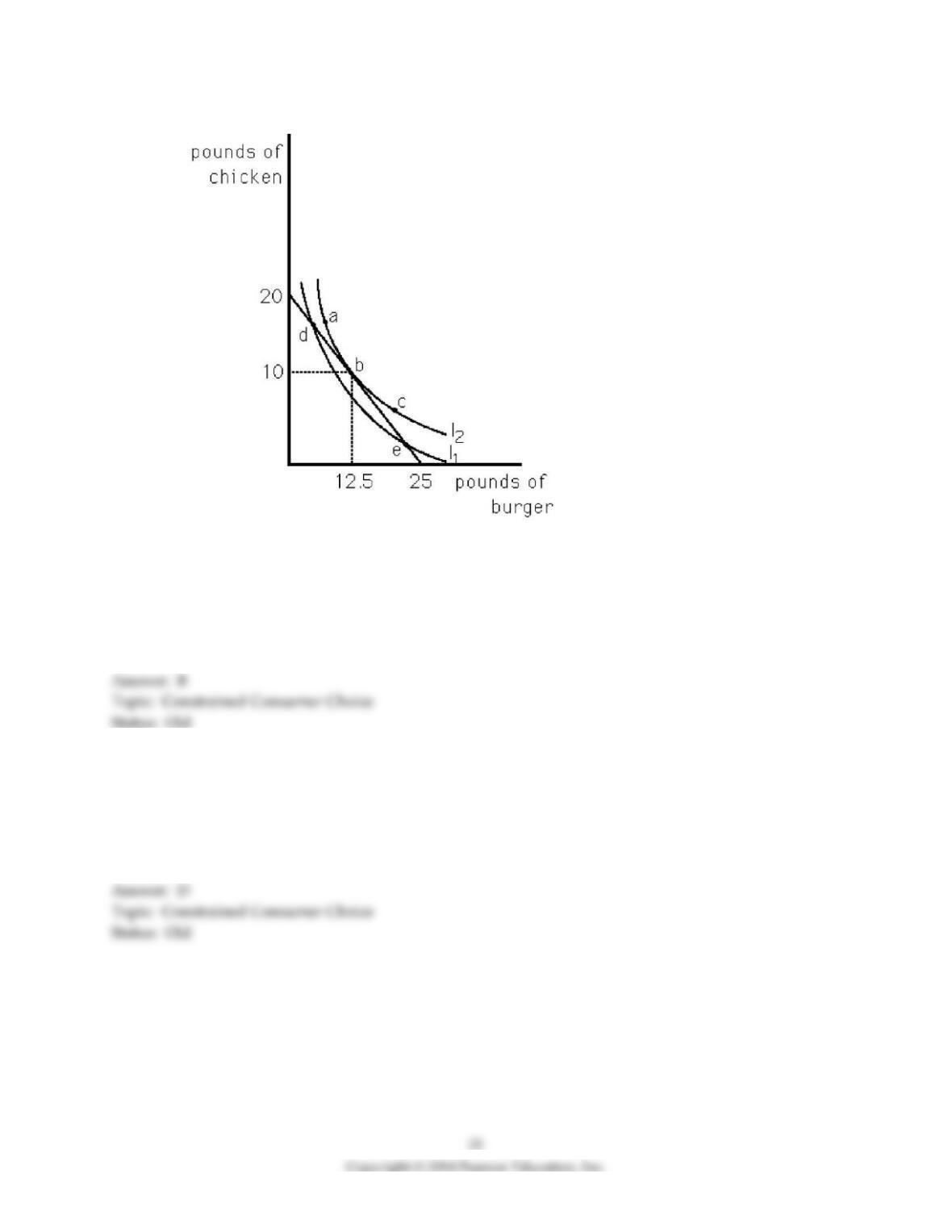
10) Max has allocated $100 toward meats for his barbecue. His budget line and an indifference map are
shown in the above figure. Which bundle will Max choose?
A) a
B) b
C) c
D) d
11) Max has allocated $100 toward meats for his barbecue. His budget line and an indifference map are
shown in the above figure. What is the price of chicken?
A) $0.80/lb
B) $1.25/lb
C) $4/lb
D) $5/lb
12) Max has allocated $100 toward meats for his barbecue. His budget line and an indifference map are
shown in the above figure. If the price of burger increases,
A) Max will buy less burger and more chicken.
B) Max will buy less burger and the same quantity of chicken.
C) Max will buy less of both meats.
D) More information is needed to answer the question.
13) Max has allocated $100 toward meats for his barbecue. His budget line and an indifference map are
shown in the above figure. What happens if Max’s mother gives him 10 pounds of burger?
A) Max would have preferred receiving the dollar-value of the burger.
B) Max is indifferent between this gift and the dollar-value of the burger.
C) Max prefers this gift to the dollar-value of the burger.
D) None of the above.
14) Max has allocated $100 toward meats for his barbecue. His budget line and an indifference map are
shown in the above figure. What happens if Max’s mother gives him 30 pounds of burger?
A) Max would have preferred receiving the dollar-value of the burger.
B) Max is indifferent between this gift and the dollar-value of the burger.
C) Max prefers this gift to the dollar-value of the burger.
D) None of the above.
15) Max has allocated $100 toward meats for his barbecue. His budget line and an indifference map are
shown in the above figure. What happens if Max receives a $100 cash grant to buy either meat or chicken?
A) Max will double his consumption of both meats.
B) Max will spend it all on burger. Because of its lower price, he can buy more of it.
C) Max will take advantage of the gift by buying all chicken because it is the more expensive meat.
D) There is not enough information to answer the question.
16) Max has allocated $100 toward meats for his barbecue. His budget line and an indifference map are
shown in the above figure. Which of the following best describes Max’s preferences?
A) d > b > e
B) d = b = e
C) a = b > c
D) a = b > e
17) Max has allocated $100 toward meats for his barbecue. His budget line and an indifference map are
shown in the above figure. Which of the following bundles are in Max’s opportunity set?
A) a, b, c
B) b, d, e
C) a, b, d
D) None of the above.
18) Max has allocated $100 toward meats for his barbecue. His budget line and indifference map are
shown in the above figure. If the price of burger increases, which of the following bundles are in Max’s
opportunity set?
A) b, d, e
B) d, e
C) a, b, c, d, e
D) None of the labeled points are in Max’s opportunity set.
19) Max has allocated $100 toward meats for his barbecue. His budget line and indifference map are
shown in the above figure. If Max is currently at point e,
A) his MRS is less than the trade-off offered by the market.
B) he is willing to give up more burger than he has to, given market prices.
C) he is not maximizing his utility.
D) All of the above.
20) Max has allocated $100 toward meats for his barbecue. His budget line and indifference map are
shown in the above figure. If Max is currently at point d,
A) his MRS is larger than the trade-off offered by the market.
B) he is willing to give up more chicken than he has to, given market prices.
C) he is not maximizing his utility.
D) All of the above.
21) Max has allocated $100 toward meats for his barbecue. His budget line and indifference map are
shown in the above figure. If Max’s current MRS = -0.8, then Max is at point
A) b
B) d
C) e
D) None of above.
22) Max has allocated $100 toward meats for his barbecue. His budget line and indifference map are
shown in the above figure. If Max’s current MRS=-1, then Max
A) is at point e.
B) is maximizing his utility.
C) will be better off by purchasing more burgers.
D) None of above.
23) Jane’s utility function is represented as: U = F0.5 C0.5, F is quantity of food and C is quantity of
clothing. If her budget constraint is represented as: 120 = 2F + C, her optimal bundle of consumption
should be
A) (40F, 40C).
B) (20F, 60C).
C) (50F, 50C).
D) (45F, 20C).
For the following, please answer “True” or “False” and explain why.
24) If MRS > MRT, then the consumer is better off than at equilibrium.
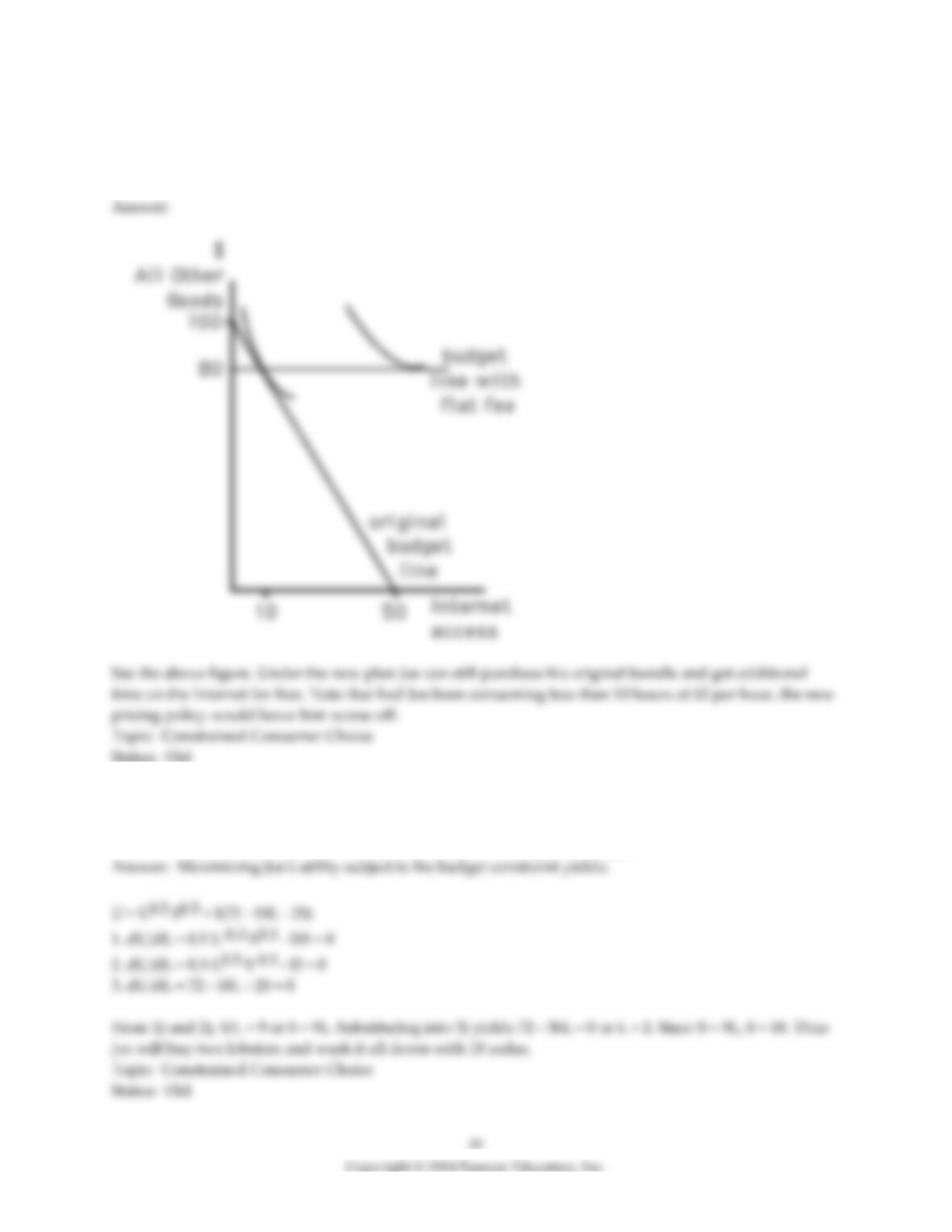
25) Joe subscribes to an Internet provider that charges $2 per hour. He has $100 per month to spend and is
at equilibrium by buying 10 hours of Internet access and $80 worth of other goods. Draw the indifference
curve and budget line. If the company switches to a $20 monthly fee for unlimited Internet access, is Joe
better off?
26) Suppose Joe’s utility for lobster (L) and soda (S) can be represented as U = L0.5 S0.5. Joe walks into a
restaurant with $72. Lobsters cost $18 each and sodas cost $2 each. How much lobster and soda will Joe
consume if he intends to spend all his money? (There are no tax and no tips.)
27) A consumer has preferences given by the constant elasticity of substitution utility function:
U(q1,q2) = (q1.5 + q2.5)2
a. Write the Lagrangian for the consumer’s maximization problem.
b. Use the Lagrangian to solve for the optimal quantities in terms of the prices and income.
28) Jezz has the quasi log-linear utility function
U(q1,q2) = q1 + 2ln(q2)
Jezz has an income of $100 and faces prices p1 = p2 = 20.
a. What is the marginal rate of substitution for this utility function?
b. Solve for Jezz’s optimal bundle.
c. Suppose Jezz’s income falls to $20. What will happen to his optimal bundle? Is the MRS=MRT at the
optimal bundle?
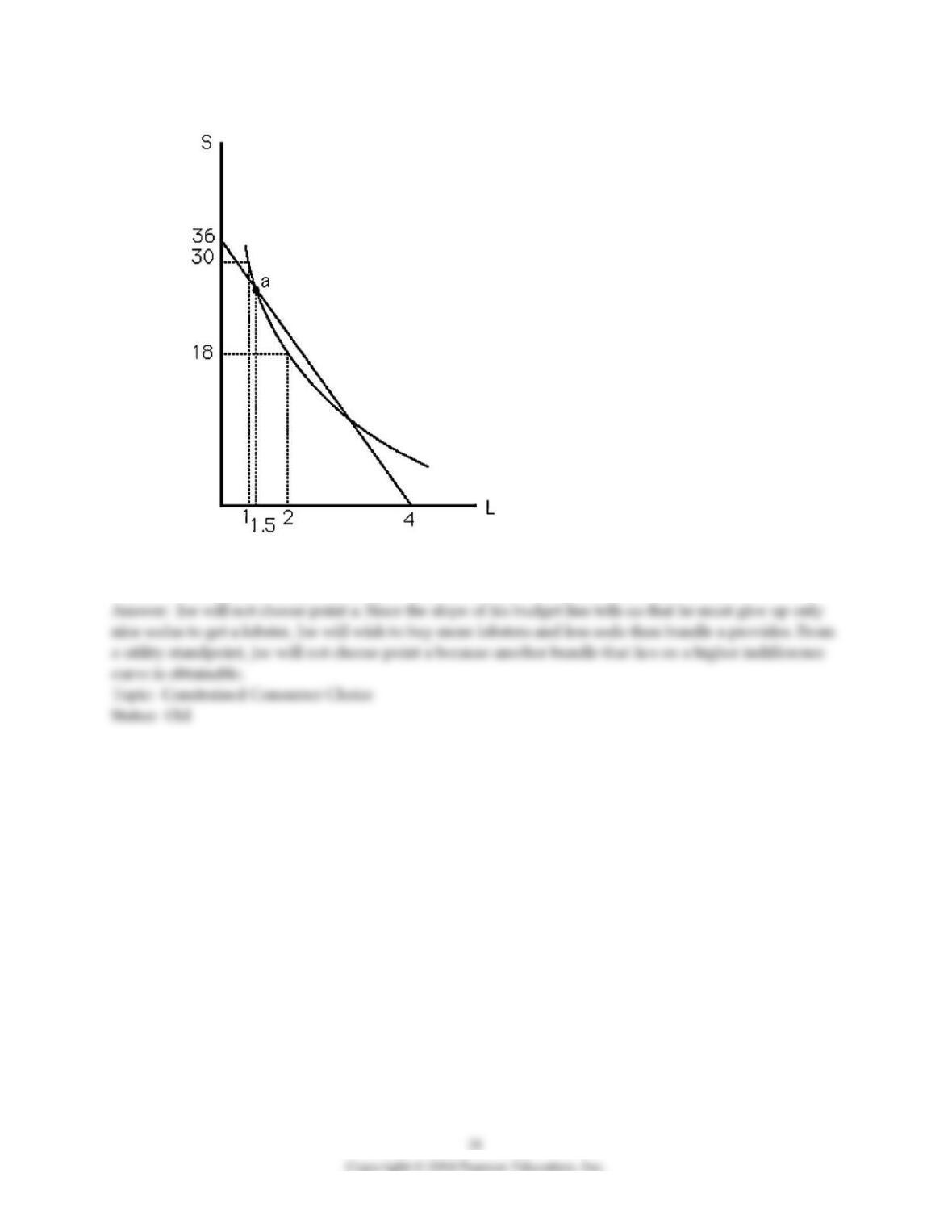
29) Joe’s indifference map for lobster and soda is shown in the above figure along with his budget line.
Will Joe choose point a? Explain your answer in terms both of MRS and the level of utility.