Chapter 03 – The Concept of Elasticity and Consumer and Producer Surplus
Chapter 03 The Concept of Elasticity and Consumer and Producer
Surplus
Multiple Choice
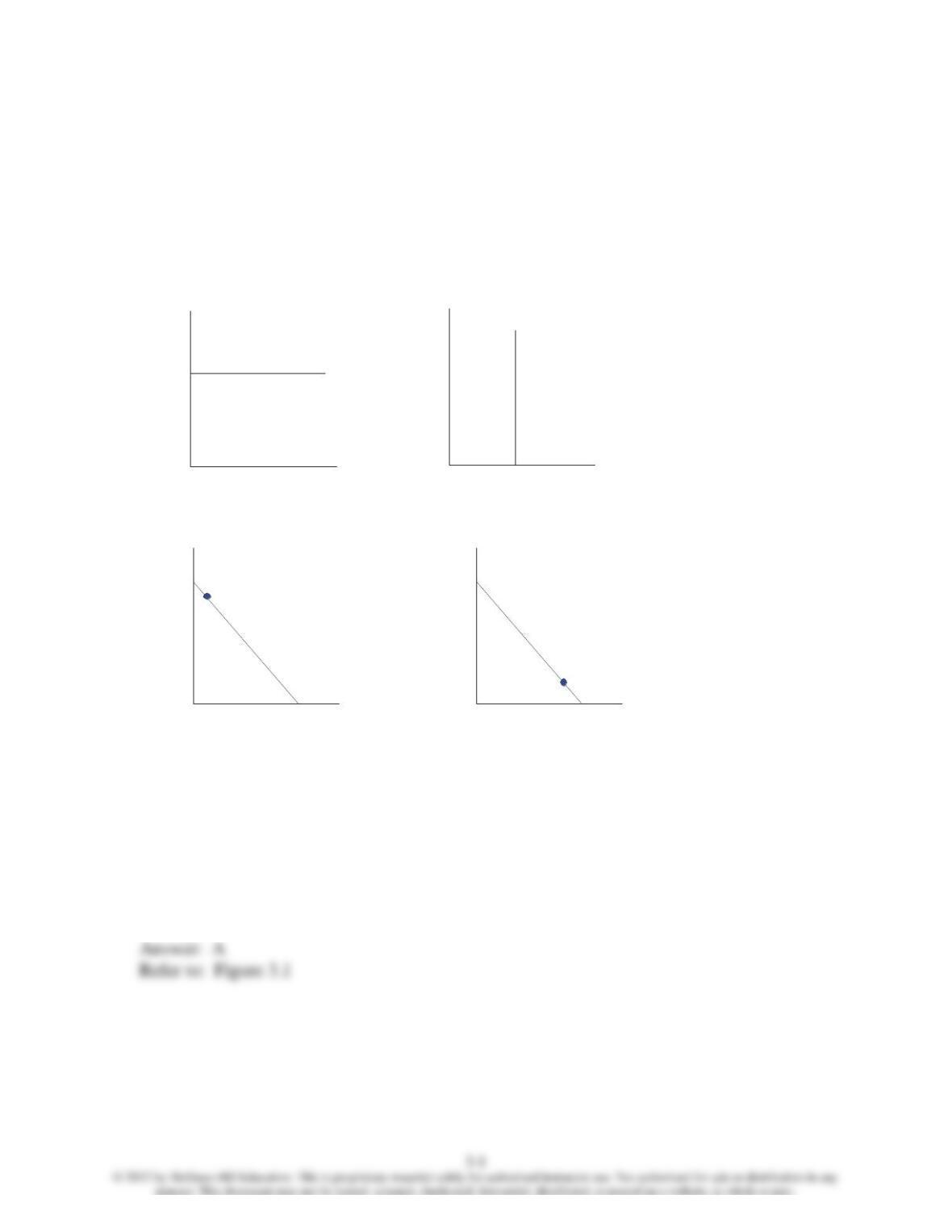
Use the following Figure 3.1 to answer questions 1-4:
P
Q/t
P
Q/t
P
Q/t
D
D
D
P
Q/t
D
Figure 1
Figure 4
Figure 2
Figure 3
A
B
Figure 3.1
1) In Figure 3.1, if demand is considered perfectly elastic, then the appropriate figure is?
A) Figure 1
B) Figure 2
C) Figure 3
D) Figure 4
Chapter 03 – The Concept of Elasticity and Consumer and Producer Surplus
2) In Figure 3.1, if demand is considered perfectly inelastic, then the appropriate figure is?
A) Figure 1
B) Figure 2
C) Figure 3
D) Figure 4
3) At point A of Figure 3 within Figure 3.1, demand is
A) elastic.
B) inelastic.
C) perfectly inelastic.
D) perfectly elastic.
4) At point B of Figure 4 within Figure 3.1, demand is
A) elastic.
B) inelastic.
C) perfectly inelastic.
D) perfectly elastic.
5) The elasticity of demand is related to the slope of the demand curve
A) and only the slope of the demand curve.
B) but also the (price, quantity) position on the demand curve.
C) but also the slope of the supply curve.
D) and whether the good is normal or inferior.
6) Because the demand curve is downward sloping, the elasticity of demand is
A) positive.
B) negative (however, the negative sign is assumed and therefore ignored).
C) zero.
D) decreases from positive to negative.
Chapter 03 – The Concept of Elasticity and Consumer and Producer Surplus
7) When there is a decrease in the price of a good
A) the demand curve will shift to the right.
B) the demand curve will shift to the left.
C) the elasticity of demand will determine the degree to which quantity demanded rises.
D) the elasticity of demand will determine the degree to which quantity demanded falls.
8) When there is an increase in the price of a good
A) the demand curve will shift to the right.
B) the demand curve will shift to the left.
C) the elasticity of demand will determine the degree to which quantity demanded rises.
D) the elasticity of demand will determine the degree to which quantity demanded falls.
9) The formula for elasticity of demand (in words) is
A) the change in price divided by the change in quantity.
B) the percentage change in price divided by the percentage change in quantity.
C) the change in quantity divided by the change in price.
D) the percentage change in quantity divided by the percentage change in price.
10) If the price of a good increases by 10% and the quantity demanded decreases by 5%, then at
that price, the good is
A) elastic.
B) inelastic.
C) perfectly inelastic.
D) perfectly elastic.
11) If the price of a good increases by 5% and the quantity demanded decreases by 10%, then at
that price, the good is
A) elastic.
B) inelastic.
C) perfectly inelastic.
D) perfectly elastic.
12) If the price of a good decreases by 10% and the quantity demanded increases by 5%, then at
that price, the good is
A) elastic.
B) inelastic.
C) perfectly inelastic.
D) perfectly elastic.
Chapter 03 – The Concept of Elasticity and Consumer and Producer Surplus
13) If the price of a good decreases by 5% and the quantity demanded increases by 10%, then at
that price, the good is
A) elastic.
B) inelastic.
C) perfectly inelastic.
D) perfectly elastic.
14) If the price of a good increases by 10% and the quantity demanded decreases by 10%, then at
that price, the good is
A) elastic.
B) inelastic.
C) perfectly inelastic.
D) unit elastic.
15) If the price of a good increases by 5% and the quantity demanded decreases by 5%, then at
that price, the good is
A) elastic.
B) inelastic.
C) perfectly inelastic.
D) unit elastic.
16) If the price of a good decreases by 10% and the quantity demanded increases by 10%, then at
that price, the good is
A) elastic.
B) inelastic.
C) perfectly inelastic.
D) unit elastic.
17) If the price of a good decreases by 5% and the quantity demanded increases by 5%, then at
that price, the good is
A) elastic.
B) inelastic.
C) perfectly inelastic.
D) unit elastic.
Chapter 03 – The Concept of Elasticity and Consumer and Producer Surplus
18) If the price of a good increases by 10% and the quantity demanded remains unchanged, then
at that price, the good is
A) elastic.
B) inelastic.
C) perfectly inelastic.
D) perfectly elastic.
19) If the price of a good increases by 5% and the quantity demanded remains unchanged, then at
that price, the good is
A) elastic.
B) inelastic.
C) perfectly inelastic.
D) perfectly elastic.
20) If the price of a good decreases by 10% and the quantity demanded remains unchanged, then
at that price, the good is
A) elastic.
B) inelastic.
C) perfectly inelastic.
D) perfectly elastic.
21) If the price of a good decreases by 5% and the quantity demanded remains unchanged, then
at that price, the good is
A) elastic.
B) inelastic.
C) perfectly inelastic.
D) perfectly elastic.
22) If the price of a good increases by one thousandth of 1% and the quantity demanded goes to
zero, then at that price, the good is
A) non-responsive.
B) inelastic.
C) perfectly inelastic.
D) perfectly elastic.
Chapter 03 – The Concept of Elasticity and Consumer and Producer Surplus
23) Which of the following is true?
A) on a linear demand curve, the higher the price the more elastic is demand
B) on a linear demand curve, elasticity is constant
C) at the same price demand is more elastic on the steeper demand curve
D) none are true
24) Which of the following is true?
A) on a linear demand curve, the higher the price the less elastic is demand
B) on a linear demand curve, elasticity is constant
C) at the same price demand is more elastic on the steeper demand curve
D) none are true
25) Which of the following is true?
A) on a linear demand curve, the higher the price the less elastic is demand
B) on a linear demand curve, elasticity is constant
C) at the same price demand is less elastic on the steeper demand curve
D) all are true
26) Which of the following is true?
A) on a linear demand curve, the higher the price the less elastic is demand
B) on a linear demand curve, elasticity is not constant
C) at the same price demand is more elastic on the steeper demand curve
D) none are true
27) The total revenue/expenditure rule of elasticity suggests that when price and total revenue go
A) in opposite directions, demand is elastic.
B) in same direction, demand is elastic.
C) in opposite directions, demand is inelastic.
D) to infinity, demand is perfectly inelastic.
Chapter 03 – The Concept of Elasticity and Consumer and Producer Surplus
28) If the price of a good rises by 10% and the percentage increase in the total amount
consumers spend on the good is 10% then the good is
A) elastic.
B) inelastic.
C) unit elastic.
D) perfectly inelastic.
29) If the price of a good rises by 10% and the percentage increase in the total amount consumers
spend on the good is 15% then the good is
A) elastic.
B) inelastic.
C) unit elastic.
D) perfectly inelastic.
30) If the price of a good rises by 10% and the percentage increase in the total amount consumers
spend on the good is 5% then the good is
A) elastic.
B) inelastic.
C) unit elastic.
D) perfectly inelastic.
31) If the price of a good rises by 10% and the percentage decrease in the total amount
consumers spend on the good is 5% then the good is
A) elastic.
B) inelastic.
C) unit elastic.
D) perfectly inelastic.
32) If the price of a good rises by 10% and the percentage decrease in the total amount
consumers spend on the good is 10% then the good is
A) elastic.
B) inelastic.
C) unit elastic.
D) perfectly inelastic.
Chapter 03 – The Concept of Elasticity and Consumer and Producer Surplus
33) If the price of a good rises by 10% and the percentage decrease in the total amount
consumers spend on the good is 15% then the good is
A) elastic.
B) inelastic.
C) unit elastic.
D) perfectly inelastic.
34) If the price of a good rises by 10% and the total amount consumers spend on the good
remains the same then the good is
A) elastic.
B) inelastic.
C) unit elastic.
D) perfectly inelastic.
35) If the price of a good falls by 10% and the percentage increase in the total amount consumers
spend on the good is 10% then the good is
A) elastic.
B) inelastic.
C) unit elastic.
D) perfectly inelastic.
36) If the price of a good falls by 10% and the percentage increase in the total amount consumers
spend on the good is 15% then the good is
A) elastic.
B) inelastic.
C) unit elastic.
D) perfectly inelastic.
37) If the price of a good falls by 10% and the percentage increase in the total amount consumers
spend on the good is 5% then the good is
A) elastic.
B) inelastic.
C) unit elastic.
D) perfectly inelastic.
Chapter 03 – The Concept of Elasticity and Consumer and Producer Surplus
38) If the price of a good falls by 10% and the percentage decrease in the total amount consumers
spend on the good is 5% then the good is
A) elastic.
B) inelastic.
C) unit elastic.
D) perfectly inelastic.
39) If the price of a good falls by 10% and the percentage decrease in the total amount consumers
spend on the good is 10% then the good is
A) elastic.
B) inelastic.
C) unit elastic.
D) perfectly inelastic.
40) If the price of a good falls by 10% and the percentage decrease in the total amount consumers
spend on the good is 15% then the good is
A) elastic.
B) inelastic.
C) unit elastic.
D) perfectly inelastic.
41) If the price of a good falls by 10% and the total amount consumers spend on the good
remains the same then the good is
A) Elastic
B) Inelastic
C) Unit elastic
D) Perfectly inelastic
42) If the price rises and the total amount consumers spend on the good rises, then demand must
be
A) elastic.
B) inelastic.
C) perfectly inelastic.
D) perfectly elastic.
Chapter 03 – The Concept of Elasticity and Consumer and Producer Surplus
43) If the price rises and the total amount consumers spend on the good falls, then demand must
be
A) elastic.
B) inelastic.
C) perfectly inelastic.
D) perfectly elastic.
44) If the price rises and the total amount consumers spend on the good falls to zero, then
demand must be
A) elastic.
B) inelastic.
C) perfectly inelastic.
D) perfectly elastic.
45) If the price falls and the total amount consumers spend on the good rises, then demand must
be
A) elastic.
B) inelastic.
C) perfectly inelastic.
D) perfectly elastic.
46) If the price falls and the total amount consumers spend on the good falls, then demand must
be
A) elastic.
B) inelastic.
C) perfectly inelastic.
D) perfectly elastic
47) If the price rises and the total amount consumers spend on the good remains unchanged, then
demand must be
A) elastic.
B) inelastic.
C) perfectly inelastic.
D) unit elastic
Chapter 03 – The Concept of Elasticity and Consumer and Producer Surplus
48) If the price falls and the total amount consumers spend on the good remains unchanged, then
demand must be
A) elastic.
B) inelastic.
C) perfectly inelastic.
D) unit elastic.
49) Suppose a firm can not figure out whether the demand for the good it sells is elastic or
inelastic but discovers that every time it raises its price, its total revenue declines. Their
A) demand is unit elastic.
B) demand is inelastic.
C) demand is elastic.
D) demand is perfectly inelastic.
50) Suppose you observe that minor changes in supply seem to cause dramatic changes in price
with only slight changes in the amount sold, you would conclude that
A) demand is unit elastic.
B) demand is inelastic.
C) demand is elastic.
D) demand is perfectly inelastic.
51) For a given increase in supply, the condition of demand that will result in the most significant
change in price is when demand is
A) elastic.
B) inelastic.
C) perfectly elastic.
D) perfectly inelastic.
52) For a given decrease in supply, the condition of demand that will result in the most
significant change in price is when demand is
A) elastic.
B) inelastic.
C) perfectly elastic.
D) perfectly inelastic.
Chapter 03 – The Concept of Elasticity and Consumer and Producer Surplus
53) For a given increase in supply, the condition of demand that will result in no change in price
is when demand is
A) elastic.
B) inelastic.
C) perfectly elastic.
D) perfectly inelastic.
54) For a given decrease in supply, the condition of demand that will result in no change in price
is when demand is
A) elastic.
B) inelastic.
C) perfectly elastic.
D) perfectly inelastic.
55) For a given increase in supply, the condition of demand that will result in the most significant
change in quantity is when demand is
A) elastic.
B) inelastic.
C) perfectly elastic.
D) perfectly inelastic.
56) For a given decrease in supply, the condition of demand that will result in the most
significant change in quantity is when demand is
A) elastic.
B) inelastic.
C) perfectly elastic.
D) perfectly inelastic.
57) For a given increase in supply, the condition of demand that will result in no change in
quantity is when demand is
A) elastic.
B) inelastic.
C) perfectly elastic.
D) perfectly inelastic.
Chapter 03 – The Concept of Elasticity and Consumer and Producer Surplus
58) For a given decrease in supply, the condition of demand that will result in no change in
quantity is when demand is
A) elastic.
B) inelastic.
C) perfectly elastic.
D) perfectly inelastic.
59) An increase in demand will increase prices most when supply is
A) elastic.
B) unit elastic.
C) inelastic (but not perfectly inelastic).
D) perfectly inelastic.
60) An increase in demand will increase prices least when supply is
A) elastic.
B) unit elastic.
C) inelastic (but not perfectly inelastic).
D) perfectly inelastic.
61) A decrease in demand will decrease prices most when supply is
A) elastic.
B) unit elastic.
C) inelastic (but not perfectly inelastic).
D) perfectly inelastic.
62) A decrease in demand will decrease prices least when supply is
A) elastic.
B) unit elastic.
C) inelastic (but not perfectly inelastic).
D) perfectly inelastic.
Chapter 03 – The Concept of Elasticity and Consumer and Producer Surplus
63) An increase in supply will decrease prices most when demand is
A) elastic.
B) unit elastic.
C) inelastic (but not perfectly inelastic).
D) perfectly inelastic.
64) An increase in supply will decrease prices least when demand is
A) elastic.
B) unit elastic.
C) inelastic (but not perfectly inelastic).
D) perfectly inelastic.
65) A decrease in supply will increase prices most when demand is
A) elastic.
B) unit elastic.
C) inelastic (but not perfectly inelastic).
D) perfectly inelastic.
66) A decrease in supply will increase prices least when demand is
A) elastic.
B) unit elastic.
C) inelastic (but not perfectly inelastic).
D) perfectly inelastic.
67) Because there are many brands of similarly tasting light beers, the elasticity of demand for
any one of them is likely to be
A) zero.
B) higher than that of light beer itself.
C) less than that of light beer itself.
D) infinity.
Chapter 03 – The Concept of Elasticity and Consumer and Producer Surplus
68) The elasticity of demand for gasoline is likely to be
A) small, but grow as time goes by.
B) small and shrink as time goes by.
C) large and grow as time goes by.
D) large and shrink as time goes by.
69) Because most people spend a very small fraction of the income on tap water, it is likely to be
A) elastic.
B) inelastic.
C) perfectly elastic.
D) perfectly inelastic.
70) A good like water has few substitutes and takes up little of our income to purchase, as a
result its demand is likely to be
A) elastic.
B) perfectly elastic.
C) inelastic.
D) unit elastic.
71) Name brand apparel have many substitutes and can get very expensive, as a result their
demand is likely to be
A) elastic.
B) perfectly elastic.
C) inelastic.
D) unit elastic.
72) The fact that the demand for eggs is inelastic is not surprising because
A) there are many substitutes for eggs as breakfast food.
B) the demand for food is inelastic.
C) the supply of eggs is inelastic.
D) they are so inexpensive.
Chapter 03 – The Concept of Elasticity and Consumer and Producer Surplus
73) Suppose a new law makes illegal the sale of a good that had been legal. This will
A) decrease consumer surplus.
B) increase consumer surplus.
C) increase producer surplus.
D) eliminate dead weight loss.
74) Suppose a new law makes illegal the sale of a good that had been legal. This will
A) increase consumer surplus.
B) increase producer surplus.
C) decrease producer surplus.
D) eliminate dead weight loss.
75) A decrease in supply will always
A) increase producer surplus.
B) decrease consumer surplus.
C) decrease producer surplus.
D) increase consumer surplus.
76) A decrease in demand will always
A) increase producer surplus.
B) decrease producer surplus and decrease consumer surplus.
C) decrease consumer surplus and increase consumer surplus.
D) increase consumer surplus.
77) An increase in supply will always
A) increase producer surplus.
B) decrease consumer surplus.
C) decrease producer surplus.
D) increase consumer surplus.