CHAPTER 3: The Market at Work: Supply and Demand
MULTIPLE CHOICE
1. For a market to be competitive
a. each buyer and seller is small, relative to the whole market; no single decision maker has any
influence over the market price.
b. sellers must produce goods and services that are different from their competitors.
c. sellers should have substantial pricing power.
d. all you need are many buyers and many sellers.
e. the price must be a fair price.
2. Layla attends the farmer’s market in her hometown of Bakersfield every Sunday. She notices that
all of the oranges sold by the many different farmers at the market have roughly the same price, as
do most other products that are alike. Which statement best explains why the prices are so similar?
a. The farmer’s market in Bakersfield is an imperfect market, so prices are set by the producers.
b. The farmer’s market in Bakersfield is a monopoly because it is the only place to buy fresh fruit
on Sundays.
c. The farmer’s market in Bakersfield is a competitive market, so prices are set by the consumer.
d. The farmer’s market in Bakersfield is a competitive market, so neither the consumer nor the
producer has a large influence on the price, allowing for the market to set the price.
e. The farmer’s market in Bakersfield is an imperfect market where Layla’s decision whether to
purchase an orange will not change the price of an orange.
3. When a new movie is released, typically every theater offers the movie on the same day. What
would someone expect the difference in movie ticket prices to be across theaters?
a. The difference in prices across theaters will be small because no single theater has market
power.
b. The difference in prices across theaters will be large because no single theater has market
power.
c. The difference in prices across theaters will be small because the movie is new and can only be
seen at a movie theater.
d. The difference in prices across theaters will be large when a movie becomes more popular.
e. The difference in prices across theaters will be small when a movie becomes less popular.
4. If someone searches for a flight between Los Angeles and Chicago, he or she will find different
airlines offering flights at similar prices. Why does this occur?
a. This occurs because one airline offers more flights at more convenient times than other
airlines.
b. This occurs because the flights are filled primarily with workers from the largest 10 companies
in each of the cities.
c. This occurs because there are many airlines and many different kinds of customers.
d. This occurs because the cities are far away from each other and not many would choose to
drive between the two cities.
e. This occurs because passengers only pick those airlines where they collect frequent flyer
miles.
5. As electric cars have become more acceptable to drivers, more companies are building and selling
such cars. What would we expect to see happen to prices of electric cars in the future?
a. Prices for electric cars will rise in the future as more companies produce these cars.
b. Prices for electric cars will rise in the future as more consumers are willing to purchase these
cars.
c. Prices for electric cars will rise in the future if rental car companies buy more electric cars in
bulk.
d. Prices for electric cars will fall in the future as more companies produce these cars.
e. Prices for electric cars will be unaffected by their growing popularity.
6. Dawn’s family runs a business selling white paper used in photocopiers. Dawn notices that she is
under intense pressure to lower prices. Why is this occurring?
a. Prices are falling because fewer people are photocopying.
b. Prices are falling because although there are many companies that make and sell paper, there
are only a few customers that purchase large amounts of paper.
c. Prices are falling because there are only a few companies that sell and make paper, but there
are many different kinds of customers who buy paper.
d. Prices are falling because there are many companies who make and sell paper and different
kinds of customers for this paper.
e. Prices are falling because some companies make and sell more paper than others.
7. Kimberly’s sister would like to start a business with her brother selling simple T-shirts that are
green in color at all stores in the area. Her brother disagrees and thinks that the shirts should have a
special logo on them and should be sold only at specific stores. As the deciding vote, what should
Kimberly choose and why?
a. selling green T-shirts because prices will be higher as the number of stores increases
b. selling green T-shirts because prices will be higher as the shirt becomes more commonplace
c. selling shirts with a special logo because prices will be higher as the shirts becomes more
unique
d. selling shirts with a special logo because prices will be higher as the shirts are sold in fewer
stores
e. both C and D
8. There is often only one major league baseball team in a city. What is the consequence of this in
terms of ticket prices?
a. Ticket prices will be lower because each team is a monopoly in the city.
b. Ticket prices will be higher because each team is a monopoly in the city.
c. Ticket prices will be lower because each team lacks market power.
d. Ticket prices will be higher because each team is faced with strong competition.
e. Ticket prices are unaffected by the number of teams in a city.
9. In a small city, it is not unusual that a single place exists to buy or sell a car. How would we expect
the owner of this car dealership to behave?
a. The owner would lower prices on cars because the dealership lacks market power.
b. The owner would lower prices on cars because the dealership has market power.
c. The owner would raise prices on cars because the dealership has market power.
d. The owner would raise prices because the dealership has no market power.
e. The price of cars would be unaffected by the dealership’s market power.
10. Which of the following scenarios would represent a monopoly?
a. In a city, there are five hotels for visitors to stay.
b. In a city, there are 1,300 different restaurants.
c. In a city, there are 10 different carpet cleaning companies.
d. In a city, there is one Ethiopian restaurant.
e. In a city, there are two taxi cab companies.
11. A monopoly
a. exists when either the buyer or the seller has the ability to influence the market price.
b. exists when there are so many buyers and sellers that each has only a small impact on the
market price and output.
c. exists when a single consumer demands the entire market for a particular good or service.
d. can have many sellers but only one buyer.
e. exists when a single company supplies the entire market for a particular good or service.
12. Imperfect markets
a. do not exist in democracies.
b. always result in supply exceeding demand.
c. always result in demand exceeding supply.
d. occur when the buyer or seller has an influence on the price.
e. can’t occur if there are many buyers and many sellers.
13. According to the law of demand, all other things being equal,
a. the quantity demanded falls when the price falls, and the quantity demanded rises when the
price rises.
b. the quantity demanded falls when the price rises, and the quantity demanded rises when the
price falls.
c. the demand falls when the price falls, and the demand rises when the price rises.
d. the demand falls when the price rises, and the demand rises when the price falls.
e. price and quantity are always positively correlated.
14. A demand schedule
a. is a curve representing the relationship between the price of a good or service and the quantity
demanded.
b. is a list of goods and services demanded at different prices.
c. is a table representing the relationship between the price of a good or service and the quantity
demanded.
d. can only be used to analyze the individual’s demand for a good or service.
e. can only be used to analyze the entire market’s demand for a good or service.
15. As a government official, Nolan wants fewer people to smoke. He has decided to use taxes to
discourage people from smoking. How would he describe his decision to an economist?
a. If I increase taxes on cigarettes, there will be an increase in demand, which means fewer
people are smoking.
b. If I decrease taxes on cigarettes, there will be a decrease in demand, which means fewer people
are smoking.
c. If I decrease taxes on cigarettes, there will be an increase in quantity demanded, which means
fewer people are smoking.
d. If I increase taxes on cigarettes, there will be a decrease in demand, which means fewer people
are smoking.
e. Taxes will have no effect on demand for cigarettes.
16. After Sushmita lost her job, she found that she was going to the movies less often. How would she
describe this to an economist?
a. Movies are a normal good and, as my income decreased, my demand curve shifted to the right.
b. Movies are an inferior good and, as my income decreased, my demand curve shifted to the
right.
c. Movies are a normal good and, as my income decreased, my demand curve shifted to the left.
d. Movies are an inferior good and, as my income decreased, my demand curve shifted to the
right.
e. Attending movies is a necessity.
17. When the price falls, what happens?
a. There is an increase in the quantity demanded.
b. There is an increase in demand.
c. There is a decrease in the quantity demanded.
d. There is a decrease in demand.
e. There is no change in the quantity demanded or demand.
18. When the price for computers is expected to fall in the future, what happens?
a. The demand for computers decreases.
b. The demand for computers increases.
c. The quantity demanded of computers decreases.
d. The quantity demanded of computers increases.
e. Both the demand and quantity demanded increases.
19. Annabelle typically drives her car to work. But she only lives one mile from work and is willing to
ride her bike instead. If the price of a bike falls, what would happen in the market for cars?
a. The demand for cars will increase.
b. The demand for cars will decrease.
c. The quantity demanded of cars will increase.
d. The quantity demanded of cars will decrease.
e. Both the demand and quantity demanded of cars will increase.
20. When the price of an hour of tutoring increases,
a. the demand for tutoring decreases.
b. the demand for tutoring increases.
c. the demand curve for tutoring shifts.
d. the quantity demanded for tutoring increases.
e. the quantity demanded for tutoring decreases.
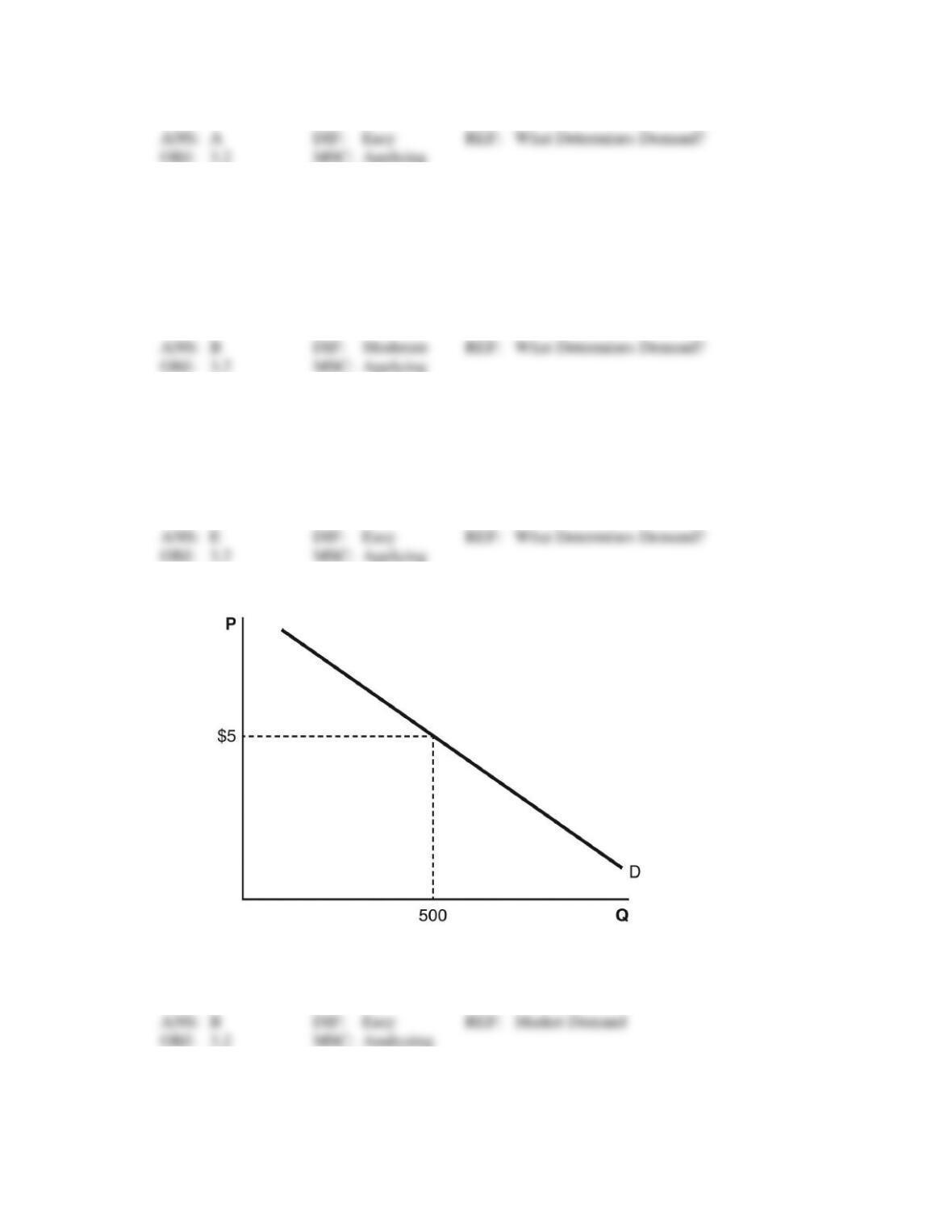
21. According to the figure below, at the price of $5,
a. the equilibrium quantity is 500. d. there is a surplus.
b. the quantity demanded is 500. e. there is a shortage.
c. the demand is 500.
22. Refer to the table below:
Price of
iPhones Christy’s
Demand Lori’s
Demand
$700.00 0 0
$650.00 1 0
$500.00 1 1
$450.00 2 1
$300.00 4 2
$275.00 5 3
$250.00 6 4
$100.00 7 4
$50.00 10 5
Assume that the market for iPhones has only two consumers: Christy and Lori. According the table
above, if the price of an iPhone is $285, the market will demand ________ iPhones.
a. 8 d. 28
b. 6 e. 45
c. 5
23. What is market demand?
a. the subtraction of the individual quantities demanded by each buyer in a market at each price
b. the addition of the individual prices of the price at each level of quantity
c. the multiplication of the prices of each product by the individual quantities demanded by each
buyer in a market
d. the division of the total spending by an individual buyer with the prices paid for the product
e. the addition of the individual quantities demanded by each buyer in a market at each price
24. How does the market demand reflect the law of demand?
a. As the price increases, each and every buyer purchases a larger quantity of the product.
b. As the price decreases, each and every buyer purchases a larger quantity of the product.
c. As the price increases, each and every buyer initially purchases a larger quantity of the product
but eventually purchases less.
d. As the price decreases, each and every buyer initially purchases a larger quantity of the
product but eventually purchases more.
e. The market demand curve does not reflect the law of demand.
25. At the price of $3 a pound of pork, Jason buys 8 pounds of pork and Noelle buys 10 pounds of
pork. When the price rises to $5 a pound, Jason buys 5 pounds of pork and Noelle buys 7 pounds
of pork. What is the market demand at $5?
a. 5 d. 12
b. 7 e. 18
c. 25
26. If the price of pants increases, what would you expect would happen in the market for pants?
a. There would be a movement to the right along the demand curve.
b. There would be a movement to the left along the demand curve.
c. There would be a shift to the left of the demand curve.
d. There would be a shift to the right of the demand curve.
e. There is both a movement along and a shift of the demand curve.
27. Something is a normal good if the demand for the good
a. increases as the consumer’s income increases.
b. increases as the consumer’s income decreases.
c. decreases if the price of a substitute good increases.
d. increases if the price of a complement good increases.
e. decreases as the income of the consumer increases.
28. Which of the following would cause a normal good’s demand curve to shift to the left?
a. Income decreases. d. The price decreases.
b. Income increases. e. The input prices increase.
c. The price increases.
29. Something is an inferior good if the demand for the good
a. increases as the consumer’s income increases.
b. increases as the consumer’s income decreases.
c. decreases as the price of a complement increases.
d. decreases as the price of a substitute increases.
e. decreases as the consumer’s income decreases.
30. Which of the following would cause the demand curve to shift to the right?
a. Income decreases for an inferior good.
b. Income decreases for a normal good.
c. Tastes and preferences decrease.
d. The price of a substitute decreases.
e. The price of a complement increases.
31. Two goods that are used together are called
a. complements. d. substitutes.
b. inferior. e. normal.
c. Giffin.
32. The price of Good X increases by 25 percent, causing the quantity consumed of Good Y to
decrease by 10 percent. If everything else is held constant in the economy, we can say with
certainty that Good X and Good Y are
a. substitutes. d. normal.
b. inferior. e. unrelated.
c. complements.
33. If the price of a good increases, holding all else constant,
a. the demand for all of that good’s substitutes will decrease.
b. the quantity demanded for that good will increase.
c. the demand for all of that good’s complements will increase.
d. the demand for all of that good’s substitutes will increase.
e. the demand curve will shift to the left.
34. Pepsi and Coke are considered substitute goods. Because of this, one would predict that, holding
all else constant, if the price of Pepsi increases, we would see
a. the demand curve for Coke shift to the right.
b. the demand curve for Coke shift to the left.
c. no change in the demand for Coke.
d. the demand curve for Pepsi shift to the right.
e. the demand curve for Pepsi shift to the left.
35. In March 2012, the state of California started requiring that all packaging for food and drink with
the additive 4-methylimidazole (4-MI) be clearly labeled with a cancer warning. Because of this,
both Pepsi and Coke changed their formula to eliminate 4-MI as an ingredient. If Pepsi and Coke
did NOT change their formula, holding all else constant, what would have happened to the demand
for these goods, assuming Pepsi and Coke were in a competitive market?
a. The demand curves for both Pepsi and Coke would have shifted to the right, causing the price
of both products to decrease and the profits for the companies to fall.
b. The demand curves for Pepsi and Coke would have remained unchanged, but the price of both
products would have decreased and the profits for the companies would have fallen.
c. The demand curves for Pepsi and Coke would have decreased, but the prices and profits would
not have changed.
d. The demand curve for only one of them would change because Pepsi and Coke are substitutes.
e. The demand curves for Pepsi and Coke would have shifted to the left, causing the price of both
products to decrease and the profits for both companies to fall.
36. What would we expect to happen to the price and quantity of Pepsi if the price of Coke increases
and Pepsi develops a new technology that makes its production process more efficient?
a. The equilibrium price will go up and the equilibrium quantity will go up.
b. The equilibrium price will be indeterminate and the equilibrium quantity will go up.
c. The equilibrium price will go down and the equilibrium quantity will be indeterminate.
d. The equilibrium price will be indeterminate and the equilibrium quantity will go down.
e. The equilibrium price will go up and the equilibrium quantity will be indeterminate.
37. Companies use advertising to shift consumer demand. On which of the following demand shifters
do advertisers most often rely?
a. changes in income
b. the price of related goods
c. changes in tastes and preferences
d. the number of buyers
e. expectations regarding the future price
38. Which of the following will cause the demand curve for burgers to shift to the right?
a. The price of burgers decreases.
b. The price of burgers increases.
c. The price of burger buns increases.
d. A study is published by the National Association for Burger Research that says eating burgers
can reduce the risk for bad acne.
e. The price of steak decreases.
39. Holding all else constant, which of the following demand schedules is most likely to represent
New York Mets T-shirts if they win the World Series?
Price Quantity Demanded
$8.00 200
$10.00 175
$12.00 150
$14.00 100
$16.00 50
a. d.
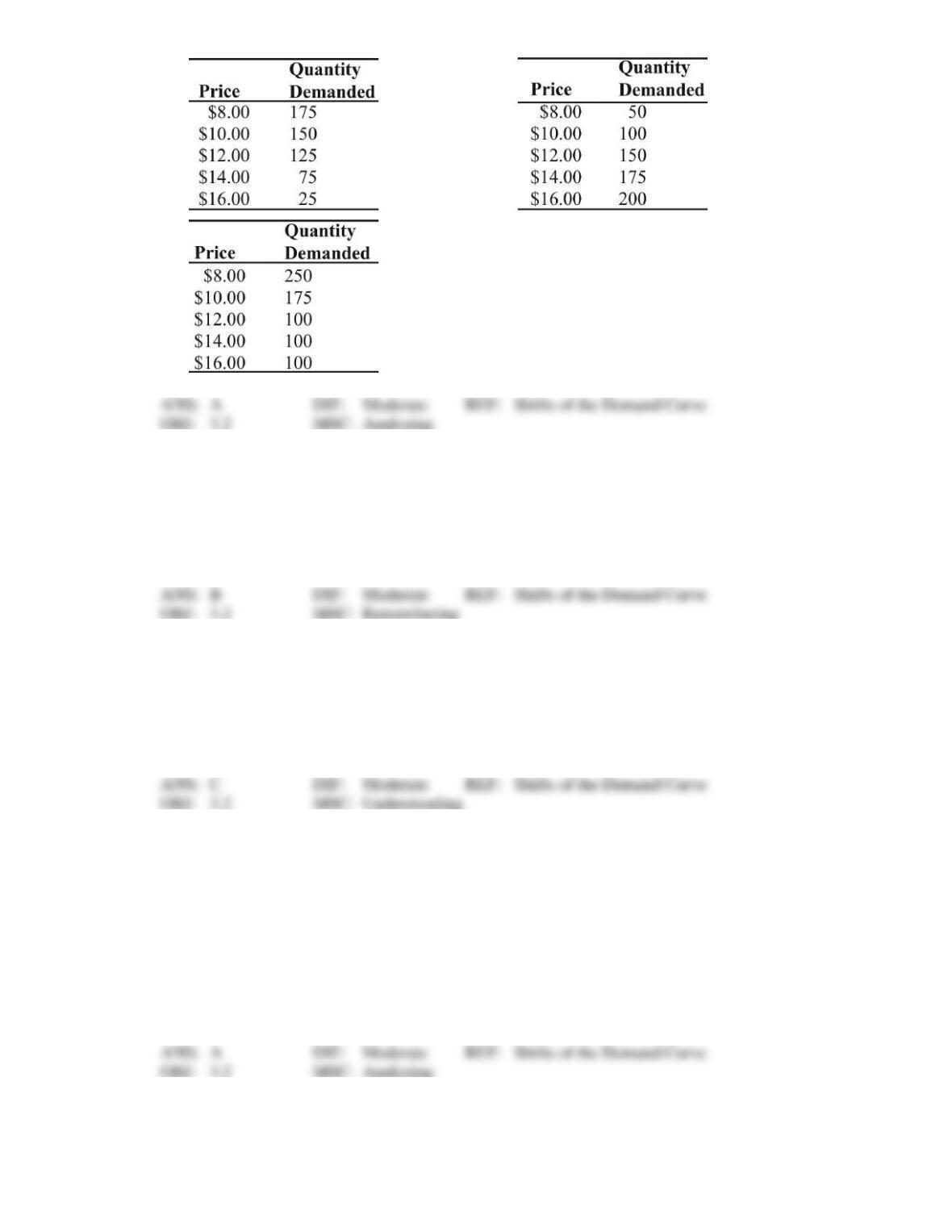
b. e.
c.
40. An expectation of a lower price in the future will
a. increase current demand.
b. decrease current demand.
c. not change demand.
d. cause demand to stay the same but increase the quantity demanded.
e. cause demand to stay the same but decrease the quantity demanded.
41. The demand curve for a good will shift to the right if, holding all else constant,
a. consumers expect future prices to decrease.
b. an input cost of the item goes up.
c. consumers expect future prices to increase.
d. the price of the good goes down.
e. the price of a substitute good goes down.
42. Katarina drives past the same gas station every day. She realizes that the gas station always
changes its prices on Tuesdays but keeps the price steady the rest of the week. On Saturday,
Katarina turns on the news and hears a report projecting that the price of gasoline is going to
increase. Holding all else constant, what do you think would happen to Katarina’s demand for
gasoline on Monday?
a. Her demand would shift to the right.
b. Her demand would shift to the left.
c. We would see a movement down on her demand curve but no shift.
d. We would see a movement up on her demand curve but no shift.
e. We would see nothing happen to her demand curve until the price changed on Tuesday.
43. Changes in population can
a. alter the supply of a good or service in an area.
b. shift the supply curve of a good or service in an area.
c. cause the price of a good or service to increase in an area but cannot cause the price to
decrease.
d. cause the price of a good or service to decrease in an area but cannot cause the price to
increase.
e. shift the demand curve of a good or service in an area.
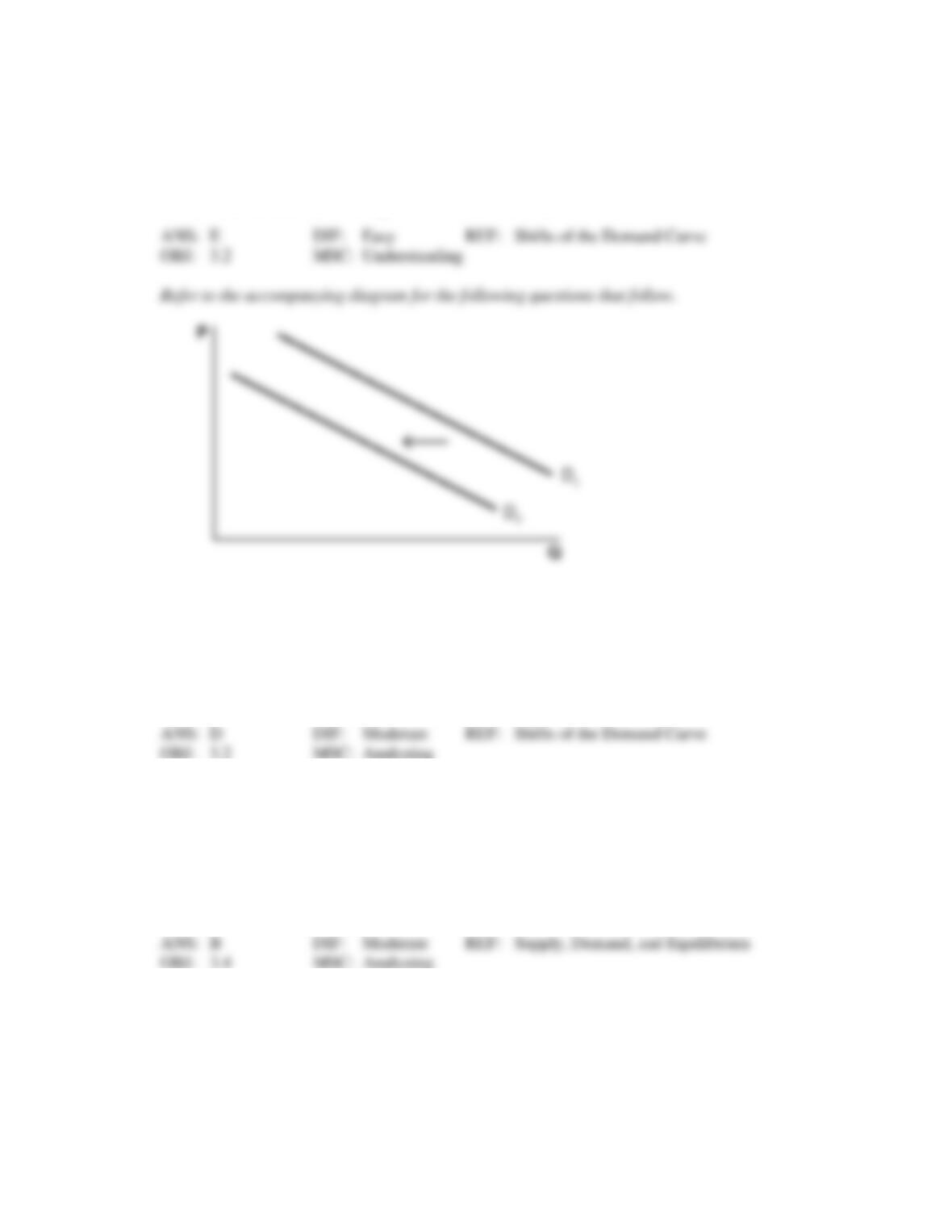
44. The demand curve shift shown in the figure was caused by a(n)
a. increase in the input cost of the good.
b. increase in the price of a substitute of the good.
c. decrease in the number of firms selling the good.
d. decrease in the number of buyers in the market for the good.
e. expectation that the future price of this good will be higher than it is currently.
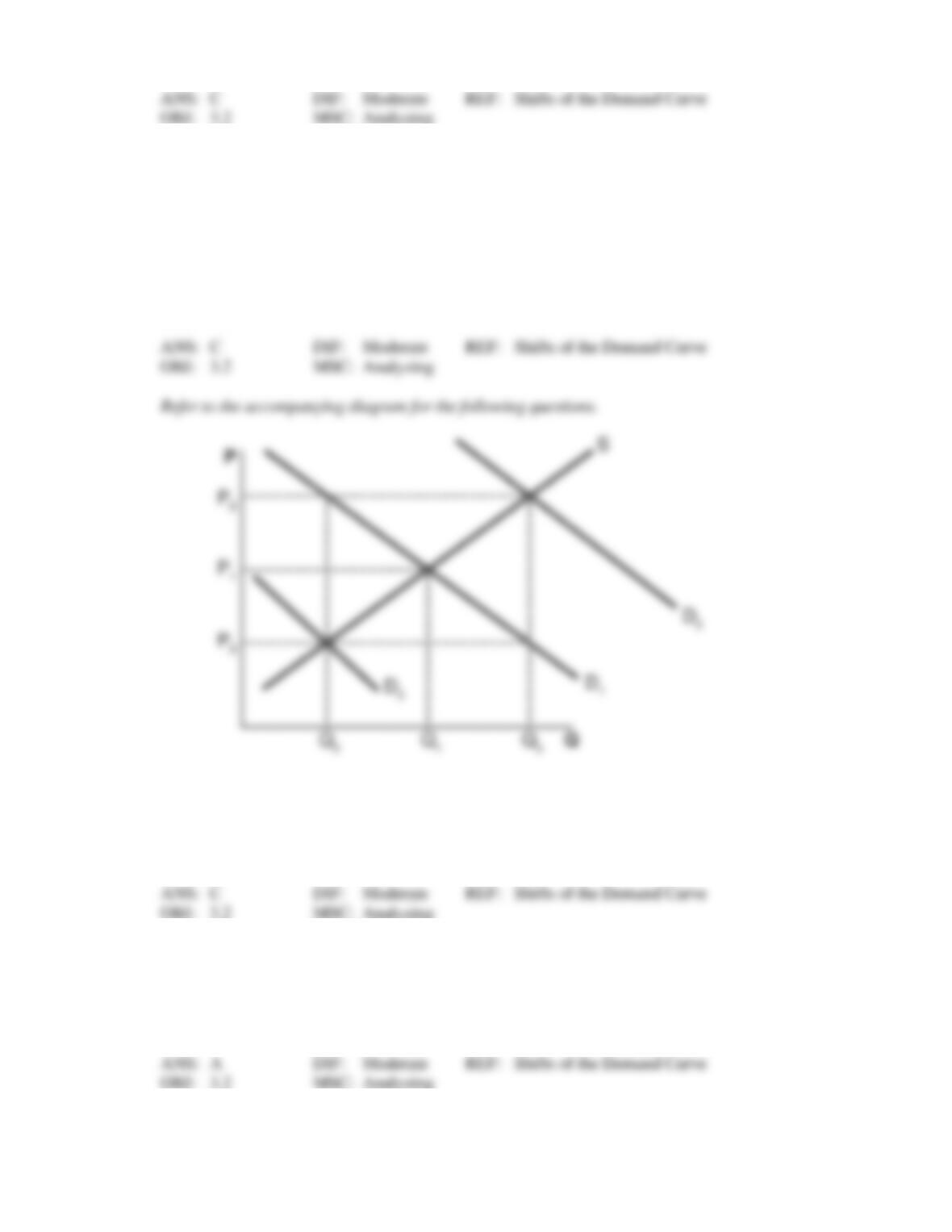
45. Which of the following scenarios would explain the change in equilibrium shown in the
accompanying figure?
a. an increase in an input price
b. a decrease in the number of buyers in a market
c. an increase in the price of a substitute good
d. an increase in the expected future price
e. a negative technological change
46. As more people migrated West during the gold rush, what happened to the demand curve in most
western markets, holding all else constant?
a. The demand curve shifted to the right.
b. The demand curve shifted to the left.
c. There was no shift, but there was an increase in quantity demanded.
d. There was no shift, but there was a decrease in quantity demanded.
e. There was no shift, nor any increase or decrease in quantity demanded.
47. As the life expectancy in the United States increases, which of the following could likely happen to
the demand curve for items such as health care, cancer treatments, and nursing facilities, holding
all else constant, and why?
a. There would be a decrease because individuals are healthier.
b. There would be an increase because the cost of these items is falling.
c. There would be an increase because there will be more buyers in these markets.
d. There would be a decrease because Social Security benefits are running out.
e. They will stay the same because these changes would affect the supply curve and not the
demand curve.
48. An increase in the number of buyers would cause the demand curve to
a. shift from D1 to D3. d. shift from D2 to D1.
b. remain at D1. e. shift from D2 to D3.
c. shift from D1 to D2.
49. If consumers expect the price of a good to decrease in the future and all else is held constant, we
would assume that the demand curve would
a. shift from D1 to D3. d. shift from D2 to D1.
b. remain at D1. e. shift from D2 to D3.
c. shift from D1 to D2.
50. The law of supply states that, all other things being equal,
a. the quantity supplied falls when the price falls, and the quantity supplied rises when the price
rises.
b. the quantity supplied falls when the price rises, and the quantity supplied rises when the price
falls.
c. the supply falls when the price falls, and the demand rises when the price rises.
d. the supply falls when the price rises, and the demand rises when the price falls.
e. price and quantity are always negatively correlated.
51. A supply schedule
a. is a curve representing the relationship between the price of a good or service and the quantity
supplied.
b. is a list of goods and services supplied at different prices.
c. is a table representing the relationship between the price of a good or service and the quantity
supplied.
d. can be used only to analyze individuals’ supplies for a good or service.
e. can be used only to analyze the entire market’s supply for a good or service.
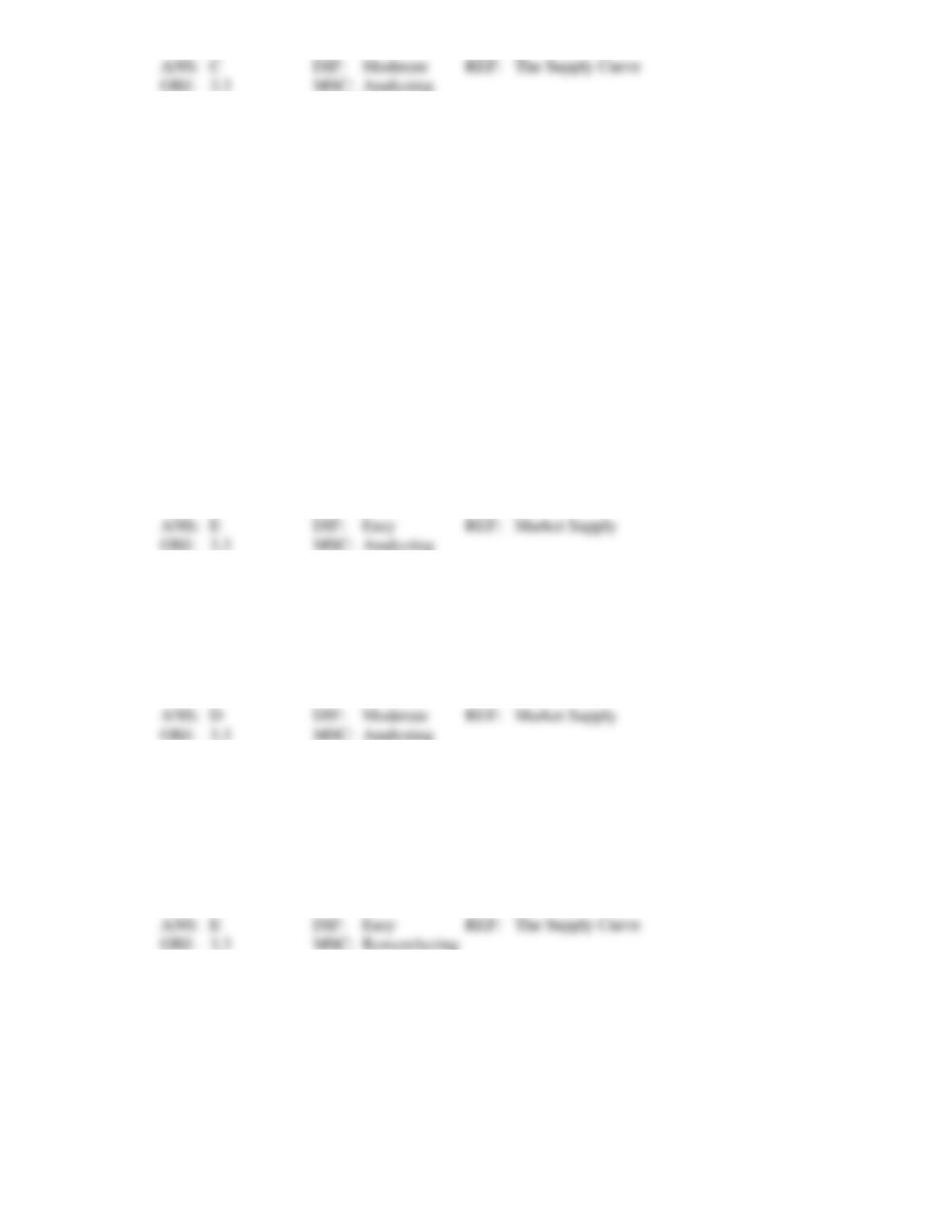
52. Refer to the accompanying figure. When the price changes from P1 to P2, we will see a(n)
a. decrease in supply from Q1 to Q2.
b. increase in supply from Q2 to Q1.
c. decrease in quantity supplied from Q1 to Q2.
d. increase in quantity supplied from Q2 to Q1.
e. shift of the supply curve.
53. Assume that the market for nachos has only two suppliers: Firm 1 and Firm 2. According to the
table below, if the price of nachos is $6, the market will supply ________ nachos.
Price of
Nachos Firm 1’s
Supply Firm 2’s
Supply
0 0 0
$1 1 0
$2 1 1
$3 2 1
$4 4 2
$5 5 3
$6 6 4
$7 7 4
$8 10 5
a. 41 d. 4
b. 6 e. 10
c. 2
54. Assume there are 100 suppliers of widgets in the widget market. Half of these suppliers supply 35
widgets to the market, a quarter of these suppliers supply 40 widgets to the market, and a quarter of
these suppliers supply 50 widgets to the market. What is the market supply for widgets?
a. 100 d. 4,000
b. 125 e. 1,750
c. 400
55. What is market supply?
a. the subtraction of the individual quantities supplied by each seller in a market at each price
b. the addition of the individual prices of the product at each level of quantity
c. the multiplication of the price of each product by the individual quantities supplied by each
supplier in a market
d. the division of the total sales by an individual seller with the price paid for the product
e. the addition of the individual quantities supplied by each seller in a market at each price
56. How does the market supply reflect the law of supply?
a. As the price increases, each and every seller sells a larger quantity of the product.
b. As the price decreases, each and every seller sells a larger quantity of the product.
c. As the price increases, each and every seller initially sells a larger quantity of the product but
eventually sells less.
d. As the price decreases, each and every seller initially sells a larger quantity of the product but
eventually sells more.
e. The market supply curve does not reflect the law of supply.
57. At the price of $5 per pack of batteries, Duracell sells 10,000 packs of batteries and Energizer sells
15,000 packs of batteries. When the price rises to $7.50, Duracell sells 12,000 packs of batteries
and Energizer sells 16,000 packs of batteries. What is the market supply at $7.50?
a. 12,000 d. 28,000
b. 16,000 e. 25,000
c. 4,000
58. When the price falls, what happens?
a. There is no change in the quantity supplied or supply.
b. There is an increase in the supply.
c. There is a decrease in the supply.
d. There is an increase in the quantity supplied.
e. There is a decrease in the quantity supplied.
59. When Paul listened to the presidential candidate debates, he heard one candidate proposing to
increase taxes and the other candidate responding that this would cause firms to decrease
production. How would this be described by an economist?
a. As taxes increase, there is a decrease in quantity supplied.
b. As taxes increase, there is an increase in quantity supplied.
c. As taxes increase, there is an increase in supply.
d. As taxes increase, there is a decrease in supply.
e. As taxes increase, there is an increase in supply and in quantity supplied.
60. Roger currently runs a restaurant on a busy street filled with many other restaurants. The local
health inspector, however, has plans to shut down many of these restaurants. What impact will the
closure of restaurants have?
a. There will be an increase in quantity supplied.
b. There will be a decrease in quantity supplied.
c. There will be an increase in supply.
d. There will be a decrease in supply.
e. There will be no change in quantity supplied or supply.
61. As computers and Internet access have become cheaper, businesses have offered these to
employees. What impact would this have on the market for what these businesses sell?
a. The technology will lead to a leftward shift of the supply curve.
b. The technology will lead to a rightward shift of the supply curve.
c. The technology will lead to a leftward shift of the demand curve.
d. The technology will lead to a leftward movement along the supply curve.
e. There will be no change in supply or quantity supplied.
62. As the owner of a business, Talia has allowed her employees to do their work on one computer
screen while watching movies on a second computer screen. She has noticed, however, that her
employees are distracted by being able to watch movies while at work. How would an economist
describe this situation?
a. As people watch movies, they become less productive and efficient and there is a leftward
movement along the supply curve.
b. As people watch movies, they become less productive and efficient and there is a rightward
movement along the supply curve.
c. As people watch movies, they become less productive and efficient and there is a rightward
shift of the supply curve.
d. As people watch movies, they become less productive and efficient and there is a leftward shift
of the supply curve.
e. As people watch movies, they become less productive and efficient and there is a rightward
shift of and movement along the supply curve.
63. The government recently imposed a number of regulations on companies that will make it more
expensive for companies to hire workers. What consequence will this have on market?
a. These regulations raise the cost of labor and shift supply to the left.
b. These regulations raise the cost of labor and shift supply to the right.
c. These regulations raise the cost of labor and cause a rightward movement along the supply
curve.
d. These regulations raise the cost of labor and cause a leftward movement along the supply
curve.
e. These regulations will not affect the supply curve.
64. Which of the following is both a shift in supply and a shift in demand?
a. the number of firms in an industry d. expectations of future prices
b. tastes and preferences e. the number of buyers
c. income changes
65. Which of the following will cause a movement along a good’s supply curve?
a. The price of an input increases.
b. The price of the good increases.
c. The production process of the good becomes more efficient.
d. More firms enter the market.
e. The government places a subsidy on the producer of the good.
66. A change in quantity supplied
a. is represented by a shift in the supply curve.
b. is represented by a movement along the supply curve.
c. happens only when the price increases.
d. happens only when the price decreases.
e. is positive if the price of the good decreases.
67. Inputs are
a. goods that are used together.
b. goods that are used in place of one another.
c. goods that one demands more of as one’s income increases.
d. goods that one demands less of as one’s income increases.
e. resources that firms use in the production of final goods and services.
68. Higher input costs
a. reduce profits.
b. increase profits.
c. shift the demand curve.
d. always happen during a recession.
e. provide an incentive to hire more workers.
69. If the cost of flour increases from $3 to $5 a bag, we could predict the supply curve for bagels to
a. shift to the right. d. become flatter.
b. shift to the left. e. increase.
c. become steeper.
70. If the price of rubber were to increase by 20 percent over the fiscal year and if all else were held
constant, what would we expect to happen to the supply curve of tires that are sold separately from
automobiles?
a. The supply curve would shift to the right.
b. The quantity supplied would increase.
c. The supply curve would shift to the left.
d. The supply curve would shift down.
e. Nothing; the cost of rubber has no impact on the supply of tires.
71. Which following change in the coffee market would shift the supply curve to the right?
a. A study finds that drinking coffee leads to higher grades.
b. The wage for employees in the coffee business decreases.
c. The income in the economy increases.
d. Firms expect the price of coffee to increase in the future.
e. Fifty Starbucks coffee shops close down.
72. An improvement in technology
a. is one way to shift the demand curve.
b. always increases producers’ profits.
c. allows a producer to decrease output with the same amount of input.
d. allows a producer to increase output with the same amount of input.
e. shifts the supply curve to the left.
73. If a new french fry–cutting machine works twice as fast as the old machine, McDonald’s would
a. be willing to produce and sell fewer french fries at every price.
b. be making less profit.
c. be willing to produce and sell more french fries at every price.
d. lose customers.
e. pay its employees more.
74. Which of the following could cause the supply curve for the market for oranges to shift to the left?
a. an increase in the income of consumers of oranges
b. a decrease in the cost of workers
c. an increase in the price of orange juice
d. a new study saying that eating oranges will give one heart disease
e. a severe hurricane in Florida
75. A subsidy
a. is a payment made by the government to encourage consumption or production of a good or
service.
b. is a payment taken by the government to discourage consumption or production of a good or
service.
c. shifts the demand curve of a product.
d. is designed to decrease the available supply of a good or service.
e. raises the cost of doing business.
76. When the government places a tax on the producer of a good or service
a. the demand curve for the good or service shifts to the right.
b. the demand curve for the good or service shifts to the left.
c. the supply curve for the good or service shifts to the right.
d. the supply curve for the good or service shifts to the left.
e. both the supply and demand curves for the good or service shifts to the left.
77. On January 30, 2012, Starbucks India announced plans to open 50 cafés. What would you expect
to happen to the market for coffee in India, assuming all other factors are held constant?
a. The demand for coffee will increase in India.
b. The demand for coffee will decrease in India.
c. Both the supply and demand for coffee will increase in India.
d. The supply for coffee will increase in India.
e. The supply for coffee will decrease in India.
78. In 1993, the government increased the tax on gasoline producers from 14.1 cents per gallon to 18.4
cents per gallon. Our model of supply and demand predicts that
a. the demand for gasoline decreased.
b. the supply for gasoline increased.
c. the demand for gasoline increased.
d. the supply for gasoline decreased.
e. both the supply and demand for gasoline decreased.
79. When the government places a tax on a good and all else is held constant, which of the following
would most likely happen?
a. The overall consumption of the good decreases, assuming the good does not have a vertical
demand curve.
b. The price the buyer pays for the good decreases, assuming the good does not have a horizontal
demand curve.
c. The supply curve shifts to the right.
d. The government receives no tax revenue if the tax is more than 20 percent.
e. The price and quantity adjust back to the competitive market equilibrium point.
80. When the number of firms in a market decreases,
a. the demand curve shifts to the left.
b. the demand curve shifts to the right.
c. the supply curve shifts to the right.
d. the supply curve shifts to the left.
e. both the supply and the demand curves shift to the left.
81. Which of the following situations would cause the demand curve to shift to the right?
a. a decrease in the number of consumers
b. a decrease in the number of producers
c. an increase in the price of a complement
d. an increase in the price of a substitute
e. a change in tastes and preferences
82. Firm A notices that Firm B is making a profit by producing footballs. There is nothing stopping
Firm A from entering the football market, so it does. Holding all else constant, the number of firms
in the market will
a. increase, causing demand to increase.
b. increase, causing the supply to shift down.
c. decrease, causing the supply to decrease.
d. decrease, causing the supply to increase.
e. increase, causing the supply to increase.
83. Old Navy stocks more Bermuda shorts during the summer months than in the winter months. The
resulting shift in supply explains
a. the change in technology. d. the change in input cost.
b. the change in income. e. the number of firms in a market.
c. price expectations.
84. James specializes in college-level economics tutoring. He knows that during the two weeks before
finals he can charge more for an hour of private tutoring. Expecting this price increase, James will
a. supply less tutoring now, shifting supply to the left.
b. supply more tutoring now, shifting supply to the right.
c. supply less tutoring now, shifting supply to the right.
d. supply more tutoring now, shifting supply to the left.
e. change the price of tutoring without any shift in supply.
85. When the price of ground beef increases and all else is held constant, we would expect the supply
of hamburgers to ________, causing the price to ________.
a. decrease; increase d. increase; increase
b. decease; decrease e. increase; decrease
c. stay the same; stay the same
86. Refer to the accompanying graph. If a tax is placed on a good and all else is held constant, we
would assume that the supply curve would