Microeconomics: Theory and Applications with Calculus, 3e (Perloff)
Chapter 3 A Consumer’s Constrained Choice
3.1 Preferences
1) An indifference curve represents bundles of goods that a consumer
A) views as equally desirable.
B) ranks from most preferred to least preferred.
C) refers to any other bundle of goods.
D) All of the above.
2) The assumption of completeness means that
A) the consumer can rank all possible consumption bundles.
B) more of a good is always better.
C) the consumer can rank all affordable consumption bundles.
D) all preferences conditions are met.
3) If a consumer prefers Apples to Bananas and prefers Bananas to Citrus Fruit, in order to satisfy
assumptions about preferences, she has to prefer
A) Bananas to Apples.
B) Citrus Fruit to Bananas.
C) Apples to Citrus Fruit.
D) Citrus Fruit to Apples.
4) The principle that “More is better” results in indifference curves
A) sloping down.
B) not intersecting.
C) reflecting greater preferences the further they are from the origin.
D) All of the above.
5) There is an indifference curve through every bundle because of the assumption of
A) transitivity.
B) completeness.
C) rationality.
D) nonsatiation.
6) Indifference curves are downward sloping because of the assumption of
A) completeness.
B) transitivity.
C) more is better.
D) All of the above.
7) If two indifference curves were to intersect at a point, this would violate the assumption of
A) transitivity.
B) completeness.
C) Both A and B above.
D) None of the above.
8) Indifference curves that are thick violate
A) the assumption of transitivity.
B) the assumption that more is better.
C) the assumption of completeness.
D) none of the assumptions.
9) A consumer’s willingness to trade one good for another can be expressed by the consumer’s
A) indifference curve.
B) marginal rate of substitution.
C) Both A and B above.
D) None of the above.
10) Convexity of indifference curves imply that consumers are willing to
A) give up more “y” to get an extra “x” the more “x” they have.
B) give up more “y” to get an extra “x” the less “x” they have.
C) settle for less of both “x” and “y”.
D) acquire more “x” only if they do not have to give up any “y”.
11) Measuring “y” on the vertical axis and “x” on the horizontal axis, convexity of indifference curves
imply that the MRS of “y” for “x”
A) is decreasing as “x” increases.
B) is increasing as “x” increases.
C) is constant as “x” increases.
D) cannot be calculated for large levels of “x”.
12) Diminishing marginal rate of substitution can be seen when indifference curves
A) cross.
B) are convex.
C) are downward sloping.
D) become flatter as we move down and to the right.
13) For which of the following pairs of goods would most people likely have convex indifference curves?
A) nickels and dimes
B) left shoes and right shoes
C) movie tickets and concert tickets
D) None of the above.
14) If two goods are perfect substitutes, then the indifference curves for those two goods would be
A) upward-sloping and concave to the origin.
B) downward-sloping and convex to the origin.
C) downward sloping and straight.
D) L-shaped.
15) The indifference curves for left shoes and right shoes would most likely be
A) upward-sloping and concave to the origin.
B) downward-sloping and convex to the origin.
C) downward sloping and straight lines.
D) L-shaped.
For the following, please answer “True” or “False” and explain why.
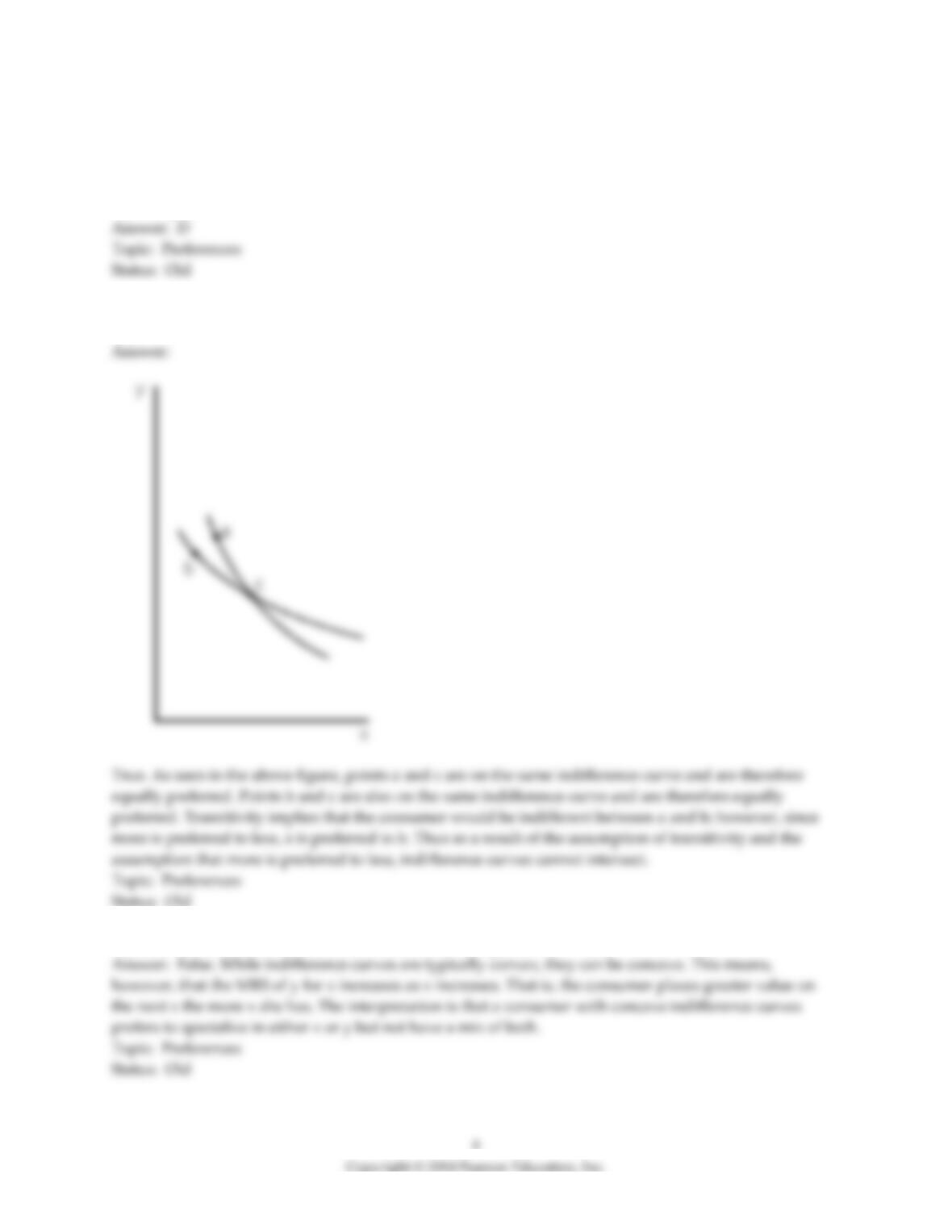
16) Indifference curves cannot intersect.
17) Indifference curves cannot ever be concave for two goods.
18) Indifference curves for perfect substitutes must be parallel lines with a slope of negative one.
19) Indifference curves on the same indifference map can have different shapes.
20) Lisa views pizzas and burritos as goods. If she prefers a bundle of four burritos and four pizzas to a
bundle of four burritos and five pizzas, which property of consumer preference is violated? What change
in the assumptions could lead a rational consumer to prefer the first bundle?
21) Explain why most indifference curves are convex.
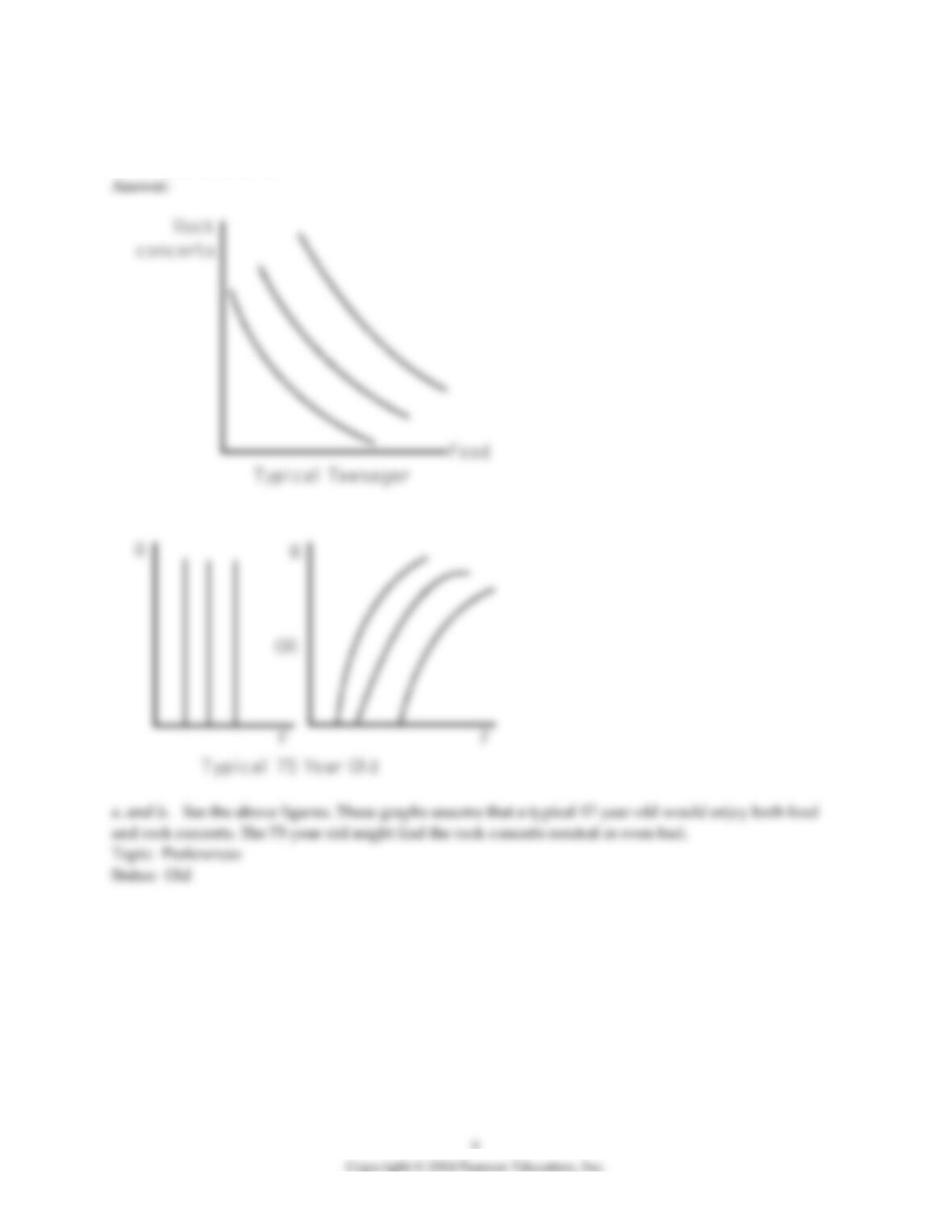
22) Draw the indifference curves for rock concerts and food for each of the following:
a. a typical 17-year-old
b. a typical 75-year-old
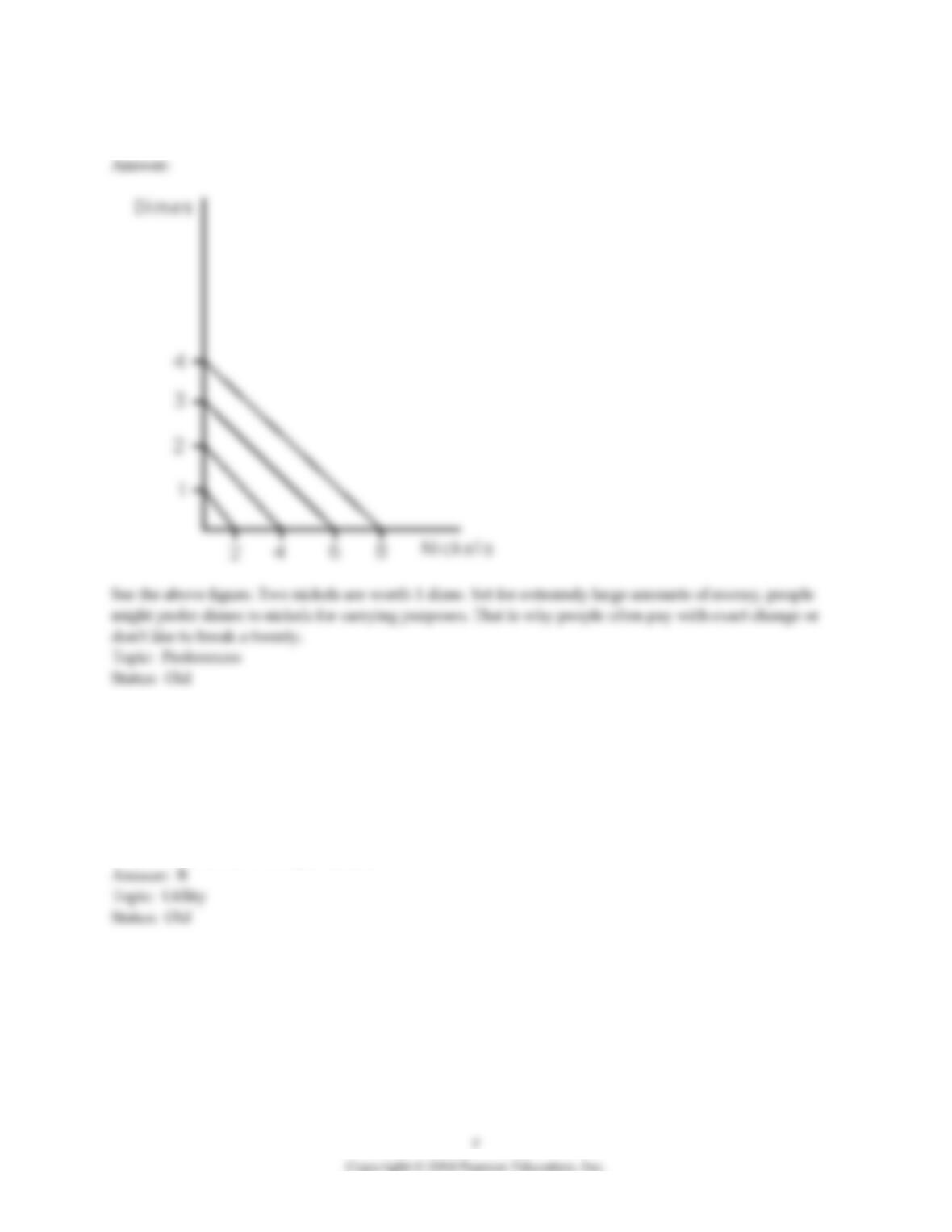
23) Draw the indifference curves for nickels and dimes. Would they ever have a non-constant slope?
Explain.
3.2 Utility
1) Utility is the set of numerical values that
A) yields an absolute level of pleasure from a bundle of goods.
B) reflects the relative ranking of various bundles of goods.
C) describes how much more a consumer prefers one bundle to another.
D) yields a cardinal ranking of bundles.
2) If two bundles are on the same indifference curve, then
A) the consumer derives the same level of utility from each.
B) the consumer derives the same level of ordinal utility from each but not the same level of cardinal
utility.
C) no comparison can be made between the two bundles since utility cannot really be measured.
D) the MRS between the two bundles equals one.
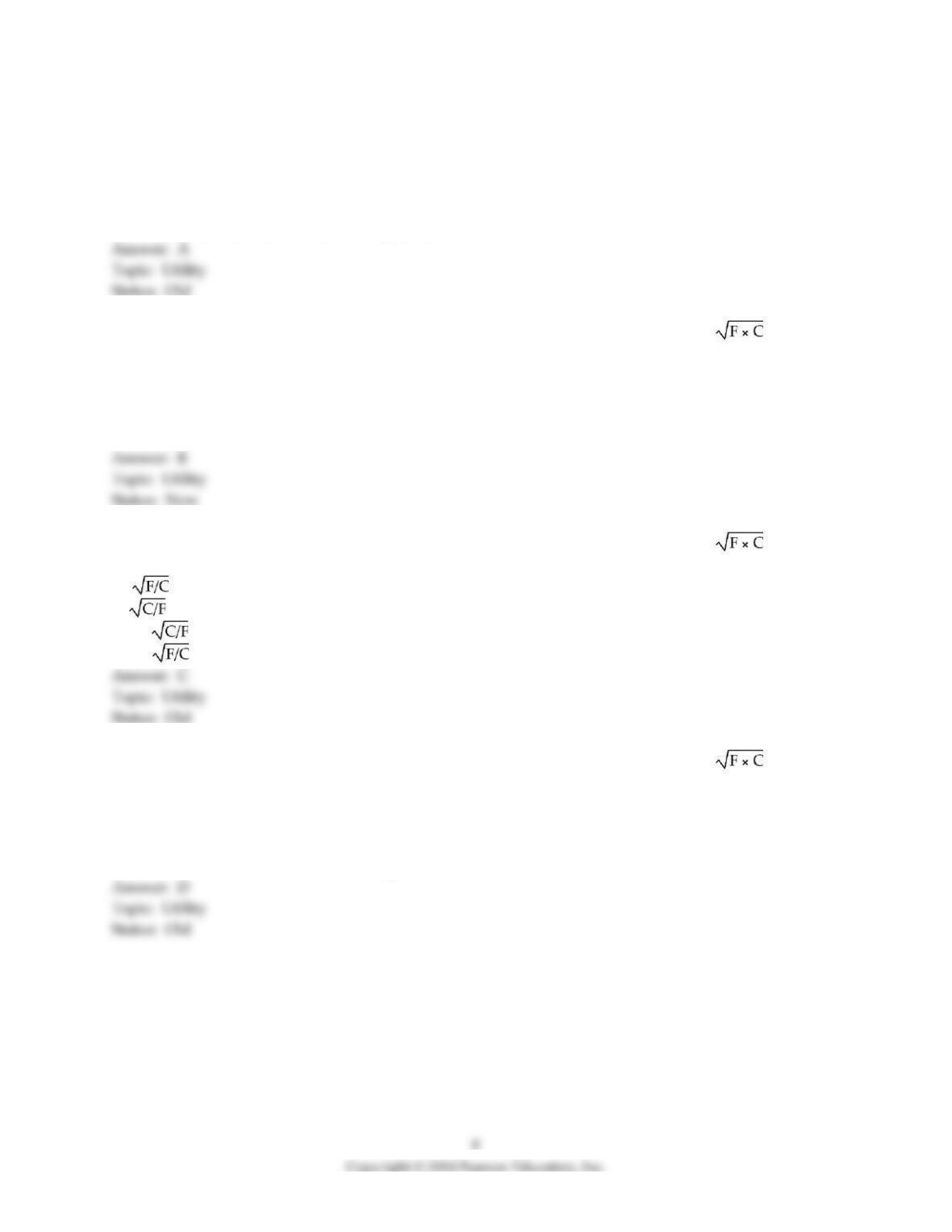
3) If the utility function (U) between food (F) and clothing (C) can be represented as U = , holding
the consumption of clothing fixed, the utility will
A) increase at an increasing speed when more food is consumed.
B) increase at an decreasing speed when more food is consumed.
C) increase at an constant speed when more food is consumed.
D) remain the same.
4) If the utility function (U) between food (F) and clothing (C) can be represented as U = , the
marginal utility of food equals
A) .
B) .
C) 1/2 .
D) 1/2 .
5) If the utility function (U) between food (F) and clothing (C) can be represented as U = , the
marginal utility of food
A) is not positive.
B) does not diminish as food increases.
C) is not affected by the amount clothing.
D) increases as one obtains more clothing.
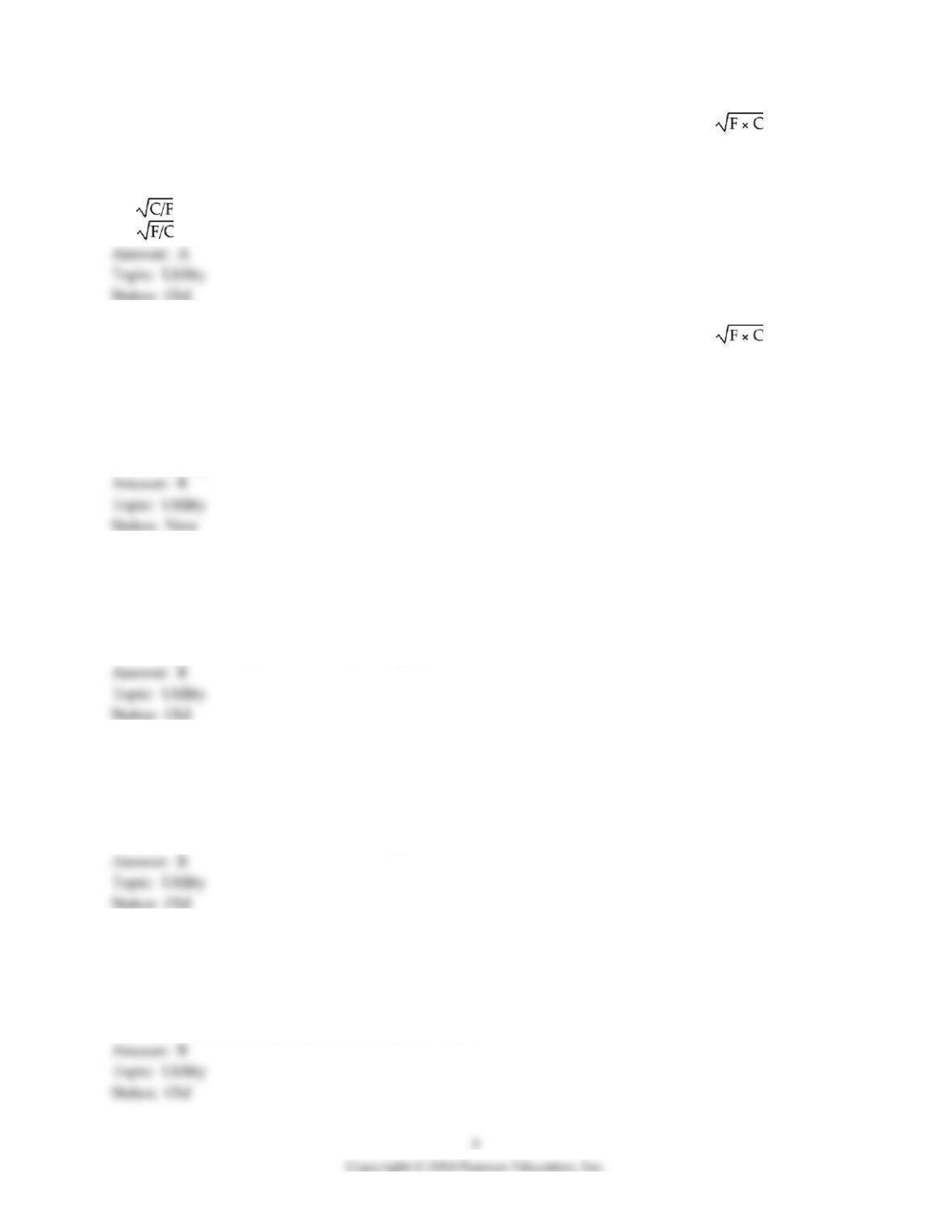
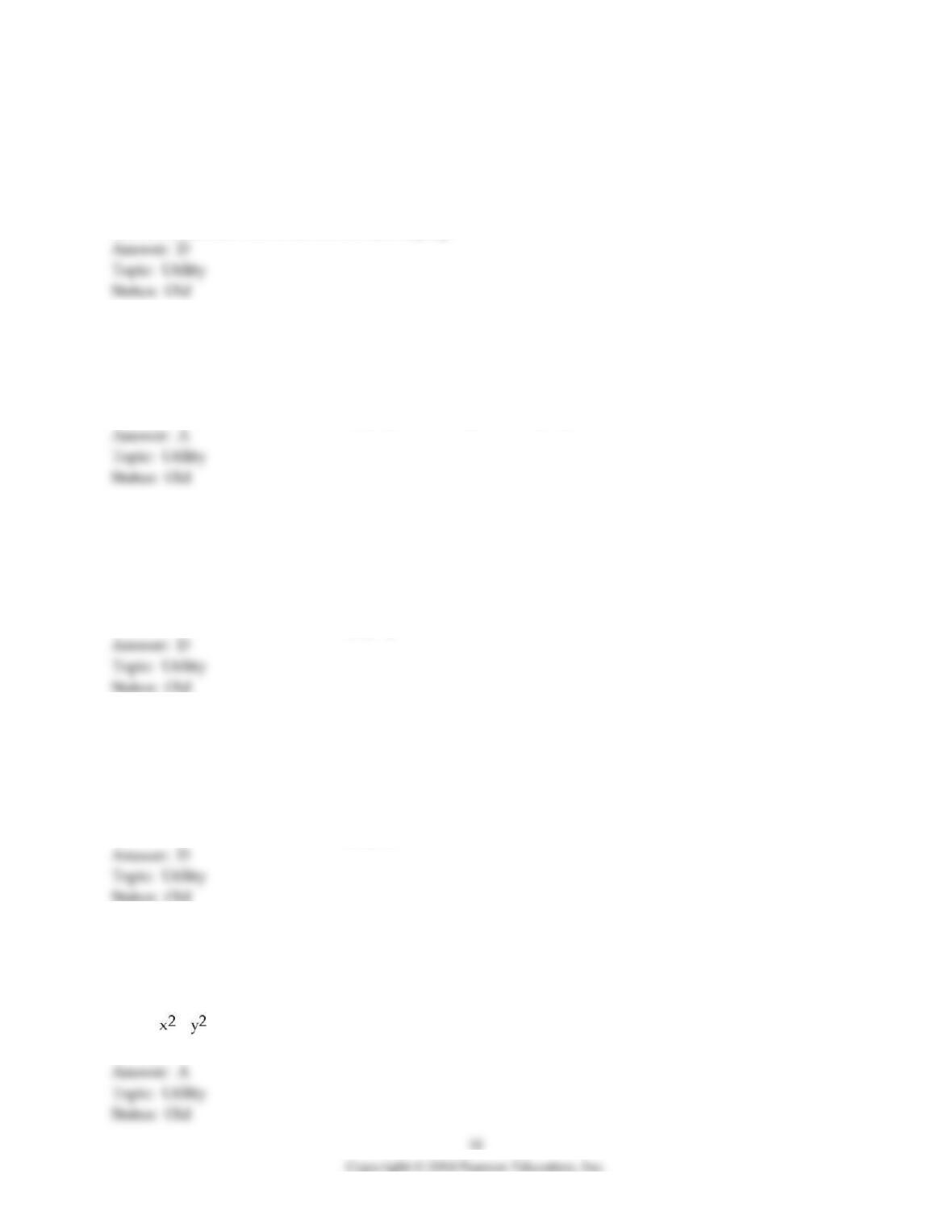
6) If the utility function (U) between food (F) and clothing (C) can be represented as U = , the
marginal rate of substitution of clothing for food equals
A) -C/F.
B) -F/C.
C) – .
D) – .
7) If the utility function (U) between food (F) and clothing (C) can be represented as U = , the
marginal rate of substitution of clothing for food will ________ if more food and less clothing are
consumed.
A) increase in absolute terms
B) decrease in absolute terms
C) remain the same
D) Not enough information.
8) If Fred’s marginal utility of pizza equals 10 and his marginal utility of salad equals 2, then
A) he would give up five pizzas to get the next salad.
B) he would give up five salads to get the next pizza.
C) he will eat five times as much pizza as salad.
D) he will eat five times as much salad as pizza.
9) If Fred’s marginal rate of substitution of salad for pizza equals five, then
A) he would give up five pizzas to get the next salad.
B) he would give up five salads to get the next pizza.
C) he will eat five times as much pizza as salad.
D) he will eat five times as much salad as pizza.
10) Adrian’s total utilities of two consumption bundles are 50 and 100. This implies that
A) the consumer prefers the first bundle.
B) the consumer prefers the second bundle.
C) the consumer likes the second bundle twice as much.
D) the consumer likes the first bundle twice as much.
11) If Fred‘s marginal utility of pizza equals 10 and his marginal utility of salad equals 2, then we know
that
A) his indifference curves are convex.
B) his indifference curves are L-shaped.
C) his indifference curves are linear.
D) his indifference curves are downward sloping.
12) If the utility for two goods “x” and “y” is measured as U = x + y, then it can be concluded that
A) “x” and “y” are perfect substitutes.
B) “x” and “y” are perfect complements.
C) “x” and “y” are both bads.
D) the indifference curves on the x,y graph will be upward sloping.
13) If the utility for two goods “x” and “y” can be measured as U = x, then it can be concluded that
A) “x” and “y” are perfect complements.
B) “y” is a “bad“.
C) the indifference curves on the x,y graph are upward sloping where “x” is measured on the horizontal
axis.
D) the indifference curves on the x,y graph are vertical where “x” is measured on the horizontal axis.
14) If the utility for two goods “x” and “y” can be measured as U = y, then it can be concluded that
A) “x” and “y” are perfect complements.
B) “x” is a “bad”.
C) the indifference curves on the x,y graph are upward sloping where “x” is measured on the horizontal
axis.
D) the indifference curves on the x,y graph are horizontal where “x” is measured on the horizontal axis.
15) If two goods, “x” and “y“, are perfect substitutes, then which of the following best represents the utility
function for the two goods?
A) U = x + y
B) U = x ∗ y
C) U = +
D) Any of the above.
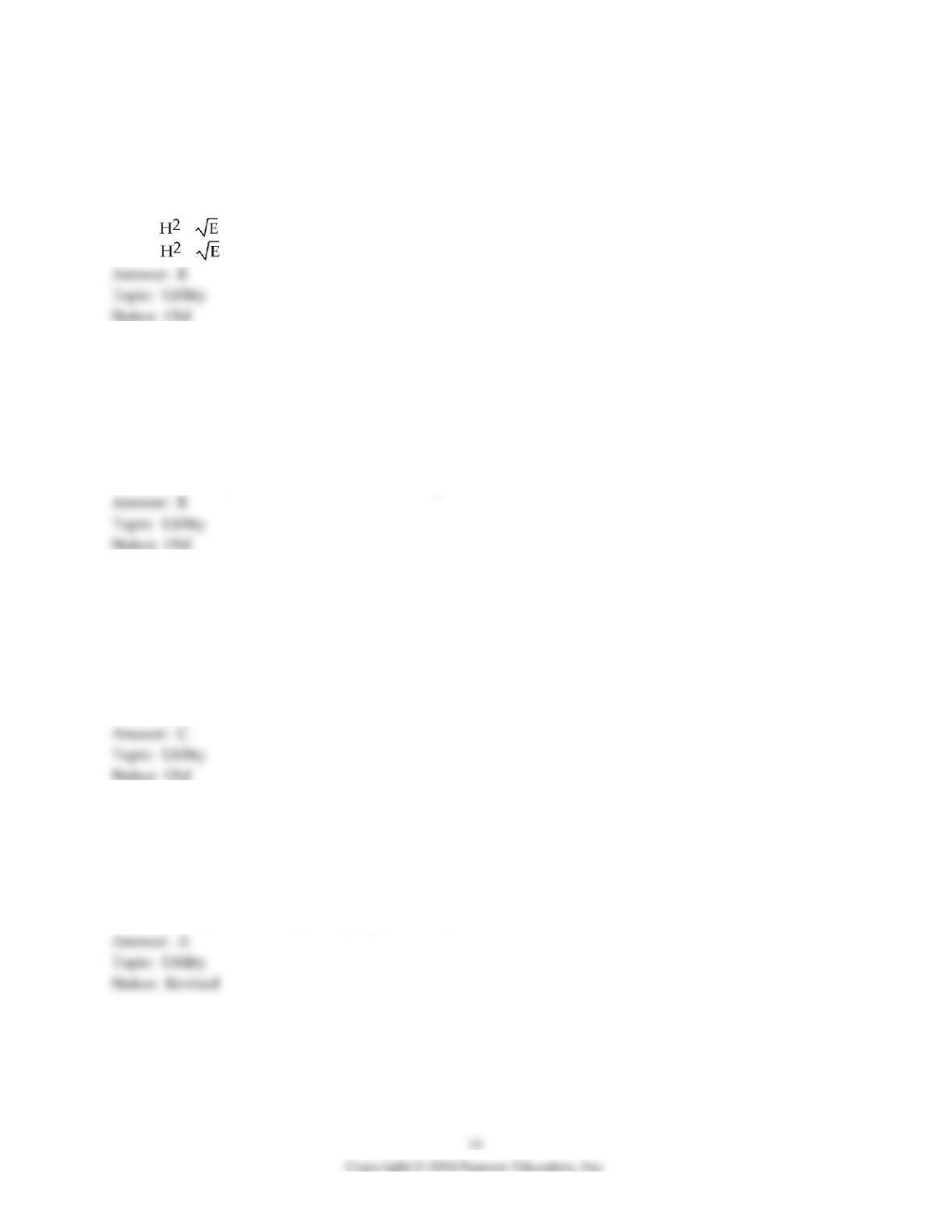
16) If Johnny likes homework (H) but hates exercise (E), which of the following might best represent his
utility function for homework and exercise?
A) U = H + E
B) U = H/E
C) U = +
D) U = ×
17) Clifford lives by the motto “Eat, drink and be merry today, for tomorrow doesn’t matter.” If today’s
consumption is measured on the horizontal axis and tomorrow’s consumption is measured on the vertical
axis, Clifford’s indifference curves
A) are horizontal straight lines.
B) are vertical straight lines.
C) show decreasing utility as one moves upward.
D) cannot be determined from the information given.
18) Clifford lives by the motto “Eat drink and be merry today, for tomorrow doesn‘t matter.” If today’s
consumption is represented by “x” and tomorrow’s consumption is represented by “y”, then which of the
following best represents Clifford’s utility function?
A) U = x – y
B) U = x/y
C) U = x
D) U = y
19) All of the following utility functions rank bundles (q1,q2) in the same order except for which one?
A) q11/2 + q21/2
B) q11/2 q21/2
C) ln(q1) + ln(q2)
D) All of the above rank bundles (q1,q2) in the same order
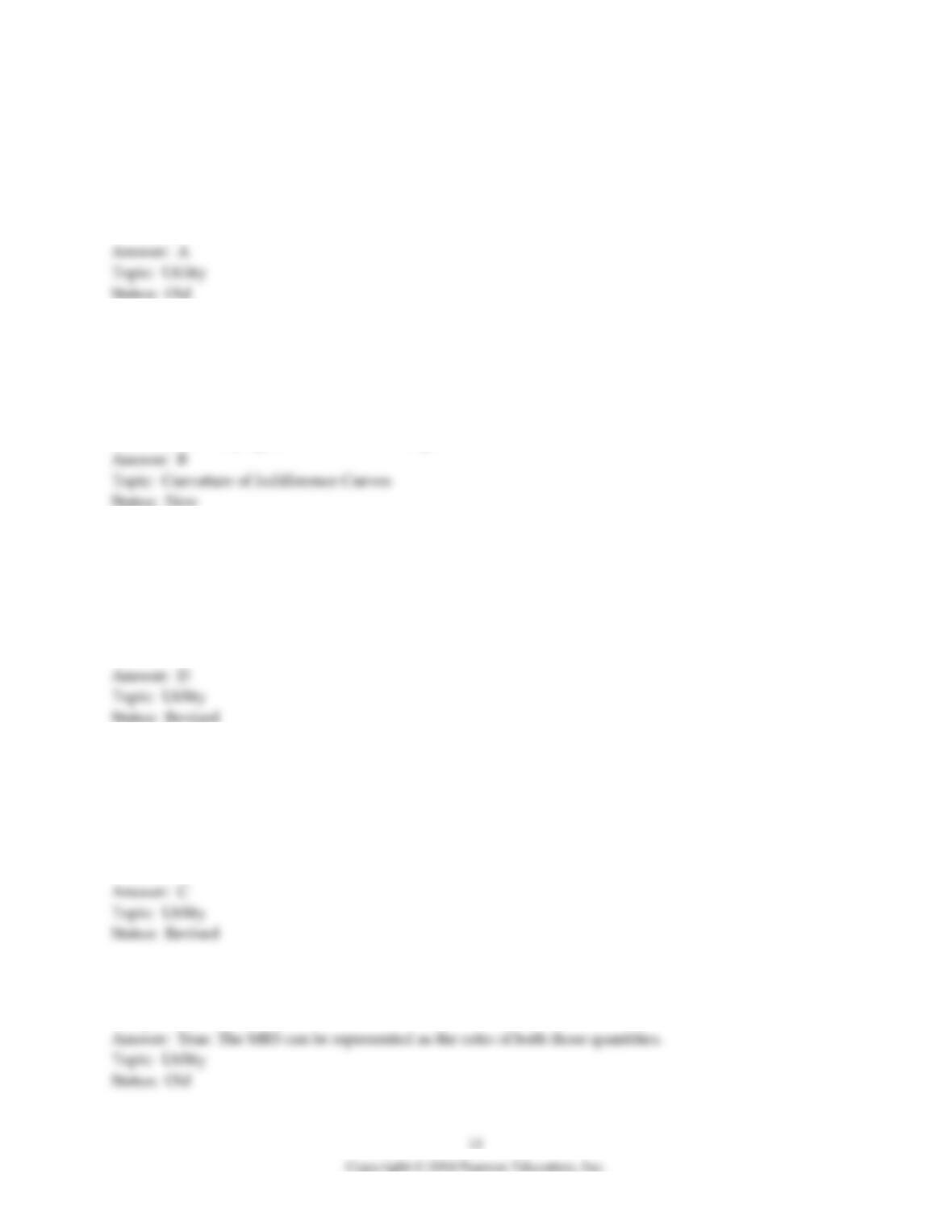
20) Which of the following utility functions has the same MRS as U(q1,q2) = q1 q2?
A) q11/2 q21/2
B) q1 + q2
C) q11/2 + q21/2
D) (q11/2 + q11/2)2
21) Suppose sugar and artificial sweeteners are perfect substitutes for Sam. Her indifference curves for
those two goods would be
A) downward-sloping and convex to the origin.
B) downward-sloping and straight lines.
C) L-shaped.
D) downward-sloping and concave to the origin.
22) Paul has the utility function U(q1, q2) = q1q2. If Paul consumes q1 = 4 and q2 = 2 his Marginal Rate of
Substitution is
A) –2.
B) 1.
C) –1.
D) –1/2.
23) Sarah has the utility function U(X,Y)=X.5Y.25. When Sarah consumes X = 2 and Y = 6 she has a
marginal rate of substitution of
A) -12.
B) -1/6.
C) –6.
D) -1/12.
For the following, please answer “True” or “False” and explain why.
24) The absolute value of the slope of an indifference curve equals the ratio of the marginal utilities of the
two goods involved.
13
25) The fact that most consumers are unable to describe their preferences in terms of a utility function
implies that not all consumer preferences can be represented with utility functions.
26) What is the difference between ordinal and cardinal measurement?
27) Show that the utility functions V(X,Y) = XaY1-a and U(X,Y) = a ln(X) + (1-a)ln(Y) represent the same
ordering of bundles.
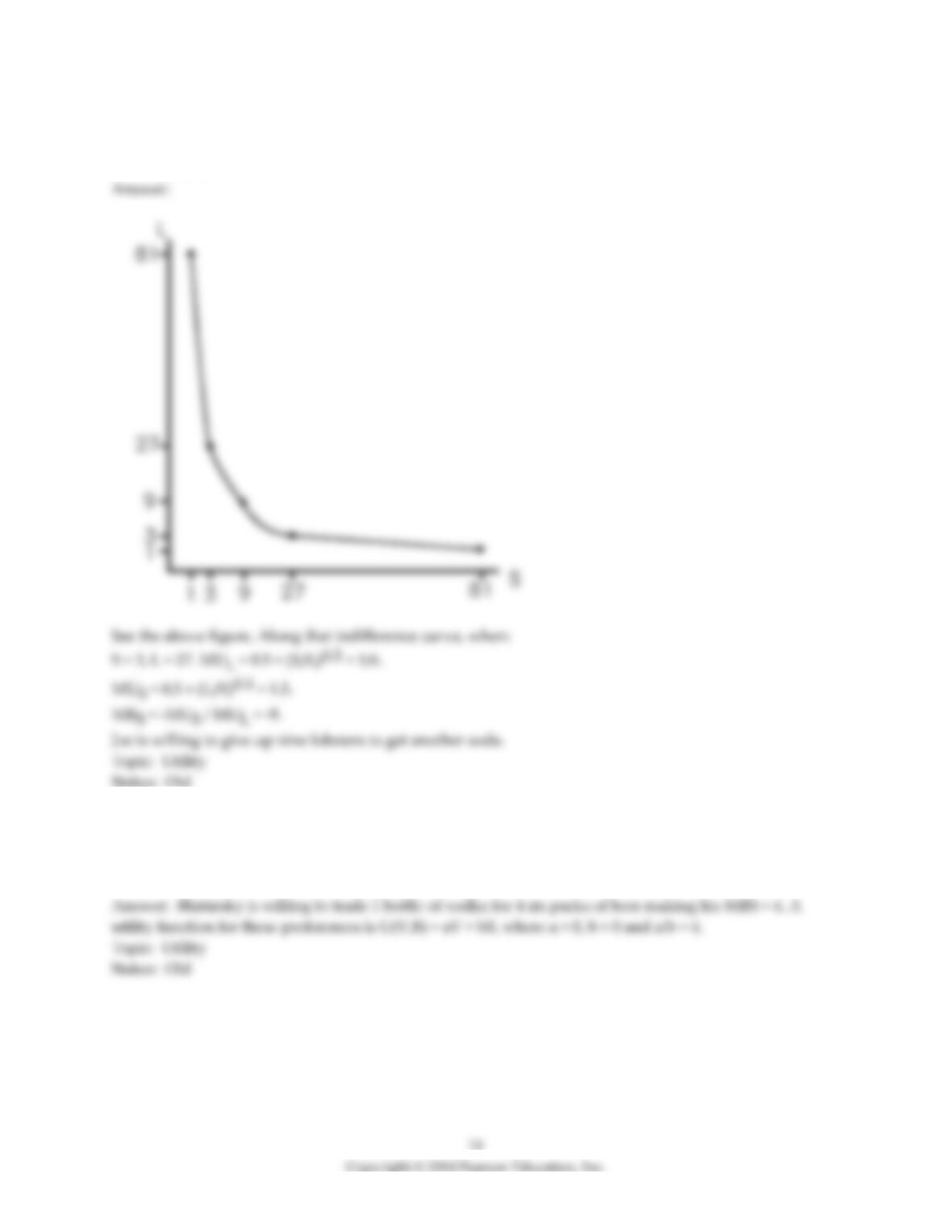
28) Suppose Joe’s utility for lobster (L) and soda (S) can be represented as U = L0.5 S0.5. Draw the
indifference curve that yields a utility level of 9. Calculate the MUL, MUS, and MRS of L for S on that
indifference curve when S = 3.
29) Blutarsky is throwing a party at his Fraternity and is trying to choose what booze to buy. A bottle of
vodka has four times the alcohol as a six-pack of beer. If Blutarsky only cares about the total amount of
alcohol in his basket, what is his marginal rate of substitution of bottles of vodka for six-packs of beer?
Devise a utility function to represent these preferences.
30) Joe consumes crawfish and shrimp. His utility function exhibits diminishing marginal utility of
crawfish but the marginal utility of shrimp is constant. Will Joe’s indifference curves be convex?
31) Teddy has preferences given by the utility function U(K,L) = 2L + K where K = pounds of Kale per
month and L = pounds of lettuce per month. What is Teddy’s Marginal Utility of Kale? What is Teddy‘s
Marginal Utility from Lettuce? If Kale is on the horizontal axis, what is Teddy’s marginal Rate of
Substitution?
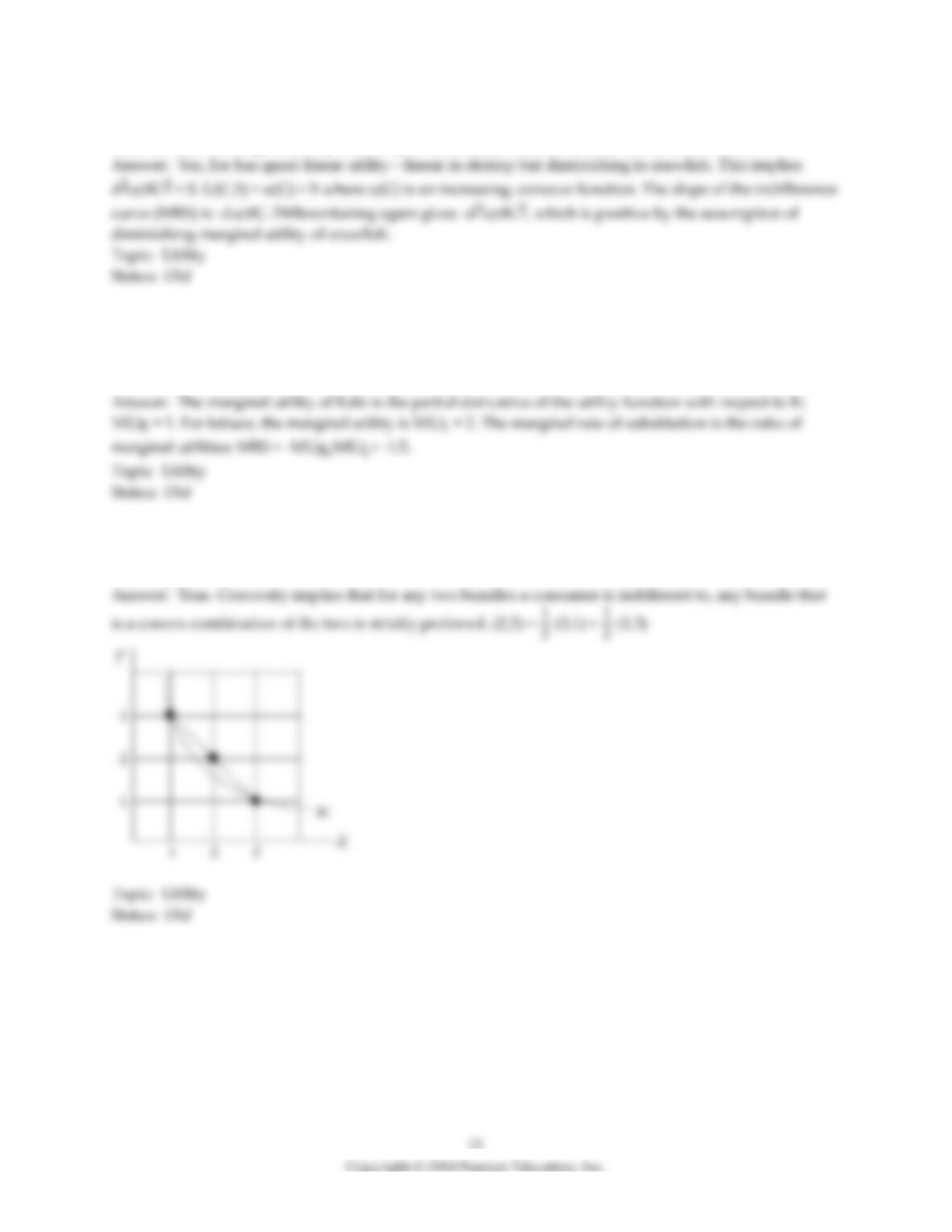
32) Amanda consumes only two goods, X and Y. Her indifference curves satisfy the four standard
assumptions. True or False: If she is indifferent between bundles (1,3) and (3,1), then bundle (2,2) must be
strictly preferred.
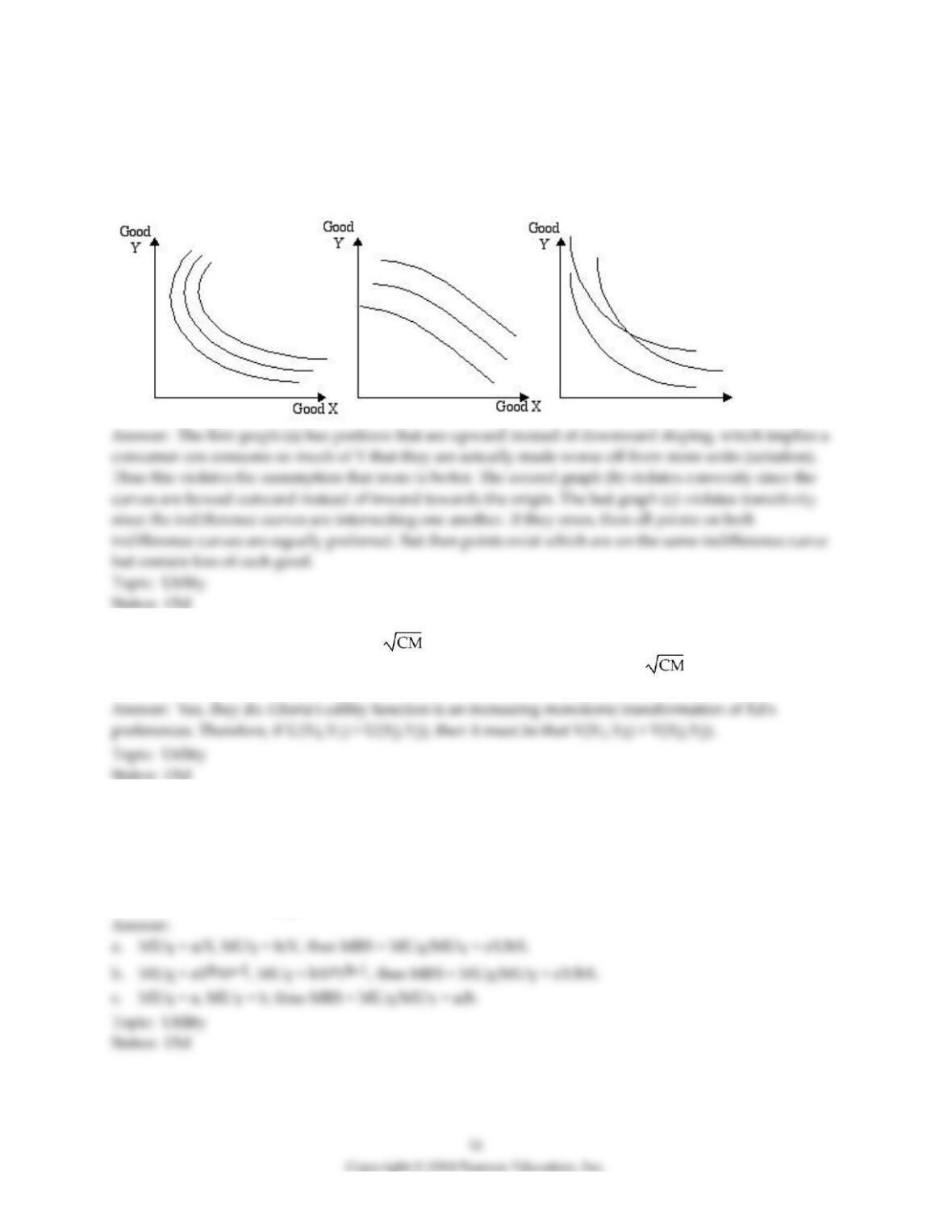
33) A friend whom you are studying with for this class has drawn three sets of indifference curves.
Explain what he has done wrong on each graph and what assumption of preferences is violated by each
particular graph.
(a) (b) (c)
34) Ed has the utility function U(F,M) = , where C = number of comic books per month and
M=number of movies per month. Gloria has the utility function V(F,M) = 15 + . Do Ed and Gloria
have the same preference ordering of comics and movies? How can you tell?
35) Compute the MRS for the following utility functions:
a. U(X,Y) = aln(X) + bln(Y),
b. U(X,Y)=XaYb, and
c. U(X,Y)=aX + bY,
where a and b are strictly positive constants.
17
3.3 Budget Constraint
1) Joe’s income is $500, the price of food (F) is $2 per unit, and the price of shelter (S) is $100. Which of the
following represents his budget constraint?
A) 500 = 2F + 100S
B) F = 250 – 50S
C) S = 5 – .02F
D) All of the above
2) Joe’s income is $500, the price of food (F) is $2 per unit, and the price of shelter (S) is $100. Which of the
following represents his marginal rate of transformation of food for shelter?
A) -5
B) –50
C) -.02
D) None of the above
3) Joe’s income is $500, the price of food (F) is $2 per unit, and the price of shelter (S) is $100. Which of the
following represents his budget constraint?
A) 500 = 100F + 2S
B) 500 = 2F + 100S
C) S = 500 – 2F
D) All of the above
4) Joe’s budget constraint equals 500 = 2F + 100S, where $500 is Joe’s income, $2 is the price of food (F) and
$100 is the price of shelter (S). How much food can Joe buy if he buys one unit of shelter?
A) two units
B) 200 units
C) 250 units
5) Joe’s income is $500, the price of food (F) is $2, and the price of shelter (S) is $100. Which of the
following bundles is in Joe’s opportunity set?
A) 50 units of food, five units of shelter
B) 200 units of food, two units of shelter
C) 100 units of food, one unit of shelter
D) 150 units of food, three units of shelter
6) The marginal rate of transformation of y for x represents
A) the slope of the budget constraint.
B) the rate at which the consumer must give up y to get one more x.
C) -Px/Py.
D) All of the above.
7) The marginal rate of transformation of y for x represents
A) the slope of the budget constraint.
B) the rate at which the consumer must give up x to get one more y.
C) -Py/Px.
D) All of the above.
8) The rate at which a consumer must give up y to get one more x is equal to
A) -Px/Py.
B) -Py/Px.
C) –MUx/MUy.
D) MUy/MUx.
9) Betty consumes good x and good y. If the price of x = $3 and the price of y = $4, then
A) an extra unit of x costs 4/3 units of y.
B) an extra unit of y costs 4/3 units of x.
C) an extra unit of x costs 3/4 units of y.
D) Both B and C.
10) If the price of one good increases while the price of the other good and the consumer’s income remain
unchanged, what will happen to the budget line?
A) The budget line rotates inward from the intercept on the axis of the good that did not change in price.
B) The budget line rotates outward from the intercept on the axis of the good that did not change in price.
C) The budget line shifts inward without a change in slope.
D) The budget line shifts outward without a change in slope.
11) Lisa eats both pizzas and burritos. If the price of a pizza increases, Lisa’s opportunity set
A) becomes larger.
B) becomes smaller.
C) is unchanged.
D) cannot be determined without more information.
12) If the consumer’s income increases while the prices of both goods remain unchanged, what will
happen to the budget line?
A) The budget line rotates inward from the intercept on the horizontal axis.
B) The budget line rotates outward from the intercept on the vertical axis.
C) The budget line shifts inward without a change in slope.
D) The budget line shifts outward without a change in slope.
13) If the prices of both goods and income increase by the same percentage, what will happen to the
budget line?
A) The budget line rotates inward from the intercept on the axis of the good that did not change in price.
B) The budget line rotates outward from the intercept on the axis of the good that did not change in price.
C) The budget line shifts outward without a change in slope.
D) Nothing.
14) A consumer buys food (F) and shelter (S). If the consumer’s income rises and there is no change in the
prices of F or S, the marginal rate of transformation of F for S will
A) increase.
B) decrease.
C) stay the same.
D) change, but there is not enough information to know how.
15) If both prices increases by 50%,
A) budget constraint will be unchanged.
B) slope of the budget constraint stay the same.
C) slope of the budget constraint will decrease.
D) budget constraint will shift outward in a parallel fashion.
16) If both prices decreases by 50%,
A) budget constraint will be unchanged.
B) slope of the budget constraint will increase.
C) slope of the budget constraint will decrease.
D) budget constraint will shift outward in a parallel fashion.
17) If a consumer’s budget line for food (F) and shelter (S) is represented as F = 250 – 5S, we know that
A) the consumer’s income is 250.
B) the price of shelter is five.
C) the price of shelter is five times the price of food.
D) All of the above.
18) If a consumer’s budget line for food (F) and shelter (S) is represented as F=250-5S, and 50 units of food
is purchased, how many units of shelter can be purchased at most?
A) 0
B) 40
C) 60
D) 80
19) A consumer’s budget line for food (F) and shelter (S) is represented as F = 250 – 5S. If this consumer’s
income increases by $10 and consumption of shelter remains unchanged, how many more units of shelter
can be purchased at most?
A) 10
B) 20
C) 50
D) 2