14) According to the above table, if the marginal revenue product is $24, how many workers will
the profit maximizing monopsonist hire?
A) 4
B) 5
C) 6
D) 7
15) From the information in the above table, calculate the marginal factor cost of the third
worker.
A) $24.00
B) $36.00
C) $18.00
D) $12.00
16) Exploitation due to a single buyer in the input market is known as
A) monopoly exploitation.
B) monopsonistic exploitation.
C) Marxian exploitation.
D) the result of closed shops.
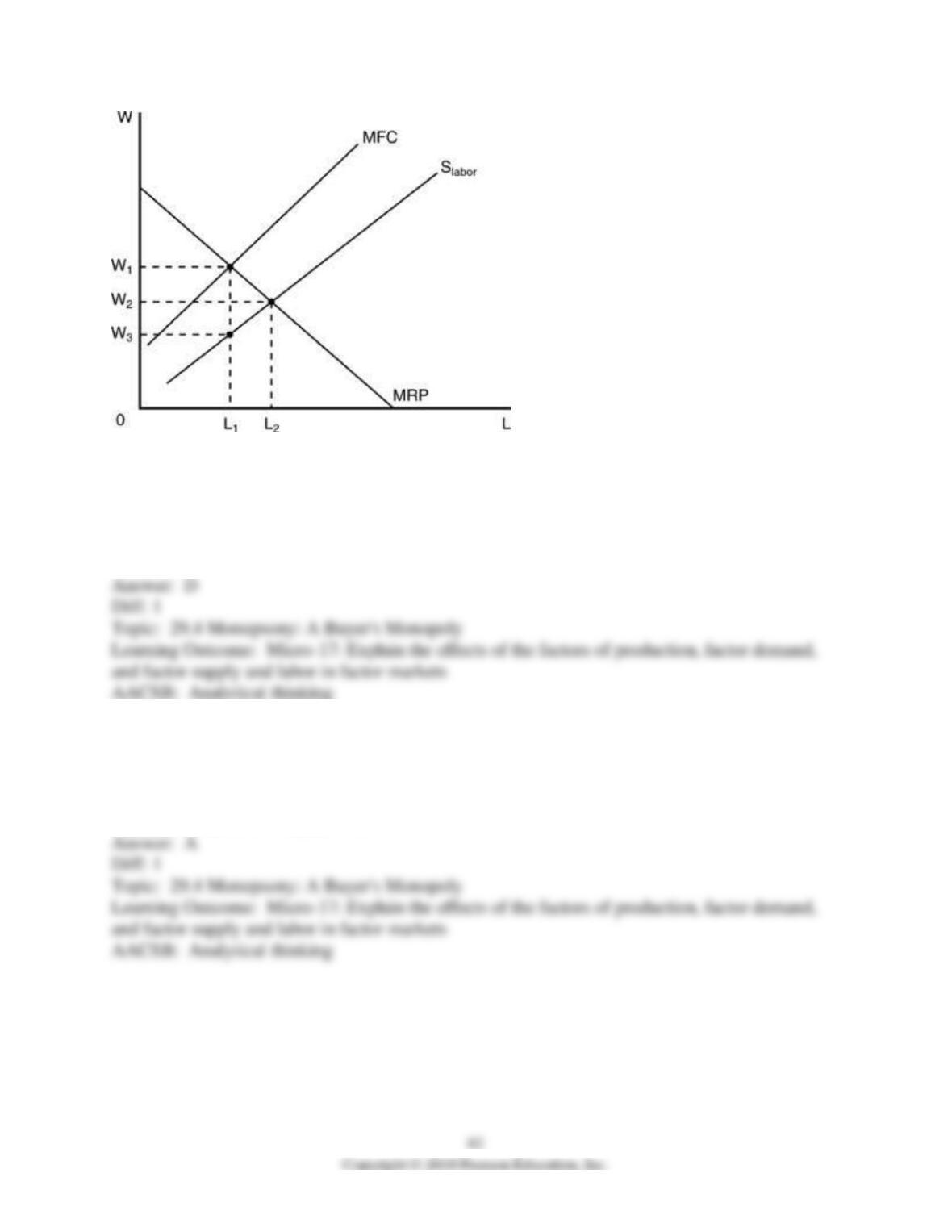
17) In the above figure, the monopsonist will employ
A) L2 at a wage of W2.
B) L2 at a wage of W3.
C) L1 at a wage of W1.
D) L1 at a wage of W3.
18) The monopsonist will employ labor to the point at which the
A) marginal factor cost equals the marginal revenue product of labor.
B) marginal revenue product equals the wage rate.
C) marginal cost of output equals the marginal revenue.
D) demand equals the supply of labor.
19) Which statement best describes the behavior of the monopsonist in the labor market?
A) It restricts its output to keep the product price high.
B) It hires less labor but pays the perfectly competitive wage rate.
C) It must pay different amounts to each unit of labor hired.
D) It hires less labor and pays a lower wage rate than in the perfectly competitive case.
20) The monopsonistic exploitation of labor refers to
A) the reduction in total output from monopoly in the product market.
B) the union wage differential.
C) workers being paid a wage less than their marginal revenue product.
D) the reduction in employment resulting from union wage setting.
21) A monopsonist finds its profit maximizing quantity of labor employed at the point at which
A) marginal revenue product is zero.
B) marginal revenue product equals marginal factor cost.
C) marginal factor cost is zero.
D) total cost equals total revenue.
22) A firm that is a monopolist in the output market and a monopsonist in the input market
A) will hire the same amount of labor as if perfect competition prevailed in both markets, but pay
a lower wage.
B) will restrict the level of output but not that of employment compared to the perfectly
competitive case.
C) will hire less labor but pay the same wage compared to the perfectly competitive case.
D) will hire less labor and pay a lower wage compared to the perfectly competitive case.
23) Bilateral monopoly exists when
A) a single buyer confronts a single seller.
B) there are two monopolistic buyers trying to buy resources.
C) two labor unions are trying to represent the same group of workers.
D) a firm is both a monopoly in its output market and a monopsonist in its input market.
24) A monopsonist is
A) a firm with monopoly power in the local area.
B) a firm that has a unionized labor force.
C) a single seller of an input.
D) a single buyer of an input.
25) When there is only one buyer in the market
A) a closed shop exists.
B) a monopsony exists.
C) then the market will be perfectly competitive.
D) the supply curve for the good will be perfectly elastic.
26) The supply curve of labor to a monopsonist is
A) upward sloping.
B) downward sloping because of the law of diminishing marginal returns.
C) downward sloping, but not because of the law of diminishing marginal returns.
D) horizontal.
27) A monopsonist that wants to hire more labor must pay more for the new labor than it is
currently paying and increase the wage rate of all existing employees because
A) the demand curve for labor is inelastic.
B) of labor unions.
C) the supply of labor is upward sloping.
D) of competition in the labor market.
28) A monopsonist wants to purchase more labor. Which of the following statements is TRUE?
A) The wage rate that the monopsonist has to pay future workers is lower than it pays current
workers since there is no other place to work.
B) The wage rate that the monopsonist has to pay future workers will be the same rate it pays
current workers.
C) The wage rate that the monopsonist has to pay future workers is higher than what it will
continue to pay current workers.
D) The monopsonist will have to raise the wage rate for current and additional employees.
29) For a monopsonist, the marginal factor cost curve will be above the supply of labor curve.
The marginal factor cost curve is above the supply curve because
A) the monopsonist will take advantage of labor and offer them lower wages.
B) in order for the monopsonist to sell an additional unit of the good, the price of the good must
be lowered.
C) in order for the monopsonist to hire more labor the monopsonist must also purchase more
capital.
D) the monopsonist will have to pay all workers a higher wage rate than the current wage rate if
it wants to hire more workers.
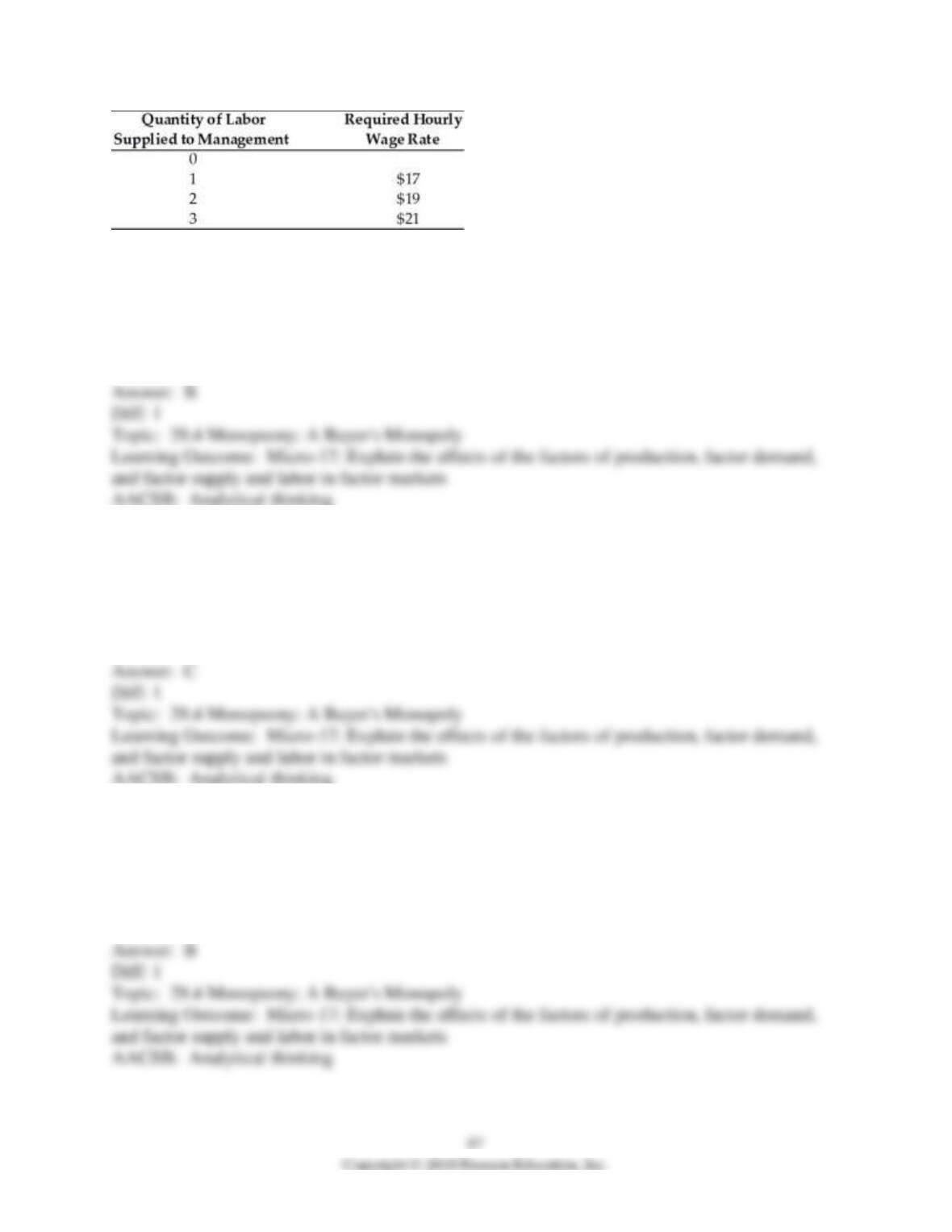
30) Refer to the above table. What is the marginal factor cost when the firm employs the second
unit of labor?
A) $19
B) $21
C) $36
D) $38
31) Refer to the above table. What is the marginal factor cost when the firm employs the third
unit of labor?
A) $62
B) $57
C) $25
D) $21
32) Refer to the above table. If the marginal revenue product is $21, how many workers will the
profit maximizing monopsonist hire and what wage will they pay each worker?
A) 1; $17
B) 2; $19
C) 2; $21
D) 3; $21
33) The marginal factor cost of a monopsonist is
A) upward sloping and the same as the supply curve.
B) downward sloping when the supply curve of labor is upward sloping.
C) upward sloping and rises faster than the supply curve.
D) horizontal.
34) For a monopsonist the marginal cost of increasing its workforce will always be greater than
the wage rate because
A) there is not good factor substitution in a monopsony.
B) the wage rate offered the newest employee must be paid to all workers.
C) the industry will be a closed shop.
D) a normal rate of return must be paid to the owner.
35) The main difference between a monopsonist and a competitive buyer of labor is that
A) the monopsonist can hire as many workers as it wants at the going wage while the
competitive firm must raise wages to hire additional workers.
B) the competitive firm can hire as many workers as it wants at the going wage while the
monopsonist can hire more workers at lower wages.
C) the competitor can hire as many workers as it wants at the going wage while the monopsonist
must raise wages to hire additional workers.
D) the monopsonist can force wages down and still hire as many workers as it wants while the
competitive firm must increase the wage rate to hire additional workers.
36) A monopsonist is currently employing 50 workers at $10 an hour. It wants to hire an
additional worker, but will have to pay the worker $10.10. The marginal factor cost is
A) ten cents.
B) $10.00.
C) $10.10.
D) $15.10.
37) Under monopsony, marginal factor cost is
A) equal to the wage rate.
B) below the wage rate but increases as more workers are hired.
C) greater than the wage rate.
D) downward sloping.
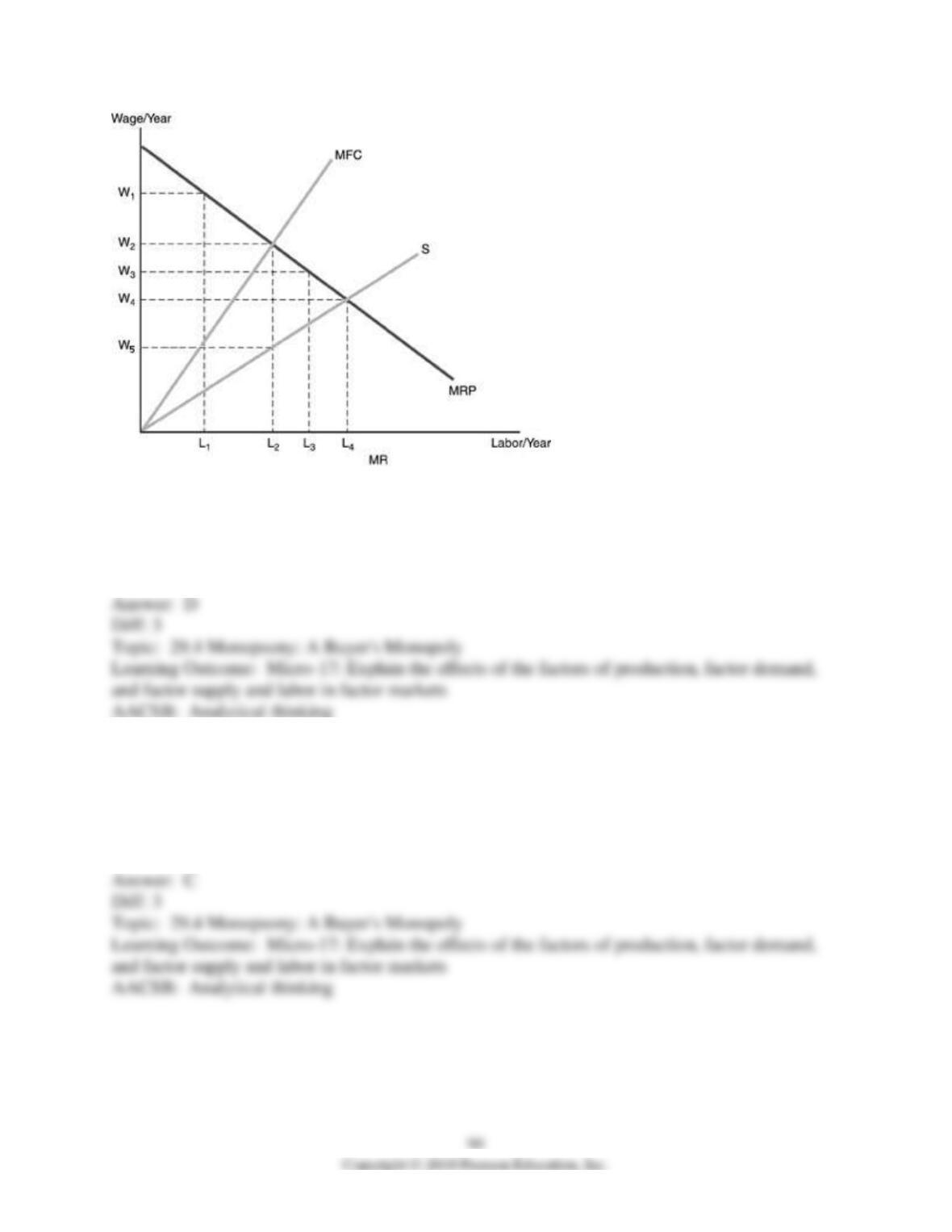
38) Refer to the above figure. Under monopsony, the wage rate will be
A) W1.
B) W2.
C) W3.
D) W5.
39) Refer to the above figure. The wage rate under perfect competition is
A) W2.
B) W3.
C) W4.
D) W5.
40) Refer to the above figure. The monopsonistic exploitation is
A) W2 – W5.
B) W1 – W5.
C) W2 – W4.
D) W2 – W3.
41) Monopsonistic exploitation is
A) measured by the area above the supply curve but below the wage paid.
B) the difference between the marginal revenue product of a worker and the wage received by
the worker.
C) measured by the height of the supply curve of labor.
D) the cost to society from unions.
42) What is it called when the price paid for a variable input is less than its marginal revenue
product?
A) bilateral monopoly
B) monopsonistic exploitation
C) monopolistic exploitation
D) featherbedding
43) Bilateral monopoly exists when
A) there is either a monopoly or a monopsony in the market.
B) there are two competing labor unions in a labor market.
C) there is a monopoly and a monopsony in a market.
D) a firm is both a monopolist in its output market and a monopsonist in the input market.
44) Which of the following is FALSE regarding a monopsonist?
A) The monopsonist is the only buyer in a market.
B) The monopsonist faces an upward sloping labor supply curve.
C) The monopsonist faces an upward sloping labor demand curve.
D) The monopsonist faces the entire market labor supply curve.
45) Since the National Basketball Association is the only significant employer of professional
basketball players, it might be referred to as a(n)
A) oligopsony.
B) monopoly.
C) monopsony.
D) oligopolist.
46) When there is only one buyer in a market, there is a
A) buyer’s monopoly.
B) monopoly.
C) monopsony.
D) buyer’s cooperative.
47) When there is only one buyer of labor in a community, we talk of a
A) monopoly.
B) monopsony.
C) monopolistic market.
D) labor cooperative.
48) A company town in the lumber or mining industry is an example of a
A) monopoly.
B) bilateral monopoly.
C) buyer’s monopoly.
D) monopsony.
49) A profit-maximizing monopsonist will hire workers up to the point at which
A) W = MRP.
B) MRP = MFC.
C) W = MFC.
D) W = MRP = MFC.
50) At the profit-maximizing level of employment, the monopsonist
A) pays a wage equal to MRP.
B) pays a wage greater than MRP.
C) pays a wage less than MRP.
D) pays a wage equal to MFC.
51) In a monopsonistic market
A) employment is lower but wages are higher than in a comparable competitive market.
B) employment is higher but wages are lower than in a comparable competitive market.
C) both employment and wages are higher than in a comparable competitive market.
D) both employment and wages are lower than in a comparable competitive market.