60) When you see a commercial on TV asking you to “look for the union label,” the union is
trying to
A) increase worker productivity.
B) increase the demand for nonunion goods.
C) increase the demand for union goods.
D) decrease the demand for nonunion goods.
61) To reduce labor surplus above the equilibrium union wage level, a union may do all of the
following EXCEPT
A) lengthen apprenticeship period.
B) assign jobs based on seniority.
C) limit the number of new members accepted.
D) encourage nonunion members to join the union.
62) All of the following are benefits of labor unions EXCEPT
A) unions reduce wage inequity.
B) unions increase the stability of the workforce.
C) unions give workers a political voice.
D) unions maximize employment for all workers.
63) Temporary or permanent workers hired to replace striking union workers are known as
A) strikebreakers.
B) backbreakers.
C) rationers.
D) strikeaiders.
64) Supposed you are hired to be a checker at a local grocery store. After ninety days of
probation you become a member of the union. As a result you feel more secure about your job
and work harder to be part of the team. This is a benefit of union membership that
A) increases demand for union-made goods.
B) decreases the demand for nonunion-made goods.
C) increases worker productivity of union members.
D) increases union dues.
65) When unions exist in markets
A) firms must have market power in their output markets.
B) there no longer is a perfectly competitive labor supply.
C) individual workers no longer make labor-leisure trade-off decisions.
D) employers have market power in labor markets.
66) Suppose a union negotiates for its members a wage that is above the market-clearing wage.
What problems does the union have to solve now? Explain.
67) A union could raise wages without causing unemployment of union members if it can
increase demand for union labor. How might this goal be achieved?
68) What is the purpose of a strike? What are the costs to workers and to management?
69) A union can be viewed as a monopoly seller of a service. What are the three wage and
employment strategies the union might use?
70) What can a union do in order to raise the wages of its members ?
71) Why might a union find that attaining the goal of employing all its members and the goal of
maximizing total union wage receipts to be incompatible objectives?
72) How can restricting entry into a union help boost members’ wages without the union
specifically setting wages?
29.3 Economic Effects of Labor Unions
1) Suppose union workers are earning more than similarly qualified nonunion workers. From
this, we can conclude that
A) unemployment of union workers must have increased.
B) unemployment of nonunion workers must have increased.
C) productivity of union workers must be greater than the productivity of nonunion workers.
D) Any of the above are possible and we cannot tell which without having more information.
2) Which is NOT one of the potential benefits of labor unions?
A) Unionism raises social efficiency.
B) Unions appear to reduce wage inequality.
C) Unions may reduce a company’s profits.
D) Unions may have contributed to safer working conditions.
3) Which of the following is TRUE about unions?
A) Unions in some settings are associated with increased productivity.
B) Unions in some settings have been effective in promoting general social legislation.
C) Both A and B are correct.
D) Neither A nor B is correct.
4) Which of the following best describes the effects of unions in the United States today?
A) The average union worker works more hours but earns a lower annual income than the
average nonunion worker.
B) The average union worker works fewer hours but earns a higher annual income than the
average nonunion worker.
C) The average union worker works more hours and earns a higher annual income than the
average nonunion worker.
D) The average union worker works fewer hours and earns a lower annual income than the
average nonunion worker.
5) In the United States the difference between union and non-union wages
A) does not exist.
B) currently averages about more than 100 percent.
C) has been narrowing.
D) tends to fall during a recession because union members typically have shorter-term contracts
than do nonunion employees.
6) Which statement is most TRUE about the impact of unions on wage levels in the United
States?
A) Unions have had no impact on the wage levels of their workers.
B) Unions have tended to increase the hourly wage rates of their members relative to nonunion
workers by an average of about $3.20.
C) Unions have contributed to increased income inequality in the United States by raising
corporate profits.
D) The union/nonunion wage differential tends to decrease during a recession.
7) The union wage differential
A) varies substantially across employment sectors.
B) increases during expansions.
C) has remained fairly constant over the past 30 years.
D) is greater for private sector employees than for government sector workers.
8) The practice of forcing employers to use more labor than they would otherwise use is called
A) railroading.
B) featherbedding.
C) dumping.
D) bootstrapping.
9) The attempt to force employers to use more labor than they otherwise would, or to force
employers to use labor inefficiently, is known as
A) a secondary boycott.
B) a sympathy strike.
C) a monopsony.
D) featherbedding.
10) A union contract requiring elevator operators in a building with automatic elevators is an
example of
A) a closed shop.
B) featherbedding.
C) a lockout.
D) a right-to-work requirement.
11) Featherbedding refers to
A) the practice of laying off union activists.
B) increased international competition and its negative impact on trade unions.
C) union leaders arguing for higher wages when they know that they will not become
unemployed given their seniority.
D) the practice of inducing a firm to use more than the cost-minimizing level of labor.
12) Featherbedding is the term for
A) any practice that forces employers to use more labor than they would otherwise.
B) training programs initiated by unions to make their less-skilled members more productive.
C) the practice of trying to recruit union members among public employees.
D) attempts by management to eliminate a union.
13) An example of featherbedding is
A) the union practice that requires younger workers to be laid off first in a recession.
B) a requirement that all construction workers working on government-funded construction
projects must be paid union wages.
C) employer-paid dental insurance negotiated by the union.
D) a requirement on railroads to keep a fireman on board after the introduction of diesel engines.
14) If we were to compare the annual earnings of union and nonunion workers in recent years,
we would find that
A) unions have not succeeded in raising the annual incomes of their members.
B) unions have succeeded in raising the annual incomes of their members.
C) the data is incomplete to tell whether unions have been successful in raising the annual
income of their members.
D) union members have annual incomes substantially below nonunion members.
15) If we were to compare the hourly earnings of union and nonunion workers in recent years,
we would find that
A) unions have not succeeded in raising the hourly incomes of their members above nonunion
members.
B) unions have succeeded in raising the hourly incomes of their members above nonunion
members.
C) state government unionized employees have earned less in hourly wages than nonunion
government employee.
D) union members have increased their hourly incomes, but are still below the hourly incomes of
nonunion members.
16) Sometimes unions can raise wages above what productivity increases would permit. When
this happens, we can be sure that
A) the employment of union workers is increasing.
B) some union workers end up losing their jobs.
C) there is a redistribution of income from union workers to nonunion workers.
D) featherbedding will occur.
17) Featherbedding refers to
A) training programs initiated by the unions to make the less-skilled workers more productive.
B) attempts by management to reduce workers’ interest in a union.
C) the practice that forces employers to use more labor than they would otherwise.
D) the amount of the union premium.
18) Any practice that forces employers to use more labor than they would otherwise use is
A) closed shop.
B) monopolistic exploitation.
C) a craft union.
D) featherbedding.
19) An example of featherbedding is
A) advertising that encourages consumers to buy union-made goods.
B) union requirements that forbid the use of certain laborsaving equipment.
C) lobbying Congress to get higher tariffs.
D) the requirement that all construction workers who work on a government-financed project
receive the union wage rate regardless if they are in the union or not.
20) When it comes to productivity, some economists argue that
A) unions have caused a decrease in productivity by excessive staffing and makework
requirements.
B) through the use of featherbedding unions have been responsible for productivity increases.
C) the passage of the Taft-Hartley Act has led to a significant decrease in productivity.
D) the union’s insistence on profitability laborsaving devices has led to an increase in
productivity.
21) Evidence in support of the hypothesis that unions increase the productivity of union workers
is
A) the fact that union wages are greater than nonunion wages.
B) there is an excess supply of labor at the union wage rate.
C) that unionized firms face lower turnover rates than nonunion firms do.
D) that most contracts are settled without a strike.
22) Critics of unions tend to focus on the fact that unions
A) tend to generate higher wages.
B) reduce profits.
C) are politically active.
D) engage in restrictive labor practices.
23) A benefit of unions is that they
A) increase firm profits.
B) increase the stability of the workforce.
C) increase wage inequality.
D) restrict the labor market.
24) Economists argue that the union wage advantage
A) has been estimated to be 100% in the private sector.
B) in the private sector is a 4% increase in wages for union workers over nonunion workers.
C) reached its height in 2000 in the private sector.
D) has been close to zero since World War II in the private sector.
25) Research indicates that on average, state government unions have
A) raised wages to 35 percent above nonunionized government workers.
B) reduce wages 20 to 30 percent below nonunionized private-sector and government workers.
C) raised wages about 100 percent above similar workers in the nonunion private sector.
D) have not significantly raised wages above similar workers in the nonunion sector.
26) Featherbedding means that
A) company management receives a cut from the collected union wages.
B) employers are force to hire apprentices.
C) employers are forced to hire more workers than they want to.
D) a union can join a sympathy strike.
27) A union requirement that a truck driver has to be hired to work in a train station would be an
example of
A) work expansion.
B) featherbedding.
C) work requirements.
D) work stabilization.
28) A practice which might force employers to use more labor than they would otherwise is
referred to as
A) wall propping.
B) featherbedding.
C) mothballing.
D) yellow-dogging.
29) Which of the following is NOT considered to be a benefit of unionism?
A) increased featherbedding
B) greater workplace safety
C) higher workforce stability
D) provision of arbitration and grievance procedures
30) In recent decades, the union-nonunion hourly wage differential has
A) increased substantially.
B) increased slightly.
C) stayed the same.
D) fallen significantly.
31) Can unions increase productivity? Explain.
32) Have unions been successful at raising wages for their members? What about raising wages
for all workers?
33) Discuss the benefits of unions.
34) “Unions in the United States have helped raise the incomes of union workers as compared to
nonunion workers.” Do you agree or disagree? Why?
29.4 Monopsony: A Buyer’s Monopoly
1) A monopsony has an upward sloping supply curve because
A) diminishing marginal product to scale does not exist in a monopsony.
B) each additional unit of labor costs less.
C) when more units of labor are hired, all laborers must receive the higher wage.
D) when more units of labor are hired, only the new workers receive the higher wage.
2) A monopsonist is
A) a single buyer.
B) a single seller.
C) a unionized labor market.
D) a non-profit-maximizing firm.
3) If the labor supply curve faced by a firm shifts to the right, the marginal factor cost curve of
labor must be
A) rising and below the supply curve.
B) rising and above the supply curve.
C) equal to the supply curve.
D) horizontal.
4) A monopsonist in the labor market has
A) a perfectly elastic labor supply.
B) a decreasing average variable cost.
C) an upward sloping labor supply curve.
D) a downward sloping marginal revenue product curve.
5) For a monopsonist, marginal factor cost exceeds the wage rate since
A) more workers have to be paid the prevailing wage rate.
B) the supply of labor is perfectly elastic.
C) when new workers are hired the wage rate must be increased for all workers and not just for
the additional workers.
D) the labor demand is downward sloping.
6) The main difference between a monopsonist and a competitive buyer of labor is that
A) the competitor can hire as many workers as it wants at the going wage while a monopsonist
can force wages down when hiring additional workers.
B) the competitor can hire as many workers as it wants at the going wage while a monopsonist
must raise wages to hire additional workers.
C) the competitor is a small firm while the monopsonist is a large firm.
D) the competitor is also a competitor in product markets while the monopsonist is also a
monopoly in product markets.
7) Marginal factor cost is
A) the change in total costs due to a one-unit change in the quantity of the good produced.
B) the change in total costs due to a one-unit increase in the variable input.
C) the change in the price of an input when an additional unit of the input is hired.
D) the marginal cost of changing the rate of production in the long run.
8) Under monopsony, marginal factor cost
A) is downward sloping.
B) is less than the wage rate, although it increases as more workers are hired.
C) equals the wage rate.
D) is greater than the going wage rate.
9) Under monopsony, the marginal factor cost of a worker is equal to
A) the additional worker’s wage rate only.
B) the additional worker’s wage rate plus the increase in the wages of all other existing workers.
C) the increase in the wages of all other existing workers.
D) the difference between the worker’s wage rate and the lower wage rate received by workers
who have already been hired.
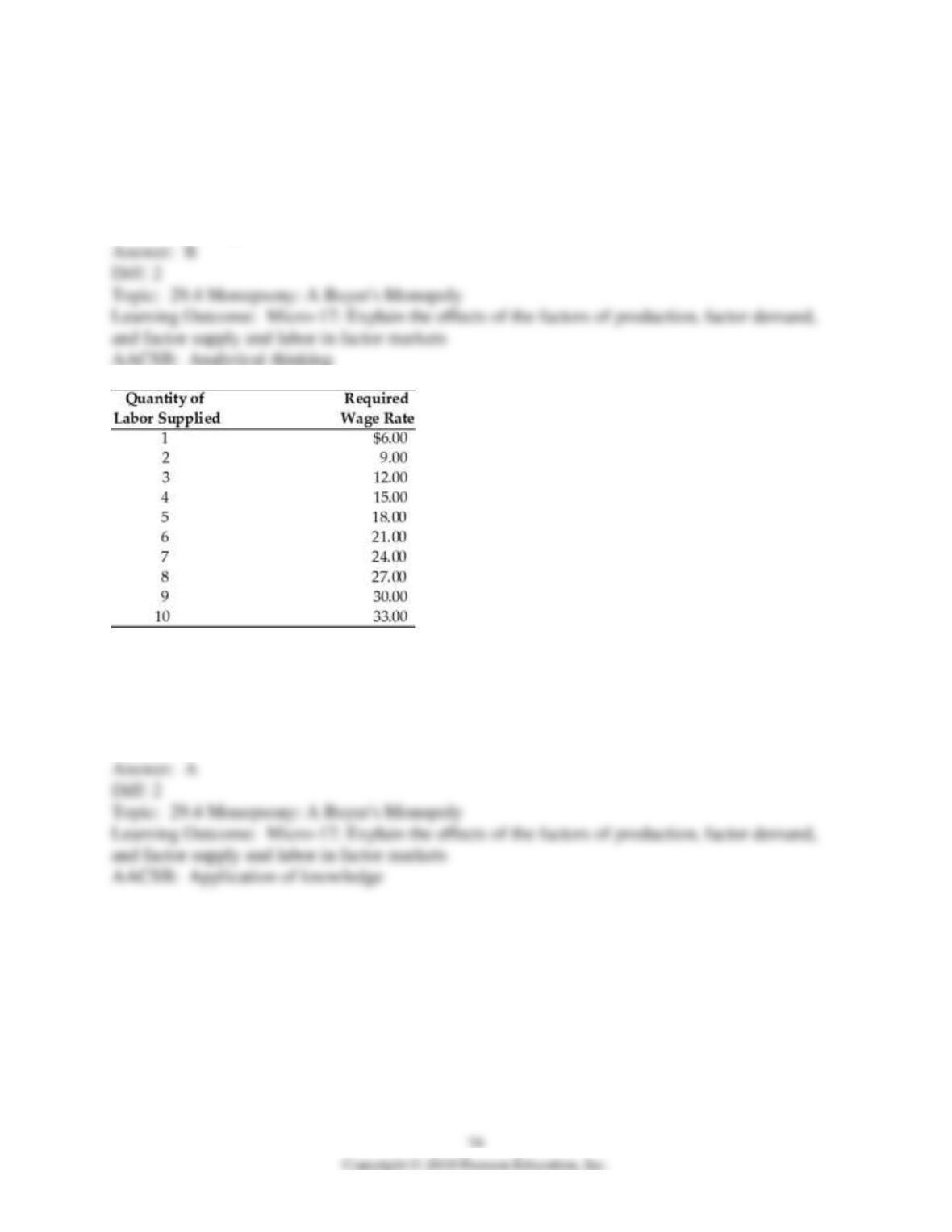
10) According to the above table, the marginal factor cost of the fifth worker is
A) $30.00.
B) $45.00.
C) $60.00.
D) $90.00.
11) According to the above table, the marginal factor cost of the eighth worker is
A) $27.00.
B) $48.00.
C) $168.00.
D) $216.00.
12) According to the above table, the marginal factor cost of the seventh worker is
A) $24.00.
B) $126.00.
C) $42.00.
D) $168.00.
13) According to the above table, if the marginal revenue product is $48, how many workers will
the profit maximizing monopsonist hire?
A) 5
B) 6
C) 7
D) 8