3) The most powerful tool unions have at their disposal when bargaining with management is
A) the Taft-Hartley Act.
B) the ability to strike.
C) the secondary boycott.
D) the power of pure competition.
4) If a union succeeds in forcing employers in a perfectly competitive product market to increase
wages above the equilibrium level, then the level of unemployment
A) will increase.
B) will remain constant.
C) will decrease.
D) may increase or decrease.
5) One method unions use to ration available jobs among excess workers is
A) lengthy apprenticeships.
B) to hire only white collar workers.
C) collective bargaining.
D) refuse to unionize.
6) Unions face a trade-off between higher wages and
A) fewer available positions.
B) more available positions.
C) equipment.
D) none of the above.
7) If a union negotiates and obtains a wage rate above the competitive wage rate,
A) it must find a way to make workers more productive.
B) employment in the union sector will increase relative to employment in the nonunion sector.
C) it must find a way to ration jobs among the excessive number of workers who wish to work in
the union sector.
D) unemployment will increase in the nonunion sector relative to the union sector.
8) If a union establishes by collective bargaining a wage rate that is above a competitive market
equilibrium wage rate, then
A) an excess quantity of labor will be supplied.
B) a shortage of labor will result.
C) there will be an increase in total employment.
D) management will want to substitute labor for machinery.
9) If a union sets the wage rate to maximize the total wage receipts of its members, the price
elasticity of demand for labor would be
A) zero.
B) numerically equal to 1.
C) finite, but greater than -1.
D) positive, but less than 1.
10) If a union sets the wage rate to maximize the total wage receipts of its members, the marginal
revenue would be
A) zero.
B) negative.
C) positive, but greater than 1.
D) positive, but less than 1.
11) A union can induce a rise in equilibrium wages in a unionized industry by
A) reducing the marginal revenue product of labor to zero.
B) successfully increasing the demand for union labor.
C) successfully decreasing the demand for union labor.
D) reducing the marginal revenue product of firms employing union labor.
12) When a group of workers forms a union, they introduce an element of
A) pure competition into the labor market.
B) monopoly into the labor market.
C) monopoly into the product market.
D) monopsony into the product market.
13) If a union succeeds in increasing the wage rate by restricting labor supply, then
A) all of its members will be better off.
B) some members may lose their jobs.
C) all of its members will be worse off.
D) more of its members will be employed.
14) If a union wishes to maximize the number of union members employed, it will
A) accept the competitive wage.
B) set a wage below the competitive wage.
C) set a wage where the elasticity of demand for labor equals one.
D) set a wage above the competitive wage.
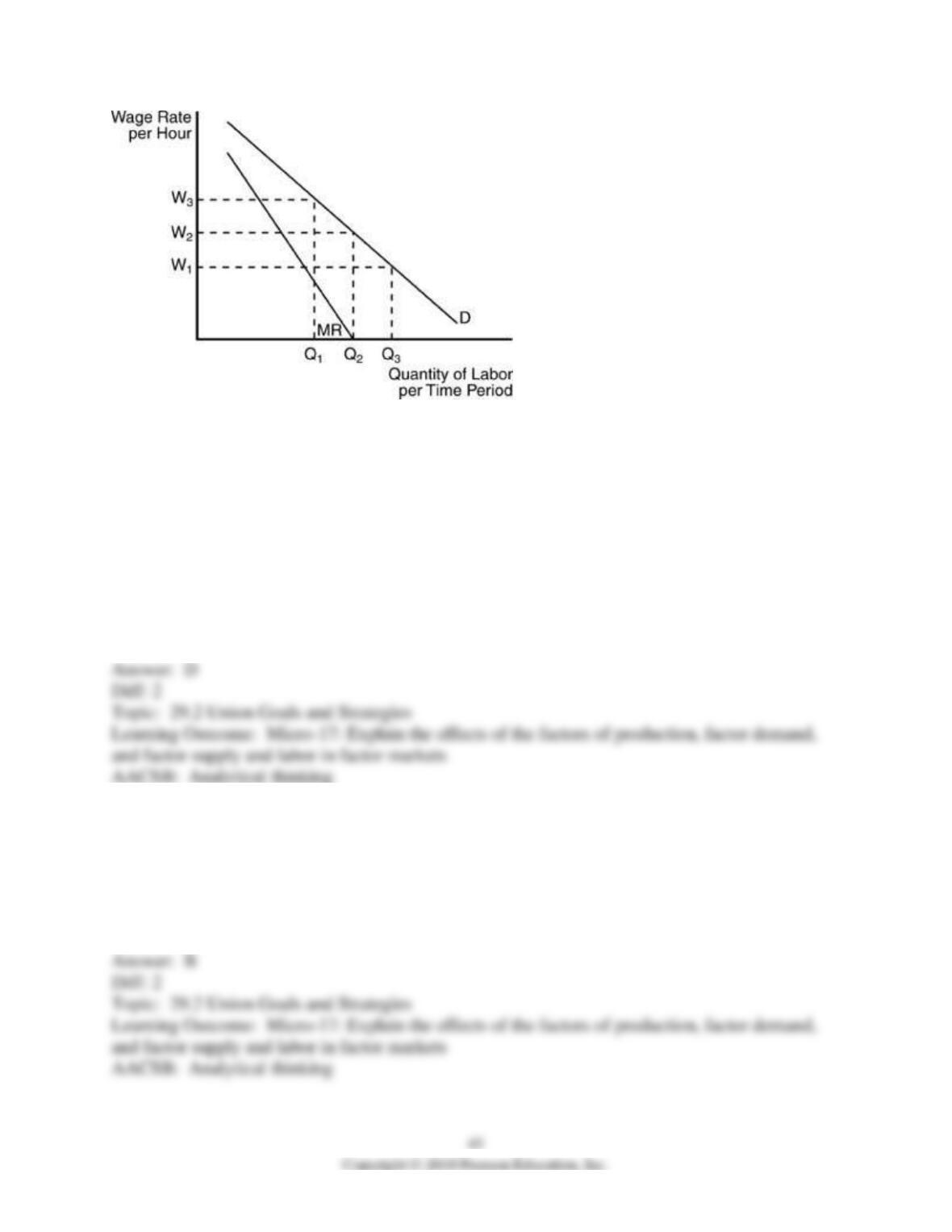
15) Consider the above figure, which displays the situation faced by a union employed by a firm
with the labor demand curve D. This union has total membership of Q3 workers, but its single
wage setting goal is to maximize wages for the Q1 members with the most seniority. If the union
managers accomplish this goal, what occurs?
A) All of the union members will be employed at the wage rate W3.
B) All of the union members will be employed at the wage rate W1.
C) The senior members of the union will receive a wage equal to W3, but Q3 union members
will be unemployed.
D) The select group of senior union members will have work and receive a wage of W3, but Q3 –
Q1 union members will not be employed by the firm.
16) In the above figure, if the union has Q2 members and wants to ensure that all members have
jobs, it will set wage equal to
A) W1.
B) W2.
C) W3.
D) none of the above.
17) Look at the above figure. A union wishes to maximize wage income for employed union
members, so it should aim for a wage rate ________ and a number of employed members equal
to ________.
A) W1, Q3
B) W2, Q2
C) W3, Q1
D) W4, Q3
18) When unions raise wages beyond what productivity increases would permit,
A) more union workers are employed.
B) there are higher wages for all union members.
C) there is a redistribution of income from low- to high-seniority workers.
D) nonunion workers wages in the economy also increase.
19) If a union limits its size to the number of employed members it had when the union was first
formed, over time there will be
A) an increase in the supply of union labor.
B) falling wages as demand for workers increases.
C) rising wages as demand for workers increases and the supply increases proportionally.
D) rising wages as demand for workers increases but some potential workers are denied a place
in the union.
20) A tariff on imported goods produced by an unlimited industry could benefit the members of
the domestic union since the tariff would most likely
A) lower the price of the output that workers purchase.
B) lower the domestic production of the good and increase wages.
C) increase the demand for domestic, union-made goods.
D) decrease the cost of the imported goods.
21) Methods that are sometimes used by unions to increase wages of union workers include
I. advertising to increase the demand for union-made goods.
II. campaigning against imports.
A) I only
B) II only
C) both I and II
D) neither I nor II
22) Unions can increase labor productivity by
A) maximizing the number of workers in the union.
B) reducing the supply of workers over time.
C) reducing conflicts between workers and management.
D) reducing the quantity of poorly made imports into the country.
23) A union-sponsored television campaign urging U.S. consumers to “Look for the union label”
is designed to
A) increase the productivity of union labor.
B) increase the derived demand for union labor by shifting consumer preferences in favor of
union-made goods.
C) raise wages by restricting the supply of union workers.
D) remind consumers that if they do not buy union-made goods, unions will strike.
24) All of the following can raise wages of union members EXCEPT
A) increasing the demand for non-union made goods.
B) increasing the demand for union-made goods.
C) limiting union membership over time.
D) increasing the productivity of union workers.
25) In an analytical sense, unions can be thought of as
A) setters of minimum wages.
B) monopoly buyers of workers.
C) generators of inflation.
D) monopsonies.
26) Collective bargaining contracts between management and the union negotiators
A) also apply to the workers who are not members of the union.
B) usually are settled only after a strike.
C) cover wages only.
D) cover wages and fringe benefits only.
27) The ultimate threat of a union is
A) the lockout.
B) the President’s power granted by the Taft-Hartley Act.
C) the unity of spirit of the union membership.
D) the strike.
28) A strikebreaker is
A) a temporary worker hired by a company to replace a union member who is striking.
B) when the President imposes a cooling-off period.
C) someone who engages in featherbedding.
D) a secondary boycott.
29) The purpose of a strike is
A) to obtain higher wages for union members only.
B) to solve jurisdictional disputes.
C) to obtain a closed shop.
D) to force management to accept the union’s proposed contract terms.
30) Other things equal, granting unemployment benefits or welfare benefits to striking workers
A) reduces the likelihood of a strike since management will be more cooperative.
B) reduces the costs of a strike to workers and will increase their willingness to strike.
C) reduces the likelihood of a strike since union workers make wages significantly above
unemployment benefits or welfare payments.
D) increases the willingness of management to permit a strike.
31) Strikes occur in about ________ percent of the labor-management negotiations.
A) 2
B) 25
C) 64
D) 99
32) Suppose a union successfully negotiates a wage rate for its members that is above the
competitive wage rate, then
A) employment in the union sector will increase.
B) the union must find a way to make union workers more productive.
C) the union must also negotiate a fringe-benefit package that the membership will like.
D) the union must find a way to ration jobs among the excessive number of workers who wish to
work at the negotiated wage.
33) Suppose a union successfully negotiates a wage rate for its members that is above the
competitive wage rate, then
A) the quantity of labor demanded will be greater than the quantity supplied.
B) the quantity of labor demanded will be less than the quantity supplied.
C) the labor market will be in equilibrium.
D) it is impossible to tell whether or not the labor market will be in equilibrium without more
information.
34) Suppose a union successfully negotiates a wage rate for its members that is above the
competitive wage rate, then
A) there will be downward pressure on the wage rate until equilibrium is established.
B) right-to-work laws become effective.
C) there is a shortage of jobs.
D) there is excess demand for labor.
35) Suppose a union successfully negotiates for its members a wage rate that is above the
competitive wage rate, then
A) there will be a surplus of jobs.
B) antitrust laws become effective.
C) there will be downward pressure on the wage rate until equilibrium is established.
D) there will be an excess supply of labor.
36) Unions can ration the excess supply of labor generated by the establishment of a wage that is
above the competitive wage by
A) lengthening the time period for apprenticeship programs.
B) lowering union dues.
C) encouraging older workers to take early retirement.
D) having more intensive membership drives to ensure a larger proportion of workers are
covered by the union contract.
37) If a union is successful in negotiating a wage rate which is above the market clearing wage,
then which of the following would not occur?
A) The higher wages attract more workers leading to a shortage of jobs.
B) Management may replace part of the workforce with machinery.
C) To handle the surplus of labor the union will form a closed shop.
D) The union may shift the supply of labor curve by developing methods to ration jobs.
38) The leadership of unions must recognize that they face
A) an economic system that is hostile to the interests of workers.
B) a no-win situation whenever they think a strike is necessary.
C) a fundamental trade-off between higher wages for members and higher taxes for members.
D) a fundamental trade-off between higher wages for members and fewer jobs for members.
39) A union that pursued a policy of restricting entry over time into the union would
A) see real wages hold constant over time at whatever premium they could get initially.
B) also have to negotiate to be sure that all the members were able to find jobs.
C) generate rising real wages for its membership over time as long as demand for union workers
increased over time.
D) fail to obtain benefits for their workers in excess of what the workers would get under open
markets.
40) Which of the following is NOT a wage or employment strategy that a union would follow?
A) Set a maximum wage rate such that a shortage of workers will result.
B) Set a wage rate such that all workers that want to find a job can find a job.
C) Set a wage rate that will maximize the income of its members.
D) Set a wage rate that will maximize the income of only some of its members.
41) If the union wants to follow the strategy of maximizing member’s income, wages should be
set
A) above the market clearing wage rate.
B) such that all that wanted to work could work.
C) at the market clearing wage rate.
D) at the point at which the price elasticity of demand equals 1.
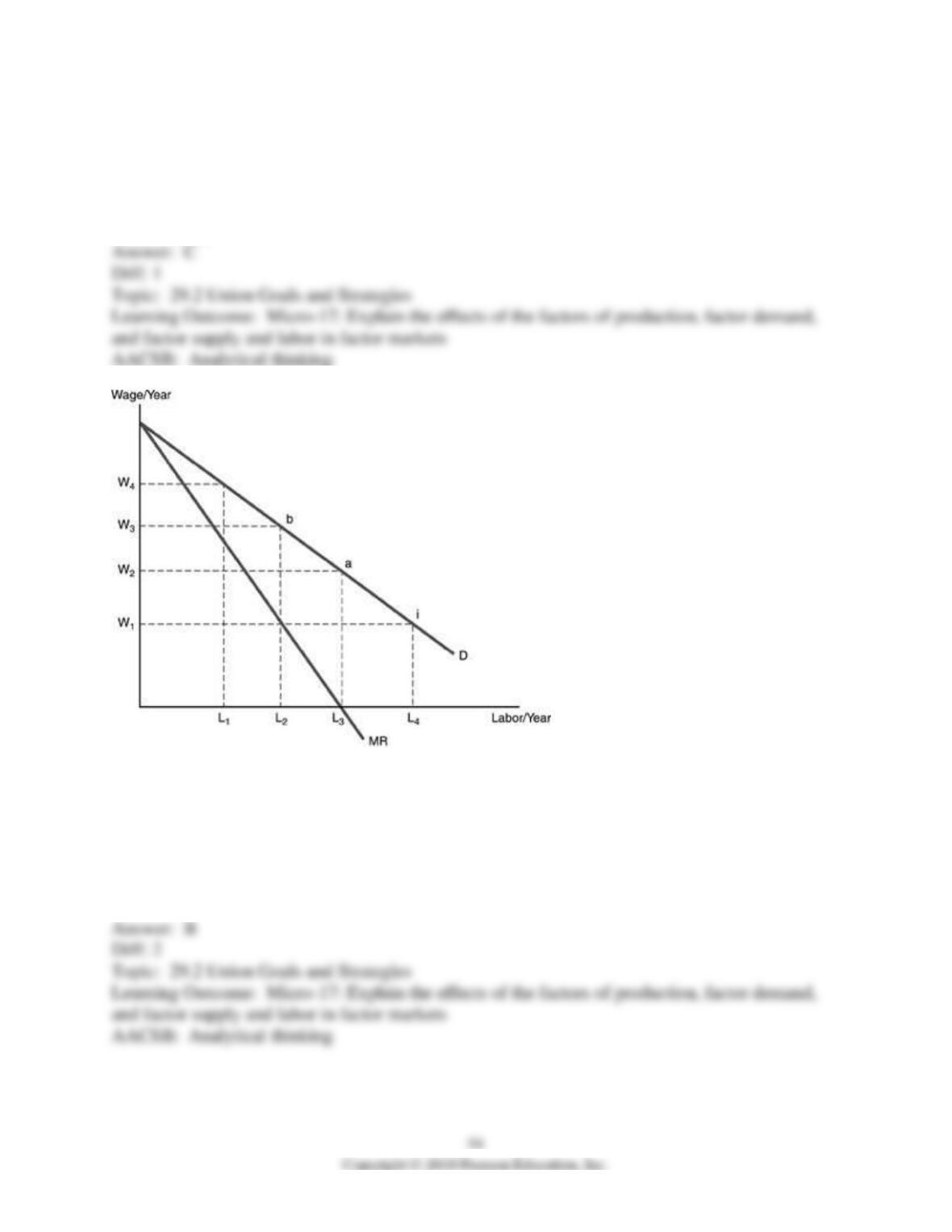
42) If the goal of the union is to maximize member income, then
A) a wage rate will be set in the inelastic portion of the demand curve.
B) a wage rate will be set at the point at which the elasticity of demand equals 1 and marginal
revenue is positive.
C) a wage rate will be set at the point at which marginal revenue equal zero.
D) the supply of labor must be inelastic.
43) Refer to the above figure. If the union wants to maximize the total income of its members
who work, it will set wages at
A) W1.
B) W2.
C) W3.
D) W4.
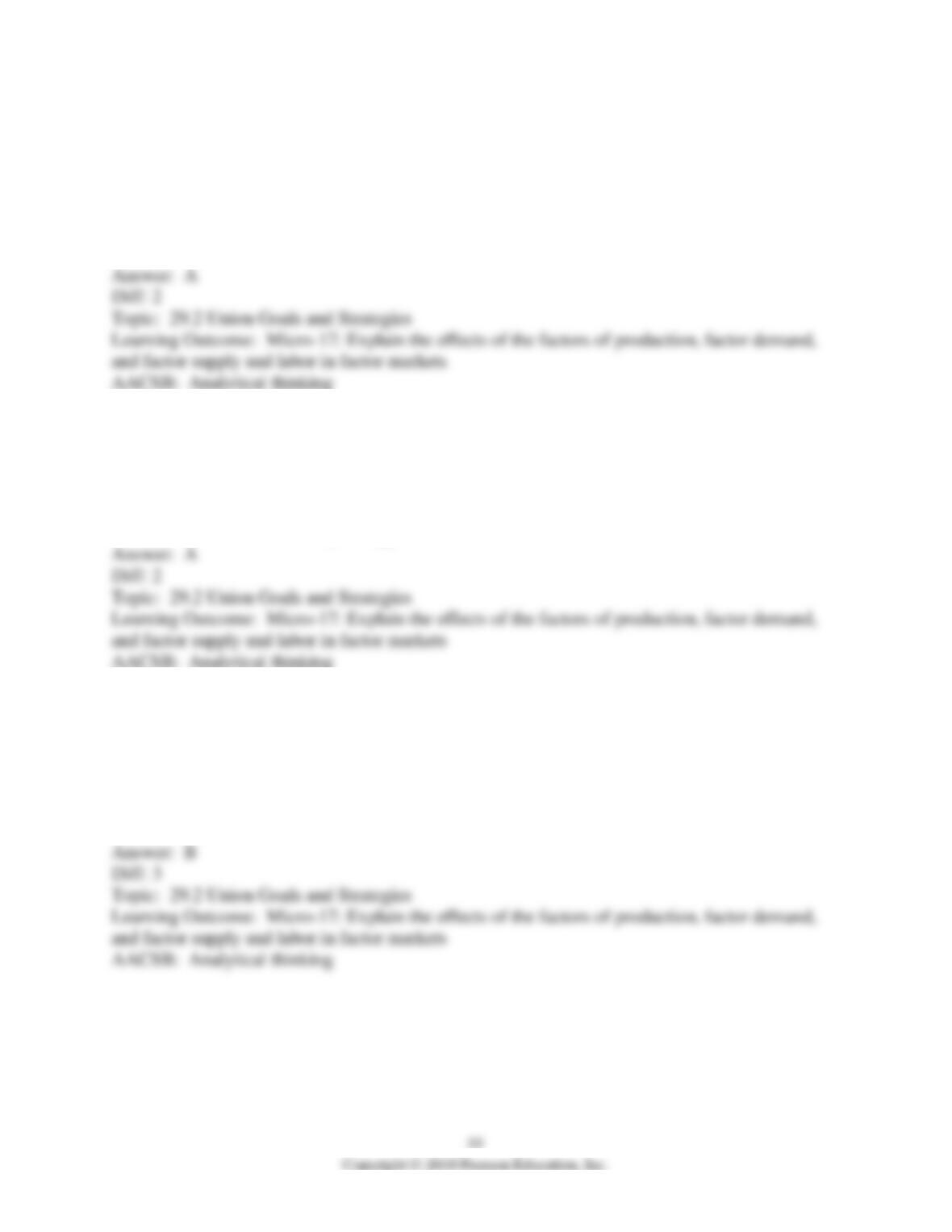
44) Refer to the above figure. Suppose there are L4 workers in the union, and the union wants all
of its workers to have a job. It will set the wage rate at
A) W1.
B) W2.
C) W3.
D) W4.
45) Refer the above figure. An increase in labor productivity is likely to stimulate and shift the
labor demand curve to
A) the right and hence increase union wages per year.
B) to the left and hence increase union wages per year.
C) the right and hence lower union wages per year.
D) None of the above is likely to happen.
46) Refer the above figure. Suppose the union sets the wage rate that will maximize the total
income for the members who work. The total wages will be
A) W1iL4O.
B) W2aL3O.
C) W3bL2O.
D) W3bhW1.
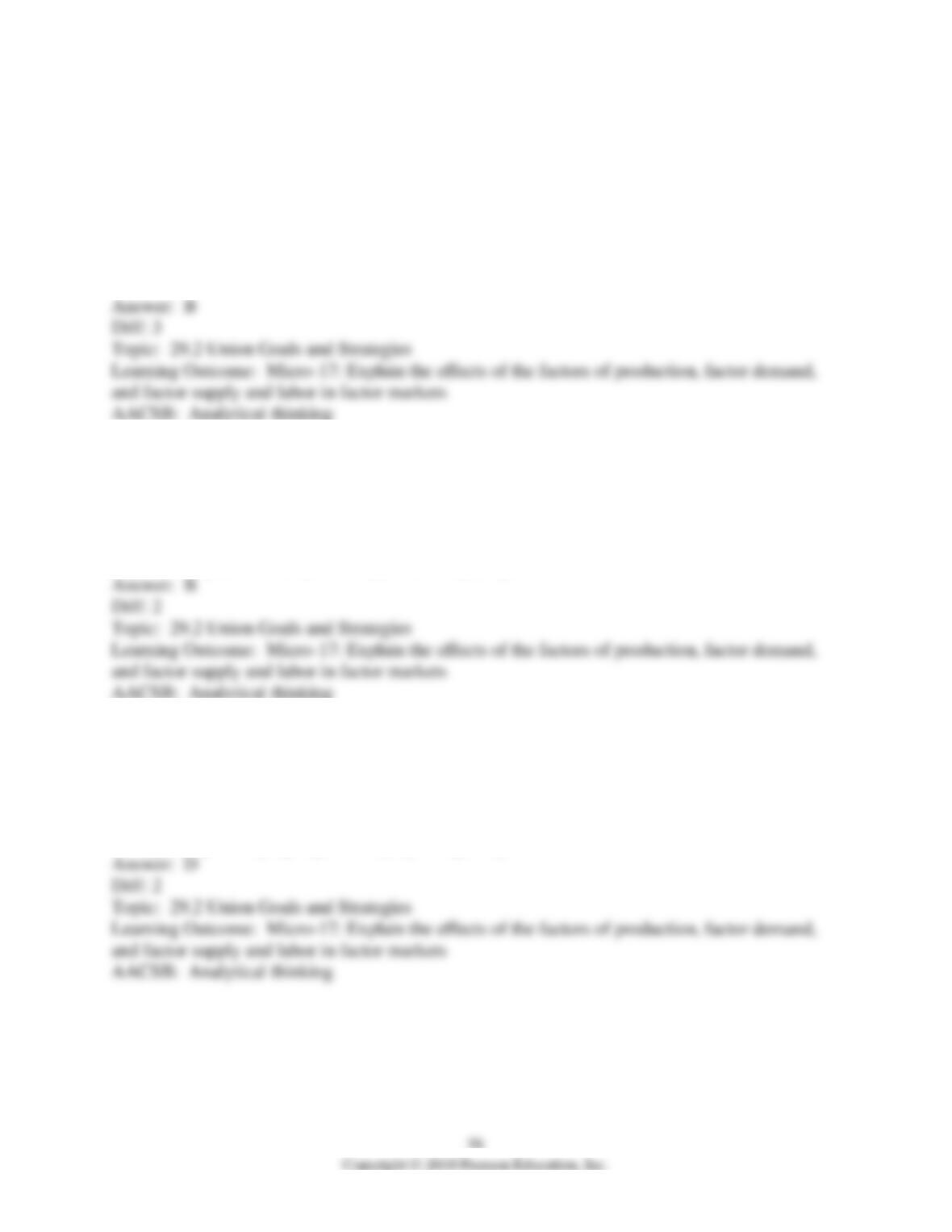
47) Refer to the above figure. Suppose there are L4 workers in the union. If the union wants to
set a wage rate of W3, it must
A) determine which of its members will earn W3 and which will earn W1.
B) accept that L4 – L2 members will not be able to find work in the industry.
C) accept that L3 – L2 workers will have to get a lower wage equal to W2 and L4 – L3 workers
will have to get a wage of W1.
D) determine the most efficient way to get the firms to accept the wage and hire all L4 workers.
48) A union can achieve higher wages without accepting lower levels of employment of
members by
A) striking.
B) increasing the productivity of its members.
C) increasing the amounts of imports.
D) increasing the difficulty of its apprenticeship program.
49) A union can achieve higher wages without accepting lower levels of employment of
members by
A) promoting right-to-work laws.
B) increasing the demand for substitute products made by non-union labor.
C) increasing conflicts with management.
D) beginning a campaign against buying foreign imports.
50) Unions tend to want import restrictions because
A) imports are usually of inferior quality.
B) they can increase the wages for union workers by increasing the productivity of union
workers when the workers aren’t worried about foreign competition.
C) the restrictions also reduce the number of immigrants that can enter the country and decrease
the supply of nonunion labor.
D) the restrictions decrease the demand for non-union made goods, increasing the demand for
union made goods.
51) The primary purpose of a strike by labor unions is to
A) force the firm out of business.
B) extract from the firm better and improved conditions of work or contract terms.
C) secure a larger market share for the firm.
D) ensure they get paid for striking.
52) Strikebreakers
A) can reduce the bargaining power of a union.
B) can strengthen the bargaining power of a union.
C) make a union negotiation invalid.
D) make a strike permanent.
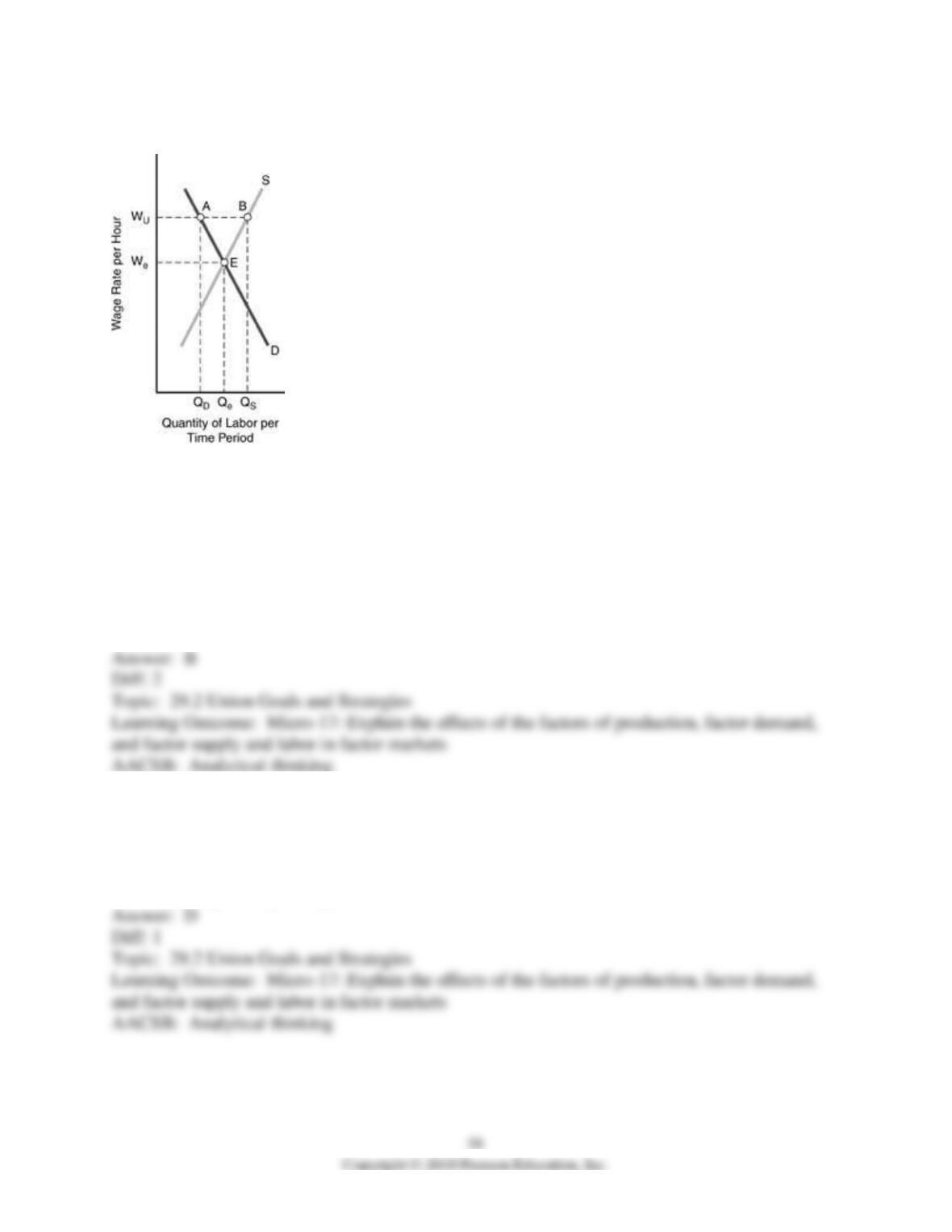
53) The figure illustrates all of the following EXCEPT
A) if the union establishes by collective bargaining a wage rate that exceeds equilibrium at point
Wu an excess quantity of labor will be supplied.
B) if the union establishes by collective bargaining a wage rate that exceeds equilibrium, an
excess quantity of labor will be demanded.
C) there is a trade-off union leadership faces: Higher wages inevitably mean a reduction in total
employment—a smaller number of positions.
D) at higher wages, more workers will seek to enter the industry, thereby adding to the surplus of
workers where QS is greater than QD.
54) Which of the following is NOT a union wage and employment strategy?
A) ensuring employment for all members of a union
B) maximizing aggregate income of workers
C) maximizing wage rates for some workers
D) minimizing the adjusted gross income of non-members
55) The ultimate bargaining tool for unions is
A) the strike.
B) “labor’s Magna Carta.”
C) the Taft-Hartley Act.
D) the sympathy strike.
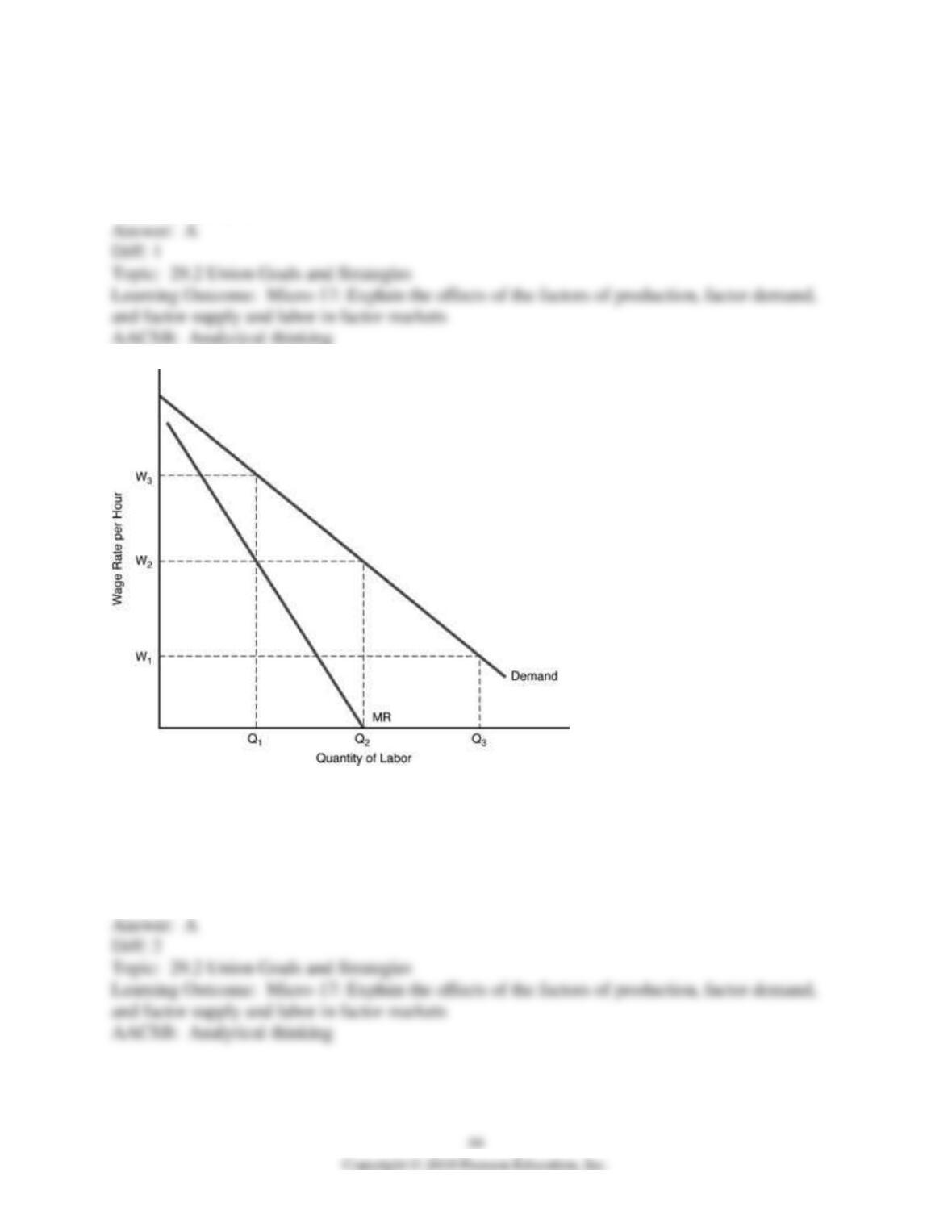
56) In the above figure, which wage rate yields the highest union employment?
A) W1
B) W2
C) W3
D) W2 – W1
57) In the above figure, which wage rate will maximize union members’ income?
A) W1
B) W2
C) W3
D) W3 – W1
58) In the above figure, which wage rate will yield the highest wage rates for particular workers?
A) W1
B) W2
C) W3
D) W3 – W2
59) If a union negotiated a wage above the market equilibrium wage, we would find
A) a surplus of laborers at the negotiated wage.
B) a shortage of laborers at the negotiated wage.
C) higher efficiency of labor at the negotiated wage.
D) lower worker productivity at the negotiated wage.