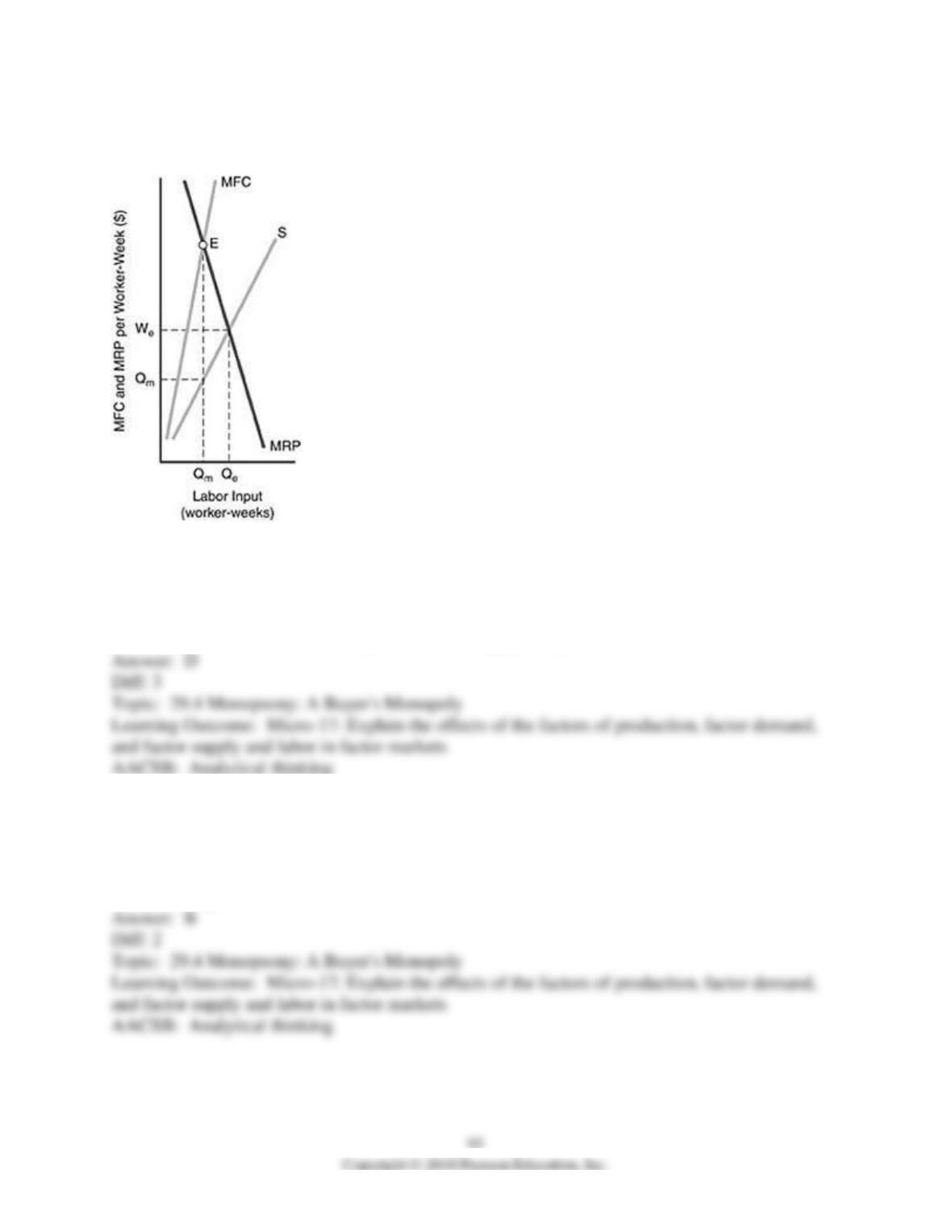
52) The figure supports all of the following statements regarding the marginal factor cost curve
for a monopsonist EXCEPT
A) the monopsonist firm looks at a marginal cost curve, MFC, which slopes upward and is above
its labor supply curve.
B) the marginal benefit of hiring additional workers is given by the firm’s MRP curve.
C) the intersection of MFC with MRP, at point E, determines the number of workers hired.
D) a monopsonist cannot find the profit-maximizing quantity of labor demanded at E.
53) In order to hire additional laborers, a monopsony must
A) lower the supply of labor.
B) raise the wage rate.
C) advertise for the labor.
D) do nothing.
54) A monopsonistic employer faces a
A) perfectly elastic labor supply curve.
B) perfectly inelastic labor supply curve.
C) MFC curve that is greater than the wage rate at each quantity of labor.
D) MFC curve that is less than the wage rate at each quantity of labor.
55) Paying a wage to an employee that is lower than the employee’s marginal revenue product is
sometimes referred to as
A) illegal in most states.
B) monopolistic exploitation.
C) monopsonistic exploitation.
D) total exploitation.
56) Monopsonistic exploitation refers to
A) the payment to the resource equal to MFC.
B) the payment to a resource less than MRP.
C) the payment to a resource equal to MRP.
D) the payment to a resource above MRP.
57) When workers are paid a wage that is less than their contribution to a monopsonist’s
revenues
A) this is sometimes referred to monopsonistic exploitation.
B) this is sometimes referred to as an incentive.
C) they seek part time employment.
D) they file a grievance with their union representative.
58) If a single supplier of labor, such as a union, were supplying labor to a single monopsonistic
employer, this is referred to as a(n)
A) bilateral monopoly.
B) trilateral monopoly.
C) total monopsony.
D) collective monopoly.
59) Which of the following is FALSE regarding bilateral monopoly?
A) Bilateral monopoly is a market structure consisting of a monopolist and a monopsonist.
B) Bilateral monopoly is defined as a market structure in which a single buyer faces a single
seller.
C) An example of bilateral monopoly is a state education employer facing a single teachers’
union in the labor market.
D) The price outcome is easily determined.
60) A bilateral monopoly means
A) that a monopsonistic employer bargains with two unions.
B) that a monopsonistic employer bargains with both an industrial and a craft union.
C) that a monopsonistic employer bargains with a monopoly.
D) that an industrial union bargains with a two-firm oligopoly.
61) A bilateral monopoly exists when there is a
A) single buyer and many sellers in the market.
B) single seller and many buyers in the market.
C) large number of buyers and sellers in the market.
D) single buyer and a single seller in the market.
62) The MFC can be calculated by the
A) change in total wages/change in labor.
B) total wages/total labor.
C) change in labor/change in total wages.
D) total wages/change in labor.
63) The labor market in professional baseball is an example of
A) a bilateral monopoly.
B) a monopsonistic labor market.
C) a monopolistic labor market.
D) a perfectly competitive labor market.
64) The MFC curve
A) lies below the labor supply curve, when the labor supply curve is upward sloping.
B) lies above the labor supply curve, when the labor supply curve is upward sloping.
C) is the labor supply curve.
D) is parallel to the labor supply curve, when the labor supply curve is downward sloping.
65) In a bilateral monopoly, the wage rate that is determined in the market
A) is equal to MFC.
B) is equal to MRP.
C) is indeterminate.
D) is the same as in a perfectly competitive market.
66) In the above table, what is the marginal factor cost of the 4th worker?
A) $16
B) $30
C) $64
D) $22
67) In the above table, what is the marginal factor cost of the 2nd worker?
A) $24
B) $14
C) $64
D) $12
68) In the above table, what is the marginal factor cost of the 5th worker?
A) $22
B) $18
C) $90
D) $26
69) In the above table, what is the marginal factor cost of the 6th worker?
A) $30
B) $18
C) $120
D) $20
70) In the above table, if the marginal revenue product is $18, how many workers will the profit
maximizing monopsonist hire?
A) 2
B) 3
C) 4
D) 5
71) In the above table, if the marginal revenue product is $14, how many workers will the profit
maximizing monopsonist hire?
A) 2
B) 3
C) 4
D) 5
72) In the above table, if the marginal revenue product is $18, how many workers will the profit
maximizing monopsonist hire and what wage will they pay each worker?
A) 5; $18
B) 3; $14
C) 3; $18
D) 4; $16
73) In the above table, if the marginal revenue product is $22, how many workers will the profit
maximizing monopsonist hire and what wage will they pay each worker?
A) 5; $18
B) 3; $14
C) 4; $22
D) 4; $16
74) In the above table, if the marginal revenue product is $26, how many workers will the profit
maximizing monopsonist hire and what wage will they pay each worker?
A) 5; $18
B) 5; $16
C) 4; $16
D) 6; $30
75) At any quantity, the marginal factor cost is always
A) parallel to the marginal revenue product.
B) below the labor supply curve.
C) above the labor supply curve.
D) above the labor demand curve.
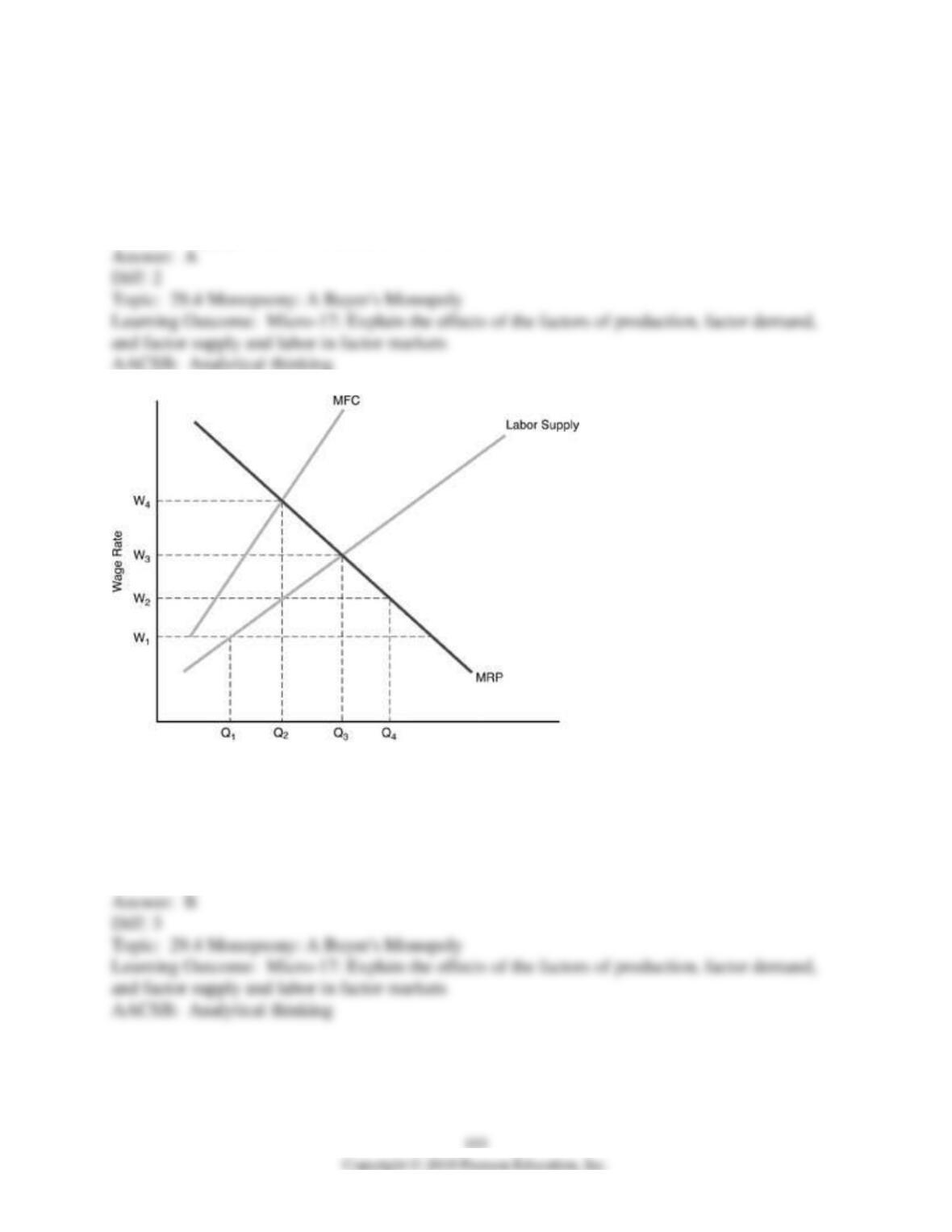
76) A firm that is a monopsonist in the labor market and a monopolist in the product market will
hire labor to the point at which
A) MFC = MRPm.
B) a perfectly elastic labor supply = MRP.
C) a perfectly inelastic labor supply = perfectly inelastic labor demand.
D) where supply of labor = demand for labor.
77) In the above figure, what is the wage rate the monopsonist will pay?
A) W1
B) W2
C) W3
D) W4
78) In the above figure, what is the wage rate for the perfectly competitive market?
A) W1
B) W2
C) W3
D) W4
79) In the above figure, what is the quantity of workers that would be hired by a monopsonist?
A) Q1
B) Q2
C) Q3
D) Q4
80) In the above figure, what is the quantity of workers that would be hired in a perfectly
competitive market?
A) Q1
B) Q2
C) Q3
D) Q4
81) Which of the following is the BEST example of a monopsonist?
A) a household hiring a gardener
B) a turnip farmer hiring seasonal help
C) Hershey’s Chocolate Factory in Hershey, PA
D) Vinaka Coffee Shop in Carlsbad, CA
82) A monopsonistic employer will pay a wage rate
A) less than the labor’s MRP.
B) greater than the labor’s MRP.
C) equal to the labor’s MRP.
D) equal to MFC.
83) Use the above table. The MFC of the 3rd worker is
A) $5.
B) $30.
C) $20.
D) $6.7.
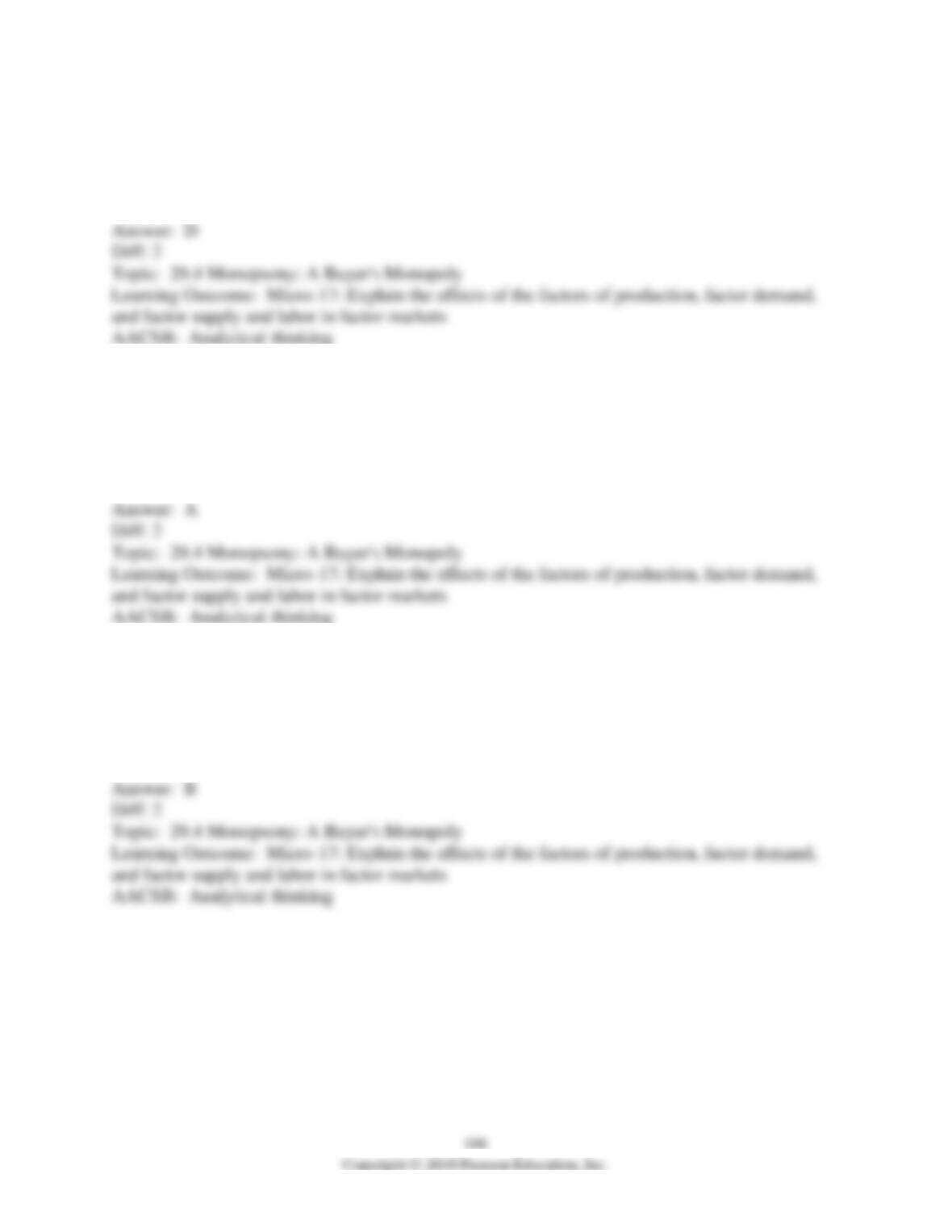
84) Use the above table. The MFC of the 4th worker is
A) $5.
B) $6.25.
C) $25.
D) $40.
85) Use the above table. If the marginal revenue product is $10, how many workers will the
profit maximizing monopsonist hire?
A) 1
B) 2
C) 3
D) 4
86) Use the above table. If the marginal revenue product is $20, how many workers will the
profit maximizing monopsonist hire?
A) 1
B) 2
C) 3
D) 4
87) Use the above table. If the marginal revenue product is $30, how many workers will the
profit maximizing monopsonist hire and what wage will they pay each worker?
A) 1; $10
B) 2; $15
C) 3; $20
D) 4; $25
88) Use the above table. The data shows that the firm
A) is hiring in a perfectly competitive labor market.
B) is selling its output in a perfectly competitive market.
C) is a monopsonist.
D) is selling its output in an imperfectly competitive market.
89) If a minimum wage is established, a monopsonist faces
A) an upward sloping supply of labor at all quantities of labor.
B) a downward sloping supply of labor at all quantities of labor.
C) a horizontal supply of labor at the minimum wage and the upward sloping portion of the labor
supply curve above minimum wage.
D) a horizontal supply of labor at the minimum wage and the downward sloping portion of the
labor demand curve below minimum wage.
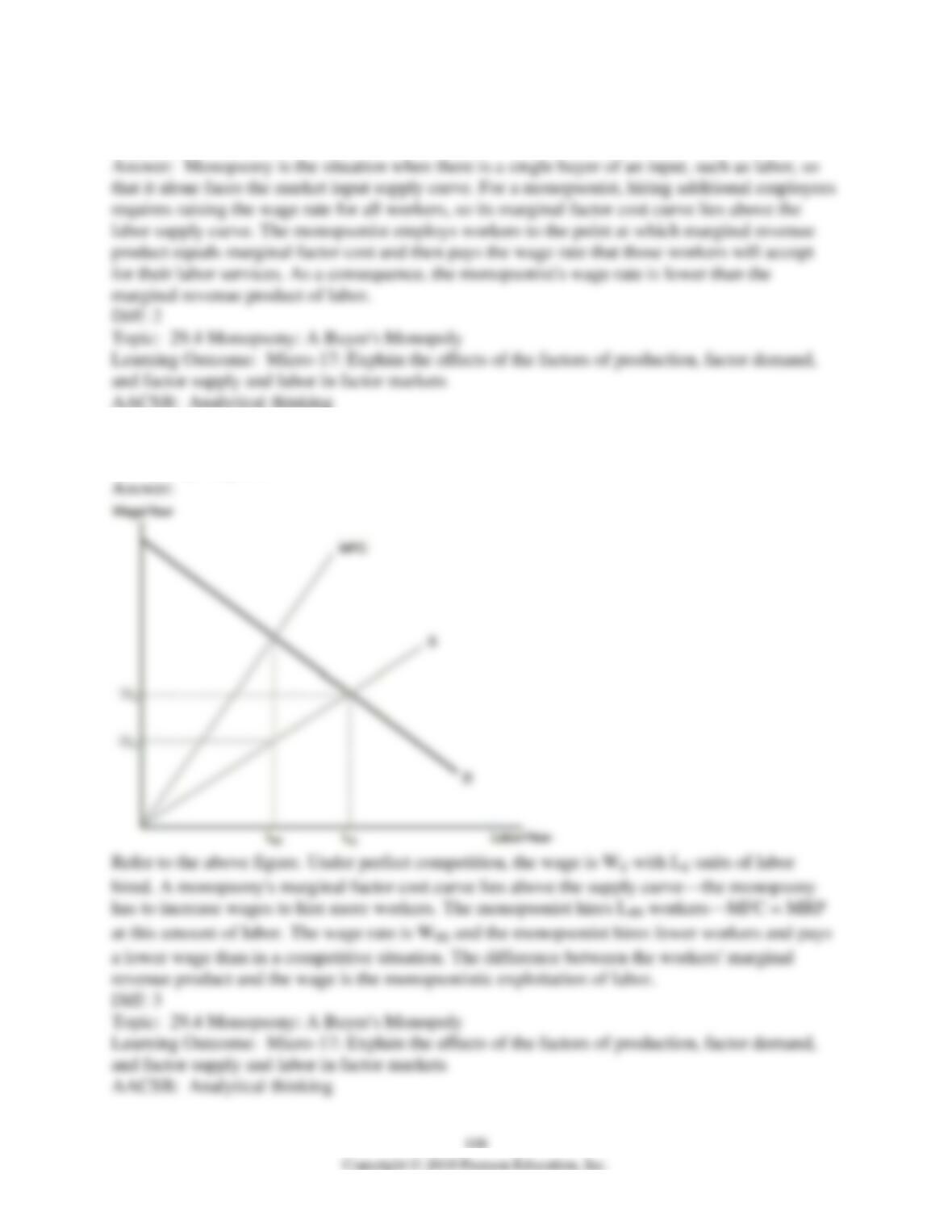
90) What is a monopsony and how does a monopsonistic firm determine the wage rate to pay its
employees?
91) Using a graph, compare the labor-market equilibrium under perfect competition and
monopsony. Explain.