c.
Taxes reduce total spending directly.
d.
Taxes do not have a multiplier effect on equilibrium GDP.
DISC: Aggregate demand and aggre – DISC: Aggregate demand and aggregate supply
United States – BPROG: Reflective Thinking – BPROG: Analysis
Aggregate demand and aggregate s – Aggregate demand and aggregate supply
Income Taxes and the Consumption Schedule
72. Which of the following observations is true?
a.
Tax changes have no impact on the consumption schedule.
b.
Tax reduction shifts the consumption schedule upward.
c.
Changes in taxes have a multiplier effect on equilibrium GDP on the supply side.
d.
Tax increases increase equilibrium GDP.
DISC: Aggregate demand and aggre – DISC: Aggregate demand and aggregate supply
United States – BPROG: Reflective Thinking – BPROG: Analysis
Aggregate demand and aggregate s – Aggregate demand and aggregate supply
Income Taxes and the Consumption Schedule
73. When we add a personal income tax to the macroeconomic model, the
a.
multiplier becomes larger.
b.
multiplier becomes smaller.
c.
expenditures schedule shifts upward.
d.
expenditures schedule becomes steeper.
United States – BPROG: Reflective Thinking – BPROG: Analysis
Understanding and applying econo – Understanding and applying economic models
Income Taxes and the Consumption Schedule
74. The oversimplified formula for the multiplier yields a number that is too large due to the exclusion of
a.
variable imports.
b.
changes in the price-level.
c.
income taxes.
d.
All of the above.
DISC: Monetary and fiscal policy
United States – BPROG: Analytic
Monetary and fiscal policy
The Multiplier Revisited
75. When income taxes are included in the basic macroeconomic model, the value of the
a.
inflationary effect is increased.
b.
multiplier is increased.
c.
multiplier is decreased.
d.
expenditure function is increased.
United States – BPROG: Analytic
Understanding and applying econo – Understanding and applying economic models
The Multiplier Revisited
76. If the value of the multiplier is smaller, the economy
a.
becomes less stable because automatic stabilizers have a larger impact.
b.
becomes more stable because automatic stabilizers have a larger impact.
c.
becomes more volatile because automatic stabilizers have a lesser impact.
d.
is subject to larger fluctuations because automatic stabilizers have no impact.
DISC: Monetary and fiscal policy
United States – BPROG: Analytic
Monetary and fiscal policy
The Multiplier Revisited
77. An increase in taxes shifts the
a.
aggregate supply curve outward.
b.
aggregate demand curve outward.
c.
consumption schedule upward.
d.
consumption schedule downward.
DISC: Monetary and fiscal policy
United States – BPROG: Analytic
Monetary and fiscal policy
The Multiplier Revisited
78. When government spending is added to the basic macroeconomic model, the multiplier for G would
a.
be higher than the multiplier for autonomous spending.
b.
be lower than the multiplier for autonomous spending.
c.
be equal to the multiplier for autonomous spending.
d.
have no relationship to the autonomous spending multiplier.
c
Moderate
United States – BPROG: Analytic
Understanding and applying econo – Understanding and applying economic models
The Multiplier Revisited
79. The reason that the multiplier is smaller if there are variable taxes is that
a.
taxes add to government spending, which increases income.
b.
people get angry about taxes and decide to work less.
c.
tax increases shift the expenditure line upward.
d.
part of an increase in income is taken away in taxes.
Moderate
DISC: Monetary and fiscal policy
United States – BPROG: Analytic
Monetary and fiscal policy
The Multiplier Revisited
80. If personal income taxes are increased, disposable income and consumption
a.
increase.
b.
stay the same.
c.
decrease.
d.
change in an unpredictable direction.
c
Easy
DISC: Monetary and fiscal policy
United States – BPROG: Analytic
Monetary and fiscal policy
The Multiplier Revisited
81. During the period from 2001 to 2006, there were several major cuts in personal income tax rates. What effect did these
have on the value of the multiplier?
a.
They decreased the value of the multiplier.
b.
They had no effect on the multiplier.
c.
They increased the value of the multiplier.
d.
The effect was uncertain.
DISC: Monetary and fiscal policy
United States – BPROG: Analytic
Monetary and fiscal policy
The Multiplier Revisited
82. During the 2009-2010 debate on the stimulus package, democrats argued primarily for increased government
spending. What effect would this have on the value of the multiplier?
a.
It would decrease the value of the multiplier.
b.
It would have no effect on the multiplier.
c.
It would increase the value of the multiplier.
d.
The effect is uncertain.
DISC: Monetary and fiscal policy
United States – BPROG: Analytic
Monetary and fiscal policy
The Multiplier Revisited
83. For any given change in taxes, the multiplier
a.
will work indirectly through consumption.
b.
effect will occur in two steps.
c.
effect will be smaller than for an equivalent dollar change in government spending.
d.
All of the above are correct.
DISC: Monetary and fiscal policy
United States – BPROG: Analytic
Monetary and fiscal policy
The Multiplier Revisited
84. The oversimplified formula for the multiplier is misleading because it ignores the effects of
a.
price-level changes.
b.
the foreign sector.
c.
variable taxes.
d.
All of the above are correct.
DISC: Monetary and fiscal policy
United States – BPROG: Analytic
Monetary and fiscal policy
The Multiplier Revisited
85. Changes in government spending
a.
are an indirect component of the expenditures schedule.
b.
have a different multiplier effect than changes in business investment spending.
c.
are a direct component of the expenditures schedule and have the same multiplier effect as changes in business
investment spending.
d.
do not have an effect on spending if they are matched by tax changes.
DISC: The role of government
United States – BPROG: Analytic
The role of government
The Multiplier Revisited
86. A change in a fixed tax will cause the consumption schedule to
a.
become steeper.
b.
become flatter.
c.
shift in a parallel manner.
d.
remain fixed as the economy moves along the schedule.
DISC: Monetary and fiscal policy
United States – BPROG: Analytic
Monetary and fiscal policy
Appendix A: Graphical Treatment of Taxes and Fiscal Policy
87. An increase in taxes will cause the consumption schedule to
a.
shift upward.
b.
shift downward.
c.
remain fixed as the economy moves upward along the schedule.
d.
remain fixed as the economy moves downward along the schedule.
Difficult
DISC: Monetary and fiscal policy
United States – BPROG: Analytic
Monetary and fiscal policy
The Multiplier Revisited
88. An automatic stabilizer is a feature of the economy that
a.
makes prices “sticky.”
b.
reduces its sensitivity to shocks.
c.
maximizes its volatility.
d.
automatically reduces recessionary trends.
Difficult
DISC: Monetary and fiscal policy
United States – BPROG: Analytic
Monetary and fiscal policy
The Multiplier Revisited
89. Which of the following is one of the main features of our modern economy that helps ensure against a repeat
performance of the Great Depression?
a.
transfer payments
b.
outsourcing
c.
multiplier
d.
personal income tax
Difficult
DISC: Monetary and fiscal policy
United States – BPROG: Analytic
Monetary and fiscal policy
The Multiplier Revisited
90. President Clinton, at the beginning of his administration, increased personal income taxes on individuals with
relatively high incomes. How will this change the consumption schedule?
a.
It will shift and become steeper.
b.
It will shift and become flatter.
c.
It will shift in a parallel manner.
d.
It will remain fixed as the economy moves along the schedule.
Difficult
DISC: Monetary and fiscal policy
United States – BPROG: Analytic
Monetary and fiscal policy
Appendix A: Graphical Treatment of Taxes and Fiscal Policy
91. When the economy has an income tax that is variable, the multiplier is
a.
unchanged.
b.
larger.
c.
smaller.
d.
unpredictable.
c
Moderate
DISC: Monetary and fiscal policy
United States – BPROG: Analytic
Monetary and fiscal policy
The Multiplier Revisited
92. Suppose that the U.S. personal income tax was eliminated and replaced with a fixed tax that raised the exact same
amount of revenue. The multiplier would be
a.
larger.
b.
unchanged.
c.
smaller.
d.
incalculable.
a
Difficult
DISC: Monetary and fiscal policy
United States – BPROG: Analytic
Monetary and fiscal policy
The Multiplier Revisited
93. Congress is debating whether to raise taxes by $100 billion or decrease spending by $100 billion in order to eliminate
a budget deficit. Which action will have the larger effect on equilibrium GDP?
a.
the increase in taxes
b.
the decrease in spending
c.
the effects will be equal
d.
not possible to determine without knowing the multiplier
94. In order to maintain a balanced budget, Congress has decided to cut taxes and government spending both by $25
billion. What will happen to GDP?
a.
It will increase.
b.
It will remain the same.
c.
It will decrease.
d.
It’s impossible to know without the multiplier.
95. The president wishes to increase spending for education by $4 billion but also maintain a balanced budget. Therefore,
taxes will also be increased by $4 billion. What will happen to GDP?
a.
It will increase.
b.
It will remain the same.
c.
It will decrease.
d.
It’s impossible to know without the multiplier.
96. In an effort to balance the budget, the government cuts spending rather than increasing taxes. What will happen to the
consumption schedule?
a.
It will become steeper.
b.
It will become flatter.
c.
It will shift upward.
d.
It will shift downward.
e.
It will remain the same and move along it.
97. If the government decides to change the level of government spending, what happens to the value of the multiplier?
a.
It becomes larger.
b.
It becomes smaller.
c.
It does not change.
d.
It is impossible to predict.
98. How will a cut in a fixed tax affect the consumption schedule?
a.
It will shift downward.
b.
It will shift upward.
c.
It will become flatter.
d.
It will become steeper.
99. How does the multiplier for a change in government spending compare to the multiplier for a change in taxes?
a.
It is smaller.
b.
It is the same.
c.
It is larger.
d.
It cannot be calculated.
The Multiplier Revisited
100. As a result of the recent financial crisis, some analysts believed that the MPC in the U.S. declined. If this is true, the
value of the multiplier is now
a.
smaller.
b.
larger.
c.
the same.
d.
magnified to a larger amount.
a
Moderate
DISC: Monetary and fiscal policy
United States – BPROG: Analytic
Monetary and fiscal policy
The Multiplier Revisited
101. Government transfer payments act as automatic stabilizers because as labor income decreases, transfer payments
a.
decrease as well.
b.
remain constant.
c.
increase.
d.
to the government increase.
c
Moderate
DISC: Monetary and fiscal policy
United States – BPROG: Analytic
Monetary and fiscal policy
The Multiplier Revisited
102. Government transfer payments
a.
are subtracted from national income to obtain disposable income.
b.
can be considered as negative taxes.
c.
intervene between national product and disposable income in the same way as taxes.
d.
are counted the same as taxes in computing national income.
Easy
DISC: Monetary and fiscal policy
United States – BPROG: Analytic
Monetary and fiscal policy
The Multiplier Revisited
103. If the federal government increases the amount of Social Security benefits for retired persons, then the
a.
consumption schedule will shift upward.
b.
aggregate demand curve will shift outward.
c.
effect on equilibrium GDP will be the same as a cut in taxes.
d.
All of the above are correct.
DISC: Monetary and fiscal policy
United States – BPROG: Analytic
Monetary and fiscal policy
The Multiplier Revisited
104. In the determination of disposable income, transfer payments are treated as if they
a.
are the same as taxes.
b.
did not exist.
c.
are the opposite of taxes.
d.
were a constant amount.
DISC: Monetary and fiscal policy
United States – BPROG: Analytic
Monetary and fiscal policy
The Multiplier Revisited
105. Transfer payments are income that is
a.
earned but not received.
b.
received but not spent.
c.
spent but not earned.
d.
received but not earned.
DISC: Monetary and fiscal policy
United States – BPROG: Analytic
Monetary and fiscal policy
The Multiplier Revisited
106. An increase in Social Security payments to retired persons has what effect on equilibrium income?
a.
GDP will fall.
b.
GDP will rise.
c.
GDP will remain the same.
d.
GDP will fall by less than the increase in payments.
Moderate
DISC: Monetary and fiscal policy
United States – Analytic – BB-Legal
Monetary and fiscal policy
The Multiplier Revisited
107. In macroeconomic analysis, a transfer payment is considered a
a.
positive tax.
b.
fixed tax.
c.
negative tax.
d.
variable tax.
c
Moderate
DISC: Monetary and fiscal policy
United States – BPROG: Analytic
Monetary and fiscal policy
The Multiplier Revisited
108. How does an increase in government transfer payments affect aggregate demand?
a.
It has the same effect as a tax increase, which lowers AD with a larger multiplier than a spending decrease.
b.
It has the same effect as a tax cut, which increases AD but with a smaller multiplier than a change in spending.
c.
It has the same effect as a spending increase, which increases AD with a larger multiplier than a tax cut.
d.
It has the same effect as a spending decrease, which increases AD with a larger multiplier than a spending
decrease.
Difficult
DISC: Monetary and fiscal policy
United States – BPROG: Analytic
Monetary and fiscal policy
The Multiplier Revisited
109. You are a member of Congress in 2007-2009 when the economy is in a recessionary gap. If your goal is to achieve
full employment, you should vote for
a.
decreased government purchases, increased taxes, and a cut in transfer payments.
b.
a balanced federal budget.
c.
increased government purchases, decreased taxes, and an increase in transfer payments.
d.
increased government purchases and transfer payments, and an equal increase in taxes.
c
DISC: Monetary and fiscal policy
United States – BPROG: Reflective Thinking – BPROG: Analysis
Monetary and fiscal policy
Planning Expansionary Fiscal Policy
110. If Congress votes to increase government purchases and at the same time decrease personal income taxes, they
a.
have decided to balance the federal budget.
b.
have voted for the proper policy to counteract a recessionary gap.
c.
have voted for the proper policy to counteract an inflationary gap.
d.
are trying to achieve a federal budget surplus.
DISC: Monetary and fiscal policy
United States – BPROG: Analytic
Monetary and fiscal policy
Planning Expansionary Fiscal Policy
111. The Japanese economy is stuck in a recessionary gap. The proper fiscal policy could include a(n)
a.
decrease in taxes.
b.
increase in government purchases.
c.
increase in transfer payments.
d.
All of the above are correct.
DISC: Monetary and fiscal policy
United States – BPROG: Analytic
Monetary and fiscal policy
Planning Expansionary Fiscal Policy
112. Expansionary fiscal policy can cause a rise in real GDP in combination with
a.
an increase in the price level.
b.
a decrease in the price level.
c.
no change in the price level.
d.
a decrease in the price level if the aggregate supply curve is upward sloping.
DISC: Monetary and fiscal policy
United States – BPROG: Analytic
Monetary and fiscal policy
Planning Expansionary Fiscal Policy
113. If the federal government wishes to move the economy out of a recessionary gap, the appropriate fiscal policy is a(n)
a.
increase in taxes.
b.
decrease in government purchases.
c.
decrease in transfer payments.
d.
None of the above are correct.
DISC: Monetary and fiscal policy
United States – BPROG: Analytic
Monetary and fiscal policy
Planning Expansionary Fiscal Policy
Figure 11-1
114. In Figure 11–1, the economy is experiencing a(n)
a.
inflationary gap equal to EF.
b.
inflationary gap equal to ET.
c.
recessionary gap equal to ET.
d.
recessionary gap equal to FT.
DISC: Aggregate demand and aggre – DISC: Aggregate demand and aggregate supply
United States – BPROG: Reflective Thinking – BPROG: Analysis
Aggregate demand and aggregate s – Aggregate demand and aggregate supply
Planning Expansionary Fiscal Policy
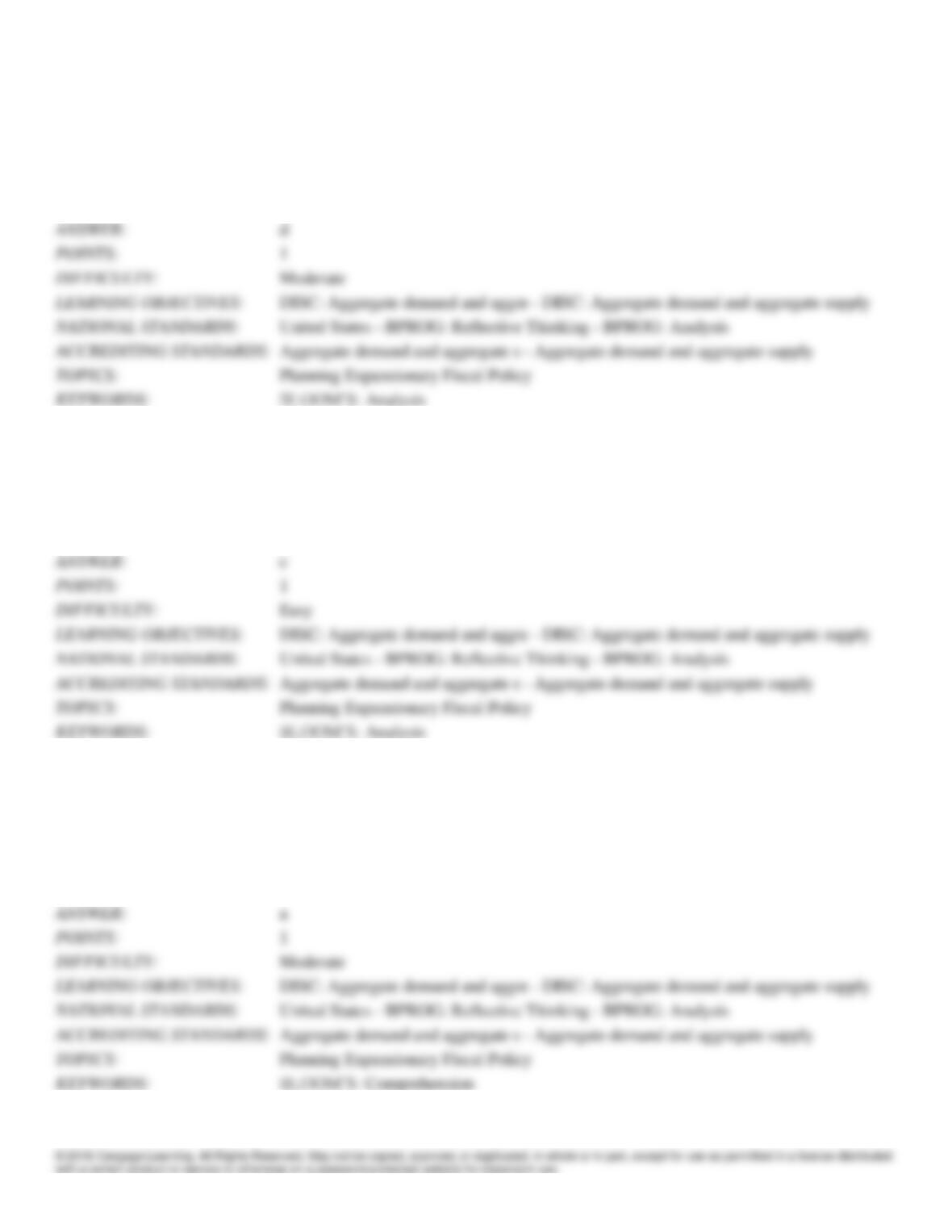
115. In Figure 11–1, the slope of the expenditures schedule is .75 and the government wishes to achieve full employment.
It should
a.
cut spending by 1,000.
b.
increase spending by 1,000.
c.
cut taxes by 1,000.
d.
increase spending by 250.
e.
cut taxes by 250.
DISC: Aggregate demand and aggre – DISC: Aggregate demand and aggregate supply
United States – BPROG: Reflective Thinking – BPROG: Analysis
Aggregate demand and aggregate s – Aggregate demand and aggregate supply
Planning Expansionary Fiscal Policy
116. In Figure 11–1, to achieve equilibrium at potential GDP the government could
a.
increase taxes.
b.
decrease transfer payments.
c.
increase government purchases.
d.
None of the above is correct.
DISC: Aggregate demand and aggre – DISC: Aggregate demand and aggregate supply
United States – BPROG: Reflective Thinking – BPROG: Analysis
Aggregate demand and aggregate s – Aggregate demand and aggregate supply
Planning Expansionary Fiscal Policy
117. In Figure 11–1, to reach the level of potential GDP, the administration of President Obama would most likely
advocate
a.
increasing Social Security payments.
b.
decreasing defense spending.
c.
decreasing personal income taxes.
d.
All of the above are correct.
DISC: Aggregate demand and aggre – DISC: Aggregate demand and aggregate supply
United States – BPROG: Reflective Thinking – BPROG: Analysis
Aggregate demand and aggregate s – Aggregate demand and aggregate supply
Planning Expansionary Fiscal Policy
118. In the middle of a severe recession, Congress passes an increase in the level of unemployment benefits. This would
be considered by economists as a
a.
positive tax.
b.
negative tax.
c.
form of government purchases.
d.
variable tax.
Moderate
DISC: Monetary and fiscal policy
United States – BPROG: Analytic
Monetary and fiscal policy
Planning Expansionary Fiscal Policy
119. If the economy experiences an unplanned inventory accumulation at the full employment level of GDP, then the
economy is in a(n)
a.
inflationary gap.
b.
hyperinflation.
c.
recessionary gap.
d.
full employment gap.
c
Moderate
DISC: Monetary and fiscal policy
United States – BPROG: Analytic
Monetary and fiscal policy
Planning Expansionary Fiscal Policy
120. After September 11, 2001, President George W. Bush believed in the need for a fiscal stimulus. The proper fiscal
policy to reflect this could include a(n)
a.
increase in taxes.
b.
reduction in transfer payments.
c.
increase in government purchases.
d.
All of the above are correct.
c
Moderate
DISC: Monetary and fiscal policy
United States – BPROG: Analytic
Monetary and fiscal policy
Planning Expansionary Fiscal Policy
121. Suppose the federal government is considering alternatives to increase the level of real GDP in order to reduce
unemployment. It can only do one of the following. Which will have the smallest impact on the federal budget?
a.
decreasing transfer payments
b.
increasing government spending
c.
increasing transfer payments
d.
decreasing government spending
DISC: Monetary and fiscal policy
United States – BPROG: Analytic
Monetary and fiscal policy
Planning Expansionary Fiscal Policy
122. Assume that the government is considering different policies to increase total expenditures in order to reduce
unemployment. Which of the following would achieve this objective?
a.
decreasing taxes
b.
increasing government spending
c.
increasing transfer payments
d.
All of the above are correct.
DISC: Monetary and fiscal policy
United States – BPROG: Analytic
Monetary and fiscal policy
Planning Expansionary Fiscal Policy
123. Assume that the federal government wishes to counteract inflation with a policy that has the smallest impact on the
federal budget. Which of the following would you recommend?
a.
Increase transfer payments.
b.
Increase government purchases.
c.
Decrease government purchases.
d.
Decrease transfer payments.
e.
Increase personal income taxes.
DISC: Monetary and fiscal policy
United States – BPROG: Analytic
Monetary and fiscal policy
Planning Contractionary Fiscal Policy
124. Which of the following is not a method to reduce the inflationary gap?
a.
Increasing government spending
b.
Reducing transfer payments
c.
Raising taxes
d.
Decreasing government expenditure
DISC: Monetary and fiscal policy
United States – BPROG: Analytic
Monetary and fiscal policy
Planning Contractionary Fiscal Policy
125. In 2000, many economists believed that the most serious macroeconomic problem confronting the U.S. economy was
an inflationary gap. Which policies would be effective in dealing with this problem?
a.
Increase transfer payments.
b.
Increase government purchases.
c.
Decrease personal income taxes.
d.
Increase personal income taxes.
DISC: Monetary and fiscal policy
United States – BPROG: Analytic
Monetary and fiscal policy
Planning Contractionary Fiscal Policy
126. To eliminate an inflationary gap, the expenditure schedule should
a.
shift upward.
b.
shift downward.
c.
become flatter.
d.
become steeper.
DISC: Monetary and fiscal policy
United States – BPROG: Analytic
Monetary and fiscal policy
Planning Contractionary Fiscal Policy
127. To eliminate an inflationary gap, the aggregate demand curve should
a.
shift outward.
b.
become vertical.
c.
become horizontal.
d.
shift inward.
DISC: Aggregate demand and aggre – DISC: Aggregate demand and aggregate supply
United States – BPROG: Analytic
Aggregate demand and aggregate s – Aggregate demand and aggregate supply
Planning Contractionary Fiscal Policy
128. In an effort to balance the federal budget, an increase in Social Security taxes is passed. What is the most likely effect
of this on equilibrium GDP?
a.
GDP will increase.
b.
GDP will decrease.
c.
GDP will not change but prices will rise.
d.
GDP will not change but employment will increase.
DISC: Monetary and fiscal policy
United States – BPROG: Analytic
Monetary and fiscal policy
Planning Contractionary Fiscal Policy
129. When total expenditures exceed the economy’s potential GDP, the proper fiscal policy is to
a.
increase transfer payments to the poor and elderly.
b.
cut personal income tax rates.
c.
decrease government purchases.
d.
increase purchasing power.
DISC: Monetary and fiscal policy
United States – BPROG: Analytic
Monetary and fiscal policy
Planning Contractionary Fiscal Policy
130. Contractionary fiscal policy may have some undesirable consequences. Among these is
a.
higher unemployment.
b.
higher inflation.
c.
higher net exports.
d.
larger federal deficits.
DISC: Monetary and fiscal policy
United States – BPROG: Analytic
Monetary and fiscal policy
Planning Contractionary Fiscal Policy
131. Compared to an economy’s self-correcting mechanism, active contractionary fiscal policy will
a.
work more slowly and calmly.
b.
work more quickly.
c.
have less deflationary effects.
d.
have a smaller effect on real GDP.
DISC: Monetary and fiscal policy
United States – BPROG: Analytic
Monetary and fiscal policy
Planning Contractionary Fiscal Policy
132. Which of the following will shift the aggregate demand curve outward?
a.
tax cuts and government spending cuts
b.
tax increases and government spending increases
c.
tax cuts and government spending increases
d.
tax increases and government spending increases
DISC: Aggregate demand and aggre – DISC: Aggregate demand and aggregate supply
United States – BPROG: Analytic
Aggregate demand and aggregate s – Aggregate demand and aggregate supply
The Choice between Spending Policy and Tax Policy
133. An active stabilization policy designed to limit the size of government would
a.
raise G to eliminate a recessionary gap and lower taxes to eliminate an inflationary gap.
b.
raise G to eliminate a recessionary gap and raise taxes to eliminate an inflationary gap.
c.
reduce taxes to eliminate a recessionary gap and raise G to eliminate an inflationary gap.
d.
reduce taxes to eliminate a recessionary gap and reduce G to eliminate an inflationary gap.
DISC: Monetary and fiscal policy
United States – BPROG: Analytic
Monetary and fiscal policy
The Choice between Spending Policy and Tax Policy