35) Which of the following will NOT lead to a change in the demand for labor?
A) a change in demand for the final good
B) a change in the supply of labor
C) a change in the price of a substitute input
D) a change in labor productivity
36) An increase in demand for Blu-ray disc players occurs. Which of the following statements is
TRUE for individual firms that produce Blu-ray disc players?
A) The price of Blu-ray disc players will decrease leading to an increase in the demand for labor
by the firm.
B) The price of Blu-ray disc players will increase leading to an increase in the demand for labor
by the firm.
C) The price of Blu-ray disc players will increase leading to a decrease in demand by customers
leading to a decrease in the demand for labor by the firm.
D) A change in demand at the industry level does not influence an individual firm’s demand
curve for labor.
37) Suppose the market for autoworkers is initially in equilibrium, but then the automakers
purchase capital goods that are a substitute for workers. What happens in the market for
autoworkers?
A) The equilibrium wage rate will increase and the equilibrium quantity of labor will decrease.
B) The equilibrium wage rate and the equilibrium quantity of labor will both increase.
C) The equilibrium wage rate and the equilibrium quantity of labor will both decrease.
D) The equilibrium wage rate will decrease and the equilibrium quantity of labor will increase.
38) Suppose the market for autoworkers is initially in equilibrium, but then suppose the
automakers improve working conditions at the plants. What happens in the market for
autoworkers?
A) The equilibrium wage rate will increase and the equilibrium quantity of labor will decrease.
B) The equilibrium wage rate and the equilibrium quantity of labor will both increase.
C) The equilibrium wage rate and the equilibrium quantity of labor will both decrease.
D) The equilibrium wage rate will decrease and the equilibrium quantity of labor will increase.
39) Suppose the market for autoworkers is initially in equilibrium, but then the demand for
automobiles increases and simultaneously the automakers allow autoworkers less flexibility
working at the plants. What happens in the market for autoworkers?
A) The equilibrium wage rate will increase and the equilibrium quantity of labor will increase,
decrease or stay the same.
B) The equilibrium wage rate will increase, decrease or stay the same and the equilibrium
quantity of labor will increase.
C) The equilibrium wage rate and the equilibrium quantity of labor will both decrease.
D) The equilibrium wage rate will decrease and the equilibrium quantity of labor will increase.
40) Suppose the market for tortillas is initially in equilibrium, but then the equilibrium wage rate
and the equilibrium quantity of labor both increased. What happened in the market for tortilla?
A) The demand for tortillas increased.
B) The demand for tortillas decreased.
C) The supply for tortillas increased.
D) The supply for tortillas decreased.
41) Suppose the market for pizza makers is initially in equilibrium, but then the equilibrium
wage rate increased and the equilibrium quantity of labor will decreased. What happened in the
market for pizza makers?
A) The demand for pizza makers increased.
B) The demand for pizza makers decreased.
C) The supply for pizza makers decreased.
D) The supply for pizza makers increased.
42) The demand for LED TVs increases. As a result
A) the wage rate in the LED TV industry increases and the quantity demanded of workers
increases.
B) the wage rate in the LED TV industry increases and the quantity supplied of workers
increases.
C) the demand for labor increases and the supply of labor also increases, leaving wages
unchanged.
D) the demand for labor increases, but since the supply curve of labor is perfectly elastic, the
wage rate does not change.
43) When manufacturing an iPhone, parts must be soldered together. This work can be done by
labor or by a robot (capital). More robots will be hired when the price of labor increases. This is
known as
A) the effect of changing labor productivity.
B) marginal revenue product.
C) the complementary effect.
D) the substitution effect.

44) Coal and iron ore are complements in the manufacture of steel. An increase in the price of
coal would lead to
A) an increase in the demand for iron ore as producers substitute more iron ore for coal in the
production process.
B) a decrease in the demand for iron ore as steel manufacturers reduce production of steel.
C) an increase in the supply of iron ore as iron ore producers see an opportunity to expand their
markets.
D) no change in the demand for iron ore since the steel makers must use both iron ore and coal if
they are to make steel.
45) Suppose firms in an industry hire unskilled labor and skilled labor. Unskilled labor is a
substitute for capital and skilled labor is a complement with capital. A decrease in the real price
of capital would
A) cause the demand for labor to increase, raising wages of both skilled and unskilled labor.
B) cause the demand for unskilled labor to increase and the demand for skilled labor to decrease.
The wage of unskilled labor would rise relative to the wage of skilled labor.
C) cause the demand for unskilled labor to decrease and the demand for skilled labor to increase.
The wage of unskilled labor would decrease relative to the wage of skilled labor.
D) cause the demand for both kinds of labor to decrease. Wages rates of both kinds of labor
would decrease too.
46) Which of the following will not lead to an increase in the demand for labor for a firm
producing automobiles?
A) a decrease in labor productivity
B) an increase in the price of robots that are used to solder parts of the car together
C) an increase in the demand for automobiles
D) an increase in the price of automobiles

47) A decrease in the supply of labor could be caused by
A) wage rates falling in another industry.
B) better working conditions.
C) more job flexibility.
D) increased wage rates in another industry.
48) Which of the following will not cause the supply of labor curve to shift in the economics
professor industry?
A) a decrease in the wage rate for Ph.D. economists in the banking industry
B) a decrease in the number of courses a professor must teach
C) Universities have discovered a way to make professors more productive.
D) University professors are going to be required to spend more time in their offices.
49) An increase in the supply of labor to an industry could be caused by
A) higher wages.
B) increased productivity of labor.
C) an increase in job flexibility in the industry.
D) an increase of wages in another industry.

50) Ajax Corporation has just decided to let managers work from home one day a week. This
decision will make working conditions better and will
A) cause the demand curve for labor for managers to increase.
B) increase the elasticity of demand for labor for managers.
C) lead to an increase in the supply curve of labor for managers.
D) leave the supply curve of labor unchanged.
51) In the perfectly competitive market, the labor supply curve faced by the individual firm is
________, while that of the market is ________.
A) perfectly elastic; perfectly inelastic
B) perfectly inelastic; perfectly elastic
C) perfectly elastic; upward sloping
D) perfectly inelastic; upward sloping
52) A single firm in a competitive labor market has a labor supply curve that is
A) upward sloping.
B) perfectly inelastic.
C) perfectly elastic.
D) downward sloping.

53) In a perfectly competitive labor market, the wage rate paid by the individual firm is
A) the equilibrium market wage rate.
B) dependent on the demand for the product.
C) below the equilibrium market wage rate.
D) a function of the tax system.
54) Absent government interference, the wage rate for labor in a competitive market is
established
A) solely by the firm’s demand for labor.
B) solely by the market supply of labor.
C) by both the demand for and supply of labor at each individual firm.
D) by the the market supply and market demand for labor.
55) A change in a price of a substitute input for labor will cause
A) a change in the demand for labor in the opposite direction of the price change.
B) no change in the demand for labor.
C) a change in the supply of labor in the opposite direction of the price change.
D) a change in the demand for labor in the same direction of the price change.

56) If an increase in the price of one input causes an increase in demand for labor, the two inputs
are
A) complementary.
B) substitutes.
C) interchangeable.
D) flexible.
57) Which of the following would NOT be a reason for a shift in the labor demand curve?
A) a change in demand for the final product
B) a change in labor productivity
C) a change in the market wage rate
D) a change in the price of a related input
58) There are a number of reasons why labor supply curves will shift in a particular industry.
Which one of the following is NOT one of them?
A) Changes in working conditions in an industry affect the labor supply curve.
B) job flexibility that determines the position of the labor supply curve
C) There is a change in the market wage rate.
D) Taxes on labor affect the labor supply curve.

59) If the price of golf balls increases, what will likely happen to the demand for golf club
manufacturing employees?
A) It will increase.
B) It will decrease.
C) It will stay the same.
D) Nothing, the two are not related.
60) When the price of labor increases, the substitution effect will ________ the quantity of labor
demanded and the output effect will ________ it.
A) increase; increase
B) increase; decrease
C) decrease; increase
D) decrease; decrease
61) Which of the following will NOT shift the MRP curve for labor?
A) a change in the productivity of labor
B) a change in the price of the product being sold
C) a change in the wage rate in the market
D) a change in the demand for the product being produced
62) All of the following shift the labor demand curve EXCEPT changes in
A) fringe benefits offered to employees.
B) the demand for the final product.
C) labor productivity.
D) prices of related factors.
63) All of the following shift an industry’s labor supply curve EXCEPT changes in
A) market wages offered in other industries.
B) the demand for the final product.
C) job flexibility.
D) working conditions.
64) Suppose the market price of zinc doubles. Which of the following scenarios is most likely?
A) The demand for zinc miners will increase, raising the market wage rate.
B) The demand for zinc miners will decrease, reducing the market wage rate.
C) The demand for zinc will increase, raising the market price further.
D) The demand for zinc miners will decrease, reducing the market price back to its original
price.
65) What does it mean for a firm to be a price taker in the labor market?
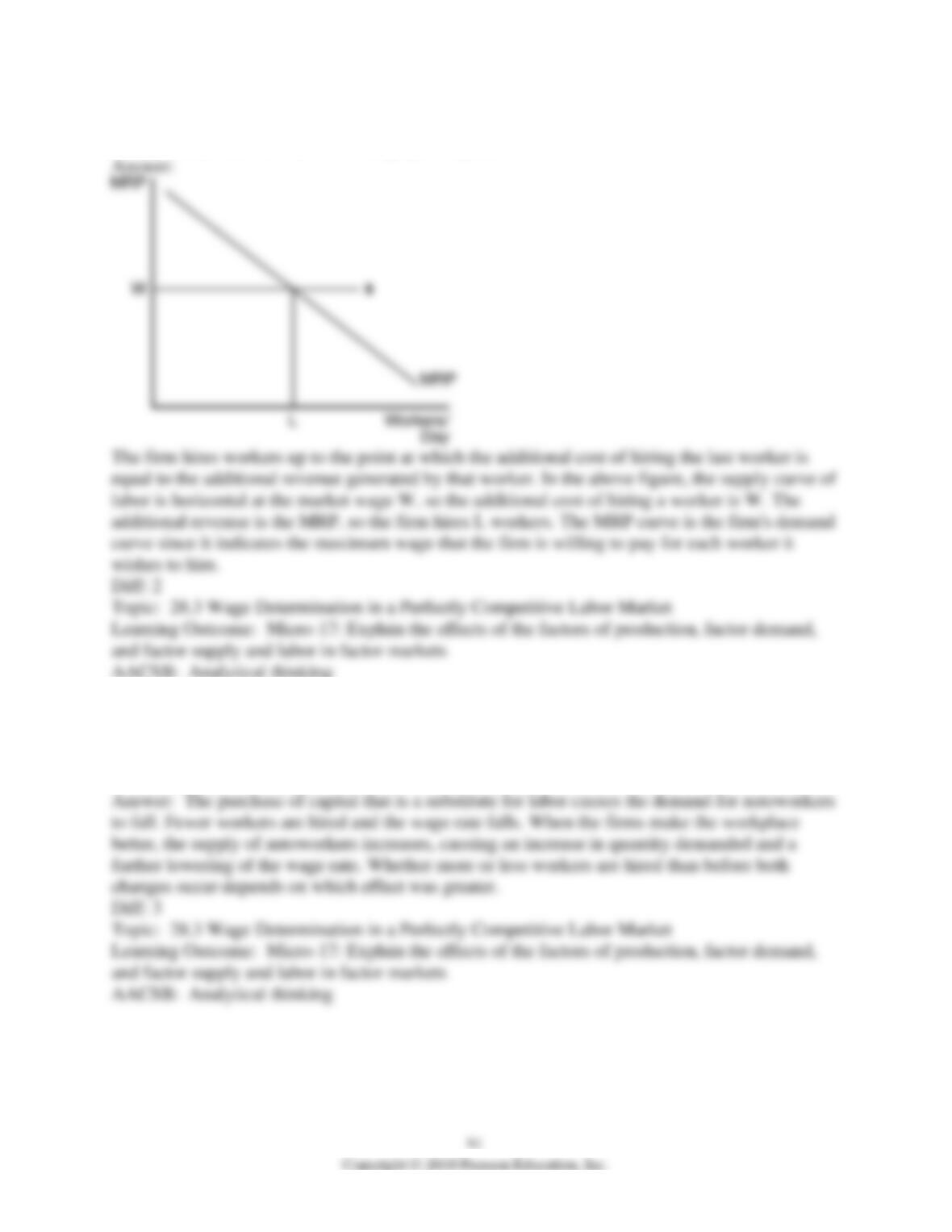
66) What is the general rule for hiring for a perfectly competitive firm? Show it on a graph. What
is the demand curve for labor on the graph? Explain.
67) Suppose the market for autoworkers is initially in equilibrium, but then the automakers
purchase capital goods that are a substitute for workers. What happens in the market for
autoworkers? Explain. Now, suppose the automakers improve working conditions at the plants.
What are the effects? Explain.
68) Explain the efficiency wage theory.
69) What can cause the demand curve for labor to shift? Explain.
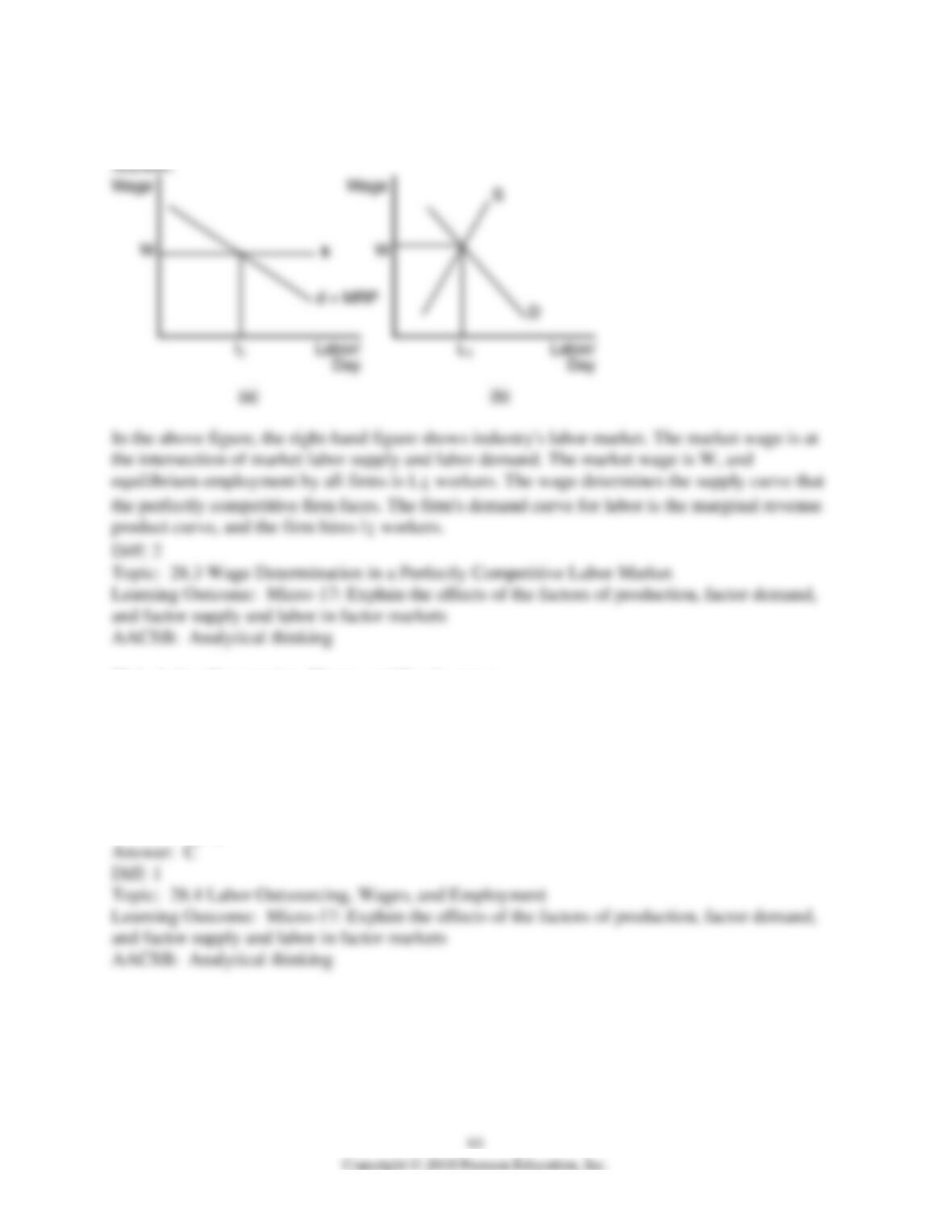
70) Explain how the equilibrium wage rate is determined for a perfectly competitive industry and
how a firm in that industry determines its profit maximizing employment level.
28.4 Labor Outsourcing, Wages, and Employment
1) When U.S. companies hire workers in India to staff their customer service call centers, they
are engaging in
A) predatory pricing.
B) unfair trade practices.
C) outsourcing.
D) labor engagement.
2) A firm’s employment of labor outside the country in which the firm is located is called
A) featherbedding.
B) a lockout.
C) outsourcing.
D) dumping.
3) The practice of outsourcing has been given a boost by
A) advances in telecommunications and computer networking.
B) support from organized labor.
C) firms that are becoming more risk-averse.
D) sharp increases in the cost of overseas labor.
4) Outsourcing is being practiced by
A) U.S. firms that want to keep jobs at home in the United States.
B) overseas firms hiring in the U.S. labor market and by U.S. firms hiring in foreign labor
markets with lower wages.
C) U.S. firms only.
D) governments but private firms are not allowed to outsource work.

5) Which of the following is an example of outsourcing?
A) A U.S. firm moves a manufacturing plant from the U.S. to Thailand where the firm can hire
cheaper labor.
B) A German firm hires an accountant in the U.S. to manage its payrolls.
C) All the above are examples of outsourcing.
D) None of the above is an example of outsourcing.
6) Suppose that U.S. firms outsource computer manufacturing jobs to China, it is expected that
A) the wage rate for workers manufacturing computers will decrease in the U.S. but increase in
China.
B) the wage rate for workers manufacturing computers will increase in the U.S. but decrease in
China.
C) the wage rate for workers manufacturing computers will increase in both the U.S. and China.
D) the wage rate for workers manufacturing computers will decrease in both the U.S. and China.
7) When Canadian firms outsource accounting services to the United States, in markets for the
labor of accountants,
A) equilibrium employment and the market clearing wage rate will both increase in Canada, but
equilibrium employment and the market clearing wage rate will both decrease in the United
States.
B) equilibrium employment and the market clearing wage rate will both decrease in Canada, but
equilibrium employment and the market clearing wage rate will both increase in the United
States.
C) equilibrium employment and the market clearing wage rate will both increase in Canada and
in the United States.
D) equilibrium employment and the market clearing wage rate will both decrease in Canada and
the United States.
8) A firm’s employment of labor outside the country in which the firm is located
A) is outsourcing.
B) shifts the supply of labor in the original country.
C) is the marginal revenue product.
D) shifts the supply of labor in the other country.
9) Outsourcing is
A) one of the factors that shifts the supply of labor curve.
B) when a firm employs labor outside the country in which the firm is located.
C) when the change in the price of a complementary input causes the demand for labor curve to
shift in the opposite direction.
D) the cost of using an additional unit of an input.
10) Outsourcing is
A) only beneficial to a few select countries.
B) another way for residents of different nations to conduct trade with one another.
C) not beneficial to any country.
D) not beneficial to the consumers who purchase outsourced goods.

11) Some companies are having their technical support calls answered by people located in
India. This is an example of
A) a factor that shifts the supply of labor curve in the U.S.
B) insourcing.
C) outsourcing.
D) a change in the demand for the final product that labor produces.
12) What are the short-run economic effects when U.S. firms substitute labor outside of the U.S.
for labor inside the U.S.?
A) The wage rate in the U.S. will remain the same, and the wage rate in the foreign country will
decrease.
B) The wage rate in the U.S. will increase, and the wage rate in the foreign country will decrease.
C) The wage rate in the U.S. will decrease, and the wage rate in the foreign country will
decrease.
D) The wage rate in the U.S. will decrease, and the wage rate in the foreign country will
increase.
13) What are the short-run economic effects when U.S. firms substitute labor outside of the U.S.
for labor inside the U.S.?
A) The demand curve for labor in the U.S. decreases, and the demand curve in the foreign
country will increase.
B) The demand curve for labor in the U.S. increases, and the demand curve in the foreign
country will decrease.
C) The demand curve for labor in the U.S. decreases, and the demand curve in the foreign
country will decrease.
D) The demand curve for labor in the U.S. increases, and the demand curve in the foreign
country will increase.
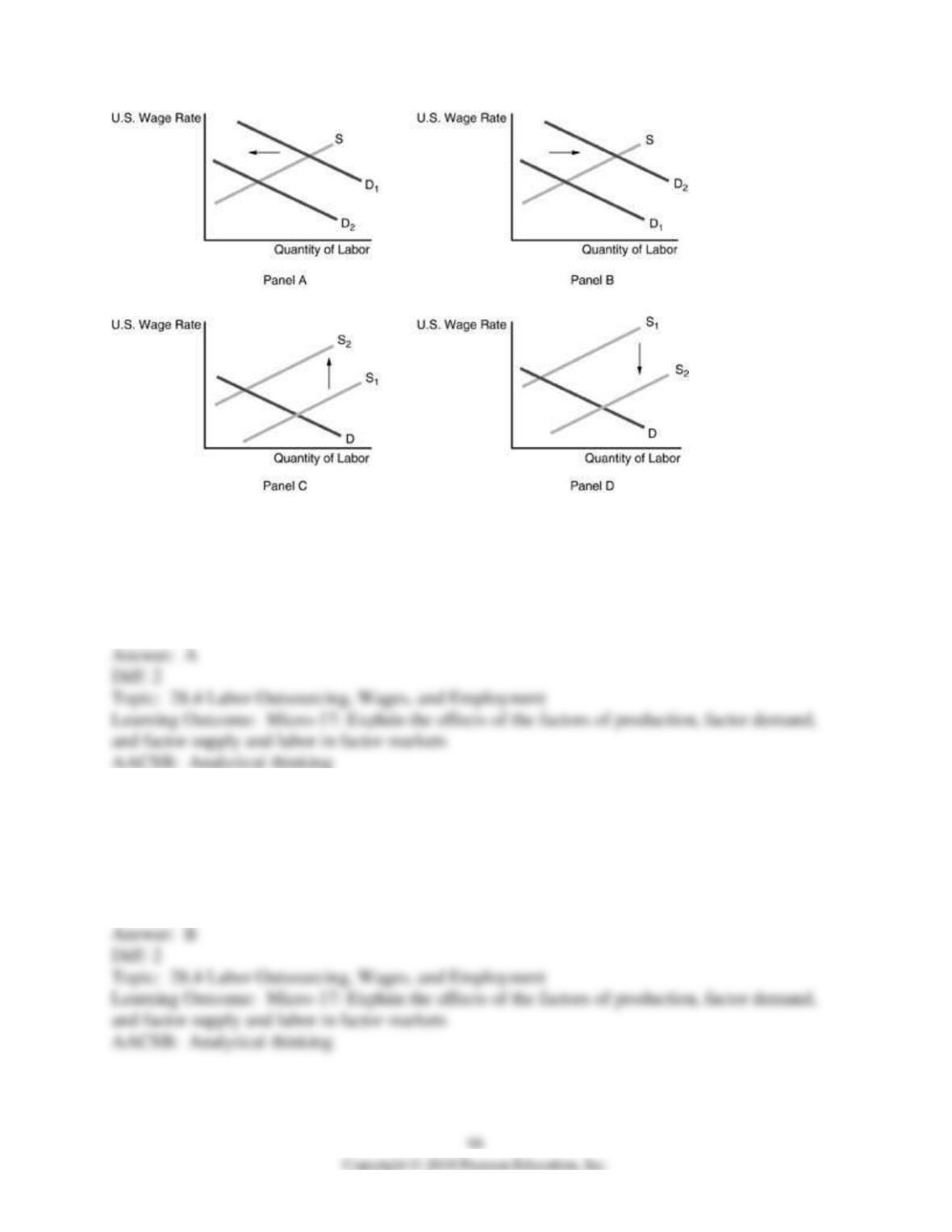
14) Refer to the above figure. Which panel represents what happens in the U.S. job market in the
short-run when U.S. firms substitute labor outside of the U.S. for labor inside the U.S.?
A) Panel A
B) Panel B
C) Panel C
D) Panel D
15) Refer to the above figure. Which panel represents what happens in the foreign job market in
the short-run when U.S. firms substitute labor outside of the U.S. for labor inside the U.S.?
A) Panel A
B) Panel B
C) Panel C
D) Panel D

16) Which of the following statements describes the long-run effects of global outsourcing?
A) Wages for U.S. workers will decrease but wages in other countries will increase.
B) Wages in all countries will remain the same as before the outsourcing.
C) Wages and employment will increase globally.
D) Wages will increase globally and employment will stay the same.
17) Which of the following statements is FALSE about the long-run effects of outsourcing?
A) Outsourcing allows countries to specialize in producing what they can produce most
efficiently.
B) More goods and services can be produced than in the absence of outsourcing.
C) Globally wages will increase because of outsourcing.
D) Employment levels will decrease globally as the result of outsourcing.
18) Employment of labor in a country other than the firm’s home country is called
A) employing guest workers.
B) outsourcing.
C) employing non-naturalized workers.
D) employing illegal aliens.

19) Economic analysis indicates the net long-run effect of outsourcing for the United States is
likely to be
A) an increased demand for labor due to economic growth.
B) a decreased in the demand for labor in the United States in the short run.
C) an increase in the supply of labor.
D) a decrease in the supply of labor.
20) When firms in a U.S. industry outsource some of their production,
A) both U.S. labor demand and U.S. wages in the industry fall
B) U.S. labor demand falls, but U.S. wages are not affected.
C) U.S. labor demand remains unchanged, but U.S. wages fall.
D) U.S. labor demand falls, but U.S. wages increase.
21) Suppose a U.S. computer company outsources its technical-support services to India. This
will cause
A) the demand for labor in the United States to fall, lowering U.S. wage rates, and the demand
for labor in India to increase, increasing Indian wage rates.
B) the demand for labor in the United States to increase, lowering U.S. wage rates, and the
demand for labor in India to fall, increasing Indian wage rates.
C) the demand for labor in the United States to fall, lowering U.S. wage rates, and the demand
for labor in India to fall, decreasing Indian wage rates.
D) the demand for labor in the United States to increase, increasing U.S. wage rates, and the
demand for labor in India to fall, decreasing Indian wage rates.