Economics Today, 19e (Miller)
Chapter 28 The Labor Market: Demand, Supply and Outsourcing
28.1 Labor Demand for a Perfectly Competitive Firm
1) For a perfectly competitive firm, the value of the marginal product of labor falls as more
workers are hired because of the diminishing
A) output price.
B) marginal physical product of labor.
C) price of labor.
D) marginal cost of production.
2) The additional revenue earned from hiring one more worker is known as the
A) marginal physical product of labor.
B) marginal revenue product of labor.
C) marginal factor cost of labor.
D) marginal utility of labor.
3) The additional cost associated with the hiring of one more unit of labor is known as the
A) marginal physical product of labor.
B) marginal revenue product of labor.
C) marginal factor cost of labor.
D) marginal utility of labor.
4) Suppose at the current level of labor used, MRP = $100 and MFC = $50. To maximize profits,
the firm should
A) hire more labor.
B) reduce the level of labor.
C) maintain the current level of labor.
D) shut down.
5) Suppose at the current level of labor used, MRP = $20 and MFC = $25. To maximize profits,
the firm should
A) hire more labor.
B) reduce the level of labor.
C) maintain the current level of labor.
D) expand production.
6) Suppose at the current level of labor used, MRP = $20 and MFC = $20. To maximize profits,
the firm should
A) hire more labor.
B) reduce the level of labor.
C) maintain the current level of labor.
D) shut down.
7) Derived demand means
A) the labor demand curve will be upward sloping.
B) labor demand is derived from demand for the product it produces.
C) labor demand will shift about in a random fashion.
D) labor demand is determined by the supply of labor.
8) The additional production resulting from hiring one more worker is
A) marginal physical product.
B) marginal cost.
C) marginal production.
D) additional production.
9) Holding other things constant, an increase in the use of capital in production would
A) increase the marginal productivity of labor.
B) decrease, but not proportionately, the marginal productivity of labor.
C) not change the marginal productivity of labor.
D) decrease proportionately the marginal productivity of labor.
10) If a firm employs an extra unit of labor, the additional product generated by employing the
extra unit of labor is
A) the marginal physical product of labor.
B) the diminished marginal product.
C) marginal revenue.
D) total product.
11) The change in total output due to the change in one variable input, while holding all other
inputs constant, is the
A) marginal revenue product.
B) derived demand for labor.
C) marginal physical product.
D) market demand curve for labor.
12) The marginal physical product of labor is the
A) total output divided by the number of labor employed.
B) wage that must be paid to labor.
C) value of sales divided by additional labor used.
D) change in output generated by a unit change in labor.
13) We assume that when a firm hires additional workers, the marginal physical product of labor
will
A) increase because more workers can always get more work done.
B) decrease because the new workers are likely to be less able than the previously hired ones.
C) decrease because each worker now has less capital and other resources to work with.
D) increase because large firms are more efficient.
14) As more workers are hired, the marginal physical product of labor eventually declines
because
A) less efficient workers are hired as the number of workers increases.
B) workers do not work well together when the number of workers increases.
C) the amount of capital each worker has to work with declines as the number of workers
increases.
D) of diseconomies of scale.
15) Marginal revenue product is
A) marginal physical product multiplied by marginal revenue.
B) marginal physical product multiplied by average variable cost of the product.
C) the price of the product.
D) the total revenue from the sale of the product sales.
16) The contribution to total revenues coming from the next worker hired is
A) marginal product.
B) marginal revenue product.
C) total product.
D) total revenues.
17) A firm’s marginal factor cost describes
A) the increase in the firm’s total revenue as one more unit of output is sold.
B) the change in total fixed cost that results from hiring one more unit of input.
C) the change in total variable cost that results from the production of an extra unit of output.
D) the change in total cost that results from using one more unit of an input.
18) If a firm is a perfectly competitive purchaser of factor inputs and the wage rate is $10, the
marginal factor cost for labor is
A) greater than $10.
B) less than $10.
C) $10.
D) indeterminate.
19) When market wages increase in a perfectly competitive market, then
A) the marginal factor cost increases.
B) the marginal product increases.
C) the marginal factor cost decreases.
D) the marginal product decreases.
20) The marginal revenue product is
A) the change in total output resulting from a one-unit change in variable output.
B) the change in marginal output resulting from a one-unit change in variable input.
C) the change in total revenue resulting from a one-unit change in variable input.
D) the change in marginal revenue resulting from a one-unit change in variable input.
21) The marginal revenue product of labor is
A) the marginal physical product multiplied by marginal revenue.
B) the marginal revenue of output multiplied by the price of the input.
C) total sales divided by total labor employed.
D) total labor employed divided by total sales.
22) When 4 units of labor are employed, total product is 6 units; when 5 units of labor are
employed, total product is 8 units of output. If the price of output is $5 per unit, what is the
marginal revenue product of the 5th unit of labor?
A) $2
B) $5
C) $10
D) $40
23) When 5 units of labor are employed, total product is 9 units; when 6 units of labor are
employed, total product is 11 units of output. If the price of output is $5 per unit, what is the
marginal revenue product of the 6th unit of labor?
A) $10
B) $5
C) $15
D) $55
24) Marginal factor cost is
A) the change in the value of output from using an additional unit of the factor.
B) the cost of an additional unit of output.
C) the total value of factor cost divided by the one cost that is being held constant.
D) the cost of using an additional unit of an input.
25) The marginal revenue product represents
A) the marginal physical product of labor divided by the price of the good produced.
B) the worker’s contribution to the firm’s total revenues.
C) the worker’s contribution to the firm’s output.
D) the value of each additional unit of output.
26) The firm’s demand curve for labor is
A) the marginal revenue product curve for labor.
B) the demand curve for the good produced divided by the price of the good.
C) the marginal physical product curve for labor divided by the price of the good.
D) the marginal physical product curve for labor multiplied by the price of labor.
27) A firm will not hire additional workers once
A) it earns accounting profits.
B) the additional cost of a worker equals the additional revenue from the worker.
C) total product is rising.
D) the company reaches its breakeven output level.
28) When MFC = MRP, a firm in a competitive market will
A) stop hiring more workers.
B) hire more workers.
C) earn additional profits.
D) layoff workers.
29) When MFC < MRP, a firm in a competitive market will
A) stop hiring more workers.
B) hire more workers.
C) earn fewer profits.
D) layoff workers.
30) When MFC > MRP, a firm in a competitive market will
A) stop hiring additional workers.
B) hire more workers.
C) earn additional profits.
D) layoff workers.
31) A profit-maximizing firm in a competitive market will continue to hire more workers when
A) the marginal factor cost exceeds the marginal revenue product of the additional workers.
B) the marginal factor cost equals the marginal revenue product of the additional workers.
C) the marginal factor cost is less than the marginal revenue product of the additional workers.
D) the marginal factor cost is less than zero.
32) Which of the following statements about a perfectly competitive market are TRUE?
I. The perfectly competitive industry faces an upward sloping labor supply curve.
II. The individual firm in a perfectly competitive industry faces a perfectly elastic labor supply
curve.
A) I only
B) II only
C) both I and II
D) neither I nor II
33) The market demand curve for labor
A) slopes downward.
B) slopes upward.
C) is vertical at the existing supply of labor.
D) is horizontal at the going wage rate.
34) A firm’s marginal revenue product of labor curve is also
A) its labor demand curve.
B) its marginal cost curve.
C) its total revenue line.
D) its long-run input cost function.
35) The demand for labor is
A) derived from the satisfaction that hiring the inputs provides the owner or manager of the firm
more money.
B) derived from the demand for the final product being produced.
C) derived from a utility maximizing process similar to that used to derive the demand curve for
goods and services.
D) totally unrelated to the demand curve for the final product.
36) When the price of a product increases, the marginal revenue product curve in a perfectly
competitive market
A) does not change.
B) becomes flatter.
C) shifts to the right.
D) shifts to the left.
37) When the price of a product decreases, the marginal revenue product curve in a perfectly
competitive market
A) does not change.
B) becomes steeper.
C) shifts to the right.
D) shifts to the left.
38) When the marginal productivity of labor decreases, the demand curve for labor in a perfectly
competitive market
A) does not change.
B) becomes steeper.
C) shifts to the right.
D) shifts to the left.
39) When increased demand raises the price of the product, the
A) marginal revenue product will also increase.
B) marginal revenue product will fall.
C) marginal revenue product will remain unchanged.
D) sales will fall.
40) The marginal revenue product curve shifts when
A) wages fall.
B) there is a change in the product price workers are producing.
C) wages rise.
D) the wages paid exceed the price.
41) A perfectly competitive firm will hire workers up to the quantity at which the wage rate
equals the
A) marginal revenue product of labor.
B) marginal factor cost of labor.
C) price of the extra output produced.
D) average physical product of labor.
42) A decrease in demand for a product, holding other things constant, will
A) increase the marginal revenue product of labor.
B) decrease the marginal revenue product of labor.
C) not change the marginal revenue product of labor.
D) have an undetermined effect upon the marginal revenue product of labor.
43) The demand for labor is considered a derived demand since it depends on
A) the supply of labor.
B) the market for capital.
C) the consumer demand for the output produced.
D) competitive markets.
44) An outward shift in the consumer demand for wheat will
A) raise the price of wheat and shift inward the marginal revenue product of labor producing
wheat.
B) lead to more capital and less labor used in producing wheat.
C) raise the price of wheat and shift out the marginal revenue product of labor producing wheat.
D) lead to downward pressure on the wages of those producing wheat.
45) A firm is a price taker in the labor market if
A) the skills of available workers do not match the requirements for the job.
B) there is a scarcity of labor in the market.
C) the hiring of more workers will drive the existing wage rate up.
D) the hiring of more workers will leave the existing wage rate unchanged.
46) If the supply of labor to a firm is perfectly elastic at the going wage rate established by the
forces of supply and demand then
A) the firm is price taker.
B) the firm can only hire additional units of labor by driving the wage rate up.
C) the wage rate has been decreasing.
D) full employment exists in the labor market.
47) For a firm in a perfectly competitive labor market, the supply curve of labor is
A) elastic.
B) inelastic.
C) perfectly elastic.
D) perfectly inelastic.
48) A firm in a competitive input market can
A) hire workers at the going wage.
B) hire additional workers only by raising wages.
C) hire additional workers at lower wages because those who are still unemployed are anxious to
work.
D) hire additional workers only after a long search process.
49) For a worker to be potentially available, he or she must
A) know about the jobs available at a particular firm.
B) be in the relevant geographic market and be willing to work for minimum wage.
C) have most of the skills required by the firm only.
D) have the skills required by the firm and be in the relevant geographic market.
50) The increase in output that results when one more unit of a variable input is hired is called
A) total physical product.
B) marginal physical product.
C) average physical product.
D) marginal revenue.
51) The marginal physical product of labor is
A) the output of the firm divided by the number of workers.
B) the change in total revenues resulting from the addition of one more worker, while increasing
one other factor of production.
C) the change in output resulting from the addition of one more worker, holding other factors of
production constant.
D) the change in output resulting from the addition of one more worker, adjusting the level of the
capital stock accordingly.
52) As a firm hires more workers, holding the amounts of capital and other inputs constant,
A) output increases at a decreasing rate.
B) output increases at a constant rate.
C) output increases for a while and then decreases.
D) output increases, but we can’t be certain whether output increases at an increasing or a
decreasing rate.
53) Other things held constant, after some point hiring additional units of labor will cause the
marginal physical product of labor to decline because
A) the firm is a price taker.
B) the wage rate increases when additional workers are hired.
C) of the law of diminishing marginal product.
D) the supply of labor is perfectly elastic.
54) As a firm hires more workers, holding capital and other factors constant, the marginal
physical product of labor declines because
A) there are diseconomies of scale.
B) less efficient workers are hired as the number of workers increase.
C) workers don’t perform well in teams.
D) the amount of other inputs each worker has to work with declines as the number of workers
increases.
55) The marginal physical product of labor for the most recent worker hired by a company is
100. If this company were to hire an additional worker we would expect the marginal physical
product of labor to
A) remain at 100.
B) be below 100.
C) be above 100 by a small amount.
D) be infinity.
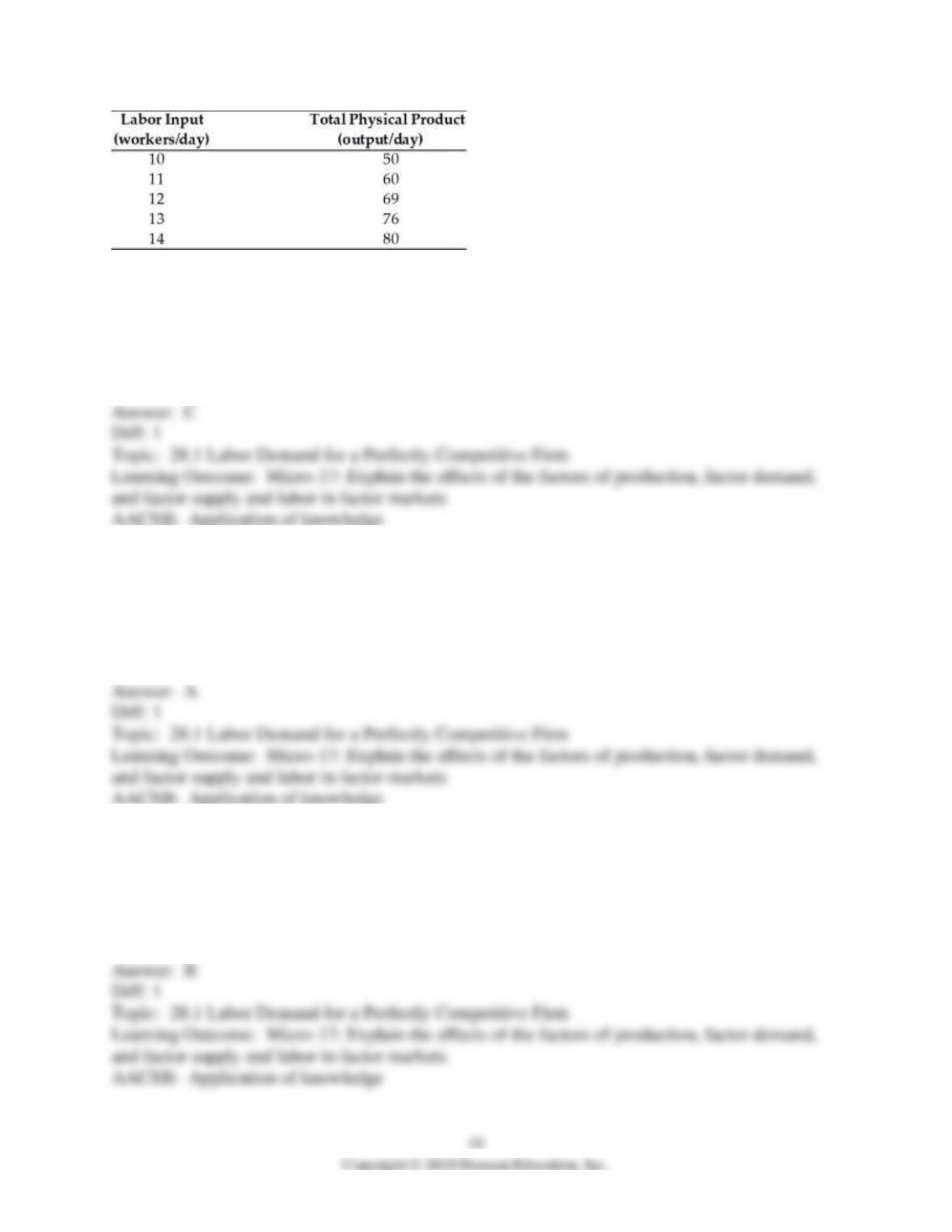
56) Refer to the above table. What does the marginal physical product equal when the amount of
labor goes from 10 to 11 units?
A) 60
B) 50
C) 10
D) 5
57) Refer to the above table. If the price of the good produced is $6, the marginal revenue
product of the 11th worker is
A) $60.
B) $66.
C) $350.
D) $360.
58) Refer to the above table. What does the marginal physical product equal when the amount of
labor goes from 11 to 12 units?
A) 60
B) 9
C) 10
D) 69
59) Refer to the above table. If the price of the good produced is $8, the marginal revenue
product of the 12th worker is
A) $72.
B) $80.
C) $552.
D) $56.
60) Refer to the above table. What does the marginal physical product equal when the amount of
labor goes from 12 to 13 units?
A) 10
B) 7
C) 69
D) 76
61) Refer to the above table. If the price of the good produced is $9, the marginal revenue
product of the 13th worker is
A) $81.
B) $36.
C) $684.
D) $63.