KEYWORDS:
BLOOM’S: Comprehension
134. Policy makers and citizens who want to expand the size of the government sector would favor stabilization policies
that
a.
raise G to eliminate a recessionary gap and lower taxes to eliminate an inflationary gap.
b.
raise G to eliminate a recessionary gap and raise taxes to eliminate an inflationary gap.
c.
reduce taxes to eliminate a recessionary gap and raise G to eliminate an inflationary gap.
d.
reduce taxes to eliminate a recessionary gap and reduce G to eliminate an inflationary gap.
ANSWER:
POINTS:
DIFFICULTY:
DISC: Monetary and fiscal policy
United States – BPROG: Analytic
Monetary and fiscal policy
TOPICS:
The Choice between Spending Policy and Tax Policy
KEYWORDS:
BLOOM’S: Comprehension
135. President George W. Bush, who favored a smaller government sector,
a.
believed we should increase G to eliminate a recessionary gap.
b.
believed we should raise taxes to eliminate an inflationary gap.
c.
favored an active fiscal policy just as well as those who favor a larger government sector.
d.
argued against the use of an active fiscal policy.
ANSWER:
POINTS:
DIFFICULTY:
DISC: Monetary and fiscal policy
United States – BPROG: Analytic
Monetary and fiscal policy
TOPICS:
The Choice between Spending Policy and Tax Policy
KEYWORDS:
BLOOM’S: Comprehension
136. One of the practical issues in the choice of government spending or taxes to change aggregate demand is how large a
a.
change in demand we want.
b.
trade deficit we want.
c.
budget deficit we want.
d.
government sector we want.
ANSWER:
POINTS:
DIFFICULTY:
DISC: Monetary and fiscal policy
United States – BPROG: Analytic
Monetary and fiscal policy
TOPICS:
The Choice between Spending Policy and Tax Policy
KEYWORDS:
BLOOM’S: Comprehension
137. A fiscal policy that reduces taxes or increases government spending will cause a(n)
a.
increase in real GDP and a decrease in the price level.
b.
increase in real GDP and an increase in the price level.
c.
decrease in real GDP and a decrease in the price level.
d.
decrease in real GDP and an increase in the price level.
DISC: Monetary and fiscal policy
United States – BPROG: Analytic
Monetary and fiscal policy
The Choice between Spending Policy and Tax Policy
138. A “conservative” would most likely argue in favor of
a.
tax increases when fiscal stimulus is necessary, and spending cuts when fiscal restraint is necessary.
b.
tax cuts when fiscal restraint is necessary, and spending cuts when fiscal stimulus is necessary.
c.
tax cuts when fiscal stimulus is necessary, and spending cuts when fiscal restraint is necessary.
d.
spending increases when fiscal expansion is necessary, and tax increases when fiscal stimulus is necessary.
DISC: Monetary and fiscal policy
United States – BPROG: Analytic
Monetary and fiscal policy
139. A “liberal” would most likely argue in favor of
a.
tax increases when fiscal stimulus is necessary, and spending cuts when fiscal restraint is necessary.
b.
tax cuts when fiscal restraint is necessary, and spending cuts when fiscal stimulus is necessary.
c.
tax cuts when fiscal stimulus is necessary, and spending cuts when fiscal restraint is necessary.
d.
spending increases when fiscal expansion is necessary, and tax increases when fiscal restraint is necessary.
DISC: Monetary and fiscal policy
United States – BPROG: Analytic
Monetary and fiscal policy
The Choice between Spending Policy and Tax Policy
140. A conservative who was opposed to an increase in the size of the government sector but believed in the Keynesian
approach to aggregate demand management would most likely favor which of the following expansionary policies?
a.
increase taxes
b.
decrease taxes
c.
increase government spending
d.
decrease government spending
DISC: Monetary and fiscal policy
United States – BPROG: Reflective Thinking – BPROG: Analysis
Monetary and fiscal policy
The Choice between Spending Policy and Tax Policy
141. Which of the following statements would appeal to someone who favors an expanded public sector as the basis of
expansionary fiscal policy?
a.
“The government isn’t the solution; it’s the problem.”
b.
“The government that governs least governs best.”
c.
“The American people want national defense; they want laws to be enforced; they want federal support for
education and environmental protection, and they want transfer payments for the elderly and unemployed.”
d.
“If you ever got anything good out of the government you can be sure that some rich so-and-so got more.”
DISC: Monetary and fiscal policy
United States – BPROG: Analytic
Monetary and fiscal policy
The Choice between Spending Policy and Tax Policy
142. When policy makers choose between tax policy and spending policy to affect the level of aggregate demand, they
tend to choose on the basis of
a.
how large a public sector they want.
b.
how much they want to change aggregate demand.
c.
how much they want to change aggregate supply.
d.
which has the larger multiplier.
DISC: Monetary and fiscal policy
United States – BPROG: Analytic
Monetary and fiscal policy
The Choice between Spending Policy and Tax Policy
143. For liberals, the United States has a(n)
a.
public sector that is too large.
b.
private sector that is too small.
c.
economy that is too heavily regulated.
d.
public sector that is too small.
DISC: Monetary and fiscal policy
United States – BPROG: Analytic
Monetary and fiscal policy
The Choice between Spending Policy and Tax Policy
144. For conservatives, the United States needs
a.
an expanded public sector to protect consumers.
b.
a smaller public sector and less regulation.
c.
a larger tax rate and more government spending.
d.
more public goods and services, such as national health care.
DISC: Monetary and fiscal policy
United States – BPROG: Analytic
Monetary and fiscal policy
The Choice between Spending Policy and Tax Policy
145. Which of the following individuals would most likely favor an increase in government spending, as opposed to a tax
cut, as the basis for expansionary fiscal policy?
a.
“There must be a constant philosophical prejudice against any intervention by the state into our lives, for by
definition such intervention abridges liberty.”-William Simon
b.
“The bastards [read politicians] can’t spend what they don’t have.”-Howard Jarvis
c.
“The family that takes its mauve and cerise, air-conditioned, power-steered, power-braked automobile through
cities that are badly paved, made hideous by litter, [and] blighted buildings…to picnic beside a polluted stream
amid the stench of refuse may properly reflect on the curious unevenness of their blessings.”-J.K. Galbraith
d.
“Public expenditures are made for the primary benefit of the middle class and financed with taxes on the poor
and rich.”-Director’s Law
DISC: Monetary and fiscal policy
United States – BPROG: Analytic
Monetary and fiscal policy
The Choice between Spending Policy and Tax Policy
146. If a “conservative” wanted to increase aggregate demand, which of the following would she tend to favor?
a.
An increase in government spending, because it has a larger multiplier than tax changes.
b.
A decrease in transfer payments, because it keeps the public sector small.
c.
An increase in transfer payments, because it has a larger multiplier than tax changes.
d.
A decrease in taxes, because it makes the public sector smaller.
DISC: Monetary and fiscal policy
United States – BPROG: Analytic
Monetary and fiscal policy
The Choice between Spending Policy and Tax Policy
147. If a “liberal” wanted to increase aggregate demand, which of the following would she tend to favor?
a.
An increase in government spending, because it will increase the size of the public sector.
b.
A decrease in transfer payments, because it keeps the public sector small.
c.
An increase in transfer payments, because it has a larger multiplier than tax changes.
d.
A decrease in taxes, because it makes the public sector smaller.
DISC: Monetary and fiscal policy
United States – BPROG: Analytic
Monetary and fiscal policy
The Choice between Spending Policy and Tax Policy
148. If President Obama wanted to decrease aggregate demand, which of the following would he tend to favor?
a.
An increase in government spending, because it will increase the size of the public sector.
b.
A decrease in government spending, because it keeps the public sector small.
c.
An increase in transfer payments, because it has a larger multiplier than tax changes.
d.
An increase in taxes, because it would not make the public sector smaller.
DISC: Monetary and fiscal policy
United States – BPROG: Analytic
Monetary and fiscal policy
The Choice between Spending Policy and Tax Policy
149. If a “liberal” wanted to decrease aggregate demand, which of the following would she tend to favor?
a.
An increase in government spending, because it will increase the size of the public sector.
b.
A decrease in government spending, because it keeps the public sector small.
c.
An increase in transfer payments, because it has a larger multiplier than tax changes.
d.
An increase in taxes, because it makes the public sector larger.
DISC: Monetary and fiscal policy
United States – BPROG: Analytic
Monetary and fiscal policy
The Choice between Spending Policy and Tax Policy
150. Ronald Reagan’s presidency could be characterized as a period of
a.
passive monetary policy.
b.
passive fiscal policy.
c.
active fiscal policy.
d.
active regulatory policy.
DISC: Monetary and fiscal policy
United States – BPROG: Analytic
Monetary and fiscal policy
The Choice between Spending Policy and Tax Policy
151. The macroeconomic policy planner’s job is made difficult because of
a.
inaccurate multiplier estimates.
b.
timing problems.
c.
disagreements over potential GDP.
d.
uncertain forecasts.
e.
All of the above are correct.
DISC: Monetary and fiscal policy
United States – BPROG: Analytic
Monetary and fiscal policy
Some Harsh Realities
152. Which of the following is a correct conclusion regarding the successful implementation of fiscal policy?
a.
Successful fiscal policy would be easy to achieve if Congress would stay out of the economy and permit
natural market forces to restore full-employment equilibrium.
b.
Successful fiscal policy is difficult to achieve because in the real world the investment, net exports, and
consumption schedules are constantly shifting.
c.
Successful fiscal policy is much easier to achieve today because econometric models make economic
forecasting much easier.
d.
As the income-expenditure model suggests, fiscal policy planners can move GDP to any level they please by
changing tax and spending levels.
DISC: Monetary and fiscal policy
United States – BPROG: Analytic
Monetary and fiscal policy
Some Harsh Realities
153. A major complication with fiscal policy to control aggregate demand is the
a.
inability to agree on macroeconomic goals.
b.
accuracy of modern forecasting models.
c.
inability to change aggregate demand with fiscal tools.
d.
constantly changing investment and net exports because of other events.
DISC: Monetary and fiscal policy
United States – BPROG: Analytic
Monetary and fiscal policy
Some Harsh Realities
154. Do policy makers know the exact value of the fiscal multiplier?
a.
No, economists have almost no idea of the value of fiscal multipliers.
b.
No, they are not known with complete accuracy.
c.
Yes, economists know the precise value of the multiplier.
d.
Yes, although there is a very small range of uncertainty in the value.
DISC: Monetary and fiscal policy
United States – BPROG: Analytic
Monetary and fiscal policy
Some Harsh Realities
155. Do policy makers know the level of unemployment that is associated with “full employment”?
a.
Yes, economists have the precise level of unemployment that is full employment.
b.
Yes, although there is a small range of uncertainty in this measure.
c.
No, economists have no idea what this level of unemployment is.
d.
No, this number is not known with complete accuracy.
DISC: Monetary and fiscal policy
United States – BPROG: Analytic
Monetary and fiscal policy
Some Harsh Realities
156. Decreasing aggregate demand to eliminate an inflationary gap often creates the problem of
a.
unemployment.
b.
increasing real GDP.
c.
increasing inflation.
d.
increasing the labor force.
a
Moderate
DISC: Monetary and fiscal policy
United States – BPROG: Analytic
Monetary and fiscal policy
Some Harsh Realities
157. The central idea of supply-side tax cuts is that certain types of tax cuts will increase
a.
aggregate demand.
b.
aggregate supply.
c.
the supply of imports.
d.
the supply of money.
Easy
DISC: Aggregate demand and aggre – DISC: Aggregate demand and aggregate supply
United States – BPROG: Analytic
Aggregate demand and aggregate s – Aggregate demand and aggregate supply
The Idea Behind Supply-Side Tax Cuts
158. A proponent of supply-side economics would advocate
a.
reducing income taxes on saving.
b.
reducing tax credits for research and development.
c.
eliminating the depreciation allowance.
d.
increasing the corporate income tax.
a
Moderate
DISC: Aggregate demand and aggre – DISC: Aggregate demand and aggregate supply
United States – BPROG: Analytic
Aggregate demand and aggregate s – Aggregate demand and aggregate supply
The Idea Behind Supply-Side Tax Cuts
159. A proponent of supply-side economics would advocate
a.
increasing income taxes on saving.
b.
reducing corporate income tax.
c.
increasing capital gains tax.
d.
increasing personal income tax.
DISC: Aggregate demand and aggre – DISC: Aggregate demand and aggregate supply
United States – BPROG: Analytic
Aggregate demand and aggregate s – Aggregate demand and aggregate supply
The Idea Behind Supply-Side Tax Cuts
160. One of the objectives of supply-side policies is to
a.
focus attention on the trade-off between inflation and unemployment.
b.
sharpen the trade-off between inflation and unemployment.
c.
eliminate the trade-off between inflation and unemployment.
d.
convince the public of the trade-off between inflation and unemployment.
DISC: Aggregate demand and aggre – DISC: Aggregate demand and aggregate supply
United States – BPROG: Analytic
Aggregate demand and aggregate s – Aggregate demand and aggregate supply
161. The primary goal of supply-side economics is to
a.
balance the federal budget.
b.
reduce the balance of payments deficit.
c.
reduce the money supply.
d.
reduce inflation and increase growth at the same time.
DISC: Aggregate demand and aggre – DISC: Aggregate demand and aggregate supply
United States – BPROG: Analytic
Aggregate demand and aggregate s – Aggregate demand and aggregate supply
The Idea Behind Supply-Side Tax Cuts
162. The main idea behind supply-side tax cuts is that
a.
tax cuts increase spending, which increases aggregate supply.
b.
some tax cuts can increase aggregate supply.
c.
people like lower taxes and will spend more if they get them.
d.
it is easier to shift aggregate supply than aggregate demand.
b
1
DISC: Monetary and fiscal policy
United States – BPROG: Analytic
Aggregate demand and aggregate s – Aggregate demand and aggregate supply
The Idea Behind Supply-Side Tax Cuts
163. A reduction in the capital gains tax, often advocated by proponents of supply-side economics, is supposed to
stimulate increased
a.
consumer spending.
b.
net exports.
c.
investment spending.
d.
government spending.
1
DISC: Monetary and fiscal policy
United States – BPROG: Analytic
Aggregate demand and aggregate s – Aggregate demand and aggregate supply
The Idea Behind Supply-Side Tax Cuts
164. Which graph in Figure 11-2 best reflects a Keynesian view of the impact of a $500-per-person tax cut?
a.
1
b.
2
c.
3
d.
4
b
1
DISC: Monetary and fiscal policy
United States – BPROG: Reflective Thinking – BPROG: Analysis
Aggregate demand and aggregate s – Aggregate demand and aggregate supply
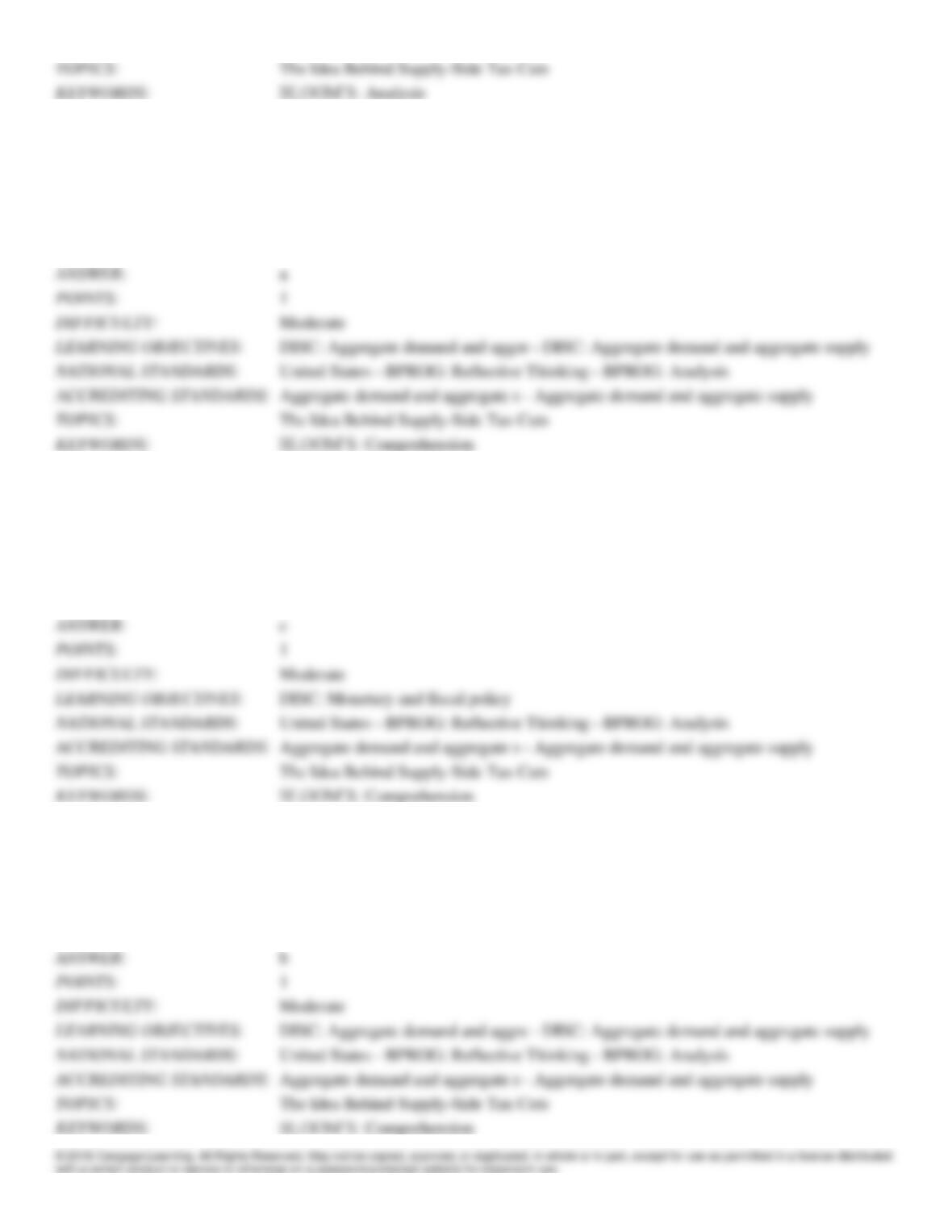
165. Which graph in Figure 11-2 best reflects a supply-sider’s view of the impact of an increase in the personal income tax
rate?
a.
1
b.
2
c.
3
d.
4
1
166. Which graph in Figure 11-2 best reflects a Keynesian’s view of the short-run impact of an increase in the personal
income tax rate?
a.
1
b.
2
c.
3
d.
4
1
167. Which graph in Figure 11-2 best reflects a Keynesian’s view of the impact of raising taxes on saving?
a.
1
b.
2
c.
3
d.
4
b
1
168. The Bush tax cuts
a.
reduced tax rates for the upper brackets and increased tax rates for lower income taxpayers.
b.
reduced tax rates for the upper brackets and held constant tax rates for lower income taxpayers.
c.
reduced tax rates for the upper brackets and decreased tax rates for lower income taxpayers.
d.
held constant tax rates for the upper brackets and decreased tax rates for lower income taxpayers.
e.
Increased tax rates for the upper brackets and decreased tax rates for lower income taxpayers.
DISC: Monetary and fiscal policy
United States – BPROG: Analytic
Monetary and fiscal policy
The Idea Behind Supply-Side Tax Cuts
169. Critics of supply-side economics argue that a major flaw is
a.
the small magnitude of supply-side effects.
b.
the large size of demand-side effects.
c.
increased income inequality.
d.
All of the above.
DISC: Aggregate demand and aggre – DISC: Aggregate demand and aggregate supply
United States – BPROG: Analytic
Aggregate demand and aggregate s – Aggregate demand and aggregate supply
The Idea Behind Supply-Side Tax Cuts
170. One objection to supply-side tax cuts is that demand-side changes
a.
are smaller than supply-side changes.
b.
and supply-side changes are about equal.
c.
are more unpredictable than supply-side changes.
d.
are larger than supply-side changes.
DISC: Aggregate demand and aggre – DISC: Aggregate demand and aggregate supply
United States – BPROG: Analytic
Aggregate demand and aggregate s – Aggregate demand and aggregate supply
The Idea Behind Supply-Side Tax Cuts
171. Critics of supply-side economics argue that
a.
tax cuts do not affect supply, only demand.
b.
supply-siders exaggerate the effects of tax cuts.
c.
incentives have no effect on behavior.
d.
the goals of supply-siders are not supported by most economists.
DISC: Aggregate demand and aggre – DISC: Aggregate demand and aggregate supply
United States – BPROG: Analytic
Aggregate demand and aggregate s – Aggregate demand and aggregate supply
The Idea Behind Supply-Side Tax Cuts
172. If the demand-side effects of supply-side tax cuts are greater than the supply-side effects, then we can expect the
result to be a(n)
a.
decrease in output and prices.
b.
decrease in output and an increase in prices.
c.
increase in output and prices.
d.
increase in output and a decrease in prices.
DISC: Aggregate demand and aggre – DISC: Aggregate demand and aggregate supply
United States – BPROG: Analytic
Aggregate demand and aggregate s – Aggregate demand and aggregate supply
The Idea Behind Supply-Side Tax Cuts
173. Critics of supply-side economics argue that tax cuts favored by supply-siders will have the greatest effect on
a.
aggregate supply.
b.
tax receipts.
c.
aggregate demand.
d.
the money supply.
DISC: Aggregate demand and aggre – DISC: Aggregate demand and aggregate supply
United States – BPROG: Analytic
Aggregate demand and aggregate s – Aggregate demand and aggregate supply
The Idea Behind Supply-Side Tax Cuts
174. Supply-side tax cuts designed to increase investment spending are attractive in theory, but in practice
a.
the effect is the opposite of what theory suggests.
b.
are less useful, because they take a long time to increase the capital stock.
c.
they have no effect on the capital stock in the short or long run.
d.
are powerful in the short run as capital stock rapidly increases, but the effect tapers off in the long run.