22) Explain the implications of outsourcing for employment and wages in the domestic and
foreign labor markets.
28.5 Labor Demand of a Monopolist and Overall Input Utilization
1) Other things being equal, the behavior of a monopolist differs from that of a competitive
industry in that
A) the monopolist does not attempt to maximize economic profit.
B) the monopolist hires more labor.
C) the monopolist restricts output and hires less labor.
D) the monopolist must consider fixed costs in deciding the optimal level of output to produce in
the short run.
2) Which of the following would be the most likely outcome if all perfectly competitive firms in
a product market join together to form a monopoly?
A) Both the rate of output and the quantity of labor input employed will decrease.
B) Both the rate of output and the quantity of labor input employed will increase.
C) The rate of output in the market will increase but the quantity of labor input will decrease.
D) The rate of output in the market will decrease but the quantity of labor input will increase.
3) The monopolist’s input demand curve is equal to its
A) variable cost curve.
B) marginal cost curve.
C) average cost curve.
D) marginal revenue product curve.
4) Other things being equal, the monopolist will
A) hire more workers than if the industry were perfectly competitive.
B) hire the same number of workers as a perfectly competitive industry would.
C) hire fewer workers than if the industry were perfectly competitive.
D) have lower profits than if the industry were perfectly competitive.
5) A monopolist hires fewer workers than a perfectly competitive industry, other things being
equal, because
A) a monopolist has to pay higher wages in order to attract additional workers.
B) the monopolist substitutes more capital for labor when compared to a competitive industry.
C) the monopolist producer has to deal with unions and face higher wages than do competitive
industries.
D) the monopolist produces less output than a competitive industry.
6) A monopolist will hire fewer workers than a competitive firm, other things being equal,
because
A) the monopolist exploits labor and other types of producers do not.
B) the monopolist must take account of the declining product price that must be charged in order
to sell more units of the product.
C) the monopolist is more efficient.
D) diminishing marginal productivity of labor is more severe for a monopolist.
7) If a firm sells its product in a monopolistic market, even though the firm operates in a
perfectly competitive labor market, the firm will employ workers up to the point where
A) TR = TC.
B) the MRP = the wage rate.
C) the MRP = the marginal physical product of labor.
D) the MRP = the output price.
8) A firm wanting to maximize profits should operate in such a way that
A) the MRP of each input is equal to or greater than its MFC.
B) MRP equal MFC in the input market but MC must exceed MR in the output market.
C) marginal revenue must be equal to the marginal revenue product.
D) none of the above.
9) If a monopolist has an output price of $10, marginal revenue equal to $4, and faces a fixed
wage rate of $7, then the monopolist should hire labor until the marginal revenue product is
equal to
A) $10.
B) $4.
C) $7.
D) $14.
10) The demand curve for labor of a monopolist
A) is horizontal even though the demand curve for labor for a competitive firm is downward
sloping.
B) slopes down for the same reason as the demand curve for labor of a perfectly competitive
firm.
C) slopes down because of the law of diminishing marginal product and because the monopolist
must lower prices to sell additional units of the good.
D) slopes upward because monopolists use more capital than do perfectly competitive firms.
11) The monopolist’s input demand curve is the
A) marginal revenue curve.
B) marginal revenue product curve.
C) marginal physical product curve.
D) marginal factor cost.
12) Compared to the perfectly competitive firm, the monopolist’s input demand curve is
A) more elastic.
B) more inelastic.
C) due to a constant per-unit price of the product.
D) marginal factor cost.
13) A monopolist will hire an additional unit of labor as long as
A) the additional cost of the worker is outweighed by the additional revenues made from selling
the output of theses workers.
B) the marginal revenue curve is above the demand curve.
C) the marginal revenue product is larger than the marginal factor cost.
D) the marginal revenue product is less than the marginal factor cost.
14) A profit maximizing monopolist will hire labor up to the point where
A) marginal revenue product equals the price of the product.
B) marginal revenue product is greater than the wage rate.
C) marginal revenue product equals than the wage rate.
D) marginal revenue product is less than the wage rate.
15) A rule of thumb in the employment of resources is to set
A) marginal revenue product (MRP) equal to marginal factor cost (MFC).
B) marginal revenue (MR) equal to marginal cost (MC).
C) marginal physical product equal to marginal resource cost.
D) none of the above.
16) Other things equal, a monopolist will hire
A) more workers than a perfectly competitive industry.
B) fewer workers than a perfectly competitive industry.
C) more workers than a perfectly competitive firm.
D) the same number of workers as a perfectly competitive industry would.
17) A monopolist will hire fewer workers than a perfectly competitive firm because
A) the marginal product curve decreases as additional units of labor are hired for a monopoly but
not for a competitive firm.
B) there is a variety of employers in a competitive market and only one in a monopoly.
C) marginal revenue is greater than price for a monopoly while marginal revenue is equal to
price for a competitive firm.
D) to sell an additional unit of the good the competitive firm will keep the price the same while
the monopolist must lower it on all units sold.
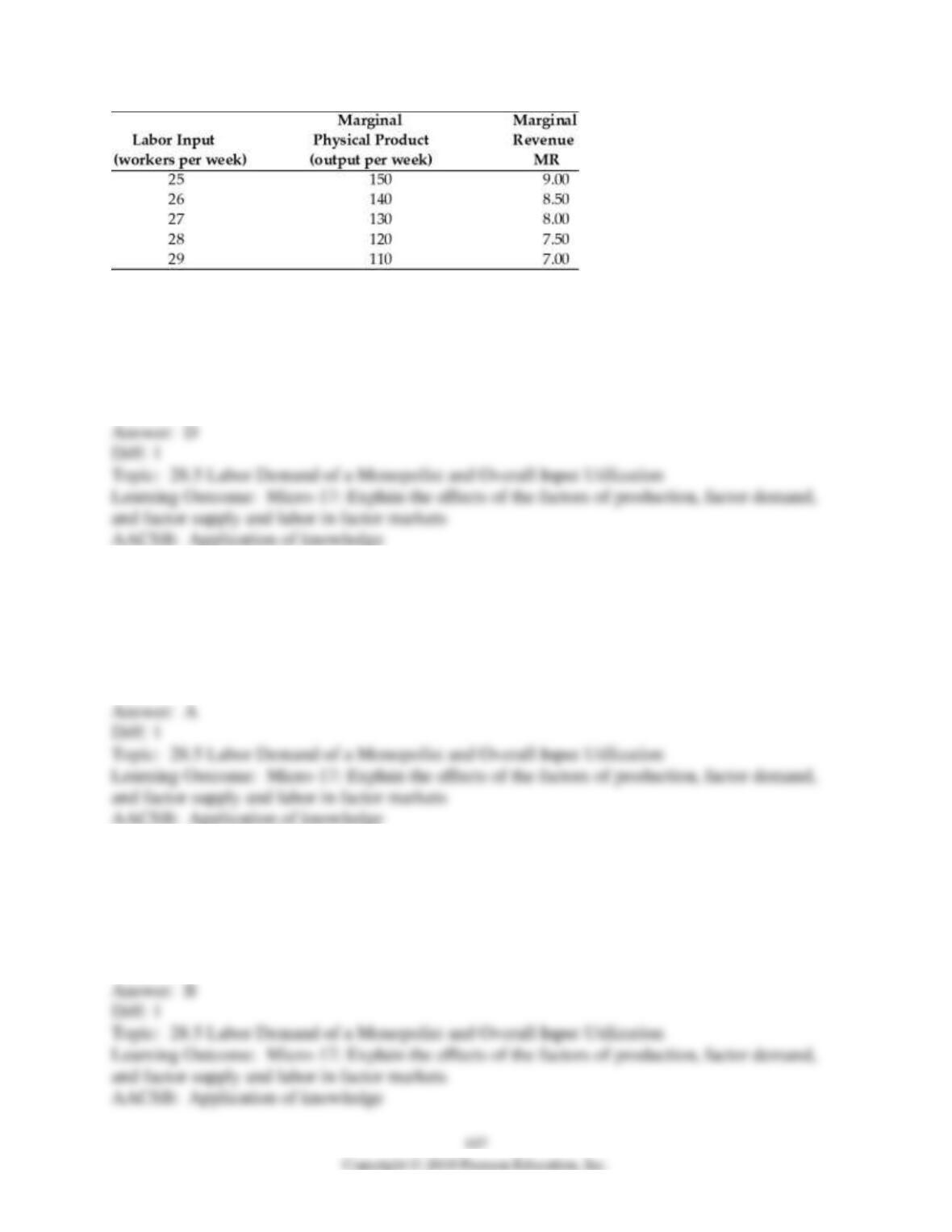
18) Refer to the above table. What does the marginal revenue product equal when 26 workers are
hired a week?
A) $8.50
B) $26
C) $221
D) $1190
19) Refer to the above table. What does the marginal revenue product equal when 27 workers are
hired a week?
A) $1040
B) $216
C) $16.25
D) $8
20) Refer to the above table. What does the marginal revenue product equal when 28 workers are
hired a week?
A) $1040
B) $900
C) $210
D) $7.50
21) Refer to the above table. How many worker will this firm hire if the weekly wage rate is
$1350?
A) 28
B) 25
C) 26
D) 27
22) Refer to the above table. How many workers will this firm hire if the weekly wage rate is
$770?
A) 26
B) 27
C) 28
D) 29
23) Refer to the above table. How many workers will this firm hire if the weekly wage rate is
$900?
A) 26
B) 27
C) 28
D) 29
24) Refer to the above table. How do we know that this is NOT a competitive firm?
A) The marginal physical product decreases as the amount of labor hired increases.
B) The marginal revenue changes as output changes.
C) The marginal revenue product decreases as the amount of labor increases.
D) Marginal physical product cannot be computed for competitive firms.
25) If we assume competitive labor markets, the supply curve of labor when the firm is a
monopoly is
A) upward sloping.
B) vertical.
C) horizontal.
D) downward sloping.
26) In an imperfectly competitive labor market, the firm is faced with a(n) ________ MPP curve
and a(n) ________ MR curve.
A) downward sloping; upward sloping
B) downward sloping; downward sloping
C) upward sloping; downward sloping
D) downward sloping; horizontal
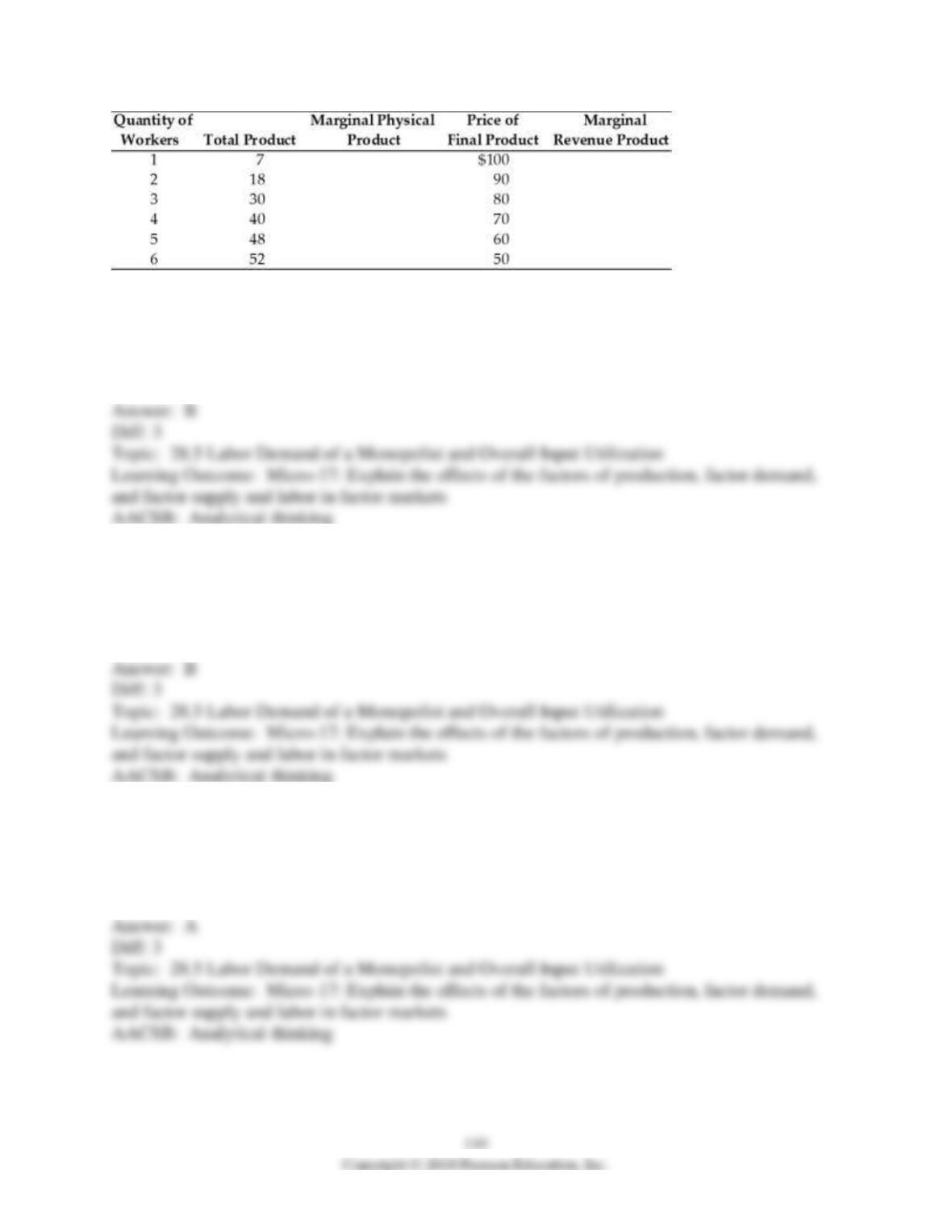
27) In the above table, what is the marginal revenue product of the 4th worker?
A) $920
B) $700
C) $400
D) $80
28) In the above table, what is the marginal revenue product of the 1st worker?
A) $920
B) $700
C) $400
D) $80
29) In the above table, what is the marginal revenue product of the 2nd worker?
A) $990
B) $700
C) $1100
D) $90
30) In the above table, if the marginal factor cost is $200, how many workers would be hired?
A) 3
B) 4
C) 5
D) 6
31) In the above table, if the marginal factor cost is $480, how many workers would be hired?
A) 3
B) 4
C) 5
D) 6
32) In the above table, if the marginal factor cost is $960, how many workers would be hired?
A) 3
B) 4
C) 5
D) 2
33) In constructing the monopolist’s input demand curve, which of the statements is FALSE?
A) The demand curve has a negative slope due to the law of diminishing marginal product.
B) Marginal revenue is always positive.
C) A monopoly restricts output and hires fewer units of labor than a perfectly competitive firm.
D) The supply curve a monopoly faces is horizontal because the monopoly is a price taker.
34) The MRP curve for a monopolist in the product market is
A) the same as the MRP curve for a perfectly competitive firm in the product market.
B) to the left and below the MRP curve for a perfectly competitive firm in the product market.
C) to the right and above the MRP curve for a perfectly competitive firm in the product market.
D) upward sloping and below the MFC curve for a perfectly competitive firm in the product
market.
35) When a firm has monopoly power, it
A) hires fewer workers because its marginal revenue lies below the demand curve.
B) hires more workers because its marginal revenue lies below the demand curve.
C) hires fewer workers because its marginal revenue lies above the demand curve.
D) hires more workers because its marginal revenue lies above the demand curve.
36) If the demand for a monopolist’s product increases, its
A) marginal revenue increases, making it more profitable to hire more workers.
B) marginal revenue increases, making it more profitable to hire fewer workers.
C) marginal revenue decreases, making it more profitable to hire more workers.
D) marginal revenue decreases, making it more profitable to hire fewer workers.
37) In a perfectly competitive labor market, the least-cost combination rule for resource use
A) requires that resources be used in combinations such that marginal products are equal.
B) requires that the marginal physical product per dollar spent for each resource is equalized.
C) assures the firm an economic profit.
D) assures the firm a normal profit.
38) In the employment of any resource, a firm should
A) equate marginal revenue product with the cost of the additional resource.
B) hire each input unit that adds more to revenue than it adds to costs.
C) hire each input unit provided its marginal physical product is greater than zero.
D) A and B are both correct.
39) Assume that a perfectly competitive firm faces a fixed wage rate of $4 and a constant per-
unit cost of capital of $2. If the marginal product of labor and capital are 16 and 6, respectively,
then to maximize profits the firm should
A) use relatively more capital.
B) use relatively less capital.
C) increase all inputs proportionately.
D) decrease all inputs proportionately.