62) Refer to the above table. Suppose the price of the good sold is $10 and the marginal factor
cost of labor is $70, how many units of labor will the firm hire?
A) 10
B) 11
C) 12
D) 13
63) Refer to the above table. For each level of employment of labor shown
A) marginal product declines.
B) marginal product holds constant.
C) marginal product rises.
D) marginal product falls for all employees beyond the 10th unit of labor.
64) Refer to the above table. Which of the following statements is correct?
A) The table follows economic principles because in an increasing cost industry, increases in a
variable input will lead to increase in output.
B) The table does not follow economic principles because in an increasing cost industry,
increases in a variable input will lead to decrease in output.
C) The table follows economic principles because the law of diminishing marginal product
predicts that increase in a variable input will eventually lead to a decrease in the marginal
physical product.
D) The table does not follow economic principles because the law of diminishing marginal
product predicts that increase in a variable input will eventually lead to an increase in the
marginal physical product.
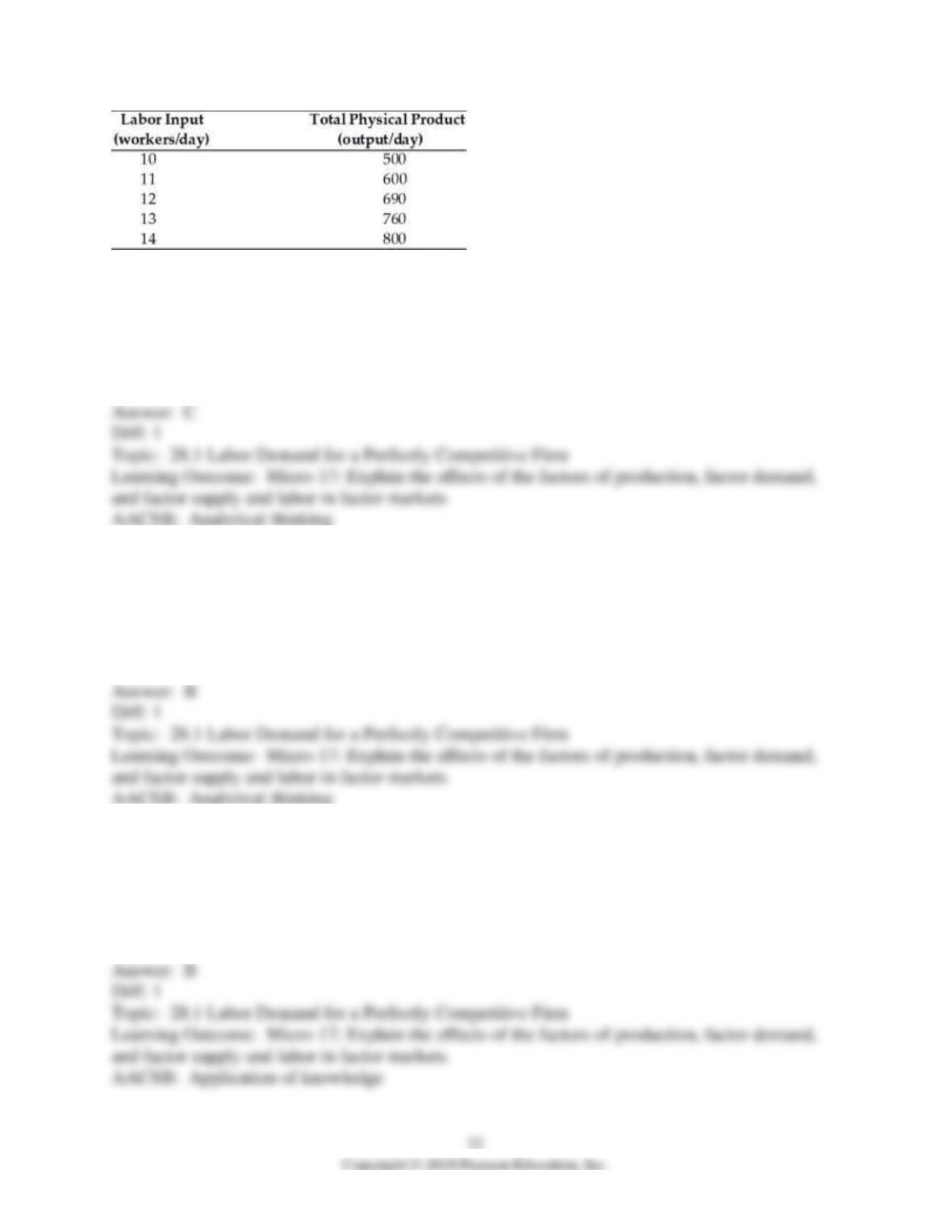
65) Refer to the above table. If the price of the product is $1.50, what is the marginal revenue
product of the 11th worker?
A) $1.50
B) $13.64
C) $150
D) $900
66) Refer to the above table. If the price of the product is $1.50, what is the marginal revenue
product of the 12th worker?
A) $1035
B) $135
C) $90
D) $1.50
67) Refer to the above table. If the price of the product is $1.50, and the marginal factor cost of
an additional unit of an input is $135, how many units of labor should be hired?
A) 11
B) 12
C) 13
D) 14
68) Refer to the above table. If the price of the product is $1.50, and the marginal factor cost of
an additional unit of an input is $105, how many units of labor should be hired?
A) 11
B) 12
C) 13
D) 14
69) If a firm hires 215 workers it will produce 3,016 units of output. If it hires 216 workers it will
produce 3,128 units of output. The marginal physical product of labor equals
A) 1.
B) 112.
C) 216.
D) 3,128.
70) If a firm hires 312 workers it will produce 4,522 units of output. If it hires 313 workers it will
produce 4,786 units of output. The marginal physical product of labor equals
A) 4,786.
B) 313.
C) 264.
D) 1.
71) If a firm hires 200 workers and produces 5,000 computers. If the firm hires one more worker,
it produces 5,050 computers. If computers sell at a constant price of $100 and labor is hired at a
constant wage rate of $4,000 per worker
A) the firm should hire and retain the additional worker.
B) the marginal factor cost of labor is $4,000.
C) the marginal revenue product of the added worker is $5,000.
D) all of the above.
72) The additional revenue obtained by a firm when it hires an additional worker, holding other
inputs constant, is
A) the marginal physical product of labor.
B) the marginal revenue product of labor.
C) the marginal cost of labor.
D) equal to total revenue divided by the number of workers.
73) The marginal revenue product gives
A) the change in total product for an additional unit of a variable input.
B) the amount that other inputs must increase by when labor increase by one unit.
C) the additions to total cost when an additional unit of a variable input is hired.
D) the additional revenue obtained when an additional unit of a variable input is hired.
74) The marginal revenue product
A) represents the incremental contribution to the firm’s total revenues obtained from an increase
in a variable input.
B) always increases when there is an increase in a variable input.
C) gives the increase in cost when there is an increase in a variable input.
D) gives the change in total product when an additional unit of a good is hired.
75) The addition to revenue obtained from hiring an additional unit of labor is
A) total product.
B) marginal revenue product.
C) marginal factor cost.
D) marginal physical product of labor.
76) The marginal revenue product of labor declines as the number of workers increases because
A) firms hire the most efficient workers first and the least efficient workers last.
B) firms must lower prices for the final product when they want to sell more units.
C) of the law of diminishing marginal product.
D) of diseconomies of scale.
77) For a perfectly competitive firm, the value of the marginal product is
A) the same thing as marginal factor cost.
B) the same thing as marginal physical product.
C) marginal physical product times the product price.
D) marginal physical product times the wage rate.
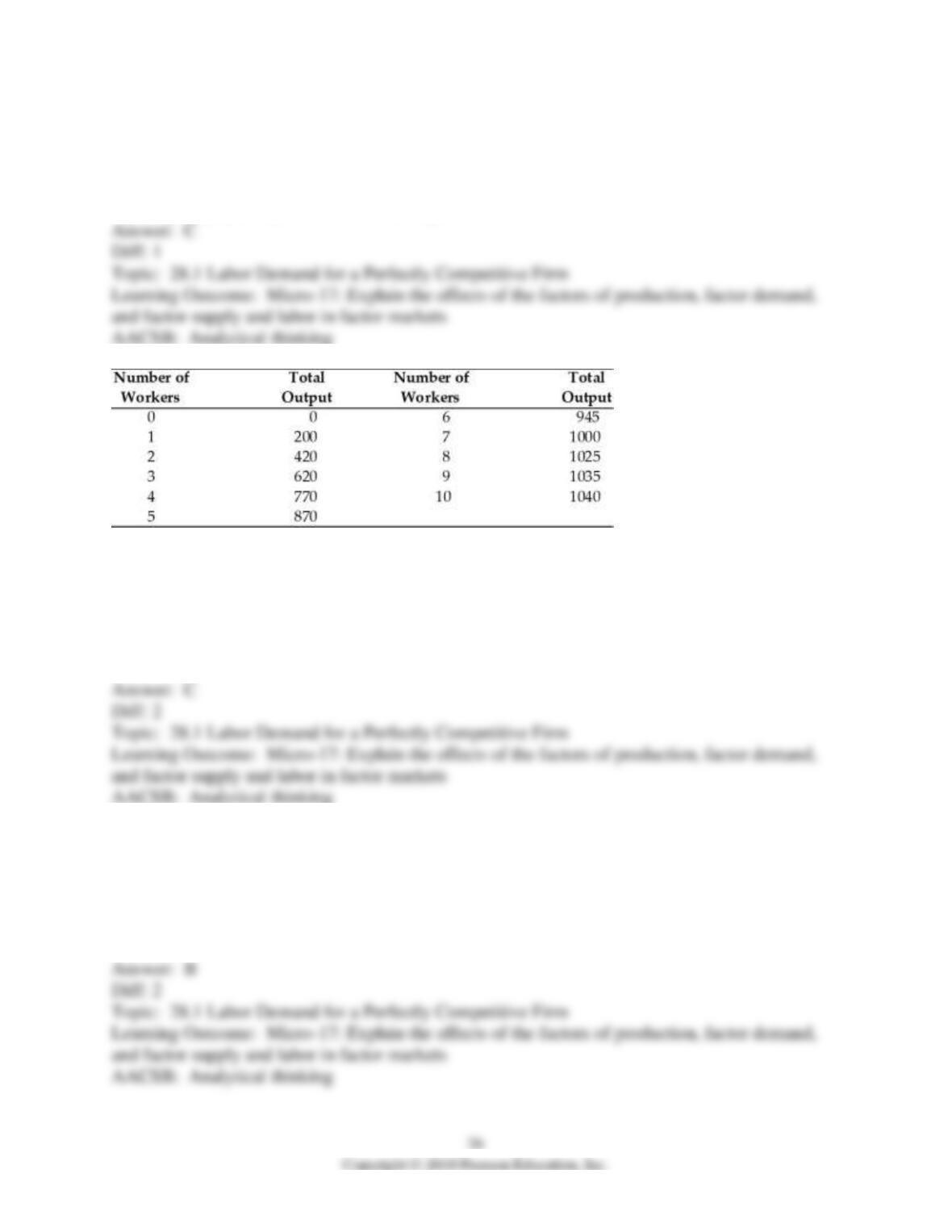
78) Refer to the above table. If the price of the good produced is $5, the marginal revenue
product of the 5th worker is
A) $3350.
B) $670.
C) $500.
D) $100.
79) Refer to the above table. If the price of the good produced is $5, the marginal revenue
product of the 7th worker is
A) $125.
B) $275.
C) $5000.
D) $55.
80) Refer to the above table. Suppose the marginal revenue product of the 7th worker is $1100.
This implies that
A) the price of the good is $1.
B) the price of the good is $8.
C) the price of the good is $20.
D) we cannot tell what the price of the good is without more information.
81) Refer to the above table. Suppose the marginal revenue product of the 5th worker is $800.
This implies that
A) the price of the good is $5.33.
B) the price of the good is $8.
C) the price of the good is $70.
D) we cannot tell what the price of the good is without more information.
82) Refer to the above table. The marginal factor cost of labor is $200. To get the firm to hire 8
workers, the
A) firm must be able to reduce wages below the marginal factor cost.
B) price of the good must be $8.
C) eighth worker must be at least as productive as the seventh worker was.
D) wage rate must be a fraction of the marginal factor cost of labor.
83) Refer to the above table. Suppose the firm hires 5 workers and the price of the good sold is
$3. The marginal factor cost of labor must be
A) $3.
B) $100.
C) $300.
D) $900.
84) Refer to the above table. Suppose the price of the good sold is $3 and the marginal factor
cost of labor is $300, how many units of labor will the firm hire?
A) 4
B) 5
C) 6
D) 3
85) Refer to the above table. Suppose the firm hires 4 workers and the price of the good sold is
$4. The marginal factor cost of labor must be
A) $4.
B) $150.
C) $3080.
D) $600.
86) Refer to the above table. Suppose the price of the good sold is $4 and the marginal factor
cost of labor is $600, how many units of labor will the firm hire?
A) 4
B) 5
C) 6
D) 3
87) The cost of using an additional unit of an input is called the
A) marginal revenue product.
B) marginal physical product cost.
C) marginal factor cost.
D) marginal product of labor.
88) The marginal factor cost is the
A) additional revenue obtained from a one-unit change in labor input.
B) additional revenue obtained from a one-unit change in output.
C) change in output resulting from the addition of one more worker.
D) cost of using an additional unit of an input.
89) When the supply of labor to a firm is perfectly elastic the marginal factor cost will equal the
A) market price of the product.
B) wage rate.
C) marginal physical product.
D) wage rate times the number of workers.
90) A profit-maximizing firm will hire additional units of labor until
A) the additional cost of hiring the last worker equals the additional revenue generated by that
worker.
B) the additional cost of hiring the last worker equals the marginal factor cost of the worker.
C) the extra revenue from hiring the last worker equals the marginal physical product of labor.
D) the extra cost from hiring the last worker equals the cost of the product.
91) Ajax has just discovered that the marginal revenue product generated by the last worker
hired was $125 while the marginal factor cost was $85. What should Ajax do?
A) Leave the level of production unchanged.
B) Increase the amount produced.
C) Reduce the amount produced.
D) Collect more information before making a decision.
92) Company A has just discovered that the marginal revenue product generated by the last
worker hired was $80 while the marginal factor cost was $90. What should Company A do?
A) Leave the level of production unchanged.
B) Increase the amount produced.
C) Reduce the amount produced.
D) Collect more information before making a decision.
93) Company B has just discovered that the marginal revenue product generated by the last
worker hired was $25 while the marginal factor cost was $25. What should Company B do?
A) Leave the level of production unchanged.
B) Increase the amount produced.
C) Reduce the amount produced.
D) Collect more information before making a decision.
94) If the marginal revenue product of the last worker hired exceeds the marginal factor cost of
the worker, the firm would be better served if it
A) hires additional workers.
B) maintains its current level of workers already hired.
C) lays off the last worker hired.
D) None of the above is a good option for a profit-seeking firm.
95) If MFC > MRPL, the firm should
A) hire more workers.
B) lower wages.
C) get rid of some capital.
D) reduce the number of workers.
96) A firm should hire workers up to the point where
A) MP = P.
B) MFC = P.
C) MFC = MRP.
D) MP = MRP.
97) If MFC < MRPL, the firm should
A) hire more workers.
B) lower wages.
C) get rid of some capital.
D) reduce the number of workers.
98) If the additional revenue from hiring an additional worker equals the additional costs from
hiring the extra worker, then we know that
A) MFC = MPPL.
B) MFC/MPPL = wage.
C) MFC = MRPL.
D) MRPL/P = MFC.
99) The demand curve for labor is the
A) marginal factor cost curve for labor.
B) marginal physical product curve for labor.
C) marginal physical product curve for labor times the wage rate.
D) marginal revenue product curve for labor.
100) The demand curve for labor slopes down because
A) firms value less efficient workers less than they value more efficient workers.
B) firms must lower prices to sell the additional units of its product that the extra workers
produce.
C) of the law of diminishing marginal product.
D) of profit maximizing behavior.
101) An increase in the marginal factor cost of labor will
A) lead to an increase in the quantity demanded of labor.
B) induce a firm to hire fewer workers.
C) lead to an increase in the value of an additional worker.
D) cause the value of the marginal product of labor to increase.
102) A decrease in the marginal factor cost of labor will
A) lead to an decrease in the quantity demanded of labor.
B) induce a firm to hire fewer workers.
C) induce a firm to hire more workers.
D) cause the value of the marginal product of labor to decrease.
103) The wage rate for widget makers is currently $25 per hour and Ajax hires 20 widget
makers. If the wage rate were decreased to $20, what would happen to the marginal revenue
product for labor at Ajax?
A) It would remain the same.
B) It would increase since Ajax’s demand for labor curve will shift.
C) It would increase since the price of widgets would decrease.
D) It would decrease since Ajax will hire more workers.
104) When the demand curve for an input is a derived demand this means that
A) the demand curve is derived from the demand for the final product being produced.
B) the demand curve depends upon the MFC.
C) the law of diminishing marginal product does not hold.
D) the demand curve slopes upward.
105) The demand for labor is
A) derived from the demand for the final product of the firm.
B) derived from the satisfaction that hiring labor provides the owner of the firm.
C) derived from the satisfaction workers get for being employed.
D) derived from a utility-maximizing process similar to that used to derive the demand curve for
all workers in a given industry.
106) The demand curve for labor will shift whenever
A) the wage rate changes.
B) the marginal factor cost changes.
C) demand for the final product changes.
D) the supply of labor changes.
107) Which of the following will not cause the marginal revenue product of labor curve for a
firm to shift?
A) an increase in the productivity of workers
B) an increase in demand for the product
C) a decrease in the price of the product
D) an increase in the wage rate
108) An increase in product price implies that
A) the firm’s marginal factor cost will increase.
B) the wage rate the firm pays will increase.
C) the firm’s demand for labor increases.
D) the firm’s demand for labor decreases.
109) An increase in the productivity of labor induces
A) an increase in the demand for labor.
B) an increase in the cost of labor.
C) a firm to hire fewer workers since fewer workers are needed with the increase in productivity.
D) a firm to offer a higher wage for workers since the workers are now more productive.
110) If the wage rate doesn’t change but a profit-maximizing competitive firm hires fewer
workers, we know that
A) the price of the product increased.
B) technical change occurred that increased labor productivity, reducing the firm’s demand for
labor.
C) demand for the product fell or there has been a reduction in labor productivity.
D) marginal factor cost increased.
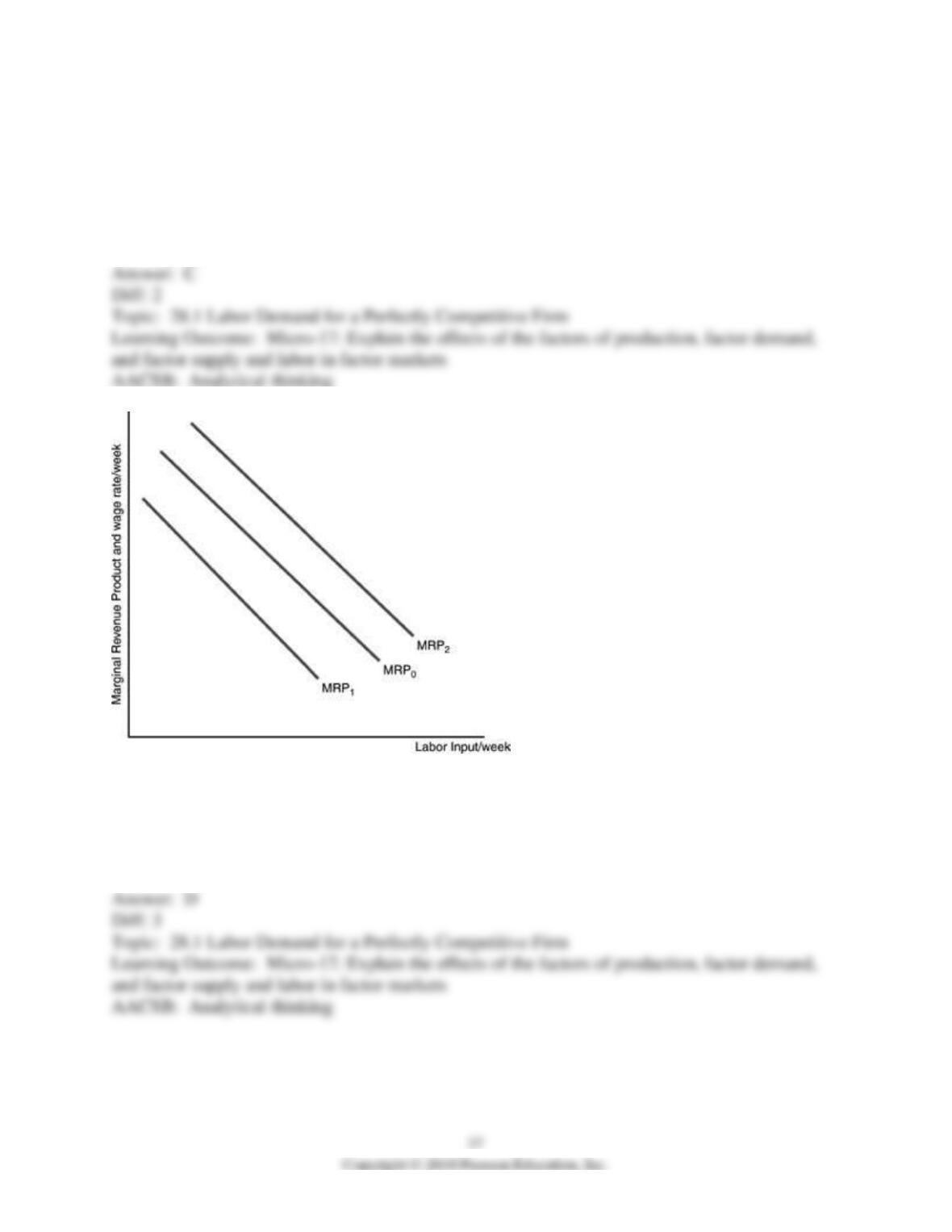
111) Refer to the above figure. MRP0 represents
A) the supply curve for the product.
B) the supply curve for labor.
C) the demand curve for the product.
D) the demand curve for labor.
112) Refer to the above figure. The firm is operating using MRP0. An increase in demand for the
product has occurred. The relevant curve for the firm after the increase in price
A) is MRP0.
B) is MRP1.
C) is MRP2.
D) could be MRP1 or MRP2 depending upon whether the firm was earning a positive profit.
113) Refer to the above figure. The firm is operating using MRP0. An increase in productivity
has occurred. The relevant curve for the firm after the increase in productivity
A) is MRP0.
B) is MRP1.
C) is MRP2.
D) could be MRP1 or MRP2 depending upon whether the firm was earning a positive profit.
114) Sam, who owns a carpentry shop, discovered that with 4 laborers he could produce 18
cabinets per day. With 5 laborers he produced 25 cabinets and with 6 laborers he produced 36
cabinets. What was the MPP of the 5th laborer?
A) 8 cabinets
B) 7 cabinets
C) 6 cabinets
D) 4 cabinets
115) Sam, who owns a carpentry shop, discovered that with 4 laborers he could produce 18
cabinets per day. With 5 laborers he produced 25 cabinets and with 6 laborers he produced 36
cabinets. What was the MPP of the 6th laborer?
A) 11 cabinets
B) 7 cabinets
C) 36 cabinets
D) 9 cabinets
116) The change in output resulting from the addition of one more worker is
A) marginal physical product.
B) marginal revenue product.
C) average physical product.
D) average revenue product.
117) The marginal physical product (MPP) is calculated by
A) dividing total physical product by labor.
B) dividing the change in total physical product by the change in the input.
C) dividing the change in total cost by the change in labor.
D) the difference between the output of skilled and unskilled workers.
118) The downward sloping marginal revenue product of labor is
A) the firm’s supply of labor.
B) the firm’s short-run demand for labor.
C) the firm’s marginal cost of labor.
D) another term for the marginal revenue product of labor.
119) A firm’s demand curve for labor is equal to the
A) total revenue product.
B) marginal revenue product.
C) marginal factor cost.
D) marginal wage.
120) Marginal revenue product is
A) marginal physical product times marginal factor cost.
B) marginal physical product times marginal revenue.
C) average physical product times marginal revenue.
D) marginal physical product times the wage rate.
121) If the price of a product being sold in a perfectly competitive market decreases
A) the MRP curve shifts to the left.
B) the MRP curve shifts to the right.
C) the MFC curve shifts to the right.
D) the MFC curve shifts to the left.