
122) The additional revenue associated with hiring one additional unit of some factor input, such
as labor, is called
A) marginal cost.
B) marginal revenue product.
C) marginal factor cost.
D) marginal physical product.
123) Marginal factor cost is computed as
A) total cost of the resource/total amount of the resource being used.
B) change in the total cost of the resource/total amount of the resource being used.
C) total cost of the resource/change in the amount of the resource being used.
D) change in the total cost of the resource/change in the amount of the resource being used.
124) The cost of hiring one more worker, ceteris paribus, is known as
A) marginal revenue product.
B) marginal physical product.
C) marginal factor cost.
D) marginal wage.
125) The additional cost associated with hiring one additional unit of some factor input, such as
labor, is referred to as
A) marginal physical product of labor.
B) marginal revenue cost.
C) marginal factor cost.
D) marginal revenue product.
126) The firm’s demand for labor curve is its
A) average product of labor curve.
B) marginal product of labor curve.
C) marginal revenue product of labor curve.
D) average revenue product of labor curve.
127) The MRP of labor will shift to the right if
A) labor productivity increases.
B) labor productivity decreases.
C) wages increase.
D) wages decrease.
128) The MRP of labor will shift to the left if
A) labor productivity increases.
B) labor productivity decreases.
C) wages increase.
D) wages decrease.
129) The additional revenue a firm obtains when it hires an additional worker (holding other
inputs constant) is the
A) marginal revenue product (MRP) of labor.
B) total factor cost (TFC) per worker.
C) general rule for hiring.
D) marginal physical product (MPP) of labor.
130) The additional output from one more worker is known as
A) marginal revenue product.
B) marginal physical product.
C) marginal factor cost.
D) marginal wage.

131) All of the following statements regarding the marginal revenue product (MRP) curve and
the demand for labor are true EXCEPT
A) an individual firm’s demand for labor is its MRP curve.
B) under conditions of perfect competition, MRP equals marginal physical product multiplied by
the product’s price.
C) an increase in the market demand for a given product decreases the product’s price.
D) the demand for labor is a derived demand.
132) The MRP is
A) the supply curve of labor for an individual firm.
B) the demand curve for labor for an individual firm.
C) the demand curve for labor for the entire market.
D) the supply curve of labor for the entire market.
133) Which of the following represents the general rule of hiring for a firm?
A) Total physical product equals marginal factor cost.
B) Average revenue product equals the wage rate.
C) Marginal cost equals marginal revenue.
D) Marginal revenue product equals marginal factor cost.
134) If the marginal factor cost of hiring an additional worker is $10 while the marginal revenue
product is $15, then the firm should
A) hire more workers.
B) stop hiring more workers.
C) fire some workers.
D) none of the above: insufficient information to answer the question.
135) Derived demand is
A) a derivative of the demand curve.
B) the demand for goods and services produced by companies using scarce resources.
C) the demand for advertising to increase the sales of the product.
D) the demand for the factors of production that are used to produce goods and services.
136) Since the demand for labor depends upon the demand for the final product, we say that
labor is
A) a derived demand.
B) an “inverse” demand.
C) a positive demand.
D) a reverse demand.
137) The demands for labor and other input factors are called
A) derived demands, because the demand for these inputs depends on the demand for goods and
services they are employed to produce.
B) developed demands, because the demand for these inputs is developed from an analysis of the
costs of advertising products.
C) indirect demands, because the demand for these inputs is indirectly related to the costs of
advertising products.
D) reverse demands, because the demand for these inputs varies inversely with the demand for
goods and services they are employed to produce.
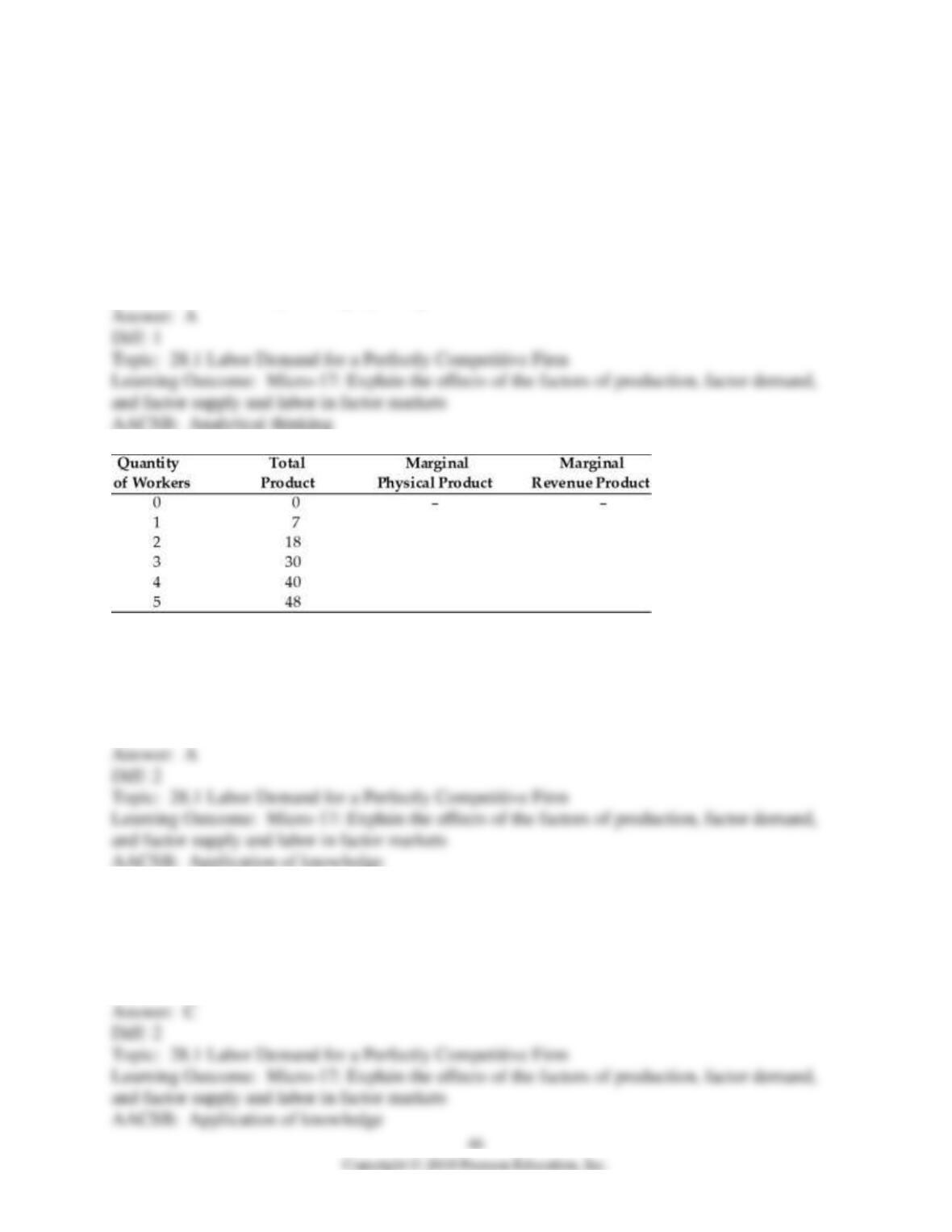
138) In the above table, what is the marginal physical product of worker 5?
A) 8
B) 10
C) 11
D) 7
139) In the above table, what is the marginal physical product of worker 2?
A) 10
B) 18
C) 11
D) 9
140) In the above table, if this is a perfectly competitive firm and the market price of the product
is $10, what is the marginal revenue product of worker 4?
A) $210
B) $100
C) $411
D) $120
141) In the above table, if this is a perfectly competitive firm and the market price of the product
is $8, what is the marginal revenue product of worker 3?
A) $96
B) $88
C) $80
D) $240
142) In the above table, if this is a perfectly competitive firm and the market price of the product
is $5 and the marginal factor cost of labor is $60, how many units of labor will the firm hire?
A) 2
B) 3
C) 4
D) 6
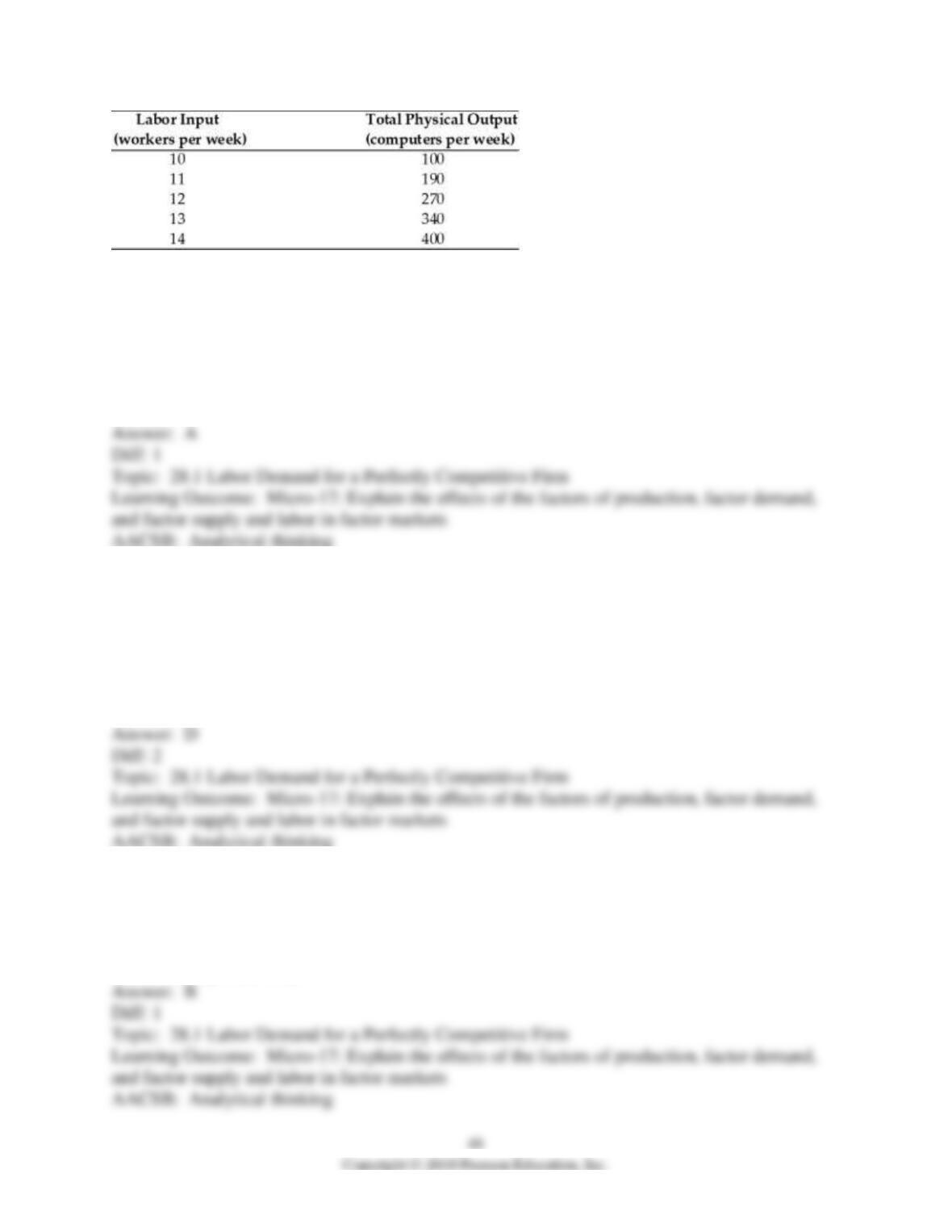
143) The above table depicts the output of a firm that manufactures computers. The computers
sell for $1,000 each. What is the marginal physical product (MPP) of the eleventh worker per
week?
A) 90 units
B) 80 units
C) $7,000
D) $6,000
144) The above table depicts output from a firm that manufactures computers. The computers
sell for $1,000 each. What is the marginal revenue product (MRP) for the fourteenth worker per
week?
A) 90 units
B) 80 units
C) $70,000
D) $60,000
145) An increase in the price of a product
A) automatically increases wages.
B) raises the firm’s demand for labor.
C) would probably decrease total revenues.
D) increases productivity.

146) If labor productivity increases
A) labor costs rise by equal increments.
B) the demand for labor increases.
C) some workers will be laid off.
D) jobs will relocate.
147) An increase in labor productivity will shift
A) MRP curve to the left.
B) MFC curve to the right.
C) MRP curve to the right.
D) MFC curve to the left.
148) At a perfectly competitive firm, all of the following is true of the MRP curve EXCEPT
A) the MRP curve is the derived supply of labor.
B) the MRP curve shifts leftward when labor productivity falls.
C) the MRP curve shifts rightward when the product price rises.
D) the MRP curve shifts leftward when the demand for the final product falls.
149) If the demand for online banking decreases, we would expect to see the
A) supply of workers that produce online-banking services to increase.
B) supply of workers that produce online-banking services to decrease.
C) demand for workers that produce online-banking services to increase.
D) demand for workers that produce online-banking services to decrease.

150) If workers in an industry become less productive, we would expect the
A) supply of workers to increase.
B) supply of workers to decrease.
C) demand for workers to decrease.
D) demand for workers to increase.
151) If laborers become more efficient over time, and if Company X would want to expand
production, it would
A) substitute capital for labor.
B) hire more laborers.
C) hire fewer laborers.
D) produce less product.
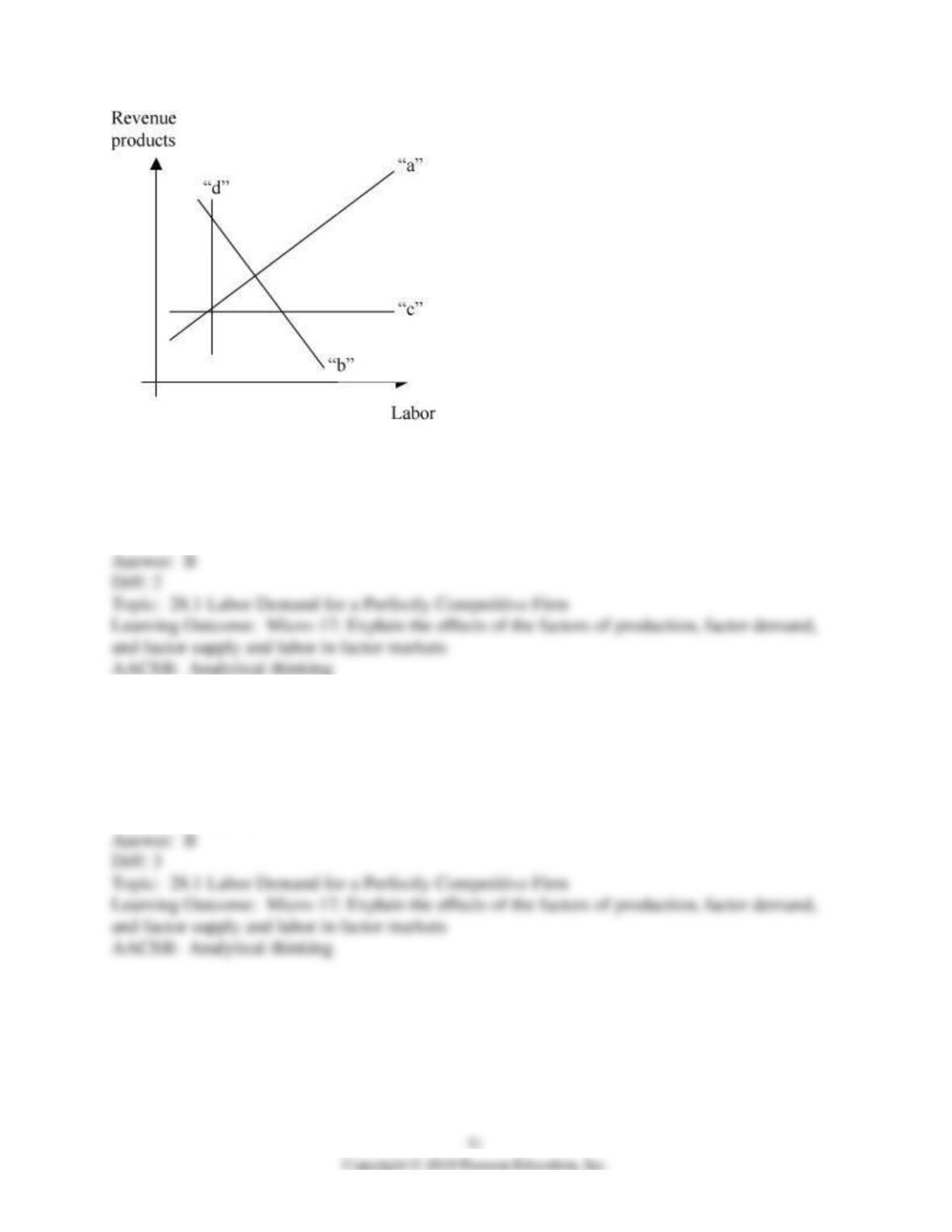
152) In the above figure, the marginal revenue product is represented by line
A) “a.”
B) “b.”
C) “c.”
D) “d.”
153) The individual demand curve for an input such as labor to a firm would be the downward
sloping portion of the firm’s
A) marginal physical product curve.
B) marginal revenue product curve.
C) marginal revenue curve.
D) total revenue curve.
154) Suppose that in a computer factory, if there is 1 worker, 80 computers are produced per
week. If there are 2 workers, 150 computers are produced per week. If there are 3 workers, 210
computers are produced per week. Given this information, there
A) is diminishing marginal product.
B) are too many workers.
C) are not enough workers.
D) is increasing marginal product.
155) Suppose that in a computer factory, if there is 1 worker, 80 computers are produced per
week. If there are 2 workers, 150 computers are produced per week. If there are 3 workers, 200
computers are produced per week. Given this information, the marginal product of the third
worker is
A) 210 computers per week.
B) 70 computers per week.
C) 60 computers per week.
D) 50 computers per week.
156) Suppose that in a computer factory, if there is 1 worker, 80 computers are produced per
week. If there are 2 workers, 150 computers are produced per week. If there are 3 workers, 210
computers are produced per week. Given this information and the fact that the firm receives $200
per computer, the marginal revenue product of the third worker is
A) $4,200.
B) $12,000.
C) $10,000.
D) $14,000.
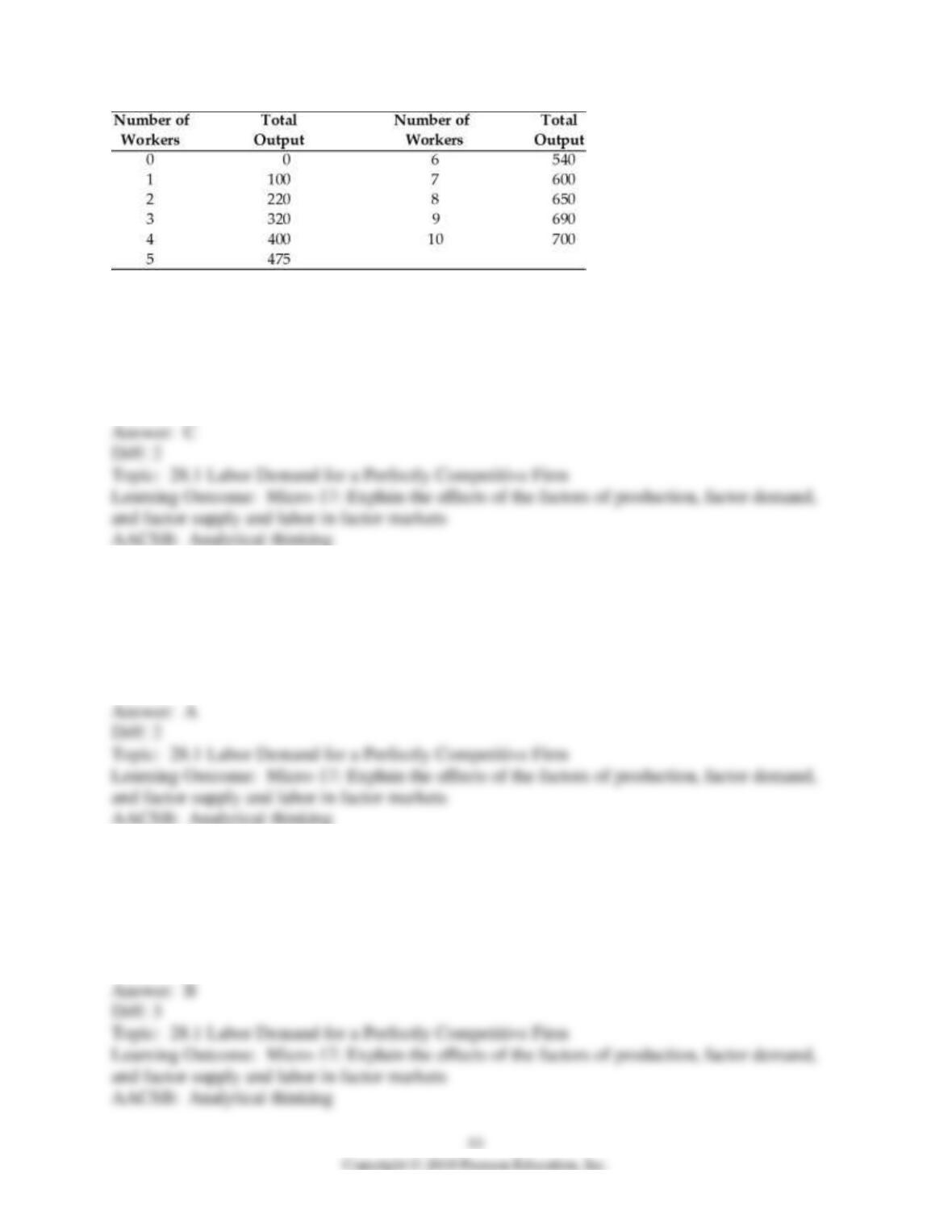
157) Refer to the above table. If the price of the good produced is $10 and the wage rate is $500,
then the marginal revenue product of the 5th worker is
A) $10.
B) $50.
C) $750.
D) $4,750.
158) According to the above table, if the price of the good produced is $5 and the wage rate is
$400, then the marginal revenue product of the 7th worker is
A) $300.
B) $60.
C) $12.
D) $400.
159) According to the above table, if the wage rate is $400 a week and the price of the good
produced is $5, the perfectly competitive firm should hire
A) 3 workers.
B) 4 workers.
C) 5 workers.
D) 6 workers.

160) If the demand for hamburgers increases, it is likely that the demand for fast-food employees
will
A) increase.
B) decrease.
C) stay the same.
D) increase at first but then fall rapidly.
161) Suppose the MRP of the 49th worker at a firm is $25 and that the market wage rate is $15.
We know that if this firm operates in perfectly competitive product and labor markets
A) the firm is paying wages above the minimum wages.
B) the firm’s profits would increase if it fired some workers.
C) the firm would be more profitable if it hired more workers.
D) the firm should use more capital.
162) Which of the following is FALSE regarding the general rule for hiring?
A) Virtually every optimizing rule in economics involves comparing marginal benefits with
marginal cost.
B) The benefit from added workers is extra output and consequently more revenues.
C) The firm hires workers up to the point at which the additional cost associated with hiring the
last worker is equal to the additional revenue generated by that worker.
D) If any firm hired fewer workers over time, profits would definitely increase at that firm.
163) “A firm should continue to hire more workers as long as wages are low.” Do you agree or
disagree? Why?
164) What is the marginal revenue product of labor (MRP)? What shape does the MRP curve
have? Why?
165) What is marginal factor cost? How is it related to the supply curve of an input?
1) The market demand for labor will be
A) insensitive to the wage rate in the short run.
B) downward sloping.
C) the inverse of the market demand for output.
D) perfectly inelastic.
2) If labor is 20 percent of total costs in industry A and 70 percent in industry B, then other
things equal, we would expect the elasticity of demand for labor to be
A) greater in industry A than in industry B.
B) greater in industry B than in industry A.
C) the same in both industries.
D) uncertain since no general relationship exists between cost shares and elasticities.
3) In the long run, input demand becomes more
A) elastic.
B) inelastic.
C) unit-elastic.
D) cost efficient.
4) Whenever an input makes up a large percentage of a good’s final cost, an increase in that
input’s price will
A) affect total cost relatively more.
B) not affect total revenues.
C) affect only accounting profits.
D) cause the firm to shutdown.

5) As new substitutes for office productivity software are developed, the demand for workers in
office productivity software production should
A) become more elastic.
B) become less elastic.
C) be unchanged.
D) change in an undetermined way.
6) Suppose a new technology allows firms to substitute mechanical flower pickers for farm
laborers. As a result, the demand curve for farm laborers will
A) become less elastic.
B) become more elastic.
C) shift to the right.
D) not be affected.
7) The more inelastic the consumer demand for the final product, the
A) greater will be the economic profit in a competitive market.
B) greater the impact on employment from a change in the wage rate.
C) more inelastic the demand for labor producing the product.
D) more responsive the output demand to a change in the price of labor.

8) If the price elasticity of demand is greater than 1, then consumer demand is
A) unrelated to the elasticity of demand.
B) inelastic.
C) elastic.
D) unitary elastic.
9) If the price elasticity of demand is less than 1, then consumer demand is
A) unrelated to the elasticity of demand.
B) inelastic.
C) elastic.
D) unitary elastic.
10) When an input represents a small proportion of a firm’s total costs, then
A) demand for the input will tend to be less elastic.
B) the input demand will vary significantly with a change in input price.
C) the usage of the input cannot be varied in the production function.
D) output demand will be highly elastic.
11) When an input represents a larger proportion of a firm’s total costs, then
A) demand for the input will tends to be less elastic.
B) the input demand will not vary significantly with a change in input price.
C) the usage of the input cannot be varied in the production function.
D) demand for the input will tends to be more elastic.

12) The price elasticity of demand for a variable input will be greater
A) the fewer substitutes there are for the final product.
B) the easier it is for a particular input to be substituted for by other inputs.
C) the lower the price elasticity of supply of all other inputs.
D) the smaller the proportion of total costs accounted for by a particular variable input.
13) Steel cannot be produced without iron. Hence, the price elasticity of demand for iron by steel
mills will be
A) perfectly elastic.
B) elastic.
C) inelastic.
D) unitary elastic.
14) Suppose there are four industries. Labor costs are 70 percent of total costs in industry A, 80
percent in B, 45 percent in C, and 10 percent in D. In which of these industries will a 10 percent
increase in the price of labor reduce quantity demanded of labor by the largest proportion?
A) A
B) B
C) C
D) D

15) We would expect that a fall in labor supply will have a proportionately larger effect on the
market wage rate when
A) capital goods exist that can replace many of the workers.
B) the product produced in the industry has several close substitutes.
C) the product produced in the industry makes up a large portion of most families’ budgets.
D) labor represents a relatively small portion of total costs.
16) We would expect that a rise in labor supply will have a proportionately larger effect on the
market wage rate when
A) the demand for labor is unitary elastic.
B) the demand for labor is inelastic.
C) the supply for labor is elastic.
D) the demand for labor is elastic.
17) We would expect that a fall in labor supply will have a proportionately smaller effect on the
market wage rate when
A) workers can easily be replaced by capital goods.
B) the product produced in the industry has very few substitutes.
C) the product is produced in a perfectly competitive industry.
D) labor represents a relatively small portion of total costs.