18) What has been the impact of the widespread adoption of automated teller machines (ATMs)
on the demand for bank tellers?
A) The demand for tellers has increased.
B) The demand for bank tellers has become more inelastic.
C) The demand for bank tellers has become more elastic.
D) There has been no change because the ATMs and the employees provide completely different
services.
19) Which of the following statements is TRUE?
A) A firm cannot increase quantity demand for labor when the wage rate falls without causing
the product price to decline.
B) A movement along the market demand curve for labor does not require a change in the
product price.
C) A firm can increase quantity demanded for labor when the wage rate falls without affecting
the product price but the industry cannot hire more workers without causing the product price to
fall.
D) Both a firm and the industry can move down their demand curves for labor without causing
product price to change.
20) Which of the following will cause a shift in the demand curve of labor?
A) an increase or decrease in the productivity of labor
B) an increase or decrease in the demand for the product labor produces
C) a decline in the price of a complementary input
D) all of the above
21) Which of the following statements is TRUE about the market demand curve for labor?
A) The market demand curve is the sum of the individual firm’s demand curve.
B) The market demand curve will be perfectly inelastic since firms need labor.
C) The market demand curve shows the quantities of labor demanded by all firms in the industry
at various marginal products.
D) The market demand curve depends upon labor productivity, the wage rate and the price of the
final product.
22) Suppose there are 100 firms in a market and all are identical. Firm A will hire 20 workers
when the wage rate is $10, 25 workers when the wage rate is $9, and 30 workers when the wage
rate is $8. The equilibrium wage rate for a number of years has been $9. If the wage rate falls to
$8, we know that
A) the quantity demanded for the market will increase to 3,000 workers.
B) the quantity demanded for the market will increase to more than 3,000 workers.
C) the quantity demanded for the market will increase to less than 3,000 workers.
D) the quantity demanded for the market will increase, but we can’t tell which of the above
answers is correct.
23) The price elasticity of demand for labor will depend upon all but the
A) price elasticity of demand for the final product.
B) price elasticity of supply for the final product.
C) time period being considered.
D) availability of substitutes for inputs.
24) All of the following make the demand for labor more elastic EXCEPT
A) greater elasticity of demand for the final product.
B) the longer the time period under consideration.
C) the smaller the proportion of total costs accounted for by labor.
D) the easier it is to substitute another input for labor.
25) The price elasticity of demand for labor equals
A) the percentage change in the price of labor divided by the percentage change in the supply of
labor.
B) the change in the quantity demanded of labor divided by the change in the price of labor.
C) the slope of the demand curve for labor.
D) the percentage change in the quantity demanded of labor divided by the percentage change in
the price of labor.
26) The elasticity of demand for labor will be less the
A) longer the time period.
B) easier it is to substitute one input for another.
C) less the demand elasticity for the final product.
D) larger the share of total costs accounted for by labor.
27) Iron is required to make steel. Hence, the price elasticity of demand for iron by steel
manufacturers will be
A) unit elastic.
B) inelastic.
C) elastic.
D) perfectly elastic.
28) Suppose there are four industries. Labor costs are 20 percent of total costs in A, 40 percent in
B, 60 percent in C, and 80 percent in D. A ten percent increase in the price of labor will cause
industry ________ to reduce quantity demanded of labor by the largest proportion.
A) A
B) B
C) C
D) D
29) We would expect unions to have a more difficult time negotiating higher wages for their
members when
A) labor represents a small portion of total costs.
B) the product produced makes up a small portion of families’ budgets.
C) the product produced has several close substitutes.
D) there are not good substitutes for labor in the production process.

30) A 10 percent increase in the wage rate induces firms in an industry to reduce quantity
demanded for labor by 5 percent in the first year. Five years later we would expect, other things
constant,
A) the reduction in the quantity demanded of labor to be much greater than 5 percent.
B) the reduction in the quantity demanded of labor to be less than 5 percent.
C) the reduction in the quantity demanded of labor to be about 5 percent.
D) the quantity demanded of labor to be back to its original level.
31) The price elasticity of demand for labor will be greater, the
A) greater is the price elasticity of demand for the final product.
B) more difficult it is to employ substitute inputs in production.
C) smaller is the proportion of wage costs in the total cost of production.
D) shorter is the time period under examination.
32) The price elasticity of demand for labor will be greater, the
A) smaller is the price elasticity of demand for the final product.
B) easier it is to employ substitute inputs in production.
C) smaller is the proportion of wage costs in the total cost of production.
D) shorter is the time period under examination.
33) The price elasticity of demand for labor will be smaller, the
A) smaller is the price elasticity of demand for the final product.
B) easier it is to employ substitute inputs in production.
C) larger is the proportion of wage costs in the total cost of production.
D) longer is the time period under examination.
34) The price elasticity of demand for labor will be smaller, the
A) greater is the price elasticity of demand for the final product.
B) easier it is to employ substitute inputs in production.
C) smaller is the proportion of wage costs in the total cost of production.
D) longer is the time period under examination.
35) The greater the elasticity of demand for a final product, we find ________ the demand for
the factor inputs.
A) the greater will be
B) the lower will be
C) that it will not impact
D) The answer cannot be determined.
36) The price elasticity of demand for a variable input will be more elastic in all the following
cases EXCEPT
A) the greater the price elasticity of demand for the final product.
B) the easier it is for a particular variable input to be substituted for by other inputs.
C) the larger the proportion of total costs accounted for by a particular variable input.
D) the shorter the time period being considered.
37) The demand for an input will be more inelastic when
A) the demand for the product being produced is elastic.
B) the cost of the input is a relatively large percentage of total production costs.
C) the time period being considered is relatively long.
D) it is difficult to substitute other inputs for this input.
38) All of the following affect the demand elasticity for labor EXCEPT
A) final product income elasticity.
B) ease of substitution of labor for other inputs.
C) final product price elasticity.
D) labor costs as a portion of total cost.
39) Which of the following would cause the price elasticity of demand for a variable input to be
greater?
A) the smaller the price elasticity of demand for the final product
B) the longer the time period being considered
C) the smaller the proportion of total costs accounted for by the variable input
D) the harder it is for a variable input to be substituted for by other inputs
40) Which will NOT affect the elasticity of demand for labor?
A) the labor intensity of the production process
B) the elasticity of supply for labor
C) the elasticity of demand for the good
D) the substitutability of capital for labor
41) “The market demand curve for labor is the horizontal summation of the labor demand curves
of all firms.” Do you agree or disagree? Why?
42) What would make the demand for labor more elastic?
43) Suppose the price elasticity of demand for iPods is inelastic. What would you expect about
the demand elasticity for workers producing iPods? Explain.
1) In a perfectly competitive labor market, the labor supply curve facing the firm will be
A) upward sloping.
B) downward sloping.
C) horizontal.
D) vertical.
2) Which of the following would cause the labor demand curve to shift to the right?
A) a decrease in demand for the product the labor is used to produce
B) an increase in labor productivity
C) a decrease in the price of a complimentary resource
D) a decrease in output price
3) In a perfectly competitive labor market, the industry demand curve is ________ and the
industry supply curve is ________.
A) perfectly elastic; upward sloping
B) downward sloping; upward sloping
C) upward sloping; downward sloping
D) vertical; perfectly elastic
4) An industry’s equilibrium wage rate is established
A) by the industry supply curve for labor alone.
B) by the slope of the industry demand curve for labor alone.
C) by the Labor Department and based on the cost of living in the area.
D) by the intersection of the industry supply and demand curves for labor.
5) When there is an increase in the wages the banking industry offers accountants, what happens
to the supply of accountants available to other industries?
A) The supply to other industries increases.
B) The supply to other industries falls.
C) The supply curve for other industries shifts to the right.
D) no change
6) In a perfectly competitive industry, an individual firm faces
A) a perfectly inelastic labor supply curve.
B) a perfectly vertical labor supply curve.
C) a perfectly elastic labor supply curve.
D) none of the above.
7) The supply of labor to the individual firm in a perfectly competitive market is
A) perfectly inelastic at the current equilibrium employment level.
B) perfectly elastic at the current market clearing wage rate.
C) downward sloping.
D) equal to the marginal revenue of output.
8) The individual firm operating in a perfectly competitive labor market
A) can hire more labor only by offering a higher wage.
B) faces an inelastic demand for labor.
C) will pay less to the additional labor employed.
D) can buy all the labor it wants at the going market wage rate.
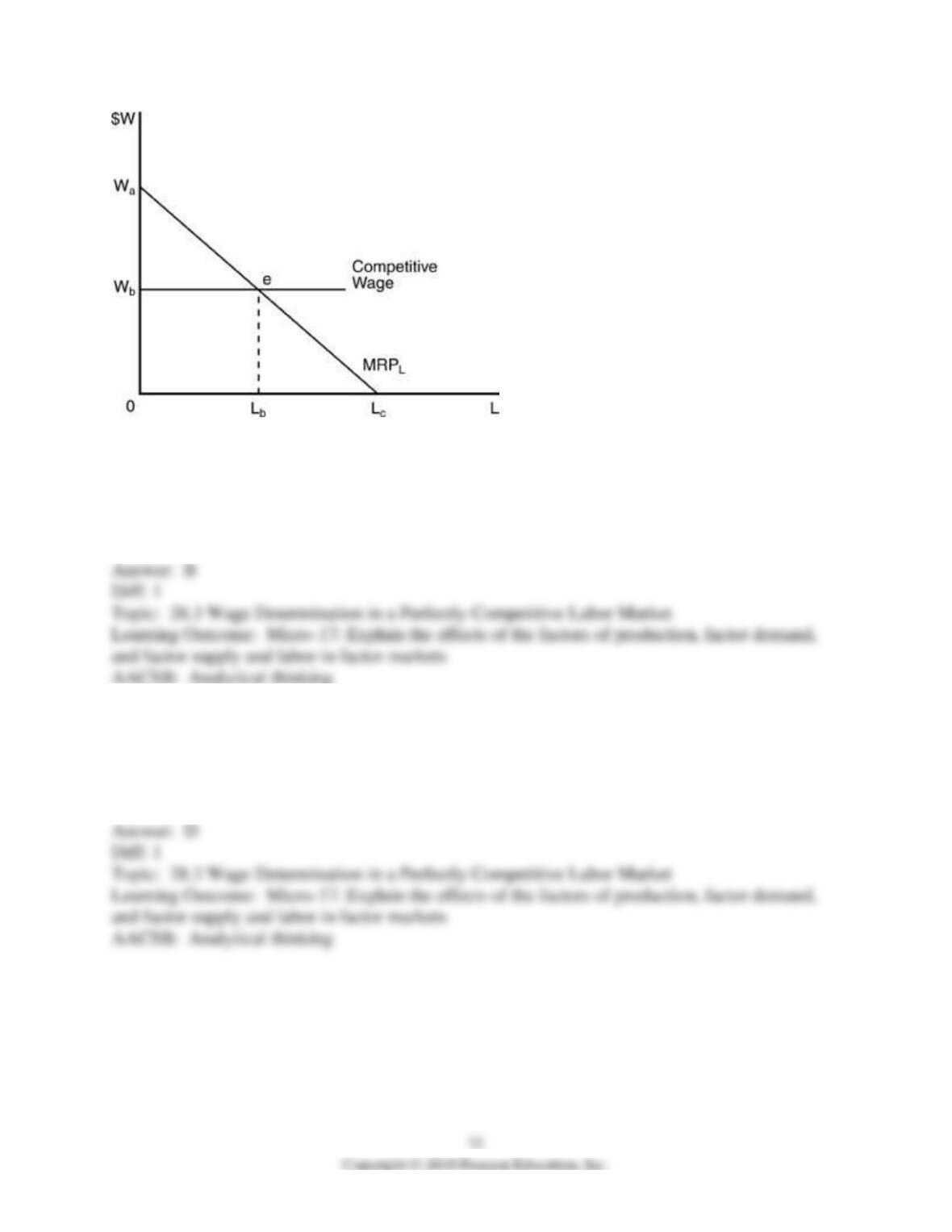
9) In the above figure, the competitive firm will employ the quantity of labor
A) equal to Lc.
B) equal to Lb.
C) less than Lb.
D) greater than Lc.
10) In the above figure, the line labeled “MRPL” also represents the firm’s
A) supply curve.
B) marginal physical product curve.
C) total physical product curve.
D) demand curve.
11) In the above figure, if the wage rate fell below Wb, in the short run the firm would
A) hire more workers.
B) fire several workers.
C) reduce its level of output.
D) keep all its input levels the same as they were before.
12) The labor supply curve faced by an individual firm in a perfectly competitive market is
A) upward sloping.
B) horizontal.
C) vertical.
D) downward sloping.
13) When hiring additional workers, a firm operating in a perfectly competitive labor market will
A) have to offer higher wages to hire additional workers, but the old workers do not get the
higher wage.
B) have to offer higher wages to hire additional workers, and the old workers will also receive
the new, higher wage.
C) be able to hire additional workers without offering higher wages.
D) be able to hire additional workers at lower wages because the new workers have been
unemployed.
14) The equilibrium wage rate in an industry is determined by
A) finding where the market supply curve indicates that the substitution effect and income effect
of a wage increase are offsetting.
B) the intersection of the market demand curve for labor and the market supply curve for labor.
C) the strength of the substitution effect relative to the elasticity of demand for labor.
D) whether workers or management are better at negotiating.
15) As the wage rate falls, other things constant, perfectly competitive firms will employ
A) fewer workers.
B) more capital.
C) the same number of workers.
D) more workers.
16) If the price of labor increases, the typical perfectly competitive firm in the short run will
A) produce more output.
B) hire less labor.
C) hire the same labor and produce the same output.
D) hire more labor.
17) A short-run decrease in the price of a firm’s output will typically
A) lead to a movement along the firm’s demand for labor curve.
B) lead to lower employment of labor in the competitive firm.
C) not impact the hiring of labor.
D) make the demand for labor more inelastic.
18) Which of the following will lead to an outward shift in the firm’s short-run demand for labor?
A) an increase in the price of output
B) less capital per unit of labor
C) a decline in labor productivity
D) a reduction in average consumer income
19) Which of the following will lead to an increase in the firm’s short-run demand for labor?
A) a decrease in the price of the final product
B) an increase in price of the final product’s substitute good
C) an improvement in labor productivity
D) a decrease in the number of buyers for the final product
20) Goods A and B are substitutes. If the price of good A falls, the marginal revenue product of
good B
A) will not change.
B) will shift out.
C) will become more inelastic.
D) will shift in.
21) The demand curve for labor will shift whenever
A) the demand for the final product changes.
B) the wage rate changes.
C) the supply curve of labor shifts.
D) the marginal factor cost changes.
22) A fall in the price of the final product produced by a firm will cause
A) a decline in the price of an input used to produce the good.
B) a movement down the demand curve for an input used to produce the final product.
C) a reduction in demand for an input used to produce the final product.
D) a reduction in the supply of an input used to produce the final product.
23) Assume that the labor market is perfectly competitive. An increase in the productivity of
labor
A) causes the marginal factor cost of labor to decrease.
B) generates a lower wage rate.
C) causes an increase in the demand for labor.
D) causes a reduction in the demand for labor since each worker is now more productive.
24) An industry utilizes capital and two types of labor. Unskilled labor is a substitute for capital
while the skilled labor is complementary to capital. An increase in the price of capital will
A) cause the demand for labor to increase, raising wages of both skilled and unskilled labor.
B) cause the wage of unskilled labor to rise relative to the price of skilled labor.
C) induce the firms in the industry to cut back on all levels—capital, unskilled and skilled labor.
D) cause the demand for skilled labor to rise and the demand for unskilled labor to fall.
25) If the marginal productivity of labor decreases, then
A) the quantity of labor demanded at every possible wage rate will be less.
B) the quantity of labor demanded at every possible wage rate will be higher.
C) the quantity of labor demanded will not be affected.
D) the demand curve for labor will shift upward and to the right.
26) In labor markets, the substitution effect occurs when
A) a substitute good also functions as a complement.
B) the cost of production falls enough that the firm will produce a larger amount of output.
C) a change in the price of a substitute input causes the demand for labor to change in the same
direction.
D) a change in the price of a substitute input reduces the cost of capital.
27) Which of the following would NOT shift an industry’s supply of labor curve?
A) The wage rate in the particular industry falls.
B) Wage rates in industries using similar labor rise.
C) Working conditions within the industry become less desirable.
D) Wage rates in other industries fall.
28) An increase in the supply of labor generates
A) increased unemployment.
B) lower wages.
C) an offsetting increase in the demand for labor.
D) a decrease in the quantity demanded of labor.
29) The supply of labor to one industry will decrease when
A) the price of leisure activities falls.
B) the income effect dominates the substitution effect.
C) the demand for labor falls in the industry.
D) workers receive better employment opportunities in other industries.
30) The demand for computers increases. As a result
A) the quantity demanded of workers increases, the wage rate rises, and the supply of labor
increases.
B) the demand for workers increases, hiring increases, but wages stay the same since each firm
faces a horizontal supply curve of labor.
C) the wage rate increases in the industry and the quantity demanded of workers falls.
D) the wage rate increases in the industry and the quantity supplied of workers increases.
31) The equilibrium wage rate in an industry is found by
A) the intersection of the market demand curve for labor and the marginal revenue product curve
of labor.
B) the intersection of the firm’s demand curve for labor and the firm’s supply curve of labor.
C) the intersection of the market demand curve for labor and the market supply curve of labor.
D) negotiations between the union leadership and the managers of the firms.
32) The wage rate found by the intersection of the market demand and supply curves for labor
then determines the
A) firm’s demand curve for labor.
B) firm’s supply curve for labor.
C) labor’s supply curve of labor.
D) labor’s demand curve for jobs.
33) Which of the following statements is TRUE about the market and individual firm’s supply
curve for labor?
A) The market supply curve is perfectly elastic and the individual firm’s supply curve is perfectly
inelastic.
B) The market supply curve is perfectly inelastic and the individual firm’s supply curve is
perfectly elastic.
C) The market supply curve is more elastic than the firm’s supply curve.
D) The market supply curve is more inelastic than the firm’s supply curve.
34) A firm purchases less capital equipment. We would expect to observe
A) a rightward shift in the supply curve of labor to this firm.
B) a decrease in the supply of labor for this firm.
C) a decrease in the demand for labor by this firm.
D) a decrease in the wage rate paid for labor by this firm.