DISC: Aggregate demand and aggre – DISC: Aggregate demand and aggregate supply
United States – BPROG: Analytic
Aggregate demand and aggregate s – Aggregate demand and aggregate supply
The Idea Behind Supply-Side Tax Cuts
175. Capital gains tax cuts inevitably benefit
a.
low-income workers.
b.
retired persons.
c.
workers in large cities.
d.
high-income stock owners.
DISC: Monetary and fiscal policy
United States – BPROG: Analytic
Monetary and fiscal policy
The Idea Behind Supply-Side Tax Cuts
176. Supply-side tax cuts tend to benefit the rich because tax cuts
a.
on income tend to benefit high income earners more than low income earners.
b.
on savings benefit high income earners who do most of the personal saving.
c.
for capital formation tend to benefit those with the means to accumulate capital.
d.
on capital gains tend to benefit those with larger financial assets.
e.
All of the above are correct.
DISC: Monetary and fiscal policy
United States – BPROG: Analytic
Monetary and fiscal policy
The Idea Behind Supply-Side Tax Cuts
177. Tax cuts associated with supply-side economics often lead to increased
a.
federal budget surpluses.
b.
federal budget deficits.
c.
foreign trade surpluses.
d.
government spending.
DISC: Monetary and fiscal policy
United States – BPROG: Analytic
Monetary and fiscal policy
The Idea Behind Supply-Side Tax Cuts
178. Federal budget deficits are often increased by supply-side policies because of their reliance on
a.
income tax cuts.
b.
income tax increases.
c.
increased government spending.
d.
decreased government spending.
DISC: Monetary and fiscal policy
United States – BPROG: Analytic
Monetary and fiscal policy
The Idea Behind Supply-Side Tax Cuts
179. Supply-side tax cuts are more likely to have the intended beneficial effect on
a.
budget deficits.
b.
consumer spending.
c.
investment spending.
d.
net exports.
DISC: Monetary and fiscal policy
United States – BPROG: Analytic
Monetary and fiscal policy
The Idea Behind Supply-Side Tax Cuts
180. Reductions in the personal income tax, often advocated by supply-siders to increase labor supply and effort, can be
expected to also
a.
decrease consumption spending.
b.
increase consumption spending.
c.
decrease investment spending.
d.
increase export sales.
DISC: Aggregate demand and aggre – DISC: Aggregate demand and aggregate supply
United States – BPROG: Analytic
Aggregate demand and aggregate s – Aggregate demand and aggregate supply
The Idea Behind Supply-Side Tax Cuts
181. There is some agreement between the beliefs of President George W. Bush in 2001 on the effectiveness of tax cuts
with the beliefs of former President
a.
Keynes.
b.
Clinton.
c.
Reagan.
d.
Carter.
c
Easy
DISC: Aggregate demand and aggre – DISC: Aggregate demand and aggregate supply
United States – BPROG: Analytic
Aggregate demand and aggregate s – Aggregate demand and aggregate supply
The Idea Behind Supply-Side Tax Cuts
182. Which of the following conclusions about supply-side tax initiatives is accepted by most economists?
a.
Supply-side tax cuts are likely to benefit the poor as much as the rich.
b.
Supply-side tax cuts will almost certainly lead to smaller budget deficits.
c.
Such tax cuts probably will increase aggregate supply quickly, but an increase in aggregate demand will come
later.
d.
Tax reductions aimed at stimulating business investment are likely to have a greater impact than tax reductions
aimed at getting people to work longer hours or save more.
Moderate
DISC: Aggregate demand and aggre – DISC: Aggregate demand and aggregate supply
United States – BPROG: Analytic
Aggregate demand and aggregate s – Aggregate demand and aggregate supply
The Idea Behind Supply-Side Tax Cuts
183. The Reagan tax cuts of the 1980s
a.
had not impact on the budget deficit.
b.
decreased the budget deficit.
c.
increased the budget deficit.
d.
initially decreased the deficit but later increased it.
c
Moderate
DISC: Aggregate demand and aggre – DISC: Aggregate demand and aggregate supply
Aggregate demand and aggregate s – Aggregate demand and aggregate supply
The Idea Behind Supply-Side Tax Cuts
184. Most economists seem to agree that cutting taxes
a.
on saving has more impact than cutting taxes to increase investment.
b.
to stimulate investment is more effective than cutting taxes to stimulate work.
c.
to increase work is more effective than cutting taxes to stimulate investment.
d.
to increase work incentives is more effective than cutting taxes on saving.
Moderate
DISC: Aggregate demand and aggre – DISC: Aggregate demand and aggregate supply
United States – BPROG: Analytic
Aggregate demand and aggregate s – Aggregate demand and aggregate supply
The Idea Behind Supply-Side Tax Cuts
185. In the short run, tax cuts that are intended to increase aggregate supply have
a.
almost no effect on aggregate demand, and a small effect on aggregate supply.
b.
about an equal effect on both aggregate demand and aggregate supply.
c.
a much greater effect on aggregate demand than on aggregate supply.
d.
almost no effect on aggregate supply, and a negative effect on aggregate demand.
c
Moderate
DISC: Aggregate demand and aggre – DISC: Aggregate demand and aggregate supply
United States – BPROG: Analytic
Aggregate demand and aggregate s – Aggregate demand and aggregate supply
The Idea Behind Supply-Side Tax Cuts
186. A Keynesian economist would expect a supply-side tax cut to shift
a.
only the aggregate supply curve outward.
b.
only the aggregate demand curve outward.
c.
both the aggregate demand and aggregate supply curves outward.
d.
the aggregate supply curve outward and the aggregate demand curve inward.
Moderate
DISC: Aggregate demand and aggre – DISC: Aggregate demand and aggregate supply
United States – BPROG: Analytic
Aggregate demand and aggregate s – Aggregate demand and aggregate supply
The Idea Behind Supply-Side Tax Cuts
187. As a general rule, when an income tax is added to the basic macroeconomic model, what happens to the consumption
schedule?
a.
It will shift downward.
b.
It will shift upward.
c.
It will become flatter.
d.
It will become steeper.
United States – BPROG: Analytic
Understanding and applying econo – Understanding and applying economic models
Appendix A: Graphical Treatment of Taxes and Fiscal Policy
188. When government increases a fixed tax, consumption schedule
a.
shifts downward in a parallel manner.
b.
shifts upward in a parallel manner.
c.
becomes horizontal.
d.
becomes vertical.
DISC: Monetary and fiscal policy
United States – BPROG: Reflective Thinking – BPROG: Analysis
Monetary and fiscal policy
Appendix A: Graphical Treatment of Taxes and Fiscal Policy
Figure 11-3
189. In Figure 11–3, which line represents the change in the consumption schedule caused by a cut in fixed taxes?
a.
C1 in graph (a)
b.
C2 in graph (a)
c.
C1 in graph (b)
d.
C2 in graph (b)
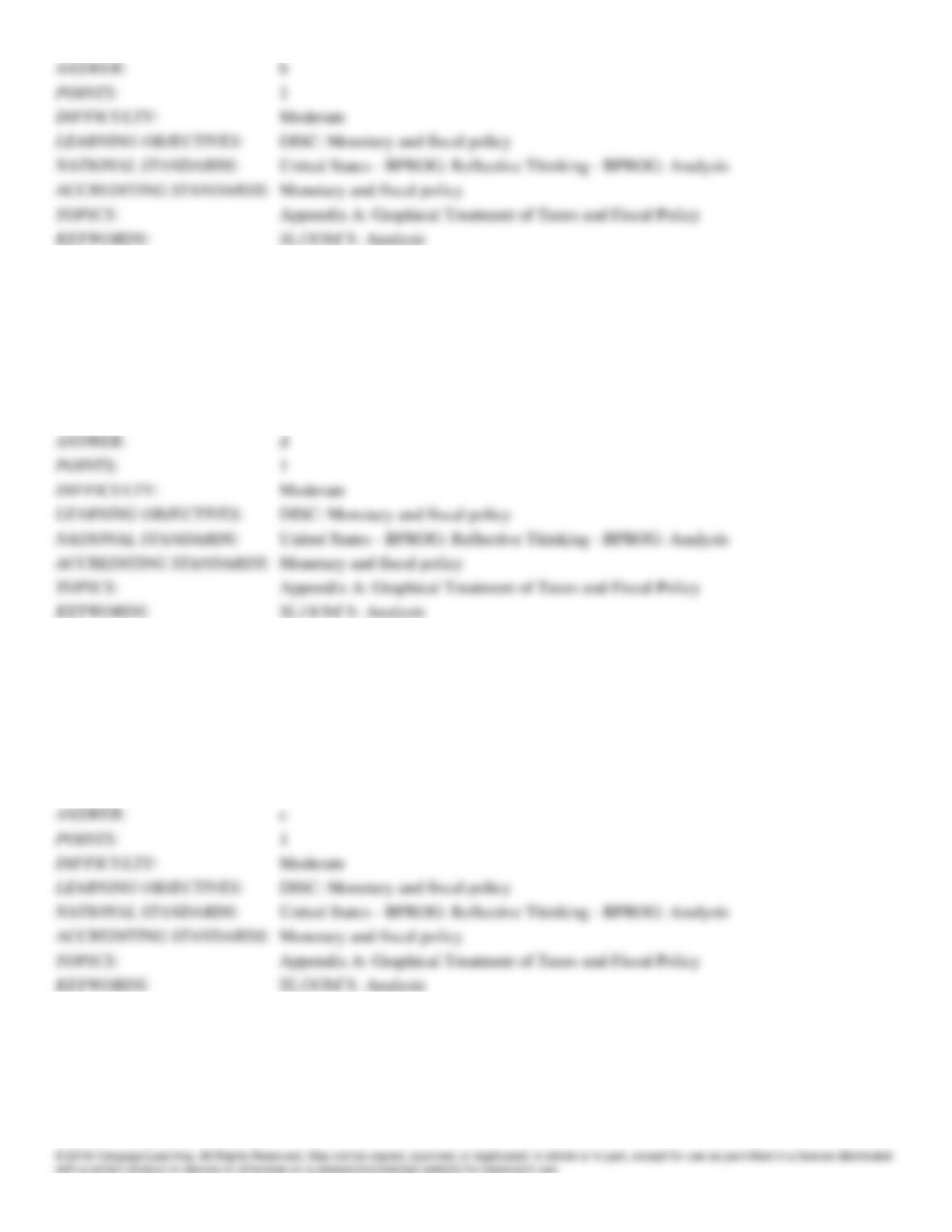
190. In Figure 11–3, which line represents the change in the consumption schedule caused by a cut in the personal income
tax as advocated by President George W. Bush in 2001?
a.
C1 in graph (a)
b.
C2 in graph (a)
c.
C1 in graph (b)
d.
C2 in graph (b)
191. In Figure 11–3, which line represents the change in the consumption schedule caused by an increase in the personal
income tax?
a.
C1 in graph (a)
b.
C2 in graph (a)
c.
C1 in graph (b)
d.
C2 in graph (b)
192. In Figure 11–3, which line represents the change in the consumption schedule caused by an increase in the residential
property tax?
a.
C1 in graph (a)
b.
C2 in graph (a)
c.
C1 in graph (b)
d.
C2 in graph (b)
a
Moderate
DISC: Monetary and fiscal policy
United States – BPROG: Reflective Thinking – BPROG: Analysis
Monetary and fiscal policy
Appendix A: Graphical Treatment of Taxes and Fiscal Policy
Table 11-1
Y =
C + I + G
C =
500 + .8(Y − T)
I =
300
G =
700
T =
.25Y
193. Refer to Table 11–1. What is the equilibrium level of income in this model?
a.
5,000
b.
4,500
c.
3,750
d.
3,500
e.
3,250
c
Difficult
DISC: Monetary and fiscal policy
United States – BPROG: Reflective Thinking – BPROG: Analysis
Monetary and fiscal policy
Appendix B: Algebraic Treatment of Fiscal Policy
194. Refer to Table 11–1. What is the level of tax revenues in this model?
a.
1,000
b.
950
c.
945.5
d.
937.5
e.
437.5
Difficult
DISC: Monetary and fiscal policy
United States – BPROG: Reflective Thinking – BPROG: Analysis
Monetary and fiscal policy
Appendix B: Algebraic Treatment of Fiscal Policy
195. Refer to Table 11–1. What is the level of saving in this model?
a.
92.5
b.
72.5
c.
62.5
d.
52.5
e.
42.5
c
Difficult
DISC: Monetary and fiscal policy
United States – BPROG: Reflective Thinking – BPROG: Analysis
Monetary and fiscal policy
Appendix B Algebraic Treatment of Taxes and Fiscal Policy
196. Refer to Table 11–1. What is the level of consumption in this model?
a.
2,950
b.
2,750
c.
2,550
d.
2,350
e.
2,150
Difficult
DISC: Monetary and fiscal policy
United States – BPROG: Reflective Thinking – BPROG: Analysis
Monetary and fiscal policy
Appendix B Algebraic Treatment of Taxes and Fiscal Policy
197. Government can raise GDP by $1,000 billion by:
a.
raising government purchases
b.
reducing taxes
c.
increasing transfer payments
d.
All of the above.
Moderate
DISC: Monetary and fiscal policy
United States – BPROG: Analytic
Monetary and fiscal policy
Planning Expansionary Fiscal Policy
198. Which of the following factors has the most quantitative importance on the oversimplified multiplier formula?
a.
it ignores variable imports
b.
it ignores price-level changes
c.
it ignores income taxes
d.
All of these equally affect the oversimplified multiplier formula
c
Difficult
DISC: Aggregate demand and aggre – DISC: Aggregate demand and aggregate supply
United States – BPROG: Reflective Thinking – BPROG: Analysis
Aggregate demand and aggregate s – Aggregate demand and aggregate supply
Planning Contractionary fiscal policy
Essay
199. Define the following terms and explain their significance to the study of macroeconomics:
a.
fiscal policy
b.
transfer payments
c.
effect of income taxes on the multiplier
d.
supply-side tax cuts
to shift the aggregate supply curve outward.
Easy
DISC: Monetary and fiscal policy
United States – BPROG: Analytic
Monetary and fiscal policy
Planning Expansionary Fiscal Policy
200. Explain why a change in income tax rates causes the consumption schedule to change slope.
201. Why does the numerical value of the multiplier fall when an income tax is added to the income-expenditure model?
202. Why is the personal income tax considered to be one of the main features of our modern economy that helps ensure
against a repeat performance of the Great Depression?
203. How do transfer payments function as negative taxes?
204. Explain how a “conservative” and a “liberal” might differ in the types of policies they advocate to counteract a
recessionary gap.
205. Explain some of the steps that a government would wish to adopt in an inflationary environment.
206. What is the difference between tax cuts imposed on higher-income households compared with lower- and middle-
income households? Discuss the implications for the multiplier and the effectiveness of the tax cuts for boosting GDP.
207. What are the policies usually advocated by supply side economists? How do they justify these proposals?
208. Why did President George W. Bush feel the need for a stimulus package for the U.S. economy after September 11,
2001? As a conservative, what type of fiscal stimulus would be most appealing to President Bush?
209. Discuss some of the general conclusions arrived at about supply-side tax initiatives.
210. Why did President Obama want to repeal the Bush era tax cuts on upper income taxpayers? How would the repeal of
these tax cuts impact aggregate demand and to what degree? How did the economic conditions in 2010 make such a
repeal less likely to take place?