40) Assume that a perfectly competitive firm faces a fixed wage rate of $4 and a constant per-
unit cost of capital of $2. If the marginal product of labor and capital are 16 and 6, respectively,
then to maximize profits the firm should
A) use relatively more labor.
B) use relatively less labor.
C) increase all inputs proportionately.
D) decrease all inputs proportionately.
41) If a firm faces perfectly competitive product and factor markets and the marginal product of
labor and capital are 4 and 9, respectively, while the wage rate is $2 and the rental rate on capital
is $4, the firm should
A) use relatively more capital.
B) use relatively less capital.
C) increase all inputs proportionately.
D) decrease all inputs proportionately.
42) If a firm faces perfectly competitive product and factor markets and the marginal product of
labor and capital are 4 and 9, respectively, while the wage rate is $2 and the rental rate on capital
is $4, the firm should
A) use relatively more labor.
B) use relatively less labor.
C) increase all inputs proportionately.
D) decrease all inputs proportionately.
43) A firm will hire a unit of input up to the point where
A) the marginal cost of the input equals the marginal cost of output.
B) the marginal revenue product of the input is equal to the marginal factor cost of the input.
C) the price of the input is equal to the price of output.
D) the marginal physical product of the input is equal to the price of output.
44) If the marginal revenue product of an input exceeds the marginal factor cost of the input, the
firm
A) should hire less of the input.
B) is maximizing profit.
C) is not on its marginal cost curve.
D) should increase its use of the input.
45) When a firm is hiring an input such that the marginal revenue product of the input is equal to
the marginal factor cost of the input, the firm
A) should be expanding output.
B) is hiring too little of the input.
C) is maximizing economic profit.
D) is producing too much output.
46) A profit maximizing firm will hire additional workers until
A) the additional cost associated with hiring the last worker equals the average wage rate of the
workers.
B) the additional cost associated with hiring the last worker equals the additional revenue
generated by that worker.
C) the extra revenue generated by the last worker hired equals zero.
D) the extra cost associated with hiring the last worker equals the price of the good produced.
47) Profit maximization requires that
A) the marginal factor cost of every input equals that input’s marginal physical product.
B) the marginal factor cost of every input equals that input’s marginal revenue product.
C) the amount of one input hired divided by the amount of another input hired equals the total
costs of the first input hired divided by the total costs of the second input.
D) equal amounts of each input are employed.
48) The profit maximizing combination of resources
A) usually involves more of each input hired than the cost minimizing combination of resources.
B) usually involves less of each input hired than the cost minimizing combination of resources.
C) usually involves hiring more of some resources and less of other resources than the cost
minimizing combination of resources.
D) is also the cost minimizing combination of resources.
49) Profit maximization occurs where
A) each factor is used up to the point where its marginal revenue product is equal to its marginal
factor cost.
B) each factor is used up to the point where its marginal physical product is equal to its marginal
factor cost.
C) average variable cost equals marginal cost.
D) average variable cost equals average total cost.
50) If a perfectly competitive firm is currently employing workers to the point where the value of
the last worker’s marginal product is equal to the wage rate, and the government imposes a
minimum wage higher than the value of the worker’s marginal product, we can predict that
A) the firm will pay the higher wage rate and not change the number of workers hired.
B) the firm will no longer employ the marginal worker.
C) the firm will increase its price.
D) the firm will employ more workers.
51) To minimize total costs for a particular rate of output, a firm will equate
A) the average cost of each factor.
B) the marginal revenue of each factor.
C) the marginal physical product per dollar spent on each factor.
D) the marginal revenue product and variable marginal revenue for each factor.
52) Cost minimization suggests that two inputs should be employed to the point where
A) the marginal cost of each input is identical.
B) the marginal revenue product of each input is identical.
C) the marginal physical product per dollar spent on each input is identical.
D) the extra contribution to physical output of the inputs is identical.
53) If the marginal physical product (MPP) of the last dollar spent on labor is only half as large
as the MPP from the last dollar spent on capital, this firm should
A) increase its use of labor and employ less capital.
B) employ more capital.
C) increase its use of both labor and capital.
D) maintain its current factor utilization pattern.
54) If a firm uses only capital and labor as inputs, then what should the firm do at a given rate of
production if the marginal physical product of labor per last dollar spent is higher than the
marginal physical product of capital per last dollar spent?
A) The firm should increase both the quantity of capital and the quantity of labor.
B) The firm should decrease both the quantity of capital and the quantity of labor.
C) The firm should increase the quantity of capital and reduce the quantity of labor.
D) The firm should decrease the quantity of capital and increase the quantity of labor.
55) If a firm uses only capital and labor as inputs, then what should the firm do at a given rate of
production if the marginal physical product of labor per last dollar spent is lower than the
marginal physical product of capital per last dollar spent?
A) The firm should increase both the quantity of capital and the quantity of labor.
B) The firm should decrease both the quantity of capital and the quantity of labor.
C) The firm should increase the quantity of capital and reduce the quantity of labor.
D) The firm should decrease the quantity of capital and increase the quantity of labor.
56) A perfectly competitive firm discovers that its MRPL divided by the wage equals 1.5. The
firm should
A) check the MRP of the other inputs and divide them by their prices. If they are all equal to 1.5
it is maximizing profits.
B) hire more labor.
C) purchase more capital.
D) try to pay a lower wage rate.
57) A firm that wants to maximize profits should hire each input to the point where
A) its marginal revenue product divided by the price of the input equals one.
B) its marginal revenue product divided by its marginal physical product equals the wage.
C) its marginal revenue product divided by the product price equals one.
D) its marginal physical product divided by the price of the input equals the product price.
58) If a firm wants to maximize profits it should
A) hire lots of capital and very little labor since labor needs to be trained.
B) hire unskilled labor rather than skilled labor since unskilled labor is cheaper.
C) equate the marginal physical product for each input to the price of the input.
D) equate the marginal revenue product for each input to the price of the input.
59) A firm that maximizes profits also
A) is inefficient.
B) cuts corners in production processes so that its products are made too cheaply.
C) uses the least-cost combination of resources.
D) pays input prices lower than other firms do.
60) If a firm wants to maximize profits it should
A) hire each factor of production up to the point at which the marginal physical product per last
dollar spent is equalized.
B) hire each factor of production up to the point at which the marginal revenue product per last
dollar spent is equalized.
C) hire each factor of production up to the point at which the marginal factor cost per last dollar
spent is equalized.
D) hire the same number of units of all inputs.
61) The cost-minimizing rule is that a firm should utilize inputs such that the marginal physical
product of an input divided by the price of the input is the same for all inputs. This is also the
profit-maximizing rule because
A) we obtain the profit-maximizing rule by multiplying each ratio by the marginal revenue
produced.
B) we obtain the profit-maximizing rule by multiplying each ratio by the product price, which is
the same for each input.
C) the profit-maximizing rule is just the inverse of the cost-minimizing rule.
D) they are exactly the same.
62) A profit-maximizing firm will hire workers up to the point at which
A) MRP < MFC.
B) MRP = MFC.
C) MRP > MFC.
D) MRP = MPP.
63) For a firm in a perfectly competitive labor market
A) W > MFC.
B) W < MFC.
C) W > MRP.
D) W = MFC.
64) If a firm wants to maximize profits, it should hire workers up to the point at which
A) total factor cost = total revenue.
B) marginal factor cost = marginal revenue product.
C) marginal utility = marginal cost.
D) total social benefit = total social costs.
65) Profit-maximizing employment is the quantity of labor at which
A) marginal revenue product is equal to marginal factor cost.
B) marginal revenue product is equal to product price.
C) marginal factor cost is equal to marginal revenue.
D) marginal factor product is equal to product price.
66) In a perfectly competitive situation, the profit-maximizing hiring situation for all inputs
being used is where
A) the MRP of each input is equal to the price of each input.
B) the MRP of each input is greater than the price of each input.
C) the MRP of each input is less than the price of each input.
D) There is no relationship between MRP and the prices of the inputs.
67) The profit-maximizing combination of resources in a perfectly competitive situation occurs
at the point at which
A) MRP of labor = price of labor (wage rate).
B) MRP of land = price of land (rental rate per unit).
C) MRP of capital = price of capital (cost per unit of service).
D) All of the above are correct.
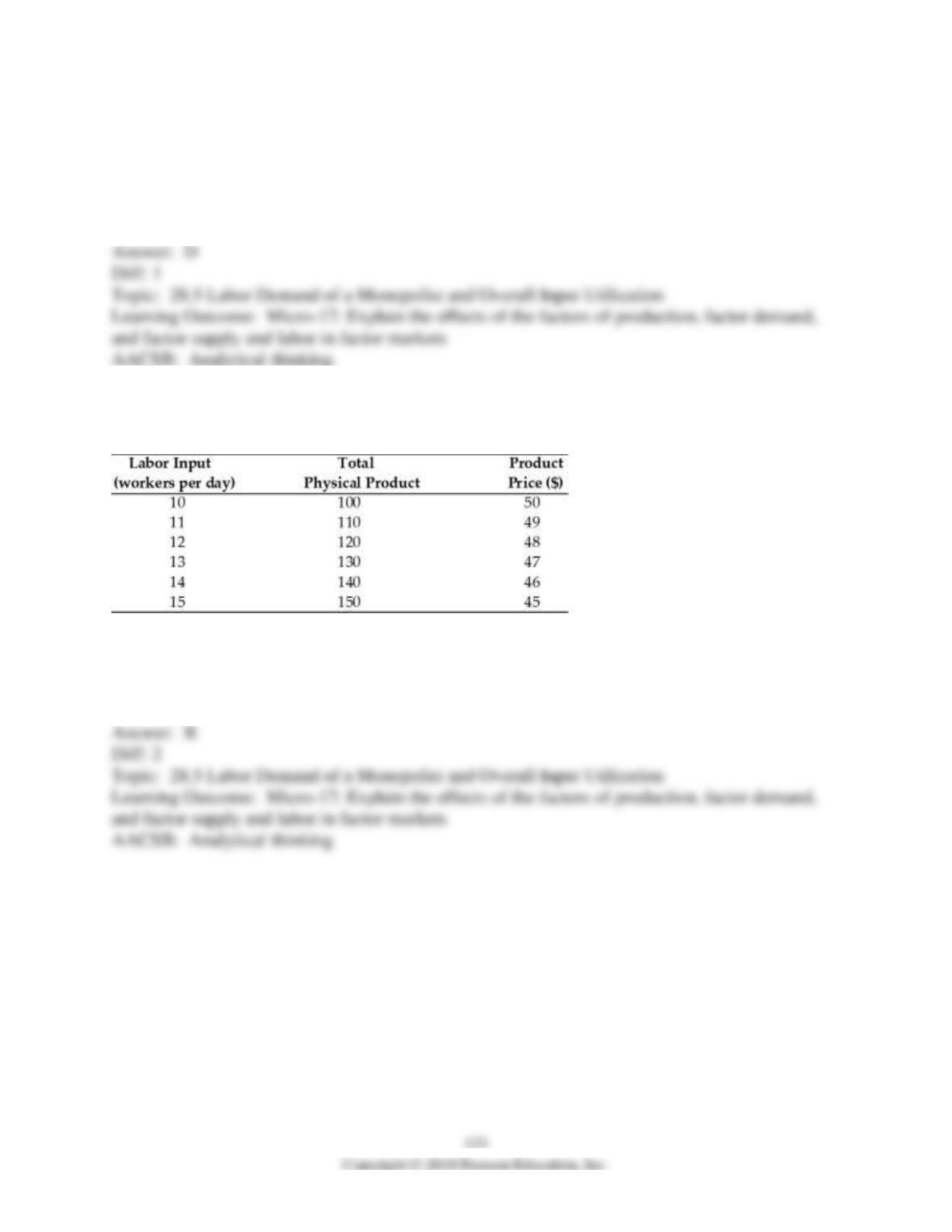
68) The following table depicts both the product and labor markets for imported coffee. What is
the total revenue when 15 workers per day are hired?
A) $5,000
B) $6,750
C) $7,350
D) $7,500
69) A perfectly competitive firm is hiring variable resources M and N. It will minimize total
costs
A) MRPm/MFCm = MRPn/MFCn.
B) MRPm ∗ MFCm = MRPn ∗ MFCn.
C) Pm/MPPm = Pn/MPPn.
D) MPPm/Pm = MPPn/Pn.
70) When a firm has maximized profits
A) it has also minimized total costs.
B) the marginal product of each input is also maximized.
C) the marginal physical product is greater than the input price for all inputs.
D) its marginal cost is zero.
71) “Other things being equal, the monopolist hires fewer workers than would be hired than a
perfectly competitive industry.” Do you agree or disagree? Why?
72) What does a monopolist’s demand curve for labor look like? How does it compare to the
market demand curve for a competitive industry? What does the supply curve of labor to a
monopolist look like? Explain.
73) For a firm that uses land, labor and capital as inputs, how should the inputs be utilized in
order to minimize total costs?
74) Show how the profit-maximizing rule for hiring resources is equivalent to the cost-
minimizing rule.
75) Explain what the profit-maximizing combination of resources is for the perfectly competitive
firm.
76) Suppose a firm employs only capital and labor as inputs. Explain how the firm should
allocate its inputs in order to maximize profits in a perfectly competitive market.