CHAPTER 28
Consumption Theory: Demand
MULTIPLE CHOICE
278. The founders of neoclassical economics built on the philosophy of Jeremy Bentham who
has placed mankind under the governance of two sovereign masters . .
a. utility and pleasure
b. pain and suffering
c. pain and pleasure
d. hunger and thirst
279. When neoclassical economists assume that individuals are rational, they mean that people
a. rarely show emotion.
b. are generally unselfish and self-sacrificing.
c. make purposeful choices based on their own self-interest.
d. make impulsive decisions based on what feels good at the time.
280. What does the assumption of diminishing marginal utility mean?
a. eventually additional units consumed will lead to a decline in total utility.
b. utility cannot be precisely measured but consumers can produce a ranking of
consumption choices.
c. as more units are consumed each additional unit will provide less and less additional
utility.
d. an increase in units of labor will leads to less and less additional output.
281. Sam, the robot, has a utility meter on his forehead. Sam has just consumed 1 cookie, and
the utility meter reads 15 utils. If Sam reacts according to eco
cookie will increase his utility meter
a. by another 15 utils for a total of 30 utils.
b. by less than 15 utils
c. by more than 15 utils.
d. by zero.
282. Sam is at lunch trying to decide between a small salad and a cheeseburger. Sam loves
cheeseburgers, but he really does not like salad. In fact, salad gives him negative utility.
What choice would you expect Sam to make?
a. Sam will choose a salad, because he knows it is in his best interest to eat healthy food.
b. Sam will choose a cheeseburger, because it will send his utility meter through the roof.
c. Sam will choose both the salad and the cheeseburger, because he will get healthy food
plus an increase in his utils.
d. Sam will probably buy 2 salads.
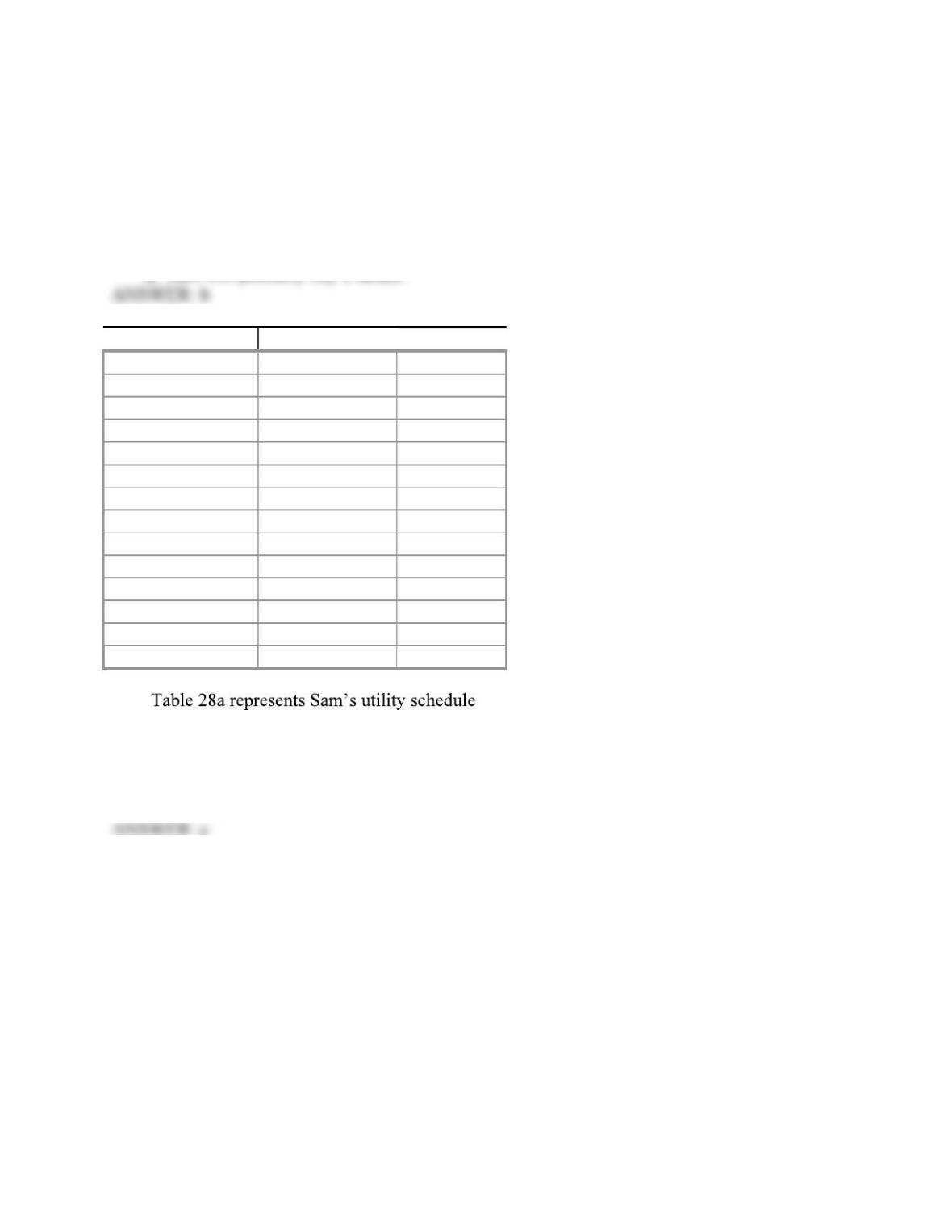
Table 28a
Quantity of DVDs
Marginal
Utility
Total Utility
1
100
100
2
90
190
3
80
270
4
70
340
5
60
400
6
50
450
7
40
490
8
30
520
9
20
540
10
10
550
11
0
550
12
–
10
540
13
–
20
520
14
–
30
490
283. for DVDs. Assuming no budget constraints,
Sam is likely to consume
a. 1 or 2 DVDs
b. 8 DVDs
c. 10 or 11 DVDs
d. 12 DVDs
APPENDIX 28.1
Utility Maximization and the Demand Curve
MUTLIPLE CHOICE
284. A consumer will maximize utility when
a. the marginal utility per dollar of the last item of each good consumed is the same.
b. he or she consumes as much as possible of his or her favorite good.
c. the marginal utility of the last item of each good consumed is the same.
d. the marginal utility of the last item of each good is exactly zero.
285. Sam is maximizing his utility with a consumption bundle of 5 cookies, 10 DVDs, and 2
a. Sam will continue to buy the same number of each good.
b. Sam will tend to buy more DVDs
c. Sam will tend to buy more cookies.
d. Sam will tend to buy more cheeseburgers.
Table 28.1a
Apples
Bread
Cake
11 units of utility
22 units of utility
33 units of utility
286.
cake. Sam is currently maximizing utility it
a. the price of apples is $1, bread is $2 and cake is $3
b. the prices of apples, bread and cake are all $1.
c. the price of apples is $3, bread is $2, and cake is $1
d. all items are $11 each
287.
a. consumers can be swayed by advertisers to buy things they do not want.
b. businesses make goods in response to the desires of consumers.
c. consumers buy goods in response to the advertisements of businesses.
d. consumers buy goods in response to their sovereign master, utility.