Aggregate demand and aggregate s – Aggregate demand and aggregate supply
The Aggregate Supply Curve
73. Resource prices are fixed for some period of time because
a.
some workers enter into long-term contracts.
b.
firms purchase raw materials on set-price contracts.
c.
many workers get pay increases only once a year.
d.
All of the above are correct.
Moderate
DISC: Aggregate demand and aggre – DISC: Aggregate demand and aggregate supply
United States – BPROG: Analytic
Aggregate demand and aggregate s – Aggregate demand and aggregate supply
The Aggregate Supply Curve
74. If profit per unit equals (price – cost per unit) and costs are temporarily fixed, then the aggregate supply curve will
have
a.
a basic “U” shape.
b.
a negative slope.
c.
a positive slope.
d.
All of the above could be correct.
c
Moderate
DISC: Aggregate demand and aggre – DISC: Aggregate demand and aggregate supply
United States – BPROG: Analytic
Aggregate demand and aggregate s – Aggregate demand and aggregate supply
The Aggregate Supply Curve
75. A statement issued by the president’s economic advisors stating that growth can continue without price increases
indicates that they believe the relevant aggregate supply curve is
a.
vertical.
b.
horizontal.
c.
downward sloping.
d.
upward sloping.
Moderate
DISC: Aggregate demand and aggre – DISC: Aggregate demand and aggregate supply
United States – BPROG: Analytic
Aggregate demand and aggregate s – Aggregate demand and aggregate supply
The Aggregate Supply Curve
76. An increase in wages will cause the aggregate supply curve to
a.
shift outward.
b.
shift inward.
c.
become flatter.
d.
become steeper.
DISC: Aggregate demand and aggre – DISC: Aggregate demand and aggregate supply
United States – BPROG: Analytic
Aggregate demand and aggregate s – Aggregate demand and aggregate supply
The Aggregate Supply Curve
77. A decrease in the price of resources will cause the aggregate supply curve to
a.
shift outward.
b.
shift inward.
c.
become flatter.
d.
become steeper.
DISC: Aggregate demand and aggre – DISC: Aggregate demand and aggregate supply
United States – BPROG: Analytic
Aggregate demand and aggregate s – Aggregate demand and aggregate supply
The Aggregate Supply Curve
78. A company succumbs to a wage increase demand without any changes in the productivity of labor, price of the
product, and the total output sold. Which of the following would happen?
a.
Total revenue of the company will fall.
b.
Investment by the company will increase.
c.
Profit per unit of the product will fall.
d.
Average profit per unit will increase.
DISC: Aggregate demand and aggre – DISC: Aggregate demand and aggregate supply
United States – BPROG: Analytic
Aggregate demand and aggregate s – Aggregate demand and aggregate supply
The Aggregate Supply Curve
79. The slope of the aggregate supply curve increases as output increases because
a.
the cost of resource-use increases as potential is reached.
b.
consumers are willing to pay more as output expands.
c.
firms substitute capital for labor as prices increase.
d.
firms substitute capital for labor as capacity is reached.
DISC: Aggregate demand and aggre – DISC: Aggregate demand and aggregate supply
United States – BPROG: Analytic
Aggregate demand and aggregate s – Aggregate demand and aggregate supply
The Aggregate Supply Curve
80. The aggregate supply curve shows for each price level the
a.
total amount of money supply at each price level.
b.
amount of frictional unemployment that will occur.
c.
amount of structural unemployment that will occur.
d.
quantity of goods and services that businesses are willing to produce.
DISC: Aggregate demand and aggre – DISC: Aggregate demand and aggregate supply
United States – BPROG: Analytic
Aggregate demand and aggregate s – Aggregate demand and aggregate supply
81. The aggregate supply curve is drawn with
a.
the price level on the vertical axis and nominal GDP on the horizontal.
b.
nominal GDP on the vertical axis and real GDP on the horizontal.
c.
the price level on the vertical axis and real GDP on the horizontal.
d.
real GDP on the horizontal and the rate of inflation on the vertical.
DISC: Aggregate demand and aggre – DISC: Aggregate demand and aggregate supply
United States – BPROG: Analytic
Aggregate demand and aggregate s – Aggregate demand and aggregate supply
The Aggregate Supply Curve
82. An economist who claims that an increase in government spending would result mainly in a higher price level believes
the economy is operating where
a.
the MPC is small.
b.
the MPC is large.
c.
aggregate supply curve is flat.
d.
aggregate supply curve is steep.
Moderate
DISC: Aggregate demand and aggre – DISC: Aggregate demand and aggregate supply
United States – BPROG: Analytic
Aggregate demand and aggregate s – Aggregate demand and aggregate supply
The Aggregate Supply Curve
83. Aggregate supply can be thought of as
a.
a fixed amount of output.
b.
unrelated to the price level.
c.
a schedule of output at different price levels.
d.
the volume of goods at the ends of the production possibilities curve.
c
Moderate
DISC: Aggregate demand and aggre – DISC: Aggregate demand and aggregate supply
United States – BPROG: Analytic
Aggregate demand and aggregate s – Aggregate demand and aggregate supply
The Aggregate Supply Curve
84. If the price level rises, what will happen to aggregate supply?
a.
It will shift outward.
b.
It will shift inward.
c.
Nothing.
d.
It will get steeper.
e.
It will get flatter.
c
Moderate
DISC: Aggregate demand and aggre – DISC: Aggregate demand and aggregate supply
United States – BPROG: Analytic
Aggregate demand and aggregate s – Aggregate demand and aggregate supply
The Aggregate Supply Curve
85. If the price level falls, what will happen to the aggregate supply curve?
a.
It will shift outward.
b.
It will shift inward.
c.
Nothing.
d.
It will get steeper.
e.
It will get flatter.
c
Moderate
DISC: Aggregate demand and aggre – DISC: Aggregate demand and aggregate supply
United States – BPROG: Analytic
Aggregate demand and aggregate s – Aggregate demand and aggregate supply
The Aggregate Supply Curve
86. The aggregate supply curve shows the relationship between ____ and ____, holding all other factors constant.
a.
price level; quantity of real GDP supplied
b.
price level; supply of nominal GDP
c.
nominal GDP; price level of real GDP
d.
price level; amount of nominal GDP supplied
a
Moderate
DISC: Aggregate demand and aggre – DISC: Aggregate demand and aggregate supply
United States – BPROG: Analytic
Aggregate demand and aggregate s – Aggregate demand and aggregate supply
The Aggregate Supply Curve
87. If the price level rises, what will happen to the level of real GDP supplied?
a.
It will usually decrease.
b.
It will usually increase.
c.
Nothing.
d.
It will decrease at first and then increase.
Moderate
DISC: Aggregate demand and aggre – DISC: Aggregate demand and aggregate supply
United States – BPROG: Analytic
Aggregate demand and aggregate s – Aggregate demand and aggregate supply
The Aggregate Supply Curve
88. If the price level decreases, what will happen to the level of real GDP supplied?
a.
It will usually decrease.
b.
It will usually increase.
c.
Nothing.
d.
It will decrease at first and then increase.
a
Moderate
DISC: Aggregate demand and aggre – DISC: Aggregate demand and aggregate supply
United States – BPROG: Analytic
Aggregate demand and aggregate s – Aggregate demand and aggregate supply
The Aggregate Supply Curve
89. The concept of aggregate supply is a
a.
fixed number.
b.
schedule.
c.
predetermined amount of output.
d.
All of the above are correct.
Easy
DISC: Aggregate demand and aggre – DISC: Aggregate demand and aggregate supply
United States – BPROG: Analytic
Aggregate demand and aggregate s – Aggregate demand and aggregate supply
The Aggregate Supply Curve
90. Aggregate supply is defined as
a.
how much the economy can produce at zero unemployment.
b.
an amount of output the economy will produce at full employment.
c.
the relationship between the expenditures schedule and the leakages schedule.
d.
the relationship between the price level and the quantity of real GDP supplied.
Moderate
United States – BPROG: Analytic
The study of economics, and defi – The study of economics, and definitions of economics
The Aggregate Supply Curve
91. The relationship between the price level and the quantity of real GDP supplied is
a.
full employment output.
b.
inflationary or recessionary gap.
c.
aggregate supply.
d.
supply-side equilibrium.
c
Moderate
DISC: Aggregate demand and aggre – DISC: Aggregate demand and aggregate supply
United States – BPROG: Analytic
Aggregate demand and aggregate s – Aggregate demand and aggregate supply
The Aggregate Supply Curve
92. The general shape of the aggregate supply curve is
a.
downward sloping.
b.
upward sloping.
c.
vertical.
d.
horizontal.
Easy
DISC: Aggregate demand and aggre – DISC: Aggregate demand and aggregate supply
United States – BPROG: Analytic
Aggregate demand and aggregate s – Aggregate demand and aggregate supply
The Aggregate Supply Curve
93. What is the usual response of firm to an increase in the price of what they sell?
a.
An increase in output.
b.
An increase in hiring factors of production.
c.
An increase in the profit level of the firm.
d.
An increase in employment at the firm.
e.
All of the above.
e
Moderate
DISC: Aggregate demand and aggre – DISC: Aggregate demand and aggregate supply
United States – BPROG: Analytic
Aggregate demand and aggregate s – Aggregate demand and aggregate supply
The Aggregate Supply Curve
94. The main reason that firms adjust their output when the price level changes is that
a.
uncertainty causes a drop in output.
b.
taxes cause a supply-side reaction.
c.
their profit margins change.
d.
increased risks lead to a change in output.
e.
All of the above are correct.
c
Moderate
DISC: Aggregate demand and aggre – DISC: Aggregate demand and aggregate supply
United States – BPROG: Analytic
Aggregate demand and aggregate s – Aggregate demand and aggregate supply
The Aggregate Supply Curve
95. The aggregate supply curve slopes upward because firms
a.
seek to maximize profits and output.
b.
normally can purchase inputs at fixed prices.
c.
employ technology, which is always fixed.
d.
purchase inputs whose prices rise as output rises.
DISC: Aggregate demand and aggre – DISC: Aggregate demand and aggregate supply
United States – BPROG: Analytic
Aggregate demand and aggregate s – Aggregate demand and aggregate supply
The Aggregate Supply Curve
96. The aggregate supply curve will shift to the left if
a.
energy prices fall.
b.
technology and productivity increase in the economy.
c.
the capital stock of the economy increases.
d.
the money wage rate increases.
DISC: Aggregate demand and aggre – DISC: Aggregate demand and aggregate supply
United States – BPROG: Analytic
Aggregate demand and aggregate s – Aggregate demand and aggregate supply
97. The OPEC production cuts of 1999-2000 increased energy prices and caused the aggregate supply curve to
a.
shift outward.
b.
shift inward.
c.
become flatter.
d.
become steeper.
DISC: Aggregate demand and aggre – DISC: Aggregate demand and aggregate supply
United States – BPROG: Analytic
Aggregate demand and aggregate s – Aggregate demand and aggregate supply
The Aggregate Supply Curve
98. If scientific research produces a technological breakthrough in the production of computer memory, then
a.
business costs will increase, profits will fall, and production will decrease.
b.
business costs will fall, but profits will also fall, and production will decrease.
c.
business costs will fall, profits will improve, and production will increase.
d.
profits will increase, allowing businesses to cut back production.
DISC: Aggregate demand and aggre – DISC: Aggregate demand and aggregate supply
United States – BPROG: Analytic
Aggregate demand and aggregate s – Aggregate demand and aggregate supply
The Aggregate Supply Curve
99. An increase in the money wage rate will cause the aggregate supply curve to shift
a.
outward, which means the quantity supplied at any price level decreases.
b.
outward, which means the quantity supplied at any price level increases.
c.
inward, which means the quantity supplied at any price level increases.
d.
inward, which means the quantity supplied at any price level decreases.
DISC: Aggregate demand and aggre – DISC: Aggregate demand and aggregate supply
United States – BPROG: Analytic
Aggregate demand and aggregate s – Aggregate demand and aggregate supply
The Aggregate Supply Curve
100. Increases in productivity are caused by
a.
better education and training of the labor force.
b.
higher levels of literacy.
c.
improvements in technology.
d.
All of the above are correct.
DISC: Aggregate demand and aggre – DISC: Aggregate demand and aggregate supply
United States – BPROG: Analytic
Aggregate demand and aggregate s – Aggregate demand and aggregate supply
The Aggregate Supply Curve
101. The typical movement of the aggregate supply curve resulting from an increase in productivity is that it
a.
shifts inward and becomes flatter.
b.
shifts inward.
c.
shifts outward.
d.
becomes flatter.
e.
becomes steeper.
DISC: Aggregate demand and aggre – DISC: Aggregate demand and aggregate supply
United States – BPROG: Analytic
Aggregate demand and aggregate s – Aggregate demand and aggregate supply
The Aggregate Supply Curve
102. Increases in the availability of natural resources will affect the aggregate supply curve such that it
a.
shifts inward and becomes flatter.
b.
shifts inward.
c.
shifts outward.
d.
becomes flatter.
e.
becomes steeper.
DISC: Aggregate demand and aggre – DISC: Aggregate demand and aggregate supply
United States – BPROG: Analytic
Aggregate demand and aggregate s – Aggregate demand and aggregate supply
The Aggregate Supply Curve
103. If the prices of inputs changes, what will happen to the aggregate supply curve?
a.
It does not move but the economy moves along the curve.
b.
It depends on whether the input prices rise or fall.
c.
The curve will become flatter or steeper depending on whether the input prices rise or fall.
d.
It shifts inward or outward depending on whether the input prices rise or fall.
DISC: Aggregate demand and aggre – DISC: Aggregate demand and aggregate supply
United States – BPROG: Analytic
Aggregate demand and aggregate s – Aggregate demand and aggregate supply
The Aggregate Supply Curve
104. If money wages increase, the most likely result is a(n)
a.
increase in aggregate supply.
b.
decrease in aggregate supply.
c.
steeper aggregate supply curve.
d.
flatter aggregate supply curve.
DISC: Aggregate demand and aggre – DISC: Aggregate demand and aggregate supply
United States – BPROG: Analytic
Aggregate demand and aggregate s – Aggregate demand and aggregate supply
The Aggregate Supply Curve
105. The investment and capital spending boom of the late 1990s most likely resulted in a(n)
a.
increase in aggregate supply.
b.
decrease in aggregate supply.
c.
steeper aggregate supply curve.
d.
flatter aggregate supply curve.
DISC: Aggregate demand and aggre – DISC: Aggregate demand and aggregate supply
United States – BPROG: Analytic
Aggregate demand and aggregate s – Aggregate demand and aggregate supply
The Aggregate Supply Curve
106. A severe hurricane hits Florida, destroying large amounts of the citrus crop. What is the most likely effect of this on
aggregate supply?
a.
It will be unchanged.
b.
No effect, the economy will move along the curve to a higher price level.
c.
No effect, the economy will move along the curve to a lower price level.
d.
It will increase.
e.
It will decrease.
DISC: Aggregate demand and aggre – DISC: Aggregate demand and aggregate supply
United States – BPROG: Analytic
Aggregate demand and aggregate s – Aggregate demand and aggregate supply
The Aggregate Supply Curve
107. At levels of output close to full employment, the aggregate supply curve is probably
a.
very flat.
b.
very steep.
c.
sloped downward.
d.
perfectly elastic.
DISC: Aggregate demand and aggre – DISC: Aggregate demand and aggregate supply
United States – BPROG: Analytic
Aggregate demand and aggregate s – Aggregate demand and aggregate supply
The Aggregate Supply Curve
108. The only factor that can cause movement along the aggregate supply curve is the
a.
labor force.
b.
capital stock.
c.
availability of resources.
d.
price level.
e.
All of the above are correct.
DISC: Aggregate demand and aggre – DISC: Aggregate demand and aggregate supply
United States – BPROG: Analytic
Aggregate demand and aggregate s – Aggregate demand and aggregate supply
The Aggregate Supply Curve
109. The price of imported oil decreased in 2001. How did this affect the aggregate supply curve?
a.
It became steeper.
b.
It became flatter.
c.
It shifted inward.
d.
It shifted outward.
DISC: Aggregate demand and aggre – DISC: Aggregate demand and aggregate supply
United States – BPROG: Analytic
Aggregate demand and aggregate s – Aggregate demand and aggregate supply
The Aggregate Supply Curve
110. Educational reforms that result in improved reading and math skills of high school graduates as they enter the labor
force would do what to the aggregate supply curve?
a.
Shift it outward.
b.
Shift it inward.
c.
Move the economy up along the curve.
d.
Move the economy down along the curve.
DISC: Aggregate demand and aggre – DISC: Aggregate demand and aggregate supply
United States – BPROG: Analytic
Aggregate demand and aggregate s – Aggregate demand and aggregate supply
The Aggregate Supply Curve
111. Many economists are in favor of increased immigration of adult foreigners who possess high levels of skills and
education. Why?
a.
Economists are very caring individuals.
b.
Economists believe this is a way to increase understanding among different ethnic groups.
c.
Economists believe foreigners will work cheaper.
d.
Economists believe this will increase aggregate supply.
DISC: Aggregate demand and aggre – DISC: Aggregate demand and aggregate supply
United States – BPROG: Analytic
Aggregate demand and aggregate s – Aggregate demand and aggregate supply
The Aggregate Supply Curve
112. In response to the demands of environmentalists, large sections of timberlands are put off limits to logging. What
effect will this have on the aggregate supply curve?
a.
Shift it outward.
b.
Shift it inward.
c.
Move the economy up along the curve.
d.
Move the economy down along the curve.
DISC: Aggregate demand and aggre – DISC: Aggregate demand and aggregate supply
United States – BPROG: Analytic
Aggregate demand and aggregate s – Aggregate demand and aggregate supply
The Aggregate Supply Curve
113. The aggregate demand and aggregate supply curve intersect
a.
at potential GDP.
b.
below potential GDP.
c.
above potential GDP.
d.
at a point which may or may not be equal to potential GDP.
DISC: Aggregate demand and aggre – DISC: Aggregate demand and aggregate supply
United States – BPROG: Analytic
Aggregate demand and aggregate s – Aggregate demand and aggregate supply
Equilibrium of Aggregate Supply and Demand
114. If aggregate quantity demanded exceeds aggregate quantity supplied, we can expect an unplanned
a.
depletion of inventories, causing firms to raise prices.
b.
depletion of inventories, causing firms to lower prices.
c.
accumulation of inventories, causing firms to raise prices.
d.
accumulation of inventories, causing firms to lower prices.
DISC: Aggregate demand and aggre – DISC: Aggregate demand and aggregate supply
United States – BPROG: Analytic
Aggregate demand and aggregate s – Aggregate demand and aggregate supply
Equilibrium of Aggregate Supply and Demand
115. If aggregate quantity supplied exceeds aggregate quantity demanded, we can expect an unplanned
a.
depletion of inventories, causing firms to raise prices.
b.
depletion of inventories, causing firms to lower prices.
c.
accumulation of inventories, causing firms to raise prices.
d.
accumulation of inventories, causing firms to lower prices.
DISC: Aggregate demand and aggre – DISC: Aggregate demand and aggregate supply
United States – BPROG: Analytic
Aggregate demand and aggregate s – Aggregate demand and aggregate supply
Equilibrium of Aggregate Supply and Demand
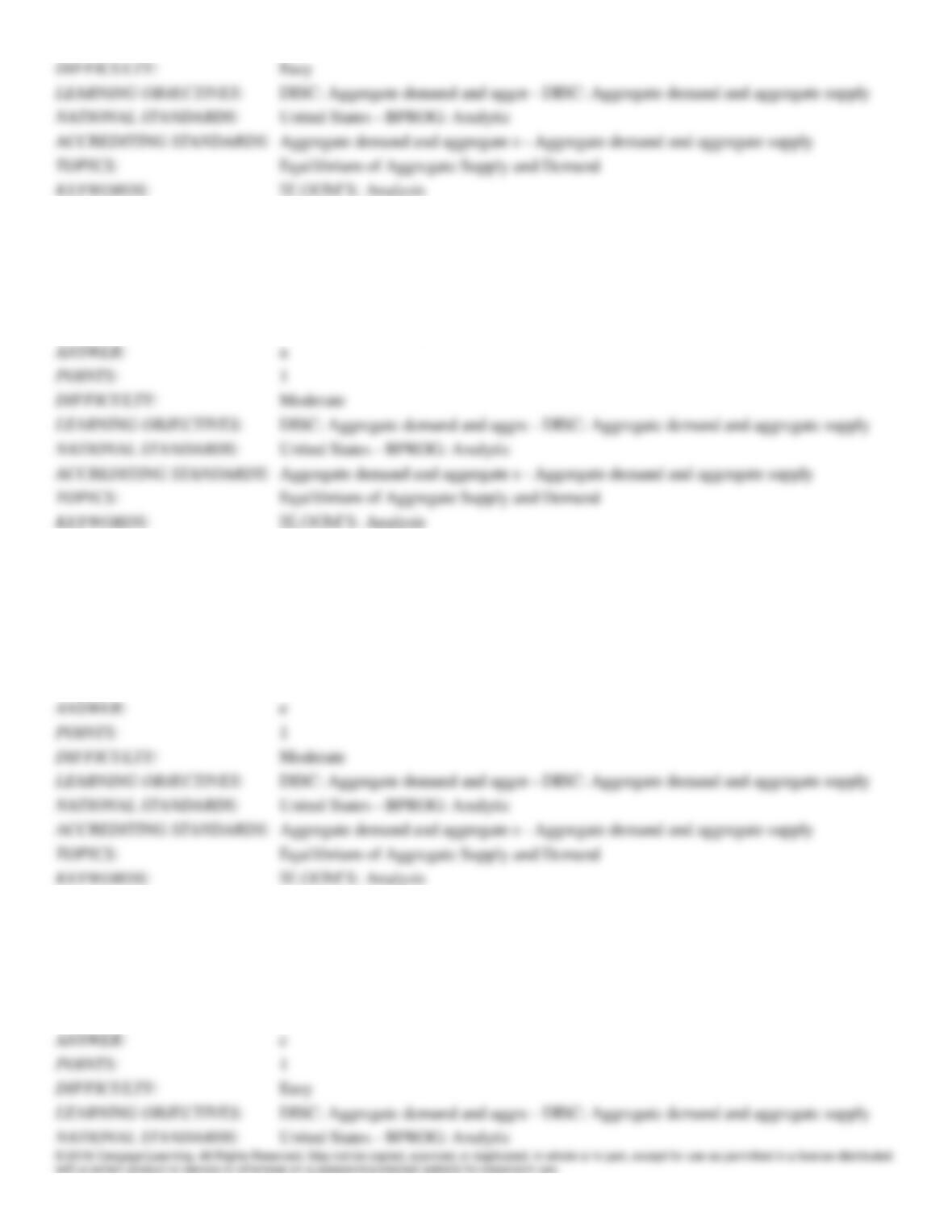
Figure 10-1
116. In Figure 10–1, what is the equilibrium level of real GDP and equilibrium price?
a.
$6,000 billion real GDP and price level of 110
b.
$5,000 billion real GDP and price level of 120
c.
$5,000 billion real GDP and price level of 110
d.
$7,500 billion real GDP and price level of 100
DISC: Aggregate demand and aggre – DISC: Aggregate demand and aggregate supply
United States – BPROG: Analytic
Aggregate demand and aggregate s – Aggregate demand and aggregate supply
Equilibrium of Aggregate Supply and Demand
117. If the price level in Figure 10-1 were 120,
a.
there would be excess goods on the market.
b.
firms would have to raise their prices.
c.
inventories would be disappearing.
d.
aggregate quantity demanded would exceed aggregate quantity supplied.
DISC: Aggregate demand and aggre – DISC: Aggregate demand and aggregate supply
United States – BPROG: Analytic
Aggregate demand and aggregate s – Aggregate demand and aggregate supply
Equilibrium of Aggregate Supply and Demand
118. If the price level in Figure 10-1 were 100,
a.
firms would have to lower their prices.
b.
inventories would be accumulating.
c.
shortages of goods would exist.
d.
aggregate quantity demanded would exceed aggregate quantity supplied.
e.
both c and d would occur.
DISC: Aggregate demand and aggre – DISC: Aggregate demand and aggregate supply
United States – BPROG: Analytic
Aggregate demand and aggregate s – Aggregate demand and aggregate supply
Equilibrium of Aggregate Supply and Demand
119. If the price level in Figure 10-1 were 110,
a.
inventories would be accumulating.
b.
firms would have to lower their prices.
c.
aggregate quantity demanded would equal aggregate quantity supplied.
d.
shortages of goods would exist.
DISC: Aggregate demand and aggre – DISC: Aggregate demand and aggregate supply
United States – BPROG: Analytic
Aggregate demand and aggregate s – Aggregate demand and aggregate supply
Equilibrium of Aggregate Supply and Demand
120. What does inflation do to the value of the oversimplified multiplier?
a.
Inflation increases the value of the multiplier above the value of the oversimplified formula.
b.
Inflation does not change the value of the multiplier.
c.
Inflation decreases the value of the multiplier below the value of the oversimplified formula.
d.
Inflation increases the value of the multiplier unless the level of unemployment also rises.
DISC: Aggregate demand and aggre – DISC: Aggregate demand and aggregate supply
United States – BPROG: Analytic
Aggregate demand and aggregate s – Aggregate demand and aggregate supply
Inflation and the Multiplier
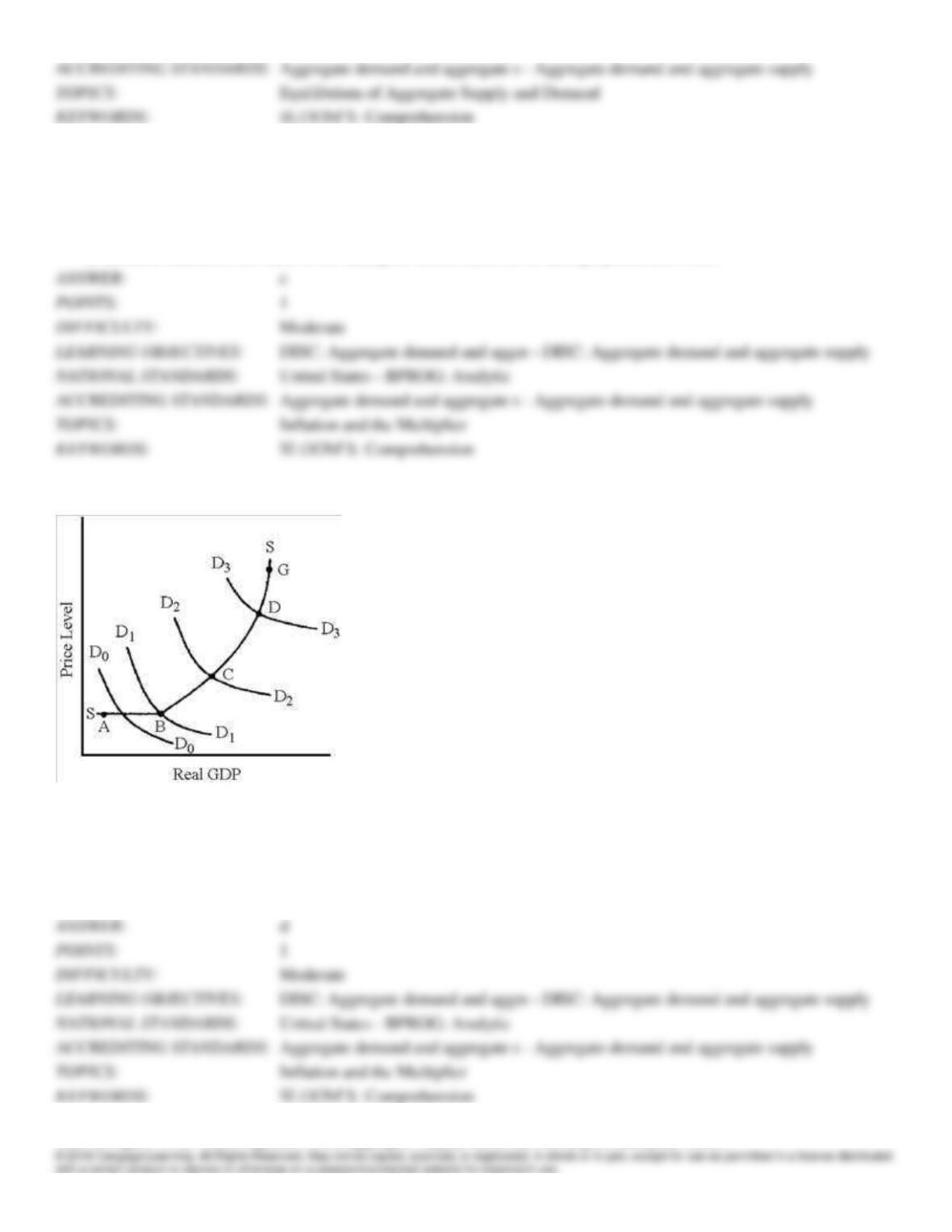
Figure 10-2
121. In Figure 10–2, which segment of the aggregate supply curve has the smallest multiplier effect?
a.
AB
b.
BC
c.
CD
d.
DG
DISC: Aggregate demand and aggre – DISC: Aggregate demand and aggregate supply
United States – BPROG: Analytic
Aggregate demand and aggregate s – Aggregate demand and aggregate supply
Inflation and the Multiplier
122. In Figure 10–2, which segment of the aggregate supply curve has the largest multiplier effect?
a.
AB
b.
BC
c.
CD
d.
DG
DISC: Aggregate demand and aggre – DISC: Aggregate demand and aggregate supply
United States – BPROG: Analytic
Aggregate demand and aggregate s – Aggregate demand and aggregate supply
Inflation and the Multiplier
123. One reason the oversimplified multiplier is incorrect is that inflation
a.
increases the multiplier by increasing investment spending.
b.
increases the multiplier by increasing consumer spending.
c.
decreases the multiplier by increasing net exports.
d.
decreases the multiplier by decreasing consumer spending.
DISC: Aggregate demand and aggre – DISC: Aggregate demand and aggregate supply
United States – BPROG: Analytic
Aggregate demand and aggregate s – Aggregate demand and aggregate supply
124. Assume an economy with an upward-sloping aggregate supply curve and an MPC of .80. An increase in investment
spending of $50 billion will most likely increase total income by
a.
$200 billion.
b.
$40 billion.
c.
more than $200 billion.
d.
more than $50 billion but less than $250 billion.
DISC: Aggregate demand and aggre – DISC: Aggregate demand and aggregate supply
United States – BPROG: Reflective Thinking – BPROG: Analysis
Aggregate demand and aggregate s – Aggregate demand and aggregate supply
Inflation and the Multiplier
125. The federal government increases spending by $50 billion and the main effect is an increase in the price level. It must
be true that the economy is operating on the
a.
horizontal portion of the aggregate demand curve.
b.
horizontal portion of the aggregate supply curve.
c.
vertical portion of the aggregate supply curve.
d.
vertical portion of the aggregate demand curve.
c
Moderate
DISC: Aggregate demand and aggre – DISC: Aggregate demand and aggregate supply
United States – BPROG: Analytic
Aggregate demand and aggregate s – Aggregate demand and aggregate supply
Inflation and the Multiplier
126. As the slope of the aggregate supply curve increases, this indicates that
a.
the economy is getting close to potential GDP.
b.
the economy is reducing employment.
c.
inflation will be less of a problem.
d.
output is falling.
a
Moderate
DISC: Aggregate demand and aggre – DISC: Aggregate demand and aggregate supply
United States – BPROG: Analytic
Aggregate demand and aggregate s – Aggregate demand and aggregate supply
Inflation and the Multiplier
127. When inflation occurs, consumers
a.
realize gains in their wealth.
b.
increase spending to catch up with higher prices.
c.
automatically shift the consumption line upward.
d.
suffer a decrease in real wealth.
Moderate
DISC: Aggregate demand and aggre – DISC: Aggregate demand and aggregate supply
United States – BPROG: Analytic
Aggregate demand and aggregate s – Aggregate demand and aggregate supply
Inflation and the Multiplier
128. As long as the aggregate supply curve is upward sloping, an increase in aggregate demand will increase
a.
real wealth.
b.
price levels.
c.
unemployment.
d.
net exports.
DISC: Aggregate demand and aggre – DISC: Aggregate demand and aggregate supply
United States – BPROG: Analytic
Aggregate demand and aggregate s – Aggregate demand and aggregate supply
Inflation and the Multiplier
129. When inflation occurs, net exports will
a.
increase as imports decrease.
b.
increase as exports increase.
c.
decrease as imports decrease.
d.
decrease as imports increase.
DISC: Aggregate demand and aggre – DISC: Aggregate demand and aggregate supply
United States – BPROG: Analytic
Aggregate demand and aggregate s – Aggregate demand and aggregate supply
Inflation and the Multiplier
130. If the MPC of an economy is .90 and the economy has a horizontal aggregate supply curve, then an increase in
investment spending of $50 million will increase total income by
a.
$50 million.
b.
more than $50 million but less than $500 million.
c.
$500 million.
d.
more than $500 million.
United States – Analytic – BB-Legal
Aggregate demand and aggregate s – Aggregate demand and aggregate supply
Inflation and the Multiplier
131. The reason why inflation reduces the value of the multiplier is that part of the change in demand is
a.
absorbed by price changes.
b.
saved rather than spent.
c.
matched by changes in supply.
d.
matched by changes in income.
DISC: Aggregate demand and aggre – DISC: Aggregate demand and aggregate supply
United States – BPROG: Analytic
Aggregate demand and aggregate s – Aggregate demand and aggregate supply
Inflation and the Multiplier
132. According to an old saying, when too much money is chasing too few goods, we have a(n)
a.
recessionary gap.
b.
inflationary gap.
c.
full employment.
d.
paradox of thrift.
Easy
DISC: Aggregate demand and aggre – DISC: Aggregate demand and aggregate supply
United States – BPROG: Analytic
Aggregate demand and aggregate s – Aggregate demand and aggregate supply
Recessionary and Inflationary Gaps Revisited
Table 10-1
Aggregate Quantity
Aggregate Quantity
Demanded
Supplied
Price
(billions)
(billions)
Level
$3500
$2900
65
3400
3000
75
3350
3150
90
3250
3250
110
3100
3400
130
133. In Table 10–1, what is the equilibrium level of real output and the equilibrium price?
a.
$3,100 real output and a price of 75
b.
$3,250 real output and a price of 110
c.
$3,350 real output and a price of 90
d.
$3,400 real output and a price of 75
Easy
DISC: Aggregate demand and aggre – DISC: Aggregate demand and aggregate supply
United States – BPROG: Analytic
Aggregate demand and aggregate s – Aggregate demand and aggregate supply
Recessionary and Inflationary Gaps Revisited
134. In Table 10–1, if full employment occurs at $3,100 billion, then
a.
the economy experiences a recessionary gap of $150 billion.
b.
the economy experiences a recessionary gap of $300 billion.
c.
the economy experiences an inflationary gap of $150 billion.
d.
the economy experiences an inflationary gap of $300 billion.
c