DISC: Aggregate demand and aggre – DISC: Aggregate demand and aggregate supply
United States – BPROG: Analytic
Aggregate demand and aggregate s – Aggregate demand and aggregate supply
Recessionary and Inflationary Gaps Revisited
135. In Table 10–1, if full employment occurs at $3,400 billion, then
a.
the economy experiences a recessionary gap of $75 billion.
b.
the economy experiences a recessionary gap of $150 billion.
c.
the economy experiences an inflationary gap of $75 billion.
d.
the economy experiences an inflationary gap of $150 billion.
DISC: Aggregate demand and aggre – DISC: Aggregate demand and aggregate supply
United States – BPROG: Analytic
Aggregate demand and aggregate s – Aggregate demand and aggregate supply
Recessionary and Inflationary Gaps Revisited
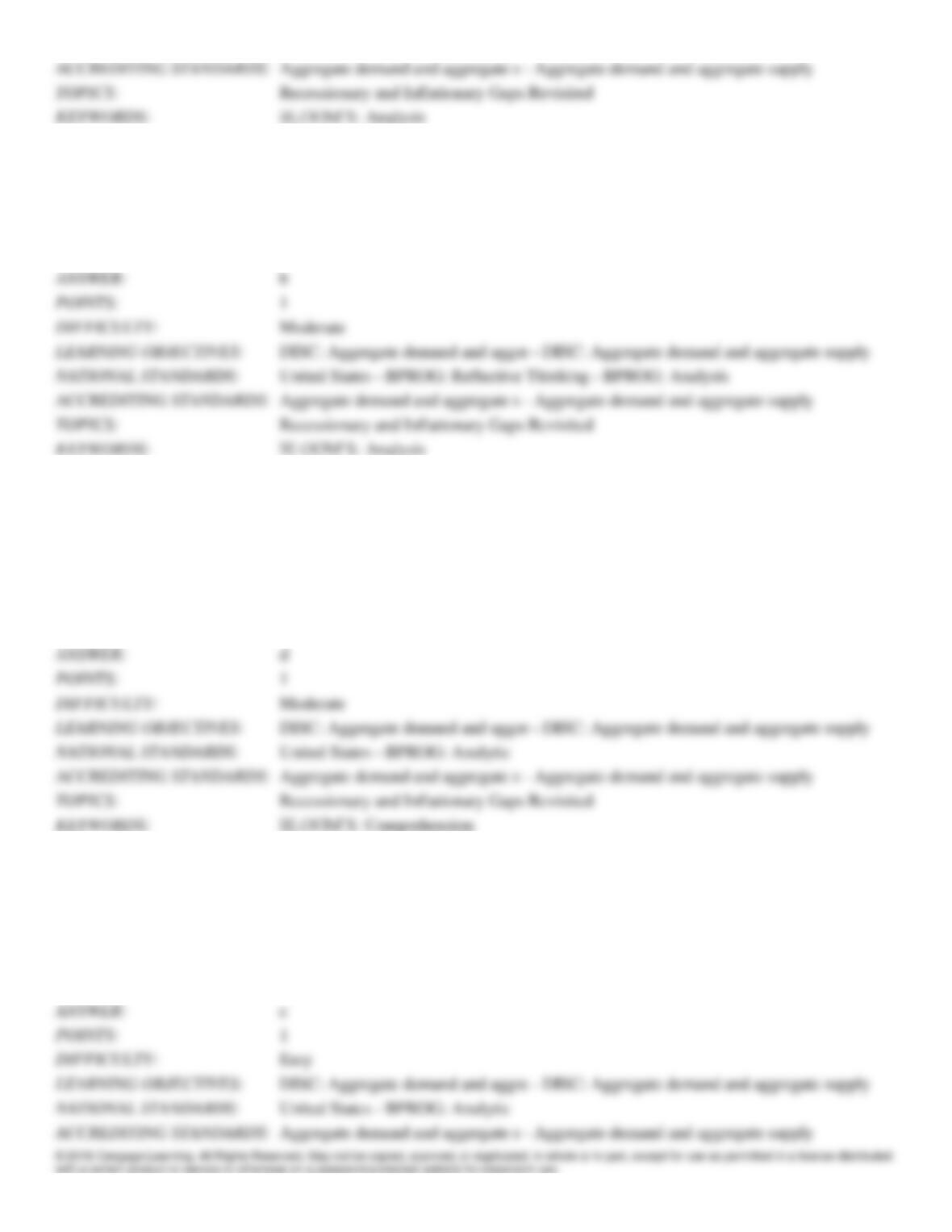
Figure 10-3
136. In Figure 10–3, both graphs (a) and (b) indicate that the economy is experiencing a(n)
a.
recessionary gap of RE.
b.
recessionary gap of RG.
c.
inflationary gap of RG.
d.
inflationary gap of RE.
DISC: Aggregate demand and aggre – DISC: Aggregate demand and aggregate supply
United States – BPROG: Reflective Thinking – BPROG: Analysis
Aggregate demand and aggregate s – Aggregate demand and aggregate supply
Recessionary and Inflationary Gaps Revisited
137. In Figure 10–3, we would expect the aggregate supply curve in graph (b) to eventually
a.
shift to the right, eliminating the recessionary gap.
b.
shift to the left, eliminating the inflationary gap.
c.
become steeper in the upper portion, eliminating the inflationary gap.
d.
become flatter in the upper portion, eliminating the recessionary gap.
Moderate
DISC: Aggregate demand and aggre – DISC: Aggregate demand and aggregate supply
United States – BPROG: Reflective Thinking – BPROG: Analysis
Aggregate demand and aggregate s – Aggregate demand and aggregate supply
Recessionary and Inflationary Gaps Revisited
138. When the economy represented in Figure 10-3 has completed the self-correcting adjustment process, the expenditure
line in graph (a) will be
a.
flatter.
b.
steeper.
c.
higher.
d.
lower.
e.
unchanged.
Moderate
DISC: Aggregate demand and aggre – DISC: Aggregate demand and aggregate supply
United States – BPROG: Analytic
Aggregate demand and aggregate s – Aggregate demand and aggregate supply
Recessionary and Inflationary Gaps Revisited
139. How is it possible for the economy to have an inflationary gap?
a.
Equilibrium is at a GDP level below full employment.
b.
Equilibrium is at a GDP level equal to full employment.
c.
Equilibrium is at a GDP level above full employment.
d.
GDP is rising at full employment.
e.
GDP is falling at full employment.
c
Easy
DISC: Aggregate demand and aggre – DISC: Aggregate demand and aggregate supply
United States – BPROG: Analytic
Aggregate demand and aggregate s – Aggregate demand and aggregate supply
Recessionary and Inflationary Gaps Revisited
140. How is it possible for the economy to have a recessionary gap?
a.
Equilibrium is at a GDP level below full employment.
b.
Equilibrium is at a GDP level equal to full employment.
c.
Equilibrium is at a GDP level above full employment.
d.
GDP is rising at full employment.
e.
GDP is falling at full employment.
DISC: Aggregate demand and aggre – DISC: Aggregate demand and aggregate supply
United States – BPROG: Analytic
Supply and demand
Recessionary and Inflationary Gaps Revisited
141. What is the principal reason that economists give for the existence of deflationary and inflationary gaps?
a.
Wages are flexible in the short run.
b.
Wages are flexible in the long run.
c.
Wages are fixed in the long run.
d.
Wages are fixed in the short run.
DISC: Aggregate demand and aggre – DISC: Aggregate demand and aggregate supply
United States – BPROG: Analytic
Aggregate demand and aggregate s – Aggregate demand and aggregate supply
Recessionary and Inflationary Gaps Revisited
Figure 10-4
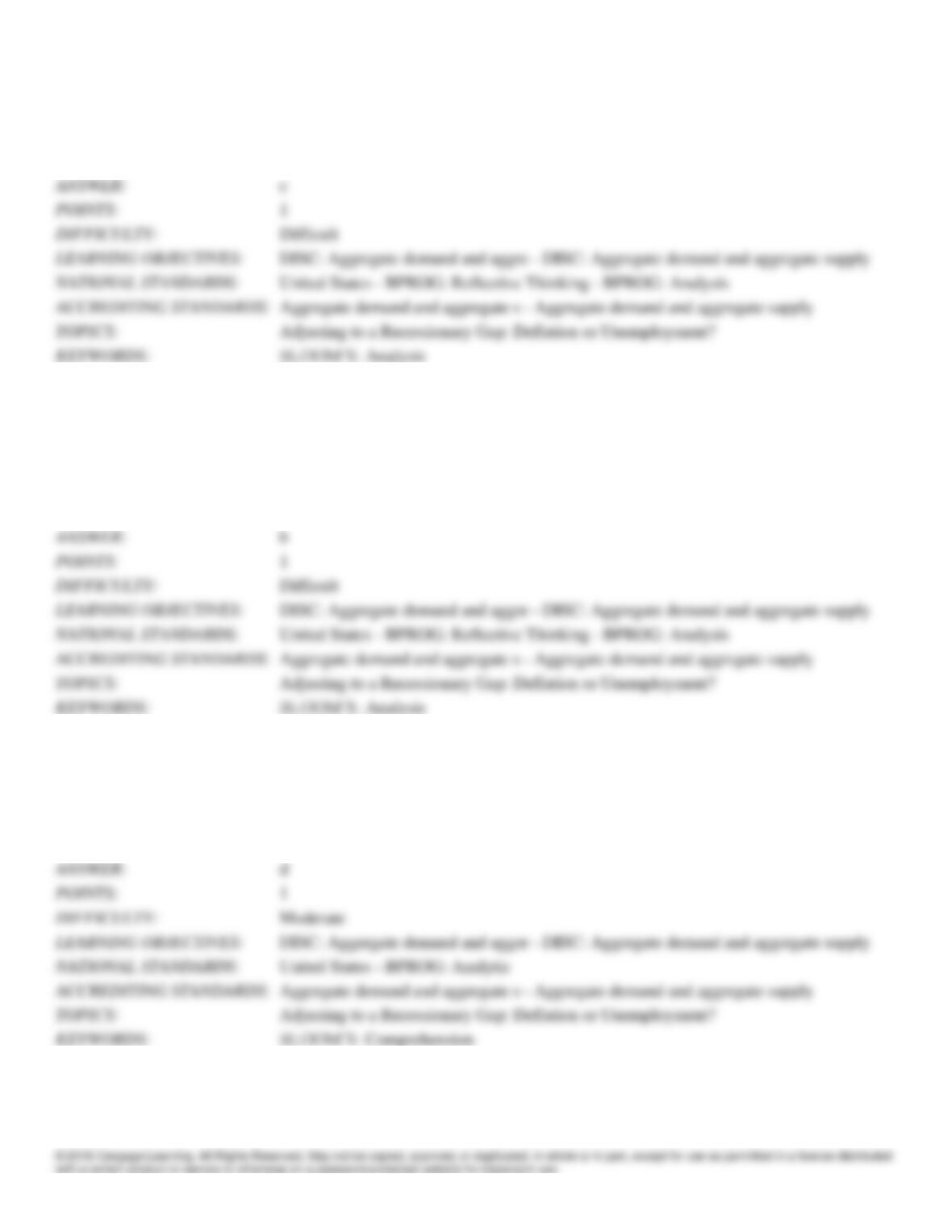
142. In Figure 10–4, if full employment occurs at 5,000 and the price level is currently 130, then we can expect the
a.
aggregate supply curve to shift to the left until a new equilibrium is established at an output level of 4,000.
b.
aggregate demand curve to shift to the right until a new equilibrium is established at an output level of 6,000.
c.
the price level to fall to 110.
d.
aggregate demand to shift to the left and aggregate supply to shift to the right until the price level reaches 130.
DISC: Aggregate demand and aggre – DISC: Aggregate demand and aggregate supply
United States – BPROG: Reflective Thinking – BPROG: Analysis
Aggregate demand and aggregate s – Aggregate demand and aggregate supply
Adjusting to a Recessionary Gap: Deflation or Unemployment?
143. In Figure 10–4, if full employment occurs at an output level of 4,000 and the economy is currently at an output level
of 5,000 then we can expect a(n)
a.
increase in autonomous consumer spending that shifts the aggregate demand curve to the left.
b.
increase in wages that will shift the aggregate supply curve to the left.
c.
decrease in investment spending that shifts the aggregate demand curve to the left.
d.
decrease in wages that will shift the aggregate supply curve to the left.
DISC: Aggregate demand and aggre – DISC: Aggregate demand and aggregate supply
United States – BPROG: Reflective Thinking – BPROG: Analysis
Aggregate demand and aggregate s – Aggregate demand and aggregate supply
Adjusting to a Recessionary Gap: Deflation or Unemployment?
144. A recessionary gap exists when
a.
real GDP exceeds nominal GDP.
b.
nominal GDP exceeds real GDP.
c.
real GDP exceeds potential GDP.
d.
potential GDP exceeds real GDP.
DISC: Aggregate demand and aggre – DISC: Aggregate demand and aggregate supply
United States – BPROG: Analytic
Aggregate demand and aggregate s – Aggregate demand and aggregate supply
Adjusting to a Recessionary Gap: Deflation or Unemployment?
145. Recessionary gaps usually lead to
a.
structural unemployment.
b.
cyclical unemployment.
c.
seasonal unemployment.
d.
frictional unemployment.
DISC: Aggregate demand and aggre – DISC: Aggregate demand and aggregate supply
United States – BPROG: Analytic
Aggregate demand and aggregate s – Aggregate demand and aggregate supply
Adjusting to a Recessionary Gap: Deflation or Unemployment?
146. A recession can be expected to reduce inflation in the economy if the recession is caused by a(n)
a.
increase in aggregate demand.
b.
increase in aggregate supply.
c.
decrease in aggregate demand.
d.
decrease in aggregate supply.
DISC: Aggregate demand and aggre – DISC: Aggregate demand and aggregate supply
United States – BPROG: Analytic
Aggregate demand and aggregate s – Aggregate demand and aggregate supply
Adjusting to a Recessionary Gap: Deflation or Unemployment?
147. One complication in the process of reducing inflation by creating recessions is that the price level
a.
adjusts more quickly to recessionary gaps than to inflationary gaps.
b.
does not apply as it does in inflationary gaps.
c.
always rises.
d.
rarely falls.
DISC: Aggregate demand and aggre – DISC: Aggregate demand and aggregate supply
United States – BPROG: Analytic
Aggregate demand and aggregate s – Aggregate demand and aggregate supply
Adjusting to a Recessionary Gap: Deflation or Unemployment?
148. If the price level does not fall or only falls very slowly, then the result will be a prolonged period of
a.
inflation whenever supply increases.
b.
production below potential GDP.
c.
production above potential GDP.
d.
rapid price increases when demand changes.
Moderate
DISC: Aggregate demand and aggre – DISC: Aggregate demand and aggregate supply
United States – BPROG: Analytic
Aggregate demand and aggregate s – Aggregate demand and aggregate supply
Adjusting to a Recessionary Gap: Deflation or Unemployment?
149. When equilibrium GDP is below potential GDP, jobs are
a.
plentiful and unemployment is low.
b.
plentiful and unemployment is high.
c.
scarce and unemployment is high.
d.
scarce and unemployment is low.
c
Moderate
DISC: Aggregate demand and aggre – DISC: Aggregate demand and aggregate supply
United States – BPROG: Analytic
Aggregate demand and aggregate s – Aggregate demand and aggregate supply
Adjusting to a Recessionary Gap: Deflation or Unemployment?
150. Most economists agree that the economy will adjust to a recessionary gap, but the adjustment process
a.
is rapid and destabilizing.
b.
is moderately quick, but not as rapid as necessary.
c.
takes place solely on the supply side.
d.
is very slow.
Moderate
DISC: Aggregate demand and aggre – DISC: Aggregate demand and aggregate supply
United States – BPROG: Analytic
Aggregate demand and aggregate s – Aggregate demand and aggregate supply
Adjusting to a Recessionary Gap: Deflation or Unemployment?
151. The post-World War II record shows that recessionary gaps may be long-lasting because ____ tends not to occur.
a.
deflation
b.
reflation
c.
stagflation
d.
disinflation
a
Moderate
DISC: Aggregate demand and aggre – DISC: Aggregate demand and aggregate supply
United States – BPROG: Analytic
Aggregate demand and aggregate s – Aggregate demand and aggregate supply
Adjusting to a Recessionary Gap: Deflation or Unemployment?
152. One complication that tends to prolong recessionary gaps is that wages
a.
are fixed by unions, which represent nearly all workers in the United States.
b.
tend to rise rapidly.
c.
rarely fall.
d.
tend to move in the opposite direction from prices.
DISC: Aggregate demand and aggre – DISC: Aggregate demand and aggregate supply
United States – BPROG: Analytic
Aggregate demand and aggregate s – Aggregate demand and aggregate supply
Adjusting to a Recessionary Gap: Deflation or Unemployment?
153. The diminished employment prospects for the graduates of 2002 is most likely due to the existence of a(n)
a.
inflationary gap.
b.
significant increase in real GDP.
c.
shift of the aggregate demand curve outward.
d.
recessionary gap.
DISC: Aggregate demand and aggre – DISC: Aggregate demand and aggregate supply
United States – BPROG: Analytic
Aggregate demand and aggregate s – Aggregate demand and aggregate supply
Adjusting to a Recessionary Gap: Deflation or Unemployment?
154. The Japanese economy has been consistently weak throughout the 1990s. This has caused a slight deflation,
illustrating the
a.
negligible cost of eliminating inflation.
b.
very slow operation of the economy’s self-correcting mechanism.
c.
tendency of inflation to accelerate during recessions.
d.
rapidity with which inflation can be stopped.
DISC: Aggregate demand and aggre – DISC: Aggregate demand and aggregate supply
United States – BPROG: Analytic
Aggregate demand and aggregate s – Aggregate demand and aggregate supply
Adjusting to a Recessionary Gap: Deflation or Unemployment?
155. Many economists describe the 2007-2009 period in the United States as being a condition of a(n)
a.
deflationary gap.
b.
recessionary gap.
c.
inflationary gap.
d.
reflationary gap.
Easy
DISC: Aggregate demand and aggre – DISC: Aggregate demand and aggregate supply
United States – BPROG: Analytic
Aggregate demand and aggregate s – Aggregate demand and aggregate supply
Adjusting to an Inflationary Gap: Inflation
156. When an inflationary gap exists, the job prospects of new college graduates are
a.
very dim.
b.
somewhat encouraging.
c.
worse in comparison to a recessionary gap.
d.
excellent.
Easy
DISC: Aggregate demand and aggre – DISC: Aggregate demand and aggregate supply
United States – BPROG: Analytic
Aggregate demand and aggregate s – Aggregate demand and aggregate supply
Adjusting to an Inflationary Gap: Inflation
157. When money wages rise, the most significant effect on the aggregate supply curve is that it
a.
shifts outward.
b.
shifts inward.
c.
becomes flatter.
d.
becomes steeper.
Moderate
DISC: Aggregate demand and aggre – DISC: Aggregate demand and aggregate supply
United States – BPROG: Analytic
Aggregate demand and aggregate s – Aggregate demand and aggregate supply
Adjusting to an Inflationary Gap: Inflation
158. An inflationary gap will occur when
a.
real GDP exceeds nominal GDP.
b.
nominal GDP exceeds real GDP.
c.
real GDP exceeds potential GDP.
d.
potential GDP exceeds real GDP
DISC: Aggregate demand and aggre – DISC: Aggregate demand and aggregate supply
United States – BPROG: Analytic
Aggregate demand and aggregate s – Aggregate demand and aggregate supply
Adjusting to an Inflationary Gap: Inflation
159. An equilibrium point beyond a potential GDP is termed as
a.
deflationary gap.
b.
recessionary gap.
c.
inflationary gap.
d.
acceleration gap
DISC: Aggregate demand and aggre – DISC: Aggregate demand and aggregate supply
United States – BPROG: Analytic
Aggregate demand and aggregate s – Aggregate demand and aggregate supply
Adjusting to an Inflationary Gap: Inflation
160. An inflationary gap will exist when
a.
aggregate demand grows more slowly than aggregate supply.
b.
there is downward pressure on prices.
c.
expenditures are not equal to aggregate demand.
d.
equilibrium GDP is greater than full employment GDP.
DISC: Aggregate demand and aggre – DISC: Aggregate demand and aggregate supply
United States – BPROG: Analytic
Aggregate demand and aggregate s – Aggregate demand and aggregate supply
Adjusting to an Inflationary Gap: Inflation
161. Which of the following is evidence of an inflationary gap?
a.
very long lines at employment agencies
b.
very short waiting times for product delivery
c.
very low sales figures
d.
very long search times for people looking for jobs
e.
very low unemployment rates
Moderate
DISC: Aggregate demand and aggre – DISC: Aggregate demand and aggregate supply
United States – BPROG: Analytic
Aggregate demand and aggregate s – Aggregate demand and aggregate supply
Adjusting to an Inflationary Gap: Inflation
162. Equilibrium GDP in excess of potential GDP eventually will cause the aggregate
a.
demand curve to shift outward.
b.
supply curve to shift outward.
c.
supply curve to shift inward.
d.
demand curve to become flatter.
c
Moderate
DISC: Aggregate demand and aggre – DISC: Aggregate demand and aggregate supply
United States – BPROG: Analytic
Aggregate demand and aggregate s – Aggregate demand and aggregate supply
Adjusting to an Inflationary Gap: Inflation
163. The existence of an inflationary gap would tend to benefit most
a.
bankers.
b.
retired persons.
c.
unemployed workers.
d.
stock owners.
c
Moderate
DISC: Aggregate demand and aggre – DISC: Aggregate demand and aggregate supply
United States – BPROG: Analytic
Aggregate demand and aggregate s – Aggregate demand and aggregate supply
Adjusting to an Inflationary Gap: Inflation
164. The principal way in which an economy self-corrects from an inflationary gap is through
a.
deflation, which increases purchasing power.
b.
inflation, which reduces purchasing power.
c.
disinflation, which maintains purchasing power.
d.
price level decreases, which stimulate production.
Moderate
DISC: Aggregate demand and aggre – DISC: Aggregate demand and aggregate supply
United States – BPROG: Analytic
Aggregate demand and aggregate s – Aggregate demand and aggregate supply
Adjusting to an Inflationary Gap: Inflation
165. When the inflationary gap is finally eliminated, a long-run equilibrium is established with a ____ price level and with
GDP ____ potential GDP.
a.
higher; equal to
b.
higher; greater than
c.
lower; equal to
d.
lower; greater than
a
Moderate
DISC: Aggregate demand and aggre – DISC: Aggregate demand and aggregate supply
United States – BPROG: Analytic
Aggregate demand and aggregate s – Aggregate demand and aggregate supply
Adjusting to an Inflationary Gap: Inflation
166. A consequence of an inflationary gap is ____ as output begins to decrease and prices continue to increase.
a.
stagflation
b.
reflation
c.
disinflation
d.
perflation
a
Easy
DISC: Supply and demand
United States – BPROG: Analytic
Supply and demand
Adjusting to an Inflationary Gap: Inflation
167. The existence of an inflationary gap should cause
a.
wages to fall.
b.
prices to fall.
c.
unemployment to rise.
d.
net exports to rise.
Moderate
DISC: Aggregate demand and aggre – DISC: Aggregate demand and aggregate supply
United States – BPROG: Analytic
Aggregate demand and aggregate s – Aggregate demand and aggregate supply
Adjusting to an Inflationary Gap: Inflation
168. The underlying cause of inflation is
a.
labor unions demanding higher wages.
b.
businesses charging higher prices.
c.
government raising taxes.
d.
increasing aggregate demand.
Moderate
DISC: Aggregate demand and aggre – DISC: Aggregate demand and aggregate supply
United States – BPROG: Analytic
Aggregate demand and aggregate s – Aggregate demand and aggregate supply
Adjusting to an Inflationary Gap: Inflation
169. An inflationary gap exists when consumers
a.
are saving more than businesses are investing.
b.
and businesses are purchasing less than the economy is capable of producing.
c.
and businesses are demanding more than the economy is capable of producing.
d.
and businesses are demanding less than the full employment level of output.
c
Moderate
DISC: Aggregate demand and aggre – DISC: Aggregate demand and aggregate supply
United States – BPROG: Analytic
Aggregate demand and aggregate s – Aggregate demand and aggregate supply
Adjusting to an Inflationary Gap: Inflation
170. The example of an inflationary gap in 2006-2007 suggested that the economy adjusts
a.
rapidly to inflationary gaps by lowering prices.
b.
rapidly to inflationary gaps by raising prices.
c.
slowly to inflationary gaps by lowering prices.
d.
slowly to inflationary gaps by increasing inflation.
Moderate
DISC: Aggregate demand and aggre – DISC: Aggregate demand and aggregate supply
United States – BPROG: Analytic
Aggregate demand and aggregate s – Aggregate demand and aggregate supply
Adjusting to an Inflationary Gap: Inflation
171. Part of the normal aftermath of a period of excessive aggregate demand is
a.
improvement in the quality of life.
b.
reflation.
c.
real GDP growth.
d.
stagflation.
e.
All of the above.
Easy
DISC: Aggregate demand and aggre – DISC: Aggregate demand and aggregate supply
United States – BPROG: Analytic
Aggregate demand and aggregate s – Aggregate demand and aggregate supply
Adjusting to an Inflationary Gap: Inflation
172. An economic boom that creates an inflationary gap is usually followed later by
a.
falling prices.
b.
a period of stagflation.
c.
an increase of potential GDP.
d.
an increase in aggregate supply.
Moderate
DISC: Aggregate demand and aggre – DISC: Aggregate demand and aggregate supply
United States – BPROG: Analytic
Aggregate demand and aggregate s – Aggregate demand and aggregate supply
Adjusting to an Inflationary Gap: Inflation
173. A period of stagflation is the normal aftermath of a period of
a.
excess aggregate supply.
b.
deficient aggregate demand.
c.
excess aggregate demand.
d.
high unemployment rates.
c
Easy
DISC: Aggregate demand and aggre – DISC: Aggregate demand and aggregate supply
United States – BPROG: Analytic
Aggregate demand and aggregate s – Aggregate demand and aggregate supply
Adjusting to an Inflationary Gap: Inflation
174. Stagflation is the conjunction of
a.
stagnation and recession.
b.
inflation and stagnation.
c.
depression and inflation.
d.
stagnation and deflation.
DISC: Aggregate demand and aggre – DISC: Aggregate demand and aggregate supply
United States – BPROG: Analytic
Aggregate demand and aggregate s – Aggregate demand and aggregate supply
Adjusting to an Inflationary Gap: Inflation
175. Which of the following situations would cause a period of stagflation at a later point in time?
a.
a recessionary gap
b.
a reduction in investment spending
c.
an increase in technological development
d.
an inflationary gap
DISC: Aggregate demand and aggre – DISC: Aggregate demand and aggregate supply
United States – BPROG: Analytic
Aggregate demand and aggregate s – Aggregate demand and aggregate supply
Adjusting to an Inflationary Gap: Inflation
176. A period of stagflation can be considered as part of the normal aftermath of a
a.
decrease in aggregate demand.
b.
period of high unemployment.
c.
period of low unemployment.
d.
period of inward shifting aggregate demand.
DISC: Aggregate demand and aggre – DISC: Aggregate demand and aggregate supply
United States – BPROG: Analytic
Aggregate demand and aggregate s – Aggregate demand and aggregate supply
Adjusting to an Inflationary Gap: Inflation
177. A common error of business managers is to blame inflation on
a.
consumer spending.
b.
rising wages.
c.
rising prices.
d.
rising interest rates.
e.
rising unemployment.
DISC: Aggregate demand and aggre – DISC: Aggregate demand and aggregate supply
United States – BPROG: Analytic
Aggregate demand and aggregate s – Aggregate demand and aggregate supply
Adjusting to an Inflationary Gap: Inflation
178. The reason that stagflation tends to follow an inflationary gap is that
a.
output tends to fall even as prices continue to rise as part of the self-correcting mechanism.
b.
government officials tend to overact in controlling inflation.
c.
businesses try to increase profits by raising prices and increasing output.
d.
workers accept pay cuts to maintain employment.
DISC: Aggregate demand and aggre – DISC: Aggregate demand and aggregate supply
United States – BPROG: Analytic
Aggregate demand and aggregate s – Aggregate demand and aggregate supply
Adjusting to an Inflationary Gap: Inflation
179. The economy’s self-correcting mechanism appears to be more efficient at curing
a.
recessionary gaps by reducing price levels.
b.
inflationary gaps by reducing price levels.
c.
unemployment by reducing wage levels.
d.
inflationary gaps through inflation.
DISC: Aggregate demand and aggre – DISC: Aggregate demand and aggregate supply
United States – BPROG: Analytic
Aggregate demand and aggregate s – Aggregate demand and aggregate supply
Adjusting to an Inflationary Gap: Inflation
180. When economists refer to the economy’s self-correcting mechanism, they are referring to the fact that the
a.
economy will react automatically to a recessionary gap through inflation.
b.
economy will react automatically to an inflationary gap through deflation.
c.
economy will react automatically to an inflationary gap through inflation.
d.
simple multiplier is greater than the complex multiplier.
DISC: Aggregate demand and aggre – DISC: Aggregate demand and aggregate supply
United States – BPROG: Analytic
Aggregate demand and aggregate s – Aggregate demand and aggregate supply
Adjusting to an Inflationary Gap: Inflation
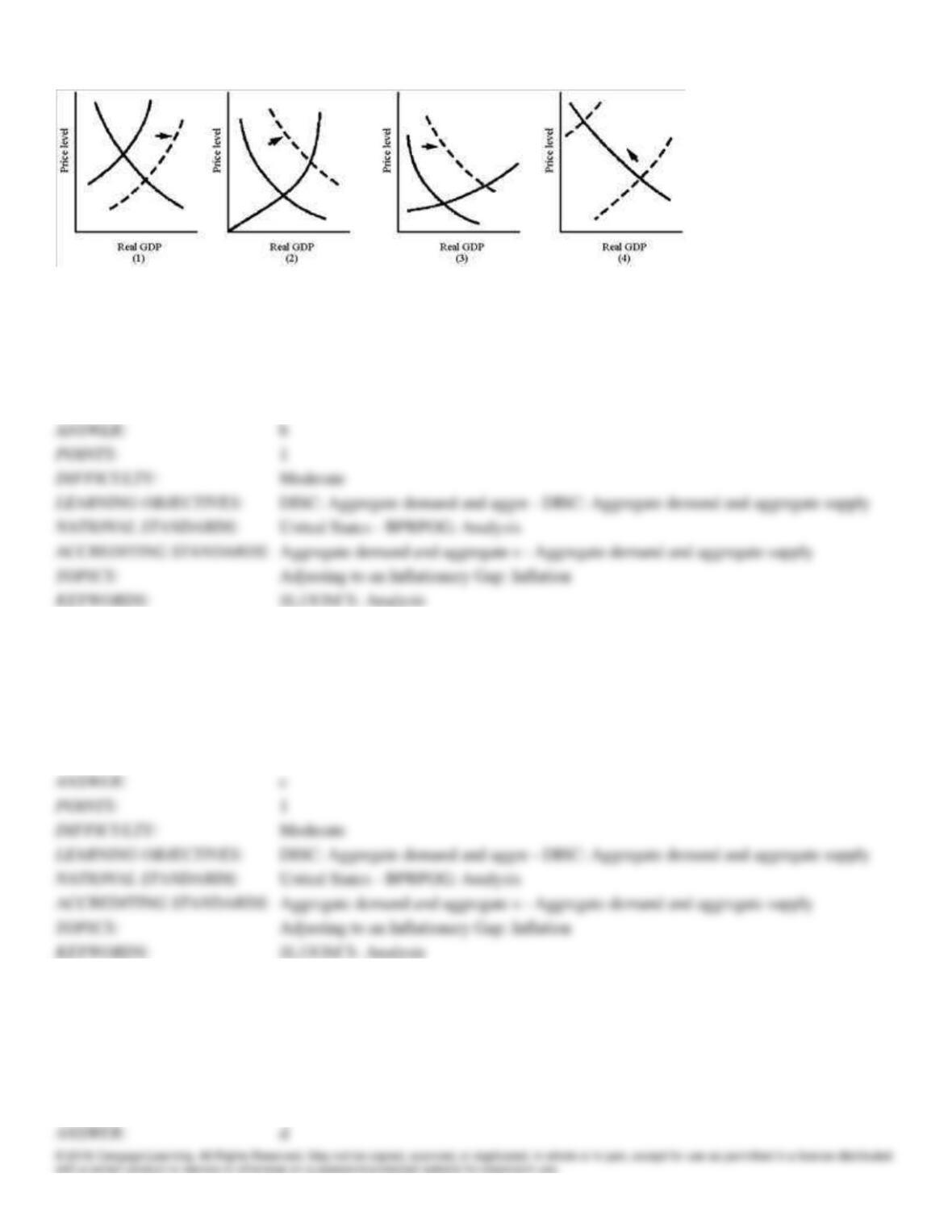
Figure 10-5
181. In Figure 10–5, which graph best illustrates the situation of an economy near full employment that experiences an
increase in autonomous consumer spending?
a.
(1)
b.
(2)
c.
(3)
d.
(4)
Moderate
182. In Figure 10–5, which graph best illustrates the situation of an economy with high unemployment that experiences an
increase in investment spending?
a.
(1)
b.
(2)
c.
(3)
d.
(4)
c
Moderate
183. In Figure 10–5, which graph best illustrates the situation of an economy reacting to an inflationary gap through an
increase in wage levels?
a.
(1)
b.
(2)
c.
(3)
d.
(4)
Moderate
DISC: Aggregate demand and aggre – DISC: Aggregate demand and aggregate supply
United States – BPRPOG: Analysis
Aggregate demand and aggregate s – Aggregate demand and aggregate supply
Adjusting to an Inflationary Gap: Inflation
184. In Figure 10–5, which graph best illustrates the situation of an economy reacting to a recessionary gap by reducing
resource cost levels?
a.
(1)
b.
(2)
c.
(3)
d.
(4)
a
Moderate
DISC: Aggregate demand and aggre – DISC: Aggregate demand and aggregate supply
United States – BPRPOG: Analysis
Aggregate demand and aggregate s – Aggregate demand and aggregate supply
Adjusting to an Inflationary Gap: Inflation
185. According to Baumol and Blinder, does the U.S. economy have a self-correcting mechanism?
a.
No, there is no such thing in reality.
b.
Yes, and it works very rapidly.
c.
Yes, and it works very slowly.
d.
No, unless the aggregate supply curve is perfectly flat.
c
Moderate
DISC: Aggregate demand and aggre – DISC: Aggregate demand and aggregate supply
United States – BPROG: Analytic
Aggregate demand and aggregate s – Aggregate demand and aggregate supply
Adjusting to an Inflationary Gap: Inflation
186. The self-correcting mechanism would be expected to be very rapid in an economy with
a.
a large multiplier.
b.
flexible prices.
c.
rigid wages.
d.
high labor productivity.
Moderate
DISC: Aggregate demand and aggre – DISC: Aggregate demand and aggregate supply