Economics Today, 19e (Miller)
Chapter 27 Regulation and Antitrust Policy in a Globalized Economy
27.1 Forms of Industry Regulation
1) U.S. government regulation of social and economic activity
A) only began after World War II.
B) costs less now than it did in the 1980s.
C) has increased steadily since 1970.
D) is confined to antitrust law.
2) The Federal Trade Commission is an agency that would enforce
A) social regulation.
B) economic regulation.
C) antitrust laws.
D) fair pricing for consumers.
3) Which of the following government agencies enforces social regulation?
A) Environmental Protection Agency
B) Federal Deposit Insurance Corporation
C) Federal Reserve
D) Federal Aviation Administration
4) The two basic types of government regulation are
A) regulation of natural monopolies and regulation of cartels.
B) economic regulation and industry regulation.
C) social regulation and labor law.
D) social regulation and economic regulation.
5) Which of the following is NOT an objective of economic regulation?
A) to regulate the prices enterprises are allowed to charge
B) to fix prices so that they are never allowed to rise
C) to keep rates of return in an industry at a competitive level
D) to prevent monopoly profits
6) The Securities and Exchange Commission and the Federal Aviation Administration are
examples of agencies engaged in
A) the regulation of natural monopolies.
B) the regulation of nonmonopolistic industries.
C) social regulation.
D) health and safety regulation.
7) Which of the following federal agencies is NOT engaged in social regulation?
A) Environmental Protection Agency
B) Federal Trade Commission
C) Food and Drug Administration
D) Federal Deposit Insurance Corporation
8) Which of the following federal agencies is NOT engaged in economic regulation?
A) the Federal Reserve
B) Federal Aviation Administration
C) Food and Drug Administration
D) Federal Deposit Insurance Corporation
9) Which type of regulation applies to all firms in the economy, as opposed to only covering
specific industries?
A) economic regulation
B) social regulation
C) rate regulation
D) statutory regulation
10) Commonwealth Edison is the only provider of electricity to many households in the Chicago
area. Commonwealth Edison is regulated by the government. This type of regulation is known as
A) the Federal Register.
B) social regulation.
C) the market share test.
D) economic regulation.
11) The regulation of the prices charged by insurance companies is known as
A) the Federal Register.
B) social regulation.
C) the market share test.
D) economic regulation.
12) The Federal Trade Commission (FTC) is a regulatory agency that is responsible for
preventing firms from engaging in misleading advertising. This type of regulation is known as
A) the Federal Register.
B) social regulation.
C) the market share test.
D) economic regulation.
13) Which of the following protects people from incompetent or unscrupulous producers?
A) the Federal Register
B) social regulation
C) the market share test
D) economic regulation
14) According to OSHA standards, the air in the building that John works in is unsafe. The type
of regulation that OSHA engages in is known as
A) the Federal Register.
B) social regulation.
C) the market share test.
D) economic regulation.
15) One of the basic differences between social and economic regulations is that
A) economic regulations only apply to financial institutions while social regulations apply to a
greater variety of institutions.
B) social regulations only apply to non-profit organizations while economic regulations apply
only to for-profit organizations.
C) economic regulations cover only particular industries while social regulations apply to all
firms in the economy.
D) economic regulations focus on the banking industry while social regulations focus on
monopolies.
16) One key purpose of economic regulation is
A) to force a firm to produce at the point at which marginal cost equals marginal revenue.
B) to control the quality of service provided by a monopolist.
C) to control the price that regulated enterprises are allowed to charge.
D) to focus on the impact of production on the environment and society, the working conditions
under which goods and services are produced, and sometimes the physical attributes of goods.
17) Which of the following federal agencies is engaged in social regulation?
A) Equal Employment Opportunity Commission
B) Office of the Comptroller of the Currency
C) the Securities and Exchange Commission
D) Federal Deposit Insurance Corporation
18) Which of the following federal agencies is engaged in economic regulation?
A) Occupational Safety and Health Administration
B) Federal Motor Carrier Safety Administration
C) Food and Drug Administration
D) Consumer Product Safety Commission
19) Cab drivers operating from JFK Airport to the City of New York legally must charge a
specific fare. This is an example of
A) social regulation.
B) economic regulation.
C) the market share test.
D) the rate of return test.
20) The goals of rate regulation have included the prevention of
A) monopoly profits.
B) oligopolistic pricing.
C) marginal cost pricing.
D) average cost pricing.
21) A difference between economic regulation and social regulation is that
A) the former tends to affect the prices at which products are sold and the latter does not.
B) the former tends to affect the profits of firms and the latter does not.
C) the former tends to be specific to an industry and the latter tends to affect firms in all
industries.
D) the former tends to be done at the state level and the latter at the federal level.
22) The purpose of social regulation is
A) to force a firm to produce at the point where marginal cost equals marginal revenue.
B) to control the quality of service provided by a monopolist.
C) to control the price that regulated enterprises are allowed to charge.
D) to focus on the impact of production on the environment and society, the working conditions
under which goods and services are produced, and sometimes the physical attributes of goods.
23) The major goal of social regulation is
A) a better quality of life through a less polluted environment, better working conditions, and
safer and better products.
B) to make sure that firms are not earning monopoly profits.
C) to make sure that prices are kept low enough so that every person can purchase the good.
D) to make sure that the firm produces at the socially optimal point of production.
24) All of the following are regulatory agencies EXCEPT
A) the National Rifle Association.
B) the Environmental Protection Agency.
C) the Food and Drug Administration.
D) the Occupational Safety and Health Administration.
25) This agency is responsible for preventing businesses from engaging in misleading
advertising, unfair trade practices, and monopolistic actions, as well as for protecting consumer
rights.
A) Environmental Protection Agency
B) Food and Drug Administration
C) Equal Employment Opportunity Commission
D) Federal Trade Commission
26) This agency is responsible for regulating the quality and safety of foods, health and medical
products, pharmaceuticals, cosmetics, and animal feed.
A) Environmental Protection Agency
B) Food and Drug Administration
C) Equal Employment Opportunity Commission
D) Federal Trade Commission
27) This agency is responsible for investigating complaints of discrimination based on race,
religion, sex or age in hiring, promotion, firing, wages, testing, and all other conditions of
employment.
A) Environmental Protection Agency
B) Food and Drug Administration
C) Equal Employment Opportunity Commission
D) Federal Trade Commission
28) This agency develops and enforces environmental standards for air, water, toxic waste, and
noise.
A) Environmental Protection Agency
B) Consumer Product Safety Commission
C) Equal Employment Opportunity Commission
D) Occupational Safety and Health Administration
29) This agency regulates workplace safety and health conditions.
A) Environmental Protection Agency
B) Consumer Product Safety Commission
C) Equal Employment Opportunity Commission
D) Occupational Safety and Health Administration
30) This agency is responsible for protecting consumers from products posing fire, electrical,
chemical, or mechanical hazards or dangers to children.
A) Environmental Protection Agency
B) Consumer Product Safety Commission
C) Equal Employment Opportunity Commission
D) Occupational Safety and Health Administration
31) The two basic types of government regulation are
A) monopoly and oligopoly regulation.
B) labor and environmental regulation.
C) federal and state industrial regulation.
D) economic and social regulation.
32) While economic regulation applies to ________ industries, social regulation applies to
________ firms.
A) particular; individual
B) particular; all
C) all; individual
D) utility; healthcare
33) Which of the statements best describes the difference between economic regulation and
social regulation?
A) There are no significant differences between economic and social regulation, social regulation
is a more modern way of regulating an economy.
B) Economic regulation focuses on output and price; social regulation focuses on improving the
quality of life.
C) Social regulation focuses on output and price; economic regulation focuses on quality of life
issues.
D) Social regulation targets industries like transportation, while economic regulation targets
utilities.
34) Since 1970, federal expenditures by regulatory agencies have
A) remained constant.
B) decreased slightly.
C) increased dramatically.
D) increased slightly.
35) All of the following are forms of social regulation EXCEPT
A) the Food and Drug Administration regulating the quality of drugs.
B) the Public Utility Commission regulating the price of telephone service.
C) the Environmental Protection Association regulating automobile emissions.
D) the Occupational Safety and Health Administration regulating workplace safety.
36) Regulation imposed by such organizations as the Food and Drug Administration or the
Environmental Protection Agency seeking to protect the welfare of people in our nation is
referred to as
A) moral regulation.
B) natural regulation.
C) rate-of-return regulation.
D) social regulation.
37) The federal regulatory agency whose mission is to regulate workplace health and safety is
the
A) AFL-CIO.
B) FTC.
C) OSHA.
D) SEC.
38) Which of the following is concerned with social regulation?
A) Federal Reserve Board
B) Sherman Commission
C) Food and Drug Administration
D) Board of Education
39) An agency that regulates product markets is the
A) Equal Employment Opportunity Commission.
B) Environmental Protection Agency.
C) Federal Trade Commission.
D) Occupational Safety and Health Administration.
40) An agency that regulates labor markets is the
A) Equal Employment Opportunity Commission.
B) Environmental Protection Agency.
C) Federal Trade Commission.
D) Consumer Product Safety Commission.
41) Social regulation is focused on all of the following EXCEPT
A) the impact of production on the environment and society.
B) better working conditions, and safer and better products.
C) a better quality of life through a less polluted environment.
D) ensuring costs are minimized and benefits are maximized.
42) The Federal Register
A) itemizes state and local government spending.
B) is used to track immigration.
C) publishes all the new federal regulatory rules.
D) has decreased in size.
43) Financial markets are regulated by
A) the Securities and Exchange Commission.
B) the Stock and Bond Exchange Commission.
C) the Security and Protection Commission.
D) the Stock and Exchange Commission.
44) What is the main difference between economic regulation and social regulation?
45) How does social regulation differ from economic regulation?
27.2 Regulating Natural Monopolies
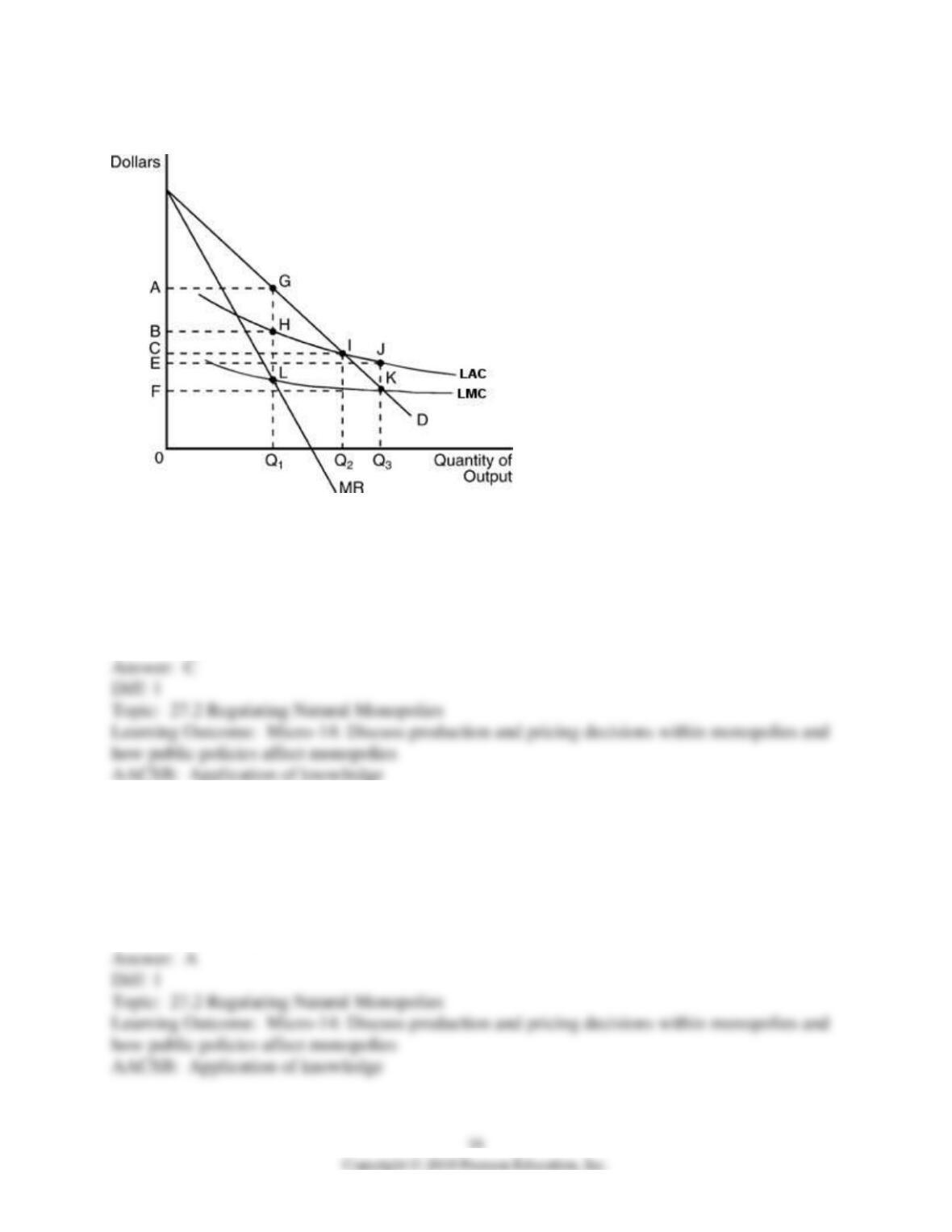
1) In the above figure, if this natural monopolist were forced to use marginal cost pricing, it
would produce
A) at Q1 output rate.
B) at Q2 output rate.
C) at Q3 output rate.
D) past the Q3 output rate.
2) In the above figure, if this natural monopolist were unregulated, the profit maximizing firm
would produce
A) at Q1 output rate.
B) at Q2 output rate.
C) at Q3 output rate.
D) past the Q3 output rate.
3) In the above figure, if this natural monopolist were regulated and allowed to earn a “fair” rate
of return, it would produce
A) at Q1 output rate.
B) at Q2 output rate.
C) at Q3 output rate.
D) past the Q3 output rate.
4) In the above figure, if this natural monopolist were forced to use marginal cost pricing, it
would sell the product at the price
A) A.
B) C.
C) E.
D) F.
5) In the above figure, if this natural monopolist were unregulated, the profit maximizing firm
would sell the product at the price
A) A.
B) B.
C) C.
D) F.
6) In the above figure, if this natural monopolist were regulated and allowed to earn a “fair” rate
of return, it would sell the product at the price
A) A.
B) C.
C) B.
D) F.
7) If regulators force a natural monopoly to price as a perfectly competitive firm would, the
natural monopolist
A) will experience a lower marginal cost.
B) will earn an economic loss.
C) will expand its output.
D) will experience a rise in long-term average costs.
8) If a public service commission requires a natural monopoly to set its price equal to the long-
run marginal cost, this will result in
A) excessive economic profits to the monopoly.
B) normal economic profits to the monopoly.
C) losses to the monopoly.
D) either economic profits or losses, depending on the efficiency of the monopoly.
9) Suppose that a regulatory agency has imposed marginal cost pricing on a natural monopolist.
We expect that
A) the firm will earn only a normal profit.
B) the firm’s average total cost of production is rising over the relevant range of production.
C) the firm will rise its price above marginal cost.
D) the firm will earn economic losses.
10) Regulators usually encourage natural monopolists to engage in
A) marginal cost pricing.
B) average cost pricing.
C) marginal cost pricing, with subsidies from the government offsetting the losses.
D) inefficient pricing.
11) In a natural monopoly situation
A) there are large economies of scale relative to demand.
B) the firm has an upward sloping average cost curve.
C) producers try to differentiate their product with advertising.
D) there is no need for government regulation.
12) In average cost pricing, the natural monopoly would have to set price equal to
A) AFC.
B) AVC.
C) ATC.
D) MC.
13) In marginal cost pricing, the natural monopoly would have to set price equal to
A) AFC.
B) AVC.
C) ATC.
D) MC.
14) A natural monopoly owes its existence to
A) control of a key input.
B) persistently declining long-run average costs as scale increases.
C) patents.
D) increasing marginal returns and the ability to obtain quantity discounts from suppliers.