70) Regulation of monopolies that allows prices to reflect only the actual cost of production and
no monopoly profits is referred to as
A) cost-of-service regulation.
B) rate-of-return regulation.
C) service-opportunity regulation.
D) natural regulation.
71) The type of regulation that attempts to keep prices and the rate of return in an industry at a
competitive level is referred to as
A) cost-of-service regulation.
B) rate-of-return regulation.
C) service-opportunity regulation.
D) natural regulation.
72) Regulation that is based on allowing prices to reflect only the actual operating cost of
production is known as
A) average cost regulation.
B) marginal cost regulation.
C) rate-of-return regulation.
D) cost-of-service regulation.
73) Regulation that is based upon the cost of providing the good or service is known as
A) rate-of-return regulation.
B) cost-of-service regulation.
C) social regulation.
D) deregulation.
74) Regulation that keeps the rate of return in the industry competitive is known as
A) rate-of-return regulation.
B) cost-of-service regulation.
C) social regulation.
D) deregulation.
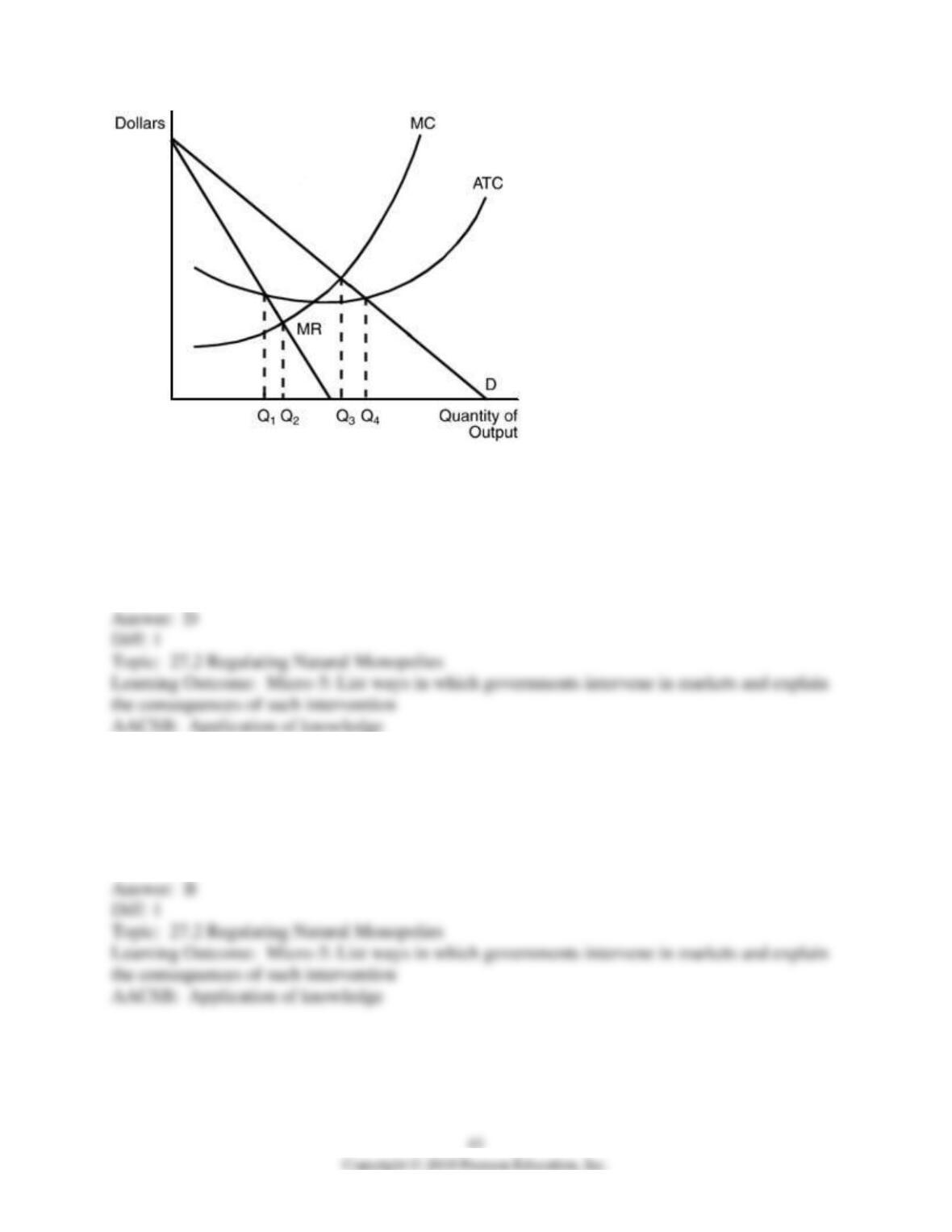
75) In the above figure, a regulation requiring average cost pricing would force the firm to
produce at output level
A) Q1.
B) Q2.
C) Q3.
D) Q4.
76) In the above figure, an unregulated natural monopolist will produce output level
A) Q1.
B) Q2.
C) Q3.
D) Q4.
77) Cost-of-service regulation allows regulated companies to charge prices that
A) reflect the cost of regulating the industry, plus the marginal cost of the product.
B) allow monopoly profits to the producer.
C) reflect the actual average cost of providing the services to the customer.
D) are determined by competition in other geographic markets.
78) The difference between cost-of-service regulation and rate-of-return regulation is that
A) the former sets prices based on actual costs, and the latter focuses on setting prices such that
the firm earns a normal rate of return.
B) the latter sets prices first, and then the firm must keep costs in line if it wants to earn a profit,
and the former sets price high enough to cover costs.
C) the former uses marginal cost pricing and the latter uses average cost pricing.
D) the former uses average cost pricing and the latter uses marginal cost pricing.
79) One type of economic regulation often used in the United States by various public utility
commissions allows prices to reflect only the actual cost of production and no monopoly profits.
This type of economic regulation is known as
A) rate-of-return regulation.
B) cost-of-service regulation.
C) price per constant-quality-unit regulation.
D) creative response regulation.
45
80) What is the problem with marginal cost pricing in the natural monopoly situation? How do
regulatory agencies in the United States usually handle the problem?
81) Why do government regulators not enforce marginal cost pricing for natural monopolies?
What are the common regulatory solutions?
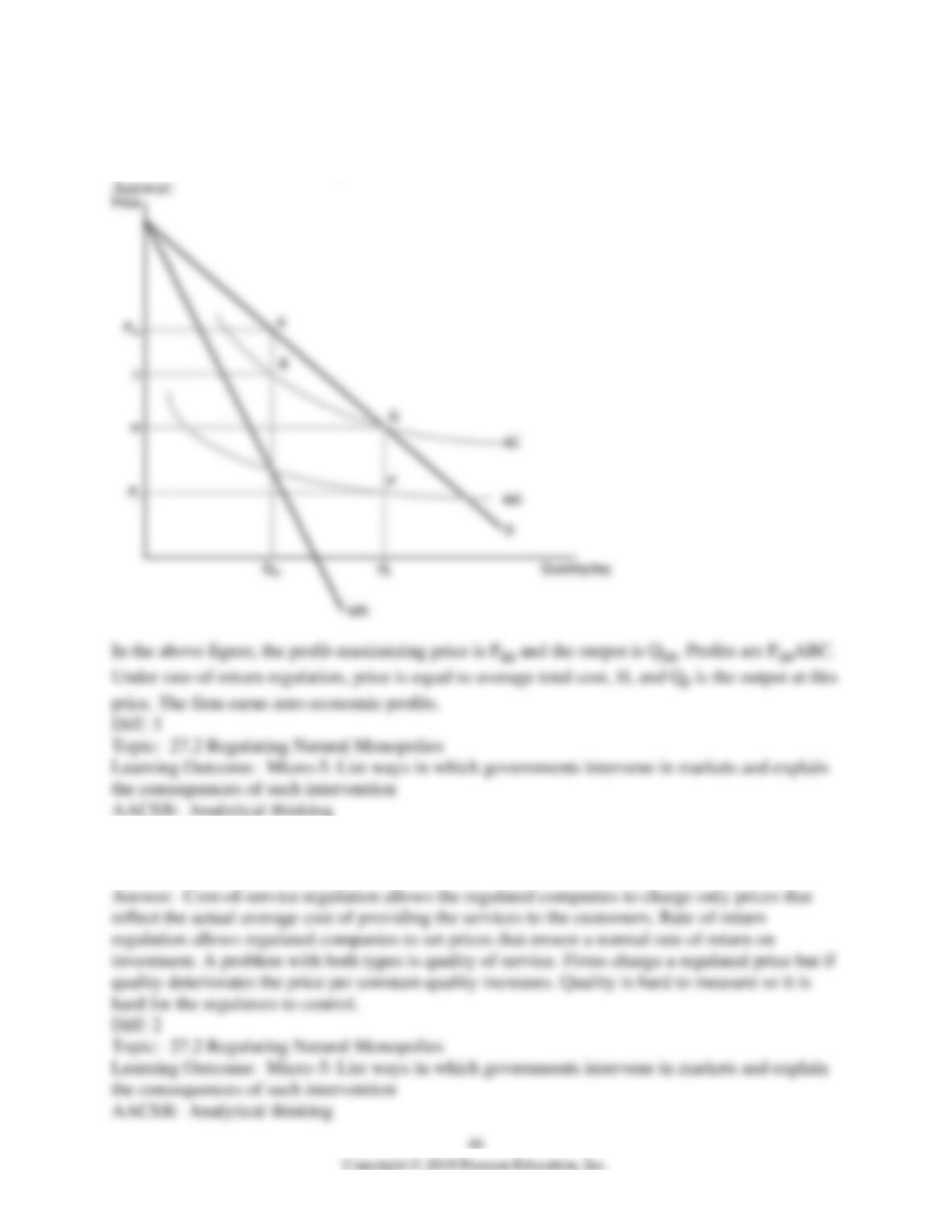
82) Using a graph, show the price-output combination of a natural monopoly without regulation
and the price-output combination if the government requires the monopoly to earn a normal rate
of return. What are economic profits in each situation?
83) Distinguish between cost-of-service regulation and rate-of return regulation. What problem is
inherent in both types of regulation?
84) “Today the U.S. telecommunications industry remains heavily regulated by the government
as it was some 30 years ago.” Do you agree or disagree? Why?
27.3 Regulating Nonmonopolistic Industries
1) Which of the following is a possible market solution to the lemons problem?
A) Producers might offer product guarantees and warranties.
B) Producers might be required to meet certain legal standards to obtain licenses granting the
right to sell their products.
C) Government agencies might be charged with directly overseeing production and distribution
of certain products.
D) Liability laws might be established to ensure that firms selling certain products must face
penalties in the event the products function poorly.
2) One problem that might occur as a result of economic regulation is
A) the firm may be earning more than a normal rate of return on investment.
B) the quality of service might be lowered.
C) that social regulation may follow.
D) the demand for the good may be greater than the supply.
3) The potential for asymmetric information to bring about a general decline in product quality in
an industry is known as the ________ problem.
A) moral hazard
B) liability
C) capture
D) lemons
4) When consumers have less information about a product than do sellers, then this is the
situation of
A) asymmetric information.
B) rationality.
C) caveat emptor.
D) a market failure.
5) Which of the following is the outcome of the lemons problem in the used-car market?
A) Only low-quality cars will be traded in the market.
B) Only high-quality cars will be traded in the market.
C) Both low-quality and high-quality cars will be traded in the market.
D) No cars will be traded in the market.
6) The lemons problem is a situation of
A) perfect competition.
B) asymmetric information.
C) price discrimination.
D) a natural monopoly.
7) Which of the following is NOT a likely market solution to the lemons problem?
A) average cost pricing
B) product warranty
C) industry standard
D) product certification
8) Credence goods are particularly susceptible to the lemons problem because
A) they have qualities that are difficult for producers to fully assess.
B) they have qualities that are difficult for consumers to fully assess.
C) creative responses among producers create volatility in market supply.
D) creative responses among consumers create volatility in market demand.
9) The main rationale for government regulatory functions is
A) to regulate for-profit institutions.
B) to make sure that firms are maximizing profits.
C) to expand the scope of the government.
D) to protect consumer interests.
10) Which of the following is NOT a reason for the government to regulate a nonmonopolistic
industry?
A) to allow firms to achieve the profit maximizing output
B) asymmetric information
C) to protect consumer interests
D) market failures
11) During the production process Ajax Corporation releases pollution into the air. Ajax
Corporation operates in a monopolistic competitive industry. Which of the following statements
addresses the pollution situation?
A) Ajax is taking advantage of asymmetric information.
B) This is an example of a market failure and is a reason for the government to regulate the
industry.
C) The quality of the product could be improved if the amount of pollution can be reduced.
D) This is known as the lemons problem.
12) Asymmetric information is
A) when a market failure occurs.
B) an externality.
C) when the producer has information on the product that the consumer lacks.
D) the regulatory price for a natural monopoly.
13) The lemons problem occurs mainly because of
A) asymmetric information.
B) a market failure.
C) negative externality.
D) positive externality.
14) The problem of excess pollution mainly occurs because of
A) asymmetric information.
B) a positive externality.
C) a negative externality.
D) a monopoly.
15) The problem of asymmetric information that brings about a general decline in product
quality in an industry is
A) a market failure.
B) the result of government regulation.
C) creative response.
D) the lemons problem.
16) A possible market solution that a reputable firm can engage in when faced with the lemons
problem is
A) to offer a warranty.
B) to engage in externalities.
C) to create asymmetric information.
D) to use average cost pricing.
17) Which of the following is NOT a government response to asymmetric information?
A) liability laws
B) social regulation
C) manufacturer’s warranties
D) government licensing
18) Which of the following is a government response to asymmetric information?
A) product guarantees
B) external product certification
C) manufacturer’s warranties
D) government licensing
19) Which of the following is most subject to the lemons problem?
A) credence goods
B) homogeneous goods
C) search goods
D) inferior goods
20) The two most important rationales for government intervention in non-monopolistic markets
are
A) market failure and asymmetric information.
B) substandard products and job creation for public employees.
C) job creation and income maintenance.
D) unfair pricing and usury.
21) The potential for a decline in product quality due to asymmetric information is commonly
referred to as
A) the lemons problem.
B) planned obsolescence.
C) diminishing marginal product.
D) the externality problem.
22) An automobile manufacturer voluntarily recalls certain models to fix a defective part at no
cost to the owners. This action has the effect of
A) the lemon problem.
B) a manufacturer’s warranty.
C) a market failure.
D) none of the above.
23) What are the major rationales for consumer protection in nonmonopolistic industries?
24) What is the lemons problem? How do firms try to address this problem?
27.4 Incentives and Costs of Regulation
1) The benefits of social regulation usually are
A) always a zero sum.
B) obvious to people while the costs are hidden.
C) less than the costs of social regulation, reducing overall welfare.
D) difficult to measure.
2) All of the following are possible criticisms of social regulation EXCEPT
A) that the costs may outweigh the benefits.
B) that social regulation may create anticompetitive effects.
C) that the regulations have not resulted in safer working conditions.
D) that the regulations lead to higher production costs.
3) A firm that responds to a regulatory rule in a way that permits technical compliance while
allowing the firm to violate the spirit of the regulation has.
A) reduced the scope of the lemons problem.
B) shared the gains and pains of regulation.
C) engaged in a creative response to regulation.
D) become a captured regulator.
4) According to the text, the federal government spends the most taxpayer-provided funds
regulating which area of the economy?
A) the environment
B) finance and banking
C) consumer safety and health
D) transportation
5) A potential benefit that comes from social regulations would be
A) higher costs.
B) a cleaner environment.
C) higher tax collections.
D) more layoffs.
6) According to the text, critics point out that the costs incurred by firms due to regulations
A) increase production costs.
B) lower production costs to the shutdown point.
C) reduce taxes too far.
D) none of the above.
7) The benefits of social regulation are
A) easy to measure by the marginal value method.
B) often difficult to measure.
C) obvious to almost everyone, but the costs are usually hidden.
D) greater than the costs of social regulation in every example in the country today.
8) Regulation focused on the impact of production on the environment and society, the working
conditions under which production occurs, or the physical attributes of goods, is known as
A) cost-of-service regulation.
B) rate-of-return regulation.
C) social regulation.
D) monopoly regulation.
9) Which of the following is an example of an agency concerned with social regulation?
A) Federal Communications Commission
B) Securities and Exchange Commission
C) Consumer Product Safety Commission
D) Federal Energy Regulatory Commission
10) Which of the following statements can correctly be made about social regulation?
I. Extensive social regulation may have an anticompetitive effect.
II. The benefits of social regulation are easier to measure than are the costs of social regulation.
A) I only
B) II only
C) both I and II
D) neither I nor II
11) A creative response to regulations can be described as
A) conforming to the letter of the law but undermining its spirit.
B) totally conforming to the law.
C) completely ignoring the law.
D) none of the above.
12) In some cases, social regulation may alter individuals’ behavior. For example, there is
evidence to indicate that as more automobile safety regulations have been introduced, more
individuals have begun to drive recklessly. This phenomenon is known as
A) the feedback effect.
B) the share-the-gains effect.
C) the share-the-pains effect.
D) the capture effect.
13) Which of the following refers to the capture hypothesis of regulation?
A) the ability of the government to capture monopoly profits
B) the control of regulatory agencies by firms in an industry
C) consumer cost savings captured through regulation
D) horizontal mergers
14) The notion that regulated industry members themselves, sooner or later, are able to control
regulatory bodies is referred to as
A) consumerism.
B) cartelization.
C) the capture theory.
D) the control theory.
15) The capture hypothesis suggests that
A) marginal cost regulation is superior to average cost regulation.
B) the well-focused interests of consumers will lead to the over-regulation of most industries.
C) the firms being regulated will unduly influence the regulators.
D) regulation will lead to over-entry and eventual losses for firms in the industry.
16) The “capture” in the capture hypothesis occurs because
A) regulators try to promote everyone’s best interest.
B) society doesn’t care for regulatory agencies.
C) regulators always know what is in society’s best interest.
D) regulators usually have been or will be associated with the industries they regulate.
17) According to the capture hypothesis
A) regulators eventually support the views of consumers instead of the firms or the taxpayers,
regardless of the reasons why the regulatory agency was established.
B) regulators support the view of the regulated firms all along because that is the reason the
regulatory agency was established.
C) regulators eventually support the views of the regulated firms instead of the consumers or
taxpayers, regardless of why the regulatory agency was established.
D) regulators eventually support the views of either the firms or the consumers, but at the
expense of the taxpayers, regardless of the reasons why the regulatory agency was established.
18) According to the capture hypothesis, it appears that regulators eventually end up
A) adopting policies that benefit the firms being regulated.
B) adopting policies that benefit consumers at the expense of the regulated firms.
C) adopting policies that benefit no one.
D) satisfying neither producers nor consumers, but striving to control as much as possible.