15) A firm that has taken advantage of economies of scale and expanded to become the only
producer in the market is
A) a cartel.
B) a natural monopoly.
C) a monopolistic competitor.
D) an oligopolist.
16) For a natural monopoly, long-run average costs
A) fall as output increases.
B) rise as output increases.
C) fall as output falls.
D) rise as output falls.
17) The price charged by a monopolist is socially inefficient because the price
A) exceeds the true marginal cost of the resources used.
B) is less than the opportunity cost of the resources used.
C) puts the monopolist into a higher tax bracket.
D) is too low.
18) An unregulated natural monopolist would produce to the point at which
A) P = AC.
B) MR = AC.
C) MR = MC.
D) P = MR.
19) A regulated natural monopolist allowed to earn a “fair” rate of return would produce to the
point at which
A) the price per unit equals the long-run average cost.
B) the marginal revenue curve meets the long-run average cost curve.
C) the marginal revenue curve meets the long-run marginal cost curve.
D) the price per unit equals its marginal revenue.
20) Without any regulation, the natural monopolist will
A) not produce any output.
B) produce to the point at which P = ATC.
C) produce less output than it would if the industry was purely competitive.
D) have an upward-shifting average cost curve.
21) A natural monopoly that is NOT regulated will choose to produce at the
A) minimum point of the long-run average cost curve.
B) point at which marginal cost is above average total cost.
C) point at which the demand curve intersects the long-run average cost curve.
D) point at which marginal revenue equals marginal cost.
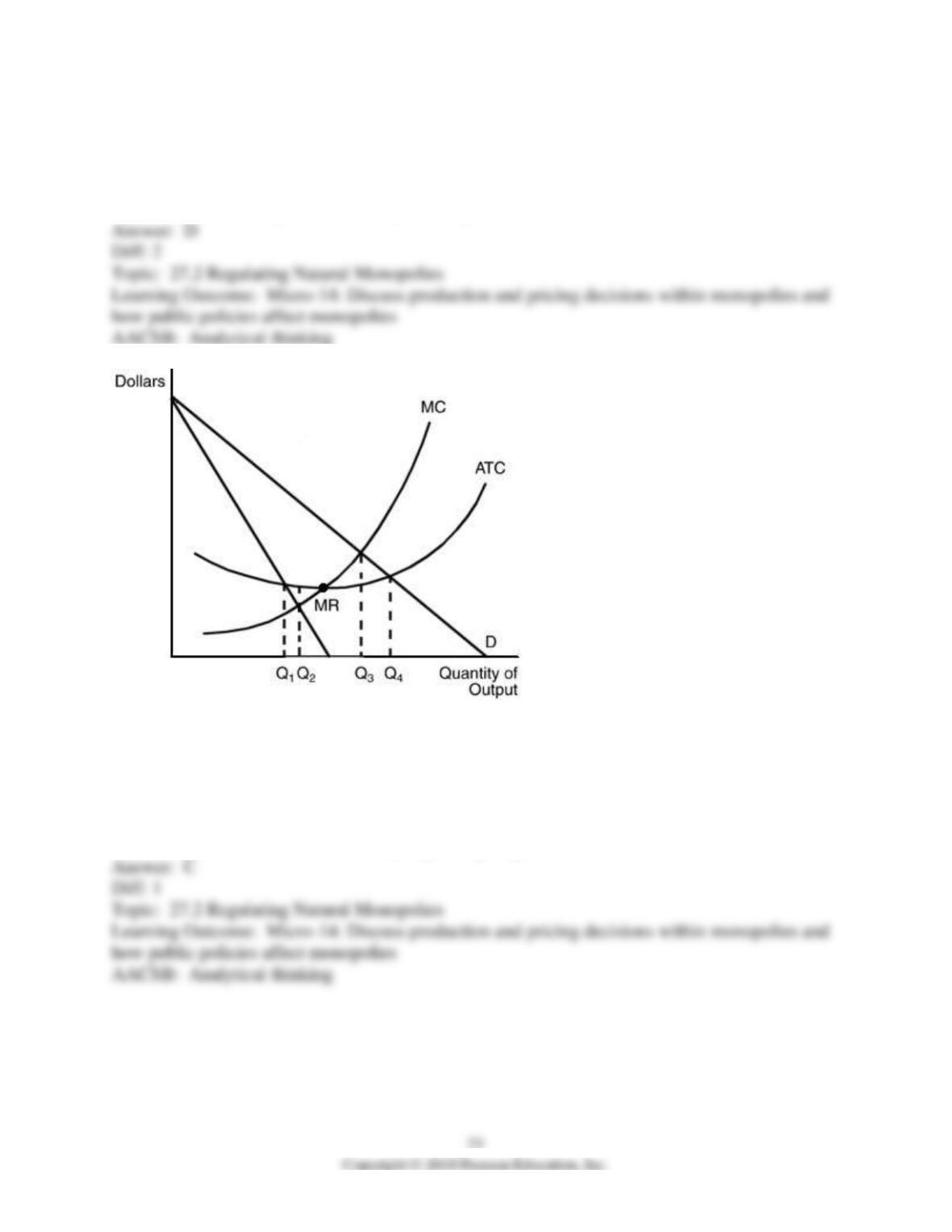
22) In the above figure, which of the following statements is FALSE if the firm is operating at
output level Q2?
A) The output is equivalent to an unregulated monopolist.
B) Economic profits are positive.
C) The price is lower than at an equivalent firm forced by regulators to charge ATC pricing.
D) Average costs would be lowered by expanding output.
23) One goal of rate-of-return regulation is the prevention of
A) free market entry.
B) positive economic profits.
C) poor quality service.
D) environmental degradation.
24) The primary purpose of economic regulation of an industry is to
A) control the prices charged by the regulated industry.
B) increase taxes across the board.
C) reduce output.
D) control hiring and firing within the industry.
25) If regulators disallow price increases requested by a natural monopoly that is currently
earning an economic loss, quality of service will
A) increase rapidly.
B) likely fall.
C) remain unchanged.
D) none of the above.
26) Which of the following statements regarding economic regulation is TRUE?
A) Economic regulation has failed by insisting that firms must be allowed to earn a normal rate
of return.
B) Rate-of-return regulation has been much more effective than cost-of-service regulation.
C) Economic regulation deals only with rates of return, and not with prices.
D) Economic regulation deals mainly with prices firms charge, but firms can alter their return by
altering quality of service, effectively raising the price per constant-quality-unit.
27) With average cost pricing, the monopolist
A) earns no accounting profit.
B) produces where P = MC.
C) earns a normal rate of return for its shareholders.
D) does not cover opportunity costs.
28) When promoting average cost pricing, regulators
A) include what they consider to be a normal rate of return on investment.
B) encourage firms to produce at the output level where price equals marginal cost.
C) fail to consider a return to investors, so regulated firms often have a hard time raising
investment funds.
D) inflate costs so much that price ends up as large as would prevail under unregulated
monopoly.
29) Regulators employ average cost pricing instead of marginal cost pricing because
A) average cost pricing is more efficient than marginal cost pricing.
B) price must be high enough to cover all opportunity costs if the firm is to stay in business.
C) the price is lower with average cost pricing.
D) average cost pricing is simpler to compute than marginal cost pricing.
30) A natural monopoly exists when
A) control of a key input leads to a single-firm industry.
B) increasing marginal returns and the ability to obtain quantity discounts from suppliers leads to
a single-firm industry.
C) economies of large-scale production are substantial, leading to a single-firm industry.
D) the government restricts entry that leads to a single-firm industry.
31) When production is characterized by persistently declining long-run average costs as output
increases
A) the costs of production are greater when competition exists than when a single firm produces
a good.
B) it is impossible for two firms to compete in the market.
C) the costs are lower if a single firm exists, and even if the firm is unregulated, price will still be
lower with a single firm.
D) there is no need for the government to limit competition by licensing requirements.
32) An unregulated natural monopolist will produce the quantity at which
A) average total costs are minimized.
B) marginal cost equals marginal revenue.
C) marginal cost equals the long run average cost curve.
D) the long-run average cost curve intersects the demand curve.
33) Which of the following statements about natural monopoly is correct?
A) Governments regulate natural monopolies in order to ensure that costs of production are
minimized.
B) Governments regulate natural monopolies in order to ensure that the firm earns a normal
profit.
C) Governments regulate natural monopolies in order to prevent them from making profits.
D) Governments regulate natural monopolies in order to keep their workers from earning wages
that are too high.
34) If a natural monopolist is unregulated, then
A) the monopoly will produce efficiently from society’s point of view.
B) the monopoly will produce inefficiently from society’s point of view.
C) the monopolist will be earning just a normal rate of return on investment.
D) the monopolist will determine the profit maximizing quantity by equating marginal cost to the
demand curve.
35) The reason an unregulated natural monopolist will produce at an economically inefficient
quantity is
A) due to the fact that the monopolist will equate marginal cost with price to determine the
output level.
B) due to the fact that the monopolist will equate average total cost with price to determine the
output level.
C) that the price does not equal the true marginal cost of producing the good.
D) that the monopolist will produce a quantity greater than the minimum of the average total cost
curve.
36) For a firm to be economically efficient from society’s point of view, it should produce to the
point at which
A) marginal cost equals marginal revenue.
B) marginal cost equals average total cost.
C) marginal cost equals price.
D) average total cost equals price.
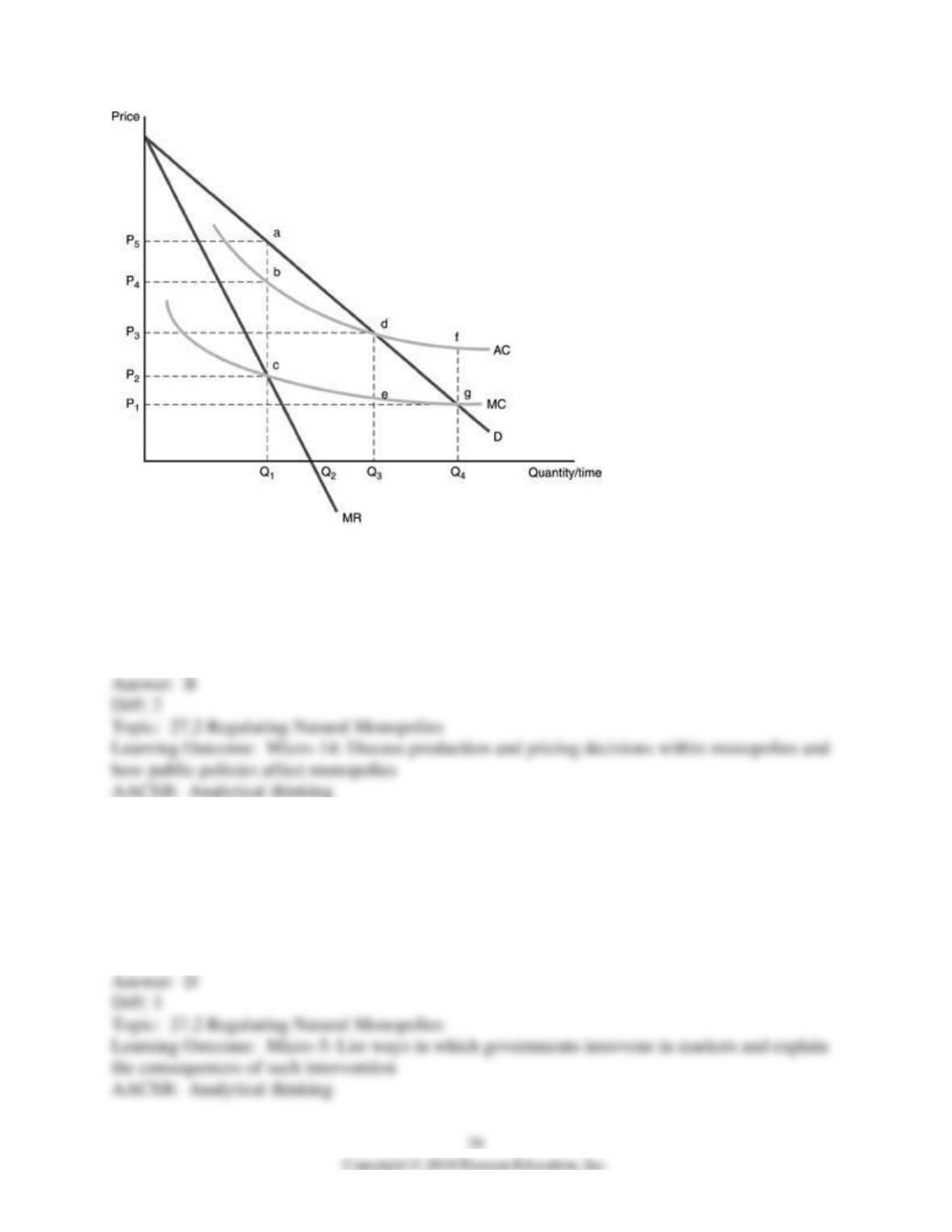
37) Refer to the above figure. An unregulated natural monopolist would choose
A) output rate of Q1 and price P2.
B) output rate Q1 and price P5.
C) output rate Q3 and price P3.
D) output rate Q4 and price P1.
38) Refer to the above figure. If the government requires the natural monopolist to charge the
efficient price, it will charge price
A) P5 and sell Q1 units.
B) P2 and sell Q1 units.
C) P3 and sell Q3 units.
D) P1 and sell Q4 units.
39) Refer to the above figure. If the government uses rate-of-return regulation for the natural
monopolist, the firm will charge price
A) P5 and sell Q1 units.
B) P2 and sell Q1 units.
C) P3 and sell Q3 units.
D) P1 and sell Q4 units.
40) Refer to the above figure. Suppose the government requires the natural monopolist to charge
the efficient price. Then profits for the firm will be
A) zero.
B) losses equal to Q4 times distance f-g.
C) losses equal to Q3 times distance d-e.
D) profits equal to Q1 times distance a-b.
41) Refer to the above figure. An unregulated natural monopolist’s profits will be
A) profits equal to Q1 times distance a-c.
B) losses equal to Q4 times distance f-g.
C) losses equal to Q3 times distance d-e.
D) profits equal to Q1 times distance a-b.
42) Refer to the above figure. Regulators cannot force natural monopolies to operate in the long
run at a loss. Therefore, they usually require the firms to charge a price equal to
A) marginal cost, which is P1.
B) marginal cost, which is P2.
C) average cost, which is P3.
D) average cost, which is P4.
43) Refer to the above figure. What are the price and quantity if this monopolist is required to
use average cost pricing?
A) P5, Q1
B) P3, Q3
C) P2, Q1
D) P1, Q4
44) Refer to the above figure. From the standpoint of society, the optimal output is
A) Q1
B) Q2
C) Q3
D) Q4
45) Refer to the above figure. From the standpoint of society, the optimal price is
A) P1
B) P2
C) P3
D) P5
46) If government regulators make the natural monopolist set price equal to marginal cost
A) the natural monopolist will make zero economic profits.
B) the natural monopolist will make normal profits.
C) the natural monopolist will make losses and go out of business.
D) the natural monopolist will make positive economic profits larger than if it wasn’t regulated at
all.
47) When regulating a natural monopoly, average cost pricing is usually used rather than
marginal cost pricing because
A) average cost pricing allows the firm to earn a normal rate of return on investment, while
marginal cost pricing leads to economic losses.
B) average cost pricing is more economically efficient than marginal cost pricing.
C) average cost pricing leads to lower profits than marginal cost pricing.
D) average cost pricing leads to a lower market price than marginal cost pricing.
48) Under rate-of-return regulation, natural monopolies must use
A) marginal cost pricing.
B) average cost pricing.
C) efficient pricing.
D) monopoly pricing.
49) Under rate-of-return regulation, average cost pricing
A) is inflated so the firm can make economic profits.
B) includes variable costs but not a cost for capital.
C) includes what they consider to be a fair rate of return on investment.
D) includes a cost for capital that generates an above normal rate of return.
50) Cost-of-service-regulation sets prices by considering
A) the actual variable cost of providing the service to the customer.
B) the actual total cost of providing the service to the customer.
C) the actual average cost of providing the service to the customer.
D) the actual marginal cost of providing the service to the customer.
51) Under rate-of-return regulation, the price is set so that
A) price equals the marginal cost of production.
B) the firm earns a positive economic profit.
C) the firm earns a monopoly profit.
D) the firm earns a normal rate of return on investment.
52) Which of the following best describes the difference between cost-of-service regulation and
rate-of-return regulation?
A) Costs determine prices in cost-of-service regulation and prices determine costs in rate-of–
return regulation.
B) Costs determine prices in cost-of-service regulation and prices are set in rate-of-return
regulation so the firm can make a normal rate of return.
C) Variable costs determine prices in cost-of-service regulation and prices are set in rate-of-
return regulation so the firm can make an economic profit.
D) Regulators determine prices in cost-of-service regulation and market forces determine prices
in rate-of-return regulation.
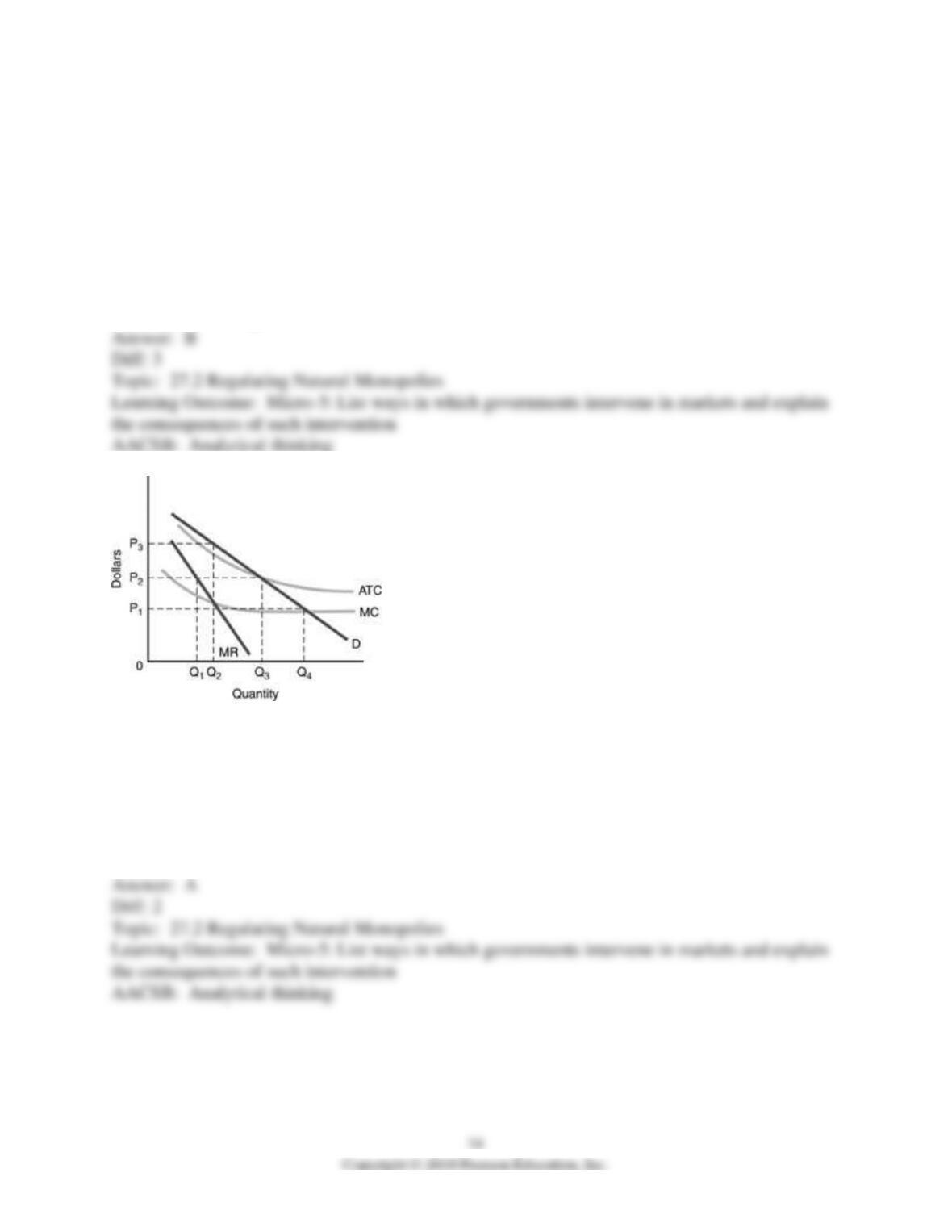
53) Use the above figure. A regulatory commission sets the maximum price this monopolist can
charge at P1. If this monopolist were to produce, it
A) would produce Q4 output and generate losses.
B) would produce Q4 output and generate profits.
C) would produce Q2 output and generate losses.
D) would produce Q2 output and generate profits.
54) Use the above figure. If a commission regulates the above monopoly using fair-return
(average cost pricing), then the industry’s output will be ________ and the product’s price will be
________.
A) Q1; P1
B) Q2; P3
C) Q3; P2
D) Q4; P1
55) Use the above figure. If a commission regulates the above monopoly using marginal cost
pricing, then the industry’s output will be ________ and the product’s price will be ________.
A) Q2; P1
B) Q2; P3
C) Q3; P2
D) Q4; P1
56) Use the above figure. If this monopolist was not regulated, the profit-maximizing quantity
and price would be
A) Q2 and P1.
B) Q2 and P3.
C) Q3 and P2.
D) Q4 and P1.
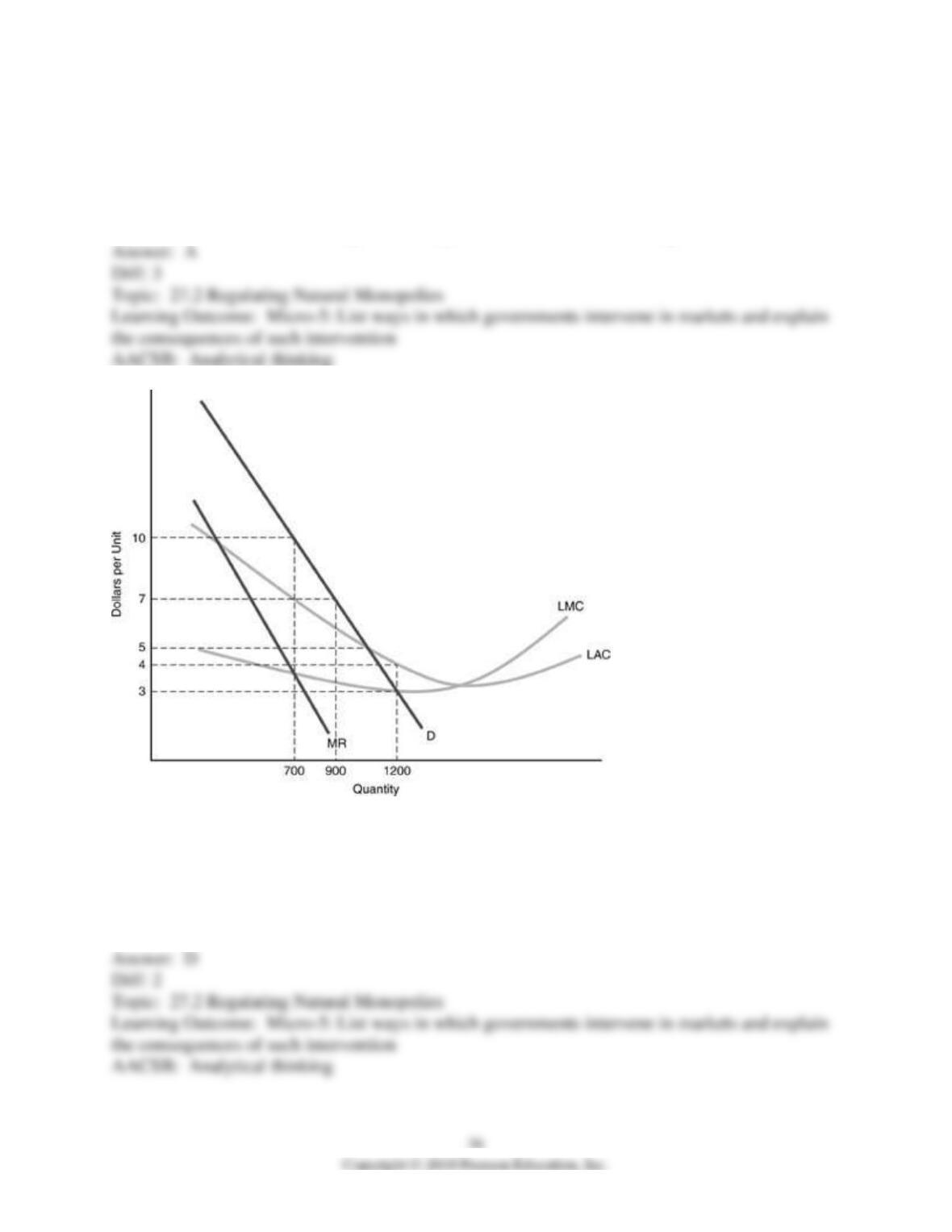
57) Use the above figure. Suppose that a regulatory agency requires this natural monopolist to
engage in marginal cost pricing. This would lead to
A) losses, which would drive the monopolist out of business in the long run.
B) profits, which would encourage new producers to enter the industry in the long run.
C) profits, but new firms cannot enter the industry in the long run due to high barriers to entry.
D) losses, which would encourage the monopolist to lower costs in the long run.
58) In the above figure, what would be the profit-maximizing output and price for this natural
monopolist?
A) 1,200; $3
B) 900; $7
C) 700; $7
D) 700; $10
59) In the above figure, what would be the profit or loss at the profit-maximizing output for this
natural monopolist?
A) -$300
B) $2,700
C) $2,100
D) -$1,200
60) In the above figure, if the monopolist engages in marginal cost pricing, what are its output
and price?
A) 1,200, $3
B) 900, $7
C) 700, $7
D) 700, $10
61) In the above figure, what would be the profit or loss at the marginal cost pricing point for this
natural monopolist?
A) -$300
B) $2,700
C) $2,100
D) -$1,200
62) In the above figure, what will be the output level produced if average cost pricing is used?
A) 1,200
B) 900
C) 700
D) somewhere between 900 and 1,200
63) A natural monopoly
A) has one lowest-cost producer in the industry.
B) exists only when it is regulated.
C) has long-run average costs equal to zero.
D) always experiences diseconomies of scale.
64) Which of the following is the BEST example of a natural monopoly?
A) book publisher
B) electric utility
C) coffee shop
D) airline
65) If a regulator forced a natural monopolist to set P = MC
A) the monopolist would earn economic profits.
B) the monopolist would suffer economic losses.
C) the monopolist would break even.
D) the monopolist would earn monopolistic profits.
66) When a regulator allows a monopolist to set its price equal to long-run average cost, the
regulator is practicing
A) marginal cost pricing.
B) operating cost pricing.
C) average cost pricing.
D) optimal cost pricing.
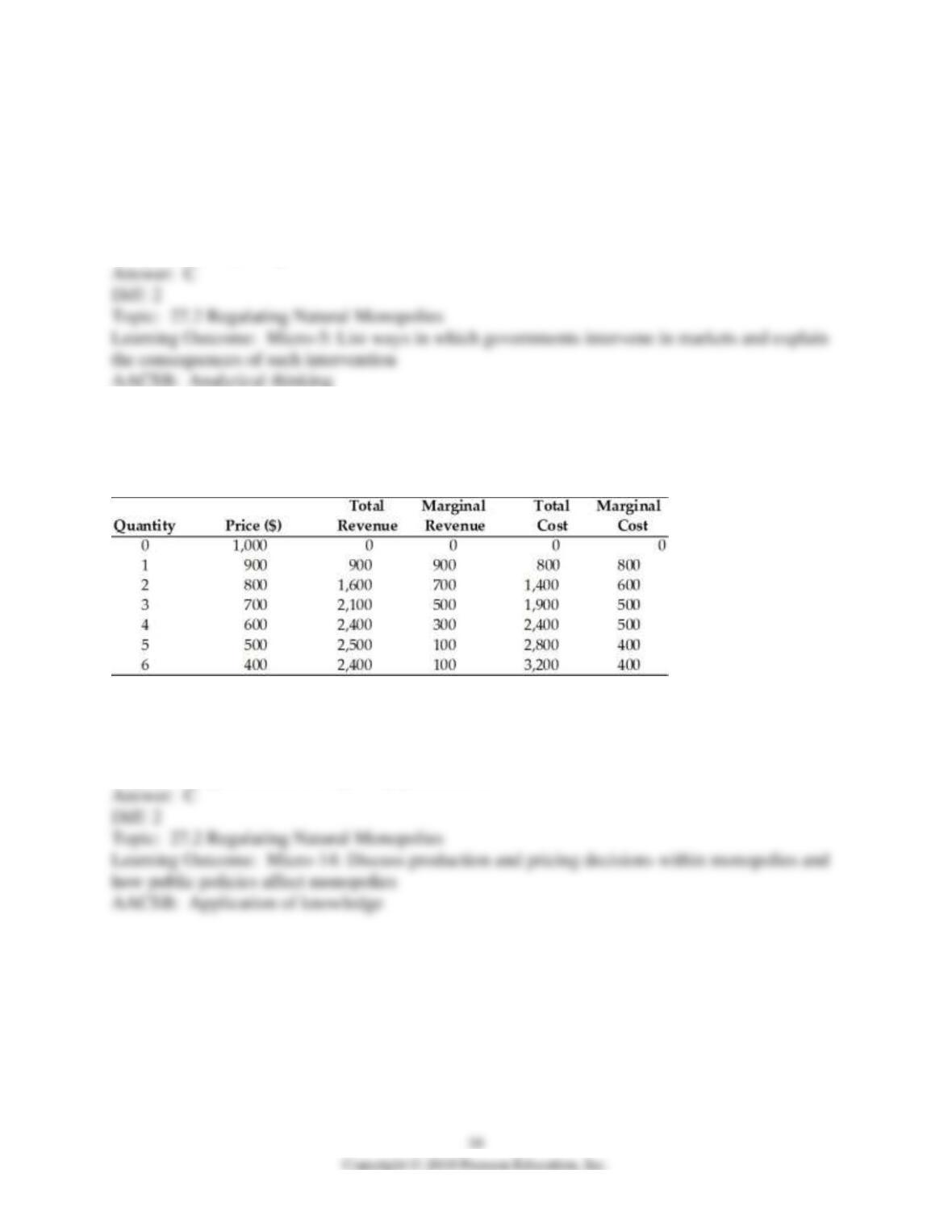
67) The following table depicts the cost and demand structure a natural monopoly faces.
Provided that the firm operates as a monopolist, what is the price charged and quantity produced
in order to maximize profits?
A) price charged of $900 and quantity produced of 1
B) price charged of $800 and quantity produced of 2
C) price charged of $700 and quantity produced of 3
D) price charged of $600 and quantity produced of 4
68) Regulation of a natural monopoly that forces it to price and produce as if it were a
competitive firm results in
A) the market being instantly competitive.
B) higher profits for the monopoly.
C) economic losses for the monopoly.
D) a highly unstable marketplace.
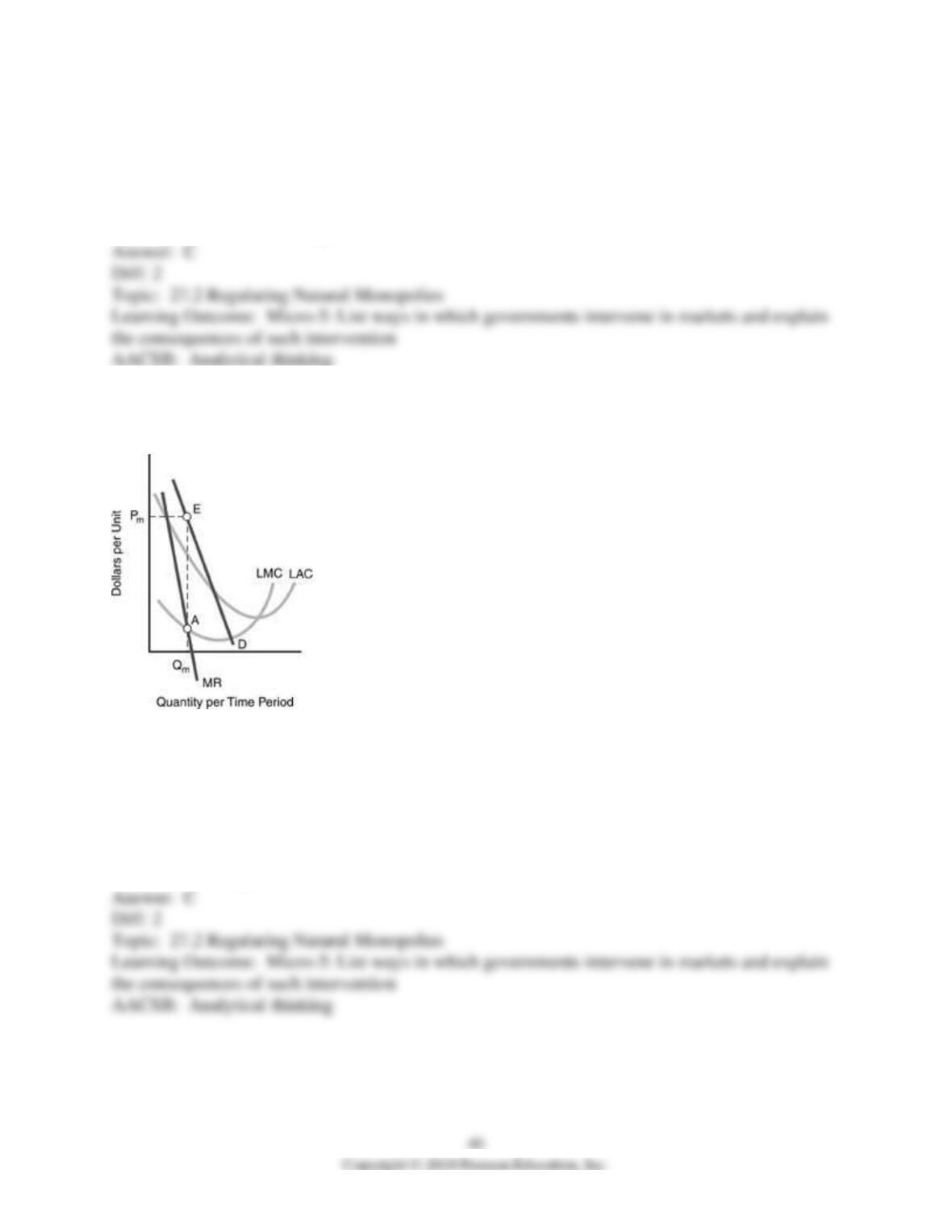
69) Using the figure as a guide, which of the following is FALSE with respect to profit
maximization and the monopolist?
A) A monopolist (like any other firm) will select an output rate at which marginal revenue is
equal to marginal cost, at the intersection of the marginal revenue curve and the marginal cost
curve.
B) The monopolist will produce quantity Qm and charge a price of Pm.
C) When compared to a competitive situation, consumers pay a higher price to the monopolist,
and consequently are forced to purchase more of a product as price varies directly with quantity
demanded.
D) Profits are the positive difference between total revenues and total costs.