United States – BPROG: Analytic
Aggregate demand and aggregate s – Aggregate demand and aggregate supply
Demand-Side Equilibrium and Full Employment
135. In Table 9-1, inventories will be increasing as long as output is above
a.
1,000.
b.
1,500.
c.
2,000.
d.
3,000.
Moderate
DISC: Aggregate demand and aggre – DISC: Aggregate demand and aggregate supply
United States – BPROG: Analytic
Aggregate demand and aggregate s – Aggregate demand and aggregate supply
Demand-Side Equilibrium and Full Employment
136. In the basic 45-degree line model, what is the effect of an increase in the price level?
a.
There will be movement to the left on the expenditure line.
b.
There will be movement to the right on the expenditure line.
c.
The expenditure line will shift downward.
d.
The expenditure line will shift upward.
c
Easy
DISC: Aggregate demand and aggre – DISC: Aggregate demand and aggregate supply
United States – BPROG: Analytic
Aggregate demand and aggregate s – Aggregate demand and aggregate supply
Demand-Side Equilibrium and Full Employment
137. In the basic 45-degree line model, what is the effect of a decrease in the price level?
a.
The expenditure line will shift downward.
b.
The expenditure line will shift upward.
c.
There will be movement to the left on the expenditure line.
d.
There will be movement to the right on the expenditure line.
Easy
DISC: Aggregate demand and aggre – DISC: Aggregate demand and aggregate supply
United States – BPROG: Analytic
Aggregate demand and aggregate s – Aggregate demand and aggregate supply
Demand-Side Equilibrium and Full Employment
138. Why does an increase in the price level cause a decrease in real GDP demanded?
a.
Consumer wealth increases.
b.
Net exports will increase.
c.
Interest rates decrease and cause higher investment.
d.
Net exports will decrease.
DISC: Aggregate demand and aggre – DISC: Aggregate demand and aggregate supply
United States – BPROG: Analytic
Aggregate demand and aggregate s – Aggregate demand and aggregate supply
Demand-Side Equilibrium and Full Employment
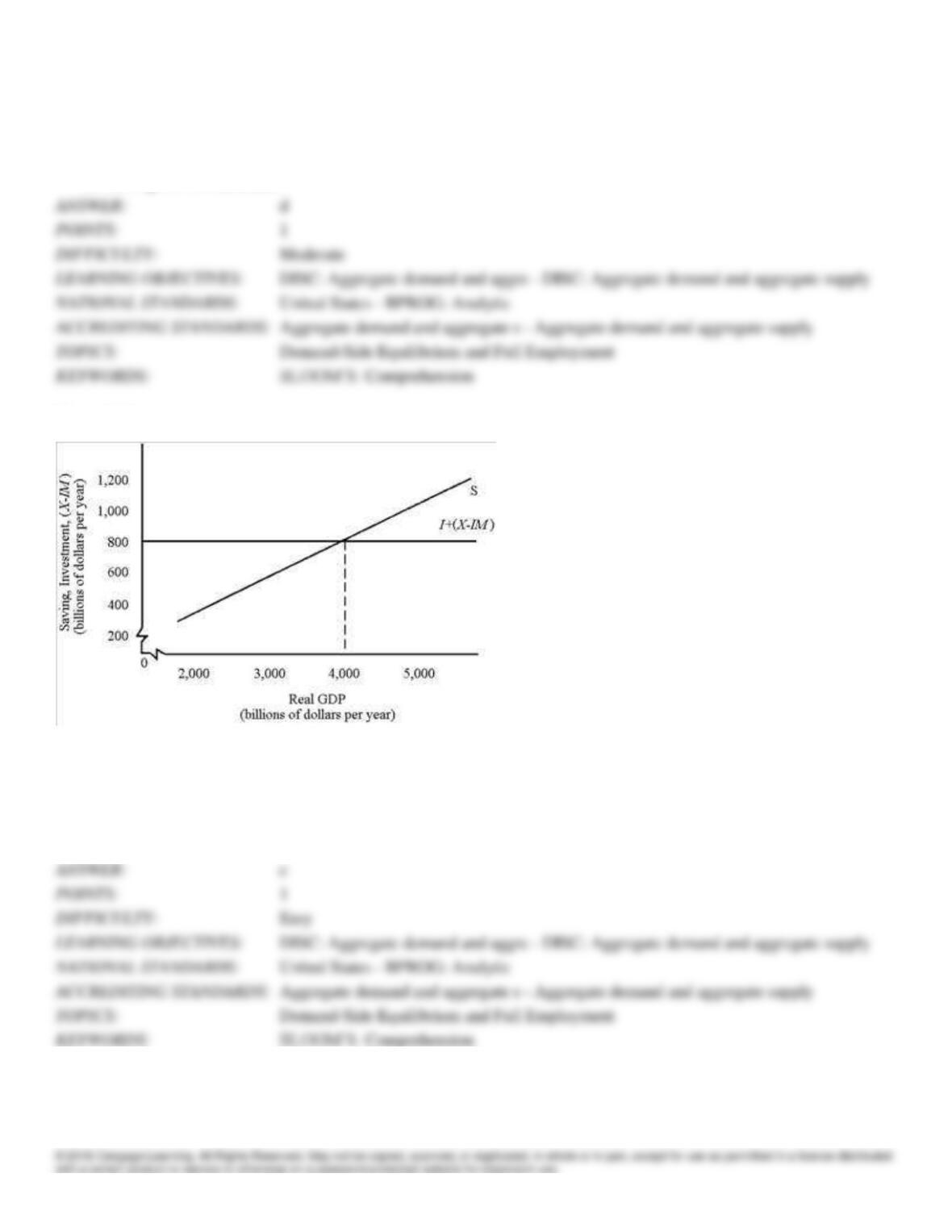
Figure 9-3
139. In Figure 9-3, equilibrium GDP is
a.
$2,000 billion.
b.
$3,000 billion.
c.
$4,000 billion.
d.
$5,000 billion.
DISC: Aggregate demand and aggre – DISC: Aggregate demand and aggregate supply
United States – BPROG: Analytic
Aggregate demand and aggregate s – Aggregate demand and aggregate supply
Demand-Side Equilibrium and Full Employment
140. In Figure 9-3, saving at equilibrium GDP is.
a.
$1,200 billion.
b.
$1,000 billion.
c.
$800 billion.
d.
$600 billion.
e.
$400 billion.
DISC: Aggregate demand and aggre – DISC: Aggregate demand and aggregate supply
United States – BPROG: Analytic
Aggregate demand and aggregate s – Aggregate demand and aggregate supply
Demand-Side Equilibrium and Full Employment
141. In Figure 9-3, investment plus net exports equals
a.
$200 billion.
b.
$400 billion.
c.
$600 billion.
d.
$800 billion.
e.
$1,200 billion.
DISC: Aggregate demand and aggre – DISC: Aggregate demand and aggregate supply
United States – BPROG: Analytic
Aggregate demand and aggregate s – Aggregate demand and aggregate supply
142. In Figure 9-3, at $3,000 billion GDP,
a.
inventories will be falling, signaling businesses to decrease production.
b.
inventories will be falling, signaling businesses to increase production.
c.
planned saving increases planned investment.
d.
inventories will be accumulating, signaling businesses to increase production.
DISC: Aggregate demand and aggre – DISC: Aggregate demand and aggregate supply
United States – BPROG: Analytic
Aggregate demand and aggregate s – Aggregate demand and aggregate supply
Demand-Side Equilibrium and Full Employment
143. In Figure 9-3, at $5,000 billion GDP, inventories will be
a.
falling, signaling businesses to increase production.
b.
accumulating, signaling businesses to increase production.
c.
accumulating, signaling businesses to cut production.
d.
falling, signaling businesses to cut production.
1
DISC: Aggregate demand and aggre – DISC: Aggregate demand and aggregate supply
United States – BPROG: Analytic
Aggregate demand and aggregate s – Aggregate demand and aggregate supply
Demand-Side Equilibrium and Full Employment
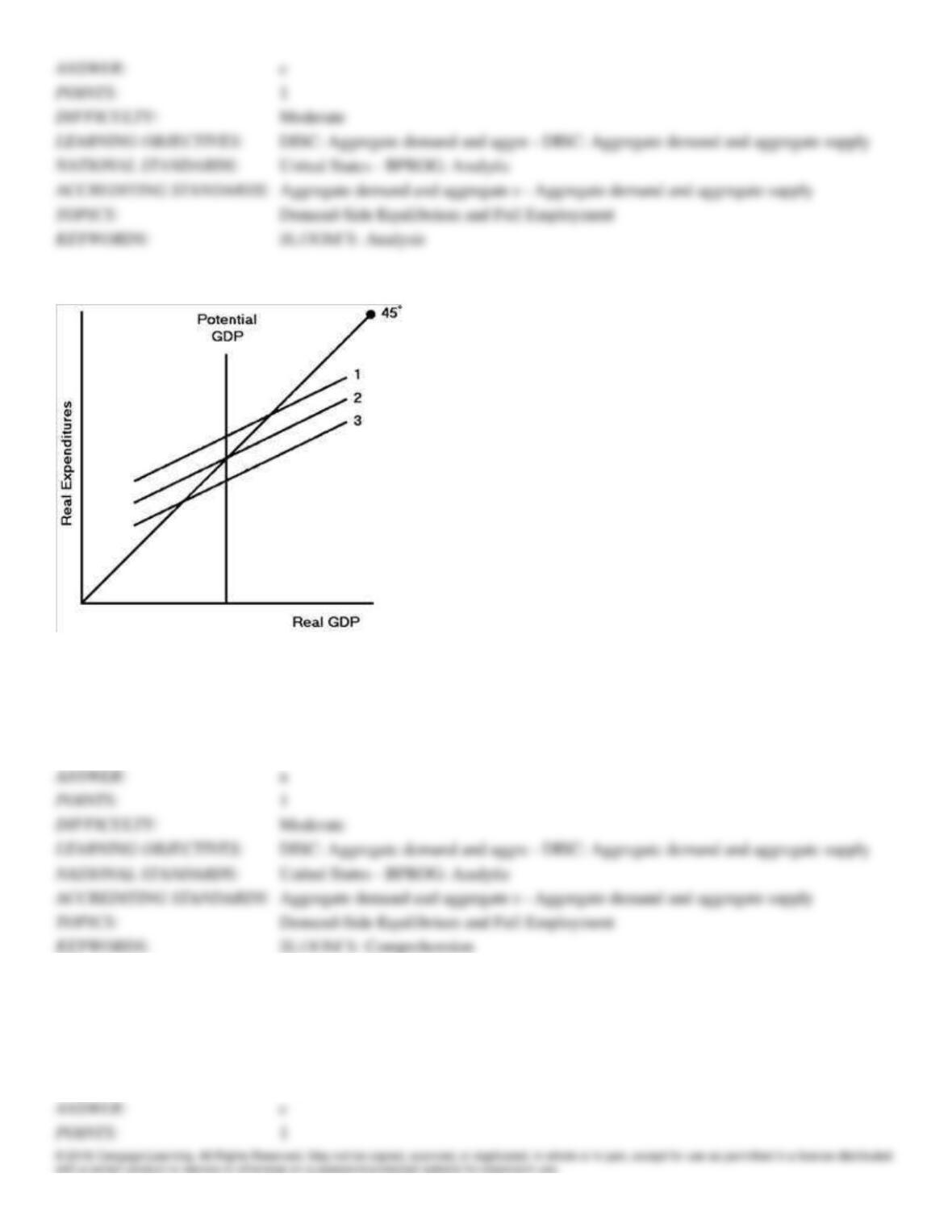
Figure 9-4
144. In Figure 9-4, which expenditure level will cause an inflationary gap?
a.
1
b.
2
c.
3
d.
There will be no inflationary gap.
1
DISC: Aggregate demand and aggre – DISC: Aggregate demand and aggregate supply
United States – BPROG: Analytic
Aggregate demand and aggregate s – Aggregate demand and aggregate supply
Demand-Side Equilibrium and Full Employment
145. In Figure 9-4, which expenditure level will result in a recessionary gap?
a.
1
b.
2
c.
3
d.
There will be no deflationary gap.
1
DISC: Aggregate demand and aggre – DISC: Aggregate demand and aggregate supply
United States – BPROG: Analytic
Aggregate demand and aggregate s – Aggregate demand and aggregate supply
Demand-Side Equilibrium and Full Employment
146. In Figure 9-4, if the economy is in a recessionary gap, what must happen to reach potential GDP?
a.
The expenditure level must fall and/or the price level must rise.
b.
The expenditure level must rise and/or the price level must fall.
c.
The expenditure level must rise and/or the price level must rise.
d.
The expenditure level must fall and /or the price level must fall.
DISC: Aggregate demand and aggre – DISC: Aggregate demand and aggregate supply
United States – BPROG: Reflective Thinking – BPROG: Analysis
Aggregate demand and aggregate s – Aggregate demand and aggregate supply
Demand-Side Equilibrium and Full Employment
147. In Figure 9-4, if the economy faces an inflationary gap, what must happen to reach potential GDP?
a.
The expenditure level must rise and/or the price level must rise.
b.
The expenditure level must rise and/or the price level must fall.
c.
The expenditure level must fall and/or the price level must fall.
d.
The expenditure level must fall and/or the price level must rise.
DISC: Aggregate demand and aggre – DISC: Aggregate demand and aggregate supply
United States – BPROG: Analytic
Aggregate demand and aggregate s – Aggregate demand and aggregate supply
Demand-Side Equilibrium and Full Employment
148. If the amount that consumers wish to save at the full employment level of income is greater than the amount that
businesses plan to invest, then
a.
there will be an inflationary gap.
b.
there will be a recessionary gap.
c.
total demand will exceed potential GDP.
d.
the economy will move to a higher level of output.
DISC: Aggregate demand and aggre – DISC: Aggregate demand and aggregate supply
United States – BPROG: Analytic
Aggregate demand and aggregate s – Aggregate demand and aggregate supply
Demand-Side Equilibrium and Full Employment
149. If, at the full employment level of income, the amount that businesses plan to invest is greater than the amount that
consumers plan to save, then
a.
there will be an inflationary gap.
b.
there will be a deflationary gap.
c.
total demand will fall short of potential GDP.
d.
the economy will suffer from increasing unemployment.
a
Moderate
DISC: Aggregate demand and aggre – DISC: Aggregate demand and aggregate supply
United States – BPROG: Analytic
Aggregate demand and aggregate s – Aggregate demand and aggregate supply
Demand-Side Equilibrium and Full Employment
150. In the circular flow diagram saving
a.
is a leakage and investment is an injection.
b.
and investment are both injections.
c.
is an injection and investment is a leakage.
d.
and investment are both leakages.
a
Easy
DISC: Aggregate demand and aggre – DISC: Aggregate demand and aggregate supply
United States – BPROG: Analytic
Aggregate demand and aggregate s – Aggregate demand and aggregate supply
The Coordination of Savings and Investment
151. Which of the following occurs when party A would like to change his behavior if party B would change hers, and
vice versa, and yet the two changes do not take place because the decisions of A and B are made independently?
a.
Moral hazard
b.
Coordination failure
c.
Leakage
d.
Lemon problem
Easy
DISC: Aggregate demand and aggre – DISC: Aggregate demand and aggregate supply
United States – BPROG: Analytic
Aggregate demand and aggregate s – Aggregate demand and aggregate supply
The Coordination of Savings and Investment
152. To avoid a coordination failure, the intentions of savers and investors must be both
a.
increasing.
b.
at their planned levels.
c.
more than full employment GDP.
d.
at levels set by the government.
Difficult
DISC: Aggregate demand and aggre – DISC: Aggregate demand and aggregate supply
United States – BPROG: Analytic
Aggregate demand and aggregate s – Aggregate demand and aggregate supply
The Coordination of Savings and Investment
153. If saving exceeds investment, then the level of GDP will
a.
increase.
b.
remain constant.
c.
decrease.
d.
rise above potential GDP.
c
Moderate
DISC: Aggregate demand and aggre – DISC: Aggregate demand and aggregate supply
United States – BPROG: Reflective Thinking – BPROG: Analysis
Aggregate demand and aggregate s – Aggregate demand and aggregate supply
The Coordination of Savings and Investment
154. Investment spending
a.
cannot be stimulated by decreasing the interest rate.
b.
is often the cause of business fluctuations in the United States.
c.
is a remarkably stable function of the level of real GDP.
d.
is the primary solution to recessions and inflations, according to John Maynard Keynes.
Moderate
DISC: Aggregate demand and aggre – DISC: Aggregate demand and aggregate supply
United States – BPROG: Analytic
Aggregate demand and aggregate s – Aggregate demand and aggregate supply
Changes on the Demand Side: Multiplier Analysis
155. The basic idea behind the multiplier is that an increase in
a.
GDP brings about an additional, larger increase in GDP.
b.
consumer spending causes a larger increase in investment spending.
c.
government spending causes a larger increase in tax revenues.
d.
spending will cause an even larger increase in equilibrium GDP.
Easy
DISC: Aggregate demand and aggre – DISC: Aggregate demand and aggregate supply
United States – BPROG: Analytic
Aggregate demand and aggregate s – Aggregate demand and aggregate supply
Changes on the Demand Side: Multiplier Analysis
156. The concept that increases in spending cause larger increases in equilibrium GDP is known as the
a.
profiler.
b.
mystifier.
c.
multiplier.
d.
depreciator.
c
Easy
DISC: Aggregate demand and aggre – DISC: Aggregate demand and aggregate supply
United States – BPROG: Analytic
Aggregate demand and aggregate s – Aggregate demand and aggregate supply
Changes on the Demand Side: Multiplier Analysis
157. The reason for the multiplier effect is that
a.
businesses make decisions about investment projects based on anticipated profits.
b.
one person’s additional expenditure creates a new source of income for another person, and this additional
income leads to still more spending.
c.
changes in government spending typically deepen recessions and exacerbate inflationary conditions in the
economy.
d.
additional spending lowers the rate of interest and leads to further borrowing and spending.
Moderate
DISC: Aggregate demand and aggre – DISC: Aggregate demand and aggregate supply
United States – BPROG: Analytic
Aggregate demand and aggregate s – Aggregate demand and aggregate supply
Changes on the Demand Side: Multiplier Analysis
158. If an economy at the equilibrium level of GDP experiences an increase in the amount of investment spending, then
inventories will be
a.
depleted, causing firms to cut production.
b.
accumulated, causing firms to cut production.
c.
depleted, causing firms to increase production.
d.
accumulated, causing firms to expand production.
Moderate
DISC: Aggregate demand and aggre – DISC: Aggregate demand and aggregate supply
United States – BPROG: Reflective Thinking – BPROG: Analysis
Aggregate demand and aggregate s – Aggregate demand and aggregate supply
Changes on the Demand Side: Multiplier Analysis
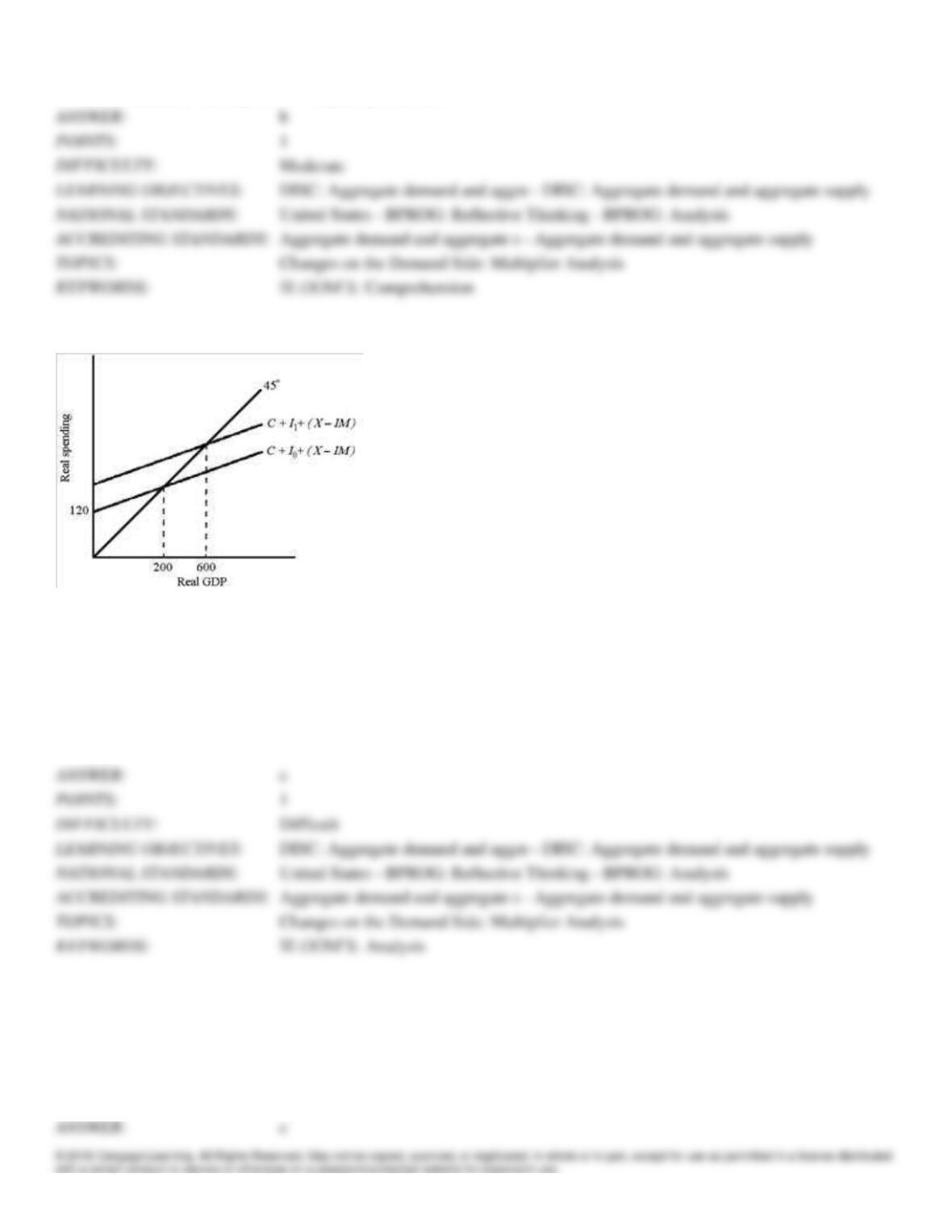
Figure 9-5
159. If the shift in the C + I + (X − IM) in Figure 9-5 was caused by a 80 dollar increase in investment, then the multiplier
is
a.
0.
b.
2.
c.
3.
d.
4.
e.
5.
e
Difficult
DISC: Aggregate demand and aggre – DISC: Aggregate demand and aggregate supply
United States – BPROG: Reflective Thinking – BPROG: Analysis
Aggregate demand and aggregate s – Aggregate demand and aggregate supply
Changes on the Demand Side: Multiplier Analysis
160. In Figure 9-5, if the second round effect of an increase in autonomous spending of $100,000 is $75,000, then the
multiplier is
a.
400,000.
b.
6.
c.
4.
d.
4/5.
c
Difficult
DISC: Aggregate demand and aggre – DISC: Aggregate demand and aggregate supply
United States – BPROG: Reflective Thinking – BPROG: Analysis
Aggregate demand and aggregate s – Aggregate demand and aggregate supply
Changes on the Demand Side: Multiplier Analysis
161. If the level of investment spending increases by $100 and the MPC in the economy is 0.8, then the cumulative
spending increase after three rounds of spending is
a.
$280.
b.
$260.
c.
$244.
d.
$220.
c
Difficult
DISC: Aggregate demand and aggre – DISC: Aggregate demand and aggregate supply
United States – BPRPOG: Analysis
Aggregate demand and aggregate s – Aggregate demand and aggregate supply
Changes on the Demand Side: Multiplier Analysis
162. The multiplier principle explains how
a.
any change in the economy will be magnified.
b.
$1 invested will increase GDP by more than $1.
c.
expenditures and incomes increase as investment increases.
d.
All of the above are correct.
Moderate
DISC: Aggregate demand and aggre – DISC: Aggregate demand and aggregate supply
United States – BPROG: Reflective Thinking – BPROG: Analysis
Aggregate demand and aggregate s – Aggregate demand and aggregate supply
Changes on the Demand Side: Multiplier Analysis
163. The multiplier principle illustrates that
a.
an increase in investment spending will be multiplied into a larger increase in GDP.
b.
an increase in GDP will be multiplied into a larger amount of investment spending.
c.
an increase in GDP will be multiplied into a larger increase in consumer spending.
d.
investment spending is always a multiple of consumer spending.
a
Easy
DISC: Aggregate demand and aggre – DISC: Aggregate demand and aggregate supply
United States – BPROG: Analytic
Aggregate demand and aggregate s – Aggregate demand and aggregate supply
Changes on the Demand Side: Multiplier Analysis
164. If the government increases defense spending by $1 billion and the MPC is 0.8, how much additional spending will
occur in the third “round” of spending?
a.
$640 million
b.
$800 million
c.
$1 billion
d.
$1.8 billion
DISC: Aggregate demand and aggre – DISC: Aggregate demand and aggregate supply
United States – BPROG: Reflective Thinking – BPROG: Analysis
Aggregate demand and aggregate s – Aggregate demand and aggregate supply
Changes on the Demand Side: Multiplier Analysis
165. Investment increases by $200 million and the value of MPC is 0.75. What would be the total increase in spending?
a.
$200 million
b.
$266 million
c.
$750 million
d.
$800 million
DISC: Aggregate demand and aggre – DISC: Aggregate demand and aggregate supply
United States – BPROG: Reflective Thinking – BPROG: Analysis
Changes on the Demand Side: Multiplier Analysis
166. Because of a recession in Japan, net exports from the United States decrease by $10 billion. If the MPC is 0.75, how
much less spending will occur in the U.S. economy in the second “round” of spending?
a.
$17.5 billion
b.
$10 billion
c.
$7.5 billion
d.
$5.0 billion
DISC: Aggregate demand and aggre – DISC: Aggregate demand and aggregate supply
United States – BPROG: Reflective Thinking – BPROG: Analysis
Aggregate demand and aggregate s – Aggregate demand and aggregate supply
Changes on the Demand Side: Multiplier Analysis
167. The economic impact of a change in spending, working through the multiplier, takes effect
a.
immediately.
b.
very quickly, with a small number of rounds of spending.
c.
after a very long period of time.
d.
after multiple rounds of spending occur.
Moderate
DISC: Aggregate demand and aggre – DISC: Aggregate demand and aggregate supply
United States – BPROG: Analytic
Aggregate demand and aggregate s – Aggregate demand and aggregate supply
Changes on the Demand Side: Multiplier Analysis
168. The economic impact of the multiplier is ____, and then becomes ____.
a.
slow, faster
b.
small, tiny
c.
large, smaller
d.
small, larger
c
Moderate
DISC: Aggregate demand and aggre – DISC: Aggregate demand and aggregate supply
United States – BPROG: Analytic
Aggregate demand and aggregate s – Aggregate demand and aggregate supply
Changes on the Demand Side: Multiplier Analysis
169. As the multiplier process works through time, the size of the multiplier effect becomes
a.
larger.
b.
smaller.
c.
constant.
d.
explosive.
Moderate
DISC: Aggregate demand and aggre – DISC: Aggregate demand and aggregate supply
United States – BPROG: Analytic
Aggregate demand and aggregate s – Aggregate demand and aggregate supply
Changes on the Demand Side: Multiplier Analysis
170. The multiplier principle is built on the premise that one person’s spending is another person’s
a.
debt.
b.
obligation.
c.
income.
d.
saving.
c
Easy
DISC: Aggregate demand and aggre – DISC: Aggregate demand and aggregate supply
United States – BPROG: Analytic
Aggregate demand and aggregate s – Aggregate demand and aggregate supply
Changes on the Demand Side: Multiplier Analysis
171. The basic reason for the multiplier effect is that, when you spend money,
a.
another person receives income.
b.
another person must pay for it.
c.
your money balances are reduced.
d.
your net worth decreases.
a
Easy
DISC: Aggregate demand and aggre – DISC: Aggregate demand and aggregate supply
United States – BPROG: Analytic
Aggregate demand and aggregate s – Aggregate demand and aggregate supply
172. The effect throughout the entire economy of one individual’s increase in spending will be
a.
less than the individual’s spending.
b.
equal to the individual’s spending.
c.
greater than the individual’s spending.
d.
offset by another individual’s saving.
c
Moderate
DISC: Aggregate demand and aggre – DISC: Aggregate demand and aggregate supply
United States – BPROG: Analytic
Aggregate demand and aggregate s – Aggregate demand and aggregate supply
Changes on the Demand Side: Multiplier Analysis
173. If businesses spend an additional $150 billion for investment projects in 2010, what will be the impact on national
income (Y) if the multiplier is 2?
a.
Y will increase by $50 billion.
b.
Y will increase by $150 billion.
c.
Y will increase by $300 billion.
d.
Y will increase by $450 billion.
c
Moderate
DISC: Aggregate demand and aggre – DISC: Aggregate demand and aggregate supply
United States – BPROG: Analytic
Aggregate demand and aggregate s – Aggregate demand and aggregate supply
Changes on the Demand Side: Multiplier Analysis
174. The actual multiplier for the U.S. economy is estimated to be
a.
about 10.
b.
approximately 5.
c.
between 3 and 4.
d.
less than 2.
Easy
DISC: Measuring the Economy
United States – BPROG: Analytic
Measuring the Economy
Changes on the Demand Side: Multiplier Analysis
175. If the MPC is .67, then the oversimplified multiplier is
a.
7.60.
b.
6.70.
c.
3.00.
d.
33.
c
Moderate
DISC: Aggregate demand and aggre – DISC: Aggregate demand and aggregate supply
United States – BPROG: Analytic
Aggregate demand and aggregate s – Aggregate demand and aggregate supply
Changes on the Demand Side: Multiplier Analysis
176. Businesses in the United States cut their investment projects by $30 billion. If the MPC is 2, what will be the impact
on the national income (Y)?
a.
Y will fall by $15 billion.
b.
Y will fall by $30 billion.
c.
Y will fall by $60 billion.
d.
Y will fall by $120 billion.
c