United States – BPROG: Analytic
Aggregate demand and aggregate s – Aggregate demand and aggregate supply
The Mechanics of Income Determination
72. 45° line diagrams show how
a.
investment varies with income.
b.
expenditures vary with income.
c.
investment spending rises when GDP rises.
d.
GDP is affected by government purchases.
DISC: Aggregate demand and aggre – DISC: Aggregate demand and aggregate supply
United States – BPROG: Analytic
Aggregate demand and aggregate s – Aggregate demand and aggregate supply
The Mechanics of Income Determination
73. If the economy is in equilibrium, it must be
a.
on the 45° line.
b.
on the 60° line.
c.
below the 45° line.
d.
below the 60° line.
DISC: Aggregate demand and aggre – DISC: Aggregate demand and aggregate supply
United States – BPROG: Analytic
Aggregate demand and aggregate s – Aggregate demand and aggregate supply
The Mechanics of Income Determination
74. A rising price level should shift the expenditure schedule
a.
upward and decrease equilibrium real GDP.
b.
downward and increase equilibrium real GDP.
c.
downward and decrease equilibrium real GDP.
d.
upward and increase equilibrium real GDP.
DISC: Aggregate demand and aggre – DISC: Aggregate demand and aggregate supply
United States – BPROG: Analytic
Aggregate demand and aggregate s – Aggregate demand and aggregate supply
The Aggregate Demand Curve
75. The price level effects consumer spending through changes in real
a.
disposable income.
b.
interest rates.
c.
wealth.
d.
GDP.
c
Easy
DISC: Aggregate demand and aggre – DISC: Aggregate demand and aggregate supply
United States – BPROG: Analytic
Aggregate demand and aggregate s – Aggregate demand and aggregate supply
The Aggregate Demand Curve
76. A higher price level would mean ____ for a person who has a bank deposit of $2 million.
a.
an increase in real income
b.
a decrease in real wealth
c.
a decrease in nominal income
d.
an increase in nominal income
Easy
DISC: Aggregate demand and aggre – DISC: Aggregate demand and aggregate supply
United States – BPROG: Analytic
Aggregate demand and aggregate s – Aggregate demand and aggregate supply
The Aggregate Demand Curve
77. If the price level rises, the effect on the expenditure schedule and equilibrium real GDP is to
a.
increase both.
b.
decrease both.
c.
shift the expenditure schedule upward and decrease equilibrium real GDP.
d.
shift the expenditure schedule downward and increase equilibrium real GDP.
Moderate
DISC: Aggregate demand and aggre – DISC: Aggregate demand and aggregate supply
United States – BPROG: Analytic
Aggregate demand and aggregate s – Aggregate demand and aggregate supply
The Aggregate Demand Curve
78. When the price level in the United States rises, then net exports should
a.
rise and equilibrium real GDP should increase.
b.
fall and equilibrium real GDP should increase.
c.
fall and equilibrium real GDP should decrease.
d.
rise and equilibrium real GDP should decrease.
DISC: Aggregate demand and aggre – DISC: Aggregate demand and aggregate supply
United States – BPROG: Analytic
Aggregate demand and aggregate s – Aggregate demand and aggregate supply
The Aggregate Demand Curve
79. The slope of the aggregate demand curve illustrates that as the price level rises,
a.
real GDP demanded decreases.
b.
real GDP demanded increases.
c.
the aggregate demand curve shifts rightward.
d.
the aggregate demand curve shifts leftward.
DISC: Aggregate demand and aggre – DISC: Aggregate demand and aggregate supply
United States – BPROG: Analytic
Aggregate demand and aggregate s – Aggregate demand and aggregate supply
The Aggregate Demand Curve
80. The slope of the aggregate demand curve illustrates that real GDP demanded will increase when
a.
the price level rises.
b.
the price level falls.
c.
real income rises.
d.
real income falls.
DISC: Aggregate demand and aggre – DISC: Aggregate demand and aggregate supply
United States – BPROG: Analytic
Aggregate demand and aggregate s – Aggregate demand and aggregate supply
The Aggregate Demand Curve
81. Given the slope of the aggregate demand curve, real GDP demanded will decrease when
a.
real income rises.
b.
real income falls.
c.
the price level falls.
d.
the price level rises.
DISC: Aggregate demand and aggre – DISC: Aggregate demand and aggregate supply
United States – BPROG: Analytic
Aggregate demand and aggregate s – Aggregate demand and aggregate supply
The Aggregate Demand Curve
82. The aggregate demand curve
a.
slopes upward.
b.
slopes downward.
c.
is perfectly vertical.
d.
is perfectly horizontal.
DISC: Aggregate demand and aggre – DISC: Aggregate demand and aggregate supply
United States – BPROG: Analytic
Aggregate demand and aggregate s – Aggregate demand and aggregate supply
The Aggregate Demand Curve
83. Two variables that affect the slope of the aggregate demand curve are
a.
government purchases and real taxes.
b.
tax rates and interest rates.
c.
government purchases and interest rates.
d.
exchange rates and income rates.
DISC: Aggregate demand and aggre – DISC: Aggregate demand and aggregate supply
United States – BPROG: Analytic
Aggregate demand and aggregate s – Aggregate demand and aggregate supply
The Aggregate Demand Curve
84. Each C + I + G + (X − IM) expenditure schedule is drawn assuming a specific
a.
income level.
b.
spending level.
c.
production level.
d.
price level.
DISC: Aggregate demand and aggre – DISC: Aggregate demand and aggregate supply
United States – BPROG: Analytic
Aggregate demand and aggregate s – Aggregate demand and aggregate supply
The Aggregate Demand Curve
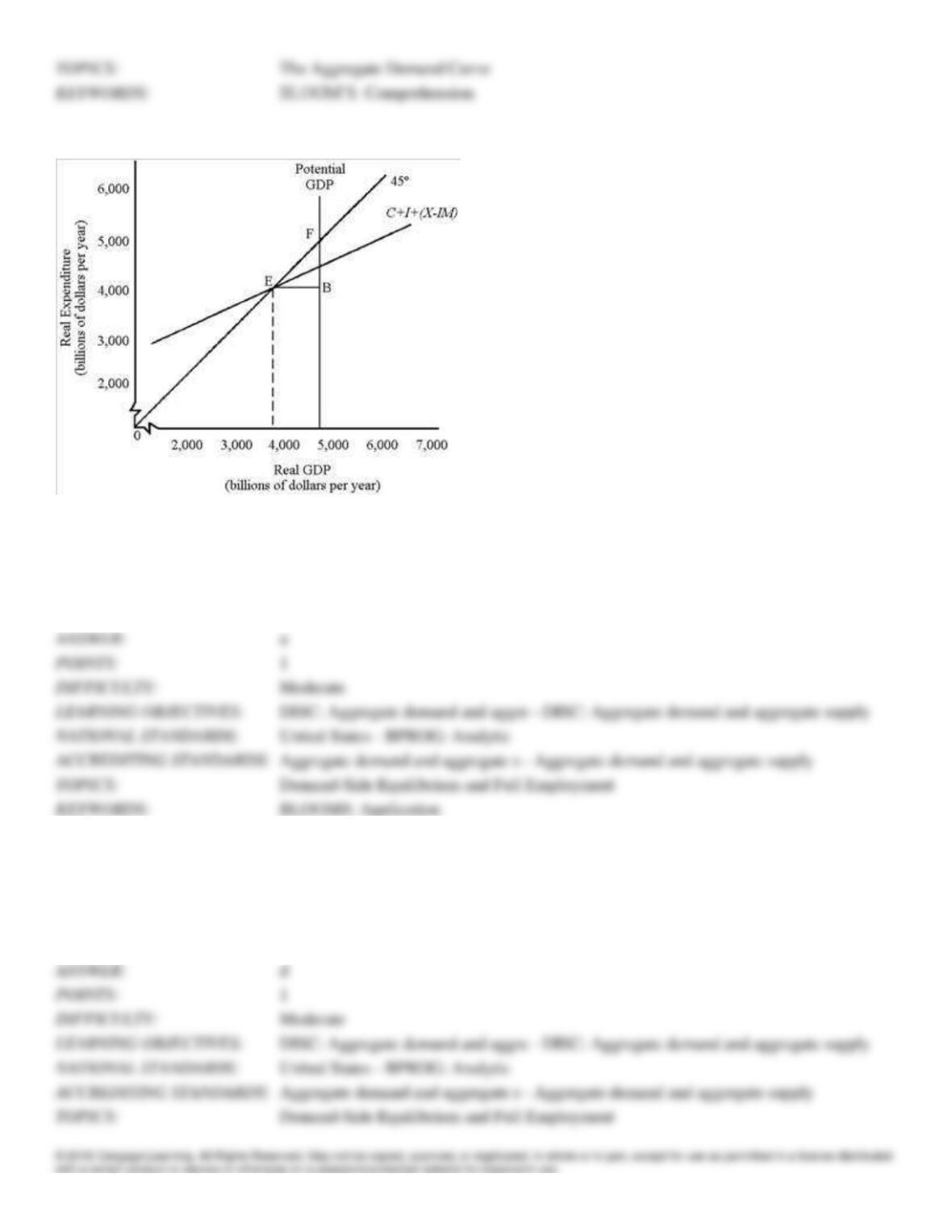
Figure 9-1
85. In Figure 9-1, at $3,000 billion real GDP,
a.
spending exceeds total output and inventories will fall.
b.
inventories are constant.
c.
aggregate demand equals aggregate supply.
d.
spending falls short of output and inventories will rise.
DISC: Aggregate demand and aggre – DISC: Aggregate demand and aggregate supply
United States – BPROG: Analytic
Aggregate demand and aggregate s – Aggregate demand and aggregate supply
Demand-Side Equilibrium and Full Employment
BLOOMS: Application
86. In Figure 9-1, at $7,000 billion real GDP,
a.
inventories are increasing.
b.
spending falls short of output.
c.
spending exceeds output.
d.
Both a and b are correct.
DISC: Aggregate demand and aggre – DISC: Aggregate demand and aggregate supply
Aggregate demand and aggregate s – Aggregate demand and aggregate supply
Demand-Side Equilibrium and Full Employment
BLOOMS: Application
87. In Figure 9-1,
a.
the 45-degree line represents all points where spending equals output.
b.
to the left of equilibrium GDP, inventories will fall.
c.
to the right of equilibrium GDP, inventories will rise.
d.
All of the above are correct.
DISC: Aggregate demand and aggre – DISC: Aggregate demand and aggregate supply
United States – BPROG: Analytic
Aggregate demand and aggregate s – Aggregate demand and aggregate supply
Demand-Side Equilibrium and Full Employment
88. In Figure 9-1, the economy is
a.
experiencing an inflationary gap, shown by the horizontal distance EB.
b.
at full employment without inflation.
c.
experiencing a recessionary gap, shown by the horizontal distance EB.
d.
experiencing a recessionary gap, shown by the distance between EF.
DISC: Aggregate demand and aggre – DISC: Aggregate demand and aggregate supply
United States – BPROG: Analytic
Aggregate demand and aggregate s – Aggregate demand and aggregate supply
Demand-Side Equilibrium and Full Employment
89. Using the standard 45-degree line diagram, how does an increase in investment spending effect the expenditure
schedule?
a.
It shifts the expenditure schedule downward.
b.
It shifts the expenditure schedule upward.
c.
It increases the slope of the expenditure schedule.
d.
It decreases the slope of the expenditure schedule.
DISC: Aggregate demand and aggre – DISC: Aggregate demand and aggregate supply
United States – BPROG: Analytic
Aggregate demand and aggregate s – Aggregate demand and aggregate supply
Demand-Side Equilibrium and Full Employment
90. Using the standard 45-degree line diagram, how does a decrease in investment spending effect the expenditure
schedule?
a.
It increases the slope of the expenditure schedule.
b.
It decreases the slope of the expenditure schedule.
c.
It shifts the expenditure schedule downward.
d.
It shifts the expenditure schedule upward.
c
Easy
91. Using the standard 45-degree line diagram, how does a decrease in net exports effect the expenditure schedule?
a.
It increases the slope of the expenditure schedule.
b.
It decreases the slope of the expenditure schedule.
c.
It shifts the expenditure schedule upward.
d.
It shifts the expenditure schedule downward.
Easy
92. Using the standard 45-degree line diagram, how does an increase in autonomous consumption effect the expenditure
schedule?
a.
It shifts the expenditure schedule downward.
b.
It shifts the expenditure schedule upward.
c.
It increases the slope of the expenditure schedule.
d.
It decreases the slope of the expenditure schedule.
Moderate
93. The amount by which equilibrium real GDP exceeds full-employment GDP is known as
a.
stagflation.
b.
employment.
c.
a recessionary gap.
d.
an inflationary gap.
DISC: Aggregate demand and aggre – DISC: Aggregate demand and aggregate supply
United States – BPROG: Analytic
Aggregate demand and aggregate s – Aggregate demand and aggregate supply
Demand-Side Equilibrium and Full Employment
94. Government stabilization policy
a.
cannot influence investment spending.
b.
can stimulate aggregate demand and thereby induce businesses to invest, but the amount is not totally
predictable.
c.
can stimulate aggregate demand, but investment spending will not be affected.
d.
can stimulate aggregate demand, but only in the long run.
DISC: Monetary and fiscal policy
United States – BPROG: Analytic
Monetary and fiscal policy
Demand-Side Equilibrium and Full Employment
95. The federal government could stimulate investment spending by
a.
phasing out the depreciation allowance on corporate income taxes.
b.
enacting an investment tax credit.
c.
reinstating the windfall profits tax.
d.
reducing the tax rate on capital gains.
e.
Both b and d are correct.
DISC: Monetary and fiscal policy
United States – BPROG: Analytic
Monetary and fiscal policy
Demand-Side Equilibrium and Full Employment
96. If the economy automatically tends toward full employment, then government stabilization policy
a.
must be constantly in force.
b.
will be necessary only in recessions.
c.
will be necessary only in inflationary periods.
d.
will not be necessary.
DISC: Monetary and fiscal policy
United States – BPROG: Analytic
Monetary and fiscal policy
Demand-Side Equilibrium and Full Employment
97. Government stabilization policy would be unnecessary if the economy automatically gravitated toward
a.
full inflation.
b.
full employment.
c.
full recession.
d.
an inflationary gap.
DISC: Monetary and fiscal policy
United States – BPROG: Analytic
Monetary and fiscal policy
Demand-Side Equilibrium and Full Employment
98. If total spending is greater than the value of output, firms will
a.
cut prices.
b.
decrease production levels.
c.
tend to raise prices.
d.
see inventories rise.
DISC: Aggregate demand and aggre – DISC: Aggregate demand and aggregate supply
United States – BPROG: Analytic
Aggregate demand and aggregate s – Aggregate demand and aggregate supply
Demand-Side Equilibrium and Full Employment
99. If total spending is less than the value of total output, firms
a.
may decide to cut prices.
b.
may increase production levels.
c.
will tend to raise prices.
d.
will notice inventories falling.
DISC: Aggregate demand and aggre – DISC: Aggregate demand and aggregate supply
United States – BPROG: Analytic
Aggregate demand and aggregate s – Aggregate demand and aggregate supply
Demand-Side Equilibrium and Full Employment
100. When equilibrium real GDP falls short of potential GDP, there is a(n)
a.
inflationary gap.
b.
potential gap.
c.
recessionary gap.
d.
precautionary gap.
DISC: Aggregate demand and aggre – DISC: Aggregate demand and aggregate supply
United States – BPROG: Analytic
Aggregate demand and aggregate s – Aggregate demand and aggregate supply
Demand-Side Equilibrium and Full Employment
101. One of the main conclusions of Keynes in The General Theory of Employment, Interest, and Money is that the
economy
a.
will usually be at full employment.
b.
will not automatically gravitate to full employment.
c.
will automatically move quickly toward full employment without inflation.
d.
is usually on the verge of a major depression or hyperinflation.
DISC: Aggregate demand and aggre – DISC: Aggregate demand and aggregate supply
United States – BPROG: Analytic
Aggregate demand and aggregate s – Aggregate demand and aggregate supply
Demand-Side Equilibrium and Full Employment
102. The recessionary gap is the
a.
amount of unemployment compensation required during a recession.
b.
budget deficit encountered during a recession.
c.
amount of government spending needed to end a recession.
d.
distance between the equilibrium level of output and the full employment level of output.
DISC: Aggregate demand and aggre – DISC: Aggregate demand and aggregate supply
United States – BPROG: Analytic
Aggregate demand and aggregate s – Aggregate demand and aggregate supply
Demand-Side Equilibrium and Full Employment
103. The inflationary gap is the
a.
inflation rate that will occur from excess aggregate demand.
b.
budget deficit that caused the inflation to occur.
c.
distance between the equilibrium level of output and the full employment level of output.
d.
gap between expected and actual inflation.
DISC: Aggregate demand and aggre – DISC: Aggregate demand and aggregate supply
United States – BPROG: Analytic
Aggregate demand and aggregate s – Aggregate demand and aggregate supply
Demand-Side Equilibrium and Full Employment
104. Assume a simple macroeconomic model. When inventories rise unexpectedly,
a.
income is above its equilibrium value.
b.
income will rise until it reaches its equilibrium value.
c.
total spending is higher than total output.
d.
All of the above.
DISC: Aggregate demand and aggre – DISC: Aggregate demand and aggregate supply
United States – BPROG: Analytic
Aggregate demand and aggregate s – Aggregate demand and aggregate supply
Demand-Side Equilibrium and Full Employment
105. Inventory reductions are a signal indicating that
a.
the economy is close to disaster.
b.
the Dow Jones Industrial Average will fall.
c.
manufacturers need to increase production.
d.
All of the above are true.
DISC: Aggregate demand and aggre – DISC: Aggregate demand and aggregate supply
United States – BPROG: Analytic
Aggregate demand and aggregate s – Aggregate demand and aggregate supply
Demand-Side Equilibrium and Full Employment
106. The equilibrium level of GDP is the level at which
a.
aggregate demand exceeds output.
b.
aggregate demand equals output.
c.
aggregate demand is less than output.
d.
inventories are being depleted to meet demand.
Easy
DISC: Aggregate demand and aggre – DISC: Aggregate demand and aggregate supply
United States – BPROG: Analytic
Aggregate demand and aggregate s – Aggregate demand and aggregate supply
Demand-Side Equilibrium and Full Employment
107. Writing during the Great Depression, Keynes naturally focused on problems of
a.
hyperinflation.
b.
budget deficits.
c.
trade deficits.
d.
unemployment.
Easy
DISC: Aggregate demand and aggre – DISC: Aggregate demand and aggregate supply
United States – BPROG: Analytic
Aggregate demand and aggregate s – Aggregate demand and aggregate supply
Demand-Side Equilibrium and Full Employment
108. Recessionary gaps are most likely to be accompanied by
a.
inflation.
b.
inventory reductions.
c.
unemployment.
d.
expanding output.
c
Moderate
DISC: Aggregate demand and aggre – DISC: Aggregate demand and aggregate supply
United States – BPROG: Analytic
Aggregate demand and aggregate s – Aggregate demand and aggregate supply
Demand-Side Equilibrium and Full Employment
109. A recessionary gap exists when potential GDP
a.
falls short of equilibrium GDP.
b.
exceeds equilibrium GDP.
c.
equals equilibrium GDP.
d.
All of the above are correct.
Moderate
DISC: Aggregate demand and aggre – DISC: Aggregate demand and aggregate supply
United States – BPROG: Analytic
Aggregate demand and aggregate s – Aggregate demand and aggregate supply
Demand-Side Equilibrium and Full Employment
110. A recessionary gap exists when the equilibrium level of GDP
a.
falls short of potential GDP.
b.
equals potential GDP.
c.
exceeds potential GDP.
d.
causes inventory levels to fall.
a
Moderate
DISC: Aggregate demand and aggre – DISC: Aggregate demand and aggregate supply
United States – BPROG: Analytic
Aggregate demand and aggregate s – Aggregate demand and aggregate supply
Demand-Side Equilibrium and Full Employment
111. In the 2007-2009 period, the expenditure level in the United States intersected the 45-degree line below potential
GDP, causing
a.
hyperinflation.
b.
a growing trade deficit.
c.
a government budget surplus.
d.
unemployment.
Moderate
DISC: Measuring the Economy
United States – BPROG: Analytic
Measuring the Economy
Demand-Side Equilibrium and Full Employment
112. To eliminate a recessionary gap, the expenditure schedule should be
a.
shifted downward.
b.
shifted upward.
c.
made steeper.
d.
made flatter.
Moderate
DISC: Aggregate demand and aggre – DISC: Aggregate demand and aggregate supply
United States – BPROG: Analytic
Aggregate demand and aggregate s – Aggregate demand and aggregate supply
Demand-Side Equilibrium and Full Employment
113. If the expenditure schedule must be shifted upward to reach potential GDP, then the economy is experiencing a(n)
a.
inflationary gap.
b.
precautionary gap.
c.
recessionary gap.
d.
expansionary gap.
c
Moderate
DISC: Aggregate demand and aggre – DISC: Aggregate demand and aggregate supply
United States – BPROG: Analytic
Aggregate demand and aggregate s – Aggregate demand and aggregate supply
Demand-Side Equilibrium and Full Employment
114. An expenditure schedule that lies below the full employment level of GDP will cause
a.
rising prices.
b.
increasing output.
c.
falling inventories.
d.
falling prices.
Moderate
DISC: Aggregate demand and aggre – DISC: Aggregate demand and aggregate supply
United States – BPROG: Analytic
Aggregate demand and aggregate s – Aggregate demand and aggregate supply
Demand-Side Equilibrium and Full Employment
115. One of the possible consequences of the expenditure schedule lying below the level of full employment GDP is
a.
unemployment.
b.
rising prices.
c.
increasing production.
d.
decreasing inventories.
a
Moderate
DISC: Aggregate demand and aggre – DISC: Aggregate demand and aggregate supply
United States – BPROG: Analytic
Aggregate demand and aggregate s – Aggregate demand and aggregate supply
Demand-Side Equilibrium and Full Employment
116. In a simple economy (no government), the vertical distance between the consumption function and the expenditure
schedule measures
a.
undesired inventory depletion.
b.
planned investment
c.
undesired investment.
d.
unintended investment.
DISC: Aggregate demand and aggre – DISC: Aggregate demand and aggregate supply
United States – BPROG: Analytic
Aggregate demand and aggregate s – Aggregate demand and aggregate supply
Demand-Side Equilibrium and Full Employment
117. Which one of the following could cause a recessionary gap?
a.
Interest rates are too low.
b.
Consumers spend more than they earn.
c.
Price levels are too high.
d.
Businesses spend more than they save.
DISC: Aggregate demand and aggre – DISC: Aggregate demand and aggregate supply
United States – BPROG: Analytic
Aggregate demand and aggregate s – Aggregate demand and aggregate supply
Demand-Side Equilibrium and Full Employment
118. The economy will reach equilibrium in a simple economy only if saving is
a.
greater than investment.
b.
less than investment.
c.
equal to investment.
d.
equal to disposable income.
DISC: Aggregate demand and aggre – DISC: Aggregate demand and aggregate supply
United States – BPROG: Analytic
Aggregate demand and aggregate s – Aggregate demand and aggregate supply
Demand-Side Equilibrium and Full Employment
119. If the expenditure schedule lies above the level of potential GDP, then there is a(n)
a.
recessionary gap.
b.
precautionary gap.
c.
deflationary gap.
d.
inflationary gap.
DISC: Aggregate demand and aggre – DISC: Aggregate demand and aggregate supply
United States – BPROG: Analytic
Aggregate demand and aggregate s – Aggregate demand and aggregate supply
Demand-Side Equilibrium and Full Employment
120. When the expenditure level is above the full employment level of GDP, a possible consequence is
a.
falling prices.
b.
rising prices.
c.
falling disposable income.
d.
high levels of unemployment.
DISC: Aggregate demand and aggre – DISC: Aggregate demand and aggregate supply
United States – BPROG: Analytic
Aggregate demand and aggregate s – Aggregate demand and aggregate supply
Demand-Side Equilibrium and Full Employment
121. An inflationary gap will exist when the full employment level of GDP is
a.
equal to equilibrium GDP.
b.
greater than equilibrium GDP.
c.
less than equilibrium GDP.
d.
greater than disposable income.
DISC: Aggregate demand and aggre – DISC: Aggregate demand and aggregate supply
United States – BPROG: Analytic
Aggregate demand and aggregate s – Aggregate demand and aggregate supply
Demand-Side Equilibrium and Full Employment
122. A major reason for the existence of inflationary and deflationary gaps is that
a.
corporations do most of the nation’s saving.
b.
saving and investing are done by people with no social conscience.
c.
consumers do most of the nation’s saving.
d.
saving and investing are done by different groups.
DISC: Aggregate demand and aggre – DISC: Aggregate demand and aggregate supply
United States – BPROG: Analytic
Aggregate demand and aggregate s – Aggregate demand and aggregate supply
Demand-Side Equilibrium and Full Employment
123. A level of GDP cannot be at equilibrium when aggregate demand exceeds output because firms will notice that
a.
inventory stocks are building up.
b.
inventory stocks are being depleted.
c.
their profits are negative.
d.
many of their workers have little to do.
DISC: Aggregate demand and aggre – DISC: Aggregate demand and aggregate supply
United States – BPROG: Analytic
Aggregate demand and aggregate s – Aggregate demand and aggregate supply
Demand-Side Equilibrium and Full Employment
124. From the demand side, the equilibrium level of GDP is one at which
a.
everyone who wants a job has one and firms are not looking for extra workers.
b.
the only unemployment is frictional.
c.
aggregate demand equals production.
d.
the only unemployment is cyclical.
DISC: Aggregate demand and aggre – DISC: Aggregate demand and aggregate supply
United States – BPROG: Analytic
Aggregate demand and aggregate s – Aggregate demand and aggregate supply
Demand-Side Equilibrium and Full Employment
125. Equilibrium GDP will not exist where output exceeds aggregate demand because businesses will notice that
a.
their profits are positive.
b.
inventory stocks are building up.
c.
inventory stocks are being depleted.
d.
their level of depreciation is rising.
DISC: Aggregate demand and aggre – DISC: Aggregate demand and aggregate supply
United States – BPROG: Analytic
Aggregate demand and aggregate s – Aggregate demand and aggregate supply
Demand-Side Equilibrium and Full Employment
126. According to Baumol and Blinder, from the demand side an increase in the price level causes aggregate expenditures
to
a.
fall, resulting in a lower level of equilibrium income.
b.
fall, resulting in a higher level of equilibrium income.
c.
rise, resulting in a higher level of equilibrium income.
d.
rise, resulting in a lower level of equilibrium income.
DISC: Aggregate demand and aggre – DISC: Aggregate demand and aggregate supply
United States – BPROG: Analytic
Aggregate demand and aggregate s – Aggregate demand and aggregate supply
Demand-Side Equilibrium and Full Employment
127. According to Baumol and Blinder, from the demand side a decrease in the price level causes aggregate expenditures
to
a.
fall, resulting in a lower level of equilibrium income.
b.
fall, resulting in a higher level of equilibrium income.
c.
rise, resulting in a higher level of equilibrium income.
d.
rise, resulting in a lower level of equilibrium income.
DISC: Aggregate demand and aggre – DISC: Aggregate demand and aggregate supply
United States – BPROG: Analytic
Aggregate demand and aggregate s – Aggregate demand and aggregate supply
Demand-Side Equilibrium and Full Employment
128. In a simple economy (no government sector), the equilibrium level of GDP will be less than the full employment
level of income if, at the full employment level of income, the
a.
saving that consumers want to do is less than investing that businesses want to do.
b.
saving that consumers want to do is greater than investing that businesses want to do.
c.
saving that consumers want to do is less than spending that consumers want to do.
d.
inventories are being depleted.
United States – BPROG: Analytic
Aggregate demand and aggregate s – Aggregate demand and aggregate supply
Demand-Side Equilibrium and Full Employment
129. When aggregate demand exceeds current production
a.
both output and the price level are in equilibrium.
b.
output is not in equilibrium, but the price level is.
c.
prices are not in equilibrium, but output is.
d.
neither output nor the price level is in equilibrium.
DISC: Aggregate demand and aggre – DISC: Aggregate demand and aggregate supply
United States – BPROG: Analytic
Aggregate demand and aggregate s – Aggregate demand and aggregate supply
Demand-Side Equilibrium and Full Employment
130. In the income-expenditure model, at equilibrium GDP
a.
either unemployment or inflation may occur.
b.
inflation can occur but unemployment cannot.
c.
unemployment can occur but inflation cannot.
d.
both unemployment and inflation are impossible.
DISC: Aggregate demand and aggre – DISC: Aggregate demand and aggregate supply
United States – BPROG: Analytic
Aggregate demand and aggregate s – Aggregate demand and aggregate supply
Demand-Side Equilibrium and Full Employment
131. Which of the following would be associated with an inflationary gap?
a.
interest rates too low
b.
business expectations pessimistic
c.
inventory levels too low
d.
stock market crash
e.
All of the above.
DISC: Aggregate demand and aggre – DISC: Aggregate demand and aggregate supply
United States – BPROG: Analytic
Aggregate demand and aggregate s – Aggregate demand and aggregate supply
Demand-Side Equilibrium and Full Employment
Table 9-1
Output
Consumption
Investment
Net Exports
1000
800
500
100
1500
1200
500
100
2000
1600
500
100
2500
2000
500
100
3000
2400
500
100
3500
2800
500
100
4000
3200
500
100
132. In Table 9-1, the equilibrium level of output is
a.
2,500.
b.
3,000.
c.
3,500.
d.
4,000.
Moderate
DISC: Aggregate demand and aggre – DISC: Aggregate demand and aggregate supply
United States – BPROG: Analytic
Aggregate demand and aggregate s – Aggregate demand and aggregate supply
Demand-Side Equilibrium and Full Employment
133. In Table 9-1, at output of 4,000, inventories are
a.
decreasing by 200.
b.
increasing by 200.
c.
increasing by 300.
d.
decreasing by 300.
Moderate
DISC: Aggregate demand and aggre – DISC: Aggregate demand and aggregate supply
United States – BPROG: Analytic
Aggregate demand and aggregate s – Aggregate demand and aggregate supply
Demand-Side Equilibrium and Full Employment
134. In Table 9-1, inventories are being depleted as long as output is below
a.
2,000.
b.
2,500.
c.
3,000.
d.
3,500.
c
Moderate
DISC: Aggregate demand and aggre – DISC: Aggregate demand and aggregate supply