6) A game in which players as a group lose at the end of the game is referred to as
A) zero-sum game.
B) negative-sum game.
C) positive-sum game.
D) tit-for-tat game.
7) A game in which players as a group gain at the end of the game is referred to as
A) zero-sum game.
B) negative-sum game.
C) positive-sum game.
D) tit-for-tat game.
8) A noncooperative game would refer to a situation in which oligopoly firms
A) are too small to be interdependent.
B) do not engage in collusive behavior together.
C) are made worse off by their actions.
D) behave as a joint monopoly.
9) In game theory, the strategy that always yields the highest benefit for the player using it is the
A) dominant strategy.
B) cooperative strategy.
C) prisoners’ strategy.
D) matrix strategy.
10) Collusion always involves firms engaging in a
A) vertical merger.
B) horizontal merger.
C) cooperative game.
D) noncooperative game.
11) A noncooperative game situation may occur when
A) firms collude.
B) firms find collusion too costly.
C) firms merge.
D) firms agree to price fixing.
12) The dominant strategy allows a firm to
A) obtain the highest benefit, regardless of its rivals’ actions.
B) transform a negative-sum game into a positive-sum game.
C) transform a zero-sum game into a positive-sum game.
D) escape from a Prisoners’ Dilemma situation.
13) Suppose a firm can charge a relatively low price to try to compete actively with its rivals, or
it can charge a relatively high, collusive price. If its strategy is to charge the low price regardless
of the other firms’ decisions, this low-price is the firm’s
A) dependent strategy.
B) independent strategy.
C) dominant strategy.
D) positive sum strategy.
14) In a zero-sum game
A) both players are better off at the end of the game.
B) both players are worse off at the end of the game.
C) one player’s losses are exactly offset by another player’s gains.
D) both players collude to make both of them better off.
15) When decisions are guided strictly by short-run gains, this is known as
A) opportunistic behavior.
B) the prisoners’ dilemma.
C) tit-for-tat strategy.
D) a positive-sum game.
16) A tit-for-tat strategy is one in which oligopolies
A) cooperate as long as other members cooperate, but if anyone cheats, they cut the price until
the cheater reverts to cooperation.
B) cooperate almost all of the time, but occasionally do not cooperate in order to fool the
antitrust authorities.
C) keep cutting prices to punish rivals until the competitive price is reached.
D) try to avoid the problems of the prisoners’ dilemma, but actually make themselves worse off.
17) The dominant strategy in the prisoners’ dilemma is for
A) neither player to confess.
B) both players to confess.
C) only the dominant player to confess.
D) the dominant player not to confess.
18) The prisoners’ dilemma is a game in which
A) the dominant strategy for all participants is the best outcome no matter what the other side
does.
B) the dominant strategy is to cooperate.
C) only one of the firms is able to make above-normal profits.
D) each firm, in making decisions on the basis of its own self-interest, also makes decisions that
benefit the group as a whole.
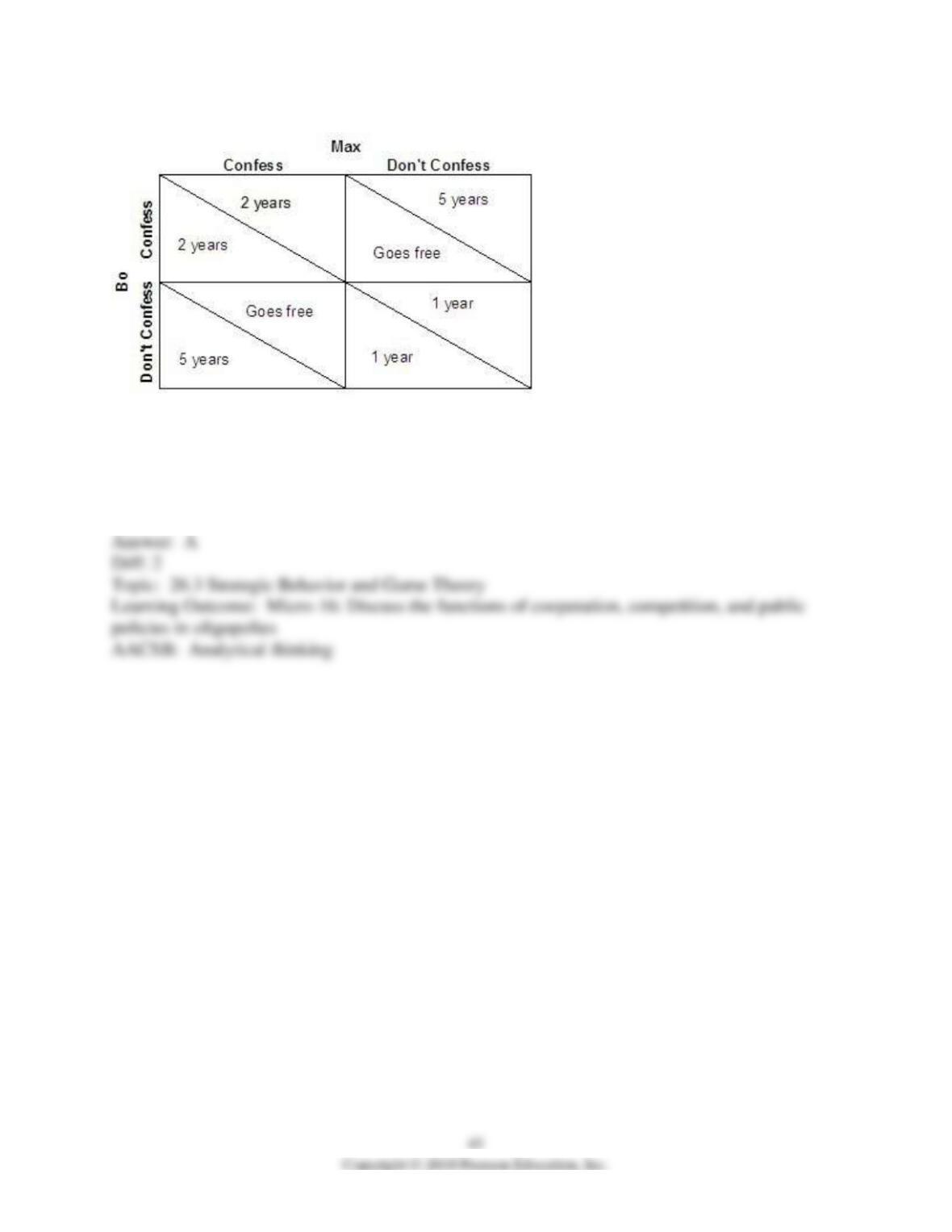
19)
Refer to the above payoff matrix (in years of sentence) for two people (Bo and Max) charged for
robbery. Which of the following is the outcome of the dominant strategy without cooperation?
A) Both Bo and Max confess.
B) Both Bo and Max do not confess.
C) Bo confesses while Max does not confess.
D) Bo does not confess while Max confesses.
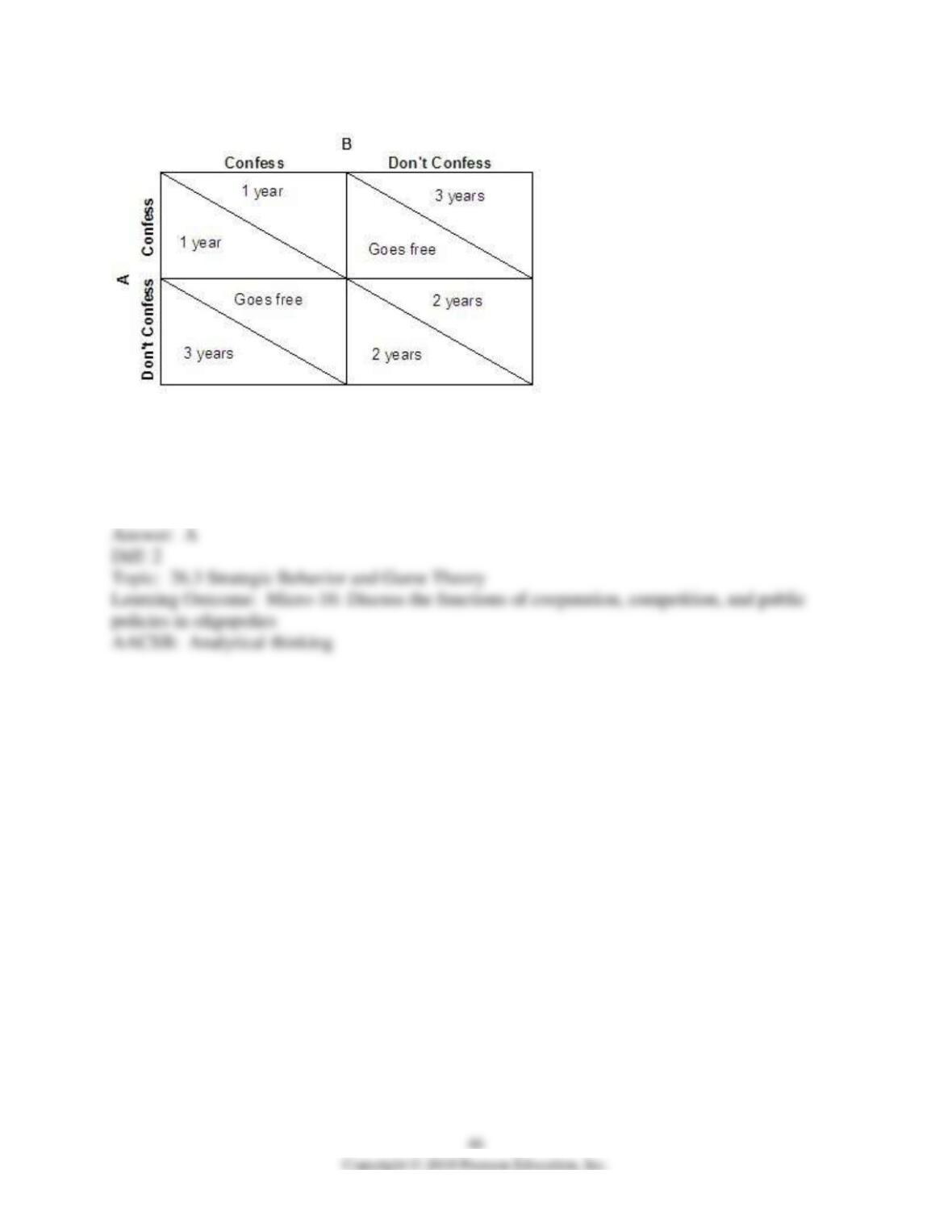
20)
Refer to the above payoff matrix (in years of sentence) for two people (A and B) charged for
robbery. Which of the following is the outcome of the dominant strategy without cooperation?
A) Both A and B confess.
B) Both A and B do not confess.
C) A confesses while B does not confess.
D) A does not confess while B confesses.
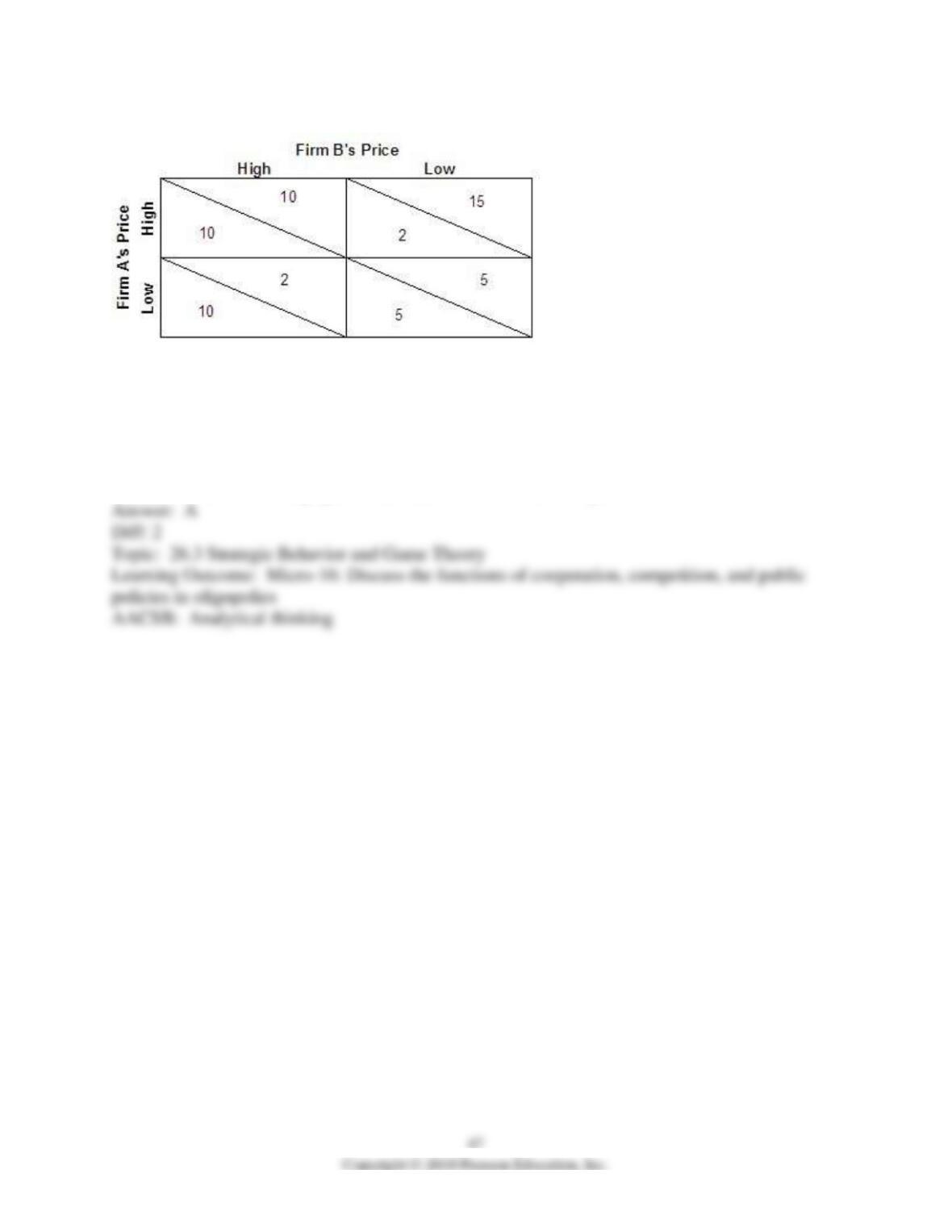
21)
Refer to the above payoff matrix for the profits (in $ millions) of two firms (A and B) and two
pricing strategies (high and low). Which of the following is the outcome of the dominant strategy
without cooperation?
A) Both firm A and firm B choose the low price.
B) Both firm A and firm B choose the high price.
C) Firm A chooses the low price while firm B chooses the high price.
D) Firm A chooses the high price while firm B chooses the low price.
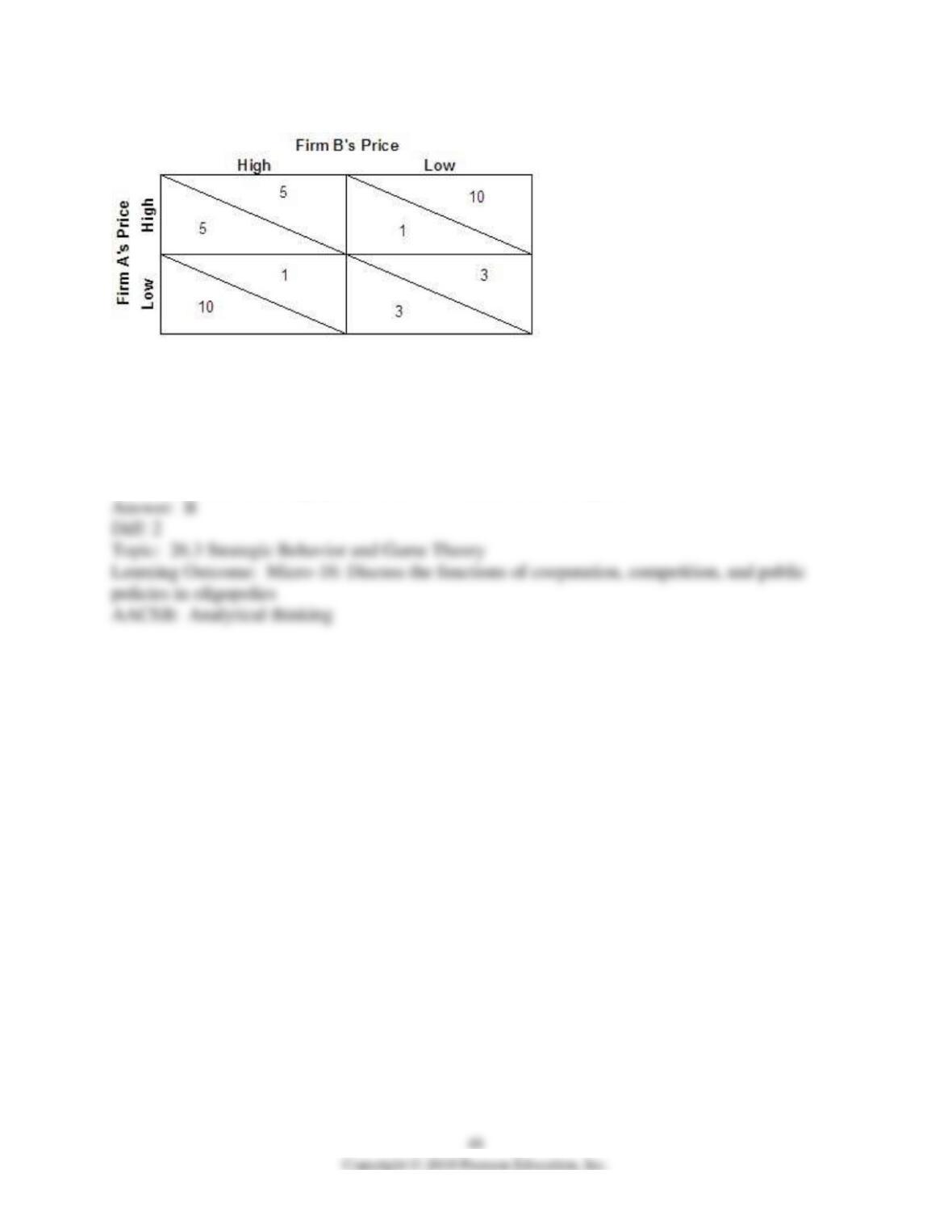
22)
Refer to the above payoff matrix for the profits (in $ millions) of two firms (A and B) and two
pricing strategies (high and low). Which of the following is the outcome of the dominant strategy
without cooperation?
A) Both firm A and firm B choose the high price.
B) Both firm A and firm B choose the low price.
C) Firm A chooses the low price while firm B chooses the high price.
D) Firm A chooses the high price while firm B chooses the low price.
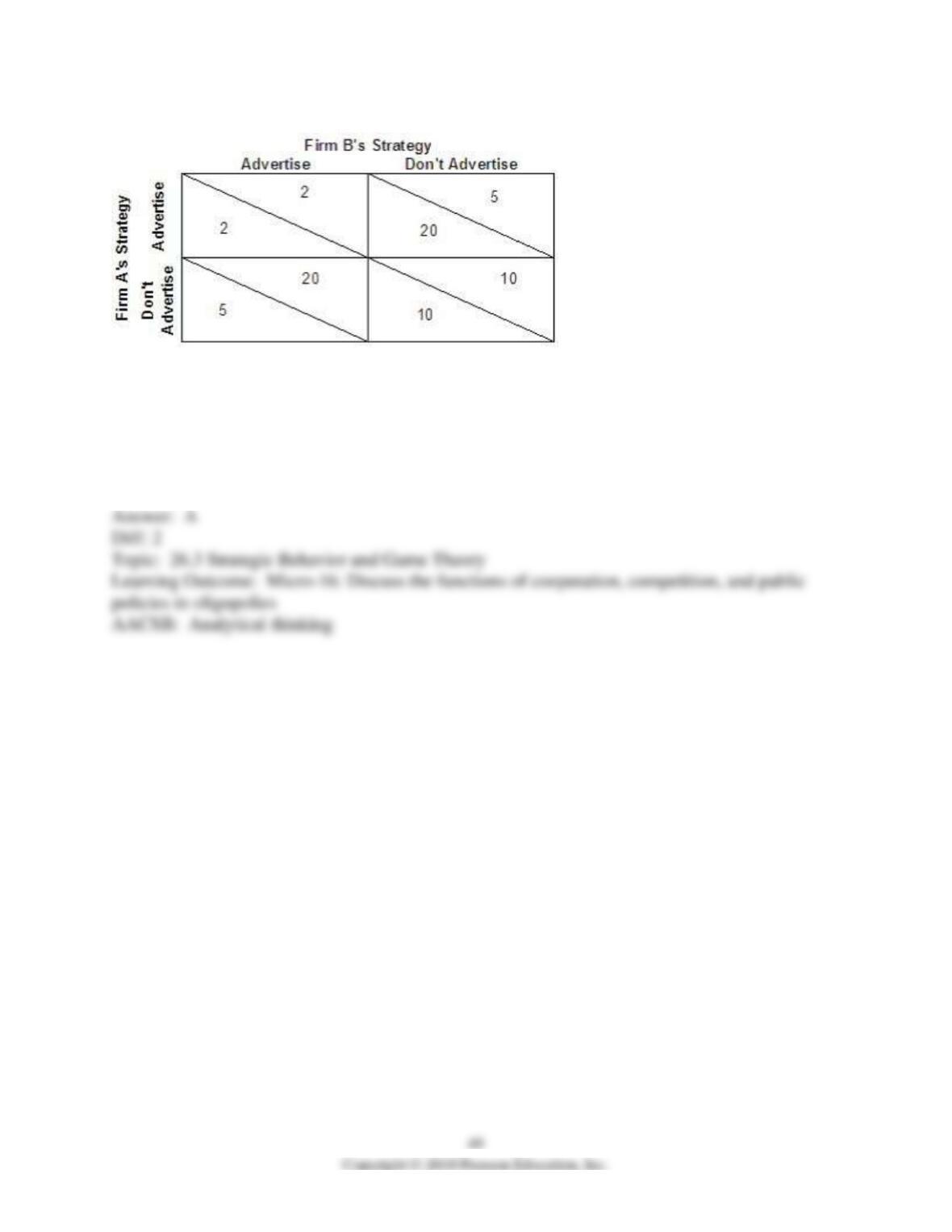
23)
Refer to the above payoff matrix for the profits (in $ millions) of two firms (A and B) making a
decision to advertise or not. Which of the following is the outcome of the dominant strategy
without cooperation?
A) There is no dominant strategy in this scenario.
B) Both firm A and firm B choose to advertise.
C) Firm A chooses to advertise while firm B chooses not to advertise.
D) Firm A chooses not to advertise while firm B chooses to advertise.
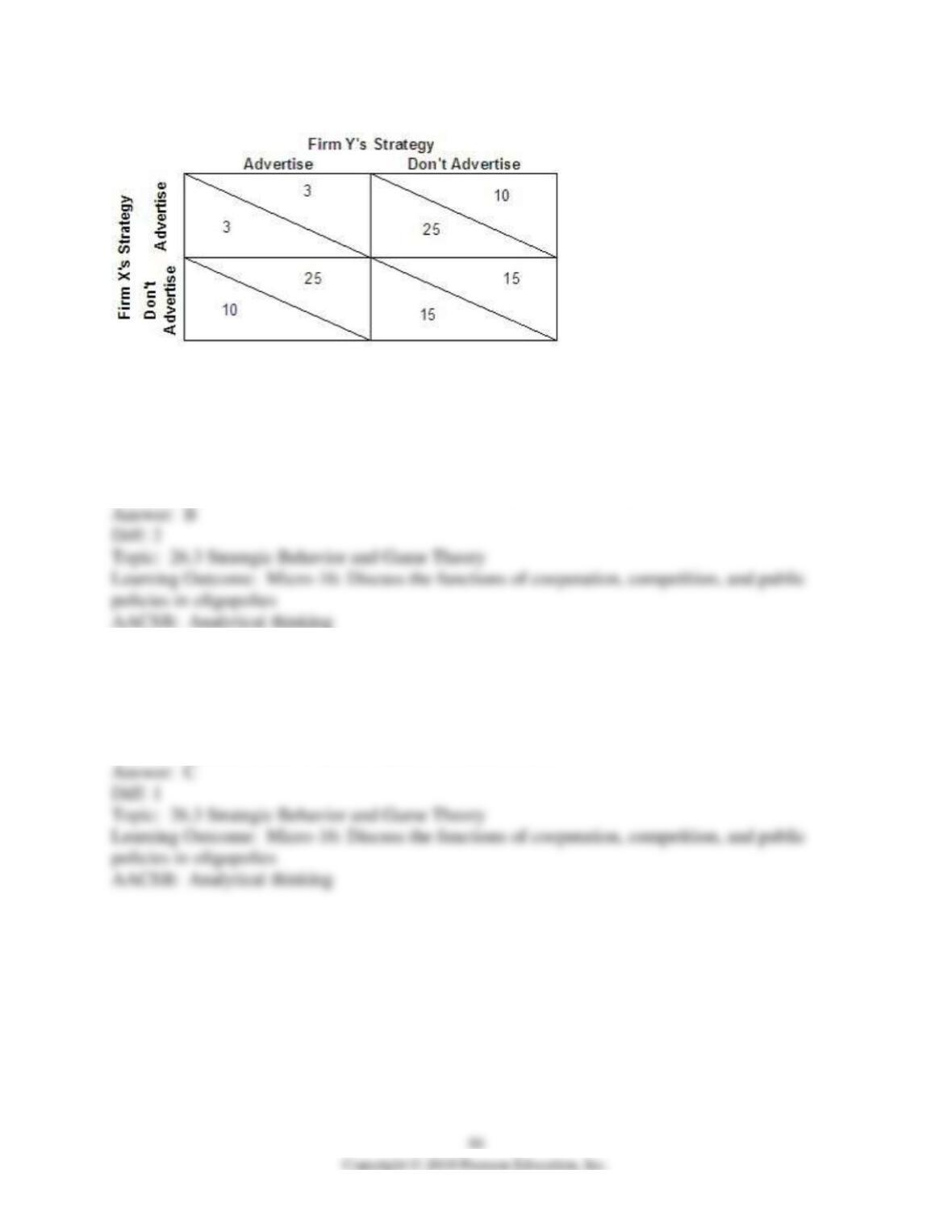
24)
Refer to the above payoff matrix for the profits (in $ millions) of two firms (X and Y) making a
decision to advertise or not. Which of the following is the outcome of the dominant strategy
without cooperation?
A) Both firm X and firm Y choose not to advertise.
B) There is no dominant strategy in this scenario.
C) Firm X chooses to advertise while firm Y chooses not to advertise.
D) Firm X chooses not to advertise while firm Y chooses to advertise.
25) The mutual interdependence of oligopolists ensures that each oligopolist has
A) a unique demand curve.
B) a perfectly elastic demand curve.
C) a reaction function.
D) a fundamental dilemma about whether to collude or not.
26) A reaction function is
A) companies colluding in order to make higher than competitive rates of return.
B) the manner in which one oligopolist reacts to a change in price made by another oligopolist in
the industry.
C) a game in which firms will not negotiate in any way.
D) when plans made by firms are known as game strategies.
27) The manner in which one oligopolist reacts to a change in price, output, or quality made by
another oligopolist in the industry is
A) a cooperative game.
B) the reaction function.
C) a zero-sum game.
D) the concentration ratio.
28) In a “game,” strategies are
A) the reactions of firms to the changes in the economy.
B) the laws regulating the industry.
C) the plans made by the participants.
D) the potential returns the participants may get.
29) The analytical framework in which two or more firms compete for certain payoffs that
depend on the strategy that the others employ is
A) game theory.
B) the concentration ratio.
C) a horizontal merger.
D) network effect.
30) A noncooperative game is
A) companies colluding in order to make higher than competitive rates of return.
B) the manner in which one oligopolist reacts to a change in price made by another oligopolist in
the industry.
C) a game in which firms will not negotiate in any way.
D) when plans made by firms are known as game strategies.
31) A cooperative game is
A) companies colluding in order to make higher than competitive rates of return.
B) the manner in which one oligopolist reacts to a change in price made by another oligopolist in
the industry.
C) a game in which firms will not negotiate in any way.
D) when plans made by firms are known as game strategies.
32) A game in which the players explicitly coordinate their decisions to make themselves better
off is a
A) cooperative game.
B) noncooperative game.
C) zero-sum game.
D) negative-sum game.
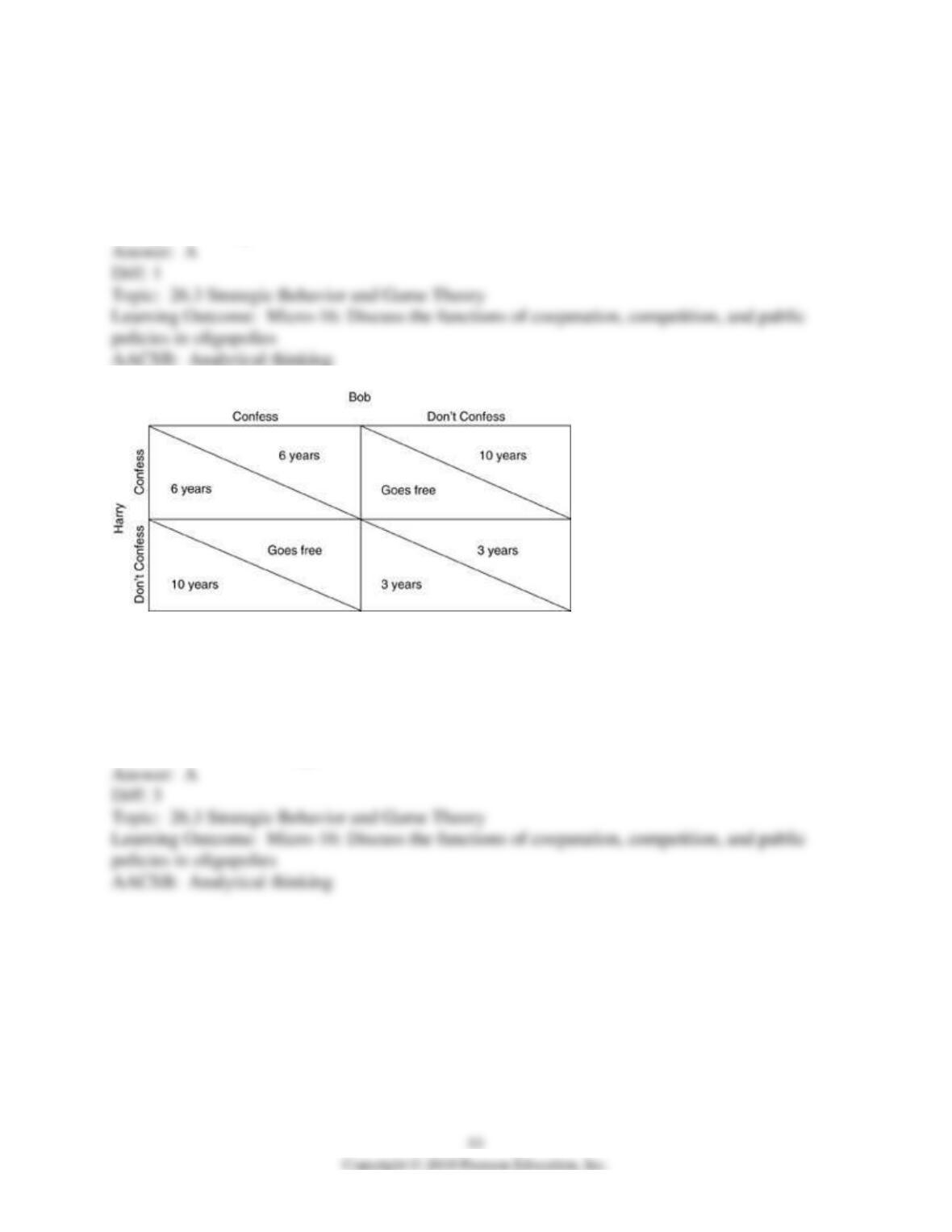
33) Refer to the above figure. The figure gives the payoff matrix for two individuals who are
being accused of robbing a bank together. If Bob confesses, what is the best strategy for Harry?
A) Confess.
B) Don’t confess.
C) Flip a coin to decide what to do.
D) There is no best strategy.
34) Refer to the above figure. The figure gives the payoff matrix for two individuals who are
being accused of robbing a bank together. If Bob does NOT confess, what is the best strategy for
Harry?
A) Confess.
B) Don’t confess.
C) Flip a coin to decide what to do.
D) There is no best strategy.
35) Refer to the above figure. The figure gives the payoff matrix for two individuals who are
being accused of robbing a bank together. What is dominant strategy for Bob?
A) Confess.
B) Don’t confess.
C) Flip a coin to decide what to do.
D) There is no dominant strategy.
36) Refer to the above figure. The figure gives the payoff matrix for two individuals who are
being accused of robbing a bank together. Which of the following is the outcome of the
dominant strategy without cooperation?
A) Both confess.
B) Both don’t confess.
C) Bob confesses while Harry does not confess.
D) Harry confesses while Bo does not confess.
37) Refer to the above figure. The figure gives the payoff matrix for two individuals who are
being accused of robbing a bank together. Which of the following is the outcome with
cooperation?
A) Both confess.
B) Both don’t confess.
C) Bob confesses while Harry does not confess.
D) Harry confesses while Bo does not confess.
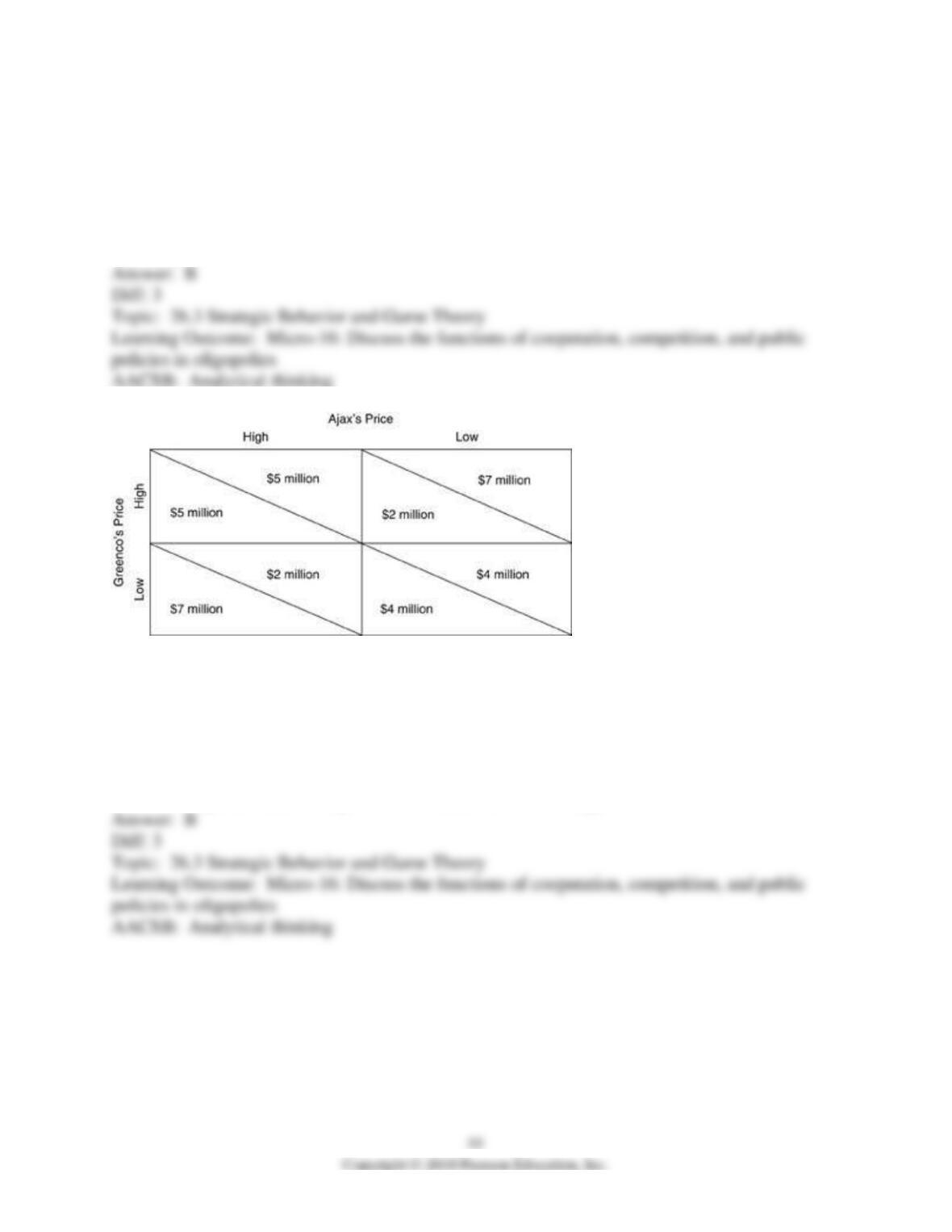
38) Refer to the above figure. Ajax and Greenco are oligopolists. Above you are given the payoff
matrix for the two firms giving the payoff associated with different pricing strategies. What is the
best strategy for Greenco if Ajax decides on charging a high price?
A) high price
B) low price
C) There is no best strategy.
D) Not enough information is given to determine the best strategy.
39) Refer to the above figure. Ajax and Greenco are oligopolists. Above you are given the payoff
matrix for the two firms giving the payoff associated with different pricing strategies. What is the
best strategy for Greenco if Ajax decides on charging a low price?
A) high price
B) low price
C) There is no best strategy.
D) Not enough information is given to determine the best strategy.
40) Refer to the above figure. Ajax and Greenco are oligopolists. Above you are given the payoff
matrix for the two firms giving the payoff associated with different pricing strategies. What is the
dominant strategy for Greenco?
A) high price
B) low price
C) There is no best strategy.
D) Not enough information is given to determine the best strategy.
41) Refer to above figure, which represents a duopoly industry. What would be the likely total
industry payoff or profit?
A) $8 million
B) $9 million
C) $10 million
D) $14 million
E) zero
42) Suppose two firms are in a game situation, and they each must decide on a strategy regarding
whether to select a high price or a low price. Profits for a firm are highest when it selects a low
price, while the other selects a high price; profits are lowest if one selects a high price, while the
other selects a low price; profits are in between when both select low prices; and profits are
slightly higher when both select high prices. In the absence of collusion we expect
A) one of the firms to select a high price and the other a low price.
B) one firm to select a high price and the other a low price in the first period, followed by a
reversal in the second period.
C) both to select high prices.
D) both to select low prices.
43) A game in which the players neither negotiate nor coordinate in any way is a
A) cooperative game.
B) noncooperative game.
C) zero-sum game.
D) negative-sum game.
44) An example of a zero-sum game is
A) exchange.
B) a consumer purchasing a used car from a used car dealer.
C) the prisoners’ dilemma.
D) poker.
45) A game in which any gains within the group are exactly offset by equal losses by the end of
the game is a
A) positive-sum game.
B) zero-sum game.
C) strategy.
D) negative-sum game.
46) Any rule that is used to make a choice is a
A) positive-sum game.
B) zero-sum game.
C) strategy.
D) rational decision.
47) Your teacher decides to play a game where every student must contribute a dollar. All money
collected is distributed at the end of the game among the students. This is an example of a
A) positive-sum game.
B) zero-sum game.
C) strategy.
D) negative-sum game.
48) A dominant strategy is one that
A) yields a position of the winner so long as the other participants act as planned.
B) every participant in the game will follow.
C) turns a negative-sum game into a positive-sum game.
D) always yields the highest benefit regardless of what the other players do.
49) Actions that ignore the possible long-run benefits of cooperation and focus solely on short-
run gains are
A) a zero-sum game.
B) a negative-sum game.
C) tit-for-tat strategic behavior.
D) opportunistic behavior.
50) Cooperation that continues as long as the players continue to cooperate is
A) a zero-sum game.
B) a negative-sum game.
C) tit-for-tat strategic behavior.
D) opportunistic behavior.
51) People do NOT usually behave in a noncooperative fashion even when it is in their
immediate interest to do so because
A) they realize such behavior is immoral.
B) they know there can be 2 winners.
C) they know they will have repeated dealings with the other people.
D) they understand the difficulties with game theory.
52) When oligopolistic companies engage in collusion, the companies are involved in a
A) noncooperative game.
B) negative-sum game.
C) competitive game.
D) cooperative game.
53) When a player in a game adopts a strategy which always yields the highest benefit regardless
of what the other player does, that player is using a(n)
A) opportunistic strategy.
B) dominant strategy.
C) tit-for-tat strategy.
D) aggressive strategy.