54) A game in which all the players are better off at the end of the game is a
A) tit-for-tat game.
B) dominant strategy game.
C) positive-sum game.
D) noncooperative game.
55) A game in which all the players are worse off at the end of the game is a
A) negative-sum game.
B) dominant strategy game.
C) positive-sum game.
D) noncooperative game.
56) A game in which any gains by the group are exactly offset by equal losses by the end of the
game is called the
A) negative-sum game.
B) zero-sum game.
C) positive-sum game.
D) cooperative game.
57) The manner in which one oligopolist reacts to a change in price, output, or quantity on the
part of another oligopolist in the industry is known as
A) a positive-sum game.
B) the reaction function.
C) a noncooperative game.
D) a zero-sum game.
58) The analytical framework in which two or more individuals, companies, or nations compete
for certain payoffs that depend on the strategy that others employ is
A) game theory.
B) opportunistic behavior.
C) the dominant equilibrium.
D) the tit-for-tat equilibrium.
59) Decision makers in oligopolistic firms must devise a strategy. One that yields the highest
benefit, regardless of what the other players do is a
A) pricing strategy.
B) rule-of-thumb strategy.
C) dominant strategy.
D) revenue strategy.
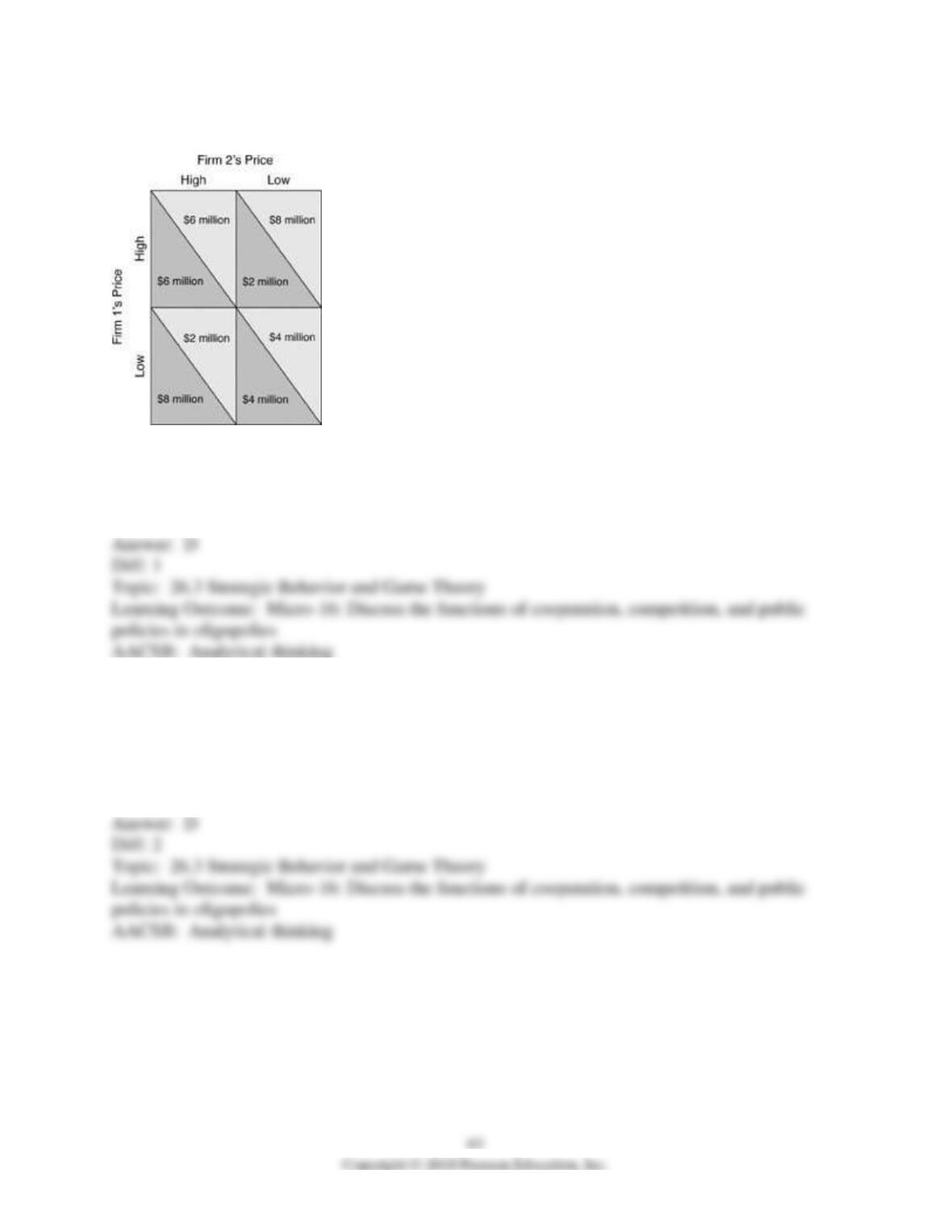
60) The payoff matrix shows all of the following EXCEPT
A) if both oligopolists choose a high price, each makes $6 million.
B) if they both choose a low price, each makes $4 million.
C) if one chooses a low price and the other doesn’t, the low priced firm will make $8 million.
D) if one oligopolist chooses a high price and the other doesn’t, the high-priced firm makes $8
million.
61) In game theory, actions such as cheating that focus solely on short-run gains are referred to
as
A) territorial behavior.
B) tit-for-tat strategic behavior.
C) predatory behavior.
D) opportunistic behavior.
62) In game theory, behavior that results in cooperation as long as the other players continue to
cooperate, is referred to as
A) nice behavior.
B) tit-for-tat strategic behavior.
C) simple behavior.
D) opportunistic behavior.
63) The way in which an oligopolist acts in response to a price change by a competitor is known
as a
A) zero-sum game.
B) positive-sum game.
C) reaction function.
D) cooperative game.
64) When OPEC meets to set production levels, this organization is playing a
A) negative sum game.
B) cooperative game.
C) non-cooperative game.
D) reaction function game.
65) When Goodyear increases its production when Michelin reduces its production, Goodyear is
playing a
A) negative-sum game.
B) cooperative game.
C) non-cooperative game.
D) reaction function game.
66) A game in which any gains one player makes are offset by equal losses by another player is
known as a
A) zero-sum game.
B) positive-sum game.
C) negative-sum game.
D) cooperative game.
67) A game in which players collectively lose is known as a
A) zero-sum game.
B) positive-sum game.
C) negative-sum game.
D) cooperative game.
68) A game in which players collectively gain is known as a
A) zero-sum game.
B) positive-sum game.
C) negative-sum game.
D) cooperative game.
69) Games can be judged according to the payoffs
A) as zero-sum, negative-sum, and positive-sum games.
B) as collusive or noncollusive games.
C) as competitive or noncompetitive games.
D) whether all companies participate or not.
70) Which of the following statements concerning the prisoner’s dilemma is TRUE?
A) The player who moves last will always win.
B) Confessing is the dominant strategy for both players.
C) Neither player will pick the dominant strategy.
D) The player who moves first will always win.
71) The prisoner’s dilemma shows that
A) players are better off if they act independently.
B) a game always ends in a positive sum condition.
C) people will always cheat.
D) players could be better off if they cooperated.
72) An action that is the best choice under all conditions is known as the
A) profit-maximizing strategy.
B) prisoner’s dilemma.
C) tit-for-tat strategy.
D) dominant strategy.
73) When a cartel breaks down and its members start cheating, the behavior in the industry
becomes a
A) noncooperative game.
B) zero-sum game.
C) high stakes game.
D) positive sum game.
74) Opportunistic behavior by oligopolies means
A) that firms cooperate in both the long run and in the short run to prevent others from entering
the industry.
B) that firms cooperate in the short run for current gains.
C) that firms refuse to cooperate in the short run.
D) that firms refuse to honor their product guarantees.
75) A dominant strategy is a
A) last-mover strategy.
B) negative-sum strategy.
C) player’s best strategy when she can make the first move.
D) player’s best strategy regardless whatever strategies are adopted by the rivals.
76) Explain the basic operations of an economic game.
77) Firms faced with prisoners’ dilemma can always make more profits by engaging in
opportunistic behavior. Why is this type of behavior NOT commonly found even in oligopolistic
markets?
78) Explain how the prisoners’ dilemma can be used to examine pricing strategies in an
oligopoly.
26.4 The Cooperative Game: A Collusive Cartel
1) A group of firms that try to work together to earn monopoly profits is called a(n)
A) monopolistic merger.
B) public enterprise.
C) cartel.
D) natural monopoly.
2) According to game theory, a cartel of several firms is an example of a(n)
A) zero-sum game.
B) positive-sum game.
C) cooperative game.
D) noncooperative game.
3) An example of a cooperative game would be
A) oligopoly.
B) monopolistic competition.
C) a cartel.
D) perfect competition.
4) An association of producers in an industry that agree to set common prices and output quotas
to prevent competition is
A) a tariff.
B) a patent.
C) economies of scale.
D) a cartel.
5) Which of the following is NOT true about a cartel?
A) Members earn economic profits.
B) Members experience large economies to scale relative to industry demand.
C) Cartels will set common prices for their members.
D) Members of a cartel will have production quotas.
6) The main objective of the members of a cartel is to
A) earn economic profits.
B) produce efficiently.
C) make the industry more competitive.
D) obtain a patent.
7) A group of producers that agree to coordinate their production is called a
A) cartel.
B) monopoly.
C) free market competition.
D) vertical merger.
8) In a cartel, firms jointly act as
A) a monopolistic competitive firm.
B) a perfectly competitive firm.
C) a monopoly firm.
D) an oligopolistic firm.
9) An association of producers that fixes common prices and output quotas is known as a
A) cartel.
B) common selling organization.
C) joint-marketing arrangement.
D) trade association.
10) Which of the following is LEAST likely to be a reason for firms to form a cartel?
A) to maximize profits of the cartel
B) to raise competition among firms in the cartel
C) to cut back output of the cartel
D) to set common prices among firms in the cartel
11) Cheating in a cartel is more likely to occur if the industry
A) has a large number of firms.
B) has homogeneous products.
C) has easily observable prices.
D) has little ability to affect market prices.
12) A cartel is a form of
A) collusion.
B) vertical merger.
C) noncooperative competition.
D) negative sum game.
13) The success of a cartel rests upon
A) inducing all members to limit their combined output and charge the same price.
B) inducing all members to differentiate their products and charge different prices.
C) making exit from the cartel as nearly costless as possible.
D) discouraging some firms in the market from joining.
14) Which of the following is LEAST likely to be an outcome of a cartel as compared to the
situation before the cartel was formed?
A) Cartel members charge higher prices.
B) Cartel members reduce production.
C) Cartel members make fewer profits.
D) Cartel members do not compete with each other in pricing decisions.
15) After participating members of a cartel form an agreement on common prices and output
quotas, then an individual firm can increase its own profits by
A) increasing production.
B) increasing prices.
C) leaving the cartel.
D) incurring higher input costs.
16) After participating members of a cartel form an agreement on common prices and output
quotas, then an individual firm can increase its own profits by
A) decreasing production.
B) decreasing prices.
C) advertising.
D) paying its employees higher wages.
17) Which of the following is a condition that helps enforce a cartel agreement?
A) a large number of firms
B) relatively differentiated products
C) easily observable prices
D) large variation in prices
18) Which of the following is NOT a condition that helps enforce a cartel agreement?
A) a small number of firms
B) nearly homogeneous products
C) easily observable prices
D) large variation in input prices
19) One of the fundamental problems a cartel faces is
A) to determine how much each producer will decrease its output.
B) to determine how much each producer will increase its output.
C) to determine how much each producer will lower it price.
D) to determine how much each producer will lower its profit.
20) Cartel agreements are more likely to break down when
A) there are few variations in market demand.
B) new firms enter the market.
C) participating firms earn huge profits.
D) none of the above.
21) A cartel is likely to last longer if
A) more new firms enter the market.
B) the profits of participating members are relatively stable.
C) market prices vary more over time.
D) there are more firms in the industry.
22) The goal of a cartel is to
A) increase competition among members.
B) maximize industry profits.
C) increase industry supply.
D) none of the above.
23) A cartel most likely forms in
A) an oligopolistic market.
B) a perfectly competitive market.
C) a monopolistically competitive market.
D) a heavily regulated industry.
24) A member in a cartel can earn more profits by
A) charging a slightly lower price and raising production.
B) producing less than the agreed rate.
C) selling less than the agreed amount.
D) none of the above.
25) A cartel will break down more easily if
A) there are only a few members.
B) industry demand is very stable.
C) market prices can be observed easily.
D) there are many entrants in the industry.
26) In a cartel, participating members can cheat by
A) letting more entrants join the cartel.
B) leaving the industry.
C) producing a lower production level than the cartel quota.
D) charging a slightly lower price and raising production.
27) A cartel is
A) a group of producers that agree to set common prices and output quotas.
B) a group of consumers that bid against each other for the same product.
C) a government agency that regulates markets.
D) an arbitrator to settle disputes between consumers and producers.
28) Between 1986 and 1998 the De Beers company controlled the world diamond market. De
Beers and its affiliated association of producers restricted diamond sales to maximize profits. De
Beers and its association was “the only game in town” and had what is
A) a cartel.
B) a duopoly.
C) monopolistic competitor.
D) perfect competitor.
29) A cartel behaves like
A) a monopolistic competitive firm.
B) a perfectly competitive firm.
C) a monopolist.
D) an oligopolistic firm.
30) If three firms of similar sizes join to form a cartel, then it is most likely that
A) they will charge a common, higher market price.
B) they will collectively produce more than before.
C) all three firms will stop producing.
D) all three firms will earn zero profits.
31) If five firms of similar sizes join to form a cartel, then it is most likely that
A) they will charge a common, lower market price.
B) they will collectively produce less than before.
C) all five firms will earn the same profits as before.
D) all five firms as a group will have falling profits, but increased output.
32) When oligopolistic firms in an industry form a cartel, then it is most likely that
A) both industry output and prices will increase.
B) both industry output and prices will decrease.
C) industry output will increase while prices will decrease.
D) industry output will decrease while prices will increase.
33) An association of producers in an industry that agree to set common prices and output quotas
to prevent competition is
A) an oligopolist.
B) a monopolistic competitor.
C) a constrained monopoly.
D) a cartel.
34) A group of producers that agree to set common pricing or output goals is known as a
A) cartel.
B) conglomerate.
C) perfect competitor.
D) monopoly.
35) What is a cartel? Can cartels generate long-term profits without the existence of barriers to
entry?
36) Why do firms form a cartel? How do cartels achieve their goals?
37) What are the main characteristics that make it more likely for a cartel to enforce agreements
among participating members?
38) Why would a member of a cartel cheat?
39) Why do cartels often break down?
26.5 Network Effects and Two-Sided Markets
1) When a consumer’s willingness to buy a good or service is influenced by the number of people
who have purchased that good or service, this is called
A) a switching cost.
B) an opportunity cost.
C) a network effect.
D) an advertising gimmick.